One-Liner Wednesday: more fatigue

I’ve had a major uptick in my fatigue level so I haven’t been able to manage writing the couple dozen of posts that I wish I had over the last few weeks, but my health care team is working on a new batch of tests, a med change, and probably an additional diagnosis that may eventually lead to improvement, so stay tuned…

Join us for Linda’s One-Liner Wednesdays! Find out more here: https://lindaghill.com/2026/06/10/one-liner-wednesday-you-know-youre-tired/

EDS/HSD Primer

May is EDS & HSD Awareness Month and I promised to do some posts on it. I had hoped to get this first post out earlier in the month but I’m having some difficulties with an hEDS flare, which has slowed me down a bit.

Ehlers-Danlos Syndrome (EDS) and Hypermobility Spectrum Disorder (HSD) are heritable connective tissue disorders. There are 13 types of EDS. In 12 of those types, the exact genetic cause has been identified. Some of these types are very rare, affecting less than one in a million people. The most common form of EDS is hypermobile (hEDS), which is known to be inherited in an autosomal dominant pattern but appears to have a more complex genetic profile. The prevalence of hEDS is unknown because it is very often missed diagnostically. Case in point, I was diagnosed at age 65.

HSD is related to hEDS, usually involving fewer hypermobile joints than most people with hEDS. While some clinicians and researchers look at HSD and hEDS as separate disroders, others look at hEDS as occupying a certain segment of the hypermobile spectrum. In December, 2026, updated diagnostic criteria will be published, with best practices to follow in spring ’27. It will be interesting to see if hEDS and HSD will be merged into a single diagnosis.

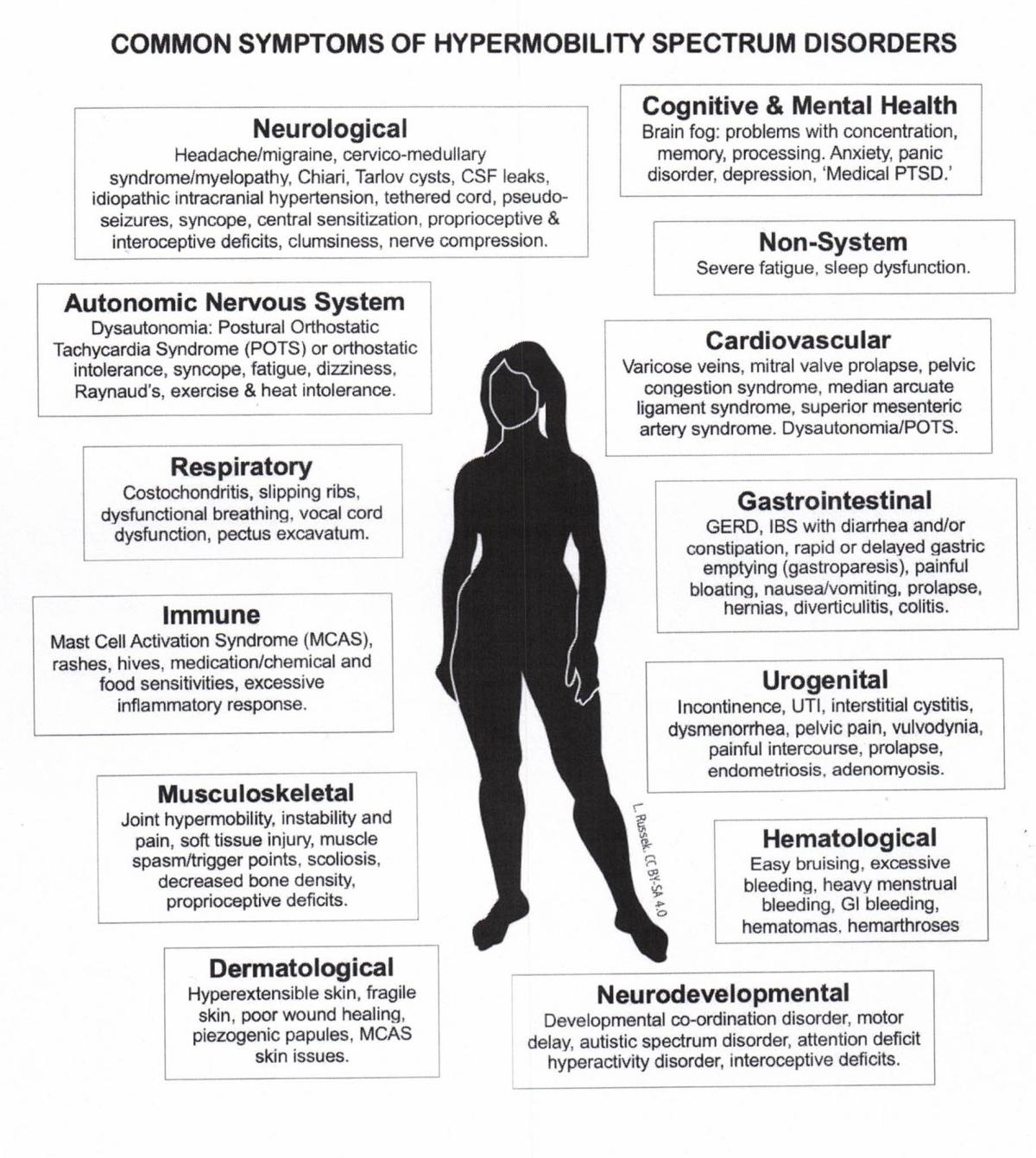
One of the difficulties with obtaining a diagnosis with EDS or HSD is that they present in different ways in different individuals and can vary with age. All forms of EDS/HSD affect connective tissue, making it stretchier than is typical, often due to genetic impacts on the proteins involved in collagen production. Symptoms appear throughout the body and in different body systems. The charts at the top gives you some idea of how wide-ranging the symptoms can be. Thankfully, no one has all the symptoms but when tends to happen in the medical systems in most countries is that you see separate specialists for different body systems and there is no one with enough knowledge to integrate all the information and realize that connective tissue is the common denominator underlying it all.

Because EDS/HSD are genetic in origin, treatment revolves around symptoms. Physical therapy is often a big part of the treatment plan. There are medications, vitamins, and supplements to help certain aspects of the disorder, too. For example, I have a mast cell activation disorder as part of my hEDS and take several medications to help relieve respiratory and gastrointestinal symptoms.

Having an EDS/HSD diagnosis also allows your care team to keep an eye out for conditions that may develop, such as heart valve problems. It’s very important for surgeons to know if your connective tissues are not typical, as this may impact how a procedure is done or if it should be done at all. How well medications work and the dosages required can also differ. For example, my hEDS diagnosis explained why topical anethetics, like lidocaine, don’t work well for me.

I am hoping that, when the new diagnostic criteria are published, there will be increased awareness of inherited connective tissue disorders among both the medical community and the general public. For too long, symptoms have been dismissed as unrelated, idiopathic, stress-induced, hormonal, anxety-induced, unimportant, or imaginary. Like autoimmune diseases, these disorders are more prevalent in females than males, adding to the burden of being taken seriously and the dearth of studies.

The Ehlers-Danlos Society is an important organization spearheading study, training, education, and treatment of EDS/HSD internationally. Their website is a great source of information for patients and their families, as well as for clinicians and researchers. This month, as we raise awareness, my hope is that more people will learn about EDS/HSD and help those affected get the diagnosis, treatment, and validation they deserve.

JC’s Confessions #33

being high-maintenance

In the first few seasons of The Late Show, Stephen Colbert did a recurring skit, then a best-selling book, called Midnight Confessions, in which he “confesses” to his audience with the disclaimer that he isn’t sure these things are really sins but that he does “feel bad about them.” While Stephen and his writers are famously funny, I am not, so my JC’s Confessions will be somewhat more serious reflections, but they will be things that I feel bad about. Stephen’s audience always forgives him at the end of the segment; I’m not expecting that – and these aren’t really sins – but comments are always welcome.

In recent months, I’ve become very high-maintenance.

Not a fan.

My style for years has been no-muss, no-fuss. My hairstyle doesn’t require blowdrying and products. I don’t wear make-up. My clothing style is simple. I can get ready to go out in five minutes or less.

I could spend most of my time and brainpower on more creative endeavors and helping others.

Now, it seems that taking care of myself has become a full-time job.

In attempts to improve my current state of health, there are physical therapy exercises daily and near-constant attention to my posture and head/neck position. Needed rest periods. An increasing complicated array of medications, including one that needs to be mixed in a full glass of water and drunk immediately – four times a day – which makes it a bit tricky if I have to be away from home for several hours. Trying to figure out what to eat and drink when a food recommended for dealing with one of my syndromes is excluded by another to the extent where I sometimes don’t know what to eat. Dealing with my AutoPAP machine. Fussing with dental care and retainers. Going to appointments and tests with so many specialists that I’ve lost track of them all and trying to get information coordinated among them and with my primary care doctor, because, of course, the practices, despite all the electronic records systems, can’t seem to do it. Doing research on the various symptoms and diagnoses and trying to piece everything together.

It’s time-consuming and frustrating and doens’t leave much energy or brainpower for the thousand things I’d rather be doing.

There is some hope.

Lately, my brain fog and fatigue have diminished and it seems that we are finally getting closer to a more comprehensive diagnosis and clinical outlook.

Maybe that will translate into an easier daily regimen.

I don’t think I will ever be low-maintenance again, but maybe medium?

One-Liner Wednesday: persistence

Recently, a doctor told me I might have to give up on finding a diagnosis for my medical problems, but I’m not giving up.

Join us for Linda’s One-Liner Wednesdays! Find out more here: https://lindaghill.com/2025/07/23/one-liner-wednesday-some-days-ya-just-cant-win/

EDS/HSD Awareness Month

May is Ehler-Danlos Syndrome/Hypermobility Spectrum Disorder Awareness Month, begun by the Ehlers-Danlos Society to bring attention to this family of connective tissue disorders which affect millions of people around the world, many of whom will take decades to be diagnosed while others will never know for sure what causes their bodies to exhibit an unusual constellation of symptoms. I apologize for being late to the effort, although I did do one awareness post here for One-Liner Wednesday and shared some informative posts via Facebook. It’s been a bit of a rough month for me.

I am one of those people who is yet to be officially diagnosed, despite decades of symptoms, though I will spare you the details of my specific case.

The Ehlers-Danlos Society is a great resource for information about both Ehlers-Danlos Syndrome (EDS) and Hypermobility Spectrum Disorder (HSD), both for individuals and for clinicians and researchers. It also plays a role in funding research around the world for these connective tissue disorders. There is a lot to know but I will just give a broad outline here.

EDS is a group of inherited connective tissue disorders, currently classified into 13 types. Twelve of the types have a known genetic cause, where a chromosome affects a particular protein, and can be identified with testing. Some of these affect less than one in a million people.

The largest group of people with EDS, though, have hypermobile EDS (hEDS), estimated to affect 3,100-5,000 people per million. While it is known to have a dominant genetic inheritance pattern, the genes or groups of genes responsible have not yet been identified. There is some question among researchers and clinicians if hEDS should remain classified as a form of EDS or if it should be considered as part of Hypermobility Spectrum Disorder in which the hypermobility is more widespread and severe than in most people with HSD.

In HSD, people exhibit joint hypermobility/instability in at least one joint, which may suffer frequent sprains, pain, subluxation/dislocation, joint or soft tissue damage, and/or early arthritis. They may also have poor proprioception, which means they can have difficulty with awareness of their bodies’ position or movement, for example, being clumsy.

They may also have symptoms over many parts/systems of their body. Fatigue, headaches, gastrointestinal problems, autonomic dysfunction, and anxiety are some of the kinds of symptoms that can be part of HSD, with each person exhibiting a different constellation of symptoms which may shift over time. This makes sense in that we have connective tissue throughout our bodies, so symptoms as diverse as unusually stretchy or delicate skin, a frequently sprained ankle, irritable bowel syndrome, and blood vessel problems can all be related through differences in the way connective tissues behave in the body. We don’t know how prevalent HSD is, because the current classification system dates from only 2017, our current medical system tends to silo various body systems into separate specialties – without there being any specialists in connective tissues – and most primary care providers haven’t been taught to recognize it. This often leaves patients in the uncomfortable position of having pieced together their own diagnosis but not being able to find a doctor willing to consider it.

I feel that it is important to be properly diagnosed, even though, as inherited conditions, EDS/HSD cannot be “cured.” It helps to know about the underlying cause in order to treat symptoms more effectively. For example, physical therapy may need to be prescribed for a longer period of time with more gentle techniques to avoid further tissue damage. Surgeries may need to be modified to better support lax connective tissue. Knowing what other symptoms may arise that are connected to EDS/HSD is also helpful, along with awareness that connective tissue disorders can help explain some disorders, such as irritable bowel syndrome, that have often been written off as idiopathic.

As EDS/HSD Awareness Month draws to a close, I’d like to thank the Ehlers-Danlos Society for their valuable work in raising awareness of these conditions, advocating for patients, disseminating information, and spearheading research into these connective tissue disorders. Maybe, as more people and, critically, more health care providers learn more about these disorders, patients will be diagnosed and treated more quickly and effectively.

I hope.

(About the photo: Doctors are taught in med school that “when you hear hoofbeats, think horses, not zebras.” However, sometimes, it is actually zebras! Zebras have come to signify EDS/HSD. My daughter T gave me this zebra unicorn pin in that spirit.)

JC’s Confessions #31

In the first few seasons of The Late Show, Stephen Colbert did a recurring skit, then a best-selling book, called Midnight Confessions, in which he “confesses” to his audience with the disclaimer that he isn’t sure these things are really sins but that he does “feel bad about them.” While Stephen and his writers are famously funny, I am not, so my JC’s Confessions will be somewhat more serious reflections, but they will be things that I feel bad about. Stephen’s audience always forgives him at the end of the segment; I’m not expecting that – and these aren’t really sins – but comments are always welcome.

On April 6, 2025, Pope Francis appeared in public for the first time after returning home from his long hospitalization. It was at the end of a special Jubilee liturgy for the sick and health care workers and others who care for them. He had written the homily and a special blessing for the mass, although they were read by others. Francis wrote:

In this moment of my life I share a lot: the experience of infirmity, feeling weak, depending on the others for many things, needing support. It is not easy, but it is a school in which we learn every day to love and to let ourselves be loved, without demanding and without rejecting, without regretting, without despairing, grateful to God and to our brothers for the good that we receieve, trusting for what is still to come.

I am currently entering the second year of dealing with a complex medical situation that has not yet been fully diagnosed. I don’t know if I will be able to be adequately treated or if I will continue to see progression in my symptoms.

It’s hard.

I confess that I am not always gracious in this situation. I manage to let others do things for me and to ask for accommodations if I need them, but I find it difficult to set aside regret and to trust in the future.

This is especially hard for me in regard to my future as a poet. I don’t know if I will regain the creativity I’ve lost to brain fog and fatigue. I’m even losing the concentration and attention to detail needed to do submissions for my already existing poems and manuscripts.

I’m trying not to get to the point of despair.

These next few weeks are important in that I have a new batch of tests and specialist visits coming up.

Maybe having some more information about what is happening will help me to be better with being sick.

Maybe not.

I’ll try.

(I realized when I went back in my blog to find the number confession this was that this confession is, in a way, a continuation of #30.)

SoCS: calendar

My calendar used to be filled with meetings, volunteer gigs, poetry workshops and readings, family events, and music rehearsals and concerts.

Now, it’s mostly medical appointments.

I am still holding on to singing with the Madrigal Choir of Binghamton. We are coming up on performance week, which will be a challenge with my diminished energy.

Maybe this next round of tests and specialists will get to a full diagnosis and some kind of treatment to improve my situation. I know that it is unlikely to be fully reversed but I’m trying to retain hope that I can bring back the most important abilities and activities I can’t manage now.

If that happens, maybe my calendar will have somewhat fewer medical appointments and more poetry – with some more travel to see family and outings with friends.

Maybe that can even happen later in 2025.

It depends on what happens with the tests and doctor visits that are in those calendar boxes this spring…
*****
Linda’s prompt for Stream of Consciousness Saturday is “calendar.” Join us! Find out more here: https://lindaghill.com/2025/03/21/the-friday-reminder-and-prompt-for-socs-march-22-2025/

getting there…

I’m slow to recover from my angiogram on Monday. I will, though, be heading to physical therapy early this morning, which will be the first time I’ve left the house. Later in the day, I have a phone appointment with my insurer, who may finally have account numbers for me. Fingers crossed!
*****
There’s still time left to join in Linda’s Just Jot It January! Find out more here: https://lindaghill.com/2025/01/30/daily-prompt-jusjojan-the-30th-2025/

SoCS: what I’ve sunk to

I am having real trouble keeping things in line.

Until last spring, I was used to having days that were fairly busy with activities, errands, and writing. Granted, I did need to use a calendar to keep everything in line but I had the wherewithal to keep up.

And now I don’t.

This last week has been particularly challenging.

The current theory, for which there is quite a lot of evidence, is that I’m having some blood flow issues that are keeping me from getting enough blood to my brain and perhaps my left arm. I’m scheduled to have an angiogram on Monday to look into my blood vessels and see if there are any compression areas or blockages. It will be diagnostic, so we might finally be able to figure out what is going on and what we can do for treatment.

I admit that, until yesterday, I had hoped that they might be able to treat whatever they find during the angiogram. I fantasized about coming out of the sedation without the constant buzzing in my left ear that has been there since last March.

But, no.

It hasn’t helped that the transfer of my health insurance after B’s retirement has not gone smoothly. I do have insurance in effect but I don’t have the account numbers yet. Yesterday, they almost cancelled the angiogram because of it. I told them I would let them bill me directly so that they would go through with it.

The extra stress has not been a lot of help.

My fatigue has gotten even worse. I had hoped that I could rest this morning so that I could go to a poetry reading and church this afternoon but I have to face the fact that I can’t. I’m writing this from bed because even sitting in my recliner seems like too much work right now.

My new weekend plan is to lie down as much as possible and rest so that I can get through getting to the hospital for my test Monday morning. It’s likely I’ll be there the whole day but should be able to come home by evening.

Maybe, finally, with a diagnosis.
*****
Linda’s prompt for Stream of Consciousness Saturday this week is “in line.” Join us! Find out more about SoCS and Just Jot It January here: https://lindaghill.com/2025/01/24/the-friday-reminder-for-socs-jusjojan-2025-daily-prompt-for-jan-25th/

Next step

Following up from yesterday’s post, my specialist appointment is resulting in an order for the next step toward diagnosis, an angiogram to evaluate the blood vessels in my neck.

I’m not sure how long it will take to get on the schedule but I’ll let you know when I have more information.
*****
Join us for Linda’s Just Jot It January! Find out more here: https://lindaghill.com/2025/01/03/daily-prompt-jusjojan-the-3rd-2025/