BCAC reading!

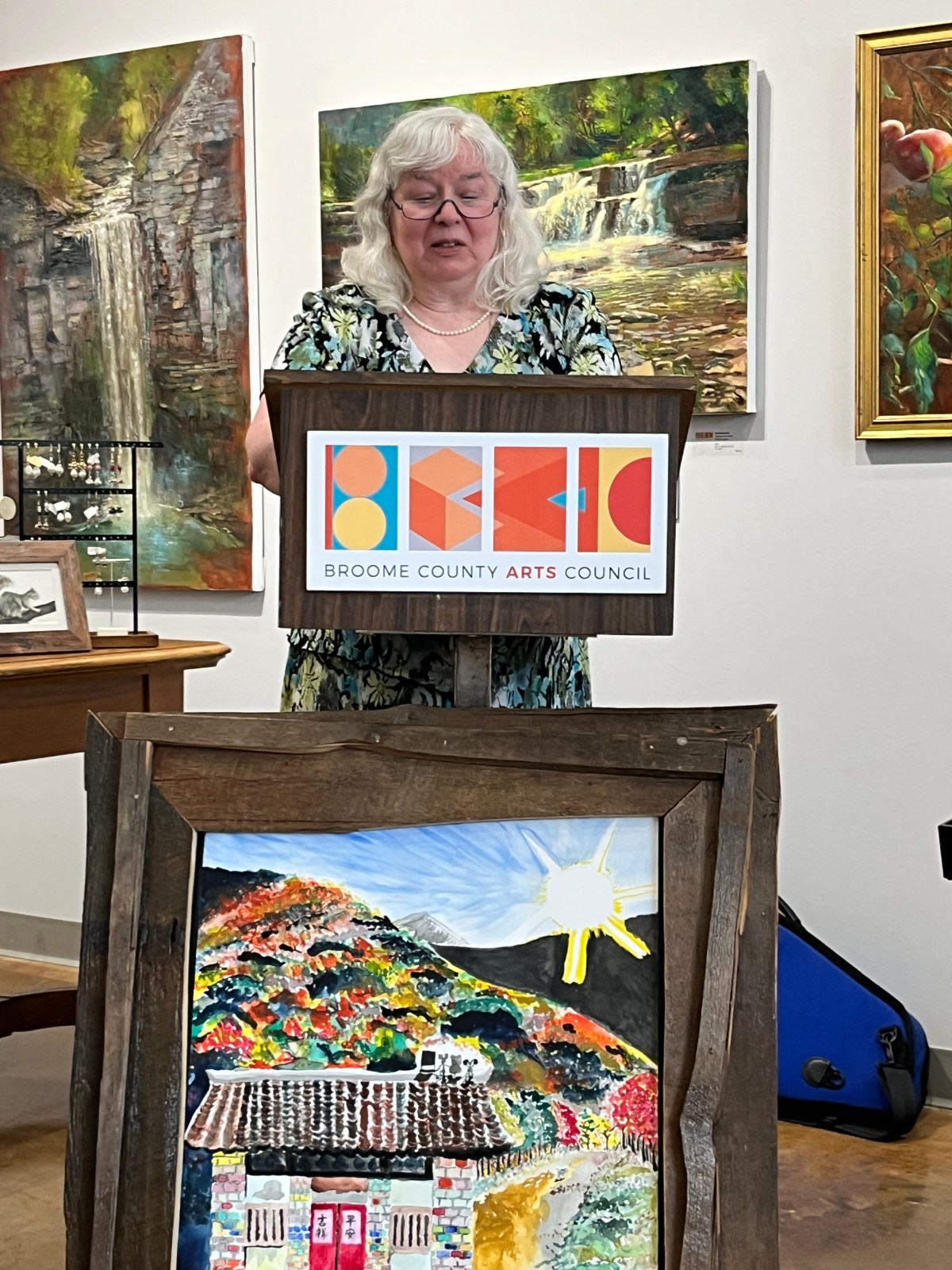
Just proving that I made it through the reading event at the Broome County (NY) Arts Council last night.

Things went well with poems, a short story in translation, music, paintings, and a film, all represented.

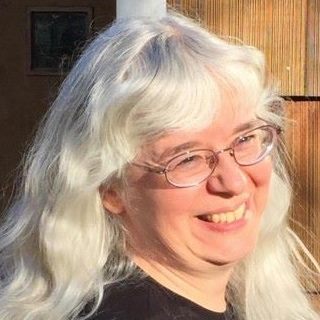
Thanks to Connie, Ann, and all the BCAC staff for making the America 250 exhibition and event possible. Thanks also to fellow poet Samantha Terrell who sent me this photo that her husband took while I was reading.

One-Liner Wednesday: BCAC America 250 reading tomorrow!

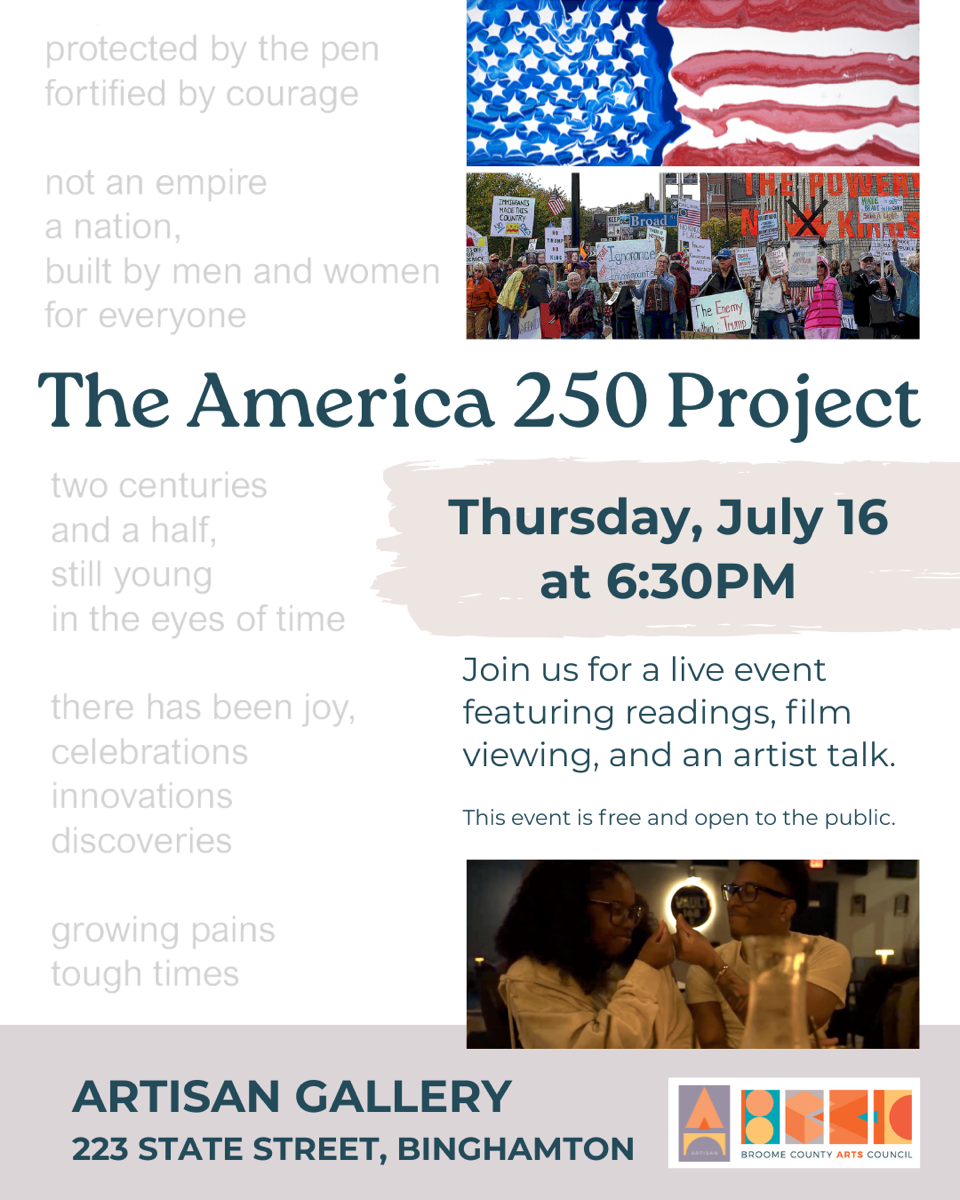
Binghamton NY area folks are invited to an event celebrating the Broome County Arts Council’s America 250 project tomorrow, July 16, at 6:30 PM, in which I will be participating.

This friendly invitation is part of Linda’s One-Liner Wednesdays series. Join us! Find out more here: https://lindaghill.com/2026/07/15/one-liner-wednesday-hey-dilly-dilly/

BCAC America 250 Project opening

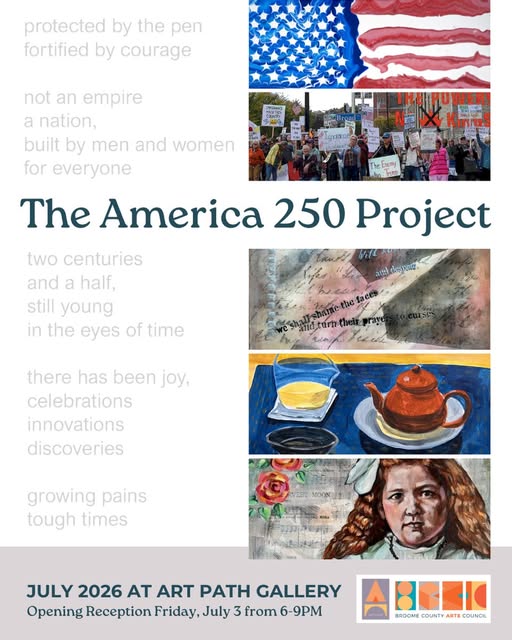
Folks in the Binghamton, New York area can visit a special exhibition at the Broome County Arts Council, beginning today, July 3rd, and continuing throughout the month of July.

The official opening is tonight from 6-9 PM for First Friday. There will be visual and literary arts on display around the theme of our personal American heritage.

I am happy to announce that my poem, “Giovanni”, about my Italian-speaking, immigrant grandfather will be part of the exhibition.

On Thursday, July 16th at 6:30 PM, there will be a reading event in conjunction with the exhibition which will include the authors presenting their poems and personal recollections.

Please, join us, if you are able!

The Revolution Will Be Poeticized

(Graphic credit: WSKG Public Media)

WSKG, our local public broadcaster serving the Southern Tier of New York and Northern Tier of Pennsylvania, sponsored a call for poets in our region as we observe the semiquincentennial of the United States of America.

The call asked for poems addressing one or more of these themes:

Looking Back: history, founding ideals, and untold stories

Right Now: modern America, democracy today, and lived experience

Looking Forward: hopes for future generations.

They received 163 submissions from 25 counties, which I thought was a very impressive showing from our region’s poets!

You can read the ten winning entries here and listen to recordings of their work, nine as of July 2nd, here. (The link to the recordings may not be a permalink, but should work through July, 2026, at least.)

All the submissions were compiled into an anthology. At over 200 pages, it shows the breadth of talent from our region.

For my entry, I combined all three themes around the concept of women’s rights. I intentional wrote two 13-line stanzas, in honor of the 13 colonies that became states. Because I chose to only use the first names of the people I referenced, I also included an explanatory note.

We Work and Wait
by Joanne Corey

Remember the ladies, Abigail
wrote John before the Declaration
but after Sojourner, Elizabeth, Susan
and their sisters of the First Wave
Betty, Gloria, Angela
and their sisters of the Second Wave
Judith, Rebecca, Amy
and their sisters of the Third Wave
Tarana, Wendy, Jessica
and their siblings of the Fourth Wave
and the passage of 250 years
women still work toward
their full independence.

When Shirley ran in ‘72
my girl-self thought soon
but as Wave after Wave
crashed against that
highest, hardest glass ceiling
it inexplicably held.
Will it be my daughters
or my granddaughters
who see the First Ms.
President, the Second
Third, Fourth? So many
they don’t think
to keep count.

Note: People referenced in this poem in order of appearance: Abigail Adams, John Adams, Sojourner Truth, Elizabeth Cady Stanton, Susan B. Anthony, Betty Friedan, Gloria Steinem, Angela Davis, Judith Butler, Rebecca Walker, Amy Richards, Tarana Burke, Wendy Davis, Jessica Valenti, Shirley Chisholm. Quote from Hillary Rodham Clinton’s 2016 concession speech.

I’m grateful to WSKG for this project and the opportunity to respond creatively and share poems with the community. I hope you engage with the arts, whether as a creator or an interactor, at this critical moment in United States history.

SoCS: writing

I miss writing.

Because of the brain fog and fatigue I’ve had over the last couple of years as a result of my extra-stetchy connective tissue from my hEDS, I can’t spend as much time writing as I would like.

Some kinds of writing, like poetry, have become almost non-existent in my life. I feel like the creative side of my brain isn’t operational the vast majority of the time – and the more analytic side is only at half-capacity, at best. Heck, I have difficulty reading literature of any kind these days. I can sometimes manage to grasp poems, if it’s in the morning and they aren’t too long. I can’t read novels because I can’t get plots and characters to stick in my head over days. I can’t even manage non-fiction books because the brain fog is too thick to remember topics over the course of days and the fatigue level is such that I can’t read very long at a sitting. I’ve been trying to keep up by reading news and commentary articles and newsletters but have been so tired lately that my inbox is overflowing with unread material.

There has been so much happening here in the US that I’ve wanted to write posts about but haven’t been able to manage, which makes me sad. I keep thinking that the next specialist visit will give us something actionable to improve my condition but, instead, it usually means more tests are needed, which means waiting for the tests to be scheduled, doing them, waiting for them to be interpreted, waiting for the specialist to see the results and interpret them – which often yields a different result than the radiology reports that land in my health portal – and get back to me with what they think is going on. Then, maybe, we get to trying a treatment that may or may not work and then onto the next option or the next specialist.

I’m grateful, though, that this year I have a specialist who was finally able to diagnose my hEDS and cerebellar ectopia and that I finally have specialists who know what to try with patients like me. Unfortunately, I might need some pretty scary treatments, like brain surgery.

So, I’m grateful and scared and exhausted and anxious and tired of all the waiting and struggling and symptoms and uncertainty.

And I miss writing and being able to make it through a day without having to spend a good chunk of it lying down and being able to take walks without having someone with me in case I lose my ability to keep my balance and going to visit family and friends and being able to concentrate and speaking without having to search for the right word in some kind of frantic brain race.

I miss the life of the mind that I took for granted as part of my identity.

And here you have an illustration of why stream of consciousness writing is so dangerous to put out there, because this is a way darker post than I thought I was going to be writing when I started out with Linda’s prompt of the word miss and decided to write about missing writing.

It is, though, on brand with Top to JC’s Mind where I usually write honestly about whatever is top of mind for me, even when that mind is more scattered and glitchy and exhausted than it used to be.

There are two big imaging studies coming up for me this week and a hugely important appointment with a specialized neurosurgeon at the end of July. Meanwhile, I’m hoping against hope to get a few significant posts written here, as opposed to the last month which has not been very substantive.

Sigh.

I miss writing.
*****
Join us for Linda’s Stream of Consciousness Saturday! Find out more here: https://lindaghill.com/2026/06/19/the-friday-reminder-and-prompt-for-socs-june-20-2026/

Smith blackout poetry ’26

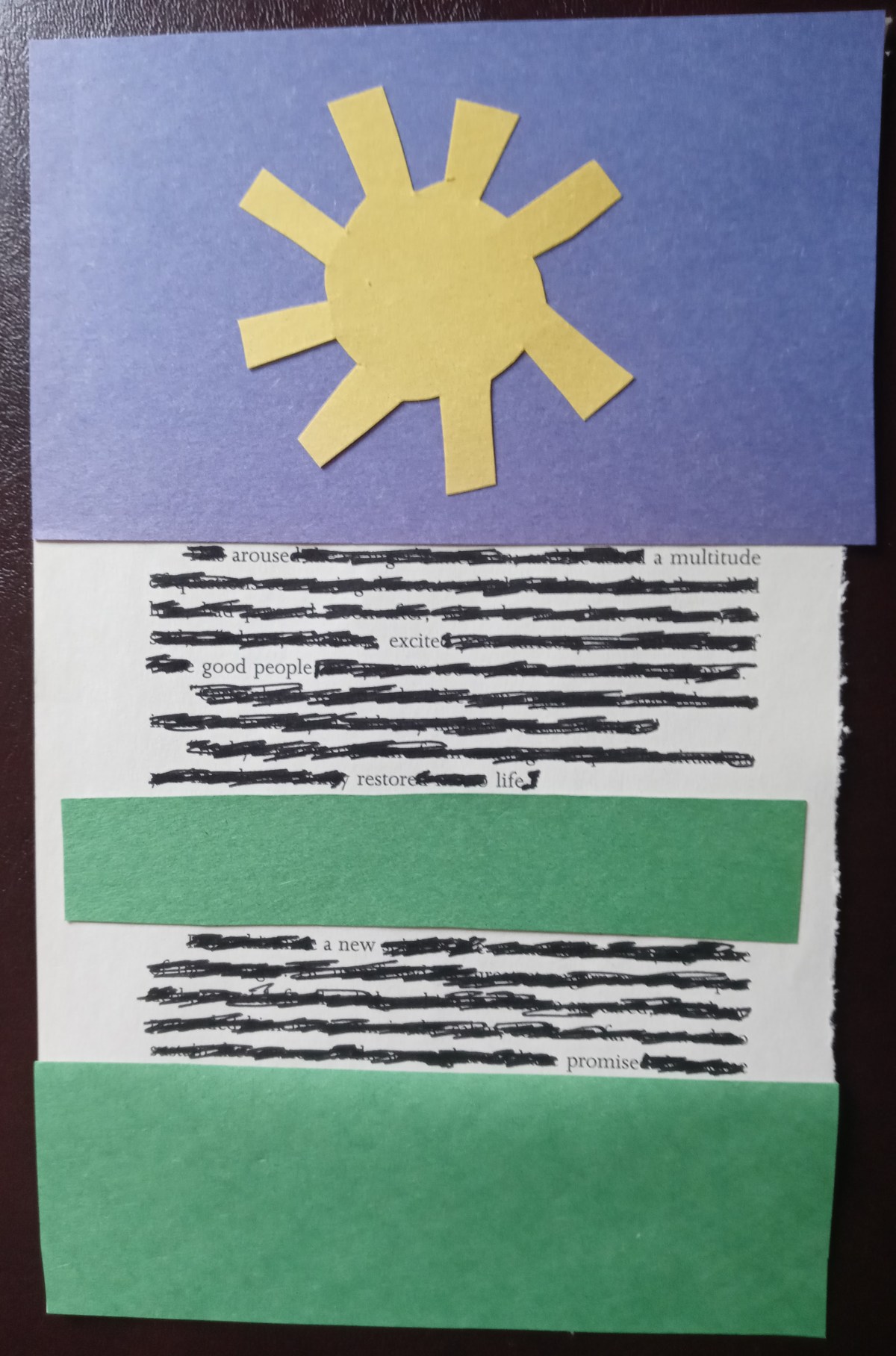
For the past several years, the Boutelle-Day Poetry Center at my alma mater, Smith College, has offered a Blackout Poetry Project to the Smith community, including alums. In the blackout poetry style, one takes a page of pre-existing text and crosses out words or letters to create a poem. The pages are then sometimes embellished with color or other visual art elements. I have participated in prior years, such as the year when the theme was Emily Dashes, using the poems of Emily Dickinson.

This year’s theme is Monster Mash, creating blackout poetry using pages from Mary Wollstonecraft Shelley’s Frankenstein. As you can imagine, the work is quite dark in tone, so I decided to take page 22, which was sent to me from the Center, and transform it into a brighter message.

As it may be difficult to read from the photo, the words I chose to highlight are:
arouse a multitude
excite good people
restore life
a new promise

My visual artist friends will, I’m sure, forgive my rudimentary collage but I felt that we are all in need of a bit of sunshine today.

Write Out Loud ’26 recording!

As I wrote here, I was unable to attend the Write Out Loud ’26 event at the Fenimore Art Museum near Cooperstown, NY, last month, but I’m happy to share the newly released recording.


My poem “Nor’easter Numbers” is first on the program, read wonderfully by the fabulous Sharon Rankins-Burd. If you watch the video on YouTube and click on “more,” you can see the program and timings laid out so you can easily navigate to particular pieces. Enjoy! As always, feel free to comment.

National Poetry Month ’26

Here in the United States, April is observed as National Poetry Month. While my writing and activities are constrained by my health, it was my privilege to be involved with a couple of poetry events this month.

I was able to read a couple of my poems as part of the Tioga Arts Council‘s Poetry Out Loud event. Area poets gathered to read poems, their own or others’. I especially loved hearing from some of my friends of the Grapevine Poets and from Dante Di Stefano, whose spouse is director of the Tioga Arts Council. The amazing thing about the reading was that there were a number of participants who had never before done a reading or even attended one. We also had a wide range of work read, including a poem in Bengali which was a combination of singing and speaking.

For the third consecutive year, one of my poems was accepted to the Write Out Loud event at the Fenimore Art Museum near Cooperstown, NY. The performance was the evening before the Madrigal Choir of Binghamton’s spring concert and I knew I would not have energy to sing dress rehearsal, scoot to Cooperstown for the evening, and sing an afternoon concert the next day, so I happily ceded reading duties to Sharon Rankins-Burd, who read my poem “The Bridge” so admirably last year. This year, my poem “Nor’Easter Numbers” was the first poem on the program. I’m looking forward to the recording of the reading becoming available. I’ll post when it is! Update: the recording is now available here.

How did you celebrate poetry this month?

Baltic concert

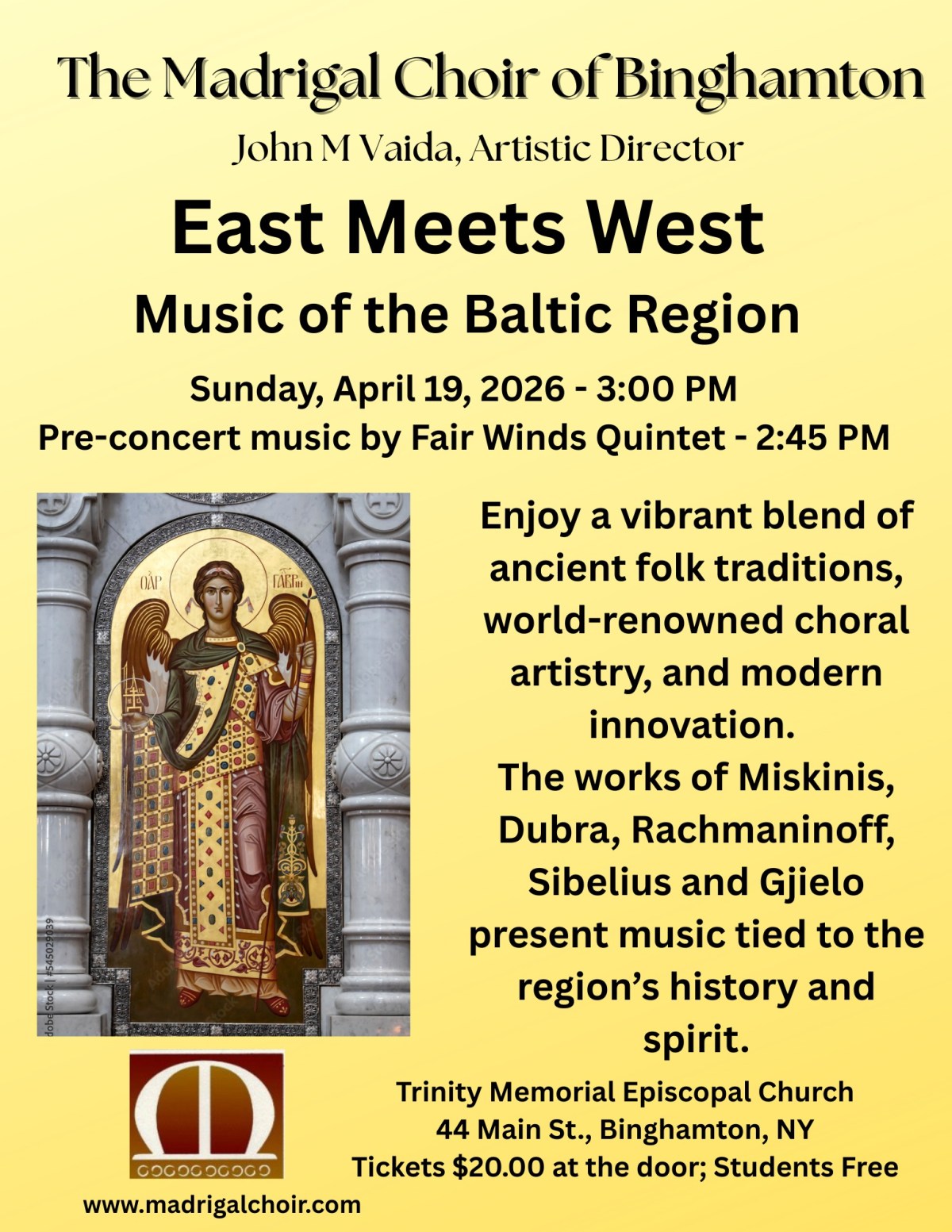
Last Sunday, I sang a concert of music from the Baltic region with the Madrigal Choir of Binghamton under the direction of John M. Vaida.

It was a great experience for us and for our audience. We got to perform pieces by composers that were new to most of us. I added languages to my personal list of sung texts, Swedish and Estonian. We also welcomed the Fair Winds Quintet as our guests, made possible by a grant from the United Cultural Fund of the Broome County Arts Council. They played a set before the sung concert and another to begin the second half of the program after intermission. It was wonderful to have these talented local artists join us for the concert.

One of my favorite pieces on the program was “Cantate Domino”, a setting of part of Psalm 98 by the Lithunian composer Vytautas Miškinis. Another highlight was Sergei Rachmaninoff’s “Bogoroditse Devo” from his All-Night Vigil. I had first sung this under the direction of Dr. Bruce Borton with the University Chorus. Bruce had prepared a new edition of the Vigil for us to use and we later sang this movement in later programs, so it always reminds me of him. Bruce also became the second artistic director of the Madrigal Choir a few years before his retirement from Binghamton University. After the pandemic shutdown and the end of University Chorus, Bruce welcomed me to Madrigal Choir. Shortly after I joined, Bruce fell ill. I wrote about the last concert he conducted with Madrigal Choir here and about singing at his funeral and Madrigal Choir tribute here. This Rachmoninoff piece was part of a concert dedicated to Bruce at the University. I was grateful for the opportunity to sing it again, especially at Trinity Episcopal Church where Bruce had sung and volunteered for many years as a congregant.

I particularly loved the final piece of the program, a newly written hymn by Carolyn Winfrey Gillette, set to the tune “Finlandia” by Jean Sibelius. Rev. Gillette is a local Presbyterian pastor and hymnist with over 500 hymns to her credit. This poem, “O God of Love, This Is a Time of Turning”, was written in January, 2026, after speaking with a seminary friend serving in Minneapolis. We printed the words in the program and invited the audience to join us in singing – and they did!

We sang, “May we stand firm for truth and peace and justice;
May we leave fear and hatred far behind.”

May it be so.

SoCS: JC’s Confessions #35

reading difficulties

While this post will be stream of consciousness for Linda’s Stream of Consciousness Saturday on the prompt “easy/hard,” it is also part of my occasional series JC’s Confessions, so I will open with the usual non-SoC opening for that series.

In the first few seasons of The Late Show, Stephen Colbert did a recurring skit, then a best-selling book, called Midnight Confessions, in which he “confesses” to his audience with the disclaimer that he isn’t sure these things are really sins but that he does “feel bad about them.” While Stephen and his writers are famously funny, I am not, so my JC’s Confessions will be somewhat more serious reflections, but they will be things that I feel bad about. Stephen’s audience always forgives him at the end of the segment; I’m not expecting that – and these aren’t really sins – but comments are always welcome.

Reading, which is something that was usually easy for me, is now often hard to do.

As someone who loves reading and who is trying to be a writer and poet, that’s a hard thing to admit.

This change is mostly related to what has recently been diagnosed as hypermobile Ehlers-Danlos syndrome (hEDS), an inherited connective tissue disorder that affects collagen. Because we have connective tissue throughout our bodies, many different body parts and systems are affected and the symptoms and their locations vary over time.

For these last couple of years, I’ve been having a lot of problems with my brain and with fatigue.

I often have brain fog, which makes it difficult to concentrate. This makes it hard to read anything that is long, like books. I do better with short things, so I do a lot of my reading these days in the forms of emails, so, given what is going on, I read commentary on political topics and environmental problems and some Catholic church/social justice news that lands in my inbox.

You would think that poems would be perfect for my length limitations, but, sadly, this isn’t the case. I’ve largely lost contact with the creative side of my thinking, making it hard for me to read poetry most of the time, as I am not able to really appreciate the art of the poet. I hadn’t realized how much of my own creativity is wrapped up in reading someone else’s work. I do still manage to do a bit of reading of poems, especially my poet-friends’ work, but it’s frustrating and sad for me, knowing that I can’t fully appreciate their artistry.

I also have severe limits on how long I can read, write, or concentrate. I’m writing this in the morning and hope to draft one other practical letter I need to write, but that will probably be about it for the day because I will be very tired afterward. In order to have energy to go to vigil mass at 4:00, I’ll most likely spend the early afternoon lying down and resting.

It’s really hard to deal with these limitations on my brain power and energy.

There are also some other problems caused by my hEDS that interfere with my reading. I’m having a couple of problems with my eyes. I have some level of visual disturbance going on, especially with my left eye, which causes some blurring that isn’t able to be corrected with glasses. The problem isn’t with the eye itself but with the brain in processing it – at least that is the current theory. It may be related to dysautonomia, where the regulation of all those things that our bodies ordinarily do without our thinking about them goes a bit haywire. On rare occasions, I can concentrate hard enough on what I am looking at that I can get the blurriness to clear, although only for a short amount of time and at risk of ramping up the fatigue.

The other connective tissue-related eye problem is dry eye, which I treat with prescription drops, artificial tears, and taking flaxseed oil. These help but don’t eliminate the problem, which, on top of everything else, makes reading, especially onscreen, more tiring.

Now that we know about the hEDS, we may be better able to address some of the problems underlying this struggle I’m having with reading.

Or not.

I have a bunch of referrals to new specialists pending. I’m most anxious to find help for the brain fog/fatigue symptoms so that I can think and feel like myself again.

Meanwhile, I feel sad – and, sometimes, guilty – that I can’t manage to read my friends’ work or keep up with the torrent of news and commentary that I would like to do.

I try to give myself grace, but it’s hard.

*****
You are invited to join us for Linda’s Stream of Consciousness Saturdays. Find out more here: https://lindaghill.com/2026/03/20/the-friday-reminder-and-prompt-for-socs-march-21-2026/