on being a zebra (unicorn)

May is EDS & HSD Awareness Month. EDS stands for Ehlers-Danlos Syndrome and HSD for Hypermobility Spectrum Disorder. They are a group of inherited connective tissue disorders that remain under-diagnosed and under-treated. Case in point: I was diagnosed with hypermobile Ehlers-Danlos Syndrome (hEDS) in January at the age of 65, making sense of decades-worth of unexplained symptoms.

The Ehlers-Danlos Society uses the zebra as a symbol of the EDS/HSD community because there is a saying among the medical community that “when you hear hoofbeats, think horses, not zebras” but, sometimes, there really are zebras. Zebras also each have their unique stripe pattern, in the same way that people with EDS/HSD have their own unique presentation, depending on how their collagen and connective tissue is impacted across different body systems at that particular time in their life. The medical system in the United States and in many other countries tends to divvy medical care to specialists who only look at one body system but connective tissue disorders are easier to recognize if one takes a more integrative approach.

And a fun zebra fact: A group of zebras is called a dazzle, which leads to the Ehlers-Danlos Society saying, “Together, we dazzle!”

As I’ve continued to research hEDS, I’ve been engaging in personal forensic diagnostics. So many things I have experienced in my life make sense now that I know of my genetic inheritence of hEDS. For example, I developed tendon problems in my elbow as a young teen which impacted my abilities as a pianist and organist. When I eventually had to resort to surgery in my thirties, the outcome wasn’t as expected and I had to give up playing. I now understand that this was due to my hEDS inherited collagen defects.

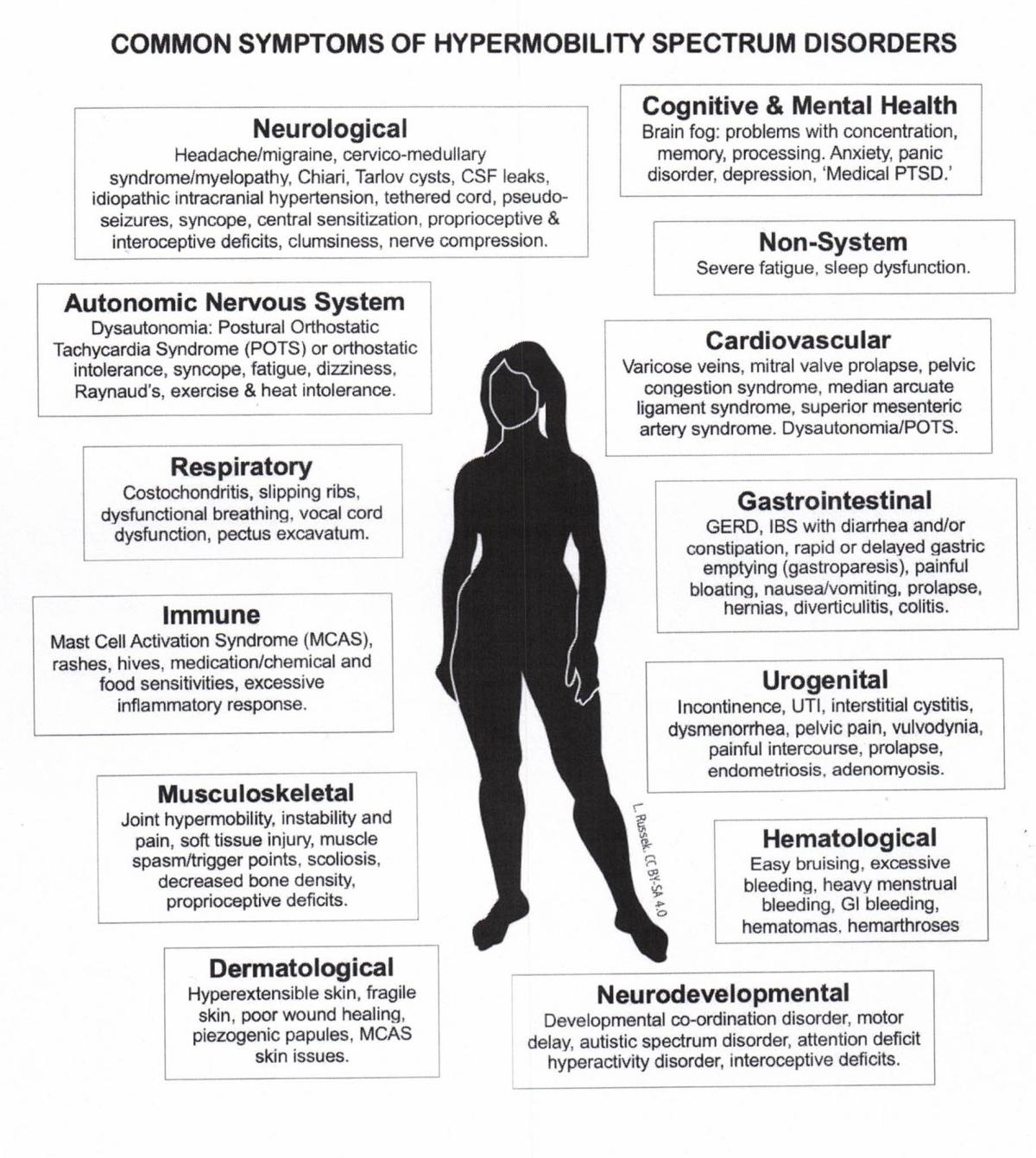
My IBS, IC, endometriosis, vulvodynia, pre-term labor, allergies, mast cell activation disorder, cervical instability, near-sightedness, depression/anxiety, cerebellar ectopia, sleep apnea, early gall bladder disease, hiatal hernia, acid reflux, chronic fatigue, diverticulosis, chronic kidney disease, sensitive skin, joints that bend more than expected, and more all have a connective tissue component and are more likely in people with EDS/HSD.

Daughter T gave me the zebra unicorn pin as a gift. While the zebra is the symbol of EDS/HSD, adding the unicorn element helps to play up the uniqueness of each individual.

And it’s super cute!

The point is that another person with hEDS could exhibit a totally different set of symptoms from mine or we could share some symptoms and not others. It just depends on which connective tissues are compromised and how much at that particular time. Other factors are involved, too, like age, activity level, hormone and endocrine function, etc. It adds to the zebra-unicorn element and takes a thoughtful and informed practitioner to pick up on the possibility of an underlying connective disorder behind all the symptoms of different body parts.

In December, there will be an update to the EDS/HSD diagnostic guidelines. My hope is that the medical community will use these and the best practices guidelines that will follow in spring 2027 to finally look more comprehensively at their patients and diagnose and help them at much younger ages than currently.

Some people are also under the mistaken impression that it doesn’t do any good to give a diagnosis when you can’t cure the disorder. While it’s true that we can’t current treat the genetic cause, there are treatments to help alleviate many of the symptoms. It’s also imperative for practitioners to know the EDS/HSD status for anyone who is contemplating surgery. Surgeons need to know about connective tissue differences so that they can compensate for that during the procedure and the recovery protocols or, perhaps, decide that surgery is not appropriate. Many EDS/HSD patients also need long-term physical therapy to help them function; it makes a huge difference if physical therapists are knowledgeable about connective tissue disorders so that they help rather than hurt.

As I continue my journey with hEDS, I will keep you posted here at Top of JC’s Mind. If we are super-lucky and we find effective treatment for my brain fog and fatigue, I may even post more regularly.

I will, though, always remain my unique, zebra-unicorn self.

EDS/HSD Primer

May is EDS & HSD Awareness Month and I promised to do some posts on it. I had hoped to get this first post out earlier in the month but I’m having some difficulties with an hEDS flare, which has slowed me down a bit.

Ehlers-Danlos Syndrome (EDS) and Hypermobility Spectrum Disorder (HSD) are heritable connective tissue disorders. There are 13 types of EDS. In 12 of those types, the exact genetic cause has been identified. Some of these types are very rare, affecting less than one in a million people. The most common form of EDS is hypermobile (hEDS), which is known to be inherited in an autosomal dominant pattern but appears to have a more complex genetic profile. The prevalence of hEDS is unknown because it is very often missed diagnostically. Case in point, I was diagnosed at age 65.

HSD is related to hEDS, usually involving fewer hypermobile joints than most people with hEDS. While some clinicians and researchers look at HSD and hEDS as separate disroders, others look at hEDS as occupying a certain segment of the hypermobile spectrum. In December, 2026, updated diagnostic criteria will be published, with best practices to follow in spring ’27. It will be interesting to see if hEDS and HSD will be merged into a single diagnosis.

One of the difficulties with obtaining a diagnosis with EDS or HSD is that they present in different ways in different individuals and can vary with age. All forms of EDS/HSD affect connective tissue, making it stretchier than is typical, often due to genetic impacts on the proteins involved in collagen production. Symptoms appear throughout the body and in different body systems. The charts at the top gives you some idea of how wide-ranging the symptoms can be. Thankfully, no one has all the symptoms but when tends to happen in the medical systems in most countries is that you see separate specialists for different body systems and there is no one with enough knowledge to integrate all the information and realize that connective tissue is the common denominator underlying it all.

Because EDS/HSD are genetic in origin, treatment revolves around symptoms. Physical therapy is often a big part of the treatment plan. There are medications, vitamins, and supplements to help certain aspects of the disorder, too. For example, I have a mast cell activation disorder as part of my hEDS and take several medications to help relieve respiratory and gastrointestinal symptoms.

Having an EDS/HSD diagnosis also allows your care team to keep an eye out for conditions that may develop, such as heart valve problems. It’s very important for surgeons to know if your connective tissues are not typical, as this may impact how a procedure is done or if it should be done at all. How well medications work and the dosages required can also differ. For example, my hEDS diagnosis explained why topical anethetics, like lidocaine, don’t work well for me.

I am hoping that, when the new diagnostic criteria are published, there will be increased awareness of inherited connective tissue disorders among both the medical community and the general public. For too long, symptoms have been dismissed as unrelated, idiopathic, stress-induced, hormonal, anxety-induced, unimportant, or imaginary. Like autoimmune diseases, these disorders are more prevalent in females than males, adding to the burden of being taken seriously and the dearth of studies.

The Ehlers-Danlos Society is an important organization spearheading study, training, education, and treatment of EDS/HSD internationally. Their website is a great source of information for patients and their families, as well as for clinicians and researchers. This month, as we raise awareness, my hope is that more people will learn about EDS/HSD and help those affected get the diagnosis, treatment, and validation they deserve.

SoCS: JC’s Confessions #35

reading difficulties

While this post will be stream of consciousness for Linda’s Stream of Consciousness Saturday on the prompt “easy/hard,” it is also part of my occasional series JC’s Confessions, so I will open with the usual non-SoC opening for that series.

In the first few seasons of The Late Show, Stephen Colbert did a recurring skit, then a best-selling book, called Midnight Confessions, in which he “confesses” to his audience with the disclaimer that he isn’t sure these things are really sins but that he does “feel bad about them.” While Stephen and his writers are famously funny, I am not, so my JC’s Confessions will be somewhat more serious reflections, but they will be things that I feel bad about. Stephen’s audience always forgives him at the end of the segment; I’m not expecting that – and these aren’t really sins – but comments are always welcome.

Reading, which is something that was usually easy for me, is now often hard to do.

As someone who loves reading and who is trying to be a writer and poet, that’s a hard thing to admit.

This change is mostly related to what has recently been diagnosed as hypermobile Ehlers-Danlos syndrome (hEDS), an inherited connective tissue disorder that affects collagen. Because we have connective tissue throughout our bodies, many different body parts and systems are affected and the symptoms and their locations vary over time.

For these last couple of years, I’ve been having a lot of problems with my brain and with fatigue.

I often have brain fog, which makes it difficult to concentrate. This makes it hard to read anything that is long, like books. I do better with short things, so I do a lot of my reading these days in the forms of emails, so, given what is going on, I read commentary on political topics and environmental problems and some Catholic church/social justice news that lands in my inbox.

You would think that poems would be perfect for my length limitations, but, sadly, this isn’t the case. I’ve largely lost contact with the creative side of my thinking, making it hard for me to read poetry most of the time, as I am not able to really appreciate the art of the poet. I hadn’t realized how much of my own creativity is wrapped up in reading someone else’s work. I do still manage to do a bit of reading of poems, especially my poet-friends’ work, but it’s frustrating and sad for me, knowing that I can’t fully appreciate their artistry.

I also have severe limits on how long I can read, write, or concentrate. I’m writing this in the morning and hope to draft one other practical letter I need to write, but that will probably be about it for the day because I will be very tired afterward. In order to have energy to go to vigil mass at 4:00, I’ll most likely spend the early afternoon lying down and resting.

It’s really hard to deal with these limitations on my brain power and energy.

There are also some other problems caused by my hEDS that interfere with my reading. I’m having a couple of problems with my eyes. I have some level of visual disturbance going on, especially with my left eye, which causes some blurring that isn’t able to be corrected with glasses. The problem isn’t with the eye itself but with the brain in processing it – at least that is the current theory. It may be related to dysautonomia, where the regulation of all those things that our bodies ordinarily do without our thinking about them goes a bit haywire. On rare occasions, I can concentrate hard enough on what I am looking at that I can get the blurriness to clear, although only for a short amount of time and at risk of ramping up the fatigue.

The other connective tissue-related eye problem is dry eye, which I treat with prescription drops, artificial tears, and taking flaxseed oil. These help but don’t eliminate the problem, which, on top of everything else, makes reading, especially onscreen, more tiring.

Now that we know about the hEDS, we may be better able to address some of the problems underlying this struggle I’m having with reading.

Or not.

I have a bunch of referrals to new specialists pending. I’m most anxious to find help for the brain fog/fatigue symptoms so that I can think and feel like myself again.

Meanwhile, I feel sad – and, sometimes, guilty – that I can’t manage to read my friends’ work or keep up with the torrent of news and commentary that I would like to do.

I try to give myself grace, but it’s hard.

*****
You are invited to join us for Linda’s Stream of Consciousness Saturdays. Find out more here: https://lindaghill.com/2026/03/20/the-friday-reminder-and-prompt-for-socs-march-21-2026/

a diagnosis (finally)

While I would usually be posting on the Stream of Consciousness Saturday prompt today, I’m opting instead for doing an edited Just Jot It January post.

Okay, this is going to be more than a “jot” but will be something that I feel compelled to give an update to the usual crowd of SoCS participants.

Since March, 2024, I’ve been having a growing array of odd symptoms – I won’t bore you with the whole list – that have been interfering with my ability to function. The brain fog and fatigue have been especially problematic.

I’ve posted variously about these symptoms and their impact on my life. Along the way, I’ve been diagnosed with a number of conditions that affect a certain body part or system but have always felt that these different symptoms were related.

This week, I finally have an answer. I’ve been diagnosed with hypermobile Ehlers-Danlos Syndrome (hEDS). hEDS is an inherited connective tissue disorder. Because we have connective tissues throughout our bodies, it impacts many different parts and systems of the body. Each individual with hEDS has their own unique combination of symptoms which may change over time. While hEDS follows an autosomal dominant inheritance pattern, the specific genes underlying it have not yet been identified. Because there is currently no test that detects hEDS, it tends to be missed, especially because there is no medical specialty dedicated to connective tissues.

Just in case you were wondering how a 65-year-old gets an initial diagnois of a genetic disorder. My (embarrassingly large) number of medical practitioners have spent the last almost two years ruling out various diagnoses or diagnosing component parties of hEDS without putting all the pieces together. I’ve learned from patient advocacy groups that there are other people who were not diagnosed until their fifties, sixties, or even older.

I actually was pretty sure I had either hEDS or the related condition, hypermobility spectrum disorder (HSD), 19 months ago. A close family member was facing an unusual medical condition that required surgery and her doctor realized that her connective tissues were not responding in a typical way. She suggested that there might be a connective tissue disorder present and advised seeing a geneticist physician. In assembling a full family history and researching hEDS/HSD with my family member, I felt that my body made sense for the first time.

I was excited and told my primary care doctor, but she felt we had to rule out every other possible cause of my symptoms first. Even when my family member was diagnosed with hEDS last June and the genetic connection was clear, my medical team was still not making the diagnosis.

That changed when I was finally able to see a nurse-practitioner who specializes in integrative/supportive medicine. With my records, family history, symptoms, and physical exam, she was able to diagnose me with hEDS and, importantly, to order additional tests to help pinpoint the cause of my current symptoms. She also knows where to send me for treatment, which will be especially important if I need to have surgery.

hEDS affects more women than men, so, no surprise, the symptoms tend to be written off as stress- or hormone-induced. I particularly remember having to explain to a doctor that I could tell the difference between brain fog and writer’s block. I also faced skepticism that I could be this old without any medical professionals realizing I have a genetic disorder, but, as others have pointed out, that should be a reflection on them, not me. Education about inherited connective tissue disorders has been lacking in medical education but I am hopeful that new research will break through and raise awareness so that it’s easier for people with hEDS/HSD to be diagnosed and treated appropriately much earlier in their lives.

I am trying to do my part by sharing my story and accurate information. As my treatment plan develops, I’ll post about it.

I must say, though, that the people who have been most helpful to me have been my physical therapists. Although my lead therapist realized that I have a connective tissue disorder and has been helping me to strengthen muscles and improve my posture, along with heat, massage, and stretching, she isn’t allowed to make medical diagnoses. She is also happy that I finally have an official hEDS diagnosis. The hope is that the additional tests I will now have will give us more data on how best to address my symptoms.

Obviously, a genetic disorder like this can’t be cured, but we should be able to improve at least some of my symptoms. For now, it feels good to have validation that there are reasons why my body reacts as it does. No more doctors implying that it’s all in my head or that I just need to reduce stress. Maybe some of them will even be moved to learn more about inherited connective tissue disorders.

They may even find that there are a lot more of us than they realized…
*****
For more information on joining in with Stream of Consciousness Saturday and/or Just Jot It January, please visit Linda’s blog here: https://lindaghill.com/2026/01/16/the-friday-reminder-for-socs-jusjojan-2026-daily-prompt-for-jan-17th/