EDS/HSD Primer

May is EDS & HSD Awareness Month and I promised to do some posts on it. I had hoped to get this first post out earlier in the month but I’m having some difficulties with an hEDS flare, which has slowed me down a bit.

Ehlers-Danlos Syndrome (EDS) and Hypermobility Spectrum Disorder (HSD) are heritable connective tissue disorders. There are 13 types of EDS. In 12 of those types, the exact genetic cause has been identified. Some of these types are very rare, affecting less than one in a million people. The most common form of EDS is hypermobile (hEDS), which is known to be inherited in an autosomal dominant pattern but appears to have a more complex genetic profile. The prevalence of hEDS is unknown because it is very often missed diagnostically. Case in point, I was diagnosed at age 65.

HSD is related to hEDS, usually involving fewer hypermobile joints than most people with hEDS. While some clinicians and researchers look at HSD and hEDS as separate disroders, others look at hEDS as occupying a certain segment of the hypermobile spectrum. In December, 2026, updated diagnostic criteria will be published, with best practices to follow in spring ’27. It will be interesting to see if hEDS and HSD will be merged into a single diagnosis.

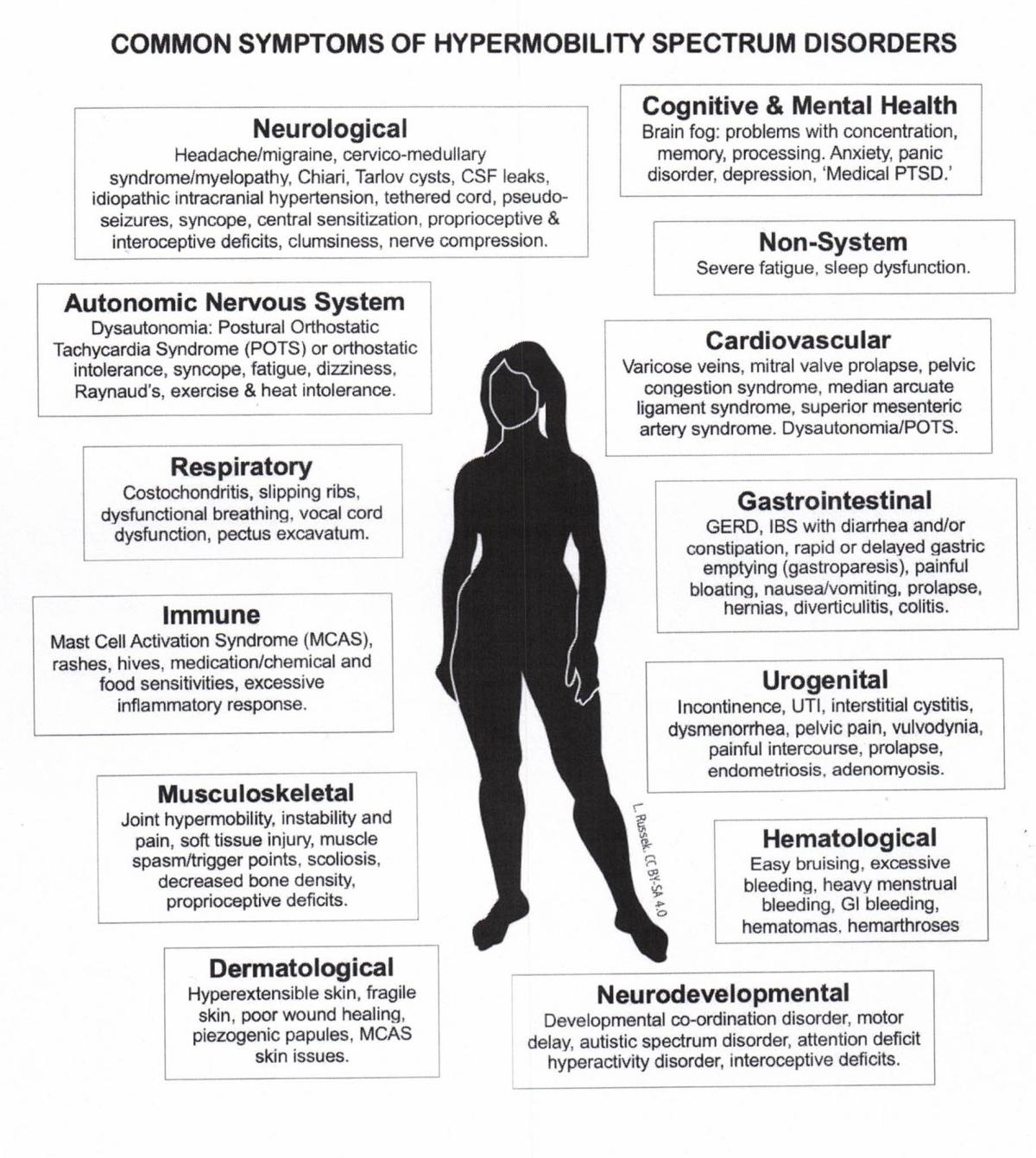
One of the difficulties with obtaining a diagnosis with EDS or HSD is that they present in different ways in different individuals and can vary with age. All forms of EDS/HSD affect connective tissue, making it stretchier than is typical, often due to genetic impacts on the proteins involved in collagen production. Symptoms appear throughout the body and in different body systems. The charts at the top gives you some idea of how wide-ranging the symptoms can be. Thankfully, no one has all the symptoms but when tends to happen in the medical systems in most countries is that you see separate specialists for different body systems and there is no one with enough knowledge to integrate all the information and realize that connective tissue is the common denominator underlying it all.

Because EDS/HSD are genetic in origin, treatment revolves around symptoms. Physical therapy is often a big part of the treatment plan. There are medications, vitamins, and supplements to help certain aspects of the disorder, too. For example, I have a mast cell activation disorder as part of my hEDS and take several medications to help relieve respiratory and gastrointestinal symptoms.

Having an EDS/HSD diagnosis also allows your care team to keep an eye out for conditions that may develop, such as heart valve problems. It’s very important for surgeons to know if your connective tissues are not typical, as this may impact how a procedure is done or if it should be done at all. How well medications work and the dosages required can also differ. For example, my hEDS diagnosis explained why topical anethetics, like lidocaine, don’t work well for me.

I am hoping that, when the new diagnostic criteria are published, there will be increased awareness of inherited connective tissue disorders among both the medical community and the general public. For too long, symptoms have been dismissed as unrelated, idiopathic, stress-induced, hormonal, anxety-induced, unimportant, or imaginary. Like autoimmune diseases, these disorders are more prevalent in females than males, adding to the burden of being taken seriously and the dearth of studies.

The Ehlers-Danlos Society is an important organization spearheading study, training, education, and treatment of EDS/HSD internationally. Their website is a great source of information for patients and their families, as well as for clinicians and researchers. This month, as we raise awareness, my hope is that more people will learn about EDS/HSD and help those affected get the diagnosis, treatment, and validation they deserve.

EDS/HSD Awareness Month

May is Ehler-Danlos Syndrome/Hypermobility Spectrum Disorder Awareness Month, begun by the Ehlers-Danlos Society to bring attention to this family of connective tissue disorders which affect millions of people around the world, many of whom will take decades to be diagnosed while others will never know for sure what causes their bodies to exhibit an unusual constellation of symptoms. I apologize for being late to the effort, although I did do one awareness post here for One-Liner Wednesday and shared some informative posts via Facebook. It’s been a bit of a rough month for me.

I am one of those people who is yet to be officially diagnosed, despite decades of symptoms, though I will spare you the details of my specific case.

The Ehlers-Danlos Society is a great resource for information about both Ehlers-Danlos Syndrome (EDS) and Hypermobility Spectrum Disorder (HSD), both for individuals and for clinicians and researchers. It also plays a role in funding research around the world for these connective tissue disorders. There is a lot to know but I will just give a broad outline here.

EDS is a group of inherited connective tissue disorders, currently classified into 13 types. Twelve of the types have a known genetic cause, where a chromosome affects a particular protein, and can be identified with testing. Some of these affect less than one in a million people.

The largest group of people with EDS, though, have hypermobile EDS (hEDS), estimated to affect 3,100-5,000 people per million. While it is known to have a dominant genetic inheritance pattern, the genes or groups of genes responsible have not yet been identified. There is some question among researchers and clinicians if hEDS should remain classified as a form of EDS or if it should be considered as part of Hypermobility Spectrum Disorder in which the hypermobility is more widespread and severe than in most people with HSD.

In HSD, people exhibit joint hypermobility/instability in at least one joint, which may suffer frequent sprains, pain, subluxation/dislocation, joint or soft tissue damage, and/or early arthritis. They may also have poor proprioception, which means they can have difficulty with awareness of their bodies’ position or movement, for example, being clumsy.

They may also have symptoms over many parts/systems of their body. Fatigue, headaches, gastrointestinal problems, autonomic dysfunction, and anxiety are some of the kinds of symptoms that can be part of HSD, with each person exhibiting a different constellation of symptoms which may shift over time. This makes sense in that we have connective tissue throughout our bodies, so symptoms as diverse as unusually stretchy or delicate skin, a frequently sprained ankle, irritable bowel syndrome, and blood vessel problems can all be related through differences in the way connective tissues behave in the body. We don’t know how prevalent HSD is, because the current classification system dates from only 2017, our current medical system tends to silo various body systems into separate specialties – without there being any specialists in connective tissues – and most primary care providers haven’t been taught to recognize it. This often leaves patients in the uncomfortable position of having pieced together their own diagnosis but not being able to find a doctor willing to consider it.

I feel that it is important to be properly diagnosed, even though, as inherited conditions, EDS/HSD cannot be “cured.” It helps to know about the underlying cause in order to treat symptoms more effectively. For example, physical therapy may need to be prescribed for a longer period of time with more gentle techniques to avoid further tissue damage. Surgeries may need to be modified to better support lax connective tissue. Knowing what other symptoms may arise that are connected to EDS/HSD is also helpful, along with awareness that connective tissue disorders can help explain some disorders, such as irritable bowel syndrome, that have often been written off as idiopathic.

As EDS/HSD Awareness Month draws to a close, I’d like to thank the Ehlers-Danlos Society for their valuable work in raising awareness of these conditions, advocating for patients, disseminating information, and spearheading research into these connective tissue disorders. Maybe, as more people and, critically, more health care providers learn more about these disorders, patients will be diagnosed and treated more quickly and effectively.

I hope.

(About the photo: Doctors are taught in med school that “when you hear hoofbeats, think horses, not zebras.” However, sometimes, it is actually zebras! Zebras have come to signify EDS/HSD. My daughter T gave me this zebra unicorn pin in that spirit.)

One-Liner Wednesday: connections?

Why are there no medical specialists in connective tissue when it is what holds us together?

This burning question for EDS/HSD Awareness Month brought to you as part of Linda’s One-Liner Wednesday. Join us! Find out more here: https://lindaghill.com/2025/05/21/one-liner-wednesday-600/