SoCS: houseguests

It’s fairly unusual for use to have houseguests but we did this week.

B’s brother and spouse stayed with us overnight as they headed to a family vacation in Maine.

Now, it looks like we may have guests again in a couple of weeks when B’s college roommate heads through on the way to a vacation spot with his spouse.

Sometimes, it’s handy to be located near the intersection of three major interstate routes!
*****
Linda’s prompt for Stream of Consciousness Saturday this week is “guest.” Join us! Find out more here: https://lindaghill.com/2026/06/12/the-friday-reminder-and-prompt-for-socs-june-13-2026/

on being a zebra (unicorn)

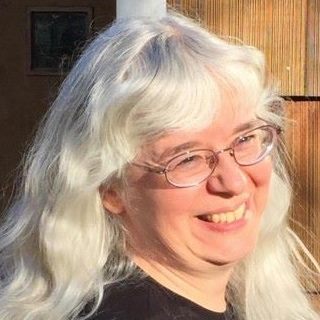
May is EDS & HSD Awareness Month. EDS stands for Ehlers-Danlos Syndrome and HSD for Hypermobility Spectrum Disorder. They are a group of inherited connective tissue disorders that remain under-diagnosed and under-treated. Case in point: I was diagnosed with hypermobile Ehlers-Danlos Syndrome (hEDS) in January at the age of 65, making sense of decades-worth of unexplained symptoms.

The Ehlers-Danlos Society uses the zebra as a symbol of the EDS/HSD community because there is a saying among the medical community that “when you hear hoofbeats, think horses, not zebras” but, sometimes, there really are zebras. Zebras also each have their unique stripe pattern, in the same way that people with EDS/HSD have their own unique presentation, depending on how their collagen and connective tissue is impacted across different body systems at that particular time in their life. The medical system in the United States and in many other countries tends to divvy medical care to specialists who only look at one body system but connective tissue disorders are easier to recognize if one takes a more integrative approach.

And a fun zebra fact: A group of zebras is called a dazzle, which leads to the Ehlers-Danlos Society saying, “Together, we dazzle!”

As I’ve continued to research hEDS, I’ve been engaging in personal forensic diagnostics. So many things I have experienced in my life make sense now that I know of my genetic inheritence of hEDS. For example, I developed tendon problems in my elbow as a young teen which impacted my abilities as a pianist and organist. When I eventually had to resort to surgery in my thirties, the outcome wasn’t as expected and I had to give up playing. I now understand that this was due to my hEDS inherited collagen defects.

My IBS, IC, endometriosis, vulvodynia, pre-term labor, allergies, mast cell activation disorder, cervical instability, near-sightedness, depression/anxiety, cerebellar ectopia, sleep apnea, early gall bladder disease, hiatal hernia, acid reflux, chronic fatigue, diverticulosis, chronic kidney disease, sensitive skin, joints that bend more than expected, and more all have a connective tissue component and are more likely in people with EDS/HSD.

Daughter T gave me the zebra unicorn pin as a gift. While the zebra is the symbol of EDS/HSD, adding the unicorn element helps to play up the uniqueness of each individual.

And it’s super cute!

The point is that another person with hEDS could exhibit a totally different set of symptoms from mine or we could share some symptoms and not others. It just depends on which connective tissues are compromised and how much at that particular time. Other factors are involved, too, like age, activity level, hormone and endocrine function, etc. It adds to the zebra-unicorn element and takes a thoughtful and informed practitioner to pick up on the possibility of an underlying connective disorder behind all the symptoms of different body parts.

In December, there will be an update to the EDS/HSD diagnostic guidelines. My hope is that the medical community will use these and the best practices guidelines that will follow in spring 2027 to finally look more comprehensively at their patients and diagnose and help them at much younger ages than currently.

Some people are also under the mistaken impression that it doesn’t do any good to give a diagnosis when you can’t cure the disorder. While it’s true that we can’t current treat the genetic cause, there are treatments to help alleviate many of the symptoms. It’s also imperative for practitioners to know the EDS/HSD status for anyone who is contemplating surgery. Surgeons need to know about connective tissue differences so that they can compensate for that during the procedure and the recovery protocols or, perhaps, decide that surgery is not appropriate. Many EDS/HSD patients also need long-term physical therapy to help them function; it makes a huge difference if physical therapists are knowledgeable about connective tissue disorders so that they help rather than hurt.

As I continue my journey with hEDS, I will keep you posted here at Top of JC’s Mind. If we are super-lucky and we find effective treatment for my brain fog and fatigue, I may even post more regularly.

I will, though, always remain my unique, zebra-unicorn self.

Mother’s or Mothers’ Day

Today is celebrated as Mother’s Day in the United States. In other years, I’ve shared about the older, Mothers’ Day begun by Julia Ward Howe in the years following the American Civil War.

This year, I’m sharing historian Heather Cox Richardson’s Substack on Howe’s views and actions.

Today, I’m wishing peace and equal rights to all mothers and all people everywhere.

EDS/HSD Primer

May is EDS & HSD Awareness Month and I promised to do some posts on it. I had hoped to get this first post out earlier in the month but I’m having some difficulties with an hEDS flare, which has slowed me down a bit.

Ehlers-Danlos Syndrome (EDS) and Hypermobility Spectrum Disorder (HSD) are heritable connective tissue disorders. There are 13 types of EDS. In 12 of those types, the exact genetic cause has been identified. Some of these types are very rare, affecting less than one in a million people. The most common form of EDS is hypermobile (hEDS), which is known to be inherited in an autosomal dominant pattern but appears to have a more complex genetic profile. The prevalence of hEDS is unknown because it is very often missed diagnostically. Case in point, I was diagnosed at age 65.

HSD is related to hEDS, usually involving fewer hypermobile joints than most people with hEDS. While some clinicians and researchers look at HSD and hEDS as separate disroders, others look at hEDS as occupying a certain segment of the hypermobile spectrum. In December, 2026, updated diagnostic criteria will be published, with best practices to follow in spring ’27. It will be interesting to see if hEDS and HSD will be merged into a single diagnosis.

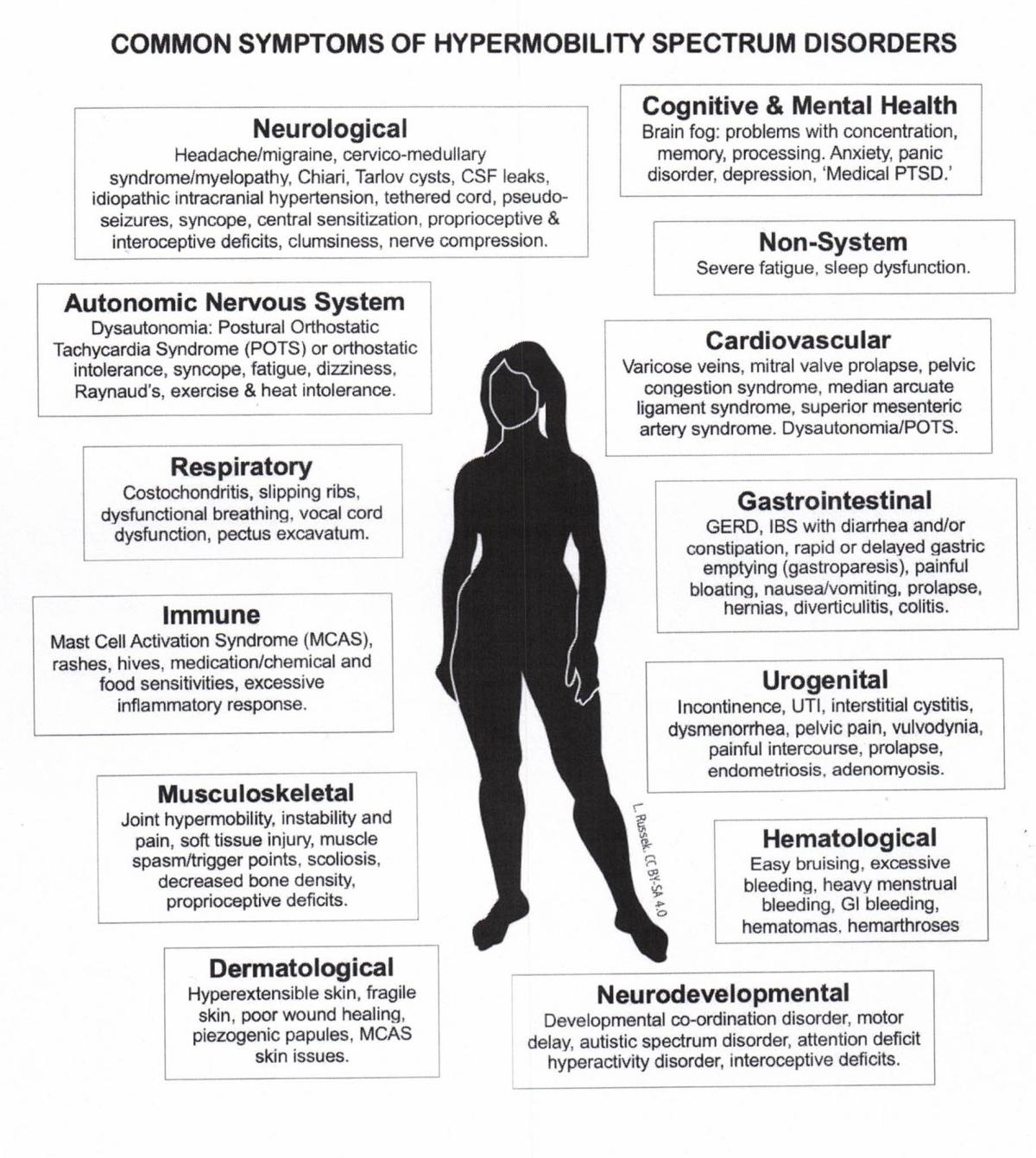
One of the difficulties with obtaining a diagnosis with EDS or HSD is that they present in different ways in different individuals and can vary with age. All forms of EDS/HSD affect connective tissue, making it stretchier than is typical, often due to genetic impacts on the proteins involved in collagen production. Symptoms appear throughout the body and in different body systems. The charts at the top gives you some idea of how wide-ranging the symptoms can be. Thankfully, no one has all the symptoms but when tends to happen in the medical systems in most countries is that you see separate specialists for different body systems and there is no one with enough knowledge to integrate all the information and realize that connective tissue is the common denominator underlying it all.

Because EDS/HSD are genetic in origin, treatment revolves around symptoms. Physical therapy is often a big part of the treatment plan. There are medications, vitamins, and supplements to help certain aspects of the disorder, too. For example, I have a mast cell activation disorder as part of my hEDS and take several medications to help relieve respiratory and gastrointestinal symptoms.

Having an EDS/HSD diagnosis also allows your care team to keep an eye out for conditions that may develop, such as heart valve problems. It’s very important for surgeons to know if your connective tissues are not typical, as this may impact how a procedure is done or if it should be done at all. How well medications work and the dosages required can also differ. For example, my hEDS diagnosis explained why topical anethetics, like lidocaine, don’t work well for me.

I am hoping that, when the new diagnostic criteria are published, there will be increased awareness of inherited connective tissue disorders among both the medical community and the general public. For too long, symptoms have been dismissed as unrelated, idiopathic, stress-induced, hormonal, anxety-induced, unimportant, or imaginary. Like autoimmune diseases, these disorders are more prevalent in females than males, adding to the burden of being taken seriously and the dearth of studies.

The Ehlers-Danlos Society is an important organization spearheading study, training, education, and treatment of EDS/HSD internationally. Their website is a great source of information for patients and their families, as well as for clinicians and researchers. This month, as we raise awareness, my hope is that more people will learn about EDS/HSD and help those affected get the diagnosis, treatment, and validation they deserve.

closures

Last Wednesday, I learned of two closures that are significant to me, one local and one further afield.

McCoy’s Chophouse closed abruptly due to health issues with long-time restauranteur Jim McCoy. McCoy had had a number of restaurants in the area over the last fifty years, most notably Number 5, housed in a renovated Binghamton (NY) fire station, complete with fire pole, which operated from 1978-2020. When Jim sold the Number 5 building in 2020, Lampy’s, the Endicott Italian restaurant Jim owned, became McCoy’s Chophouse, merging Number 5’s fine dining and Lampy’s Italian specialties. Of course, given that it was 2020, a lot of business was takeout at first due to the pandemic. As cases eased, more people chose to eat in the dining room or the bar/lounge, which featured its own, less formal menu.

While we splurged on the fine-dining menu for special occasions, we most oftened visited McCoy’s lounge on Wednesday to enjoy the $10 signature burger deal each week. The kitchen ground the trimmings from the prime steaks they prepared on the fine dining side for the burgers, topped with cheese, bacon, mushrooms, lettuce, tomato, onion, and pickles. You could leave off certain toppings; I usually asked for no onion, no pickle. The burgers were served with freshly-made potato chips. If we had room, we would order luscious desserts from the always-tempting tray.

Everyone knew that Jim had been trying to sell the restaurant so that he could retire but no buyer materialized. Apparently, a health issue arose that caused McCoy to decide to close this week. Everyone was surprised at the news. We will miss going there but have many happy memories, including B’s retirement luncheon, held in McCoy’s private dining room.

That same day, I learned that Hampshire College will close at the end of the fall semester this year. When I enrolled at Smith College, Hampshire was less than ten years old. While also a liberal arts college, it followed an alternative curriculum where each student designed their own course of study. It was part of the Five College Consortium with Smith, Mount Holyoke, Amherst, and UMass. I had several Hampshire students in my classes at Smith.

Apparently, low enrollment and high costs combined to lead to the closure decision. Seniors will be able to finish their degrees in the fall semester and Hampshire will help other students find placement. The hope is that many of the remaining students will be able to finish their degrees by transferring to one of the other Five Colleges. I know that Smith has long had a process for self-designed majors which could be helpful for Hampshire students. Another option might be to transfer into a traditional department major with the major project that Hampshire students pursue becoming an honors project. These options would be more restrictive than Hampshire’s model and would involve grading, which Hampshire famously did not use, but would keep students in the familiar and beautiful Pioneer Valley of western Massachusetts.

I’m sorry that Hampshire College will be closing and that US higher education will lose their unique approach. I am also concerned that so many fail to recognize the value of liberal arts education. Liberal arts institutions are dedicated to fostering the ability to think critically and creatively. These skills can then be applied to all aspects of one’s life, in work, personal and public life. It helps people adapt to change. One of the dangers that I see of using college as primarily job training is that too many jobs disappear. Many people work in different fields over their lifetime. Liberal arts colleges aim to educate the person rather than the worker, making their graduates more versatile and resilient.

My liberal arts education at Smith has been instrumental to my life, something that continues to bear fruit over the decades. I’m saddened that fewer of today’s students have the same opportunity that I had to learn and grow in this way.

Doug Rose

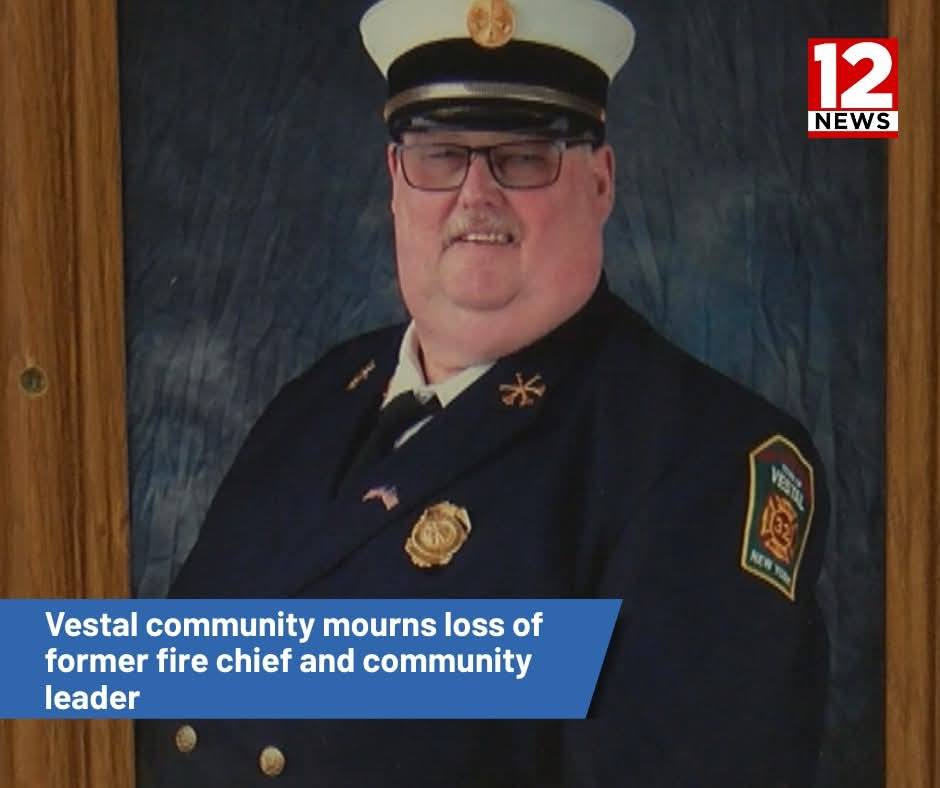
(Photo from Channel 12 News.)

Yesterday, spouse B, daughter T, and I attended the memorial service for our neighbor, Doug Rose.

Doug had lived a life of service, including being a police officer, but was known to most in our town for his fifty years of service with our volunteer fire department. He began volunteering at age 16, eventually becoming chief and training dozens of firefighters. The colon cancer that took his life was considered in the line of service, bringing to mind that firefighting is a hazardous endeavor with a lot of toxic exposure. Even during his illness when he could no longer go out on calls, Doug continued working for the department, doing planning, advising, and reports.

The fire department stood by Doug and his family, keeping vigil in his final days and helping with the memorials. Uniformed members of the department filled a third of the church at the memorial service, with emergency vehicles ready to be part of the cortege.

The most touching part of the service was when Doug’s daughter shared memories and stories of her dad. There were touches of humor, which were welcome at such a sad time. It was also a reminder of how we knew Doug and his family as neighbors. His children were a bit younger than ours but still close enough to play together and then be in school together. The whole family was service-oriented. Doug’s wife was a nurse until her retirement. His daughter now teaches at the same neighborhood elementary school that she, her brother, and our daughters attended. His son began volunteering with the fire department at 16, as Doug had, and now works as a dispatcher. Our neighborhood and town are safer and more cared-for because of Doug and his family.

A number of the stories shared involved Doug’s size. I remember the first time we met that he had to duck a bit to enter our house, his 7’2″ (220 cm) frame putting his head perilously close to the ceiling. B remembers seeing him directing traffic when he was a police officer, towering over the roof of his squad car. T recalls that, even though he was so big, she wasn’t afraid of him when she was a child. He was a dad looking out for the kids; she didn’t know that he was also well-known for his ability to break up bar fights.

Doug’s family was very important to him. He became a grandfather but his grandson, who was born early, only lived a few days. Because my faith tradition believes that we are reunited with our loved ones after death, I am imagining Doug now cradling his grandson and telling him stories about his family still on earth. As we were reminded by the reading of 1 Cor 13 at the memorial service, “Love never ends.”

Rest in peace, Doug.

what is lost

(Hearts by Angie Traverse)

Today is the 21st anniversary of the death of my friend Angie.

I’m thinking today about what is lost when a person dies at a younger-than-expected age. Angie was 54.

During one of her remissions, Angie and her spouse bought a second home on a lake that was special to their family. Angie told me she imagined grandchildren visiting there some day. I imagined visiting, perhaps with grandchildren of my own.

At the time, our children were tweens and teens.

Now, I have granddaughters, who are far away in London, UK.

I know that Angie’s children have children of their own, although I’m not sure how many or what their ages are. I imagine that they go visit the lake house sometimes. I imagine they tell stories about Angie so that her grandchildren have some inkling about who and how she was, even though she died long before they were born.

I imagine that there are still touches of Angie’s artistic and decorating skills on display.

I imagine that Angie’s spirit is still alive in her children.

Somehow.

250th Evacuation Day!

March 17th is observed by Catholics around the world – and everyone who is of Irish heritage or who just wants to join the celebration – as St. Patrick’s Day.

My late father-in-law was an elementary school principal in western Massachusetts for many years and observed March 17th as Evacuation Day, the day in 1776 when the British evacuated their soldiers, some loyalists, and their ships from Boston, ending a 332-day siege. This year marks the semiquincentennial of that event.

At school, he would announce the day over the intercom in morning announcements. As computers and dot matrix printers appeared later in his tenure as principal, he designed an Evacuation Day card.

He would also buy Evacuation Day flowers for his wife, a bit of an inside joke as she also was of Irish heritage so March 17th was St. Patrick’s Day for her. After he passed away in 2005, we took up the family tradition of Evacuation Day flowers, sending them to Grandma and also featuring them in our home.

Now, we give Evacuation Day flowers to our daughters, which is even more ironic now that one of them lives in London with daughters of her own who will, no doubt, have a different perspective on this history.

Wishing you all a great day, whether you observe St. Patrick’s Day, Evacuation Day, or just another Tuesday today!

About the photo: This is a picture of my dad, known here as Paco, taken in Ireland in 2019 when my sisters took him on his first-and-only trip there when he was 94. He was of Irish heritage and had wanted to visit but wouldn’t go without our mom who didn’t fly. The trip happened in October after her death in May and, though we couldn’t have known then, just months before COVID-19 became an international pandemic. Paco passed away in September, 2021, so it was indeed the “luck of the Irish” that he was able to see Ireland in the brief window in which it was possible.

Paco’s middle name was Patrick.

It’s Pi Day!

In honor of Pi Day (3/14), spouse B made a maple pecan pie in our special “pi” pie plate. If you can’t make it out from the photo, the rim has the value of pi printed out to a hundred or so decimal places.

Yes, we are just that geeky!

We actually have two pi pie plate because my sisters each saw them and thought of B and bought them for Christmas gifts. We use them often but lots of times the rim is covered by crust so you can’t see the numbers. Not a problem with the maple pecan pie, though!

Hoping that everyone has some pie today – or something as yummy!

One-Liner Wednesday: Hot Cross Buns

Spouse B made Lenten Hot Cross Buns with old-school dough crosses rather than icing


Join us for Linda’s One-Liner Wednesdays! Find out more here: https://lindaghill.com/2026/03/11/one-liner-wednesday-a-burning-question/