Doug Rose

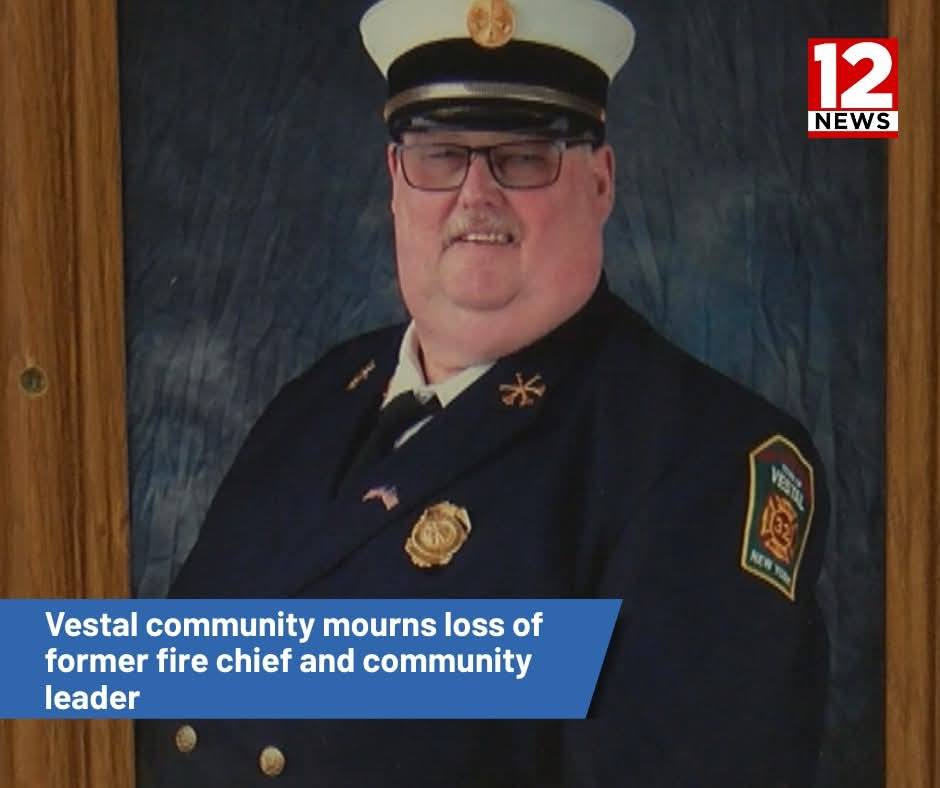
(Photo from Channel 12 News.)

Yesterday, spouse B, daughter T, and I attended the memorial service for our neighbor, Doug Rose.

Doug had lived a life of service, including being a police officer, but was known to most in our town for his fifty years of service with our volunteer fire department. He began volunteering at age 16, eventually becoming chief and training dozens of firefighters. The colon cancer that took his life was considered in the line of service, bringing to mind that firefighting is a hazardous endeavor with a lot of toxic exposure. Even during his illness when he could no longer go out on calls, Doug continued working for the department, doing planning, advising, and reports.

The fire department stood by Doug and his family, keeping vigil in his final days and helping with the memorials. Uniformed members of the department filled a third of the church at the memorial service, with emergency vehicles ready to be part of the cortege.

The most touching part of the service was when Doug’s daughter shared memories and stories of her dad. There were touches of humor, which were welcome at such a sad time. It was also a reminder of how we knew Doug and his family as neighbors. His children were a bit younger than ours but still close enough to play together and then be in school together. The whole family was service-oriented. Doug’s wife was a nurse until her retirement. His daughter now teaches at the same neighborhood elementary school that she, her brother, and our daughters attended. His son began volunteering with the fire department at 16, as Doug had, and now works as a dispatcher. Our neighborhood and town are safer and more cared-for because of Doug and his family.

A number of the stories shared involved Doug’s size. I remember the first time we met that he had to duck a bit to enter our house, his 7’2″ (220 cm) frame putting his head perilously close to the ceiling. B remembers seeing him directing traffic when he was a police officer, towering over the roof of his squad car. T recalls that, even though he was so big, she wasn’t afraid of him when she was a child. He was a dad looking out for the kids; she didn’t know that he was also well-known for his ability to break up bar fights.

Doug’s family was very important to him. He became a grandfather but his grandson, who was born early, only lived a few days. Because my faith tradition believes that we are reunited with our loved ones after death, I am imagining Doug now cradling his grandson and telling him stories about his family still on earth. As we were reminded by the reading of 1 Cor 13 at the memorial service, “Love never ends.”

Rest in peace, Doug.

what is lost

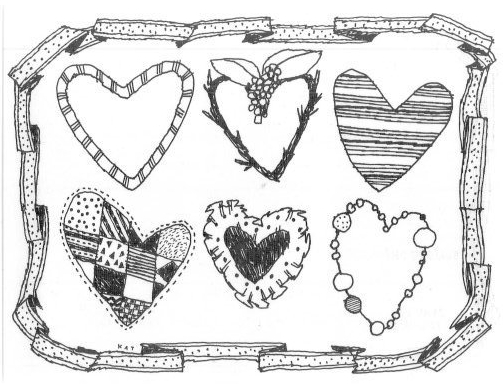
(Hearts by Angie Traverse)

Today is the 21st anniversary of the death of my friend Angie.

I’m thinking today about what is lost when a person dies at a younger-than-expected age. Angie was 54.

During one of her remissions, Angie and her spouse bought a second home on a lake that was special to their family. Angie told me she imagined grandchildren visiting there some day. I imagined visiting, perhaps with grandchildren of my own.

At the time, our children were tweens and teens.

Now, I have granddaughters, who are far away in London, UK.

I know that Angie’s children have children of their own, although I’m not sure how many or what their ages are. I imagine that they go visit the lake house sometimes. I imagine they tell stories about Angie so that her grandchildren have some inkling about who and how she was, even though she died long before they were born.

I imagine that there are still touches of Angie’s artistic and decorating skills on display.

I imagine that Angie’s spirit is still alive in her children.

Somehow.

SoCS: Be prepared

I grew up with the motto, Be Prepared.

This was very useful because we lived in a rural setting with no houses nearby so you couldn’t go to the neighbors’ house to borrow a needed tool or recipe ingredient. The grocery store was 20 miles away so it wasn’t easy to pick up bread or milk or whatever you might have run out of, so we kept a well-stocked pantry and freezer.

Even though I live in a neighborhood now – and have for years – I still tended to keep extra supplies on hand, in order to be prepared for a change in plans or an unexpected circumstances.

Still, though, despite preparations, there are some things for which we are never quite prepared.

Recently, I’ve had some instances of re-visiting my poetry chapbook, Hearts. The poems center on my mother, especially her final years when she was living with heart failure. We knew that she was slowly dying and tried to prepare but, when the time came, it was still somewhat of a shock. I know from discussions I’ve had with others that our preparations for loss are seldom adequate.

For me, there is, though, a certain comfort in trying to prepare, even when my preparations aren’t sufficient.

I’ll keep trying…
*****
Linda’s prompt for Stream of Concsiousness Saturday this week is to base your post on a word the starts with “pre.” Join us! Find out more here: https://lindaghill.com/2026/02/20/the-friday-reminder-and-prompt-for-socs-feb-21-2026/

JC’s Confessions #32

In the first few seasons of The Late Show, Stephen Colbert did a recurring skit, then a best-selling book, called Midnight Confessions, in which he “confesses” to his audience with the disclaimer that he isn’t sure these things are really sins but that he does “feel bad about them.” While Stephen and his writers are famously funny, I am not, so my JC’s Confessions will be somewhat more serious reflections, but they will be things that I feel bad about. Stephen’s audience always forgives him at the end of the segment; I’m not expecting that – and these aren’t really sins – but comments are always welcome.

I am (perhaps overly) proud of my intellect.

It wasn’t always that way.

I was brought up with the ethos of “do the best you can” and the good fortune that my best fit in well with the expectations of schooling. That, coupled with a natural love of learning, landed me various honors. High school valedictorian, also attained by both my older and younger sisters. Phi Beta Kappa and summa cum laude at Smith College, where I was also the Presser Scholar in music my senior year. While I was thrilled to be recognized, I could chalk up the honors to my hard work and liberal-artsy curiosity rather than ascribing it to particular intelligence.

Developing pride came more as a self-defense mechanism when I was a young mom. I had chosen to be the full-time, at-home caregiver, facilitated by the time and place in which B and I were navigating parenthood. This was not, though, the lifestyle expected of a high-achieving, Seven-Sisters grad. Without the external validation of a paying job and in contravention of the “having it all” Super-woman model of the 1980s, I developed pride in who I was and what I chose to do – and do well, as I continued to do the best that I could – almost as a defense mechanism.

This quiet pride helped me navigate a number of challenges in our family life and in my volunteer work over decades, but pride is both a positive attribute and a “deadly sin.”

As many of you know, I’ve been struggling with a still-not-fully-diagnosed medical condition, now well into its second year, that has caused significant brain fog and fatigue. In particular, I’ve lost access to my creative side, which is a huge blow to my life as a poet, and my ability to research, synthesize, and think critically is diminished both in scope and duration.

It’s a difficult time in my life and made more so because my intellect has long been such a core part of my identity.

Who am I living with this disability?

How will I face the prospect of losing the life of the mind that I have cultivated and loved for so long?

I’ve been fighting my way through the medical maze to try to regain what I’ve lost but it’s not at all clear at this point that it will be possible. I also am facing the prospect that I could deteriorate further.

Can I remain proud of who I am?

I know the answer should be yes, in keeping with the dignity inherent in each person.

It remains to be seen if I can apply the grace I give to others to myself.

25 months of Hearts

A little over two years ago, Hearts, my first poetry chapbook was published by Kelsay Books. The poems center around my mother, concentrating on her final years as she lived with heart failure.

I know that many people are unfamiliar with the term “chapbook.” A chapbook is a short book that is usually organized around a central theme.

As someone who didn’t pursue poetry until later in life, I am honored to have a book in print. There are several ways to buy a copy: directly from Kelsay Books, from Amazon, on special order from any bookstore that has access to Ingram, or directly from me, in person or by mail. (Please send me an email at jcorey.poet@gmail.com to make arrangements.)

People who have been following my history as a poet know that I had very little formal coursework in poetry; I have developed my skills through the generous sharing of my poetry community, including the Binghamton Poetry Project, the Grapevine Poets, and the Boiler House Poets Collective.

What has been more difficult is developing the publicity skills needed to promote a book. I am by nature an introvert and struggle with self-promotion. I’m also not great with asking people to spend money. Unfortunately, there have been other obstacles in the form of personal and family health struggles that have kept me from doing a great job at selling my book.

I am very grateful for the friends – and the people who are unknown to me – who have read my book. I especially appreciate those who have reached out to me about Hearts, often sharing stories about their own loved ones. I write in order to connect with others and am deeply honored that my work resonates with them.

One thing that I hadn’t anticipated was what it feels like to lose friends who have read Hearts and written or spoken to me about it. It adds another aspect to their loss. I also wonder what will become of the copies that they had, especially when they are inscribed. I somehow imagine someone picking up a copy in a secondhand bookstore and wondering who the prior owner was and how I was connected to them.

I still hope to publish another book some day/year but I will always be pleased that my first book was about my mom.

And every time I see bleeding hearts, I think about Hearts and about her.

sorrow

Vote for Democracy #41

(Photo by Lucas Sankey on Unsplash)

I’m not able to write much these days for various reasons, but wanted to express my deep sorrow at the immense damage that Donald Trump and his administration are inflicting both in the US and around the world.

While I’m trying to do my (infinitesimal) part in bringing our country back to decency, I am comforted knowing that millions of others are doing their part, too.

Still, the sorrow remains for the lives lost and the damage done already and for those who will continue to be affected in the future, even after the United States government returns to sanity, decency, and striving for the ideals spelled out in our Constitution and laws.

memorials

Today is the sixth anniversary of my mother’s death. I know many people who, even decades later, tell me they think of their deceased mother every day. I confess that I can’t make that claim. While I spoke to my mother nearly every day of my life, this became increasingly difficult in the last months of her life as her heart failure robbed her brain of oxygen. After her death, I had many months of flashbacks to those last difficult years, while also dealing with my father’s grief. He used to talk to and about my mother often, but, over time, his own heart failure erased the memory of her death. Toward the end, he would ask when she was coming to visit him in the skilled nursing unit and all I could say is that he would see her soon.

The photo above is of the memorials we placed at the memorial park where their cremains are inurned. I wrote this post explaining their significance when we placed them in 2022.

On Mother’s Day, I went to visit their resting place and was shocked to find that our memorials had been removed. I contacted the office, hoping that they had been placed in storage but they were just gone.

Alone in the room near my parents’ grave, I cried and told them I was sorry that these special memorials had been lost.

I think that is the only time that I have spoken aloud to my parents there.

My family has been supportive of me as I’ve dealt with the loss of these special and meaningful memorials to my parents. I’ve decided to print a photo of them and put it in a plastic frame to place on the table near their grave. That way, if it disappears, I would be able to replace it easily.

In the post linked above, I wrote about feeling more at peace when we placed the memorial. I think I had come to a place in living with loss where I could set aside the trauma of my parents’ final years and deaths and have better memories surface. I’m not sure if that is the point where I stopped thinking about my parents every day or not.

What I do know every day is that my parents gifted me not only with life but also with the foundation of who I am.

Their legacy is always with me, whether or not I bring it to consciousness.

Mother’s Day 2025

This photo from almost eight years ago is three generations of mothers in my family, Nana and me with daughter E holding baby ABC, my first grandchild and Nana’s first great-gandchild.

This Mother’s Day is without Nana, who passed away in May 2019, and with E and ABC living in London, where Mother’s Day was celebrated a couple of months ago.

Here, B baked squash maple muffins for breakfast and is planning a special dinner, chicken and artichokes over artichoke ravioli with a yet-to-be-revealed-to me dessert. Daughter T is here with us, which is a blessing.

Still, if feels strange to not be with any of the other mothers in my family, except in spirit.

I am wearing a shirt that was my mother’s, a gift from our friend Angie, who passed away twenty years ago.

Mother’s Day began as a call for peace. (That post contains Julia Ward Howe’s original proclamation, still well worth reading in our current war-torn world.) Today, I wish peace to all, especially to all who have mothered others, whether still living or deceased.

Love and compassion bring peace.

Pope Francis

(Image by manfred Kindlinger from Pixabay)

Before the conclave to choose his successor begins, I want to take a moment to write about Pope Francis, who died on Easter Monday after twelve years as pope.

From the moment that he was announced after his election with the name Francis, I knew he would be a different kind of pope than his immediate predecessors, especially when he asked the people to bless him before he blessed them. Like St. Francis of Assisi, Pope Francis dedicated himself to peace, to serving all people, especially the most vulnerable, and to caring for creation. I appreciate how he led the church in those directions while also offering his message to the whole world.

Within the church, he opened the door to greater listening and dialogue, especially through the synodal process that included the laity as well as clergy. This was especially meaningful to me as John Paul II and Benedict XVI tended to shut down discussion and silence voices that offered a different viewpoint. Francis also engaged with people of other faiths and philosophies around the world, travelling broadly and meeting with people in many different circumstances. He would even acknowledge that when he would ask people to bless him or pray for him by asking people who did not have a prayer tradition to offer their well wishes on his behalf.

I appreciated Francis’s humility in choosing to live simply in Casa Santa Marta rather than the opulent papal apartment. He dressed simply and liked to be out among the people. Even his funeral showed his humility. He simplified the papal rite so that it was recognizable to anyone that has planned a Catholic funeral. Only the final commendation and funeral procession through Rome stood out as being papal in scope. One of the most moving moments was when his body arrived for burial at the Basilica of Santa Maria Maggiore, where he was greeted by the poor of Rome and children carried baskets of flowers to place before the altar. The inscription for his grave reads simply Franciscus.

As an environmentalist, my favorite writing of Pope Francis’s is his first encyclical, Laudato Si’, which called for everyone in the world to care for our common home, the earth, and for other people, especially the most vulnerable. It was important in securing the Paris Accord and remains, along with its companion, Laudate Deum, a continuing challenge to how we address the climate crisis and social inequities.

As a feminist and progressive Catholic, I appreciate that Francis invited discussion of women’s role in the Church and appointed women to positions of authority they had never before occupied. However, it was disappointing that he could not see the full vocation of women in church and society. Still, we are further along the path toward the radical inclusion that Jesus modeled for us than we were and for that I am grateful.

Like many Catholics, I will be watching for the white smoke to rise from the Sistine Chapel where the cardinals will meet to select the next pope. The name he chooses may give us a window into the direction in which he will lead the church. For example, a John XXIV would continue in the direction of Vatican II and Francis’s synodality while a Benedict XVII would likely call for a “smaller, purer Church” that would exclude people like me.

The word catholic means universal. Pope Francis spoke to that sense of universality which I hope the next pope will continue.

In a small group a few days ago, we were invited to pray that the next pope be a woman who would take the name Clare and continue in the mode of St. Francis of Assisi and St. Clare. The Holy Spirit would have to blow through the conclave with hurricane force for that prayer to be fulfilled, but, maybe, some day?

Only God knows.

Twenty years ago

(Hearts by Angie Traverse)

Twenty years ago today, my friend Angie died.

We had met when we were volunteering at the middle school our children attended. Angie was kind and caring and funny and talented and we became friends, although she had a plethora of friends already. Because we were both doing volunteering and taking care of family, we had the flexibility to meet for lunch and chat or work on committee projects. Because Angie’s good will also embraced family, she got to know my parents.

We thought that, one day, we would become grandparents and have multi-generational hangouts.

Unfortunately, a nagging cough when Angie was 50 turned out to be stage 3 lung cancer. It was a shock because she had never been a smoker. Despite all the best efforts of her medical team, the cancer eventually progressed and took her life at 54.

March 25th was Good Friday that year.

There was a charitable fund set up in her name and, for years, I gave to it every year on March 25th and on her October birthday. The last few years, though, the website has disappeared. I think the fund probably had enough contribution for it to be endowed so its work can continue.

I’ve written about Angie before here at Top of JC’s Mind and even had a poem published about our friendship and her loss.

I didn’t know it at the time, but Angie’s death was followed by the loss of my long-time parish community and the death of B’s dad, the first loss of a grandparent for our daughters.

2005 became one of the worst years of my life.

I fear that 2025 may be even worse, especially when I look at what is happening in the United States as our democracy disintegrates and damages lives here and abroad.

Personally, this will be the year where we figure out what is going on with my health and address it or the year where I have to deal with giving up what I thought my life as an elder would be.

A small problem when people are dying or being threatened or losing family members because Trump/Musk/Vance et al think they can break laws, norms, and ethical obligations and concentrate all power in the executive branch.

I am sorry that I am too weak to be out on the streets for protests and have to confine my activities to online posts and messages and phone calls.

I’m hoping we can turn 2025 around after these horrible last couple of months.

Trying – while mourning for those who have been hurt.

And still, twenty years later, missing Angie.