JC’s Confessions #32

In the first few seasons of The Late Show, Stephen Colbert did a recurring skit, then a best-selling book, called Midnight Confessions, in which he “confesses” to his audience with the disclaimer that he isn’t sure these things are really sins but that he does “feel bad about them.” While Stephen and his writers are famously funny, I am not, so my JC’s Confessions will be somewhat more serious reflections, but they will be things that I feel bad about. Stephen’s audience always forgives him at the end of the segment; I’m not expecting that – and these aren’t really sins – but comments are always welcome.

I am (perhaps overly) proud of my intellect.

It wasn’t always that way.

I was brought up with the ethos of “do the best you can” and the good fortune that my best fit in well with the expectations of schooling. That, coupled with a natural love of learning, landed me various honors. High school valedictorian, also attained by both my older and younger sisters. Phi Beta Kappa and summa cum laude at Smith College, where I was also the Presser Scholar in music my senior year. While I was thrilled to be recognized, I could chalk up the honors to my hard work and liberal-artsy curiosity rather than ascribing it to particular intelligence.

Developing pride came more as a self-defense mechanism when I was a young mom. I had chosen to be the full-time, at-home caregiver, facilitated by the time and place in which B and I were navigating parenthood. This was not, though, the lifestyle expected of a high-achieving, Seven-Sisters grad. Without the external validation of a paying job and in contravention of the “having it all” Super-woman model of the 1980s, I developed pride in who I was and what I chose to do – and do well, as I continued to do the best that I could – almost as a defense mechanism.

This quiet pride helped me navigate a number of challenges in our family life and in my volunteer work over decades, but pride is both a positive attribute and a “deadly sin.”

As many of you know, I’ve been struggling with a still-not-fully-diagnosed medical condition, now well into its second year, that has caused significant brain fog and fatigue. In particular, I’ve lost access to my creative side, which is a huge blow to my life as a poet, and my ability to research, synthesize, and think critically is diminished both in scope and duration.

It’s a difficult time in my life and made more so because my intellect has long been such a core part of my identity.

Who am I living with this disability?

How will I face the prospect of losing the life of the mind that I have cultivated and loved for so long?

I’ve been fighting my way through the medical maze to try to regain what I’ve lost but it’s not at all clear at this point that it will be possible. I also am facing the prospect that I could deteriorate further.

Can I remain proud of who I am?

I know the answer should be yes, in keeping with the dignity inherent in each person.

It remains to be seen if I can apply the grace I give to others to myself.

My Poem in Paterson Literary Review!

2025 Paterson Literary Review cover: Maria Mazziotti Gillan, Woman in Red Asian Shawl

Yesterday, I was thrilled to receive my contributor copy of the 2025 Paterson Literary Review. The link is to their site; the 2025 issue is not yet available to order but should be shortly.

For those of you who may not be familiar, the founding editor of the Paterson Literary Review is Maria Mazziotti Gillan, poet, editor, educator, artist, and Bartle Professor Emerita of English and creative writing at Binghamton University. I live in the Binghamton area and, while I never had the privilege of studying with her, many of the local poets that I have learned from through the Binghamton Poetry Project and through other local workshops were her students and often referred to her and used her books of prompts in our work together.

Having a poem in PLR is a dream come true for me. It’s an honor to be in the company of such distinguished poets. I’d start naming names but the post would go on too long and, with a 53 year history, I’d invariably leave out someone whom I should include.

My poem is “Giovanni” and is about my maternal grandfather. It’s part of my yet-to-be-published full-length collection, The Beyond Place, which centers on the North Adams, Massachusetts area, where I grew up and several generations of my family lived. The Hoosac Tunnel is part of the fabric of this poem.

Because of my health issues, I haven’t been able to do much poetry work, including submissions, for months. I submitted “Giovanni” last September and it was accepted in November, but, because the Paterson Literary Review is a huge undertaking to print – this edition has over 300 pages – it is just arriving now. It’s good for me to have a reminder that I am still acknowledged as a poet, even when I’m not able to do much work at the moment.

Thank you, Maria Mazziotti Gillan, for the honor of appearing in the Paterson Literary Review!

25 months of Hearts

A little over two years ago, Hearts, my first poetry chapbook was published by Kelsay Books. The poems center around my mother, concentrating on her final years as she lived with heart failure.

I know that many people are unfamiliar with the term “chapbook.” A chapbook is a short book that is usually organized around a central theme.

As someone who didn’t pursue poetry until later in life, I am honored to have a book in print. There are several ways to buy a copy: directly from Kelsay Books, from Amazon, on special order from any bookstore that has access to Ingram, or directly from me, in person or by mail. (Please send me an email at jcorey.poet@gmail.com to make arrangements.)

People who have been following my history as a poet know that I had very little formal coursework in poetry; I have developed my skills through the generous sharing of my poetry community, including the Binghamton Poetry Project, the Grapevine Poets, and the Boiler House Poets Collective.

What has been more difficult is developing the publicity skills needed to promote a book. I am by nature an introvert and struggle with self-promotion. I’m also not great with asking people to spend money. Unfortunately, there have been other obstacles in the form of personal and family health struggles that have kept me from doing a great job at selling my book.

I am very grateful for the friends – and the people who are unknown to me – who have read my book. I especially appreciate those who have reached out to me about Hearts, often sharing stories about their own loved ones. I write in order to connect with others and am deeply honored that my work resonates with them.

One thing that I hadn’t anticipated was what it feels like to lose friends who have read Hearts and written or spoken to me about it. It adds another aspect to their loss. I also wonder what will become of the copies that they had, especially when they are inscribed. I somehow imagine someone picking up a copy in a secondhand bookstore and wondering who the prior owner was and how I was connected to them.

I still hope to publish another book some day/year but I will always be pleased that my first book was about my mom.

And every time I see bleeding hearts, I think about Hearts and about her.

New essay by Ellen Morris Prewitt

Photo Credit: Ellen Morris Prewitt

On December 7, 2024, I shared Ellen Morris Prewitt’s essay about the 150th anniversary of the Vicksburg Massacres.

Ellen is the granddaughter of the main instigator of the Massacres and has been sharing her experiences as she has researched her family’s involvement and grappled with the continuing legacy of racism.

Now, Ellen has a powerful essay entitled “Granddaughter of The Instigator” in the Juneteenth special edition of Salvation South, which delves further into her witness to the legacy of the Vicksburg Massacres on a community and personal level. This essay is an excerpt from her memoir-in-progress, Loving My Hateful Ancestors. You can read a post about the publication of the essay in Ellen’s Very Southern Voice blog and, while you’re there, subscribe to her newsletter and/or follow her blog.

I just realized that I keep referring to Ellen Morris Prewitt by her first name, as though we were acquainted in real life, but we only met each other through blogging. Her writing is so vivid and heartfelt, though, that I feel as if we know each other through our posts and our comments on each other’s blogs with a side of occasional personal emails.

I’m a fan of Ellen’s and invite you to join me!

Welcome, Pope Leo XIV!

(By Edgar Beltrán / The Pillar – https://x.com/edgarjbb_/status/1920590815472108021, CC BY-SA 4.0, https://commons.wikimedia.org/w/index.php?curid=164970023)

When I wrote about Pope Francis right before the conclave, I didn’t expect that the conclave would end on the second day. As a reader of NCR (National Catholic Reporter), though, I was delighted but not shocked by the selection of Cardinal Robert Prevost as the next Pontiff. Although he was born in Chicago and educated in the United States (with an additional degree from the Pontifical University of St. Thomas Aquinas in Rome), most of his ministry has been outside the US. Fluent in several languages, including Spanish and Italian, he spent over twenty years in Peru as a pastor and, later, Francis-appointed bishop. He is well-known in church circles internationally because he visited close to fifty countries as prior general of the Augustinian order and, for the last two years, had been in Rome serving as head of the Dicastery for Bishops, which advises the Pope on the appointment of bishops world-wide. He was chosen as a cardinal on assuming this prominent role in the Curia, which is the Catholic Church’s bureaucracy.

While many had felt that it was impossible for anyone from the US to be chosen as Pope because the United States is such a powerful country, Cardinal Prevost was seen as more of an international figure. He is a citizen of Peru as well as the United States and has lived in Rome for over a dozen years. He understands the workings of the Vatican but retains the skills of a pastor. He supports Francis’s efforts to make the church more synodal in its approach, which broadens those with input into church matters instead of everything being concentrated in the power of the bishops, led by the Pope, who is given primacy as the bishop of Rome. I think that his skills and resume, as well as his familiarity in so many countries, made him a natural choice for the cardinal-electors.

I was struck that the name he chose was Leo XIV. This immediately brought to mind Leo XIII, whose 1891 encyclical Rerum Novarum (Of New Things) is the bedrock of Catholic social justice doctrine. That encyclical is subtitled Rights and Duties of Capital and Labor; it brought moral teaching to bear in response to the challenges of the industrial revolution. This choice of name signals that the new pope hopes to bring social justice doctrine to bear on the current challenges of the digital age. He also will continue the work of Francis’s 2015 encyclical Laudato Si’: On Care for Our Common Home, which emphasizes working to address “the cry of the earth and the cry of the poor.”

I was struck by his age. Born in 1955, Leo XIV is the first pope who was raised in the post-Vatican II church from childhood. My hope is that his papacy will continue the reforms of Vatican II which place the Catholic Church in the modern context rather than trying to isolate itself. This is the first time that a pope feels like a brother to me because he is actually close in age to my older sister. Being from the United States, I also understand better the environment in which he grew up. It lends a feeling of closeness that was not possible with the prior popes in my lifetime.

Leo XIV’s age also opens the possibility of a long pontificate. Leo XIII had one of the longest pontificates in history at 25 years; Leo XIV may not match that length but could remain pope for over two decades if his health holds.

I also have a personal attachment to the name Leo, which was my father’s name. He was named after his own father, although not a Junior as they had different middle names. Family lore is that my great-grandparents, after suffering the loss of several children, started to name them after popes, so my grandfather was literally named after Pope Leo XIII, who was serving at the time of his birth. All their sons who were named for popes survived into adulthood.

Welcome, Leo XIV! May God bless your pontificate and all the work you do for peace, justice, the world, and all peoples.

SoCS: walks – or not

I used to enjoy going for walks with my spouse but haven’t been able to for most of the last 15 months due to my current health struggles.

You can read more about that here, in the context of today being the last day of EDS/HSD Awareness Month.

I used most of my energy getting that post together, here in this early morning timeframe, so this is a short Stream of Consciousness Saturday post. Linda’s prompt this week is “walk.” Please consider joining us or just stop by Linda’s site to wish her and her family well as they are recovering from illness at this point.

EDS/HSD Awareness Month

May is Ehler-Danlos Syndrome/Hypermobility Spectrum Disorder Awareness Month, begun by the Ehlers-Danlos Society to bring attention to this family of connective tissue disorders which affect millions of people around the world, many of whom will take decades to be diagnosed while others will never know for sure what causes their bodies to exhibit an unusual constellation of symptoms. I apologize for being late to the effort, although I did do one awareness post here for One-Liner Wednesday and shared some informative posts via Facebook. It’s been a bit of a rough month for me.

I am one of those people who is yet to be officially diagnosed, despite decades of symptoms, though I will spare you the details of my specific case.

The Ehlers-Danlos Society is a great resource for information about both Ehlers-Danlos Syndrome (EDS) and Hypermobility Spectrum Disorder (HSD), both for individuals and for clinicians and researchers. It also plays a role in funding research around the world for these connective tissue disorders. There is a lot to know but I will just give a broad outline here.

EDS is a group of inherited connective tissue disorders, currently classified into 13 types. Twelve of the types have a known genetic cause, where a chromosome affects a particular protein, and can be identified with testing. Some of these affect less than one in a million people.

The largest group of people with EDS, though, have hypermobile EDS (hEDS), estimated to affect 3,100-5,000 people per million. While it is known to have a dominant genetic inheritance pattern, the genes or groups of genes responsible have not yet been identified. There is some question among researchers and clinicians if hEDS should remain classified as a form of EDS or if it should be considered as part of Hypermobility Spectrum Disorder in which the hypermobility is more widespread and severe than in most people with HSD.

In HSD, people exhibit joint hypermobility/instability in at least one joint, which may suffer frequent sprains, pain, subluxation/dislocation, joint or soft tissue damage, and/or early arthritis. They may also have poor proprioception, which means they can have difficulty with awareness of their bodies’ position or movement, for example, being clumsy.

They may also have symptoms over many parts/systems of their body. Fatigue, headaches, gastrointestinal problems, autonomic dysfunction, and anxiety are some of the kinds of symptoms that can be part of HSD, with each person exhibiting a different constellation of symptoms which may shift over time. This makes sense in that we have connective tissue throughout our bodies, so symptoms as diverse as unusually stretchy or delicate skin, a frequently sprained ankle, irritable bowel syndrome, and blood vessel problems can all be related through differences in the way connective tissues behave in the body. We don’t know how prevalent HSD is, because the current classification system dates from only 2017, our current medical system tends to silo various body systems into separate specialties – without there being any specialists in connective tissues – and most primary care providers haven’t been taught to recognize it. This often leaves patients in the uncomfortable position of having pieced together their own diagnosis but not being able to find a doctor willing to consider it.

I feel that it is important to be properly diagnosed, even though, as inherited conditions, EDS/HSD cannot be “cured.” It helps to know about the underlying cause in order to treat symptoms more effectively. For example, physical therapy may need to be prescribed for a longer period of time with more gentle techniques to avoid further tissue damage. Surgeries may need to be modified to better support lax connective tissue. Knowing what other symptoms may arise that are connected to EDS/HSD is also helpful, along with awareness that connective tissue disorders can help explain some disorders, such as irritable bowel syndrome, that have often been written off as idiopathic.

As EDS/HSD Awareness Month draws to a close, I’d like to thank the Ehlers-Danlos Society for their valuable work in raising awareness of these conditions, advocating for patients, disseminating information, and spearheading research into these connective tissue disorders. Maybe, as more people and, critically, more health care providers learn more about these disorders, patients will be diagnosed and treated more quickly and effectively.

I hope.

(About the photo: Doctors are taught in med school that “when you hear hoofbeats, think horses, not zebras.” However, sometimes, it is actually zebras! Zebras have come to signify EDS/HSD. My daughter T gave me this zebra unicorn pin in that spirit.)

memorials

Today is the sixth anniversary of my mother’s death. I know many people who, even decades later, tell me they think of their deceased mother every day. I confess that I can’t make that claim. While I spoke to my mother nearly every day of my life, this became increasingly difficult in the last months of her life as her heart failure robbed her brain of oxygen. After her death, I had many months of flashbacks to those last difficult years, while also dealing with my father’s grief. He used to talk to and about my mother often, but, over time, his own heart failure erased the memory of her death. Toward the end, he would ask when she was coming to visit him in the skilled nursing unit and all I could say is that he would see her soon.

The photo above is of the memorials we placed at the memorial park where their cremains are inurned. I wrote this post explaining their significance when we placed them in 2022.

On Mother’s Day, I went to visit their resting place and was shocked to find that our memorials had been removed. I contacted the office, hoping that they had been placed in storage but they were just gone.

Alone in the room near my parents’ grave, I cried and told them I was sorry that these special memorials had been lost.

I think that is the only time that I have spoken aloud to my parents there.

My family has been supportive of me as I’ve dealt with the loss of these special and meaningful memorials to my parents. I’ve decided to print a photo of them and put it in a plastic frame to place on the table near their grave. That way, if it disappears, I would be able to replace it easily.

In the post linked above, I wrote about feeling more at peace when we placed the memorial. I think I had come to a place in living with loss where I could set aside the trauma of my parents’ final years and deaths and have better memories surface. I’m not sure if that is the point where I stopped thinking about my parents every day or not.

What I do know every day is that my parents gifted me not only with life but also with the foundation of who I am.

Their legacy is always with me, whether or not I bring it to consciousness.

One-Liner Wednesday: carrot cake

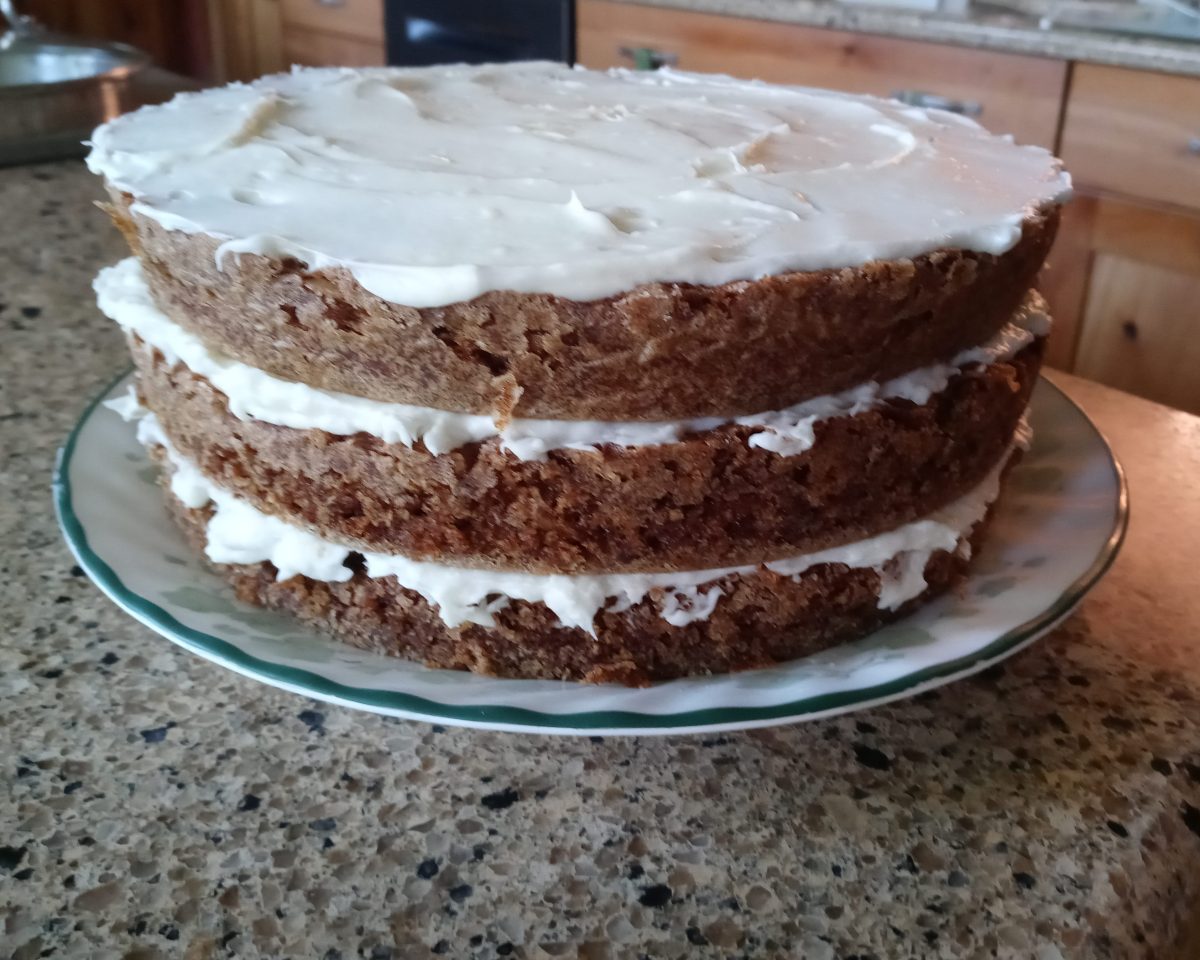
The yet-to-be-revealed dessert choice that B made for Mother’s Day was carrot cake with cream cheese icing.

Join us for Linda’s One-Liner Wednesdays! Find out more here: https://lindaghill.com/2025/05/14/one-liner-wednesday-one-of-two/

Mother’s Day 2025

This photo from almost eight years ago is three generations of mothers in my family, Nana and me with daughter E holding baby ABC, my first grandchild and Nana’s first great-gandchild.

This Mother’s Day is without Nana, who passed away in May 2019, and with E and ABC living in London, where Mother’s Day was celebrated a couple of months ago.

Here, B baked squash maple muffins for breakfast and is planning a special dinner, chicken and artichokes over artichoke ravioli with a yet-to-be-revealed-to me dessert. Daughter T is here with us, which is a blessing.

Still, if feels strange to not be with any of the other mothers in my family, except in spirit.

I am wearing a shirt that was my mother’s, a gift from our friend Angie, who passed away twenty years ago.

Mother’s Day began as a call for peace. (That post contains Julia Ward Howe’s original proclamation, still well worth reading in our current war-torn world.) Today, I wish peace to all, especially to all who have mothered others, whether still living or deceased.

Love and compassion bring peace.