Blog – Top of JC’s Mind

The Colbert Questionert

My family and I have been recording and watching Stephen Colbert for years, beginning with his years as a correspondent on The Daily Show, followed by his entire run on The Colbert Report and his current gig as host of The Late Show, which is having its final shows this week. While CBS said that it was for financial reasons, the perception is that it was really the result of Stephen’s jokes about Trump, especially as CBS’s parent company was negotiating a sale that needed administration approval.

My occasional blog series, JC’s Confessions, was inspired by Stephen’s Midnight Confessions from his early years at The Late Show, which was followed by a book.

Another long-running feature was Stephen asking his famous guests to answer the Colbert Questionert, which was supposed to reveal their inner selves and be “fully known.” In homage to Stephen and his talented writing team, I, a distinctly non-famous person, will share and answer the Colbert Questionert.

1. What’s the best sandwich?
Grilled cheese, made with Cabot cheddar cheese (which is white, not the bizarre orange that some cheddars are) on homemade white bread
2. What’s one thing you own that you really should throw out?
Deteriorating sheet music that I inherited from a friend of my family when I was a child
3. What is the scariest animal?
A violent person with a gun
4. Apples or oranges?
Apples, because, as Stephen often notes, you can’t put peanut butter on an orange. Also, for me and my delicate constitution, oranges are too acidic.
5. Have you ever asked someone for their autograph?
Lots of someones, as I often ask poets to sign their books for me
6. What do you think happens when we die?
I think that our soul, which can also be understood as our consciousness, continues to exist as energy. This allows us to reunite with loved ones who have passed away and to live eternally within Divine Love, which is my interpretation of heaven.
7. Favorite action movie? The Incredibles, because it gives action without blood and gore.
8. Favorite smell?
fresh-baked bread
9. Least favorite smell?
ammonia
10. Window or aisle?
I like to sit in a window seat because I loved studying geology in college. I like to see the landforms and the clouds.
11. What is your earliest memory? I remember playing outdoors with my older sister and neighbors at the house we lived in when I was three.
12. Cats or dogs?
Dogs, although we only have people in our household due to allergies (and the fact that there is enough to do just taking care of each other)
13. You get one song to listen to for the rest of your life: what is it?
“Ich bin der Welt abhanden gekommen” from Mahler’s Rückert Lieder with mezzo-soprano Janet Baker.
14. What number am I thinking of?
Of course, I can’t answer this in Stephen’s absence, but my choice would, of course, be wrong.
15. Describe the rest of your life in 5 words.
Family – Love – Creativity – Service – Thinking

I don’t know if anyone will think that my answers make me “fully known” or not, but I do love that phrase because it appears in one of my favorite Bible passages, 1 Corinithians 13. Like Stephen, I am a Catholic and I wonder if that passage was in his mind when they decided to use that term in the Colbert Questionert. I find it a comforting concept because so many problems in life seem to stem from misunderstanding among individuals and groups.

I know that Stephen is not retiring so we will hear more from him in whatever creative vehicles he chooses. I will miss, though, hearing from him on a regular basis.

Thank you, Stephen, for all the years of laughter and insight. I hope you get a chance to rest and rejuvenate and spend more time with family after all your hard work.

And, maybe, you should answer your own questionnaire, so you, too, are “fully known.”

Postscript: On the next-to-last episode, Stephen did take the Colbert Questionert himself, asked by a parade of celebrities. I came back to edit this post to reflect the questions asked that night, but I wanted to still include these questions from earlier iterations.
A. Exercise: worth it?
Personally, no, except for physical therapy. One of the things that I’ve learned about my brain and body is that I don’t really get endorphin rush from exercise. I just get even more tired and, if I push too hard, will wind up needing a day or more of minimal activity or even bedrest to recover. My version of dealing with the chronic fatigue that can come with hEDS.
B. Flat or sparkling?
Flat, because my system doesn’t do well with bubbles.
C. Most used app on your phone?
Text. I use my phone as little as possible.

SoCS: sweet taste

My favorite foods are sweet.

I know that humans’ first taste preference is for sweetness. It’s why breast milk is so sweet.

Most people, though, go on to develop preferences for additional flavors. I, though, am not very tolerant of foods that are sour or bitter. Strong flavors are often physically painful for me and I’ve learned that something that most people perceive as mild are often overwhelming for me. This is especially true for hot/spicy foods, like peppers. I also don’t drink coffee or tea, which are just too bitter for me.

I wonder if this taste preference for sweet and intolerance for sour and bitter is a natural defense. One of the conditions that I have is interstitial cystitis, also known as painful bladder syndrome. (It’s probably also related to my hEDS and mast cell activation disorder, but I digress.) One of the ways to help reduce IC flares is to reduce acidic foods as much as possible. Most sour or bitter foods are also high in acid, so maybe my intolerance of those flavors is a self-defense mechanism.

By the way, salty foods are also bad for people with IC so I eat low-salt, as well. I don’t find salty foods physically painful, though, unless it is really, really, really salty, which feels like burning in my mouth.

I’m such a delicate flower!

And sweet! 😉
*****
Linda’s prompt for Stream of Consciousness Saturday this week is “sweet.” Join us! Find out more here: https://lindaghill.com/2026/05/15/the-friday-reminder-and-prompt-for-socs-may-16-2026/

One-Liner Wednesday: relative threats

New favorite analogy from The Daily Show moment of Zen earlier this week: COVID is to wildfire as hantavirus is to a wet log in a cold fireplace.

Join us for Linda’s One-Liner Wednesdays! Find out more here: https://lindaghill.com/2026/05/13/one-liner-wednesday-an-oldie/ (Sorry that I couldn’t find the proper citation.)

Mother’s or Mothers’ Day

Today is celebrated as Mother’s Day in the United States. In other years, I’ve shared about the older, Mothers’ Day begun by Julia Ward Howe in the years following the American Civil War.

This year, I’m sharing historian Heather Cox Richardson’s Substack on Howe’s views and actions.

Today, I’m wishing peace and equal rights to all mothers and all people everywhere.

SoCS: contrast

One of the many things about which I have to be careful is the use of contrast with CT or MRI scans.

We think the reason is that my kidney function is kind of flaky and the contrast agents are hard on kidneys.

The wild card is that my kidneys may be stressed because of a vascular problem related to my hEDS. I have an appointment with a specialist in NYC later this month to investigate.

Stay tuned…
*****
Linda’s prompt for Stream of Consciousness Saturday this week is “contrast.” Join us! Find out more here: https://lindaghill.com/2026/05/08/the-friday-reminder-and-prompt-for-socs-may-9-2026/

Voting challenges

Vote for Democracy #57


(Photo by Lucas Sankey on Unsplash)

The United States is facing even more serious challenges to our election system.

The US Supreme Court’s 6-3 decision in Callais has set off a spate of redistricting in southern states which, while they are being labeled as partisan, are effectively race-based, even though primary elections are very close, or, as in Louisiana, already underway. All of these states are looking to cut down the number of Democrats and Black elected officials.

This morning, the Virginia Supreme Court struck down the April vote that would have redistricted that state and potentially added more Democrats to the US House of Representatives in the midterm elections in November.

It’s very discouraging because Trump and the Republicans are actively trying to stay in power through manipulating the electoral system, even though their policies are increasingly harmful and unpopular.

It’s time for citizens to take back their electoral power. Given that new district lines will make it more difficult for Democrats and people of color to elect their preferred candidates, voter turnout will be crucial. It may, though, not be sufficient to overcome these new obstacles. Voters who are registered as Republicans need to vote against all Republican nominees who favor these unfair and unconstitutional policies and help elect officials who believe in the principle of one person, one vote and who will uphold our civil liberties and rights.

I admit that this is a discouraging time in our efforts to uphold democracy but we must keep working on it. As Joyce Vance titled her recent book, Giving Up Is Unforgivable.

100,000!

Yesterday, WordPress told me that Top of JC’s Mind/joannecorey.com has passed 100,000 views!

That’s cool!

I have to remind myself that there are also additional views of my posts because some people read my blog via email and don’t visit the site directly, so would not be counted.

Perhaps, those counterbalance the views that result from random bots. Every once in a while, I have a day where I get the message that “my stats are booming.” Those days seldom result in comments or likes, though, so it’s likely they are bots roaming around WordPress. The exception was April 17 when I suddenly got 35 new subscribers, although, presumably they are mostly bots, too.

The main factor in getting to 100,000 views is that I’ve been around since September, 2013. I’ve had a long time to accumulate views. Granted, some bloggers would be disappointed if they weren’t getting 100,000 views per month/week/day(!), but, fortunately, I’m in this for the sake of sharing and chronicling and communicating rather than as a moneymaker so I can just be grateful rather than anxious about stats.

So, thank you to all my past and current visitors!

Even the bots, as long as they are not being destructive…

One-Liner Wednesday: what leads to strongmen

“Gross inequalities of income, wealth, and opportunity fuel the gross inequalities of political power that lead to strongmen who destroy both democracy and freedom.”
~~~Robert Reich

Join us for Linda’s One-Liner Wednesdays! Find out more here: https://lindaghill.com/2026/05/06/one-liner-wednesday-is-that-indiana-jones/

EDS/HSD Primer

May is EDS & HSD Awareness Month and I promised to do some posts on it. I had hoped to get this first post out earlier in the month but I’m having some difficulties with an hEDS flare, which has slowed me down a bit.

Ehlers-Danlos Syndrome (EDS) and Hypermobility Spectrum Disorder (HSD) are heritable connective tissue disorders. There are 13 types of EDS. In 12 of those types, the exact genetic cause has been identified. Some of these types are very rare, affecting less than one in a million people. The most common form of EDS is hypermobile (hEDS), which is known to be inherited in an autosomal dominant pattern but appears to have a more complex genetic profile. The prevalence of hEDS is unknown because it is very often missed diagnostically. Case in point, I was diagnosed at age 65.

HSD is related to hEDS, usually involving fewer hypermobile joints than most people with hEDS. While some clinicians and researchers look at HSD and hEDS as separate disroders, others look at hEDS as occupying a certain segment of the hypermobile spectrum. In December, 2026, updated diagnostic criteria will be published, with best practices to follow in spring ’27. It will be interesting to see if hEDS and HSD will be merged into a single diagnosis.

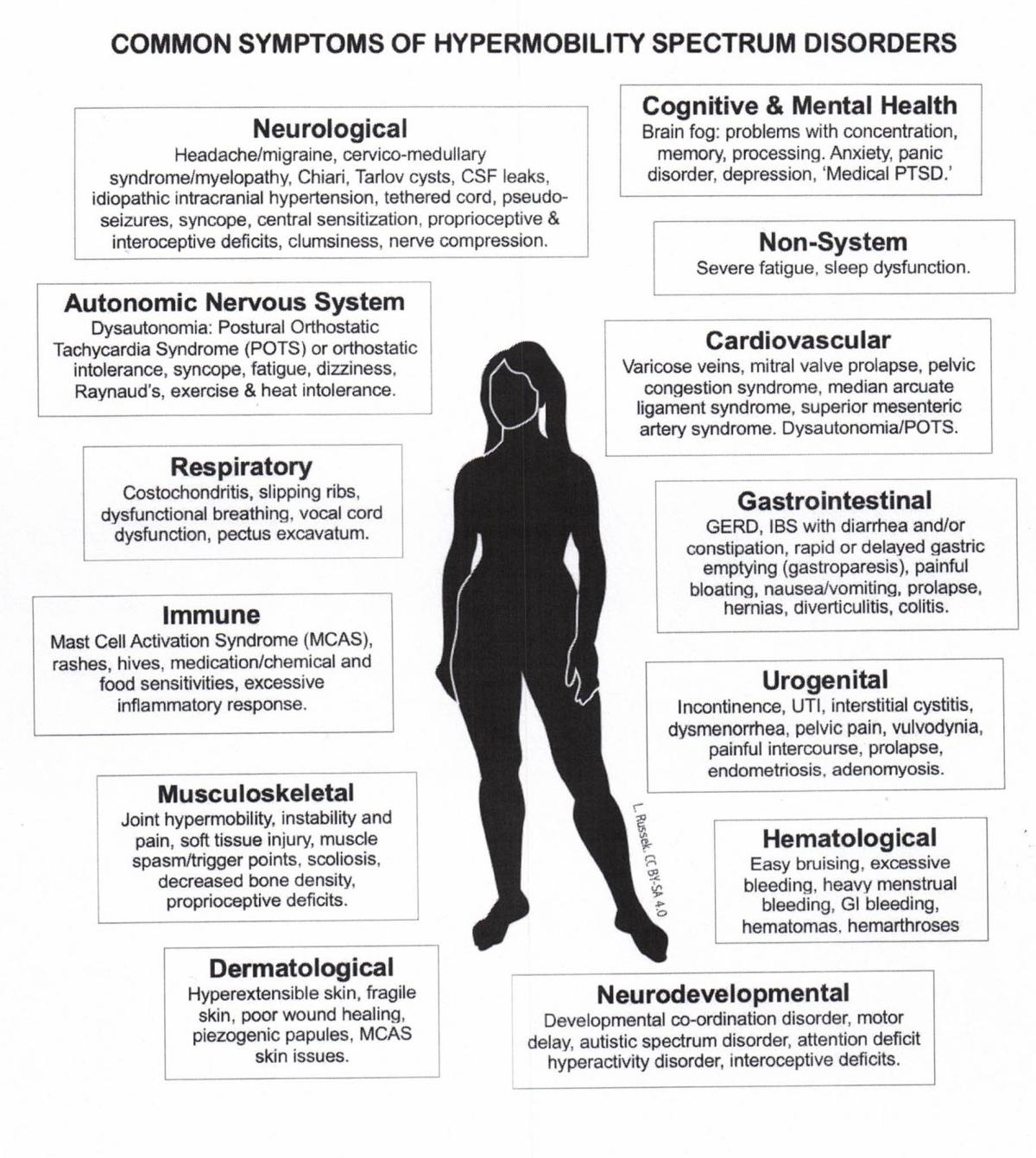
One of the difficulties with obtaining a diagnosis with EDS or HSD is that they present in different ways in different individuals and can vary with age. All forms of EDS/HSD affect connective tissue, making it stretchier than is typical, often due to genetic impacts on the proteins involved in collagen production. Symptoms appear throughout the body and in different body systems. The charts at the top gives you some idea of how wide-ranging the symptoms can be. Thankfully, no one has all the symptoms but when tends to happen in the medical systems in most countries is that you see separate specialists for different body systems and there is no one with enough knowledge to integrate all the information and realize that connective tissue is the common denominator underlying it all.

Because EDS/HSD are genetic in origin, treatment revolves around symptoms. Physical therapy is often a big part of the treatment plan. There are medications, vitamins, and supplements to help certain aspects of the disorder, too. For example, I have a mast cell activation disorder as part of my hEDS and take several medications to help relieve respiratory and gastrointestinal symptoms.

Having an EDS/HSD diagnosis also allows your care team to keep an eye out for conditions that may develop, such as heart valve problems. It’s very important for surgeons to know if your connective tissues are not typical, as this may impact how a procedure is done or if it should be done at all. How well medications work and the dosages required can also differ. For example, my hEDS diagnosis explained why topical anethetics, like lidocaine, don’t work well for me.

I am hoping that, when the new diagnostic criteria are published, there will be increased awareness of inherited connective tissue disorders among both the medical community and the general public. For too long, symptoms have been dismissed as unrelated, idiopathic, stress-induced, hormonal, anxety-induced, unimportant, or imaginary. Like autoimmune diseases, these disorders are more prevalent in females than males, adding to the burden of being taken seriously and the dearth of studies.

The Ehlers-Danlos Society is an important organization spearheading study, training, education, and treatment of EDS/HSD internationally. Their website is a great source of information for patients and their families, as well as for clinicians and researchers. This month, as we raise awareness, my hope is that more people will learn about EDS/HSD and help those affected get the diagnosis, treatment, and validation they deserve.

May Day!

Vote for Democrary #56

While May 1st is observed around the world as International Workers’ Day, it’s usually not a big thing in the United States, which observes Labor Day the first Monday in September.

This year is different.

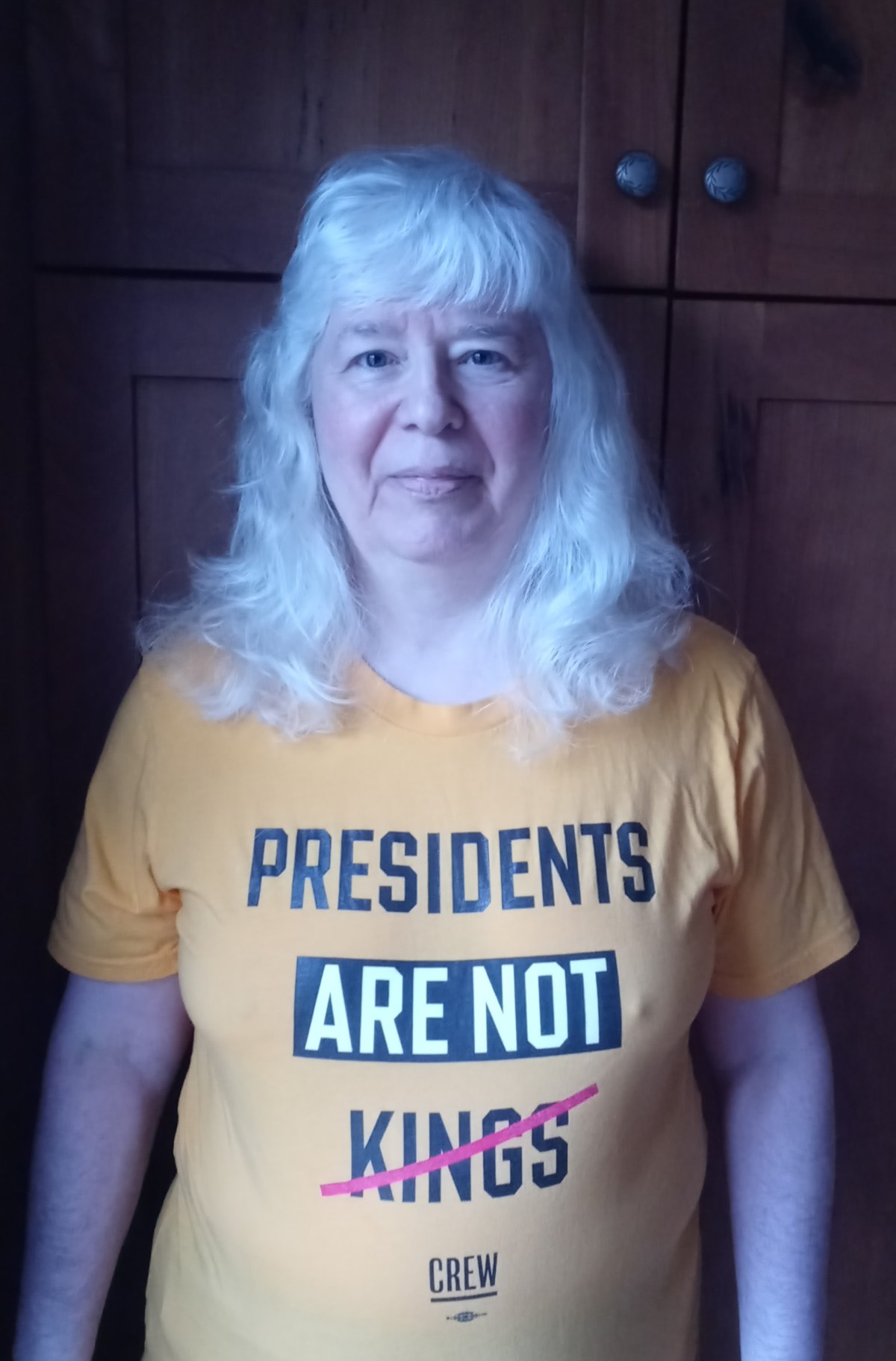
Indivisible and other organizations are spearheading May Day Strong, calling for no work, no school, and no shopping today. There will be rallies in some places for those who are able with others, like me, participating from home. I’m wearing my “Presidents are not Kings” shirt and refraining from shopping today. (No work and no school are every day things for me.)

One of the messages today is “Workers over Billionaires.” The hope is that a show of economic power will draw attention to the unfair tax structure in the United States and the undue influence that wealthy individuals and corporations have over our government. This is also tied to current abuses of power by the government, trying to strip rights and protections under the law and interfere with elections.

As it happens, May 1st is also observed as Law Day in the United States. The Amercian Bar Association explains this year’s theme:

The 2026 Law Day theme is “The Rule of Law and the American Dream.” The rule of law—the idea that no person is above the law—is what ensures the rights of the people to live their lives as freely as possible and to pursue their dreams. The ABA encourages all Americans to recognize Law Day on May 1, 2026, and to reflect on how the rule of law ensures all Americans have the ability to fulfill their dreams.

This dovetails well with the May Day actions and No Kings, Hands Off, and other rallies that have been happening during Trump’s second term. Law Day seems even more urgent this year with the lawlessness of immigration enforcement and detention/deportation without due process, election interference, the gutting of the Voting Rights Act, and the decisions of the Supreme Court that fly in the face of precedence and the Constitution.

I don’t know what the impact of this May Day and Law Day will bring but I am looking at it as another step in the movement to restore the rights and freedoms of the American people, taking back the power from the corrupting influence of autocrats and oligarchs.

There is a third thing about May 1st that is important to me. It’s the first day of EDS & HSD Awareness Month. (EDS is Ehlers-Danlos Syndrome; HSD is the related diagnosis of Hypermobility Spectrum Disorder.) I was diagnosed with hypermobile EDS (hEDS) in January, although as a genetic connective tissue disorder, it has always been there. I hope to do several posts this month to continue to raise awareness and to update my readers about my current treatment trajectory.

Of course, there will be more posts in my Vote for Democracy series, too. The caveat is that there will never be as many posts as I would like, unless/until I can clear the brain fog and get more energy back. There will be other topics popping up, as well. You can never tell what might be at the top of JC’s Mind!

Or maybe you can….