Smith College, my alma mater, is celebrating its 150th anniversary this year with a number of events. I travelled to our Northampton, Massachsuetts campus for the “Come Home to Smith” events on November 1st. The campus was beautiful as always and it was a privilege to be back on campus with other alums and current students, as well as family members who were visiting as it was also Family Weekend.
It was my privilege to also attend the first-ever event of the Smith VOICES (Variety of Opinions, Interests, Cohorts, and Experiences are Supported) initiative, organized around the theme of “Joyful Care.” I enjoyed fascinating presentations on wellness for individuals and communities, offered by alums and staff. I appreciated the opportunity to interact with other alums from across the age spectrum and from many different backgrounds and communities.
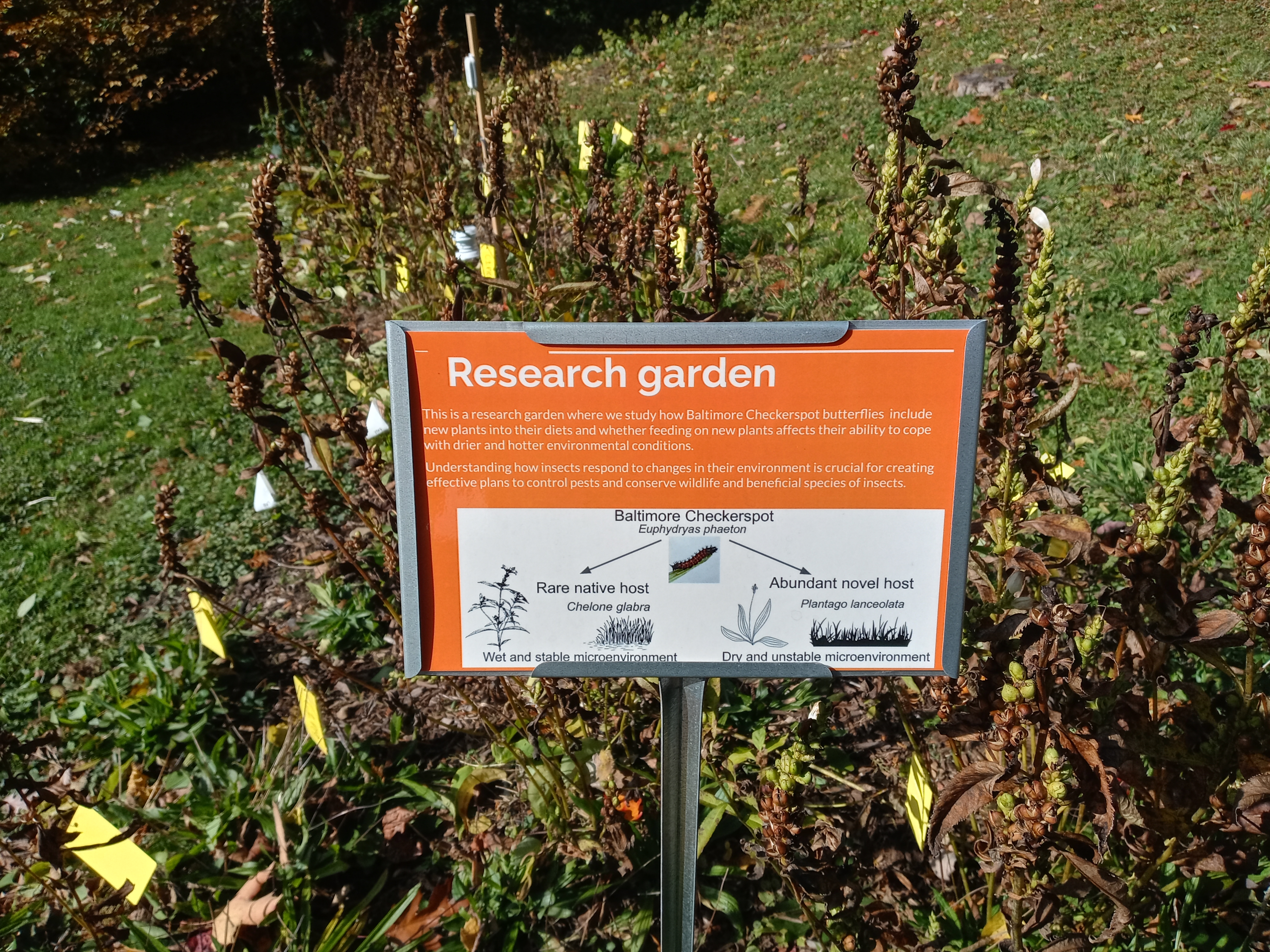
I especially enjoyed the opportunity to learn new things, reflect, and deepen my understanding. Smith is a champion for liberal arts education, encouraging both breadth and depth of learning and I cherish being part of that tradition. While I didn’t have as much time and energy to wander around campus, I had to stop and learn about this research garden, tucked along the pathway between Wright Hall and Chapin House:
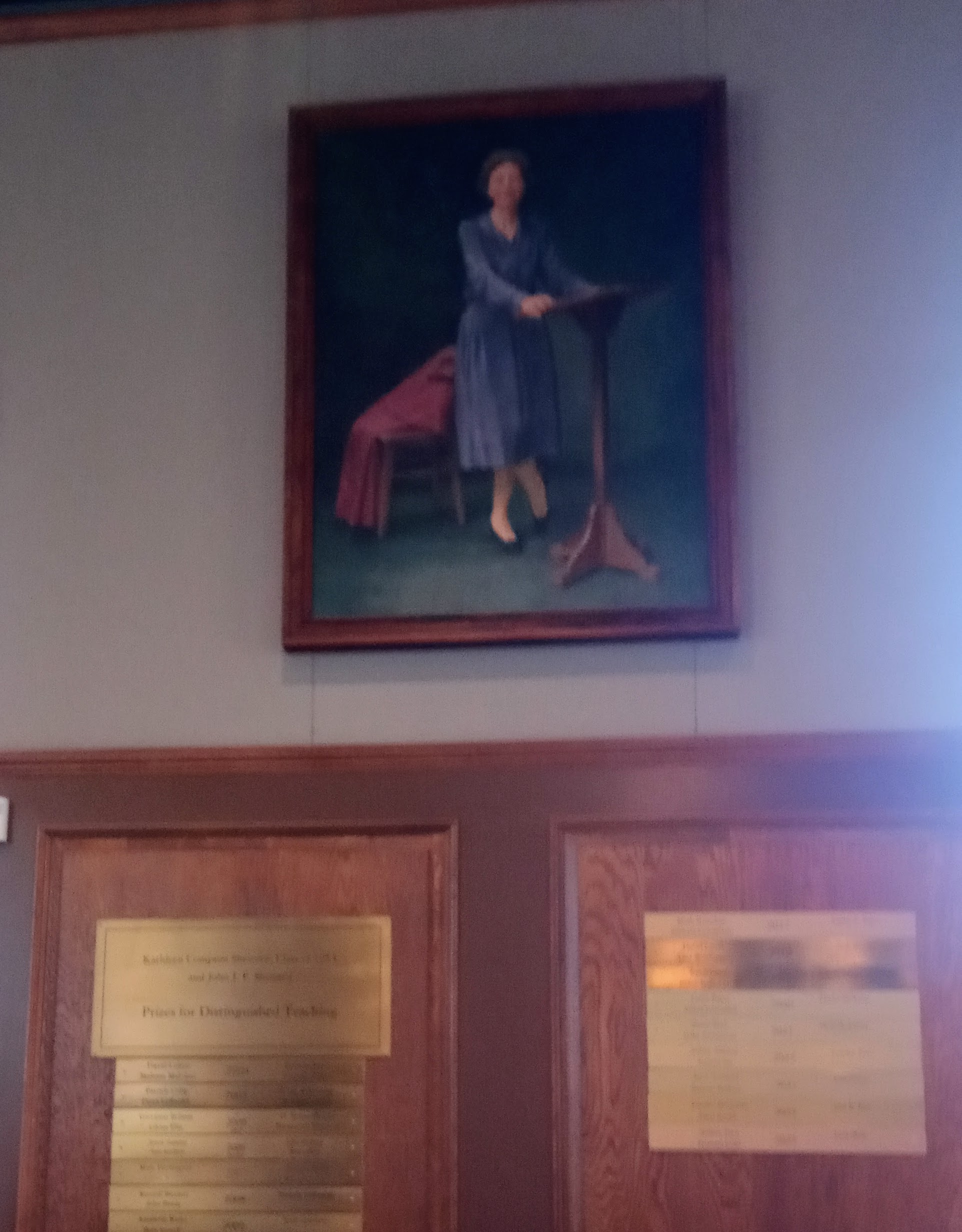
I also enjoyed spending time in some renovated spaces on campus. The opening of VOICES was in Alumnae House in the same room where we held our wedding reception in 1982. Later presentations were in Neilson Library. The photo below was taken in the Browsing Room and shows the official portrait of Jill Kerr Conway, the first woman president of Smith, who was president when I was a student.
To cap the Come Home to Smith activities, current president Sarah Willie-LeBreton addressed the alums and answered questions with insight and warmth. I heard from several alums and staff members how vital President Sarah’s leadership has been in these stressful times for higher education and for society in general. I also love how everyone calls her “President Sarah” with true affection. This was my first opportunity to hear her speak in person. She was astute, thoughtful, and joyful, even when touching on challenges that we are facing.
I ended the day with the Montage concert, which brought together musical groups now active on campus, over half of which were not in existence when I was a student. My favorite new-to-me group was the Wailing Banshees, Smith’s Celtic music ensemble. I loved seeing that the handbell choir, which was very small in my day, has grown to enable ringing five octaves. A newer tradition that has developed is ending with an audience participation piece. We joined in with “Let There Be Peace on Earth” with the Glee Club and Orchestra, which, I admit, made me teary.
In her will, Sophia Smith provided the funds to build and maintain a college for women that would provide an education equal to that available to men. The will states, “It is my wish that the institution be so conducted, that during all coming time it shall do the most good to the greatest number. I would have it a perennial blessing to the country and the world.” I’m grateful that Smith College continues to be a blessing and that it grows and changes in ways that honor Sophia Smith’s wishes. Having previously made their financial aid packages loan-free, Smith recently announced the Next 150 Pledge , which will make Smith tuition-free for families with incomes up to $150,000.
I’m proud to be part of the Smith College family and hope that we will continue as a “perennial blessing” for the next 150 years and beyond!
I have been singing for as long as I can remember. When I started school, we had a music teacher who came once a week to lead music class. Our classroom teacher also played the piano and would sometimes have us sing in the classroom which was combined first through fourth grade. She had been trained at a normal school before there were education colleges in our area and I think that grammar school teachers for young children had to learn piano as part of their program.
When I was in sixth grade, I was old enough to sing in the choir at church. Because it was a small church, the choir only sang at Christmas and for Holy Week. I sang with them until my sophomore year in high school when I became the organist. Then, I was always singing as I played the hymns. It helps your playing because you are more observant of reflecting when breaths should be taken.
In high school in a city about twenty miles from our little town, I got to sing every day! I sang with the mixed chorus and later also with a small girls’ ensemble. I learned to smile, sing, and do a bit of choreography at the same time, a skill that doesn’t seem all that useful but actually is. It makes it easier to convey the emotion of what you are singing to your audience.
When I was at Smith College, singing was a big part of my life. I worked my way through the extensive choral program at the time, starting with Choir Alpha as a first year, College Choir the next year, and my final two years in Glee Club. I also accompanied for two years for Choir Alpha. As an organist who was Catholic, I also frequently played for mass at Helen Hills Hills Chapel. I got married there the month after I graduated.
When we moved to Broome County, NY, I began to sing with the (Binghamton) University Chorus. (Actually, B had already moved and was working out here when we married, so I guess I should have said when I moved.) I sang with them until they unceremoniously disappeared, just prior to the pandemic. I still miss that group, which was a town/gown group, meaning that we had singers both from the university (students/faculty/staff) and from the broader community.
Until 2005, I also did some singing at my church with our Resurrection Choir, which ministered at funerals. It was sometimes difficult but was so important for the family to have us there to represent the parish in their time of grief.
I had thought when University Chorus ended that I would never have another choir gig but, after the pandemic shutdown, I attended a concert with the Madrigal Choir of Binghamton and found out they had openings for sopranos. This was a bit of a shock as choirs usually have more sopranos than they know what to do with but some people had moved away during the pandemic so they had lost some singers. I knew the director because I had sung with him when he directed University Chorus for 25 or so years before he retired and was very happy when he accepted me into Madrigal Choir.
Despite my current health issues, I’ve been continuing to sing with them and hope to as long as I’m able and my voice holds out. I’m lucky that I don’t have a big natural vibrato, which helps my voice to not get as much shake or wobble as some older singers get.
There are Big Hug mugs that came years ago filled with FTD flowers. A pair of floral mugs that B and I received as a wedding gift 42 years ago. Mugs from my various Smith College reunions. A line of mugs related to B’s jobs. A mug with children from around the world that was given to me by the middle school principal years ago as a thank-you for being on the building planning team. Some hand-crafted ones which double as works of art. A Doctor Who mug that changes its design depending on the temperature of the liquid inside. Some mugs designed for soup instead of beverages. Sandra Boynton mugs spanning several decades.
Our most recent acquisition is a Sunday Today mug that T and I gave to B for Father’s Day. Its claim to fame is that it is very big, although, of course, it isn’t obligatory to fill it all the way. However, if you do, you need to use two tea bags.
I don’t use mugs very often myself. I don’t drink coffee or tea. I used to love cocoa but it riles up one of my medical conditions. I sometimes will drink white hot chocolate in the cooler weather or make hot milk with spices but it isn’t that frequent.
I do, though, like having reminders of our past in the cupboard, even when they make me nostalgic, like the mug from our children’s elementary school or from the elementary school where my father-in-law was principal for decades. He passed away in 2005, a few years after he retired.
Some day, we will have to downsize and cull some of our mugs.
I got news yesterday of the death of a college friend.
Joan and I met in Ron Perera‘s first-year music theory class. Like me, Joan was a western Massachusetts native and a Catholic with close ties to her family. She was a talented violinist. I remember her giving a demonstration to our theory class, showing us all the techniques used to create different sonorities for us to use in our compositions.
For junior year, Joan went to the University of Michigan and decided to transfer there to finish her education. However, “once a Smithie, always a Smithie,” Joan remained a member of the Smith College class of ’82.
Joan went on to a successful career playing in orchestras, concluding with a long tenure with the Kennedy Center Opera Orchestra in Washington, DC. Her performance schedule kept her busy but, two years ago, she was able to attend our 40th reunion in Northampton, visiting family in the area which hadn’t been possible during the height of the pandemic. While we had been keeping in touch over the years, it was the first time in decades that we had seen each other and it was great. We started speculating where we would each be living post-retirement when our 45th reunion rolled around.
Right after reunion, Joan developed COVID. Fortunately, she wasn’t very sick but she was bummed about missing some of her opera performances.
It was a shock when she was diagnosed with acute lymphoma that fall. She immediately began chemotherapy. Due to the intensity of the treatment and her weakened immune system, she had to stay at home, where her husband Paul was her loving and capable caregiver.
In summer of last year, Joan was able to resume performing while her treatment migrated to a maintenance regimen. This January, she was posting about the orchestra.
And, sometime since, her remission ended and the cancer came back with a vengeance.
I didn’t know.
Early this month, I had emailed her some new photos of my granddaughters and Joan sent a reply about how beautiful they are. Sending photos had been something I had done during her home-bound period and continued to do from time to time. I am grateful that I was unknowingly able to add a moment of love and beauty to her final weeks.
Hearing the news of Joan’s death from our Smith friends was a shock and brought waves of tears. It’s also brought to mind this recent Washington Post article, raising the disturbing prospect that SARS-CoV -2 infection may play a role in the development of cancer, particularly rare or unusual ones. It will take years of research to determine whether or not this is the case but the mystery of it all is disquieting.
The final commendation at Joan’s funeral will begin, “May the angels lead you into Paradise.” May there be a beautiful violin waiting for you there, Joan.
About the featured image: Ada Limón, as poet laureate, has begun an initiative called Poetry in Parks in conjunction with the National Parks Service. To complement this project, she invited poets to write new work centered on our relationship with nature. In April, Milkweed Editions published You Are Here: Poetry in the Natural World as a testament to that enduring relationship.
Ada Limón, 24th poet laureate of the United States, gave an amazing reading at my alma mater, Smith College, on the last day of National Poetry Month, April 30, 2024, followed by a conversation with Matt Donovan, director of the Boutelle-Day Poetry Center at Smith.
So many things struck me about the reading, many of which resonate with my own poetic sensibilities. The sense of place and relationship with the natural world. The vast possibilities for poems that surrounds us. The exquisiteness of short poems, just long enough to offer what needs to be said. The way the mind seeks myriad connections. That there are poems written for oneself that may never be shared with others. The interest in received forms without the compulsion to write them for public consumption. The honesty and authenticity of her work and of her speaking between poems and responding to questions.
I was not able to be there in person but I know John M. Greene Hall, where the reading took place, well, having spent many hours there as a student rehearsing and performing with choral groups and practicing the organ. It’s a cavernous space, which seats about 2,000 people. I was awed at the intimacy that Ada Limón was able to project, as though she were reading and talking with a small circle of friends in a living room after dinner.
Earlier this month, I was privileged to attend a memorial concert for Ron Perera, composer and professor emeritus of music at Smith College. The concert took place in Sweeney Concert Hall in Sage Hall, the long-time center of musical life on campus. I had taken five semesters of theory and composition with Mr. Perera and he had been my major advisor. We had been in touch variously over the decades and we had enjoyed a wonderful lunch together last spring when I was back on campus to sing with the Smith College Alumnae Chorus.
All the pieces at the concert were Ron Perera’s compositions, some of which were performed by the musicians for whom they were written. I especially appreciated seeing pianist Professor Emerita Monica Jakuc Leverett perform Out of Shadow almost 36 years after its premiere. Another piano piece that I loved was Three Waltzes for Four Hands, written for Ron’s three daughters, and performed by Professor Emeritus Kenneth Fearn and his daughter, Kaeza. I’m looking forward to ordering a copy for daughter E and son-in-law L to play for our granddaughters ABC and JG.
As a writer and choral singer, I was especially drawn to the choral pieces that opened and closed the concert. The opening was “Hold Out Your Hands Over the Earth” from The Outermost House, text by Henry Beston. The work was commissioned by the Chatham Chorale, on Cape Cod. The Perera family lived on the Cape during the summers and Ron loved to sail there. Some of the text in this movement is:
To all who love her, who open to her the doors of their veins, she gives strength, sustaining them with her own measureless tremor of dark life. Touch the earth, love the earth, honor the earth, her plains, her valleys, her hills, and her seas; rest your spirit in her solitary places.
It was a perfect reflection to begin.
Besides the music, there were four remembrances in the program. The first was from one of Ron’s daughters, Rosalind, which also served as a welcome. Two were from pastors of St. John’s Episcopal Church, located in the midst of Smith’s campus, where Ron was a long-time member and volunteer. The other was from Professor Emeritus Donald Wheelock, who was Ron’s composer-colleague for many years and who helped to organize the concert. It was beautiful to hear them speak about his kind, caring nature and the depth and breadth of his thoughts, talents, interests, and beliefs. Even as a college student, I could sense what a wonderful man he was and it was inspiring to hear how he sustained those qualities throughout his life and shared them with so many, most especially his family.
The concert closed with the Smith College Chamber Singers offering Ron’s setting of Percy Bysshe Shelley’s “Music, When Soft Voices Die” conducted by Jonathan Hirsh, who is a current faculty member, friend of Ron, and another concert organizer. He had graciously kept me apprised of the plans as the memorial came together so that I could arrange to attend. It was such a perfect, quiet, love-filled ending to the memorial. “And so thy thoughts, when thou art gone,/ Love itself shall slumber on.”
At the reception after the concert, I was able to speak briefly with Don Wheelock and Jonathan Hirsh and at greater length with the third organizer, Professor Emerita Karen Smith Emerson. I am grateful for their work in putting the program together to celebrate a remarkable, generous, talented man who leaves a legacy of music and writings but, more importantly, of human connection and spiritual strength.
I’m also grateful to CK, Smith ’81, and her spouse who opened their lovely home near campus to B and me for the weekend. I appreciated their hospitality and their companionship at the concert and reception. I’m hoping CK will be able to sing with us the next time I’m back on campus for an event with the Smith College Alumnae Chorus.
It will be bittersweet, though, knowing that Ron will not be there to hear us. Maybe, we will perform a piece of his music in remembrance…
I’m a bit of – okay, more than a bit – an outlier in Linda’s Just Jot It January event in that I seldom use the provided prompts other than for One-Liner Wednesdays and Stream of Consciousness Saturdays. My blog is called Top of JC’s Mind because I write about whatever is at the top of my mind, which could be family, poetry, health, politics, spirituality, environmental issues, movies, or anything else. Today, though, I provided the #JusJoJan24 prompt, writing, hoping it would be an easy one for all of us, including me (especially me?), to use.
When I was in grammar school, we did a lot of both creative and academic/utilitarian writing in our two-room school which went up through grade 8. Besides learning to write theme papers and business and friendly letters and such, we also wrote stories and poems. I remember writing outside of school for fun, too. My sisters and I would often make our own greeting cards with poems we wrote ourselves.
At the high school I attended about twenty miles from home, there was still a lot of writing but very little of it was creative. Busy with academic writing, I stopped writing poetry and fiction. This trend continued when I was a student at Smith College – lots of writing, but none of it in fiction or poetry. I’ve wondered if the Boutelle-Day Poetry Center had existed back in my student days whether I would have written and studied poetry as an undergrad. As it happened, I made the happy discovery that I could write music; composition became an important part of my major. As a singer, organist, and composer, words were often entwined with my musical experiences, which kept me in conversation with poetry and literary writing, even when I wasn’t practicing it myself.
There has been a lot of writing in my life after Smith. There has always been correspondence, first on paper and later mostly electronic. Many of my volunteer activities had major writing components. In my years on the liturgy committee at my church, I wrote prayers and what we jokingly termed “homilettes” on seasonal themes. I worked on documents on curriculum development as a volunteer on curriculum and honors diploma committees when my daughters were in school. I researched and wrote commentary on the dangers of fracking for years as part of the rapid response team in New York State. Every once in a while, I would be inspired to write a poem, but nearly all my writing was utilitarian prose.
That changed when I turned fifty. My friend Yvonne was leading a year-long book study of Dr. Clarissa Pinkola Estés’s Women Who Run with the Wolves: Myths and Stories of the Wild Woman Archetype. A circle of women met monthly to discuss a section of the book and then create art in response. I spontaneously started to write poems to accompany my art pieces, a practice known as ekphrasis, though I didn’t know the word at the time. I had lost the church that had sometimes performed my music and I think that creative energy found a home in writing poetry.
After a poem I had written was chosen as part of a National Poetry Month initiative at our local public broadcasting radio station, I learned about the Binghamton Poetry Project and started attending their community poetry workshops, which are led by graduate students at Binghamton University. I quickly became serious about poetry and wanted to submit work for publication. One of the BPP directors found a local circle of poets meeting regularly to workshop poems that I could join. We are now known as the Grapevine Poets and I will be forever grateful to them for all their help and support with my poems and manuscripts. Last year was a milestone for me when Kelsay Books published my first chapbook of poetry, Hearts.
Running roughly concurrently with the resurgence of poetry in my life has been my blogging life. When I was writing so much fracking and political commentary, friends suggested I give blogging a try. I wasn’t sure if I could make it work but Top of JC’s Mind turned ten last September. I just passed 1,900 posts total, so there’s a lot there if anyone cares to rummage around! As part of my tenth anniversary celebration, I also finally got my own domain name, so you can also visit the blog through my author site at joannecorey.com.
Words are powerful and nearly all of us are writers, whether we are doing it for personal use or public audience. I hope that, whatever writing you do, it brings you some sense of peace, joy, clarity, outreach, and stability.
I’m pleased to share the online version of Emulate Magazine Fall 2023 (Volume 5, Issue 1), which includes three of my MASS MoCA (Massachusetts Museum of Contemporary Arts) ekphrastic poems. Many thanks to the Emulate Magazine team at Smith College for including my work in this issue! Smith is my alma mater, so being chosen for this publication is particularly close to my heart.
The theme of the issue is “Metamorphosis.” I was excited to discover that the editorial team had chosen my poem, “Time/Rate/Distance,” to open the issue! This poem is based on Richard Nonas’s Cut Back Through (for Bjorn), which is a long-term outdoor installation on the MASS MoCA grounds. It is comprised of three large granite chairs and five footstools. I suppose “Time/Rate/Distance” could be considered an American sonnet, because it has 14 lines, with a turn between lines 8 and 9, like an Italian sonnet. (Just throwing that comment in to address the common criticism that I don’t write enough in received Western forms, like sonnets, villanelles, and sestinas.)
“I Must Speak My Poem” (page 11) is based on Stephen Vitiello’s sound installation All Those Vanished Engines, housed in the Boiler House at MASS MoCA. My beloved Boiler House Poets Collective recorded our first reading there and we always visit when we are back for our reunion residencies. I was disappointed this year that we weren’t able to climb all the way to the rooftop, which offers a spectacular view of North Adams and the surrounding hills.
“Translation” (page 26) is a haiku based on the works of Justin Favela, whose pieces translating landscape paintings by José María Velasco using the paper and glue techniques of piñata art were part of the MASS MoCA Kissing Through a Curtain exhibition (2020-2021). I especially love that this poem appears on the page with a striking photograph by Avery Maltz.
All three of these poems are part of my chapbook manuscript of ekphrastic poems based on current and past exhibitions at MASS MoCA. Two of them are also included in my full-length manuscript centered on the North Adams area. I will, of course, add Emulate Magazine to my list of acknowledgements and my author page, joannecorey.com.
Be sure to check out this issue of Emulate Magazine! It is chock-full of poetry, prose, and images, all centered on metamorphosis and the myriad ways it manifests.
Over the weekend, my alma mater, Smith College, inaugurated Sarah Willie-LeBreton as their twelfth president in a joy-filled celebration.
For those of you who may not be familiar, Smith was established in 1871 in Northampton, Massachusetts as a women’s college that would provide an education for women equal to that which had long been available to men. It has continued that mission through the years and has in recent decades worked diligently to make a Smith education possible to promising students in underserved communities, such as those who are the first generation in their family to seek higher education. For example, it has eliminated student loans from its financial aid packages and gives grants to students in need to help them obtain essential items like computers.
I was a Smith student during the tenure of the first woman to be Smith president, Jill Kerr Conway (1975-85). We affectionately referred to her as “Jill” although we would always have addressed her as President Conway in person. It felt right to me to hear an alumna during the inauguration refer to Dr. Willie-LeBreton as “President Sarah” so that is how I am thinking of her now.
President Sarah is a sociologist, a member of the Society of Friends (Quakers), a Black woman, and an experienced educator and administrator. She exudes joy and elicits it in others. Her official inauguration, coming several months into her tenure as president, was a joyous celebration of the history and heritage of President Sarah and of Smith College and how they are entwined as a community for the present and the future. I loved the greetings and involvement of other college presidents, who were so welcoming of President Sarah in their remarks. I especially appreciated the video appearance of Ruth Simmons, who was Smith’s first Black president – until she was stolen recruited by Brown University to become the first Black president of an Ivy League institution.
President Sarah’s inaugural address was impressive. I appreciated her strong support for liberal arts education. She emphasized how our knowledge must be in conjunction with our values. She says:
We are at our peril when we teach rote memorization without collaborative problem-solving and when we encourage the fusion of identity with grades, rather than with what challenges students and brings them joy. We are at our peril when we nurture cleverness without providing the opportunities to consult our moral compass, without providing opportunities to do for and with others. The liberal arts education we provide is the perfect antidote to the division, threats to democracy, diminishing of rights and freedoms, violence, and natural catastrophes to which we wake up on a daily basis.
(The inauguration ceremony is available online here; President Sarah’s remarks begin at the 1:12 mark.)
I would have loved to attend in person, but, like many alumnae, could only watch virtually. Smith did a good job of including us, even though we couldn’t be there physically. One way that they did this was to invite us to send a photo and caption of where we find joy. The photos were assembled into an interactive mosaic. The mosaic is searchable by name, class year, or key word to find specific photos in the mosaic. I sent a photo of my granddaughters, ABC and JG, heading out on their new school year. I’m honored to have them represented as we all share and, in so doing, multiply our joy.
Congratulations, President Sarah! I look forward to years of connection, love, commitment, and joy as a continuing, if geographically distant, part of the Smith family.
(Photo is of my first and most enduring Smith friend, my roommate Mary, and me, on tour with the Smith Alumnae Chorus in Slovenia in 2019.)











 Joanne Corey