Writing

I’m a bit of – okay, more than a bit – an outlier in Linda’s Just Jot It January event in that I seldom use the provided prompts other than for One-Liner Wednesdays and Stream of Consciousness Saturdays. My blog is called Top of JC’s Mind because I write about whatever is at the top of my mind, which could be family, poetry, health, politics, spirituality, environmental issues, movies, or anything else. Today, though, I provided the #JusJoJan24 prompt, writing, hoping it would be an easy one for all of us, including me (especially me?), to use.

When I was in grammar school, we did a lot of both creative and academic/utilitarian writing in our two-room school which went up through grade 8. Besides learning to write theme papers and business and friendly letters and such, we also wrote stories and poems. I remember writing outside of school for fun, too. My sisters and I would often make our own greeting cards with poems we wrote ourselves.

At the high school I attended about twenty miles from home, there was still a lot of writing but very little of it was creative. Busy with academic writing, I stopped writing poetry and fiction. This trend continued when I was a student at Smith College – lots of writing, but none of it in fiction or poetry. I’ve wondered if the Boutelle-Day Poetry Center had existed back in my student days whether I would have written and studied poetry as an undergrad. As it happened, I made the happy discovery that I could write music; composition became an important part of my major. As a singer, organist, and composer, words were often entwined with my musical experiences, which kept me in conversation with poetry and literary writing, even when I wasn’t practicing it myself.

There has been a lot of writing in my life after Smith. There has always been correspondence, first on paper and later mostly electronic. Many of my volunteer activities had major writing components. In my years on the liturgy committee at my church, I wrote prayers and what we jokingly termed “homilettes” on seasonal themes. I worked on documents on curriculum development as a volunteer on curriculum and honors diploma committees when my daughters were in school. I researched and wrote commentary on the dangers of fracking for years as part of the rapid response team in New York State. Every once in a while, I would be inspired to write a poem, but nearly all my writing was utilitarian prose.

That changed when I turned fifty. My friend Yvonne was leading a year-long book study of Dr. Clarissa Pinkola Estés’s Women Who Run with the Wolves: Myths and Stories of the Wild Woman Archetype. A circle of women met monthly to discuss a section of the book and then create art in response. I spontaneously started to write poems to accompany my art pieces, a practice known as ekphrasis, though I didn’t know the word at the time. I had lost the church that had sometimes performed my music and I think that creative energy found a home in writing poetry.

After a poem I had written was chosen as part of a National Poetry Month initiative at our local public broadcasting radio station, I learned about the Binghamton Poetry Project and started attending their community poetry workshops, which are led by graduate students at Binghamton University. I quickly became serious about poetry and wanted to submit work for publication. One of the BPP directors found a local circle of poets meeting regularly to workshop poems that I could join. We are now known as the Grapevine Poets and I will be forever grateful to them for all their help and support with my poems and manuscripts. Last year was a milestone for me when Kelsay Books published my first chapbook of poetry, Hearts.

Running roughly concurrently with the resurgence of poetry in my life has been my blogging life. When I was writing so much fracking and political commentary, friends suggested I give blogging a try. I wasn’t sure if I could make it work but Top of JC’s Mind turned ten last September. I just passed 1,900 posts total, so there’s a lot there if anyone cares to rummage around! As part of my tenth anniversary celebration, I also finally got my own domain name, so you can also visit the blog through my author site at joannecorey.com.

Words are powerful and nearly all of us are writers, whether we are doing it for personal use or public audience. I hope that, whatever writing you do, it brings you some sense of peace, joy, clarity, outreach, and stability.

Write on!

Three Poems in Emulate Magazine!

I’m pleased to share the online version of Emulate Magazine Fall 2023 (Volume 5, Issue 1), which includes three of my MASS MoCA (Massachusetts Museum of Contemporary Arts) ekphrastic poems. Many thanks to the Emulate Magazine team at Smith College for including my work in this issue! Smith is my alma mater, so being chosen for this publication is particularly close to my heart.

The theme of the issue is “Metamorphosis.” I was excited to discover that the editorial team had chosen my poem, “Time/Rate/Distance,” to open the issue! This poem is based on Richard Nonas’s Cut Back Through (for Bjorn), which is a long-term outdoor installation on the MASS MoCA grounds. It is comprised of three large granite chairs and five footstools. I suppose “Time/Rate/Distance” could be considered an American sonnet, because it has 14 lines, with a turn between lines 8 and 9, like an Italian sonnet. (Just throwing that comment in to address the common criticism that I don’t write enough in received Western forms, like sonnets, villanelles, and sestinas.)

“I Must Speak My Poem” (page 11) is based on Stephen Vitiello’s sound installation All Those Vanished Engines, housed in the Boiler House at MASS MoCA. My beloved Boiler House Poets Collective recorded our first reading there and we always visit when we are back for our reunion residencies. I was disappointed this year that we weren’t able to climb all the way to the rooftop, which offers a spectacular view of North Adams and the surrounding hills.

“Translation” (page 26) is a haiku based on the works of Justin Favela, whose pieces translating landscape paintings by José María Velasco using the paper and glue techniques of piñata art were part of the MASS MoCA Kissing Through a Curtain exhibition (2020-2021). I especially love that this poem appears on the page with a striking photograph by Avery Maltz.

All three of these poems are part of my chapbook manuscript of ekphrastic poems based on current and past exhibitions at MASS MoCA. Two of them are also included in my full-length manuscript centered on the North Adams area. I will, of course, add Emulate Magazine to my list of acknowledgements and my author page, joannecorey.com.

Be sure to check out this issue of Emulate Magazine! It is chock-full of poetry, prose, and images, all centered on metamorphosis and the myriad ways it manifests.

The inauguration of President Sarah

Over the weekend, my alma mater, Smith College, inaugurated Sarah Willie-LeBreton as their twelfth president in a joy-filled celebration.

For those of you who may not be familiar, Smith was established in 1871 in Northampton, Massachusetts as a women’s college that would provide an education for women equal to that which had long been available to men. It has continued that mission through the years and has in recent decades worked diligently to make a Smith education possible to promising students in underserved communities, such as those who are the first generation in their family to seek higher education. For example, it has eliminated student loans from its financial aid packages and gives grants to students in need to help them obtain essential items like computers.

I was a Smith student during the tenure of the first woman to be Smith president, Jill Kerr Conway (1975-85). We affectionately referred to her as “Jill” although we would always have addressed her as President Conway in person. It felt right to me to hear an alumna during the inauguration refer to Dr. Willie-LeBreton as “President Sarah” so that is how I am thinking of her now.

President Sarah is a sociologist, a member of the Society of Friends (Quakers), a Black woman, and an experienced educator and administrator. She exudes joy and elicits it in others. Her official inauguration, coming several months into her tenure as president, was a joyous celebration of the history and heritage of President Sarah and of Smith College and how they are entwined as a community for the present and the future. I loved the greetings and involvement of other college presidents, who were so welcoming of President Sarah in their remarks. I especially appreciated the video appearance of Ruth Simmons, who was Smith’s first Black president – until she was stolen recruited by Brown University to become the first Black president of an Ivy League institution.

President Sarah’s inaugural address was impressive. I appreciated her strong support for liberal arts education. She emphasized how our knowledge must be in conjunction with our values. She says:

We are at our peril when we teach rote memorization without collaborative problem-solving and when we encourage the fusion of identity with grades, rather than with what challenges students and brings them joy. We are at our peril when we nurture cleverness without providing the opportunities to consult our moral compass, without providing opportunities to do for and with others. The liberal arts education we provide is the perfect antidote to the division, threats to democracy, diminishing of rights and freedoms, violence, and natural catastrophes to which we wake up on a daily basis.

(The inauguration ceremony is available online here; President Sarah’s remarks begin at the 1:12 mark.)

I would have loved to attend in person, but, like many alumnae, could only watch virtually. Smith did a good job of including us, even though we couldn’t be there physically. One way that they did this was to invite us to send a photo and caption of where we find joy. The photos were assembled into an interactive mosaic. The mosaic is searchable by name, class year, or key word to find specific photos in the mosaic. I sent a photo of my granddaughters, ABC and JG, heading out on their new school year. I’m honored to have them represented as we all share and, in so doing, multiply our joy.

Congratulations, President Sarah! I look forward to years of connection, love, commitment, and joy as a continuing, if geographically distant, part of the Smith family.

(Photo is of my first and most enduring Smith friend, my roommate Mary, and me, on tour with the Smith Alumnae Chorus in Slovenia in 2019.)

Remembering Ron Perera

Ronald C. Perera, composer and the Elsie Irwin Sweeney Professor of Music Emeritus at Smith College, passed away on August 4, 2023 at his home in Massachusetts.

Mr. Perera – I’m supposed to call him Ron but can’t quite bring myself to do so – was one of the most important people in my education at Smith (1978-1982). I was fortunate to be placed in his first-year music theory section. At the time, Smith’s sequence for teaching theory was unique. The first semester was based in 20th century music, with an emphasis on studying rhythm and melody. Having almost no background in 20th century music, I was in over my head, but Mr. Perera was always patient, good-humored, and available for extra help. The wisdom of studying the structure of melody early on in theory studies didn’t sink in until much later but it is still a help to me when learning to sing new pieces.

In the second semester, we studied common practice period four-part harmony, which meant a lot of exercises in realizing figured bass, setting hymn tunes, and analyzing Bach chorales. I was an organist at the time and Mr. Perera had been one earlier in his life; I remember us sitting together at the piano in his office geeking out over the intricacies of Bach’s harmonizations. I think some of the class thought we went a bit overboard, but I will always honor the way Mr. Perera deepened my appreciation of the genius of J.S. Bach.

(For the record, the second year of the theory sequence was a semester of counterpoint, followed by one of chromatic harmony.)

By my junior year, I had declared music as my major and Mr. Perera was my major advisor. Not wanting to finish my required theory sequence with an elective in analysis, I decided to take a semester of music composition. Once again, I was in Mr. Perera’s class. I had, of course, been doing some composition as part of my theory classes, but formally studying composition with Mr. Perera was a revelation. I was inspired to sign on to his music composition seminar for my senior year.

Composition seminar was basically private lessons in composition with occasional meetings with the other students, some of whom were graduate-level, for special presentations. That year deepened my appreciation for Mr. Perera as a teacher. He offered guidance in realizing my artistic vision for the work without interjecting his own style and aesthetic. He was always gentle, patient, and understanding, which became even more important when a family emergency occurred during my senior year. He also taught me that the work of composition is not just the creating and revising. The technical aspects, like score creation and extraction of parts, were also important; I did all of that by hand before there was software available as is common today. My seminar piece, “Psalms of Praise and Justice,” for string quintet, SSA chorus, and mezzosoprano soloist was performed at a concert for student composers and won the Settie Lehman Fatman Prize.

It was also a privilege to hear some of Mr. Perera’s compositions in concerts on campus. I particularly remember a concert featuring “Bright Angels” for organ, percussion, and tape performed in John M. Greene Hall. Mr. Perera wrote and taught electronic music as well as acoustic music and sometimes combined the two in live performance, as he did here. The score was intricate and beautiful. As a former organist, Mr. Perera understood well how to write for the instrument and fully use its capabilities while leaving the performer room to adapt for the particular instrument and room.

The other concert that immediately springs to mind was the world premiere performance of The White Whale, a monodrama for baritone and full orchestra, based on the character Ahab from Herman Melville’s Moby Dick. It is a riveting character study. All these years later, I can still recall the recurring motif, “Have you seen the white whale?”

Mr. Perera was especially well-known for his ability to wed words and music. He composed songs for solo voice, choral music, and several operas, with texts ranging from Sappho to St. Francis of Assisi to Shakespeare to Robert Frost to Mary Oliver. His love for both words and music is evident in his work.

After I graduated, I would try to reconnect with Mr. Perera when I was back at Smith for reunions or events. This became trickier after he retired in 2002. He was often at his home on Cape Cod during my visits to Northampton. I was lucky that he was in town when I returned to campus to sing in the chorus for Mahler’s Second Symphony this spring. Ron treated me to lunch at the Coolidge Park Cafe in the historic Hotel Northampton. We had a wonderful, wide-ranging conversation about family, music, poetry, current events, religion, and life in general. This quote from his obituary expresses it very well. “Ron was deeply and genuinely curious about many things, including each person he encountered. A long, thoughtful conversation was his signature, and his generous listening made everyone feel that they were the most important person in the room.” 

Mr. Perera and Jay, his wife of 56 years, attended the Mahler concert. I was pleased that I got to see them there and re-connect them with some of the other Smith singers from my era who were in attendance.

At that time, I knew that my poetry chapbook Hearts would be published soon and Mr. Perera asked me to send him notice when it became available. I did so and he ordered it. He sent me a lovely note, reflecting on his reading.

I didn’t know that would be my last contact with him.

I am so grateful to have had that wonderful conversation with him over lunch. I told him how much he meant to me when I was his student and how much I admired his ability to empower his students to realize their own artistic vision. He was an inspiration to generations of students and colleagues at Smith and beyond. They are part of his legacy along with his family – his eyes always lit up when he spoke of them – and, of course, his music which will outlive all of us.

Rest in peace, Ron.

He did tell me I should call him Ron.

One-Liner Wednesday: postage

Yesterday, I mailed a copy of my chapbook, Hearts, to the Poetry Center at Smith College, my alma mater, for their collection of books by alumnae poets, using an assortment of old stamps I had on hand.

Please join us for Linda’s One-Liner Wednesdays! Find out more here: https://lindaghill.com/2023/06/07/one-liner-wednesday-how-smoky-is-it/

A Tale of Two Concerts

My recovery from cataract surgery has been complicating my computer time but the delay gives me a chance to draw together two remarkable choral concerts that I was honored to be part of this month.

The first was a performance of Mahler’s Second Symphony at my alma mater, Smith College, on April first. As you might expect, the performance forces were large, 90-some members of the orchestra and almost 200 singers, student ensembles from Smith, Amherst, UMass-Amherst, and Penn State plus alumni from Smith and Penn State. The orchestra filled the stage at John M. Greene Hall, with the chorus in the gallery.

The concert began with a piece from each of the four college choirs, followed by a brief intermission for all of us to assemble for the Mahler. The Second Symphony is known as the “Resurrection Symphony” – you can read more about it at the link above. The chorus sings in the later part of the fifth and final movement, which afforded us the luxury of watching our conductor, Jonathan Hirsh, and the orchestra playing for an hour before we joined in. As always, I was struck by Mahler’s talent in using such large forces in ways both subtle and powerful. He also uses space in an interesting way, for example, by using percussion and brass off-stage. The fourth and fifth movements include soloists, in our performance, Katherine Saik DeLugan, soprano, and
Rehanna Thelwell, mezzo-soprano, who both sang with soaring beauty.

Of course, the disadvantage of singing at the end of a symphony is that you have to have your brain and voice ready when it’s been a couple of hours since you have warmed up. Fortunately, we were able to rise to the occasion and do our part to create a remarkable and moving performance.

It is always risky to assemble a chorus from singers in disparate locations, who literally don’t rehearse together until 24 hours before the performance. Yet, thanks to Jonathan Hirsh’s skill as a conductor, the preparation given by the other choral directors, and the solitary practice of the alums in our homes, we were able to deliver a moving performance. As soon as Jonathan’s baton came down after the final cadence, the audience was on their feet. It was the longest ovation I have ever seen after a performance in which I have participated. It was a fitting tribute to Iva Dee Hiatt, in whose memory the concert was held.

The weekend was also meaningful for me because I was able to connect with several people who I knew in my student days from 1978-82. I had a lovely lunch with RP, my theory and composition professor and major advisor, whom I also saw at the concert along with his wife. I had dinner with my friend LT, who is an alum from ’81 and who lives in town. She joined several other members of ’81 at the concert, including MC who I hadn’t seen in person in about forty years. There were several alum members of the chorus from my era, including my senior year suite-mate PT. I was able to visit some special places on campus – Helen Hills Hills chapel where I played often for services and spent countless hours practicing, the Lyman Plant House and gardens, Sage Hall, Josten Library, John M. Greene Hall where we performed and where I played my senior recital, and the Poetry Center which didn’t exist in my day but has become an important entity for me.

The second concert was on Sunday, April 23rd. The Madrigal Choir of Binghamton sang our way through a hundred years of Broadway tunes. While we are more accustomed to singing art music, it was fun to sing a popular concert. We were thrilled to draw an audience of over 250 people, who smiled, swayed with the beat, and applauded familiar tunes from Gershwin, Rodgers & Hammerstein, Sondheim, and Bernstein, while also enthusiastically receiving some newer tunes that might have been unfamiliar, such as “Who Lives, Who Dies” from Hamilton.

It was also great to have the opportunity to feature our accompanist, Jean Herman Henssler, at the beautiful grand piano at St. Thomas Aquinas Church and soloists from Madrigal Choir. We were honored to have a special guest, Bex Odorisio, who recently completed a national tour of Hadestown, sing a couple of tunes from her extensive repertoire. I especially enjoyed “Times Like This” from Lucky Stiff.

This was our final concert of the season and I’m looking forward to seeing what our director, Bruce Borton, has planned for our next season, which will be the 45th anniversary of the Madrigal Choir of Binghamton. While I’ve only been a member for a little over a year, I’m so grateful to have a choral home again after the demise of the Binghamton University Chorus, with whom I sang from 1982-2019.

Stay tuned for more music gigs, perhaps this summer, but definitely in the fall!

from N’hamp

I am at Smith College, my alma mater, to join in a performance of Mahler’s Second Symphony on Saturday. It is a memorial concert for Iva Dee Hiatt, legendary conductor and faculty member, who passed away from ALS in 1980 when I was a sophomore. It’s a privilege to be on campus to participate in this concert.

I arrived yesterday and had a wonderful lunch with professor emeritus RP, who was my theory and composition professor and major advisor. I followed that up with a lovely dinner with L, a friend from the class of ’81 who lives locally.

I know I haven’t been posting much lately – and there is so much to write about, including the continuing tragedy of gun violence in the US and the first set of indictments of former president DT – but life has been hectic and is about to become more so. I’ll weigh in as I’m able.

Emily Dashes

The Design Thinking Initiative and the Boutelle-Day Poetry Center at Smith College, my alma mater, are currently spearheading a Common Reassemble project using the works of Emily Dickinson.

To participate in the Emily Dashes project, members of the Smith community take a page or two of Dickinson’s poems and create a response to the work using whatever materials they see fit.

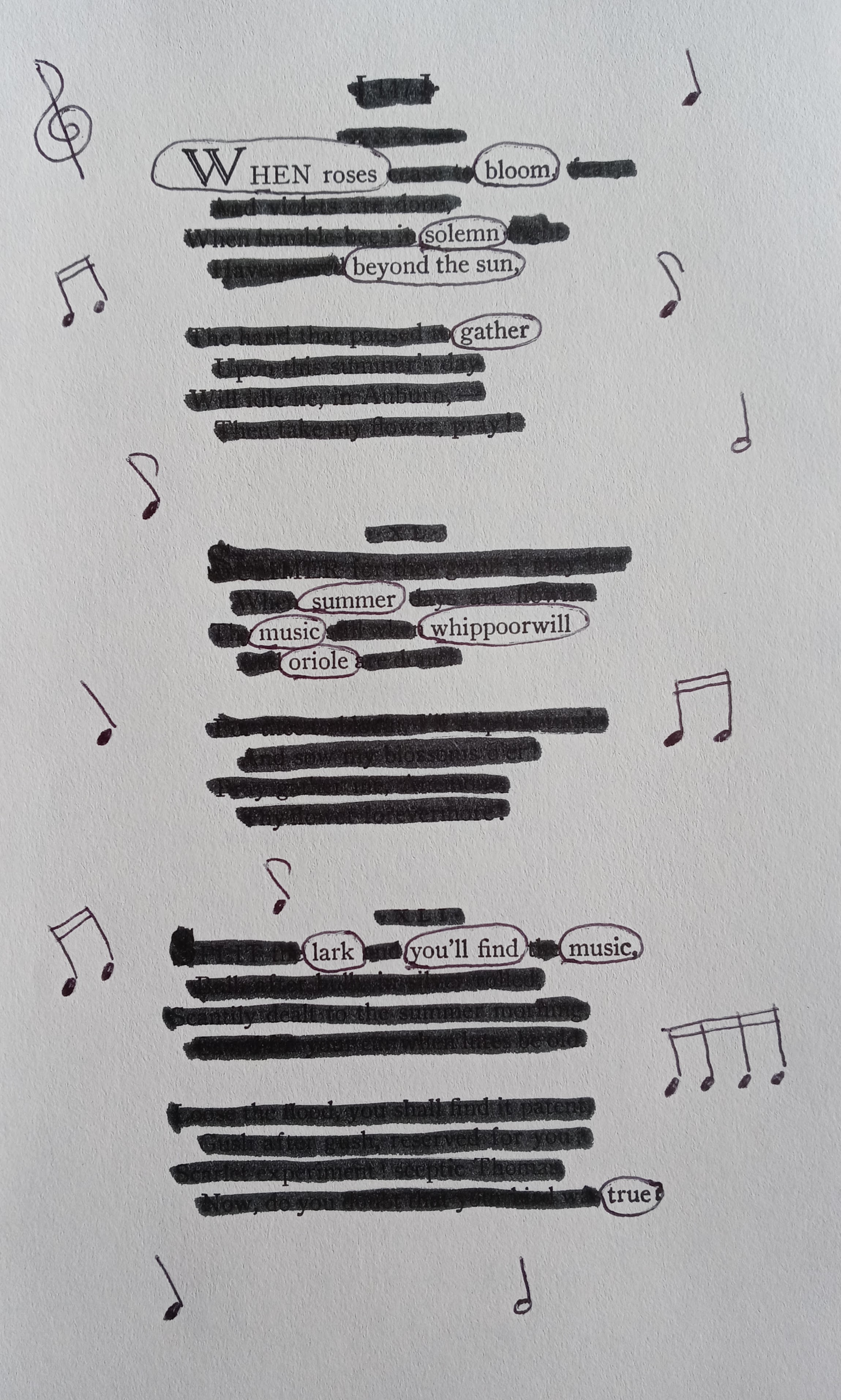
I have submitted two pages. Being more of a poet than a visual artist, I relied on erasure style with a bit of added decoration.

The pages will be displayed at the Poetry Center and may be shared on social media. At the conclusion of the project, they will be assembled and housed at the library as part of the Mortimer Rare Book collections.

What a fun and innovative way to leave a bit of myself “in residence” at Smith!

SoCS: JC’s Confessions #25

When I saw that Linda’s prompt for Stream of Consciousness Saturday this week was “key,” I knew that this would be another intersection with JC’s Confessions, my occasional series in which I “confess” to things that aren’t really sins but that I feel vaguely guilty about. (I’ll paste the usual intro to JC’s Confessions at the end of this post.)

I sometimes wear my Phi Beta Kappa key when I am nervous about a challenging meeting as a confidence booster. It’s on a necklace chain, so it isn’t that noticeable and, if someone does notice it, they are likely to think that it’s just my sorority or my husband’s fraternity key. (This would only be possible if the person doesn’t know us. I went to Smith College, which does not have sororities. B’s university did have fraternities but he would never have considered joining one.)

I think the origin of my feeling guilty about it is that I’m wearing it as a secret reminder that I am intelligent in the best liberal-artsy way, that I can use those skills to delve into new terrain, and that I can contribute to solutions to complicated problems.

That I want my membership in Phi Beta Kappa to be a secret is the problem.

So, I was always a good student. I was valedictorian of my high school class. I graduated summa cum laude from Smith College, which, at that time, placed me in the top 1% of my class. I made first election to Phi Beta Kappa in the fall of my senior year.

There is somehow in the United States an undercurrent of suspicion of people who are “smart.” Having been a good student is taken to mean that you must hold yourself above others. This is not at all true of me but others may assume it is and react in a hostile way.

I nearly always kept my little secret undetected. The one time someone noticed and commented on my key was when I was serving as a parent volunteer on a school district committee doing curriculum work. It was daunting for me to be the one person who was not a professional educator. We did do training together for the work but I had to rely on my personal skills and intellect rather than on pertinent academic background in education. Thus, my need to boost my confidence with my key.

During a break, one of the teachers commented on my Phi Beta Kappa. I probably blushed! In retrospect, it shouldn’t have surprised me, as he earned a couple of degrees from Harvard himself and would certainly have known those Greek letters when he saw them.

It was nice to have someone in on my secret that day, someone who understood what it meant without thinking I was being a show-off.

It’s been quite a while since I’ve worn my Phi Beta Kappa key. My life has been much more contained, especially since COVID appeared.

Maybe I’ll wear it someday not as a confidence booster but as a celebration of my now long ago academic past.

In the first few seasons of The Late Show, Stephen Colbert did a recurring skit, then a best-selling book, called Midnight Confessions, in which he “confesses” to his audience with the disclaimer that he isn’t sure these things are really sins but that he does “feel bad about them.” While Stephen and his writers are famously funny, I am not, so my JC’s Confessions will be somewhat more serious reflections, but they will be things that I feel bad about. Stephen’s audience always forgives him at the end of the segment; I’m not expecting that – and these aren’t really sins – but comments are always welcome.

JC

*****
As previously mentioned, Linda’s prompt for Stream of Consciousness Saturday this week is “key.” Join us! Find out more here: https://lindaghill.com/2022/08/19/the-friday-reminder-and-prompt-for-socs-aug-20-2022/

My 40th reunion at Smith

Last week, I attended my fortieth reunion at Smith College in Northampton, Massachusetts. For those who may not be familiar, Smith is a women’s liberal arts college, chartered in 1871, one of the traditional Seven Sisters, five of whom remain as women’s colleges.

I came into town a day early in order to meet up with an alumna friend who lives in Northampton and graduated a year before me. Her sister was a member of my class and passed away in fall 2020. I was honored to be able to commemorate her at the Service of Remembrance during our reunion. My ’81 friend and I enjoyed hours of conversation on her front porch, followed by dinner on the porch at Mulino’s, an Italian restaurant that did not exist back in my student days.

I stayed at the historic Hotel Northampton, which has fun features like a mail slot near the elevators on each floor that connects to a large brass mailbox on the main floor for pick-up by the postal service every morning. I also got to do a bit of shopping at Thorne’s Marketplace, a collection of local shops and restaurants housed in a grand historic building. Thorne’s was a fairly new undertaking back in my undergrad days and I’m glad to see that it continues to thrive. I bought some cards and gifts and books and made two trips to Herrell’s ice cream shop. I got a sampler each time, so I got to enjoy eight – count ’em, eight! – of their delicious homemade flavors. This will surprise no one that knows me. I also got to have lunch at Fitzwilly’s, a restaurant/bar that was also relatively new during my student days. I had mac ‘n cheese that featured fresh asparagus from a farm in nearby Hadley. I love asparagus, which is one of the glories of spring in New England; it reminds me of going with my parents to harvest a patch near my father’s hydro station, a remnant of a garden from an old company-owned house that had been torn down.

On Thursday afternoon, I went up to campus for the duration of reunion. Because of the pandemic, everyone had to have proof of vaccination and boosting to register and many of the meals and events were held outdoors. Indoor events were masked, except while eating and drinking. I immediately met up with some of my ’82 friends and the celebration began!

One of the things about Smith reunions – and Smith alums in general – is that we somehow manage to have meaningful conversations with each other at the drop of a hat. Perhaps because of our shared liberal arts background, we are engaged with a broad range of topics across current affairs, public policy, arts and culture, and on and on. Of course, the deepest conversations happen with our close friends but there is a lot of sharing of ideas with acquaintances, too. In retrospect, I wish I had prepared a succinct answer to the question “What do you do?” Lacking a shorthand reply, like “I’m a lawyer, working for this government agency” or “I teach at such-and-such school”, I found myself stumbling to explain forty years of my life in any brief, comprehensible way.

Unlike the vast majority of my classmates, I’ve done little paid work in my life. I’ve devoted many years to being a caregiver of both elder and younger generations, with more than our share of medical issues. I’ve volunteered in church music and liturgical ministry and facilitated a spiritual book study group. During my daughters’ years in public school I served on curriculum committees and shared decision making teams and helped design the honors program at the high school. I joined NETWORK, a national Catholic social justice lobby, in 2000 to advocate for social justice. I was part of the anti-fracking movement in New York which finally achieved an administrative and later legislative ban in our state; this led to ongoing involvement in the fight for climate and environmental justice. There is my writing life, as a blogger and poet.

This does not condense into an easy answer to “What do you do?” but it does constitute the bulk of my adult life, which would not have been as rich and varied were it not for my Smith education. The ideal of a liberal arts education is that you “learn how to learn.” By studying across the spectrum of academic disciplines, one absorbs different approaches to real-life issues, enabling critically sound and creative solutions that promote well-being for ourselves and others and for our environment.

Maybe I should have replied, “Just forty years of being liberal-artsy.”

The other thing that I hadn’t quite prepared myself for was the flood of family memories. Because it was only an hour-ish drive to campus, my parents visited often for concerts and events. They were there for my recitals in Helen Hills Hills Chapel and John M. Greene Hall. They visited at Haven House where I lived all four of my years on campus. There were there, of course, at B and my wedding, a few weeks after commencement with the reception at the Alumnae House. This reunion was the first time since their deaths that I was back on campus and missing them added another layer to the strange mix of familiarity and difference that the passage of forty years brings. For example, I thought about my parents when we were attending the remembrance service, sitting in rows of chairs where the pews had once stood. The pews were removed years ago to allow for more flexible use of the space but their absence felt strangely current when I remembered B and my parents there in the front pews on either side for our wedding.

I also found myself missing my mother in particular among the spring flowers. We were blessed with unusually warm weather for mid-May and the flowers and trees were blooming simultaneously and profusely in response. The scent of the lilacs between the President’s House and the Quad, where we were staying, was so overwhelming I nearly choked. There were lily-of-the valley in bloom, which are Nana’s birth flower. What would have been her 90th birthday was the day after reunion and the third anniversary of her death is a few days from now.

I’m grateful to have been among friends who could support me with this grief aspect. Many of us have lost our parents now, with some still in the phase of dealing with their final years and indeterminate endpoint. As classmates, we were also dealing with the deaths of more of our ’82ers, adding to the list that, sadly, began during our senior year when we lost one classmate in a plane accident and a second to cancer. That’s why I and some friends always make a point to attend the service of remembrance during reunion. We want to honor our departed ones and their importance in our lives, even if they left us long ago. After the service, we visited the memorial tree planted beside the chapel in honor of our classmate Beth. We took a photo which we will send to her mother, who I know finds comfort that we remember her all these decades after her death.

While the central activity in reunion is visiting friends, there are plenty of other things to keep us busy. Some are long-standing traditions, such as Ivy Day when the alums, wearing white, parade between rows of the graduating seniors, also wearing white and carrying red roses, welcoming them into the community of alumnae. The night before commencement, the central campus is illuminated with Japanese lanterns. People stroll among them with live music in several locations.

There are also a number of lectures, receptions, and concerts. The President gave an update on the state of the college. Everyone is very excited that grants are replacing loans in financial aid packages at Smith, making an education possible without graduating in debt. Smith also highlights its accessibility for students who are the first generation in their family to attend college. That was my situation forty years ago but it was not recognized in the way it is today. I also attended two lectures of interest. One was how the Botanic Gardens are being re-imagined in keeping with the UN Sustainable Development Goals and best practices for preserving species in the face of climate change, all with an eye toward education and social/environmental justice. The other was about the transition of campus to ground-source heating and cooling, which will be a major contributor to Smith being carbon-neutral by 2030 without making extensive use of purchased off-sets. I was particularly interested in this because of the projects we have done at our home to reduce our carbon footprint and because my church is in the process of drawing up a strategic plan to reduce or eliminate our use of fossil fuels.

Besides college activities, we had a few opportunities just for our class. I alluded to one in this post – an open mic event to read something from our college years. I chose a passage from my adult psychology course journal about my experience coming from a tiny town to Smith. A few of us had brought something with us but we had time to do additional sharing which was fun. Our class theme for Reunion was “Writing Our Next Chapter” and I appreciated that our futures also came into that discussion.

We were also honored to have a preview screening of Where I Became, a documentary about South African students who came to Smith during apartheid. Our classmate Jane Dawson Shang is co-producer and shared some of her experiences making the film. When it becomes publicly available, I will surely share that information here at Top of JC’s Mind so everyone can see the remarkable story of these women.

Reunions at Smith are always exhilarating but exhausting. I had originally planned to attend commencement on Sunday morning but opted for quiet conversation with friends. Walking 17-20,ooo steps a day for three days straight in hot. humid weather proved to be a bit much for my feet and ankles, which swelled rather impressively.

It also meant that my reunion experience ended with what is always most important, sharing with friends in a place that was instrumental to our lives. I hope to see some of them and return to campus before our next reunion.

Five years seems too long to wait.