orthodontia

I’ve spent years dealing with other people’s orthodontia. Spouse B in his twenties needed braces to correct his bite and preserve his teeth for the long haul. Both of our daughters inherited his jaw and went through an assortment of jaw growth appliances, full wires, headgear, and retainers.

I did a lot of traipsing people to appointments and making soft foods and supervising tooth hygiene and such, but never had to directly deal with orthodontia myself.

Until now.

My mouth has always been small for my teeth. I had to have all four of my impacted wisdom teeth removed surgically because there was nowhere for them to go. My bite had been good in my younger years, so I hadn’t had to worry about braces, but, as I’ve aged, my teeth have moved and crowded together in such a way that my bite is affected. In order to preserve my teeth for what we are hoping will be another couple of decades, I needed to take action.

Last week, I started treatment with the Invisalign system. Several weeks before, my dentist’s office had taken a series of digital photos and measurements, which Invisalign used to create fifteen pairs of clear aligners which will gradually shift the teeth into their new positions. Each set is worn for two to three weeks. There are little pegs bonded to some of my teeth to help keep the aligners in place, although they fit pretty tightly on their own. The system is designed for the aligners to be worn at least 20-22 hours a day. They need to be removed to eat or drink anything other than cool to room temperature water.

Adjusting to this is…a process.

I’m finding that taking the liners in and out is subject to a fairly steep learning curve. By design, the liners are tightly fit and put pressure on the teeth to shift them, so there is a fair amount of finesse required to get them out and then snapped back in place. As you can imagine, the teeth of a 61-year-old are not especially inclined to move quickly in a new direction and will probably noticeably loosen a bit to accomplish this, but these first few days are causing considerable discomfort, especially during the removal and insertion process, while brushing, and while eating. Due to my particular problems, biting into anything with my front teeth is not possible at the moment.

My mouth is fairly comfortable when the liners are in, so I am minimizing the number of times I have them out. Fortunately, I often only eat twice a day and don’t snack or drink anything other than water between meals, so I’m cutting down on the amount of pain. I’m trying not to catastrophize this initial adjustment period as indicative of the eight to nine months of expected treatment time. I spoke with the dentist’s office yesterday and, while I seem to be on the more severe side of the discomfort scale, they expect that I will get adjusted soon and then be more in line with the usual day or two of discomfort when progressing to a new set of liners.

We did decide to adjust when I would make that move due to a personal commitment. Rather than moving to set two next Wednesday night, I am going to delay to the following Sunday. As it happens, I will be travelling to Northampton, Massachusetts, that Wednesday to attend my fortieth reunion at Smith College. There will be lots of group meals and receptions and some longer periods of time when my liners will need to be out, so it’s best to not have the extra pain and complication of a new set of liners thrown in on top of that.

I’m also hoping that I will be more adept at getting the liners in and out by then. My goal is to get to the point where I can accomplish this in under a minute. Now, it can take several (uncomfortable) minutes in front of a sink and mirror, which may be difficult, or at least embarrassing, to engineer on a campus with thousands of soon-to-be-graduates, students, staff, alums, and guests.

I am nothing if not persistent, so I will keep working on this adjustment and deal with whatever complications come my way. This trip to Northampton will be a trial run for travelling with Invisalign because B, T, and I will be heading to London late in May to visit daughter E and family. We will be there for granddaughter ABC’s fifth birthday in early June.

At least, birthday cake is easy to chew!

SoCS: travel

Now that it’s (maybe) safer to travel, there are a few trips that I and/or family members may take this spring.

T is going to a high school friend’s wedding in Florida in April. Arrangements are all in place so this is the surest bet to happen.

The three of us have been wanting to get back to the western MA/southern Vermont area where B and I grew up and where we still have friends and relatives. Maybe we will actually make it when the weather is better and we work through a few health things that have been annoying us lately. At the moment, it’s snowing like crazy, a reminder that spring is not here yet.

B and I also are hoping for a getaway this spring. It’s been a while since the two of us could do this, first due to caring for our elders and then still having the pandemic hanging around. Granted, the pandemic is still with us, much as we all wish it were over, but the rates of infection are finally getting down to where leisure travel is possible. My sisters gave me a lovely gift certificate to a posh Finger Lakes inn that I want to use this spring, especially because our 40th anniversary is approaching.

Speaking of 40th, my reunion at Smith College is in May. We finally got word on March 1st that it will be in person. (The last couple of years had been virtual due to the pandemic.) We haven’t started the registration project yet but I’m definitely planning to attend and stay on campus, as is traditional. Our reunion will be the same weekend as commencement; it’s always great and energizing to be on campus with the students and a fuller celebration of the traditions, such as Ivy Day and Illumination Night.

I also have my fingers crossed for another trip to London to visit daughter E and family. We are hoping for June but it’s so hard to say right now if it will be possible. Will there be another variant racing around the globe? Will there be war ongoing? It’s so painful to think of the current suffering, much less project its horrifying dimensions into the future.

Which trips will take place and which will (yet again) be deferred? I don’t know, but it’s likely that you will find out here at Top of JC’s Mind.
*****
Linda’s prompt for Stream of Consciousness Saturday this week is trip. Join us! Find out more here: https://lindaghill.com/2022/03/11/the-friday-reminder-and-prompt-for-socs-march-12-2022/

the pleasures and dangers of poetry readings

One of the opportunities that has arisen during the pandemic is the easy availability of poetry readings, as many institutions have re-imagined their live readings as online events.

I admit that I wasn’t in the habit of going to a lot of readings in-person before the pandemic. They are usually in the evenings and I try to keep as much evening time reserved for family as possible, so it was difficult for me to commit to the transport time plus the reading time. That is less of a factor now that I can attend and still be at home, in case something comes up that needs my immediate attention.

I’ve had the opportunity to attend a virtual book launch for fellow Boiler House Poets Collective member Erica Bodwell’s Crown of Wild. I heard one of my Smith College poetry godmothers Anne Harding Woodworth read from her new book Trouble, as well as her previous books. I’ve tuned into readings sponsored by the Smith College Boutelle-Day Poetry Center and the Binghamton University Center for Writers. I have even participated in an online reading with the Binghamton Poetry Project.

It’s been wonderful to hear poets reading their work and I’ve also appreciated the opportunity to hear poets speak about their lives and work in interviews or question and answer sessions.

I admit, though, that these discussions, particularly when they take place in academic settings, can shake my sense of myself as a poet.

I consider myself to be a community poet, meaning that my work is informed by my experiences much more so than by my academic background. While I have been blessed with learning about craft through the Binghamton Poetry Project, the Broome County Arts Council, Sappho’s Circle, and my poet-friends of the Grapevine Group and Boiler House Poets Collective, the last time that poetry was a significant part of my academic work was in grammar school, many decades ago. I’ve also learned a lot by reading different poets.

In comments in their readings, poets that I admire talk about the wonders of writing in forms like sonnets or villanelles and how this focuses their writing.

I’ve tried variously to write in form. I’ve never managed to write a traditional sonnet or villanelle that was worth making it out of my notebook.

The thought of trying to write a decent sestina is enough to make me break out in hives.

I do a bit better with forms that have made their way into English from Japan. I have written some successful haiku, tanka, and haibun. I am especially fond of tanka and have included several in my chapbook manuscript, which is still in circulation with publishers and amassing an impressive list of rejections. (Note to self: send more submissions.)

When I am feeling shaken about not having formal training, an English major, or an MFA with all their attendant skills and expertise, I try to remember the times that my poet-friends have reassured me that, although my poetry is different, it is still worthwhile – and that I am indeed a poet.

Now if I can just find those presses and publishers that agree…

anniversary reflections

Earlier this month, I wrote about June birthdays and mentioned B and my 38th wedding anniversary while writing for Stream of Consciousness Saturday here.

Our celebration of our anniversary was different this year. We usually try to go away for a couple of days, usually to a small inn in an historic, picturesque location where there are nice places to stroll and good restaurants.

This year, B did get to take most of the day off from his now-working-from-home job. We did go out briefly for a couple of socially distanced errands and an afternoon visit to the walk-up window at a favorite local ice cream shop, but we made dinner at home with T and had a quiet evening in. All of which seemed right for this somber time.

Thirty-eight years is a respectable amount of time for a marriage and gives me hope that, if we can keep life-threatening disease at bay, we will be able to celebrate our fiftieth anniversary, as we were able to do with our own parents.

Perhaps because we are hearing so much about people changing the date or plans for their weddings, I find myself thinking about B and my wedding, the changes in plan that it entailed, and how it was perceived.

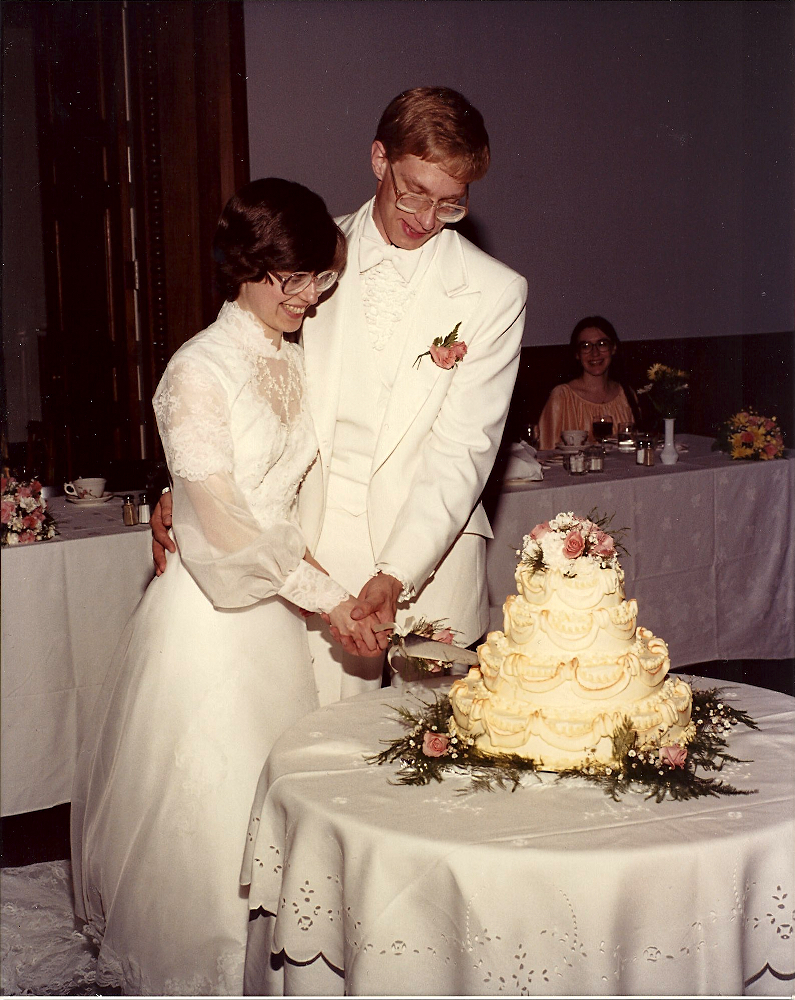
Because B and I were planning to marry shortly after I graduated from Smith College, my mother and I did most of the planning the summer before my senior year. Those were still the days where the tradition of the bride and her family doing most of the wedding arrangements (and paying the costs) was still observed, especially when the bride was young and not established in a career. I chose to be married at Helen Hills Hills chapel on the Smith campus. I had been involved in the life of the chapel throughout my years at Smth, as an organist, choir member, and accompanist and was close to Sister Judith, the Catholic chaplain. The reception would be at the Alumnae House, a short walk down Elm Street from the chapel.

There was no resident priest on campus, so an associate from one of the Northampton parishes presided at mass on Saturdays. I asked him to preside at our wedding ceremony and he agreed. In January, he was re-assigned to a nearby city and decided that he would not come to the wedding. A young priest who was assigned to the University of Massachusetts-Amherst was filling in at Smith for the spring semester became the default priest for our wedding.

This turned out to be very problematic.

He didn’t know me – that I had been serving as a Catholic church musician for over seven years, that I took my faith seriously, and that I had also studied the history of Christianity in the United States and around the world. He also didn’t trust me, which was hurtful. When I met with him to do the questionnaire that is required, he made me swear on a bible to tell him the truth, as though I was going to lie to a priest.

In May, during the reading period before my last-ever final exams, the priest and I were taking a walk on the Smith campus to finalize some of the details. Because B is not Catholic, we were having a ceremony, not a mass, which should have made things more flexible. The priest, however, would not allow any changes in wording, would not allow Sister Judith to read the gospel or offer a reflection, which should have been allowed outside a mass. As we were finishing the walk, he said to me that he thought I would be more comfortable being married in a non-Catholic ceremony.

I was devastated. It was six weeks before the wedding and I didn’t have a member of clergy to preside. I went to the chapel offices in tears. Sister Judith wasn’t there, but Rev. John, the ecumenical Protestant chaplain was. He immediately offered to preside and gave me some different prayer books to look through to find a new ceremony to follow. We had to file dispensations of place and form so that the Catholic church would recognize the marriage and the priest would still read the vows, although they would be from the Episcopal Book of Common Prayer. The best outcome was that Sister Judith delivered a beautiful reflection.

People often say that their wedding days are perfect and they wouldn’t change a thing, but there are some things I would change if I could. I would have made a recording of the ceremony because Sister Judith spoke without notes, so I have only memories and not a record of what she said. I also would have ignored the advice of the wedding gown shop and not worn heels and a headpiece that stood up on my head. Because B is about ten inches (25cm) taller than I, they were trying to make me look taller, which seemed silly at the time and even sillier now. Most of all, I would change the trauma and drama of the clericalism that led to my not having a Catholic wedding, the clericalism that still infects the church and causes so much damage.

Our wedding and reception were designed to be an adult affair, so we didn’t invite children. This wasn’t unusual at the time, but didn’t set well with a family member who wanted their grandchildren to be invited. I’m still sorry that those young cousins had a very boring day.

Some of the adults were bored and upset, too, although I, thankfully, was not aware of it at the time. The Alumnae House could serve wine but not liquor, which upset some people who somehow thought they were owed an open bar. We also did not have dancing; neither B nor I enjoy dancing and Alumnae House is not set up for it. After dinner and our delicious spice cake with buttercream icing, a break from the super-sweet white cake with white frosting that was traditional at the time, B and I went from table to table, visiting with our guests. Strangely, after we talked to people at a table, most left, so that, by the time, I changed to leave for our honeymoon, only immediate family and a few close friends were left to wave good-bye.

I don’t regret our reception choices, which reflected our personal style and preferences. I was sad that some guests gave my mother grief, although I didn’t realize that was happening at the time; it was very rude. I was also sad that people were putting their expectations over our true-to-ourselves choices.

My biggest take-away in looking back on the not-entirely-perfect wedding day that B and I had 38 years ago and in hearing so many stories of couples re-defining their own weddings due to the pandemic is that, while weddings are important days in our lives, they are just one day in a marriage. The accumulation of those days, each presenting joys and challenges, is what is most important.

Love is always most important.

Smith commencement

On this weekend in an ordinary year, the Smith College campus and Northampton, Massachusetts would have been awash in graduating students, their families, and returning alumnae, participating in the traditional activities of commencement and reunion. (While all reunions used to be held simultaneously, now only landmark years, such as the 25th and 50th hold reunions in conjunction with commencement weekend. The other classes meet on the following weekend.)

This year, though, because of the pandemic, the festivities moved online. Saturday evening, the campus would have been illuminated with hundreds of lanterns. Instead, there was a global illumination event, with alumnae and friends of Smith lighting their own lanterns or candles in honor of the class of 2020.  Commencement was livestreamed on Facebook, with a special Zoom experience for graduates, family, and friends.

As a proud member of the class of ’82, I watched the first part of the ceremony. (I admit that I didn’t watch the conferral of degrees, which included the name and photo of each graduate.) I was surprised by how often the alumnae were invoked in the addresses. It’s comforting to know that the strong connections among alumnae and to the institution persist, despite the efforts to divide people that have been so worrisome in the United States in recent years. I add my sincere good wishes to the new alumnae as we all try to find a positive path in the face of these troubled times.

Here are some of the things about the ceremony that I found especially striking:

  • The acknowledgement of the indigenous peoples of the region where the Smith campus now is by Director of Religious & Spiritual Life and College Chaplain Matilda Rose Cantwell ’96
  • The strong bond that President Kathleen McCartney has with the students, the alumnae, and the entire campus community and the sensitivity with which she treated the disruption of the pandemic
  • That 2020 Senior and Alumnae Class President Dimitra Konstantinos Sierros chose to attend Smith for much the same reason I had – because the students she met as a high schooler were so engaged and interesting that she wanted to be a part of such a vibrant community
  • That Speaker of the House Nancy Pelosi drew together the accomplishments of notable alumnae and the activism of the class of 2020 in her commencement address, while looking forward to the future endeavors of the graduates

This is not a reunion year for my class. When we meet for our 40th in 2022, I expect that there will be a vaccine and/or effective treatment for COVID-19 widely available so that we will be allowed to travel and gather on campus, although masks and less physical contact may still be a feature of post-pandemic life. I sense, though, that this experience of nurturing community at a distance will make our bonds even stronger.

The class of 2020 may prove to have the strongest bonds of all.

Spring flowers!

When I was a student at Smith College, one of my favorite annual events was the Spring Bulb Show at Lyman Plant House. It isn’t available to the public this year, but here is a lovely video tour. Enjoy!

Why we went to Slovenia

I have done a couple of posts on Slovenia here and here, but am hoping to do a series of posts on different things that we did and saw there. I thought I’d start on the reason we travelled to Slovenia.

I am a member of the Smith College Alumnae Chorus. We sing at occasional events on campus in Northampton, Massachusetts, and every other year or so, go on an international tour. This year, we spent a week in Slovenia. We sang the Haydn Missa in Angustiis, also known as the Lord Nelson Mass, and the Duruflé Requiem, in conjunction with orchestra, tenors, and basses from Slovenia. We did have a few tenors and basses of our own along, mostly spouses of alumnae, but, as a women’s college, the vast majority of our chorus is sopranos and altos.

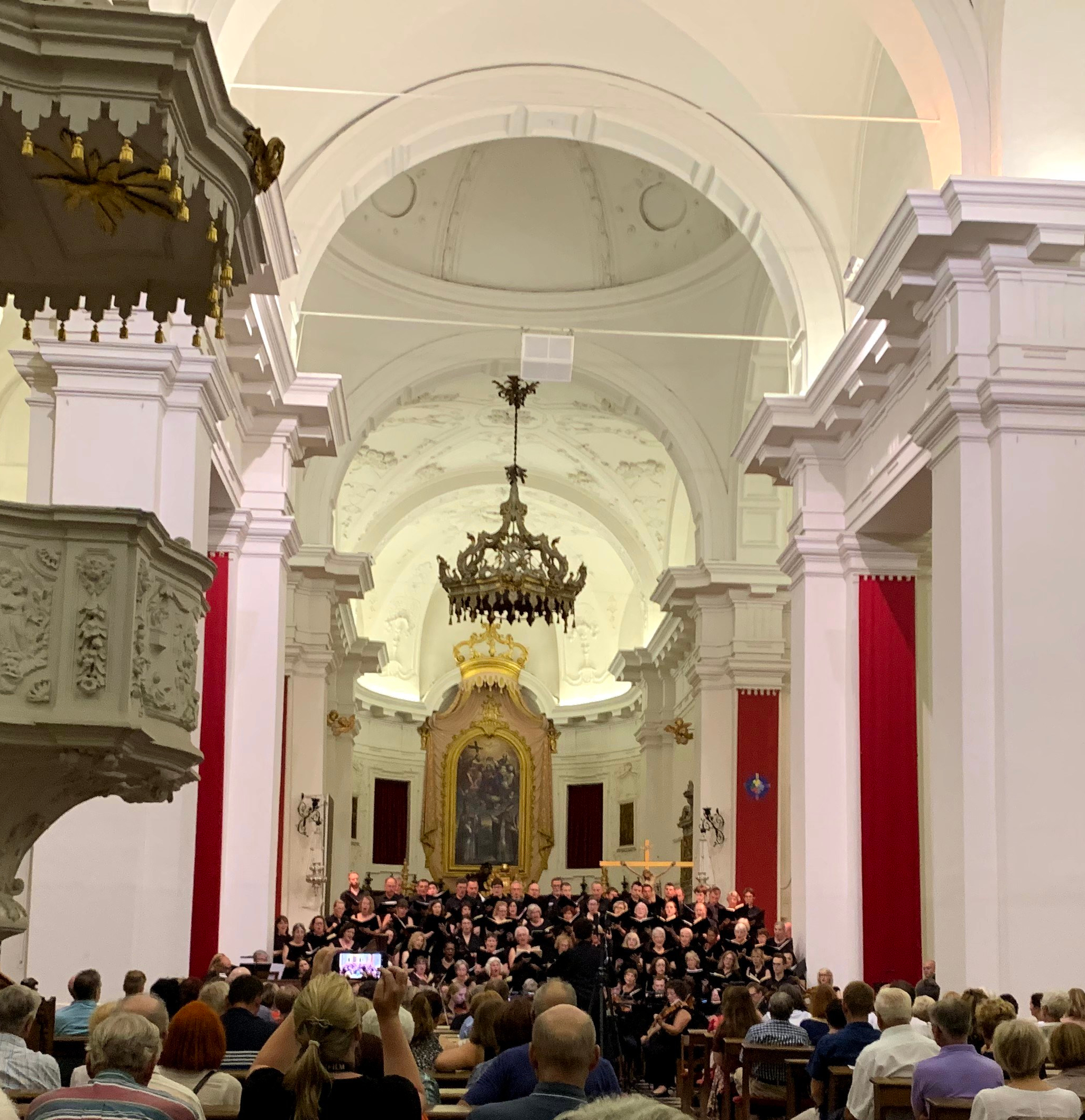
We performed two concerts under the direction of our conductor Jonathan Hirsh on our last two evenings in Slovenia. Our Friday night performance was at the cathedral in Koper.
Koper cathedral performance

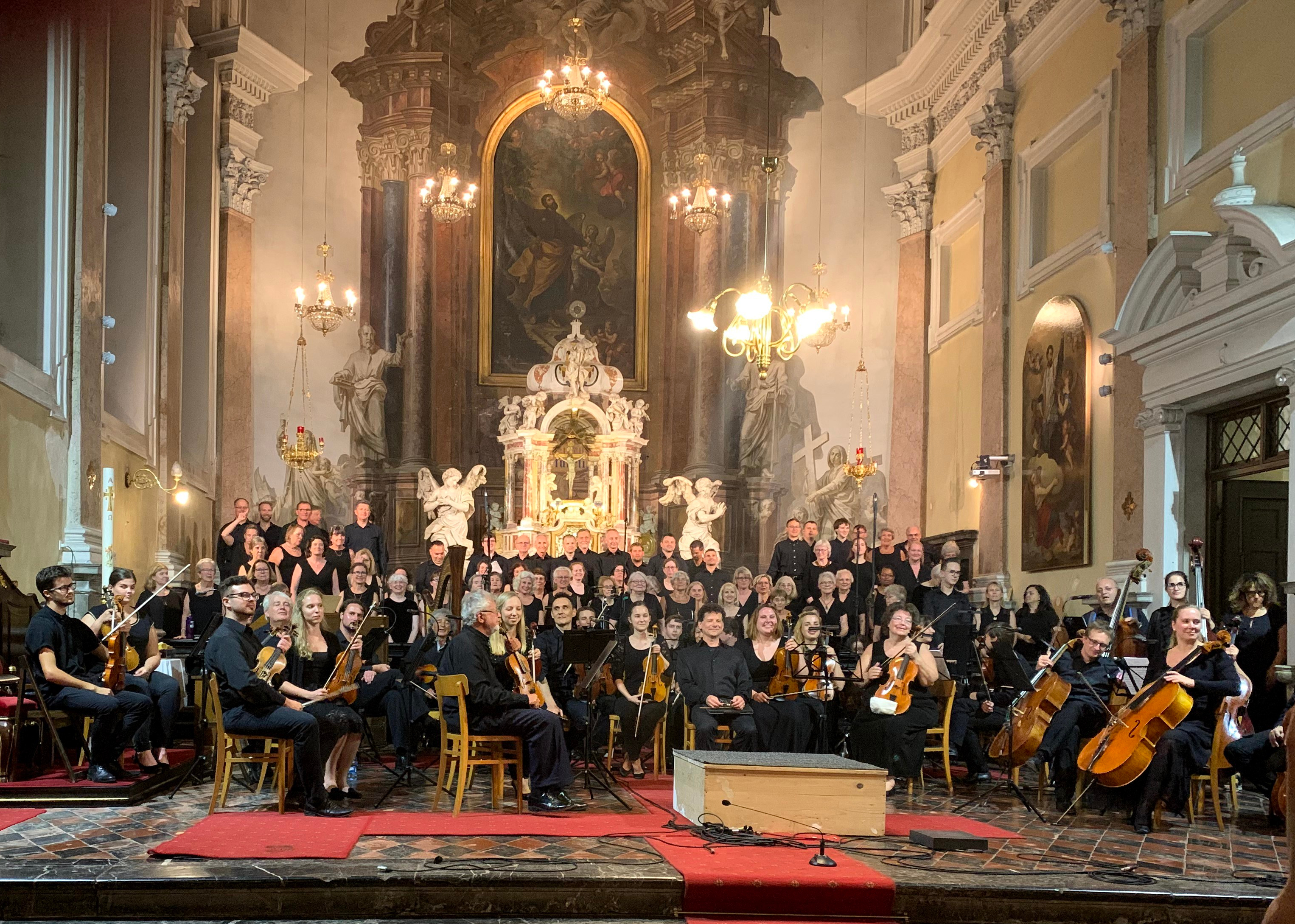
On Saturday night, we performed at Saint James’ Church in Ljubljana. To our surprise, a representative from the United States Embassy came to greet us and the performance was recorded by the Slovenian public broadcasting service.
St. James Ljubljana performance

To the delight of the audience, Maestro Hirsh addressed them in Slovene before each concert. He told them a bit about our chorus’s mission to collaborate with local musicians when we toured and a bit about each piece. Both were written in times of strife and uncertainty. The Haydn, which was the first half of the concert, ends with a forceful plea for peace. The Duruflé, however, is much more meditative and ends very quietly with the “In Paradisum” as the soul enters into paradise. Mr. Hirsh asked the audience to take a few moments to reflect before applauding.

Those moments of silence, after the last chord had finished reverberating in those magnificent spaces, were incredibly moving, illustrating the power of music to reach across language, social differences, and time to touch hearts and minds.

SoCS: art from friends

back in Northampton

In my second year at Smith College, a new voice teacher arrived on campus. Her name was Karen and my dear roommate Mary became one of her first students. Through Mary and her friendship with Karen that continued over the decades since we graduated, I felt a personal connection with Karen and had had a chance to reconnect with her a few times over the years when I was back in Northampton.

On March 23rd, a retirement recital was being held in her honor. Mary, who now lives in Colorado, had been planning for months to attend and marshaled me and two of our classmates, both sopranos who studied in the department with other teachers, to join her for the concert weekend.

The recital was given by one of Karen’s more recent students, Victoria Fraser ’10. It was a lovely mix of compositions, including a rarely-heard Buxtehude psalm setting. I was especially touched by “i carry your heart”, a setting of the e.e. cummings poem by Smith professor John Duke (1899-1984).  I have sung a choral arrangement of the piece and loved hearing Victoria’s sensitive interpretation of Duke’s original art song setting. It also reminded me of a board book of the poem, illustrated by Matti Rose McDonough, which daughter E bought for granddaughter ABC, which brings me to tears every time I look at it.

The only thing that could have improved the concert would have been the opportunity to hear Karen sing. I have many fond memories of hearing her expressive soprano voice when I was a student. She went on to sing in many recitals and concerts over the years, including singing premieres of works by Smith faculty composers Donald Wheelock and Ronald Perera, who was the Elsie Irwin Sweeney professor at Smith, an honor which Karen now holds.

The post-recital reception was fun! Many of Karen’s colleagues, most now emeriti, gave little speeches about her and told stories about her with warmth and humor. It was nice to see some of the faculty members with whom I had studied. At the same time, it was sobering to realize how much smaller the music department is now, both in number of faculty and number of students involved. It reinforced the discussions we alumnae had had three weeks earlier when we had gathered to sing Brahms Requiem to bolster the current Smith choral ensembles.

The next day, our class of ’82 quartet spent most of the afternoon visiting with Karen in her office. It was enlightening to hear about how things have changed over the years on campus and within the department. We told Karen what has been going on in our lives and listened to her plans for her retirement. We are happy to know that she will be staying in the area, so that when we return to campus we will still be able to connect with her, now without the time constraints of teaching, committees, and all the other obligations that come with being a professor.

The rest of the time, we four talked and ate and talked and shopped and talked and ate ice cream from Herrell’s. I admit that I also snuck in a solo run to Herrell’s, so I enjoyed not one, but two, samplers on Saturday!

After Palm Sunday services on Sunday morning and the scrumptious brunch buffet at Wiggins Tavern, I had to say good-bye to head for home. I am hoping there will be more mini-reunions in the future. We realized that we can arrange a weekend together even without a special event, so I hope that we will get together again later in the year when Mary comes east to visit her family in New England.

after the concert

Singing the Brahms Requiem was draining, but afterward, instead of feeling tired, I was having a bit of an adrenaline rush. I said some thank yous and goodbyes and headed back to my friend CK’s home.

When CK invited me to stay with her, she had graciously offered to have a few friends from our Smith years over after the concert. As it happened, a couple of guests grew to three, then five, then seven, until finally we were a group of ten alums from ’81-’83 with two spouses, one of them CK’s husband who was our co-host.

CK handled everything with aplomb, starting with cheeses, dips, and deviled eggs, moving on to three delicious homemade soups with bread and three salads, and ending with a make-your-own sundae bar featuring four pints of gourmet ice cream from Bart’s, a local company. And there was malted vanilla!

Whenever Smithies get together, there is an instant connection and always lively conversation. Each of us knew someone else there well, but each also was getting know someone for the first time. We talked about music, of course, as we were all choral singers, about Smith, about generations of family, about technology, and more, in various constellations, for hours.

It was a wonderful way to cap an amazing day!