Silver Birch Press has just published my tanka, “Natives“, as part of their BUGS & INSECTS series! Many thanks to Melanie and SBP for including me in this months-long series!
I really appreciate that SBP includes author notes. Here, it’s a chance to talk a bit about native plants and pollinators.
Please feel free to comment here or on the post itself, if you are so moved. Also, you can click around and read some of the diverse work centered around bugs and insects in this series or re-visit past series. I’ve loved participating in a number of Silver Birch Press prompt series over the past several years and hope to submit to more in the future.
This was very useful because we lived in a rural setting with no houses nearby so you couldn’t go to the neighbors’ house to borrow a needed tool or recipe ingredient. The grocery store was 20 miles away so it wasn’t easy to pick up bread or milk or whatever you might have run out of, so we kept a well-stocked pantry and freezer.
Even though I live in a neighborhood now – and have for years – I still tended to keep extra supplies on hand, in order to be prepared for a change in plans or an unexpected circumstances.
Still, though, despite preparations, there are some things for which we are never quite prepared.
Recently, I’ve had some instances of re-visiting my poetry chapbook, Hearts. The poems center on my mother, especially her final years when she was living with heart failure. We knew that she was slowly dying and tried to prepare but, when the time came, it was still somewhat of a shock. I know from discussions I’ve had with others that our preparations for loss are seldom adequate.
For me, there is, though, a certain comfort in trying to prepare, even when my preparations aren’t sufficient.
I started Top of JC’s Mind in September, 2013, and, sometimes, I like to take another look at some of my older posts.
It’s an eclectic blog with lots of topics and you could rummage around in old posts, too, if you like.
Sometimes, I am looking back for specific topics or events. There are also threads that weave in and out over time.
For example, I wrote a lot of comments on the eventually successful campaign to keep shale gas fracking out of New York – which had a brief, ugly reprise in the more recent effort to add CO2 fracking to our state ban. There are also renewable energy posts, including posts on heat pumps, solar panels, and EVs. We are proud to be an electrified household powered by the sun!
There are poetry posts, including posts from my residencies with the Boiler House Poets Collective at the Studios at MASS MoCA which began in fall 2015.
I’ve written quite a lot of COVID/pandemic posts. I’m humbled that one of the local historical societies has been printing those posts to place in their archives for possible research in the future.
The most poignant posts for me are the ones that involve my family. I wrote about my parents in their final years. Those posts were helpful to me at the time as a way to process what was going on but are also good to look back on from time to time.
While I’m admittedly not a great photographer, I’ve tried to include some photos. It’s handy that, during the years of Top of JC’s Mind, we have had family living in Hawai’i, and later, London. Even an amateur can take decent photos in those settings. I also like to take photos in the western Massachusetts/Southern Vermont area where I lived as a child and teen.
So, I invite you to take another look at Top of JC’s Mind.
murdered poet gifts words crowds magnify Renee’s voice radiates Good
Sharing again the haiku I posted Monday about Renee Nicole Good, whose death at the hands of an ICE agent in Minneapolis has horrified millions in the United States and around the world.
murdered poet gifts words crowds magnify Renee’s voice radiates Good
After finding out the day after her murder that Renee Nicole Good was a poet, I woke up Friday morning with the idea for this haiku in my head. I worked on it and sent it to the nearly-impossible-to-make-the-cut Rattle Poets Respond, which requires submissions by Friday midnight that relate to news from the last week and were written in that time.
After the anticipated rejection arrived, I pondered whether to try another venue or publish it here. I had the rare opportunity to meet with the Grapevine Poets yesterday and decided that I should share it here so it would be available in a timely manner.
I used to meet with the Grapevine Poets for early-evening workshopping every other week but haven’t been able to for most of the last two years due to my health situation. Yesterday, we had an afternoon craft discussion, which I could manage because I could muster enough energy and brain power at that time of day.
During this time of health struggles, I haven’t been able to write poetry very often, so I’ve seized this opportunity. I like writing haiku and tanka and those forms hold the additional appeal of being very short, which matches my limited energy and ability to focus. I haven’t shown this to anyone so this is just coming from my own head and heart.
A feature of this haiku is that I chose to forgo punctuation and capitalization, other than Renee’s name. This gives the opportunity to read the lines with pauses in different places, which places emphasis on different words. It also makes this haiku particularly dense. I’m not sure if this works for other readers or not, but I would appreciate any comments that anyone might like to share.
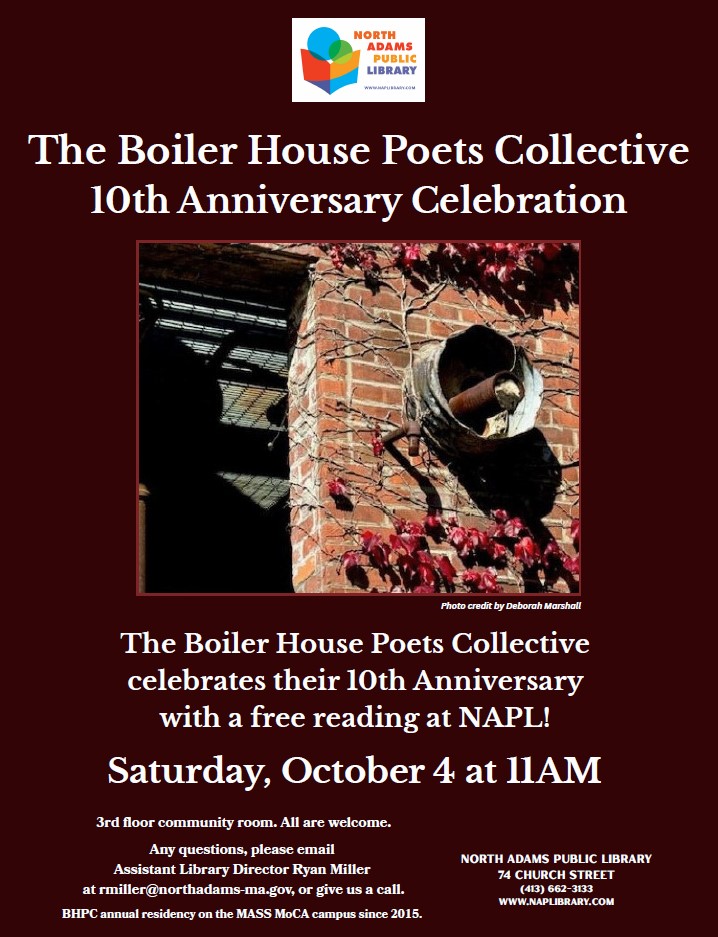
When I wrote this post on the Boiler House Poets Collective‘s tenth anniversary reading (and my birthday), I fully intended to post another couple of times during the residency, but that didn’t work out, so this is my catch-up attempt to encapsulate the rest of the residency.
Sunday was a busy day. Leery of being in an enclosed space with lots of people for over an hour, I opted for online mass. I got the above-linked blog post out and worked on an alternate bio poem modeled after one Judy Hoyer had brought to a BHPC workshop session earlier in the residency. Instead of eating with the other poets at 1:00 – daily lunches are part of our residency package – I took my lunch down the block to Main St. to await the arrival of the Fall Foliage parade. Because it was bizarrely hot (mid-80s F./29 C), I decided to wear the T-shirt that daughter T had given me for my birthday which says “This heat wave was brought to you by Big Oil.” I found a place in the shade and ate my lunch, enjoying watching the crowd, especially the little ones, as we waited for the parade to reach us.
I had read a poem at the reading the day before contrasting the full-scale parades of the my childhood in the ’60s and ’70s with the very subdued parade of 2016 where there were very few spectators and almost no children, either watching or participating. I’m happy to report that the 2025 parade was much more vibrant, with more community groups represented, including a lot of youth groups, such as Scouts, dance troupes, and sports/cheer teams. I admit that the high school bands are still at least 50% smaller than when I was a student at Drury in the ’70s, but they may grow as these younger children reach high school in a few years. I did feel sorry for the bands in their wool uniforms and the uniformed fire fighters marching in that heat, while the spectators were wearing shorts and tees. I appreciate the revived community spirit and later had a conversation with a BHPC member who lives in North Adams about recent gains in bringing together the people who have lived in the area for generations and the more recent arrivals drawn by MASS MoCA (Massachusetts Museum of Contemporary Art) and the growing arts scene. I hope that spirit will continue to strengthen and make North Adams stronger for all the residents.
Later in the afternoon, we workshopped. I brought the alternate bio poem and was shocked that people enjoyed it. By nature, that kind of poem is more light-hearted than my usual work and I am not known for being witty or humorous, so I was happy I managed to pull it off. After that, we walked to dinner and then back to our apartment for evening conversation.
It turned out to be more than I should have attempted, especially with the hot weather and the busy day on Saturday. I had to scale back on my activity level for our final two days.
There were some highlights, though. I had a delicious breakfast on Monday morning with Cousin S at Renee’s Diner. Monday evening, we ate at Grazie in their new location. Most of BHPC’s welcome dinners on the first evening of residency had been held at Grazie when it was located on the ground floor of the apartment building we call home during our time in North Adams. We definitely wanted to visit their new home, which is larger and has a parking lot! After dinner, we had our planning meeting for next year and I was thrilled to know that all ten of us want to return in October, 2026. Exact dates still need to be scheduled by The Studios but it’s nice to know that we don’t have to do any recruiting over the winter.
A highlight of Tuesday was a morning concert that BHPC member Carol Mikoda offered during storytime at the North Adams Public Library. It was in the same room where we had given our reading, except with a colorful mat on the floor, perfect for all the bouncing, dancing, and crawling the little ones did in reaction to Carol’s singing, accompanied by her guitar. Many of the songs were original compositions and the adults present enjoyed her clever lyrics. Carol had another momentous event occur during the residency. Her newest book, Outside of Time, was released by Kelsay Books. Congratulations, Carol!
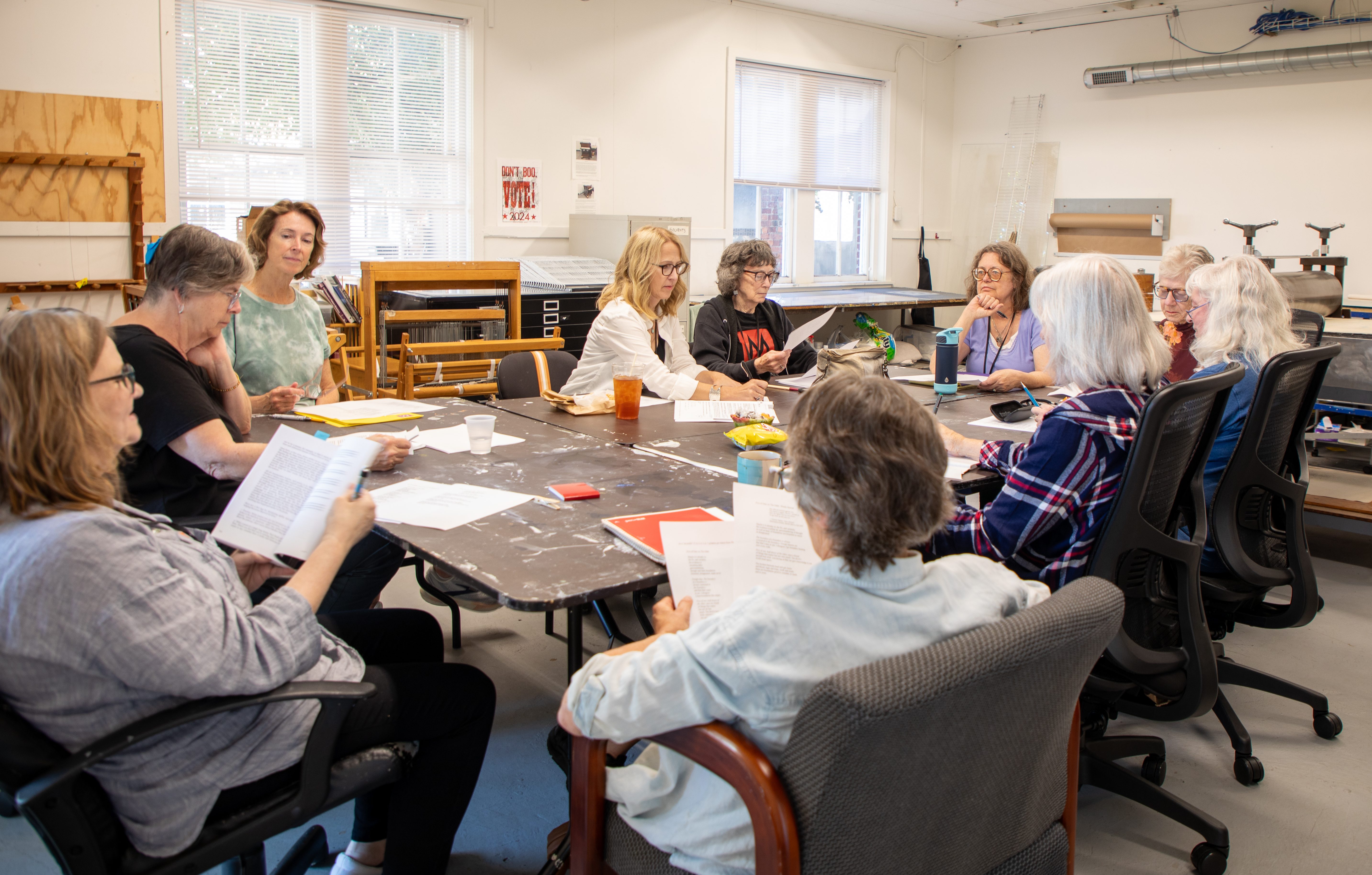
BHPC workshopping in bldg 34
Photo credit: Carolina Porras Monroy
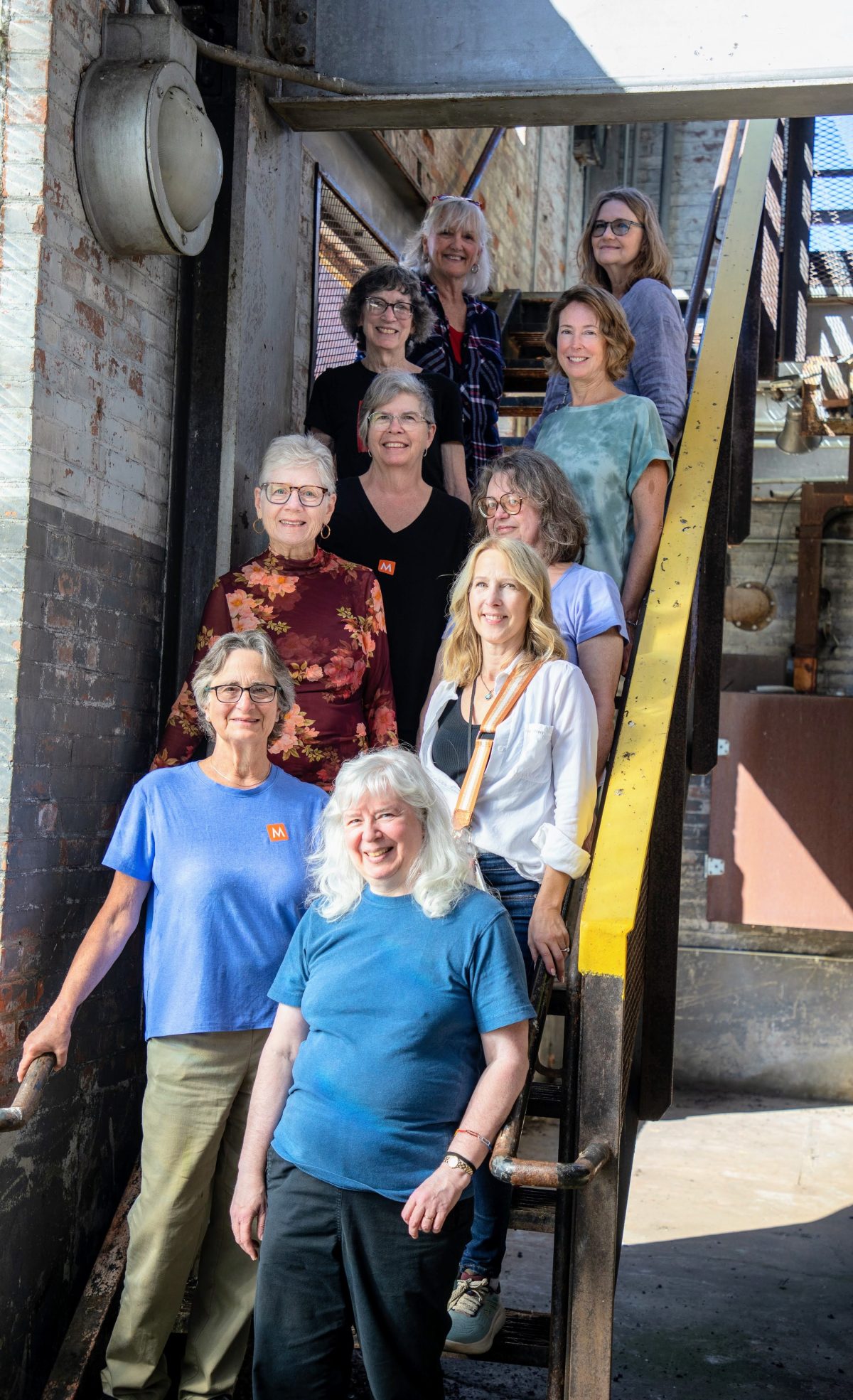
Carolina Porras Mornoy, the new director of The Studios at MASS MoCA which hosts our residencies, took some photos of us in our beloved Boiler House at the museum and while we were workshopping. There will be an Instagram post coming next week featuring the Boiler House Poets Collective. The Studios are celebrating their tenth anniversary this month so it is especially fitting to have the tenth anniversary of the Boiler House Poets Collective as part of their observance. BHPC formed at the very first poetry workshop-in-residence that The Studios hosted in fall of 2015, facilitated by Jeffrey Levine of Tupelo Press. The poets hit it off so well that, even before that week finished, we were hatching plans to return, which we have done every year since.
I am the only “original” to make all the reunions so far. In 2020, when The Studios were closed for an extended period due to the pandemic, I took the opportunity to return to North Adams for a private writing retreat. You can read about that experience by checking out my August 2020 blog archive. MASS MoCA had re-opened by then with COVID protocols in place so I was able to spend time writing about the art there, while also visiting familiar places in the surrounding towns.
I am so grateful to the Boiler House Poets Collective, The Studios at MASS MoCA, the Museum itself, and the city of North Adams for ten years of welcome, sharing, and great experiences. Here’s to the next ten years – and beyond!
BHPC ’25 in the Boiler House at MASS MoCA
photo credit: Carolina Porras Monroy
As you may have surmised from the post about our reading on this Saturday, I am once again in North Adams in residence with the Boiler House Poets Collective at The Studios at MASS MoCA (Massachusetts Museum of Contemporary Art).
This is the tenth anniversary year of the first poetry workshop-in-residence that The Studios offered within their opening weeks in fall 2015. I was just starting to publish poetry and only had the courage to apply because I had grown up in the North Adams area and thought I would feel more at thome there. That week was both daunting and wondrous. If you visit my blog archive for November, 2015, you can read about it in multiple posts, which manage to somewhat mask the terror of being thrown into the deep end that I felt at the time.
The saving grace, though, was my fellow poets, who were so welcoming and supportive. Even before we left the residency, we started to plan a return, and thus the Boiler House Poets Collective was born.
As one might expect, not all of our initial group of 9 was able to re-convene, so we invited poet-friends to join us. You can see our listing of poets for each year here. You may notice that there is no listing for 2020 as The Studios, understandably, were closed for an extended period because of the COVID-19 pandemic. Due to changes in the structure of The Studios, we now can accommodate ten members each year. Kyle Laws and I are the only “originals” in attendance this year, although we consider Jessica Dubey as an honorary original as she has been with us since 2016, our first official residency as the Boiler House Poets Collective.
My health challenges, while not as severe as they were during last year’s residency, are still impacting my energy and creativity, so I am trying to be gentle with myself and not create unrealistic expectations. My immediate focus is to make it through the reading tomorrow morning. Thanks to the wonders of alphabetical order, I will do the introduction and my poems first. Bonus: After that, I can relax and listen to all the rest of the work of my fellow BHPC poets without having to gear up to read.
I’m also excited because we will be unveiling a collaborative poem honoring North Adams as our gift to this special place that we have enjoyed so much. I will share it here on the blog at some point after the reading. I loved having a special tenth anniversary project and am thrilled that we will be able to offer it at our reading and as a special gift to the library, Studios, and other North Adams supporters as a broadside. There is also a smaller, printed version which we will have at the reading for any listeners who would like to have one.
In the spirit of not putting pressure on myself, today I plan to visit the museum and see what’s new. MASS MoCA does not have a permanent collection, so there are always new artworks to experience. There are also some exhibits that are long-term, so I will re-visit some of my old friends here, especially our namesake Boiler House. If I am lucky, something I see will spark a poem later in the residency. If not, I have some prior ekphrastic poems based on MASS MoCA art that could use revision. Or, maybe, there will just be some more blog posts.
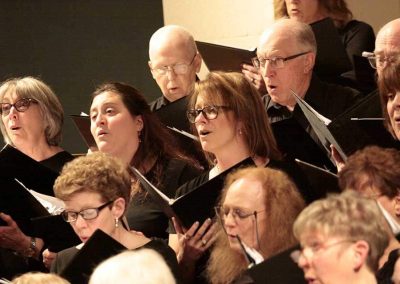
My birthday is coming up, so I have a birthday fundraiser for the Madrigal Choir of Binghamton up on Facebook here which you can share or contribute to, if you are so inclined. Thanks!
In the first few seasons of The Late Show, Stephen Colbert did a recurring skit, then a best-selling book, called Midnight Confessions, in which he “confesses” to his audience with the disclaimer that he isn’t sure these things are really sins but that he does “feel bad about them.” While Stephen and his writers are famously funny, I am not, so my JC’s Confessions will be somewhat more serious reflections, but they will be things that I feel bad about. Stephen’s audience always forgives him at the end of the segment; I’m not expecting that – and these aren’t really sins – but comments are always welcome.
In recent months, I’ve become very high-maintenance.
Not a fan.
My style for years has been no-muss, no-fuss. My hairstyle doesn’t require blowdrying and products. I don’t wear make-up. My clothing style is simple. I can get ready to go out in five minutes or less.
I could spend most of my time and brainpower on more creative endeavors and helping others.
Now, it seems that taking care of myself has become a full-time job.
In attempts to improve my current state of health, there are physical therapy exercises daily and near-constant attention to my posture and head/neck position. Needed rest periods. An increasing complicated array of medications, including one that needs to be mixed in a full glass of water and drunk immediately – four times a day – which makes it a bit tricky if I have to be away from home for several hours. Trying to figure out what to eat and drink when a food recommended for dealing with one of my syndromes is excluded by another to the extent where I sometimes don’t know what to eat. Dealing with my AutoPAP machine. Fussing with dental care and retainers. Going to appointments and tests with so many specialists that I’ve lost track of them all and trying to get information coordinated among them and with my primary care doctor, because, of course, the practices, despite all the electronic records systems, can’t seem to do it. Doing research on the various symptoms and diagnoses and trying to piece everything together.
It’s time-consuming and frustrating and doens’t leave much energy or brainpower for the thousand things I’d rather be doing.
There is some hope.
Lately, my brain fog and fatigue have diminished and it seems that we are finally getting closer to a more comprehensive diagnosis and clinical outlook.
Maybe that will translate into an easier daily regimen.
I don’t think I will ever be low-maintenance again, but maybe medium?









 Joanne Corey