
Vote for Democracy #4

(Photo by Lucas Sankey on Unsplash)

The United States is not a “Christian nation.”

In the Bill of Rights, the First Amendment makes clear that “Congress shall make no law respecting an establishment of religion, or prohibiting the free exercise thereof.” It is the first freedom listed in the ten amendments of the Bill of Rights, which was considered so vital that the states required it to be added before they would adopt the Constitution.

While some of the colonies had originally had an established religion, others, such as Rhode Island, had been founded explicitly without a government-sanctioned religion. At the time of the founding, the majority of United States residents were Christian, which is still true today, but the country was explicitly founded to be non-sectarian.

That’s why it’s so disturbing to me to see so many Republicans pushing the concept that the United States either is or should be a “Christian nation,” ignoring both the First Amendment and our history.

A particularly disturbing example of this is that this week, observed by the majority of Christian denominations as Holy Week leading to the celebration of Easter on Sunday, Donald Trump is selling the God Bless the USA bible, which includes the King James version of the Bible along with the US Declaration of Independence, Constitution, and Pledge of Allegiance. Trump’s message is “Let’s Make America Pray Again.” He thinks every home should have a (this/his) Bible.

This flies in the face of the First Amendment, which is, one assumes, included in this volume.

As a United States citizen and a Roman Catholic Christian, I am appalled that Trump is raising money in this blatant attempt to appeal to “Christian nationalists,” who want the United States to become a Christian nation, most of whom intend it to be a white Christian nation.

No.

The United States is a pluralistic nation and that is one of its strengths. It has certainly been an imperfect union with egregious examples of discrimination, bigotry, and injustice over the centuries, but we are working to move in a direction closer to equality for all people. Favoring one religion over another in our government must not be allowed.

Our government is a secular one and must remain so, as the Founders and generations of Americans intended.

When we vote, we should keep this principle in mind and reject any candidate who thinks the US is or should be a “Christian nation.”


19 years ago

About my friend Angie.

(Hearts graphic by Angie Traverse)

Nineteen years ago today, my friend Angie died from lung cancer. She was only 54. She had never smoked or lived in a house with high radon or worked in a place with known carcinogens but, by whatever combination of genetics and living, cancer appeared and was diagnosed when she was fifty.

She was treated by some great doctors locally and in Boston and she fought hard for four years and some months, but passed away on Good Friday, 2005.

There have been a lot of developments in cancer treatment since then, some of which are advertised on television. I often wonder if any of those medications would have helped Angie live longer and better.

For years, I made contributions on March 25 and on Angie’s October birthday to the charitable fund established in her memory but, a few years back, the online page went away. Now, I just remember and write an occasional post. One of my favorite Angie posts is this one, written when I turned 54.

That year, I also wrote a poem about Angie, which was published by Wilderness House Literary Review:

Fifty-four

We were the October Babes,
You from 1950,
Me from 1960.

On your fifty-fourth birthday,
You managed coffee ice cream with hot fudge
Despite the metastases in your neck.

On my fifty-fourth birthday,
I raise a solo toast with your favorite Coke-with-a-lemon-wedge
To the October Babes being fifty-four together.
*****

This October, God willing, I will turn 64.

I wish Angie were still here, as an about-to-be 74-year-old grandma, mom, artist, and dear friend. The world could use her compassion, creativity, and spirit right now.

Ronald Perera memorial concert

Earlier this month, I was privileged to attend a memorial concert for Ron Perera, composer and professor emeritus of music at Smith College. The concert took place in Sweeney Concert Hall in Sage Hall, the long-time center of musical life on campus. I had taken five semesters of theory and composition with Mr. Perera and he had been my major advisor. We had been in touch variously over the decades and we had enjoyed a wonderful lunch together last spring when I was back on campus to sing with the Smith College Alumnae Chorus.

All the pieces at the concert were Ron Perera’s compositions, some of which were performed by the musicians for whom they were written. I especially appreciated seeing pianist Professor Emerita Monica Jakuc Leverett perform Out of Shadow almost 36 years after its premiere. Another piano piece that I loved was Three Waltzes for Four Hands, written for Ron’s three daughters, and performed by Professor Emeritus Kenneth Fearn and his daughter, Kaeza. I’m looking forward to ordering a copy for daughter E and son-in-law L to play for our granddaughters ABC and JG.

As a writer and choral singer, I was especially drawn to the choral pieces that opened and closed the concert. The opening was “Hold Out Your Hands Over the Earth” from The Outermost House, text by Henry Beston. The work was commissioned by the Chatham Chorale, on Cape Cod. The Perera family lived on the Cape during the summers and Ron loved to sail there. Some of the text in this movement is:

To all who love her, who open to her the doors of their veins, she gives strength, sustaining them with her own measureless tremor of dark life. Touch the earth, love the earth, honor the earth, her plains, her valleys, her hills, and her seas; rest your spirit in her solitary places.

It was a perfect reflection to begin.

Besides the music, there were four remembrances in the program. The first was from one of Ron’s daughters, Rosalind, which also served as a welcome. Two were from pastors of St. John’s Episcopal Church, located in the midst of Smith’s campus, where Ron was a long-time member and volunteer. The other was from Professor Emeritus Donald Wheelock, who was Ron’s composer-colleague for many years and who helped to organize the concert. It was beautiful to hear them speak about his kind, caring nature and the depth and breadth of his thoughts, talents, interests, and beliefs. Even as a college student, I could sense what a wonderful man he was and it was inspiring to hear how he sustained those qualities throughout his life and shared them with so many, most especially his family.

The concert closed with the Smith College Chamber Singers offering Ron’s setting of Percy Bysshe Shelley’s “Music, When Soft Voices Die” conducted by Jonathan Hirsh, who is a current faculty member, friend of Ron, and another concert organizer. He had graciously kept me apprised of the plans as the memorial came together so that I could arrange to attend. It was such a perfect, quiet, love-filled ending to the memorial. “And so thy thoughts, when thou art gone,/ Love itself shall slumber on.”

At the reception after the concert, I was able to speak briefly with Don Wheelock and Jonathan Hirsh and at greater length with the third organizer, Professor Emerita Karen Smith Emerson. I am grateful for their work in putting the program together to celebrate a remarkable, generous, talented man who leaves a legacy of music and writings but, more importantly, of human connection and spiritual strength.

I’m also grateful to CK, Smith ’81, and her spouse who opened their lovely home near campus to B and me for the weekend. I appreciated their hospitality and their companionship at the concert and reception. I’m hoping CK will be able to sing with us the next time I’m back on campus for an event with the Smith College Alumnae Chorus.

It will be bittersweet, though, knowing that Ron will not be there to hear us. Maybe, we will perform a piece of his music in remembrance…

recording of the concert

One-Liner Wednesday: a compassionate heart

To be compassionate is to have a heart that suffers from the misfortune of others because we think of it as our own.

Thomas Aquinas

Join us for Linda’s One-Liner Wednesdays and/or the last day of Just Jot It January ’24! Find out more here: https://lindaghill.com/2024/01/31/one-liner-wednesday-jusjojan24-the-31st-goals/

One-Liner Wednesday: doing right

The time is always right to do what’s right.

Rev. Dr. Martin Luther King, Jr.

Join us for Linda’s One-Liner Wednesday and/or Just Jot It January! Find out more here: https://lindaghill.com/2024/01/17/one-liner-wednesday-jusjojan24-the-17th-grateful/

Writing

I’m a bit of – okay, more than a bit – an outlier in Linda’s Just Jot It January event in that I seldom use the provided prompts other than for One-Liner Wednesdays and Stream of Consciousness Saturdays. My blog is called Top of JC’s Mind because I write about whatever is at the top of my mind, which could be family, poetry, health, politics, spirituality, environmental issues, movies, or anything else. Today, though, I provided the #JusJoJan24 prompt, writing, hoping it would be an easy one for all of us, including me (especially me?), to use.

When I was in grammar school, we did a lot of both creative and academic/utilitarian writing in our two-room school which went up through grade 8. Besides learning to write theme papers and business and friendly letters and such, we also wrote stories and poems. I remember writing outside of school for fun, too. My sisters and I would often make our own greeting cards with poems we wrote ourselves.

At the high school I attended about twenty miles from home, there was still a lot of writing but very little of it was creative. Busy with academic writing, I stopped writing poetry and fiction. This trend continued when I was a student at Smith College – lots of writing, but none of it in fiction or poetry. I’ve wondered if the Boutelle-Day Poetry Center had existed back in my student days whether I would have written and studied poetry as an undergrad. As it happened, I made the happy discovery that I could write music; composition became an important part of my major. As a singer, organist, and composer, words were often entwined with my musical experiences, which kept me in conversation with poetry and literary writing, even when I wasn’t practicing it myself.

There has been a lot of writing in my life after Smith. There has always been correspondence, first on paper and later mostly electronic. Many of my volunteer activities had major writing components. In my years on the liturgy committee at my church, I wrote prayers and what we jokingly termed “homilettes” on seasonal themes. I worked on documents on curriculum development as a volunteer on curriculum and honors diploma committees when my daughters were in school. I researched and wrote commentary on the dangers of fracking for years as part of the rapid response team in New York State. Every once in a while, I would be inspired to write a poem, but nearly all my writing was utilitarian prose.

That changed when I turned fifty. My friend Yvonne was leading a year-long book study of Dr. Clarissa Pinkola Estés’s Women Who Run with the Wolves: Myths and Stories of the Wild Woman Archetype. A circle of women met monthly to discuss a section of the book and then create art in response. I spontaneously started to write poems to accompany my art pieces, a practice known as ekphrasis, though I didn’t know the word at the time. I had lost the church that had sometimes performed my music and I think that creative energy found a home in writing poetry.

After a poem I had written was chosen as part of a National Poetry Month initiative at our local public broadcasting radio station, I learned about the Binghamton Poetry Project and started attending their community poetry workshops, which are led by graduate students at Binghamton University. I quickly became serious about poetry and wanted to submit work for publication. One of the BPP directors found a local circle of poets meeting regularly to workshop poems that I could join. We are now known as the Grapevine Poets and I will be forever grateful to them for all their help and support with my poems and manuscripts. Last year was a milestone for me when Kelsay Books published my first chapbook of poetry, Hearts.

Running roughly concurrently with the resurgence of poetry in my life has been my blogging life. When I was writing so much fracking and political commentary, friends suggested I give blogging a try. I wasn’t sure if I could make it work but Top of JC’s Mind turned ten last September. I just passed 1,900 posts total, so there’s a lot there if anyone cares to rummage around! As part of my tenth anniversary celebration, I also finally got my own domain name, so you can also visit the blog through my author site at joannecorey.com.

Words are powerful and nearly all of us are writers, whether we are doing it for personal use or public audience. I hope that, whatever writing you do, it brings you some sense of peace, joy, clarity, outreach, and stability.

Write on!

Snow!

We are having our first major snowstorm of the season here in the Southern Tier of NY.

The system, which is coming up the Atlantic coast, arrived a bit earlier than had originally been expected. I had thought I’d be able to attend vigil mass at 4 PM as I usually do on Saturdays but the roads were too bad for travel. It’s still snowing this morning and some freezing rain is predicted, so it looks like this will be an at-home religious observance weekend, as all of them were during the pandemic.

Good thing I didn’t take the programming for recording mass out of my DVR.

Best wishes to those celebrating Epiphany this weekend and to those celebrating Christmas under the Julian calendar.
*****
Join us for Linda’s Just Jot It January! Find out more here: https://lindaghill.com/2024/01/07/daily-prompt-jusjojan-the-7th-2024/

Angelus

During Just Jot It January, I thought I’d share some of my previously published poems that have been out for a while, as I did on New Year’s Day. I usually don’t put poems within posts when a poem is first published so that people will visit the site that has been so gracious in publishing my work. I will, though, always include the link, even though I am putting the poem in the post.

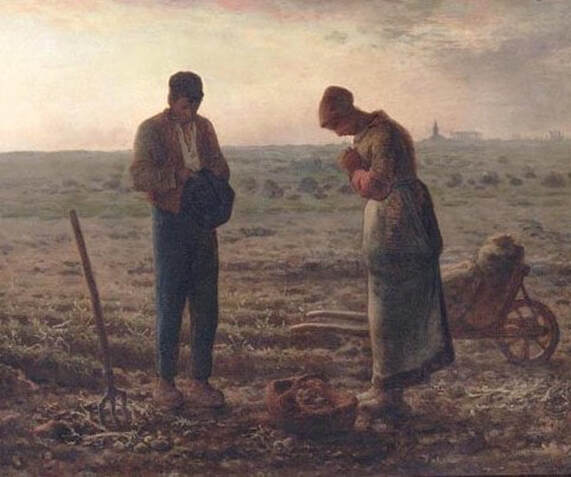
Today, I’m sharing the poem “Angelus” that I wrote in February, 2020 in response to an Ekphrastic Review Writing Challenge. I wrote a post about it at the time. I constructed a narrative inspired by The Angelus, the 1859 painting by the French artist, Jean-Francois Millet, shown below. I used part of the Angelus prayer in my poem. My home parish when I was growing up rang Angelus bells three times a day as a reminder to pray this prayer. Our pattern was to ring the bell in three groups of three followed by a group of nine. The Angelus rang at 6 AM, noon, and 6 PM, which I used in the poem. I have no idea what the tradition was in France at the time of painting but it worked for the poem, so poetic license?

Angelus by Joanne Corey

The Angel of the Lord declared unto Mary,
And she conceived of the Holy Spirit.

At the six o’clock bells, she pauses.
Her hands that had been preparing
breakfast, now clasped in front of her, drift
down to rest over her womb,
which, like Mary’s, conceals 
a miracle.

And the Word was made flesh,
And dwelt among us.

As everyone in the market stops
buying and selling to pray
at the noon bells, she reflects
that another’s flesh is forming
within her, dwelling
in mystery.

Pray for us, O holy Mother of God,
That we may be made worthy of the promises of Christ.

The evening Angelus rings
across the field. As she stands
bowed beside her husband,
she beseeches God that this time
the promised child
will be born.

*****
Join us for Linda’s Just Jot It January! Find out more here: https://lindaghill.com/2024/01/05/daily-prompt-jusjojan-the-5th-2024/

Christmas ’23

I’ve been struggling with whether or not to write a post for Christmas Day.

Maybe, it’s because I’ve been struggling with just about everything related to Christmas this year.

For so many years, the Christmas season brought most of our extended family together, often over a period of days and in various constellations, but this year, it will be just me, spouse B, and daughter T at home together. Daughter E and her family are celebrating an ocean away at home in London. B’s and my siblings are all busily dealing with their families and/or medical issues.

This lack of planned travel and guests turned out to have a silver lining when T was offered a slot for a needed shoulder surgery last week due to a cancellation in the surgeon’s schedule. So, our already subdued Christmas plan got even quieter as we have factored in the early stages of recovery.

While I’ve done some of the Christmas preparations, like singing in Lessons & Carols with the Madrigal Choir of Binghamton, writing Christmas cards and letters, and some gift-shopping and wrapping, the bulk of the decorating, cooking, and baking has been handled by B, with an assist from T prior to her surgery.

I’m sure that my feeling more somber than festive is not helped by the state of the world. The continuing horrors of war in Ukraine, the Middle East, Sudan, and elsewhere. The ever-increasing evidence of climate change impacts. The increasingly vile political rhetoric and threats against judges, Jewish people, Muslims, immigrants, pubic officials, etc. here in the US. The local battle against CO2 fracking with global implications here in the Southern Tier of New York. Increases in cases of flu and COVID in the Northern Hemisphere as winter sets in.

This somber time we face is also reflected in my religious observances. For many years, I was actively involved in music and liturgy planning for Advent and the Christmas season, but I haven’t been for a number of years now. While I still attend and participate in services, some of the anticipation and joy is muted for me.

It’s also true that there are many difficult issues raised by the nativity narrative that seem particularly salient to me this year. The real dangers that Mary faced as a young woman facing pregnancy before marriage. Her being forced to travel and give birth away from the comforts of home and neighbor-women who could come to her aid. The threats to her baby’s life. The slaughter of children ordered in an attempt to kill him. Fleeing to protect her child and their becoming refugees.

Angels and magi aside, there was a lot of pain, fear, and loss.

With all of this in my head, I went to 10 PM mass at my church for Christmas Eve. There was a photo of the baby Jesus amid rubble as displayed at a Palestinian-Lutheran Church in Bethlehem, the birthplace of Jesus on the West Bank, where Christmas observances usually draw crowds from around the world but are not being publicly held this year because of the war. The homily dealt directly with the struggle that I have been having this year and called on us to have hope. As part of the homily, we sang the first verse of “O Little Town of Bethlehem” near the beginning and the fourth, final verse at the end. We sang:

O holy Child of Bethlehem,
descend to us, we pray;
cast out our sin and enter in;
be born in us today.
We hear the Christmas angels,
the great glad tidings tell;
O come to us, abide with us,
our Lord Emmanuel!

Phillips Brooks

The message is to have hope because God, who is Divine and Eternal Love, is with all people of good will, as the angels announce.

I admit that hope is not one of my better virtues, but I will continue to add my actions, small though they are, in the efforts to make the world safer, more loving, more kind.

After all these centuries, still searching for the peace the angels proclaimed…

SoCS: blue spruce

When my spouse B was growing up in rural southern Vermont, his family always had a blue spruce as a Christmas tree.

They are beautiful trees with a nice fragrance but they are dangerous!

The needles are very stiff and sharp so they are very prickly to decorate.

Unfortunately, B is also allergic to them, so he would wind up with his hands covered in red, itchy pricks and blotches on his hands.

In our own home, we do not have a blue spruce for a Christmas tree or a spruce at all. We do have a live tree but it is a fir. We used Douglas firs until they fell victim to a pest and climate changes. Now, we usually have a concolor fir. Also beautiful with a lovely scent but no itchy, pin-prickly hands!

Wishing a happy Christmas to those who celebrate and peace, joy, and love to all!

(Photo: our tree this year)
*****
Linda’s prompt for Stream of Consciousness Saturday this week is “spruce.” Join us! Find out more here: https://lindaghill.com/2023/12/22/the-friday-reminder-and-prompt-for-socs-dec-23-2023/