The time is always right to do what’s right.
Rev. Dr. Martin Luther King, Jr.
Join us for Linda’s One-Liner Wednesday and/or Just Jot It January! Find out more here: https://lindaghill.com/2024/01/17/one-liner-wednesday-jusjojan24-the-17th-grateful/
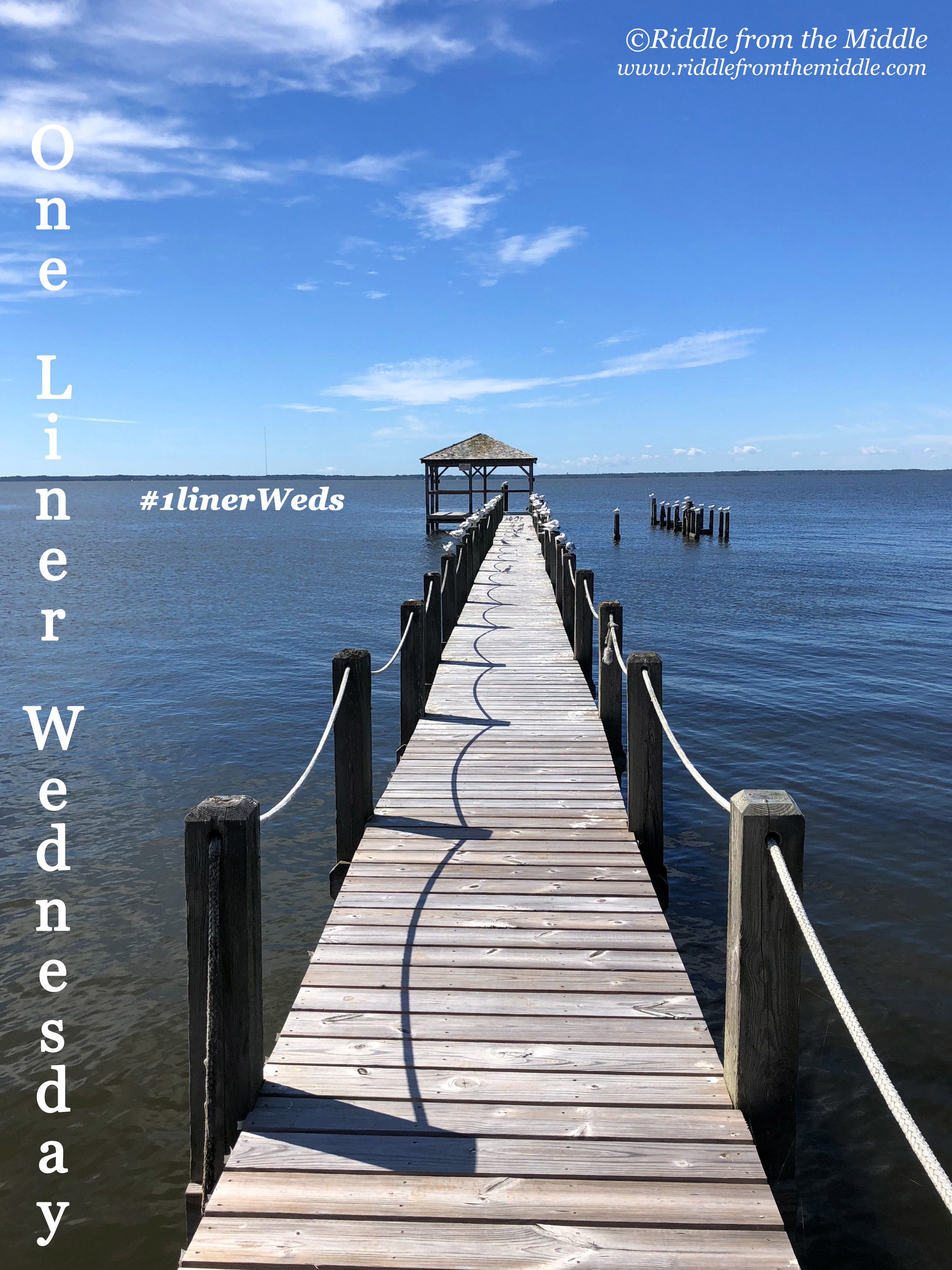

The time is always right to do what’s right.
Rev. Dr. Martin Luther King, Jr.
Join us for Linda’s One-Liner Wednesday and/or Just Jot It January! Find out more here: https://lindaghill.com/2024/01/17/one-liner-wednesday-jusjojan24-the-17th-grateful/

I’m a bit of – okay, more than a bit – an outlier in Linda’s Just Jot It January event in that I seldom use the provided prompts other than for One-Liner Wednesdays and Stream of Consciousness Saturdays. My blog is called Top of JC’s Mind because I write about whatever is at the top of my mind, which could be family, poetry, health, politics, spirituality, environmental issues, movies, or anything else. Today, though, I provided the #JusJoJan24 prompt, writing, hoping it would be an easy one for all of us, including me (especially me?), to use.
When I was in grammar school, we did a lot of both creative and academic/utilitarian writing in our two-room school which went up through grade 8. Besides learning to write theme papers and business and friendly letters and such, we also wrote stories and poems. I remember writing outside of school for fun, too. My sisters and I would often make our own greeting cards with poems we wrote ourselves.
At the high school I attended about twenty miles from home, there was still a lot of writing but very little of it was creative. Busy with academic writing, I stopped writing poetry and fiction. This trend continued when I was a student at Smith College – lots of writing, but none of it in fiction or poetry. I’ve wondered if the Boutelle-Day Poetry Center had existed back in my student days whether I would have written and studied poetry as an undergrad. As it happened, I made the happy discovery that I could write music; composition became an important part of my major. As a singer, organist, and composer, words were often entwined with my musical experiences, which kept me in conversation with poetry and literary writing, even when I wasn’t practicing it myself.
There has been a lot of writing in my life after Smith. There has always been correspondence, first on paper and later mostly electronic. Many of my volunteer activities had major writing components. In my years on the liturgy committee at my church, I wrote prayers and what we jokingly termed “homilettes” on seasonal themes. I worked on documents on curriculum development as a volunteer on curriculum and honors diploma committees when my daughters were in school. I researched and wrote commentary on the dangers of fracking for years as part of the rapid response team in New York State. Every once in a while, I would be inspired to write a poem, but nearly all my writing was utilitarian prose.
That changed when I turned fifty. My friend Yvonne was leading a year-long book study of Dr. Clarissa Pinkola Estés’s Women Who Run with the Wolves: Myths and Stories of the Wild Woman Archetype. A circle of women met monthly to discuss a section of the book and then create art in response. I spontaneously started to write poems to accompany my art pieces, a practice known as ekphrasis, though I didn’t know the word at the time. I had lost the church that had sometimes performed my music and I think that creative energy found a home in writing poetry.
After a poem I had written was chosen as part of a National Poetry Month initiative at our local public broadcasting radio station, I learned about the Binghamton Poetry Project and started attending their community poetry workshops, which are led by graduate students at Binghamton University. I quickly became serious about poetry and wanted to submit work for publication. One of the BPP directors found a local circle of poets meeting regularly to workshop poems that I could join. We are now known as the Grapevine Poets and I will be forever grateful to them for all their help and support with my poems and manuscripts. Last year was a milestone for me when Kelsay Books published my first chapbook of poetry, Hearts.
Running roughly concurrently with the resurgence of poetry in my life has been my blogging life. When I was writing so much fracking and political commentary, friends suggested I give blogging a try. I wasn’t sure if I could make it work but Top of JC’s Mind turned ten last September. I just passed 1,900 posts total, so there’s a lot there if anyone cares to rummage around! As part of my tenth anniversary celebration, I also finally got my own domain name, so you can also visit the blog through my author site at joannecorey.com.
Words are powerful and nearly all of us are writers, whether we are doing it for personal use or public audience. I hope that, whatever writing you do, it brings you some sense of peace, joy, clarity, outreach, and stability.
Write on!

We are having our first major snowstorm of the season here in the Southern Tier of NY.
The system, which is coming up the Atlantic coast, arrived a bit earlier than had originally been expected. I had thought I’d be able to attend vigil mass at 4 PM as I usually do on Saturdays but the roads were too bad for travel. It’s still snowing this morning and some freezing rain is predicted, so it looks like this will be an at-home religious observance weekend, as all of them were during the pandemic.
Good thing I didn’t take the programming for recording mass out of my DVR.
Best wishes to those celebrating Epiphany this weekend and to those celebrating Christmas under the Julian calendar.
*****
Join us for Linda’s Just Jot It January! Find out more here: https://lindaghill.com/2024/01/07/daily-prompt-jusjojan-the-7th-2024/

During Just Jot It January, I thought I’d share some of my previously published poems that have been out for a while, as I did on New Year’s Day. I usually don’t put poems within posts when a poem is first published so that people will visit the site that has been so gracious in publishing my work. I will, though, always include the link, even though I am putting the poem in the post.
Today, I’m sharing the poem “Angelus” that I wrote in February, 2020 in response to an Ekphrastic Review Writing Challenge. I wrote a post about it at the time. I constructed a narrative inspired by The Angelus, the 1859 painting by the French artist, Jean-Francois Millet, shown below. I used part of the Angelus prayer in my poem. My home parish when I was growing up rang Angelus bells three times a day as a reminder to pray this prayer. Our pattern was to ring the bell in three groups of three followed by a group of nine. The Angelus rang at 6 AM, noon, and 6 PM, which I used in the poem. I have no idea what the tradition was in France at the time of painting but it worked for the poem, so poetic license?
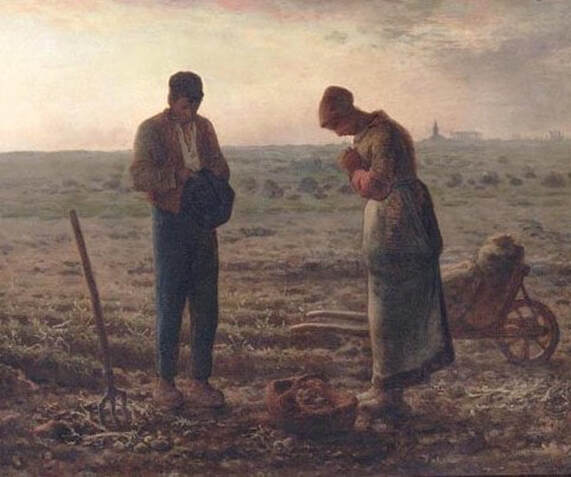
Angelus by Joanne Corey
The Angel of the Lord declared unto Mary,
And she conceived of the Holy Spirit.
At the six o’clock bells, she pauses.
Her hands that had been preparing
breakfast, now clasped in front of her, drift
down to rest over her womb,
which, like Mary’s, conceals
a miracle.
And the Word was made flesh,
And dwelt among us.
As everyone in the market stops
buying and selling to pray
at the noon bells, she reflects
that another’s flesh is forming
within her, dwelling
in mystery.
Pray for us, O holy Mother of God,
That we may be made worthy of the promises of Christ.
The evening Angelus rings
across the field. As she stands
bowed beside her husband,
she beseeches God that this time
the promised child
will be born.
*****
Join us for Linda’s Just Jot It January! Find out more here: https://lindaghill.com/2024/01/05/daily-prompt-jusjojan-the-5th-2024/

I’ve been struggling with whether or not to write a post for Christmas Day.
Maybe, it’s because I’ve been struggling with just about everything related to Christmas this year.
For so many years, the Christmas season brought most of our extended family together, often over a period of days and in various constellations, but this year, it will be just me, spouse B, and daughter T at home together. Daughter E and her family are celebrating an ocean away at home in London. B’s and my siblings are all busily dealing with their families and/or medical issues.
This lack of planned travel and guests turned out to have a silver lining when T was offered a slot for a needed shoulder surgery last week due to a cancellation in the surgeon’s schedule. So, our already subdued Christmas plan got even quieter as we have factored in the early stages of recovery.
While I’ve done some of the Christmas preparations, like singing in Lessons & Carols with the Madrigal Choir of Binghamton, writing Christmas cards and letters, and some gift-shopping and wrapping, the bulk of the decorating, cooking, and baking has been handled by B, with an assist from T prior to her surgery.
I’m sure that my feeling more somber than festive is not helped by the state of the world. The continuing horrors of war in Ukraine, the Middle East, Sudan, and elsewhere. The ever-increasing evidence of climate change impacts. The increasingly vile political rhetoric and threats against judges, Jewish people, Muslims, immigrants, pubic officials, etc. here in the US. The local battle against CO2 fracking with global implications here in the Southern Tier of New York. Increases in cases of flu and COVID in the Northern Hemisphere as winter sets in.
This somber time we face is also reflected in my religious observances. For many years, I was actively involved in music and liturgy planning for Advent and the Christmas season, but I haven’t been for a number of years now. While I still attend and participate in services, some of the anticipation and joy is muted for me.
It’s also true that there are many difficult issues raised by the nativity narrative that seem particularly salient to me this year. The real dangers that Mary faced as a young woman facing pregnancy before marriage. Her being forced to travel and give birth away from the comforts of home and neighbor-women who could come to her aid. The threats to her baby’s life. The slaughter of children ordered in an attempt to kill him. Fleeing to protect her child and their becoming refugees.
Angels and magi aside, there was a lot of pain, fear, and loss.
With all of this in my head, I went to 10 PM mass at my church for Christmas Eve. There was a photo of the baby Jesus amid rubble as displayed at a Palestinian-Lutheran Church in Bethlehem, the birthplace of Jesus on the West Bank, where Christmas observances usually draw crowds from around the world but are not being publicly held this year because of the war. The homily dealt directly with the struggle that I have been having this year and called on us to have hope. As part of the homily, we sang the first verse of “O Little Town of Bethlehem” near the beginning and the fourth, final verse at the end. We sang:
O holy Child of Bethlehem,
Phillips Brooks
descend to us, we pray;
cast out our sin and enter in;
be born in us today.
We hear the Christmas angels,
the great glad tidings tell;
O come to us, abide with us,
our Lord Emmanuel!
The message is to have hope because God, who is Divine and Eternal Love, is with all people of good will, as the angels announce.
I admit that hope is not one of my better virtues, but I will continue to add my actions, small though they are, in the efforts to make the world safer, more loving, more kind.
After all these centuries, still searching for the peace the angels proclaimed…

When my spouse B was growing up in rural southern Vermont, his family always had a blue spruce as a Christmas tree.
They are beautiful trees with a nice fragrance but they are dangerous!
The needles are very stiff and sharp so they are very prickly to decorate.
Unfortunately, B is also allergic to them, so he would wind up with his hands covered in red, itchy pricks and blotches on his hands.
In our own home, we do not have a blue spruce for a Christmas tree or a spruce at all. We do have a live tree but it is a fir. We used Douglas firs until they fell victim to a pest and climate changes. Now, we usually have a concolor fir. Also beautiful with a lovely scent but no itchy, pin-prickly hands!
Wishing a happy Christmas to those who celebrate and peace, joy, and love to all!
(Photo: our tree this year)
*****
Linda’s prompt for Stream of Consciousness Saturday this week is “spruce.” Join us! Find out more here: https://lindaghill.com/2023/12/22/the-friday-reminder-and-prompt-for-socs-dec-23-2023/


Just back from a long day that featured the first of Madrigal Choir’s Lessons and Carols performances. It was in a small church to our north. Our audience was small but appreciative. It gives me confidence in our performance in our home county tomorrow, which will draw a larger number of listeners.
Now, I need to get some rest…
*****
This short and sweet post is part of Linda’s Stream of Consciousness Saturday series. The prompt this week is “confidence.” You can find out more about SoCS here: https://lindaghill.com/2023/12/01/the-friday-reminder-and-prompt-for-socs-dec-2-2023/

Because spouse B had contracted COVID and needed to isolate at home and daughter T and I were masking around each other in case one of us was infected, we didn’t celebrate Thanksgiving last Thursday – or, I should say, we celebrated with a nice, but not fancy, dinner of roast pork with roasted vegetables with T and I eating in the dining room and B at the kitchen table where we could talk to each other at a safe distance. Instead of the traditional pie, we had (the also-traditional) Aunt Gert’s Indian pudding for dessert.
That Thursday was Day 12 of B’s COVID experience and the first day he had tested negative. On average, Omicron infections last for eight days, so B was on the long side of the spectrum but someone has to be to balance out those who have a short infectious phase. Because he needed to have two negative tests 48 hours apart for us to be unmasked around each other, he decided that our fancier Thanksgiving dinner should be on Sunday.
While, for many years, I did the bulk of the cooking at our house, I don’t especially enjoy it. B, on the other hand, likes cooking and baking, so he chose the menu and made the meal. We enjoyed a delicious dinner of individual beef Wellington with roasted Brussels sprouts with bacon and a Braeburn and Cortland apple pie for dessert.
One of the things for which we are most thankful is that B’s bout with COVID was relatively mild, even if his infectious period did hang on longer than expected. We are also thankful that T and I remained uninfected. The pool of people I know who have never had COVID has dwindled to just a few, so I know it’s likely we will contract it someday, but, for now, we are all happy to be able to spend time together at home unmasked in the same room, whether or not there is a fancy late-Thanksgiving meal on the table.
Photo by Pro Church Media on Unsplash

It’s important to me to create.
These days, I create poems. I create posts here at Top of JC’s Mind.
I also express myself creatively in less obvious ways. Through cooking. Through taking photos (on occasion. I’m not one to be constantly photographing.) In conversation. While singing. In correspondence. In my own thoughts as I’m puzzling through a complex situation and trying to find options.
I love my role in creating my family.
I also love being part of creating community, whether that is on a small, local level or something much broader, like the global community working on climate change. Even though I am a very, very tiny part of such a large community, I realize that my creativity and energy are adding to the effort.
An aspect of creativity that was very important to me as a young adult was writing music. That part of my creative life was lost to me in 2005 when we went through a crisis at my Catholic parish that fractured my relationship with it and my music ministry. Because I wrote music for them, my impetus to use my creativity to write music also broke. I think that rupture may be part of the reason I turned to poetry as a means of creative expression. That artistic energy needed somewhere to go.
Will I eventually return to writing music? At this point, I don’t anticipate that happening.
But creativity is often surprising and unpredictable and wondrous and glorious, so…
*****
Linda’s prompt for Stream of Consciousness Saturday this week is “create.” Join us! Find out more here: https://lindaghill.com/2023/11/10/the-friday-reminder-and-prompt-for-socs-nov-11-2023/


This will be super short because I’m going to meet up with a lot of people today. (Well, a lot for me, at least!)
This morning, I have a Creation Care Team meeting at church.
From early afternoon through early evening, I’ll be going to a gathering of women, organized by a friend and being held at the retreat space of another. There will be expressive arts, chair yoga, an opportunity to walk a labyrinth, companionship, and, of course, some food. I made a big bowl of applesauce to bring and share. Very indicative of fall in the Northeast.
I don’t usually see that many people in a day – or, perhaps, it’s more accurate to say I don’t usually interact with that many people in a day.
Change of pace…
*****
Linda’s prompt for Stream of Consciousness Saturday this week is “meat/meet/mete.” Join us ! Find out more here: https://lindaghill.com/2023/11/03/the-friday-reminder-and-prompt-for-socs-nov-4-2023/