Last week, I received my first ever royalties payment on the copies of my poetry chapbook Hearts, which was published by Kelsay Books in May, 2023.
The payment covered the copies sold through the Kelsay Books website and on Amazon in 2023. (If you are lucky enough to still have an independent bookstore near you, they can also order Hearts for you through Ingram.)
It turns out that I had sold more copies myself, in person and through mail order, than I had online.
Yay, me?
At any rate, I’m now working on 2024 sales, so feel free to order at either of the links above, through your favorite local independent bookstore, or directly from me. I can arrange to meet up or deliver locally or send by mail in the US. You may email me at jcorey.poet@gmail.com to make arrangements or for more information.
I’m also available to give readings at bookstores, book club meetings, libraries, or anywhere else that might want to invite me. I could discuss Hearts, which revolves around my mother in her final years, or, more likely, read a more wide-ranging selection of my work and take questions. I could even throw in some blogging discussion, if that is of interest. I’m open to travelling to your venue or appearing virtually, so feel free to make a proposal that would suit you and your group!
I’m still near the beginning of the learning curve on the whole promotion aspect of authorship, so, please, also feel free to send along any advice or tips you may have.
Thanks to everyone who has purchased or read Hearts, written a review, and/or communicated with me about their own reflections and reactions. It has been a special experience for me knowing that my poems reach people and remind them of aspects of their own lives.
I also appreciate the support of the readers at Top of JC’s Mind. I’ll continue to keep you posted about my poet-life, plus a whole lot more, here.
Earlier this month, I was privileged to attend a memorial concert for Ron Perera, composer and professor emeritus of music at Smith College. The concert took place in Sweeney Concert Hall in Sage Hall, the long-time center of musical life on campus. I had taken five semesters of theory and composition with Mr. Perera and he had been my major advisor. We had been in touch variously over the decades and we had enjoyed a wonderful lunch together last spring when I was back on campus to sing with the Smith College Alumnae Chorus.
All the pieces at the concert were Ron Perera’s compositions, some of which were performed by the musicians for whom they were written. I especially appreciated seeing pianist Professor Emerita Monica Jakuc Leverett perform Out of Shadow almost 36 years after its premiere. Another piano piece that I loved was Three Waltzes for Four Hands, written for Ron’s three daughters, and performed by Professor Emeritus Kenneth Fearn and his daughter, Kaeza. I’m looking forward to ordering a copy for daughter E and son-in-law L to play for our granddaughters ABC and JG.
As a writer and choral singer, I was especially drawn to the choral pieces that opened and closed the concert. The opening was “Hold Out Your Hands Over the Earth” from The Outermost House, text by Henry Beston. The work was commissioned by the Chatham Chorale, on Cape Cod. The Perera family lived on the Cape during the summers and Ron loved to sail there. Some of the text in this movement is:
To all who love her, who open to her the doors of their veins, she gives strength, sustaining them with her own measureless tremor of dark life. Touch the earth, love the earth, honor the earth, her plains, her valleys, her hills, and her seas; rest your spirit in her solitary places.
It was a perfect reflection to begin.
Besides the music, there were four remembrances in the program. The first was from one of Ron’s daughters, Rosalind, which also served as a welcome. Two were from pastors of St. John’s Episcopal Church, located in the midst of Smith’s campus, where Ron was a long-time member and volunteer. The other was from Professor Emeritus Donald Wheelock, who was Ron’s composer-colleague for many years and who helped to organize the concert. It was beautiful to hear them speak about his kind, caring nature and the depth and breadth of his thoughts, talents, interests, and beliefs. Even as a college student, I could sense what a wonderful man he was and it was inspiring to hear how he sustained those qualities throughout his life and shared them with so many, most especially his family.
The concert closed with the Smith College Chamber Singers offering Ron’s setting of Percy Bysshe Shelley’s “Music, When Soft Voices Die” conducted by Jonathan Hirsh, who is a current faculty member, friend of Ron, and another concert organizer. He had graciously kept me apprised of the plans as the memorial came together so that I could arrange to attend. It was such a perfect, quiet, love-filled ending to the memorial. “And so thy thoughts, when thou art gone,/ Love itself shall slumber on.”
At the reception after the concert, I was able to speak briefly with Don Wheelock and Jonathan Hirsh and at greater length with the third organizer, Professor Emerita Karen Smith Emerson. I am grateful for their work in putting the program together to celebrate a remarkable, generous, talented man who leaves a legacy of music and writings but, more importantly, of human connection and spiritual strength.
I’m also grateful to CK, Smith ’81, and her spouse who opened their lovely home near campus to B and me for the weekend. I appreciated their hospitality and their companionship at the concert and reception. I’m hoping CK will be able to sing with us the next time I’m back on campus for an event with the Smith College Alumnae Chorus.
It will be bittersweet, though, knowing that Ron will not be there to hear us. Maybe, we will perform a piece of his music in remembrance…
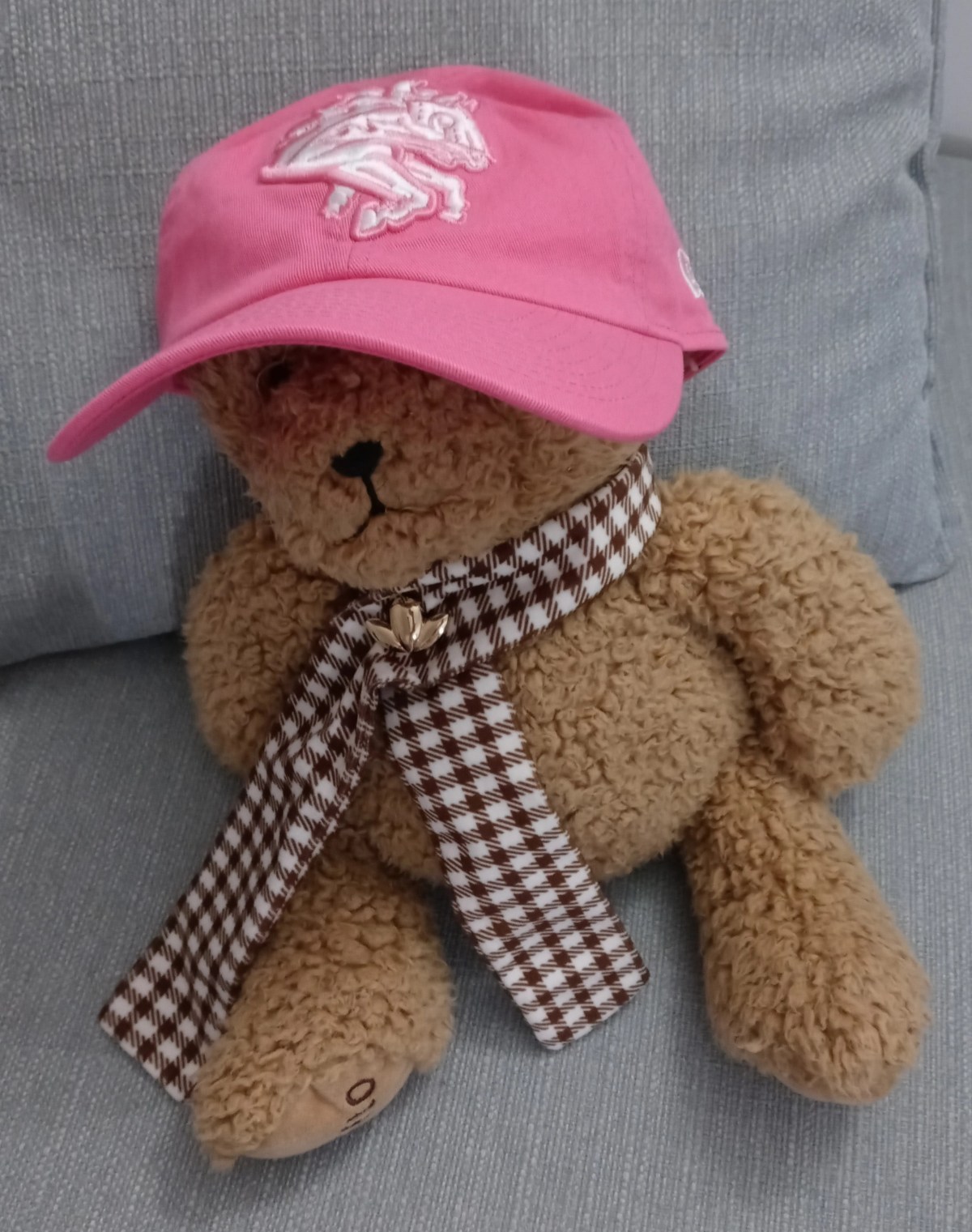
(Photo: ABC’s bear wearing a Binghamton Rumble Ponies cap)
Spouse B, daughter T, and I are in London this week visiting daughter E, son-in-law L, and granddaughters ABC and JG for half-term break. This first half of the week, both E and L are working, so our main goal is taking care of ABC and JG so they can do that.
The last time we were together in person was April when they came to our home in the US. Although we do video calls, they can’t really capture the changes that happen. JG, now 3 and attending full-day nursery school is chatting up a storm! She loves making puzzles, zooming around our rental house near their home, and following the lead of 6-year-old ABC, who likes or tolerates it most of the time. ABC, now in year 2 at school, is reading well and a master of make-believe. She can make up songs and lyrics on the spot, taking after her musically-and-literary-accomplished parents. ABC also enjoys dance and art.
I love watching B being Grandpa, playing games, reading stories, preparing meals and snacks, and dozing off during naptime. T is an involved auntie, playing endless games of hide-and-seek and whatever make-believe ABC has invented and giving gentle hugs, in deference to her still-healing shoulder.
My favorite thing is just being here as family. With the ocean between us, it’s a rare gift to snuggle on the couch, especially with JG who was born during the early part of the pandemic and whom we didn’t get to meet in person until she was a year old. Such a different grandparenting experience than with ABC who lived with us in the US until she was two.
For JG, I’m just Nana. ABC, though, remembers her Great-Nana, who passed away in 2019.
I miss my parents and wish I could be as good a grandparent as they were with E and T.
Today’s prompt for Linda’s Just Jot It January is “family,” contributed by Kim of Twisted Trunk Travels. Check out their blogs!
Over these last ten-ish years of writing poetry and blogging here at Top of JC’s Mind, I have written way more often about my family than I thought I would. Of course, it made perfect sense to blog about visiting daughter E and son-in-law L in Hawai’i, as folks often blog about their travels, but as time and circumstances changed and I faced the challenges of caregiving for various generations of the family, posts about family became more frequent. I also used poetry as a way to process things that were going on with my family, most notably about my mother’s experiences living with and dying from heart disease, which became my first published chapbook, Hearts (Kelsay Books, 2023).
I do try to protect my family members by referring to them with initials or nicknames rather than their given names. Nearly all of them use a different surname so only people who know us in real life are likely to recognize them from posts. Currently, spouse B and daughter T are most likely to appear as we are living in the same house, although we will soon be going to visit daughter E, son-in-law L, and granddaughters ABC and JG in London. which may generate some posts. My daughters’ grandparents were called on the blog by the names they used for them, Nana and Paco for my parents and Grandma for B’s mom. (Sadly, B’s dad, known as Grandpa, passed away in 2005, before I was blogging and writing poetry, although his death was the subject of one of my earliest published poems.) If you are perusing the archives of Top of JC’s Mind, you’ll come across posts dealing with their final years and the grief following their deaths.
One thing that strikes me about my family posts and poems is how often they spark comments and conversations about people’s own experiences. Knowing that I offer that space for people to reflect on themselves and their own families is a big part of why I continue to write about my family.
In the first few seasons of The Late Show, Stephen Colbert did a recurring skit, then a best-selling book, called Midnight Confessions, in which he “confesses” to his audience with the disclaimer that he isn’t sure these things are really sins but that he does “feel bad about them.” While Stephen and his writers are famously funny, I am not, so my JC’s Confessions will be somewhat more serious reflections, but they will be things that I feel bad about. Stephen’s audience always forgives him at the end of the segment; I’m not expecting that – and these aren’t really sins – but comments are always welcome.
It’s been a hard few months.
More than a few?
Hard to keep track…
When I wrote this post at the end of October, I was re-organizing to structure my time for more poetry and less volunteering, but B’s COVID diagnosis in November, which turned into two weeks of him isolating in part of the house, leaving me responsible for keeping the household going, followed by daughter T’s shoulder surgery/aftermath in December left me with a lot to do, not a lot of holiday spirit, and very little creative brain availability. Thrown on top of this was the unexpected return of the threat of shale gas development, which we thought had ended with the New York State high-volume hydrofracking ban nine years ago, this time in the guise of an unproven scheme to use supercritical carbon dioxide to extract methane from shale and sequester carbon. This necessitated the reactivation of the coalition that won the fracking ban back then and hours of conference calls, research, and emails. Oh, and what I thought would be one or two local interviews for my alma mater turned into a series of zoom interviews across the region, taking a lot more time and energy than I had expected when I said yes to the opportunity. (There’s also some other personal and family health stuff going on, which I won’t go into here.)
I’ve been struggling with prioritizing and keeping my attention where it belongs to finish tasks. My best intentions to simplify have met with the reality tsunami and washed out to sea.
I am, though, not suffering as much as I was last January when I wrote JC’s Confessions #26. Then, I realized I was still grieving. I am in a different place in dealing with losses now.
We are spending a couple of weeks in February visiting our family in London, UK. This will get me away from most meetings. If I’m lucky, I’ll get a little bit of poetry time in the early mornings or late evenings to continue work on revision of my full-length manuscript. I’m attempting to line edit the whole thing and, perhaps, re-order it to prepare for work with a professional editor in April. It’s felt like fits and starts so far but I have worked on about 20% of the poems to this point.
I have followed through on my commitment to post daily for Just Jot It January but will be pulling back the post pace for February and trying to devote that time to poetry.
So, yes, organizing my time and following through on plans is still a work in progress.
And, come next January, there is a possibility that some version of this Confession will recur.
Or, maybe, I’ll finally stop feeling badly about having to re-vamp, re-adjust, postpone, and re-jigger my life so often.
At this point in my life, I’m not a big fan of the telephone.
It can take a lot of time and energy to convince myself to make the call, especially if I know I’m likely to have to work through endless phone menus or get put on hold multiple times and shuffled between service personnel.
(Yeah, looking at you insurance companies, utilities, etc.)
There were periods in my younger years when the phone was an important lifeline and source of connection – when B used to travel a lot on business, when I was away from my mom.
Even after my parents retired near us, I usually also spoke to them every day by phone, even on days when I also saw them in person.
Those calls were not hard to make. Or receive.
I still use my landline for calls whenever I can and still have an answering machine to pick up if I can’t – or if the caller ID suspects spam, which is most of the time these days. All three of us happened to be out together earlier this week and I went to check the machine for messages when we got home. I realized that since Paco (my father) died over two years ago I seldom get personal messages on my phone.
Actually, it’s longer ago than that because Paco forgot how to make phone calls in his last months.
She loves them so much that she has a master’s degree in conservation biology of plants. One of her favorite things to do is remove invasive species so that native species can thrive. She can expound at length on the topic of relocating plant species to different elevations and latitudes to help them survive the effects of climate change.
At the moment, it’s winter here and she is recovering from shoulder surgery, so no eradicating of invasive species allowed in the near future.
She has to content herself with tending our indoor plants.
Under her care, the African violets and kalanchoe are in bloom. ***** I shockingly used the prompt “plants” from J-Dub of J-Dub’s Grin and Bear It as part of Linda’s Just Jot It January. (It’s only shocking because I seldom use the prompts and usually meander off in my own direction.) Whether you want to use prompts or not, please join us! Find out more here: https://lindaghill.com/2024/01/21/daily-prompt-jusjojan-the-21st-2024/
It’s been four years since the first cases of COVID-19 were confirmed in the US but it’s still a major health issue. While vaccines, treatments, and preventative measures have made the current situation less severe than the initial onslaught of SARS-CoV-2, people are still getting sick, with some needing to be hospitalized and some, unfortunately, succumbing to the disease, including the person I referenced in this post. In the week of Dec. 31, 2023-January 6, 2024, COVID caused 4% of all deaths in the United States.
The virus continues to mutate. The current strain that is dominant in the United States and globally is JN.1, which is related to the BA.2.86 variant of Omicron. The good news is that the most recent vaccine, which is based on the related XBB lineage, is a good match for JN.1, so the vaccine significantly reduces the risk of severe symptoms, hospitalization, and death while offering some protection against infection. The bad news is that, in the United States, only about 8% of children and 19% of adults are estimated to have received the newest vaccine, contributing to a surge of cases, amplified by holiday travel and gatherings.
More good vaccine news. This large study from Sweden concludes that vaccination reduces the risk of developing long COVID and that additional vaccine doses reduce risk even more. As someone who has particular concerns about long COVID, I appreciate that these studies are continuing to increase our understanding.
Another recent study shows that the Omicron variants don’t cause peak viral loads until day 3-4, much later than the earlier strains of the virus. The practical implication of this is that at-home COVID tests may not pick up a positive reading until several days into the illness, during which time the person could be infecting others. It also has implications for prescribing anti-virals, which need to begin within the first five days of symptoms to be effective. For me, this is a reminder to mask around other people whenever I have symptoms, as an early negative test might not be accurate.
A study published just a few days ago seems to put some science behind what we have all experienced, that SARS-CoV-2 doesn’t have a “season” in the way that some other viruses, like influenza, do. Changes in temperature and humidity don’t appear to have significant influence in transmission. This seems to go along with what we have experienced in the United States, with major waves happening in different seasons of the year. We’ve had waves in the heat of summer as well as the cold of winter. This suggests that our current winter wave is due more to low vaccination rates and holiday travel and gatherings than to the fact that it is winter. It also highlights the importance of increasing ventilation and using masks in crowded indoor spaces, as both summer heat and winter cold tend to drive people to gather indoors.
Four years in, I’ve written a lot of COVID-19 posts. From my days as part of the Pfizer/BioNTech vaccine trials through the present, I’ve always tried to give the most updated information and public health guidance available. It’s frustrating that there is less information from the Centers for Disease Control and Prevention than when the state of emergency was still in effect but some useful recent data can be found here. A lot of the information in this post came to my attention through this post from Dr. Katelyn Jetelina, writing as “Your Local Epidemiologist” and this post from Those Nerdy Girls.
Through all these challenges, especially when spouse B had the first case of COVID in our house in November, I’ve managed to avoid infection, unless I had a totally asymptomatic case at some point. I use my research to make decisions about vaccination, masking, crowd avoidance, etc. that are right for me and my family. I don’t think that advocating for health measures ought to be seen as controversial or political. There are, though, forces in the US that have warped disease prevention into a political test. It’s very sad that Republicans are more likely to die from COVID than non-Republicans. Please, don’t put your health and the health of your family and neighbors at risk over politics. COVID-19 is still out there. Take care of your health and your loved ones. ***** Join us for Linda’s Just Jot It January! Find out more here: https://lindaghill.com/2024/01/15/daily-prompt-jusjojan-the-15th-2024/
I almost started to cry when I heard this piece on National Public Radio’s Morning Edition. (The audio clip is at the link, as well as a written transcript which may offer a bit more information than the audio in addition to links to the studies cited and to people providing commentary.)
The piece discusses that people with long COVID have physical changes in their tissues that showed cause for their exhaustion or “post-exertional malaise.” The mitochondria in the muscle cells were not functioning properly, so the muscles could not get the oxygen and energy they needed. It appears that this mechanism is also at work in people diagnosed with ME/CFS and other similar, poorly understood syndromes that exhibit these symptoms.
A member of my family was diagnosed with ME/CFS, then called fibromyalgia/chronic fatigue syndrome in the United States, as a young adult, although she had been having symptoms since early adolescence. She was told that she needed to exercise to build her strength, which was common advice at the time but which proved to be detrimental to her. If she tried to push herself physically at all, she would wind up in so much pain and with so much fatigue that she could barely move for a week or more. As I was listening to the radio piece, I was thinking back to those days, when she was so debilitated that we would strategize when or if she could join the family from her upstairs bedroom because she could only manage the fourteen stairs between the levels once a day, at most.
What made a terrible situation worse was that the doctors would think she “wasn’t trying to get better,” essentially blaming her for her condition when the root of the problem was their lack of understanding of ME/CFS. Effort or mental attitude is not going to repair one’s mitochondria.
I appreciate that research money going to study long COVID is also increasing understanding of ME/CFS and other conditions with similar symptoms. (You can read some of my prior posts referencing long COVID and its commonalities with ME/CFS here and here.) I’m hoping that increased understanding will bring more effective treatments and, at least, an end to blaming patients for “not trying hard enough” to get better.
Compassion is needed in these situations, not judgmentalism.
I had saved this article on a research study that showed that SARS-CoV-2, the virus that causes COVID-19, can directly infect coronary arteries, which may help to explain the increased risk of heart attack and stroke among people who have contracted it.
It came to mind now because we received news that a friend’s family member with COVID has suffered a heart attack.
While it’s not known if infection and inflammation of the coronary arteries caused this particular person’s heart attack, it is a stark reminder that COVID can cause serious health complications. Way too many people are still getting sick and dying from it.
While there are no iron-clad ways to avoid infection, preventative measures like vaccines, avoiding crowds, and masking in indoor public spaces reduce your chances of infection and its follow-on risks.
Even if you don’t care about your personal risk of infection, remember that you could pass the infection on to someone who may be more vulnerable than you due to their age or underlying health condition. I know this has been a powerful motivating factor for me.









 Joanne Corey