One-Liner Wednesday: dogwood

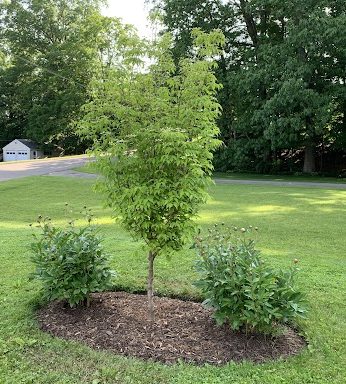
Our landscapers just brought us a new Kousa dogwood for our front yard to replace one that was dying.

Join us for Linda’s One-Liner Wednesdays! Find out more here: https://lindaghill.com/2025/06/04/one-liner-wednesday-what-day-was-it-yesterday-anyway-edition/

No-Mow May

In the United Kingdom and parts of the United States, there is an initiative called No-Mow May, encouraging people not to mow lawns (or a portion thereof) during the month of May in order to encourage the blossoming of wildflowers which provide food for bees, butterflies, and other pollinators.

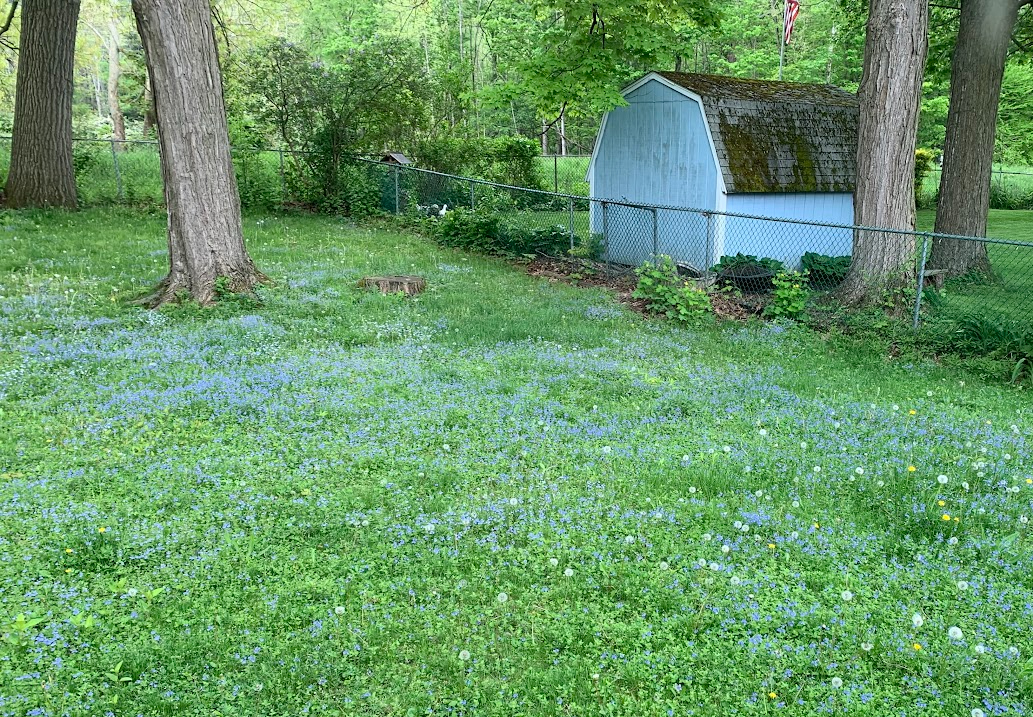
In the spirit of No-Mow May, we have limited our lawn mowing in our front yard and left most of the back yard to grow on its own. The front yard starts things off with dandelions, which we let blossom but then wind up having to mow for propriety’s sake. B leaves the lawnmower on the highest setting, though, so that the spent dandelion stems get cut while sparing the violets and white clover that follow. Even though white clover is not native, our bumblebees seem to enjoy it. It’s also helpful that we use a battery-powered mower so that the plants don’t have to contend with the heat and exhaust of burning gasoline.

Besides those, the backyard has waves of additional flowers, including wild strawberry, bluets, forget-me-nots, speedwell, buttercups, celandine, ground ivy, and fleabane. While these help our pollinators, they also provide food for other animals, including rabbits.

Besides the lawn, we have other spring-flowering plants, including bleeding hearts, PJM rhododendron, dwarf daffodils, lily-of-the-valley, brunnera, amsonia, and our heirloom rose bush.

Although not all the plants are native, our native pollinators frequently visit them, which is important to us, especially our bumblebees. When we had a landscape plan drawn up and planted in fall 2020, we requested native plants, but some of the plants that grow wild in our yard are non-native species that are now considered naturalized in our area, though not invasive. If we do find invasive species, such as garlic mustard, growing, we try to pull them out so that they don’t spread. It is also helpful that we have had wildflowers growing as part of our lawn for decades. We never use herbicides. The mix of plants and not mowing it too short also make our lawn drought-resistant. We never have to waste water by spraying it on our lawn.

We may stretch No-Mow May into early June in the backyard so that the daisies that have started to grow up but haven’t blossomed yet have a chance to do so. Perhaps, B will do what he has done in some past years and mow around the daisies until they have had a chance to flower.

Do people observe No-Mow May – or some variation better suited to your geography, like Low-Mow May or No-Mow April, where you live?

for the love of plants

My daughter T loves plants.

She loves them so much that she has a master’s degree in conservation biology of plants. One of her favorite things to do is remove invasive species so that native species can thrive. She can expound at length on the topic of relocating plant species to different elevations and latitudes to help them survive the effects of climate change.

At the moment, it’s winter here and she is recovering from shoulder surgery, so no eradicating of invasive species allowed in the near future.

She has to content herself with tending our indoor plants.

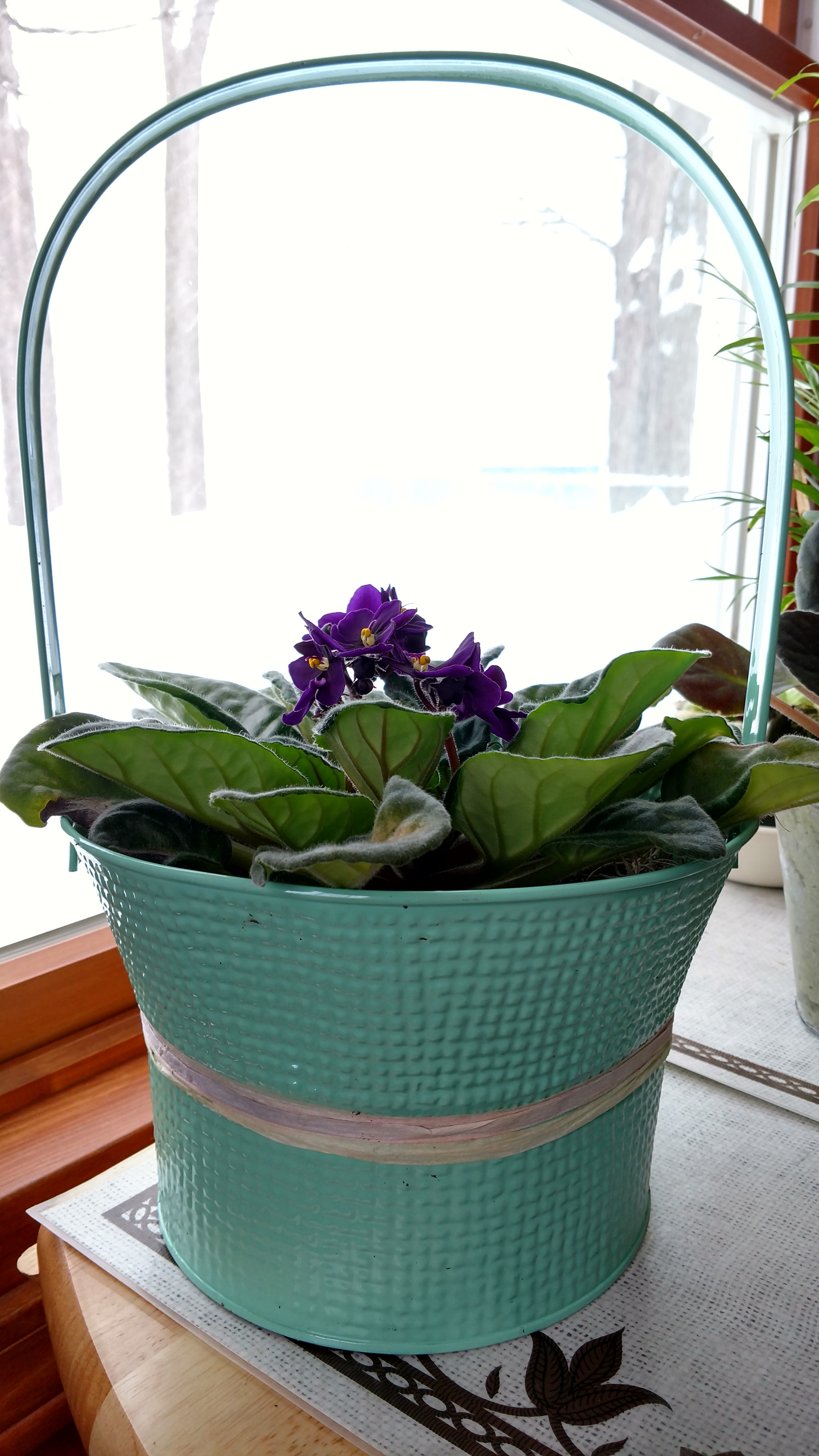
Under her care, the African violets and kalanchoe are in bloom.
*****
I shockingly used the prompt “plants” from J-Dub of J-Dub’s Grin and Bear It as part of Linda’s Just Jot It January. (It’s only shocking because I seldom use the prompts and usually meander off in my own direction.) Whether you want to use prompts or not, please join us! Find out more here: https://lindaghill.com/2024/01/21/daily-prompt-jusjojan-the-21st-2024/

SoCS: growth

It’s spring in my hemisphere so signs of new growth are everywhere.

The lawn is growing. There are new flowers blooming in turn. We are excited to see the new landscaping we had put in last fall growing. Because most of the plants are new to us, it’s fun to see how they put out new shoots and when. Some have already flowered, along with our old standbys like bleeding hearts. We are especially pleased that the ferns that were re-located in the project are coming back strong, unfurling from their fiddlehead phase.

The most important growth we are observing this spring, though, is coming over our computer screens. As some of you may recall, we have yet to meet our granddaughter JG in person. She was born during the pandemic in the UK, so we aren’t able to travel there yet.

She is now nine months old and growing up quickly. She has three teeth in with more ready to break through. She is anxious to walk and can already manage to toddle along holding with just one hand. Soon, she will be off on her own. (She doesn’t care for the whole crawling thing.)

What is most endearing is that we can now see more of her personality coming through over our computer. She has grown enough to be curious about these figures on the screen who talk directly to her. We can engage in conversations where we react to her baby-babbles. She can lock eyes with us. We can even play peek-a-boo with her.

Her mom calls us Nana and Grandpa and Auntie T. As we look forward to that blessed but currently unknown day, we wonder if our screen visits will translate into JG “knowing” us when we see her in person for the first time.

We hope she will grow to love us, even from afar, as we love her.

*****
Linda’s prompt for Stream of Consciousness Saturday this week is “growth.” Join us! Find out more here: https://lindaghill.com/2021/05/14/the-friday-reminder-and-prompt-for-socs-may-15-2021/

A POETREE

For the recently concluded National Poetry Month, the Broome County Arts Council invited local poets to contribute a short poem about spring, hope, and/or other positive things for their POETREE.

I had hoped to make it down to the gallery to see it and take photos for this post, but I didn’t manage to do that. Instead, I have copied the poem I wrote especially for the project below:

Why We Will Never Use Weedkillers
by Joanne Corey

Every spring, we watch
the jagged-edged three-ness
of strawberry leaves emerge
from the snowmelt-soaked
lawn, the white five-petaled
blossoms attract the bees
to their sunny centers,
the green-white berries
ripen to red in June,
the squirrels feasting.

baby ash

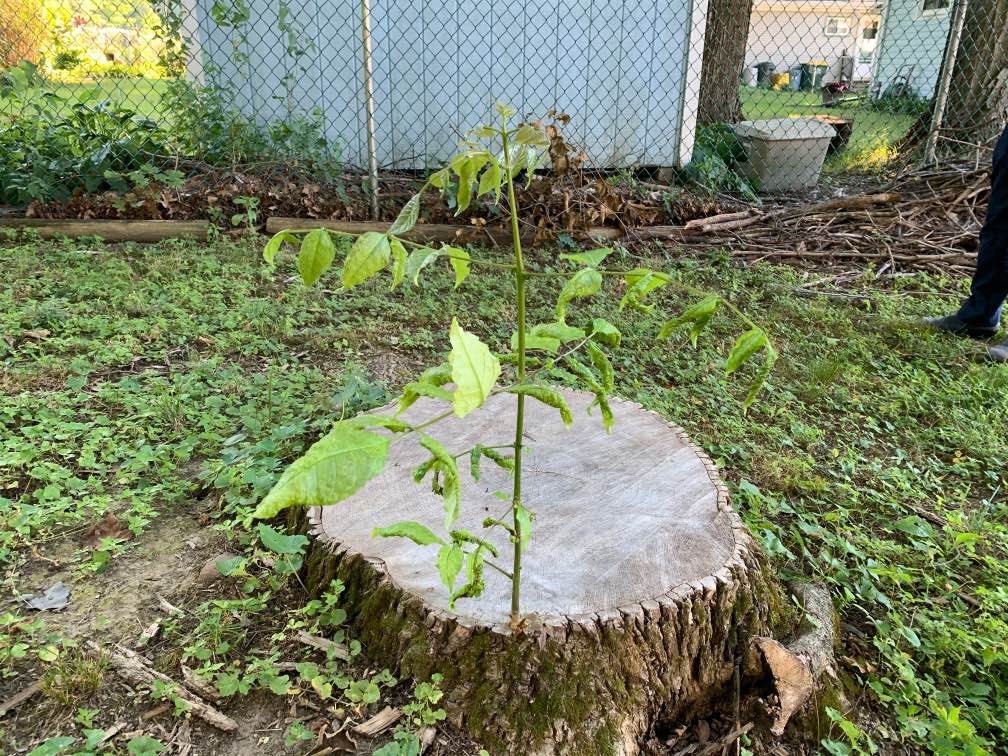
I wrote in January about having to take down the ash tree in our backyard because it had been infested with emerald ash borer.

This week, we noticed something growing near the stump.

It’s a new ash tree!

It’s growing very quickly. It certainly has a very large root structure, given that it is growing directly from where the bark meets the wood of the stump. Given its position, we aren’t sure it will survive long-term, but it is nice to see nature trying to come back from a plague.

A little hope is a good thing to have right now.

Spring flowers!

When I was a student at Smith College, one of my favorite annual events was the Spring Bulb Show at Lyman Plant House. It isn’t available to the public this year, but here is a lovely video tour. Enjoy!

March 17

Today is March 17, which is usually celebrated as Saint Patrick’s Day. Although it is a feast day for Saint Patrick in the Catholic church, it is generally celebrated in the United States also as a secular holiday with parades, Irish food, and, in many cases, way too much alcohol.

This year, with COVID-19 social distancing protocols in place, things are very, very quiet. Paco will still get to have corned beef and cabbage and potatoes, but he will be eating it in his apartment instead of a dining room filled with his senior living community friends wearing green and sitting at tables decorated for the occasion.

Fun fact:  Paco’s middle name is Patrick. He finally got to visit Ireland, the home of his grandparents, last fall.
img-20191016-wa0000

B’s side of the family had some different March 17th traditions. B’s dad was an elementary school principal who had a running joke with his students and staff. He celebrated March 17th as Evacuation Day, which commemorates the British leaving Boston on that date in 1776 after an eleven month siege, under pressure by the Continental Army, commanded by George Washington and bolstered by cannons captured from Fort Ticonderoga. Parts of Massachusetts celebrated it as an official holiday, although not the western part of the state where his school was located. He used to make an announcement on the public address system in the morning and even designed an evacuation day card which he printed with his then-new dot matrix printer.

He also used to buy an “evacuation day” bouquet for B’s mom, known here at TJCM as Grandma. After he passed away, B and I continued the tradition of giving Grandma evacuation day flowers, first ordering them delivered to her home from their favorite local florist and then bringing them in person after she moved to our area.

In 2016, we changed it up a bit and gave Grandma a planter. We had no way of knowing that she would pass away after a heart attack a few days later. Our daughter T, who has a special affinity for plants, took over care of the planter, eventually having to separate the plants into different pots as they grew too large.

Today, the African violet and the kalanchoe from the planter are in full bloom.

On the dining room table, is an evacuation day bouquet that B bought for T.

attack of the woodpeckers

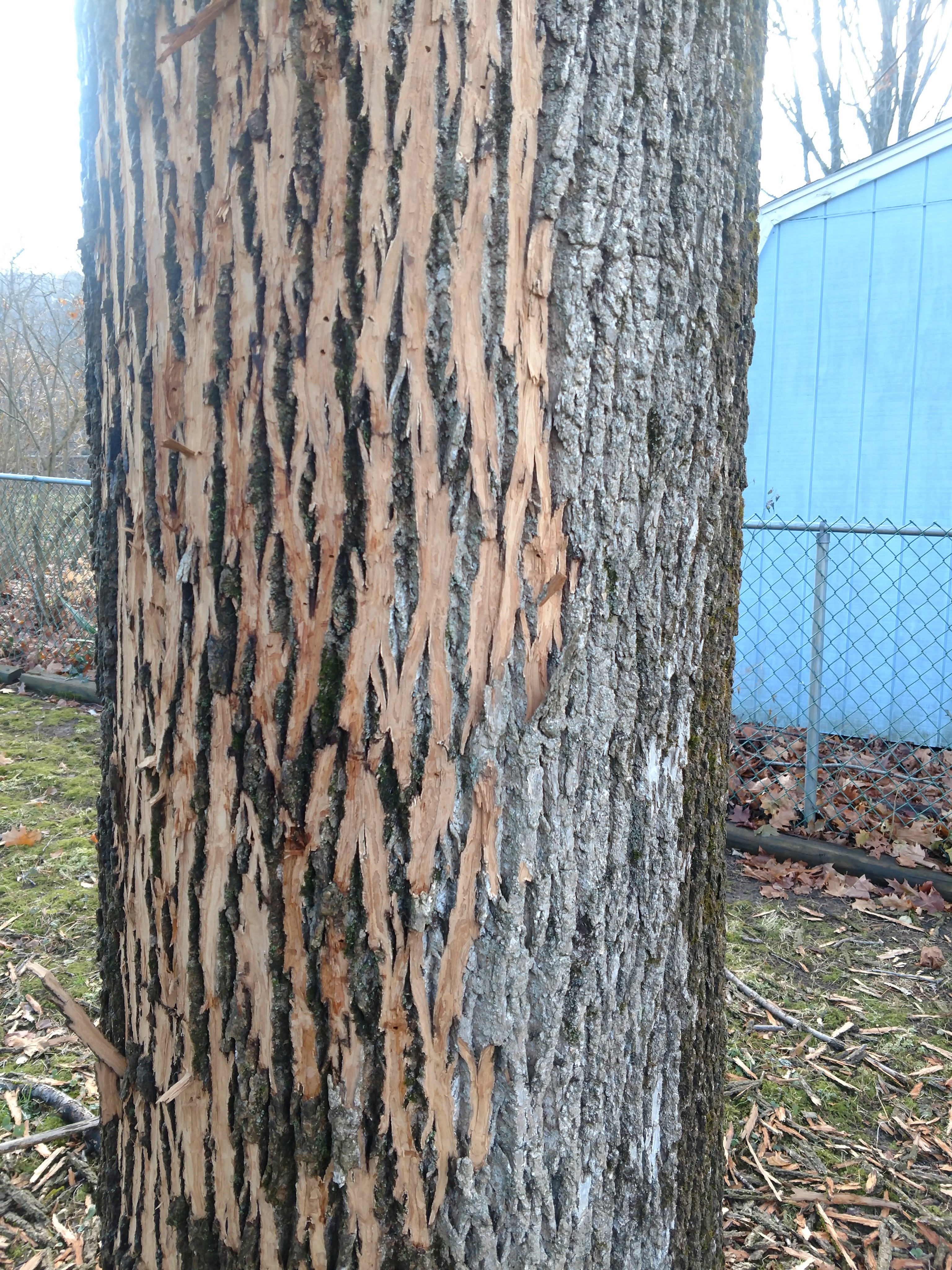
We have an ash tree in our backyard. When we looked out the window the other day, some of the bark on either side was badly scraped. At first, we thought maybe a bear had been climbing it.

Then, a piece of bark dropped down from higher up the trunk and we saw a pileated woodpecker, pecking assiduously and creating more places with almost no bark left. Although the pileated woodpeckers are far and away the largest, there are hairy and downy woodpeckers joining the party, too, creating an ever-growing patch of stripped bark on the ground.

Obviously, the tree is very sick. The wood underneath is spongy instead of hard and woodpeckers generally can’t strip bark like they have been here. We have called a tree service to evaluate, but it seems to fit the signs of infestation by emerald ash borer.

ash tree
the base of the tree with bark shards on the ground

img_20191124_153209832
Close-up of the damage

We had hoped the tree would be spared because the immediately surrounding trees are not ash, but adult insects can travel about half a mile from their source, so it was probably inevitable.

Ironically, we were getting ready to call the tree service to look at one of our maples, which seems to be dying back and may have verticillium wilt, which is caused by a soil fungus. There is a second maple that is very close to the ash tree which may need to be removed as well. It’s possible that all three of the mature trees closest to our house on the south side may be cut down, which is not good news on the air conditioning front, although our new heat pump will decrease our cooling costs a lot compared to our old central air unit. It may mean though, that we can get enough sun to grow small trees, shrubs, and flowers. We used to have a vegetable garden in the backyard, but it became too shaded. (It also got eaten by groundhogs who could easily climb the fence around the garden, but that is another story.) We may also have less moss in the yard, although I prefer more wildflowers instead of more grass.

It could also mean that we have to re-landscape on all sides of our house, given that our front and side yards are torn up from the drilling and burying of the outdoor part of our geothermal system. Given that we have had cold weather earlier than usual this year, we may have to wait for spring.

March 17th

Happy Evacuation Day!

B’s dad, who was a very long-tenured elementary school principal in western Massachusetts, used to do an announcement every March 17th about what an important day it was because, in 1776, the British were forced to leave Boston, which had been under siege since the Battle of Lexington and Concord on April 19th, 1775 (which is commemorated as Patriots’ Day). In the days of dot-matrix printers, he even had little greeting cards printed for Evacuation Day, which, of course, involved a Minuteman and cannon.

He used to use Evacuation Day as an excuse occasion to gift his wife with flowers.

After he passed away in 2005, B and I took up the tradition of giving Evacuation Day flowers to Grandma, first having them delivered from their favorite local florist, and then choosing and delivering them ourselves after she moved here from Vermont.

Last year, daughter T, who was home on spring break from grad school, and I chose a planter instead of cut flowers. Grandma loved them and put them in the center of her dining room table, as she usually did.

We didn’t know that Grandma would succumb to a heart attack less than a week later.

We kept the planter there for a remembrance and a splash of color as we did the necessary work to clear out her cottage. Then, we brought the planter to our home.

Over the summer, T, who had just finished her MPS in conservation biology of plants, took over plant care and broke the planter into separate pots, as it was becoming too crowded. The African violet stayed in the original green basket.

When she left in late January for her Missouri job-on-the-prairie, the plants were looking healthy and a few weeks ago, the African violet started to bloom.
IMG_20170314_112853788_HDR

So, this week it has many blossoms to remind us of the happy occasion of delivering flowers to Grandma for the family tradition of Evacuation Day.

Oh, and lest I forget, Happy Saint Patrick’s Day, too!