One-Liner Wednesday: hope in community

Until we find the communal meaning and significance of the suffering of all life, we will continue to retreat into our individual, small worlds in our misguided quest for personal safety and sanity.

Richard Rohr

Join us for Linda’s One-Liner Wednesdays! Find out more here: https://lindaghill.com/2022/04/13/one-liner-wednesday-creepy-enough/

One-Liner Wednesday: new poems!

In an act of shameless self-promotion, I’m using One-Liner Wednesday to promote yesterday’s post about the five – count ’em five! – new poems of mine published by Wilderness House Literary Review this week!

Join us for Linda’s One-Liner Wednesdays! Find out more here: https://lindaghill.com/2022/04/06/one-liner-wednesday-not-to-make-light-of-a-serious-situation/

Five Poems in Wilderness House Literary Review!

I am pleased and excited to share the link to the latest quarterly issue of Wilderness House Literary Review, which features five of my poems. Many thanks to poetry editor Ravi Yelamanchili and the whole team at WHLR for including me in their spring issue. If you are reading this in Spring, 2022, you can access the current issue at the link above; scroll down to the Poetry section to find Joanne Corey in the list of poets and click, which will take you to my work. If it is beyond that, you can find the issue through the cumulative index as Volume 17.1 – Spring 2022. While you are there, browse the WHLR archive for poetry, essays, art, fiction, and book reviews going back to Spring 2006. You’re sure to find something that will fascinate and delight you!

I thought I’d use this post to give some background on the poems and submission process. As folks who have been following Top of JC’s Mind for a while know, the last few years have been challenging for me as my family navigated the difficult last years of B’s mom and my parents, as well as the joy of welcoming a new generation to our family coupled with the complications of having them live across an ocean from us with the pandemic adding another layer of stress.

Because of all that, I was sandwiching in writing in a rather haphazard way and not concentrating on submissions. When I did begin making myself do the fraught work of preparing submissions, I concentrated on sending out my chapbook and collection manuscripts rather than journal submissions. Usually, a goodly number of poems in a manuscript have already been published in journals and I knew that I needed to get individual poems published as journal publications are the backbone of sharing poetry. Knowing that I was struggling with doing journal submissions, my wise poet-friend Merrill Oliver Douglas counseled me to choose five poems that I liked and send them out to a bunch of journals without stressing over style or if the poems related to each other or any of the other things that were keeping me paralyzed. I did that in early February. I chose to submit to WHLR because they were one of the first journals to publish my work back in Fall, 2015, just as I was getting more deliberate about publishing my poetry and just before we entered into our intensive phase with elder care. I thought there might be one or two of the five that would interest them but I was shocked and amazed that they accepted all five. (Being a good poetry citizen, I immediately withdrew the poems from all other journals to which I had submitted them.)

The rest of this post will give some of the background to the poems. You can choose to read them first, using the links in the first paragraph, or read the rest of the post first and the poems afterwards. I’ll write about the poems in the order in which they appear.

Starting off with a trigger warning, especially for family and friends who may not be ready to read “We probably should have taken off”, which is about the death of my father, known here as Paco. I wrote the first draft in the middle of the night while I was at the Boiler House Poets Collective residency only a couple of weeks after Paco’s death and workshopped it there. I did revisions and workshopped it again with the Grapevine Poets in October – and then couldn’t bear to look at it again for several months. I did the final edits in order to send it out this winter because I knew from the reaction of the poets who had seen the drafts that it was a strong poem. It’s sometimes hard for me to tell objectively when something is strong if it is also close to me emotionally. I had originally written this poem by hand in a journal and tried to replicate the spacing I had used when I put it into the computer. The use of white space seemed to fit the mood of the poem and is a frequently employed device in contemporary poetry, although some online journals advise against it because it can be hard to replicate in their publishing software. My original rendition is probably even “spacier” than the published version due to being on a larger page.

“Sprague Suite” is an ekphrastic poem based on the exhibit Transition: Decade of Decision, Sprague Electric>>MASS MoCA, 1989-1999 by Christopher Gillooly, which was on display there in 2018. When I was at our Boiler House residency that year, I felt as if it was my second home. I was drawn to it because it told the history of the former industrial site which is now home to the Massachusetts Museum of Contemporary Art. I am from the North Adams area, so I also have a personal perspective on that history. The six sections of “Sprague Suite” relate to Sprague Electric, which occupied the site for several decades until 1986, manufacturing capacitors. For fun, I also played a bit with form in this poem. Sections I and VI are haiku and II and V are tanka. III and IV are my go-to, free verse. “Industrial Buddha”, the title of section V, is the name of a collage sculpture of found objects that was part of the exhibit. This poem is part of my full-length poetry collection which is currently submitted to several contests and publishers.

“In my purse” began as a Binghamton Poetry Project prompt in fall of 2020. We were studying list poems and the power of juxtaposition. I’m a fan of list poems and had written several previously. When we write from prompts, we only have about ten minutes to draft, so the poems tend to be relatively short. There is also so little time to plan or ponder that words often fall onto the page in unexpected ways, which is perfect for a list poem where juxtaposition is everything. Thinking this quickly-generated draft had potential, I decided to workshop it with Grapevine and revise it to send out to journals. I’m so happy it has found a home at Wilderness House Literary Review!

“Zoom Wedding – October 4, 2020” also began as a Binghamton Poetry Project prompt in summer 2020. We were to begin a poem with a line from Ocean Vuong’s searing “Aubade with Burning City” about the final evacuation from Saigon in 1975. We were, however, to take our poem in a different direction. I chose the line, “He fills a teacup with champagne, brings it to her lips.” Given that we were then in the early months of the pandemic with public health rules making large gatherings impossible, I recast the line to open the story of a couple forced to cancel a long-planned June wedding and instead hold it in October via Zoom, which, for future readers who might see this after Zoom has been merged, renamed, or supplanted by newer technologies, is a video conferencing platform that gained ascendency when everything from business meetings to church services to family gatherings had to be cancelled or held virtually instead of in person. I began the draft during our BPP session and finished it the next day. I workshopped it with the Grapevine Poets, but then set it aside. I made some revisions in order to send it out this winter. I wasn’t sure if it would appeal to anyone as most people are trying to move beyond the pandemic, even though it hasn’t ended. Thankfully, with vaccines and treatments available, in-person gatherings are much safer in 2022 than they were in 2020.

“Monroe Bridge Mail” was drafted in May 2021 as I prepared to go on a private writing retreat back to North Adams to finish the manuscript which I referenced in the “Sprague Suite” section above. While I went to high school in North Adams, my actual hometown is Monroe Bridge, then home to about two hundred people, about twenty miles distant. I wanted to have some more Monroe Bridge poems in the collection, so I wrote this about our post office. I chose to employ a more conversational, storyteller mode, with long sentences and asides. It is a lot of fun to read aloud, which I had the opportunity to do at the Vestal Museum last summer.

Whew! Long post. If you have made it this far, thank you and congratulations! Please feel free to comment below. I love to know what people are thinking about my poems and/or posts.

Forsaken of Man

Yesterday, for the first time since the Smith College Alumnae Chorus concerts in Slovenia in July 2019, I sang in a choral concert. This ends the longest drought in choral performances since I was a teenager. While the pandemic was a major factor in this break, the other complication was that the Binghamton University Chorus, which I joined in fall of 1982 after moving to the area, may have been permanently disbanded, something that I suspected at our last concert in May, 2019.

Last fall, I attended the first in-person concert since the onset of the pandemic by The Madrigal Choir of Binghamton. I have long had friends who sang with Madrigal Choir, but always assumed that I would not be the most qualified person they could find to fill a rare opening in the soprano section. At the concert, they announced, though, that they were looking for new members in all voice parts. Bolstered by the fact that Bruce Borton, professor emeritus from Binghamton University under whose direction I sang with University Chorus throughout his tenure, is now the director of Madrigal Choir, I inquired about joining and was accepted. Due to our family trip to London for the holidays and the omicron spike, the concert yesterday was my first opportunity to perform as a member of Madrigal Choir.

We joined with the choir of Trinity Memorial Episcopal Church to present Leo Sowerby’s Lenten cantata, Forsaken of Man, under the direction of Trinity’s music director Timothy Smith. While I had been familiar with some of Sowerby’s work, I had not previously heard this powerful and dramatic piece. With passages from the gospels, including some of Jesus’s hopeful teachings, and additional text by Edward Borgers, Forsaken of Man concentrates on the betrayal and abandonment of Jesus in his final days.

As often happens in Passion settings, the story is proclaimed by The Evangelist, for us tenor Kevin Bryant. Brian Mummert portrayed Jesus and bass John Shelhart chillingly sang the roles of Caiaphas, Judas, and Peter. They were all magnificent as were the other soloists with smaller parts, including Dr. Borton as Pilate.

What I appreciate as a member of the chorus is the role that Sowerby chose for us. Sometimes, we were participants in the narrative, becoming the disciples, or the crowd calling for crucifixion, or the soldiers mocking Jesus. At other times, we set the scene or offer commentary, as in the choral prologue and epilogue.

Unlike many Passion settings, the soloists and chorus unfold the story in a series of four parts, rather than a succession of short solo arias and choral movements. This is part of the drama of the piece, as there are many sudden shifts in mood, voicing, and tempo.

Another major driver of the dramatic expression of the story is the incredibly demanding organ part, played masterfully by the William K. Trafka on Trinity’s Casavant organ, which was expanded in 2018. Sowerby was himself an organist, as is evident from the complexity and expressive nuance of the score. It was a thrill for me to be singing in the chancel at Trinity. I had served there as an assistant back in the mid-’80s and this concert brought back many memories of that time, including some choir members who are still serving.

The sad news is that this is the last public performance of the season for the Madrigal Choir but I am looking forward to the announcement of the next season. I’m grateful to have a new choral home! Stay tuned for more about Madrigal Choir in the fall when we resume – or perhaps before…

One-Liner Wednesday: fear

It is almost always fear that justifies our knee-jerk rebellion or our need to dominate—a fear that is hardly ever recognized as such because we are acting out and trying to control the situation.  

Richard Rohr

Join us for Linda’s One-Liner Wednesday! You can find out more and check out her sweet post for this week here: https://lindaghill.com/2022/03/30/one-liner-wednesday-congratulations/

JC’s Confessions #22

In the first few seasons of The Late Show, Stephen Colbert did a recurring skit, now a best-selling book, called Midnight Confessions, in which he “confesses” to his audience with the disclaimer that he isn’t sure these things are really sins but that he does “feel bad about them.” While Stephen and his writers are famously funny, I am not, so my JC’s Confessions will be somewhat more serious reflections, but they will be things that I feel bad about. Stephen’s audience always forgives him at the end of the segment; I’m not expecting that – and these aren’t really sins – but comments are always welcome.

JC

I have never seen any of The Godfather movies and hope I never do.

I have seen (more) clips (than I care to) enough to know that it is way, way, way beyond my level of tolerance for violence.

As an Italian-American on my mother’s side, I shudder at the stereotyping of being part of the Mafia when that is such a small segment of the Italian-American experience, certainly totally divorced from my family’s life in rural New England.

Because this is the fiftieth anniversary of the first film in the trilogy, there have been pieces in the media galore about the significance of the films, the references that have become part of modern parlance, and, surprisingly, a lot of people claiming that they understood what it was to become an adult because of The Godfather.

I think I managed that last part on my own without the movie, thank you very much.

I know that love and commitment to family are eminently possible without violence and that threatening or injuring or killing someone is not the way to solve problems.

In the movie You’ve Got Mail, Tom Hanks’s character, in trying to coach Meg Ryan’s character about business, quotes lessons from The Godfather frequently, including “It’s not personal – it’s business.”

And maybe that is the root of the problem for me – and perhaps the reason I would not make it in the business world. To me, everything is personal. If I’m going to watch a movie, it will affect me personally and violence, especially fictionalized violence, is not something I want to let rattle around in my mind.

So, perhaps, I have broken my own JC’s Confessions rule in that I don’t actually feel bad about not having seen The Godfather. Let’s just consider it my own tiny, countercultural protest.

(Cue dramatic music)

memorial

Daughter T and I have been preparing memorials to honor Nana and Paco (my parents) and brought them to the building in the memorial park where their cremains are inurned a couple of days ago.

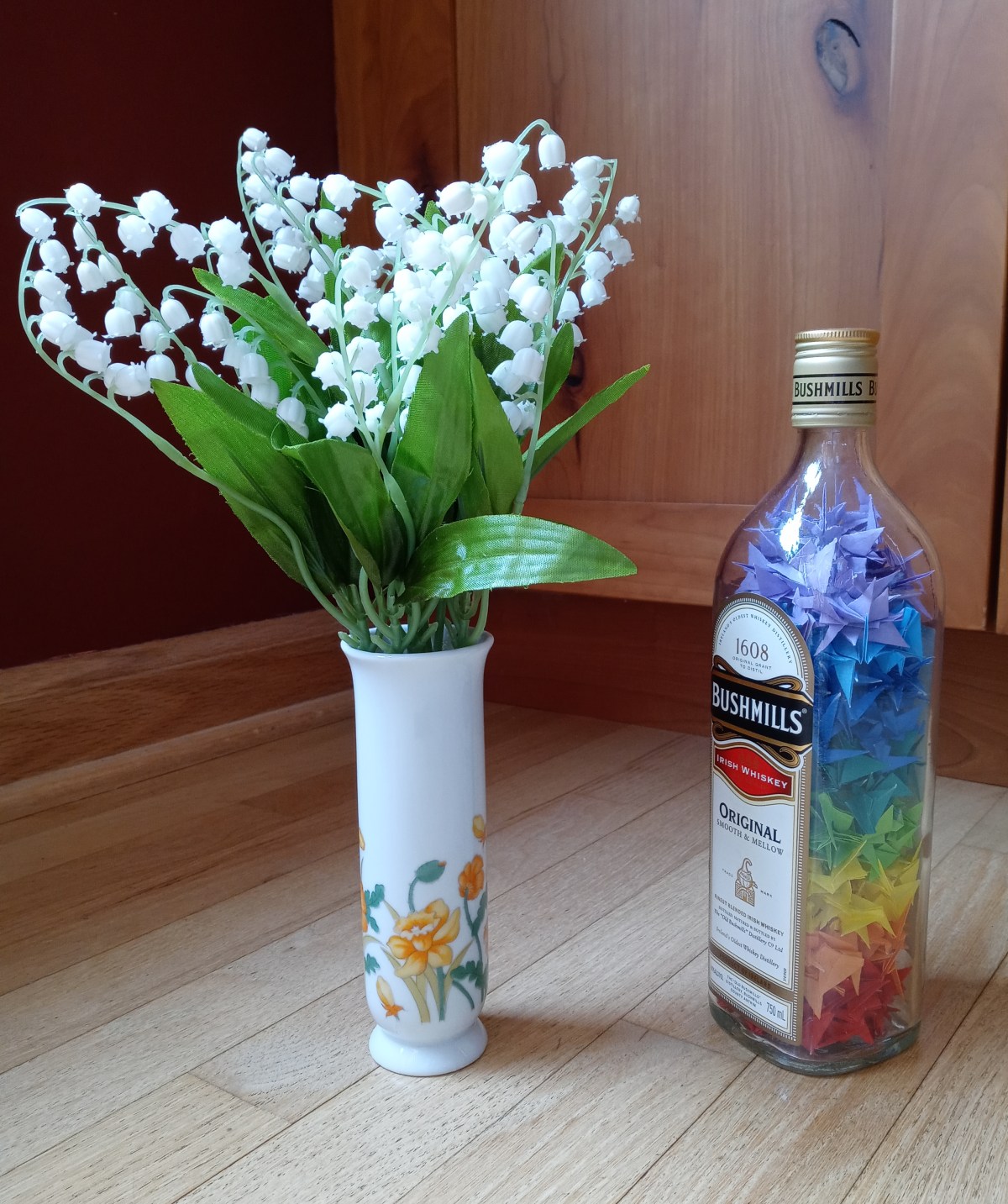
The memorial for Nana is one of her favorite bud vases filled with lily-of-the-valley, which was her birth flower. She always loved them and we would pick bouquets of them every year to bring to her for Mother’s Day and her birthday. Shortly after we bought our home in the late ’80s, we dug some pips from spouse B’s and my childhood yards and transplanted them. As lily-of-the-valley spread aggressively, we now have a large patch in our backyard and they always bloom in mid-May. The flowers in Nana’s vase now have to be artificial as fresh flowers aren’t allowed but it means there will always be a reminder of May near her grave.

Paco’s memorial was created by granddaughter T. She took an empty Irish whiskey bottle and filled it with a rainbow of origami birds. Paco was not a big drinker but he was Irish and Nana used to always make him a Blarney cake which featured Irish whiskey around St. Patrick’s Day and his birthday in March. T meticulously folded 320 tiny origami birds to fill the bottle with the colors of the rainbow. It reminds me of this photo of Paco’s trip of a lifetime to Ireland, inserted into the brief window after Nana’s death but before the pandemic descended.

Paco and an Irish rainbow

It was also the first time for Trinity to visit since the placement of a service medallion for Paco, a bronze replica of a triangularly folded US flag with the inscription “Veteran U.S. Navy”. Paco had served as a Navy SeaBee (Construction Battalion) in both the Second World War and the Korean Conflict. He didn’t talk about his service that much when we were young, but in retirement he often wore a SeaBees cap when he was out and about. It was touching that folks would thank him for his service all those decades later.

Yesterday would have been Paco’s 97th birthday. With spring arriving, the bulk of the estate work done, and our memorials placed, I’m beginning to feel a bit more settled and at peace than I have for a long time. Nana and Paco are eternally reunited and remembered with love, flowers, and a rainbow.

a just peace

Last weekend, after I published this post, I attended mass at St. Francis of Assisi, where we offered prayers for those suffering from the war in Ukraine and heard about the situation in the homily. There was also a lovely tribute to the people of Ukraine in the form of a framed artwork with sunflowers on a blue and gold draped table. We are also preparing to take up a special collection to assist the Ukrainians.

I have been continuing to reflect on the meaning of the “just peace” for which we hope and pray and what elements would be part of that. This post is a reflection of those hopes. I realize that it is not at all likely to be a practical course of action but I wanted to share what is in my heart and mind.

The obvious first step is the immediate cessation of all violence. This will enable desperately needed aid to flow to places that have been besieged or occupied, as well as making safe evacuation possible for the sick, injured, vulnerable, and those whose homes and communities have been destroyed.

All prisoners of war must be released so they can return home.

The Russians must withdraw from the entirety of Ukraine, taking the bodies of their dead with them. This includes Crimea which Russia invaded in 2014 when the current war began. Russia should not control any part of a sovereign nation that it took by force. Any residents of Ukraine who prefer to live under Russian control should be welcomed by Russia into its own territory. Any residents of Ukraine who were voluntarily or involuntarily evacuated into Russia or Belarus and wish to return to Ukraine should be repatriated immediately.

There is widespread devastation, suffering, and death in Ukraine for which there is no just remedy as they cannot be undone. The international community will certainly rush in with humanitarian aid but the responsibility for paying for rebuilding should fall primarily on Russia. Because so much of Russia’s wealth is held by Putin, his family, corrupt government officials, and Putin’s select circle of oligarchs, those are the funds that should be tapped to rebuild Ukraine. Some of those assets are already frozen under international sanctions, some of which should stay in place while the rebuilding process continues. I would hope, though, that the sanctions that make life difficult for the average Russian could be eased so that they don’t continue to suffer because Putin chose to break international law by invading a sovereign neighbor and extensively targeting civilians.

I believe that there will continue to be an investigation and an eventual trial for war crimes in The Hague. I also think that Russia should lose its seat on the UN Security Council or, at least, that the UN should change its policy so that a nation brought before the Security Council must abstain from voting on that issue.

There also needs to be redress for the environmental/climate justice issues highlighted by the war. Russia has long used its fossil fuels as a weapon. The best way to address this problem is to move away from fossil fuels as quickly as possible, blunting Russia’s power and moving the planet in the right direction in terms of the climate crisis. I wrote about some ideas for doing so in this post.

The Russian invasion of Ukraine also highlighted the security and environmental risks of relying on nuclear power, with Russia threatening the already contaminated site of Chernobyl as well as the Zaporizhzhia Nuclear Power Plant, which is the largest nuclear facility in Europe. While nuclear power does not emit carbon, the mining of uranium, the lack of secure long-term nuclear waste disposal options, and the vulnerability of the plants to natural and human-caused disaster is too great. As more and more renewable power becomes available and as efficiency gains reduce energy demands, nuclear power plants should be phased out.

The free flow of truthful information has also taken a hit in this war, especially in Russia. Putin has shut down all independent media in print, over the airwaves, and online and many journalists have fled the country. Protesters have been arrested. Apparently, some of the Russian soldiers were not even told what their mission was as they invaded. As part of a just peace, Putin must restore independent media and allow the free flow of information as well as free all prisoners, both Russians and foreign nationals who have been jailed for dissent or trumped-up charges. The Russian people should also have an independent judiciary and the rescinding of unjust laws, such as the recently passed one that can bring up to fifteen years in prison for calling the war in Ukraine a war or invasion instead of a “special military operation.”

The democratic government of Ukraine must have the freedom to choose its own path going forward. It should be able to apply for membership in the European Union, the North Atlantic Treaty Organization, or any other entity it sees fit. Because the United Nations General Assembly voted overwhelmingly to condemn Russia and support Ukraine’s sovereignty, United Nations peacekeepers should be assigned after the Russian withdrawal to help give security and support as Ukraine rebuilds.

As I said at the outset, this is my own thoughts on some elements of a just peace for Ukraine. I know the reality is that Putin hasn’t really been willing to negotiate, although a swap of ten prisoners on each side is a very small beginning. My fear is that Russia will eventually force Ukraine to accept Russian control of the Donbas region of Eastern Ukraine connecting through Mariupol to Crimea in exchange for not bombing all the major cities of Ukraine into dust. If that happens, I think that all the international sanctions should remain in place. The world must let Putin and Russia know that it will not recognize or tolerate countries taking the territory of sovereign nations by force.

Ukrainian Ekphrastic Writing Challenge

The Ekphrastic Review‘s editor, Lorette C. Luzajic, chose Carousel, a 1906 painting by Ukrainian artist Olexandr Murashko, as a prompt for a recent Ekphrastic Writing Challenge. I am honored that my poem In Kyiv is among those chosen for publication. It is the third response listed. I encourage you to read all the responses, as well as Lorette’s poignant opening note. As always, comments are welcome.

SoCS: Compassion

There is so much in the world right now for which I feel compassion. I’m sure many others are also joining in this sense of compassion, too.

Media is filled with the heart-breaking situation in Ukraine. So much destruction. So much death and injury and hunger and lack of shelter. The incomprehensible targeting of civilians in their homes, of food warehouses, of people who are trying to flee besieged cities. The deaths of so many soldiers on both sides, compounded by the fact that Russia is not bringing the bodies of its dead back home to their families. The millions of internally displaced people and the millions who have become refugees in other countries.

Meanwhile, the pandemic continues to cause suffering. The omicron subvariant is sending cases higher in many countries, just as most had relaxed their preventative strategies. Now into the third year of the pandemic, the accumulated losses are staggering. Millions dead, their absence felt by their families, friends, and communities. Many millions more dealing with lasting damage, some with long COVID, others with lung, heart, vascular, and/or neurological damage that they don’t discover until after recovery from the initial infection.

There are other armed conflicts, droughts leading to hunger, other disasters that cause suffering, and always the unfolding disaster of climate change.

All call for my compassion.

There are personal things, too. The neighbor who just lost his mother. Friends and relatives in medical battles. On and on.

I try not to be overwhelmed or succumb to compassion fatigue. I offer help as I can and support efforts for peace and justice. I don’t know if the people for whom I have compassion can feel that support or not. Perhaps, with so many sharing in compassion, they can and feel a little less alone in their suffering.

I hope.
*****
Linda’s prompt for Stream of Consciousness Saturday this week is to write about a word that contains “comp.” Join us! Find out more here: https://lindaghill.com/2022/03/18/the-friday-reminder-and-prompt-for-socs-march-19-2022/