Review: American Symphony

Last night, B, T, and I watched American Symphony on Netflix, a documentary which followed the extraordinary musician Jon Batiste in 2022. It is also being shown in theaters.

I had loved watching Jon Batiste on The Late Show with Stephen Colbert. He and his band, Stay Human, were the house band on the show, beginning with its inaugural episode in 2015. I appreciated Jon’s talent, his ability to cross and blend musical genres, and his gentle, positive spirit. While his jazz roots were always in evidence, he would often use elements from classical music or indigenous/folk music in his compositions, arrangements, and improvisations. During the early part of the pandemic when the show was being produced remotely, Jon would often still have a segment with Stephen where they would talk from their respective homes and Jon would play a bit on his piano or sing. Even though things were very different, it was a comfort to hear Jon’s expressive, calming voice in a difficult time.

Jon always had multiple projects going on, including performing, recording, and composing. For example, he won an Oscar for best original score as one of the composers for Disney-Pixar’s Soul in 2021. 2022 was set to be another busy, productive year for Jon Batiste, which director Matthew Heineman set out to document on film.

Jon was preparing to premiere his “American Symphony” which would bring together elements of influence of his and American music on stage at Carnegie Hall for a one-time-only performance. He was about to be nominated for 11 Grammy awards across an array of genres. There was still his Late Show gig.

And then, his long-time partner and soon-to-be spouse, the writer/author Suleika Jaouad, had a recurrence of leukemia after ten years in remission and American Symphony transformed from being a documentary about a composer and his music into a film about love, life, living, and how art expresses that all, helps us to process, and propels us forward.

The openness of Jon and Suleika in showing us their pain, anxieties, and vulnerability, as well as their love, art, and joys, is incredibly brave and moving. It was upsetting to me to hear that Jon faced a lot of criticism and negative comments about his eleven Grammy nominations – and eventual five wins, announced while Suleika was beginning chemotherapy. It just seemed so mean-spirited to inflect on a gentle soul at such a vulnerable time. I had known that things were stressful for Jon because he needed to end his years as band leader at The Late Show, but I hadn’t realized the extent of the situation until watching American Symphony.

While being a musician or music-lover will add to your appreciation of this film, it is certainly recommended to all teens and adults who are open to honest expressions of the human condition. It is not for younger children, who might be upset by the intensity of the medical side of the story.

My best wishes to Jon and Suleika for many years of love and art to come. Thank you for sharing so much of yourselves with us.

Photo by Denise Jans on Unsplash

SoCS: concert update

Just back from a long day that featured the first of Madrigal Choir’s Lessons and Carols performances. It was in a small church to our north. Our audience was small but appreciative. It gives me confidence in our performance in our home county tomorrow, which will draw a larger number of listeners.

Now, I need to get some rest…
*****
This short and sweet post is part of Linda’s Stream of Consciousness Saturday series. The prompt this week is “confidence.” You can find out more about SoCS here: https://lindaghill.com/2023/12/01/the-friday-reminder-and-prompt-for-socs-dec-2-2023/

One-Liner Wednesday: Lessons & Carols invitation

For those in the Binghamton/Norwich NY area, please join the Madrigal Choir of Binghamton for our annual Festival of Lessons and Carols this weekend!

This concert promotion message is brought to you as part of Linda’s One-Liner Wednesday series. Join us! Find out more here: https://lindaghill.com/2023/11/29/one-liner-wednesday-sometimes-2/

SoCS: creativity

It’s important to me to create.

These days, I create poems. I create posts here at Top of JC’s Mind.

I also express myself creatively in less obvious ways. Through cooking. Through taking photos (on occasion. I’m not one to be constantly photographing.) In conversation. While singing. In correspondence. In my own thoughts as I’m puzzling through a complex situation and trying to find options.

I love my role in creating my family.

I also love being part of creating community, whether that is on a small, local level or something much broader, like the global community working on climate change. Even though I am a very, very tiny part of such a large community, I realize that my creativity and energy are adding to the effort.

An aspect of creativity that was very important to me as a young adult was writing music. That part of my creative life was lost to me in 2005 when we went through a crisis at my Catholic parish that fractured my relationship with it and my music ministry. Because I wrote music for them, my impetus to use my creativity to write music also broke. I think that rupture may be part of the reason I turned to poetry as a means of creative expression. That artistic energy needed somewhere to go.

Will I eventually return to writing music? At this point, I don’t anticipate that happening.

But creativity is often surprising and unpredictable and wondrous and glorious, so…
*****
Linda’s prompt for Stream of Consciousness Saturday this week is “create.” Join us! Find out more here: https://lindaghill.com/2023/11/10/the-friday-reminder-and-prompt-for-socs-nov-11-2023/

Concert (and American) Reflections

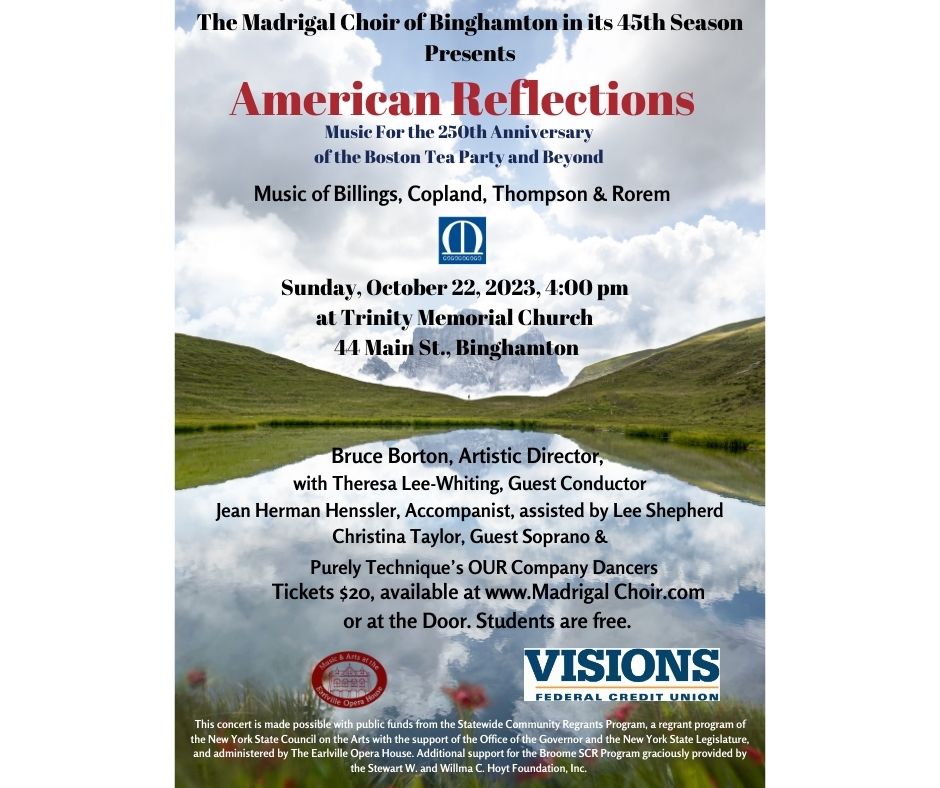
Yesterday, the Madrigal Choir of Binghamton presented the first concert of our 45th anniversary season, “American Reflections.”

Our artistic director, Bruce Borton, chose the program to commemorate a number of anniversaries. We sang a set of pieces by William Billings in commemoration of the 250th anniversary of the Boston Tea Party; Billings was a Boston resident at the time and two of the pieces we sang directly referenced the revolutionary period. Special guest soprano Christina Taylor sang four settings of Walt Whitman poems by Ned Rorem, in honor of Rorem’s centennial. We also sang Randall Thompson’s “The Testament of Freedom,” a setting of Thomas Jefferson texts composed in 1943 for the University of Virginia’s glee club commemorating the bicentennial of their founder Jefferson’s birth. We rounded out our all-American program with pieces from Aaron Copland’s opera, The Tender Land.

I’m pleased to say that the concert went well and was enthusiastically received by our audience. We owe our thanks to Theresa Lee-Whiting, who relinquished her role as singer and president of Madrigal Choir to serve as guest conductor for this concert after Dr. Borton needed to take medical leave. We were grateful that Dr. Borton was feeling well enough to attend the concert and hope that he was proud of the work we had done.

I admit that rehearsing and singing this program had its challenges from a historical perspective. For example, in “Stomp Your Foot” from The Tender Land, the text is very explicit about the devaluing of the work of “ladies” versus men. The story is set in the farmlands of the 1930s Depression era, so it is accurate for the times, if a bit galling to sing these days.

The more problematic text for me was Jefferson’s words in “The Testament of Freedom.” The bulk of the text Thompson chose to set is from the “Declaration of the Causes and Necessity of Taking Up Arms.” There are a number of references to bondage or slavery as a consequence of the colonists not taking up arms against the British. For example, “We cannot endure the infamy and guilt of resigning succeeding generations to that wretchedness which inevitably awaits them if we basely entail hereditary bondage upon them.” It’s difficult to sing the text with the knowledge that Jefferson was holding hundreds of men, women, and children in “hereditary bondage” as he wrote these words. He also writes that the colonists must take up arms “for the protection of our property, acquired solely by the honest industry of our forefathers and ourselves,” as though the work of those he enslaved was not also adding to his wealth, although he would have considered those people part of his property. I wonder if Thompson would have chosen the passages to set differently if more modern scholarship on the colonial and Revolutionary War times had been available to him in the 1940s.

Given that he was composing this work during World War II, the final movement, using text from a letter Jefferson wrote to John Adams in 1821, is poignant. “And even should the cloud of barbarism and despotism again obscure the science and liberties of Europe, this country remains to preserve and restore light and liberty to them…” Some of the young men premiering this work would have been about to enter the armed forces to fight in Europe or the Pacific theater. Both my and my spouse’s fathers were in the service during World War II eighty years ago. It was sobering for me to sing these words at a time when democracy is again assailed by authoritarian and fascist influences in Europe and here in the United States.

The fourth movement begins with these words from Jefferson to Adams, “I shall not die without a hope that light and liberty are on steady advance…” On July 4, 1826, both former presidents died on the 50th anniversary of the Declaration of Independence they both signed.

May light and liberty – and music – continue to advance.

One-Liner Wednesday: MCOB concert invitation

If you are in the Binghamton, NY area, please join the Madrigal Choir of Binghamton on Sunday, October 22, 2023 at 4 PM at Trinity Memorial Episcopal Church for a concert of American music, including works by William Billings, Aaron Copland, Ned Rorem, and Randall Thompson, with special guest Christina Taylor.

Join us for Linda’s One-Liner Wednesdays! Find out more here: https://lindaghill.com/2023/10/18/one-liner-wednesday-heading-out/. Also, check out Linda’s photo she posted today.

Catholic women and the diaconate

This week, I’ve attended celebrations at my parish in honor of St. Phoebe, who carried St. Paul’s letter from the area of Corinth to Rome. In the opening of the letter, Paul refers to her as a deacon, diakonos in Greek.

For the first few centuries of the Christian church, women served as deacons (and priests) but this ministry was suppressed as the church took on the power structure of the Roman Empire. The diaconate for men became a temporary step on the way to the ordination as a priest. The permanent diaconate was restored for men in the Catholic Church by the Second Vatican Council in the 1960s and there has been conversation since about restoring it to women. Under Pope Francis, there have been two study commissions and many bishops at the synod on the Amazon voted in favor of ordaining women, who are already doing this ministry as lay workers, as permanent deacons. However, their recommendation was not included in the final report.

On October 4th, Pope Francis will convene a new synod, called “For a Synodal Church: Communion, Participation, and Mission.” While the majority of voting members will still be bishops, there will also be vowed religious and lay men and women as voting members. It will be the first time that women have ever been voting members in a synod. The document that will be the center of their discussions, called the Instrumentum Laboris, available in several languages here, is made up largely of questions gleaned from listening sessions around the world. A major theme that arose in every region was the treatment of women in church and society and ways to recognize their ministry, service, and leadership in the Church.

The truth is that women constitute the majority of those who work in church ministry but, because they are not ordained, they seldom serve in official, high-level leadership roles. Meanwhile, in many parts of the world, particularly in the global South, where ordained priests are rare, women are ministering in their communities, teaching, preaching, leading prayer services, visiting the sick, and acting as the leader of their parishes without having the option of diaconal ordination. There is hope that this synod, which will conclude next year, will finally make women deacons a renewed reality in the Catholic Church.

So, sorry for the long wind-up, but back to celebrating St. Phoebe this week…

The impetus to celebrate St. Phoebe on or near her September third feast day comes from an organization named Discerning Deacons, whose “mission is to engage Catholics in the active discernment of our Church about women and the diaconate.” I admire their work and pray that the Synod will heed the voice of the Holy Spirit and restore the diaconate to Catholic women.

But, it’s complicated for me to have hope because of my and my sisters-in-faith’s history on the issue of women’s ordination.

I have long believed that God calls people to ordained ministry without regard to their age, gender, nationality, race, language, or any other personal characteristic. In his earthly ministry, Jesus called many disciples from among the marginalized, including women. Besides historical evidence of Catholic women deacons, there is evidence of women priests and bishops in the early centuries. Married men as priests persisted into the twelfth century; their prohibition had more to do with inheritance and property rights than with spiritual matters. For centuries, the power in the church has resided in the clergy. During Pope Francis’s papacy, he has worked to re-organize the structures of the church to allow more lay people, including women, to have leadership roles and to combat the clericalism that led to so many abuses of power and the ensuing cover-ups over the centuries.

While having women restored to ordination in the diaconate could increase leadership roles for women in the church, it doesn’t address the continued denial by the Church of the full personhood of each individual, regardless of their gender. The Church considers sexism a social sin but it cannot credibly call it out in other institutions while continuing to practice it itself.

As Catholics, we are taught to see the image of Christ in each person. Somehow, though, we are supposed to believe that only a celibate male can image Christ while standing at the Eucharistic table.

Treating women as second-class, sadly, also spills over into our social world with serious, even deadly, consequences. For example, the official Catholic viewpoint that prioritizes fetal life over the life and health of the pregnant person is leading to death or loss of fertility when care for a complication is delayed because a fetal heartbeat can still be detected, even when the gestational age or medical condition of the fetus makes survival impossible.

Even within the Church, women are not equally respected as employees. I have experienced this personally and seen it happen over and over with other women, including vowed religious. In the US, church employees don’t have recourse to employment discrimination law, so the Church can act without regard to state and federal law. Of course, it does violate Catholic social justice doctrine on respecting the dignity of work and of the worker. Sadly, restoring the diaconate to women will not address these larger inequities unless it is accompanied by intensive structural reforms of the institution, especially the clergy.

So, now comes the hard part of this post – the personal history.

Back in the mid 1980s- 1990s, I belonged to a local group called Sarah’s Circle. We began as a group of Catholic women, most of whom felt called to ordination – we did also include a couple of male members – who gathered once or twice a month for prayer, discussion, and support. While we did participate in an occasional public prayer service or event, we existed for our own spiritual fulfillment and to hold each other up when life in the Church became difficult.

Some things that our members did ruffled some feathers in the diocese. For example, the diocese ran a program to enlist parishioners to submit names for possible candidates to ordained ministry or vowed religious orders. A number of Sarah’s circle members, including me, submitted women’s names to become priests or deacons.

We wound up being discovered by the broader community when someone wrote a letter to the editor of the local newspaper accusing us of being witches, which was laughable as we were Catholics, not Wiccan. Somehow, this morphed into a brief moment of national notoriety, which included us being denounced by radio personality Rush Limbaugh. It was all very strange but served to make our local circle more powerful. We even were featured as part of a 60 Minutes piece about women’s ordination in 1996.

Over time, most of our members drifted away from the Church. Some joined other Christian denominations. One is now an ordained minister. I still grieve that the Catholic Church was so blinded by patriarchy that they turned away these compassionate, talented, holy women from ordained ministry.

Despite the pain, I stayed in the Church. I used to joke that it was “just me and the nuns” who were sticking it out. (Technically, they weren’t nuns, who are usually cloistered; they were vowed religious sisters.) As more and more of our members were drawn in different directions, we stopped meeting, staying in touch in little arcs, instead of a full circle. Sarah’s Circle’s records are now part of the archives of the Burke Library of the Union Theological Seminary, part of the Columbia University system, in New York City.

So, back to the present reality. My parish is looking into starting a Discerning Deacons group and I don’t know if I should join. Part of the reason I was able to stay within the Church was that, in a long-standing attitude of cowardice, I never did the spiritual work to discern if I was being called to ordained ministry as a deacon or priest.

Not that there weren’t signs that I should do so.

When I was a young mother, I had two vivid dreams in which I was a priest.

Back in the days before the diocese started to specify that only men and single women were invited to inquiry meetings about the call to ordination or religious life, I attended one. After the more general information sessions, we had to break into groups for prospective deacons, priests, or sisters. I originally wanted to join the priest group but didn’t want to disturb the teens and young-adult men there, so I joined the deacon’s group. I remember the deacon who was leading the group saying that, often, the wives of deacons would attend all the preparatory courses and training with their husbands and what a shame it was that, at the end, their husbands were ordained and they received no recognition of their own gifts.

Later, after my daughters were grown and before I joined my present parish, there was a powerful homily about God’s call to individuals that was entwined with the singing of the hymn “Here I Am, Lord” by Dan Schutte. At the time, the deacon serving the parish was ill and I remember looking at his empty seat near the altar and thinking, “I could be that.” I was crying while singing the refrain: “Here I am, Lord. Is it I, Lord? I have heard you calling in the night. I will go, Lord, if you lead me. I will hold your people in my heart.” I did make an appointment to speak to the pastor, who was sympathetic but, at the time, there wasn’t really anything to be done.

So, moving on to this summer. As the St. Phoebe observance was coming together at my current parish, the pastor invited me to read the gospel passage for the prayer service. I was honored to be asked because, during mass, reading the gospel is reserved to ordained clergy only. During a prayer service, lay people may read from the gospels so I wasn’t breaking any rules, but the symbolism of the invitation to publicly read from the gospels was significant for me.

I expected the evening to be emotional for me, which it was, and fraught, which it also was.

I have circled back to another opportunity to discern God’s call, but now about to turn 63 and unsure of how long I will live in this place – or live at all. I’ve amassed a lot of valuable experience but also am burdened by the pain the Church has inflicted on me and my loved ones. I’m tired. Of the struggles. Of the dismissals. Of the lack of charity. understanding, and compassion.

Do I dare to discern?

Do I, despite the history, dare to hope?

Remembering Ron Perera

Ronald C. Perera, composer and the Elsie Irwin Sweeney Professor of Music Emeritus at Smith College, passed away on August 4, 2023 at his home in Massachusetts.

Mr. Perera – I’m supposed to call him Ron but can’t quite bring myself to do so – was one of the most important people in my education at Smith (1978-1982). I was fortunate to be placed in his first-year music theory section. At the time, Smith’s sequence for teaching theory was unique. The first semester was based in 20th century music, with an emphasis on studying rhythm and melody. Having almost no background in 20th century music, I was in over my head, but Mr. Perera was always patient, good-humored, and available for extra help. The wisdom of studying the structure of melody early on in theory studies didn’t sink in until much later but it is still a help to me when learning to sing new pieces.

In the second semester, we studied common practice period four-part harmony, which meant a lot of exercises in realizing figured bass, setting hymn tunes, and analyzing Bach chorales. I was an organist at the time and Mr. Perera had been one earlier in his life; I remember us sitting together at the piano in his office geeking out over the intricacies of Bach’s harmonizations. I think some of the class thought we went a bit overboard, but I will always honor the way Mr. Perera deepened my appreciation of the genius of J.S. Bach.

(For the record, the second year of the theory sequence was a semester of counterpoint, followed by one of chromatic harmony.)

By my junior year, I had declared music as my major and Mr. Perera was my major advisor. Not wanting to finish my required theory sequence with an elective in analysis, I decided to take a semester of music composition. Once again, I was in Mr. Perera’s class. I had, of course, been doing some composition as part of my theory classes, but formally studying composition with Mr. Perera was a revelation. I was inspired to sign on to his music composition seminar for my senior year.

Composition seminar was basically private lessons in composition with occasional meetings with the other students, some of whom were graduate-level, for special presentations. That year deepened my appreciation for Mr. Perera as a teacher. He offered guidance in realizing my artistic vision for the work without interjecting his own style and aesthetic. He was always gentle, patient, and understanding, which became even more important when a family emergency occurred during my senior year. He also taught me that the work of composition is not just the creating and revising. The technical aspects, like score creation and extraction of parts, were also important; I did all of that by hand before there was software available as is common today. My seminar piece, “Psalms of Praise and Justice,” for string quintet, SSA chorus, and mezzosoprano soloist was performed at a concert for student composers and won the Settie Lehman Fatman Prize.

It was also a privilege to hear some of Mr. Perera’s compositions in concerts on campus. I particularly remember a concert featuring “Bright Angels” for organ, percussion, and tape performed in John M. Greene Hall. Mr. Perera wrote and taught electronic music as well as acoustic music and sometimes combined the two in live performance, as he did here. The score was intricate and beautiful. As a former organist, Mr. Perera understood well how to write for the instrument and fully use its capabilities while leaving the performer room to adapt for the particular instrument and room.

The other concert that immediately springs to mind was the world premiere performance of The White Whale, a monodrama for baritone and full orchestra, based on the character Ahab from Herman Melville’s Moby Dick. It is a riveting character study. All these years later, I can still recall the recurring motif, “Have you seen the white whale?”

Mr. Perera was especially well-known for his ability to wed words and music. He composed songs for solo voice, choral music, and several operas, with texts ranging from Sappho to St. Francis of Assisi to Shakespeare to Robert Frost to Mary Oliver. His love for both words and music is evident in his work.

After I graduated, I would try to reconnect with Mr. Perera when I was back at Smith for reunions or events. This became trickier after he retired in 2002. He was often at his home on Cape Cod during my visits to Northampton. I was lucky that he was in town when I returned to campus to sing in the chorus for Mahler’s Second Symphony this spring. Ron treated me to lunch at the Coolidge Park Cafe in the historic Hotel Northampton. We had a wonderful, wide-ranging conversation about family, music, poetry, current events, religion, and life in general. This quote from his obituary expresses it very well. “Ron was deeply and genuinely curious about many things, including each person he encountered. A long, thoughtful conversation was his signature, and his generous listening made everyone feel that they were the most important person in the room.” 

Mr. Perera and Jay, his wife of 56 years, attended the Mahler concert. I was pleased that I got to see them there and re-connect them with some of the other Smith singers from my era who were in attendance.

At that time, I knew that my poetry chapbook Hearts would be published soon and Mr. Perera asked me to send him notice when it became available. I did so and he ordered it. He sent me a lovely note, reflecting on his reading.

I didn’t know that would be my last contact with him.

I am so grateful to have had that wonderful conversation with him over lunch. I told him how much he meant to me when I was his student and how much I admired his ability to empower his students to realize their own artistic vision. He was an inspiration to generations of students and colleagues at Smith and beyond. They are part of his legacy along with his family – his eyes always lit up when he spoke of them – and, of course, his music which will outlive all of us.

Rest in peace, Ron.

He did tell me I should call him Ron.

One-Liner Wednesday: remembering Tony Bennett

When asked if he got tired of singing “I Left My Heart in San Francisco,” Tony Bennett replied, “Do you ever get tired of making love?”

This homage to Tony Bennett, who passed away last week at the age of 96, is brought to you through Linda’s One-Liner Wednesdays. Join us! Find out more here: https://lindaghill.com/2023/07/26/one-liner-wednesday-whats-the-hold-up/

One-Liner Wednesday: anniversary jazz

When we stayed at the Art-Deco-era Latchis Hotel in Brattleboro, VT for our anniversary, we listened to this album on the record player in our sitting room.

Join us for Linda’s One-Liner Wednesday! Find out more here: https://lindaghill.com/2023/06/28/one-liner-wednesday-day-one-is-in-the-bag/