
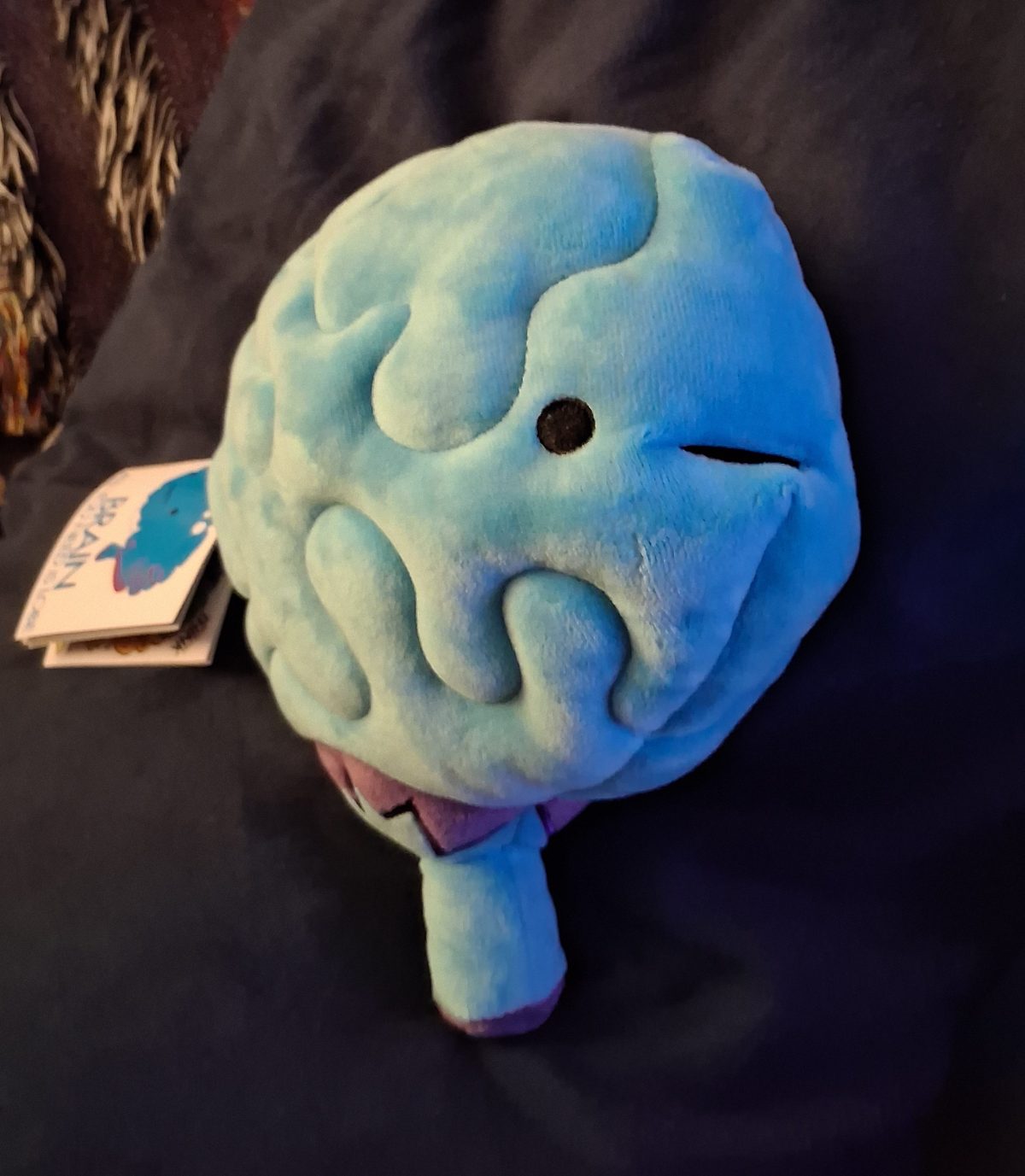
So, a month later, I’m getting around to a promised post about my surgery to address Chiari malformation last month. I think, though, that I should give some history and explanations first. (I even did headings, so you can skip to the parts you would like to read, if you are already familiar with my situation.)
History
Chiari malformation occurs when the tonsils of the cerebellum push down into top of the spinal column. It can be congenital but, when it happens in adults, it is most often caused by a connective tissue disorder. In my case, it was a manifestation of hypermobile Ehlers-Danlos syndrome (hEDS). hEDS is an inherited connective tissue disorder but I was only diagnosed this year at age 65.
In March, 2024, I developed a range of troubling symptoms, including constant left-sided tinnitus, blurring in the left eye, neck pain, balance problems, light-headedness, fatigue, and brain fog. Although the possibility of involvement of my neck and a connective tissue problem surfaced early on, my doctors took the tack that we had to rule out every possible other cause before looking into an inherited connective tissue disorder – and, even when we had, they still didn’t feel that they could diagnose me. The various specialists said it was an issue for primary care and my primary care didn’t feel qualified to make the diagnosis.
In January, 2026, I was finally able to see Lauren Eadline, a specialized nurse-practitioner dealing with complex medical situations. She diagnosed me with hEDS and surprised me by suspecting a problem with my brain tonsils, using an MRI done a year-and-a-half before that had been reviewed by at least a half dozen doctors previously. She ordered an upright MRI, which showed that 12mm of my cerebellar tonsils had pressed down into my spinal column.
Surgery and Hospital Stay
Lauren referred me to Dr. Petra Klinge, a neurosurgeon who specializes in treating Chiari malformation and other disorders that disrupt cerebrospinal fluid flow. She practices with Brown University Health in Providence, Rhode Island, about a five hour drive from home. On October 26, 2026, she operated on me at Hasbro Children’s Hospital, where she has her operating room and team that she uses for both her pediatric and adult patients.
I was very fortunate to have such a skilled team. There were some additional problems that occurred, including a kink in my endotracheal tube that interfered with my breath during surgery, which is done face-down to give access to the back of the skull and neck. Dr. Klinge made a 3 1/2 inch (9cm) incision. She removed a small portion of the back of my skull and a bit of the first vertebra to make space for my brain tonsils to return to their usual space. In order to do this, she cut into the dura, the covering of the brain, and sewed in a patch. We were very lucky that my brain tonsils were still healthy.
Another difficulty that arose was that my foramen magnum, the opening in the skull through which the spinal cord passes, was smaller than normal. Still, Dr. Klinge was able to deal with the situation and restore the cerebrospinal fluid flow. She could see the fluid flowing but they also do a CT before they close the incision to make sure. They closed the incision with dissolvable sutures with a specialized glue on the surface skin. This post has a photo of my incision, including the beguiling strip of scalp where my hair was shaved.
Besides being an active neurosurgeon, Dr. Klinge is also a teacher and researcher. I was able to participate in research she is doing on the genetic and structural aspects of connective tissue in people with hEDS and other inherited connective tissue disorders. Some of the tissue they had to remove during the surgery will be studied and, I hope, become part of the published research in order to advance understanding of hEDS and inform treatment decisions.
Because of all the idiosyncracies, my surgery took longer than expected, which was difficult for spouse B in the recovery room waiting area. As it turned out, the team kept me in the operating room during the recovery period, so B didn’t get to see me until I was in my room in the neuro intensive care unit. For the record, while the surgery was in the children’s hospital, the rest of my stay was in the adult units of the connected Rhode Island Hospital.
For the first night, I needed to stay in bed with my head elevated in order to help prevent cerebrospinal fluid leakage. There was a fair amount of nausea and vomiting, which was expected and considered a good sign that my fluid flow was restored. The surgery is close to the brain stem, which controls autonomic functions, so it was as though the whole rest of my body was getting re-acquainted with my brain. (This is probably not an adequate way to express the science of it, but it’s how I have made sense of it.)
The day after surgery when I was allowed to get out of bed, I was amazed that I could walk without losing my balance. I was a bit weak, though, so had a nurse with me. I hadn’t expected any of my symptoms to improve so quickly but it did make sense because the cerebellum has a big role in our ability to keep our balance. There were also improvements in my visual blurring. Again, the cerebellum is known to have a role in visual processing, so this made sense. Apparently, my cerebellum was much happier not having part of it stuffed into my spinal column, blocking it from having as much cerebrospinal fluid as it needed.
By evening, I was well enough to move into the adjacent neuro-stroke unit. I was still being continuously monitored electronically but didn’t need as much hands-on care and oxygen and such. Eating was still a challenge. There was some residual discomfort in my mouth and throat from the breathing tube during surgery and some of the muscles that are used for chewing were sore. Pudding and mashed potatoes were good, though!
Because of the length of my surgery, we expected I would be in the hospital until Thursday or Friday, but, when the doctors were doing rounds on Wednesday morning, they said that, if the physical therapists cleared me, I could be discharged that afternoon. I was able to walk around the unit unaided and climb stairs, so I was able to leave the hospital. B brought me back to the apartment we were renting until my follow-up appointment on November 6th. The medical team wanted me nearby, in case any complications arose.
Early Recovery
I was very grateful for the apartment, which had lots of space and a laundry room. B took care of all the errands, food prep, laundry, etc. and I spent a lot of time resting either in our bedroom or on the big couch in the front room.
On Halloween, a college friend who lives nearby came to visit, bringing some goodies along, including some candy. Sweet in more ways than one! We also were there for election night. It was strange not to be at home watching the returns come in with daughter T but it was certainly a momentous occasion, as we watched the “blue tsunami” begin to roll.
On November 5th, I got to meet someone in person that I had been in touch with via computer. R had had surgery with Dr. Klinge on the same day as mine, hers in the morning and mine in the afternoon. She is also from central NY and is a patient of Lauren’s. It was fun to be able to meet in person.
On the morning of the 6th, we had a follow-up with Sarah, Dr. Klinge’s nurse-practitioner. Everything checked out well, so we were cleared to head home. We expect that more of my brain function, especially the cognitive pieces, will return over the next several months as my brain has time for healing. It’s possible that my sleep apnea may resolve, too, which is fairly common after Chiari surgery, but we’ll have to wait and see.
The ride home was pretty uncomfortable, even with frequent rest stops. I hadn’t sat upright for that length of time since the surgery and my neck, back, and shoulder muscles tightened. We had left it open whether we would drive back in one day or two but, by the time we got to the time when hotels allow for check-in, we were already close enough to home that it didn’t make sense to stop. I was very happy, though, to see daughter T when we arrived.
Since then, I’ve been slowly recovering. I do still need a lot of rest but I seem to be having an easier time with reading, writing, and speaking. It’s still nowhere near my former level of functioning and I don’t have my poetic/creative brain on board yet but it is better than it was pre-surgery. B and I go on short walks together and I will start twice weekly physical therapy this week. Nearly all the glue over my incision has peeled away but it will be a while longer for it to look like a scar rather than an incision. Fortunately, my long hair covers it so it’s not obvious to passersby.
I’m very grateful to Lauren and to Dr. Klinge and her team for making this surgery possible. It really is helping me and I look forward to more important. Meanwhile, when I think about my limitations now and become impatient, I remind myself – or T reminds me – that I am recovering from brain surgery, which takes a lot of time!
Share this:


One thought on “surgery and hospital details”