I sometimes write poems in response to the Ekphrastic Challenge prompts from The Ekphrastic Review. I have been honored to have my poems chosen for publication on a few occasions and have taken to publishing the ones that were not chosen here at Top of JC’s Mind.
Just up today are responses to the Nebra Sky Disk, including one by my friend and fellow Boiler House Poets Collective member, Kyle Laws. You can see the artwork and the chosen responses here. My poem follows. As always, comments are welcome.
Nebra Sky Disk
Who buried you, hid you from the sun, the moon,
the stars, as if the earth could dim your essence?
Did they seek with soil and swords and hatchets to protect you from marauders
who might take you away, where your arcs would not be wedded to the sun?
They could not know the buried centuries, the indignity
of damage by looters, of clandestine sales, your glory hoarded.
Finally brought back to light, to the descendents of your people, your gold shining their place beneath
Writers often commiserate over being faced with a blank page and not being able to think of something to write on it.
Or maybe now-a-days a blank screen?
I don’t usually run into that problem, most likely because my brain almost never shuts off. There are actually reasons for this that I will go into when I’m not writing stream of consciousness….
Of course, just because I can always fill a page with thoughts doesn’t mean that the writing is worth sharing.
My natural mode when writing poetry, though, is to slosh things around in my head for days/weeks before writing them down. It’s good, though, that through the Binghamton Poetry Project, Heather Dorn, and Sappho’s Circle, I learned to write poetry quickly from prompts.
It usually works like this: The leader of the workshop gives a few choices for prompts to get you started on a poem and there is a time limit, which can be as short as ten minutes, in which to write. This plays to one of my strengths, which is writing relatively short poems, but definitely challenges me in that there isn’t time to ruminate. You really only have about a minute to decide which prompt you want to respond to and the direction you want to take before starting to draft your poem on the page.
Through practice over the last several years, I’ve gotten pretty decent at writing a poem quickly from a prompt. Obviously, there needs to be revision time later but a number of poems that were in response to prompts have made their way into my manuscripts.
I’m not sure if it’s intended to reblog a post for Just Jot It January or not but I am writing this blurb, so it should count. 😉
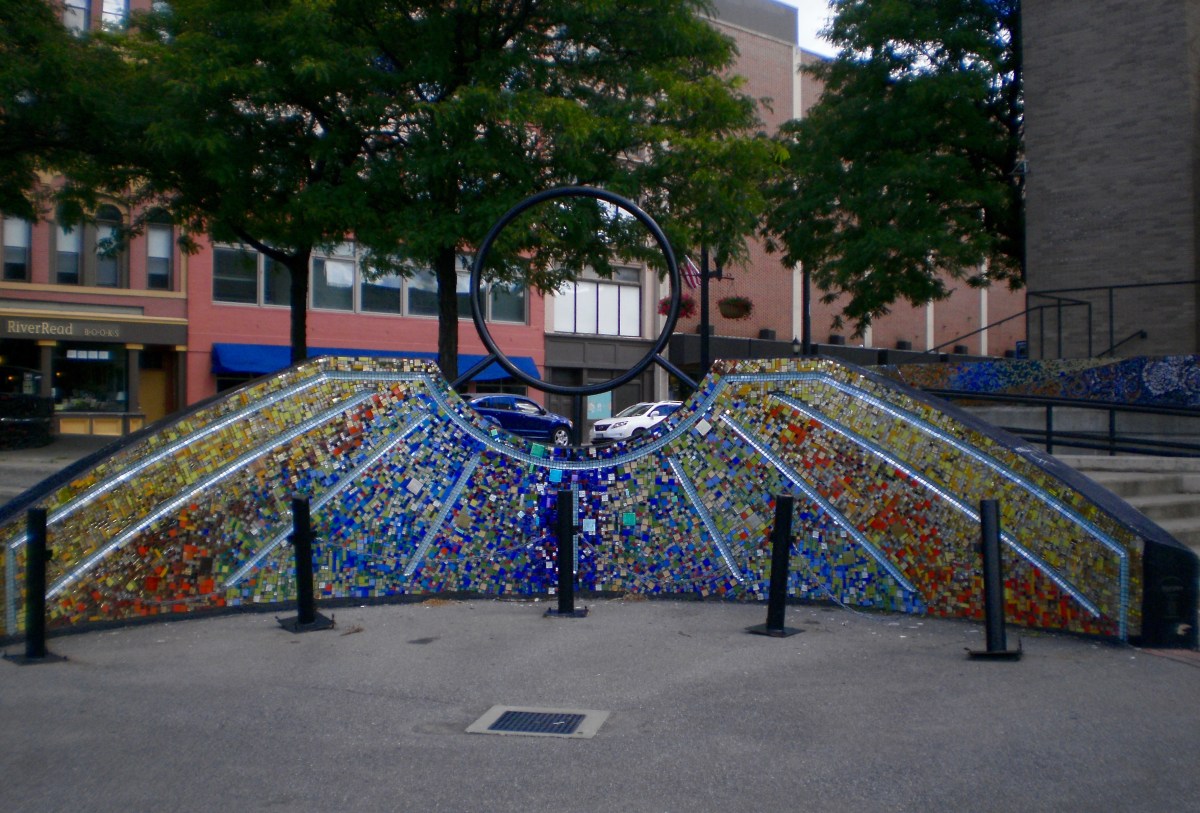
I was thinking of this poem because the Water Street parking ramp which housed murals from the Department of Public Art is being demolished. The whole first stanza is about that art so it feels strange to see local artists discussing its destruction on the news. It remains to be seen if some of the art will be re-created elsewhere as it was very site-specific.
It also occurs to me that, over five years later, the Heart of the Arts dinner crowd is still the largest audience for whom I have read.
Thanks to the Department of Public Art
~~ by Joanne Corey
for Emily Jablon, Peg Johnston, and all whose hearts are in the arts
Stencils and murals on descending levels of the Water Street parking ramp time-travel through that historic corner – Link Blue Box flight simulators evolve from pipe organs – punching in on Bundy time recording machines in the days before IBM and the move to Endicott – on street level “Welcome to the…
Sometimes, when I haven’t written a poem in a while, I try to write tanka, which is a Japanese form that, when executed in English, is 31 syllables in 5 lines with a turn at the fourth line.
At other times, I will use a prompt to get me started. These can be written specifically as prompts or can be other works of art which serves as a springboard. Poems that are responses to artwork are known as ekphrastic poems. I write them relatively often because I have been part of the Boiler House Poets Collective since 2015. During our residencies at the Massachusetts Museum of Contemporary Art, we often write ekphrastic work with most of us choosing to do this throughout the year.
Earlier this month, I submitted a tanka in response to this challenge, the painting Blind Girl Reading, by Ejnar Nielsen (Denmark) 1905. You can see the painting at the link, as well as read the selected poems and short fiction in response.
While my poem was not chosen, I thought I’d share it here:
Unseen
In darkness, pale fingers glide over pages bound heavy in her lap – the only light, electric impulse from fingers to mind.
Back in November, I posted that I had had a poem accepted by Silver Birch Press as part of their How to Heal the Earth series.
I’m pleased to share that my poem is now available here!
Please visit and comment either there or here if you are so moved. While you are there, you can read dozens of contributions to the How to Heal the Earth series along with the Thoughts About the Earth series.
When I read Linda’s prompt yesterday, the first thing I thought about was fingers. And poetry, which is probably a good sign as I am trying mightily to get back to thinking more about poetry.
I am working on editing a poem in which fingers play a prominent role.
I have an older (unpublished) poem about how I still have a pianist’s mentality about my hands, even though I can no longer play.
And, of course, I am using my fingers now to write this. I know that there are lots of tools now that are talk to text, but I feel very oddly about talking to machines. Perhaps I will get over that one day, but, for now, I’ll let my fingers do the talking. ***** Linda’s prompt for Stream of Consciousness Saturday this week was to write about a body part. Join us! Find out more here: https://lindaghill.com/2021/10/22/the-friday-reminder-and-prompt-for-socs-october-23-2021/
For the recently concluded National Poetry Month, the Broome County Arts Council invited local poets to contribute a short poem about spring, hope, and/or other positive things for their POETREE.
I had hoped to make it down to the gallery to see it and take photos for this post, but I didn’t manage to do that. Instead, I have copied the poem I wrote especially for the project below:
Why We Will Never Use Weedkillers by Joanne Corey
Every spring, we watch the jagged-edged three-ness of strawberry leaves emerge from the snowmelt-soaked lawn, the white five-petaled blossoms attract the bees to their sunny centers, the green-white berries ripen to red in June, the squirrels feasting.
I posted here and here about the first two readings from the Broome County Arts Council in celebration of National Poetry Month. I am pleased to announce that this week, I am featured along with Rindi Tas and kohloa, two poets whom I met through the Binghamton Poetry Project. We were scheduled to be joined by another BPP poet, Anita Shipway, but technical difficulties prevented Anita from joining us. The recording of the reading and our bios are available here.
I’m not sure how I came to be invited to participate in this series but I was honored to be asked. And excited. And nervous. This is my first time as a featured reader with a Q&A component and I was anxious to do a good job, knowing that most of the readers in the series are much more experienced, knowledgeable, and academically credentialed than I. I asked poet-friends to review my selections and practiced my reading, recording myself on Zoom to see how I sounded and looked. I plead guilty to over-thinking and over-preparing, but it kept me a lot calmer when we recorded.
I possibly babbled a bit answering Barrett’s questions. Barrett is part of the Grapevine Group, my local circle of poets who meet on a regular basis to workshop our poems, so we are used to “talking shop” together, but I’m not used to interacting with him in a formal setting. He asked thoughtful questions that flowed from the choices I had made for the reading but I am not great at thinking on my feet, so you all can be the judge on whether I made sense or not.
Because I didn’t take up poetry as a serious pursuit until recent years, I am not that well-known or widely published. I decided to do a mini-sampler of the kinds of poems I tend to write, realizing that I would be an unknown quantity to most prospective listeners. Of the four poems I read, only one is published. It appeared in the Nov. 2020 anthology of the Binghamton Poetry Project and can be viewed here.
The recording should be available on the BCAC website at the link at the end of the first paragraph, at least for the next few weeks. It will also be broadcast locally on the Bundy Museum’s radio station WBDY-FM radio (99.5 FM). Because I’m not sure how long BCAC will have the webpage active, I’m embedding the youtube link here, which I think will be permanent:
If you choose to give the reading a listen, I hope you enjoy it. Please feel free to comment here or on the Top of JC’s Mind Facebook page. If you want to send me a private message at topofjcsmind@gmail.com, please put a comment on this post telling me to check for it so it doesn’t get lost among the various digests and posts sent there. My inbox is out of control!
I’m pleased to announce that I have a poem on display in my hometown. The Vestal Museum has just opened a new exhibit entitled Empty the Inkpots: The History of American Typewriters. They are displaying vintage typewriters and have compiled a binder with their research on the various manufacturers. In collaboration with the Binghamton Poetry Project, the Museum is also displaying poems by area poets who have attended BPP workshops. We poets were invited to submit and I was fortunate to have one of my poems selected.
My poem with two vintage typewriters and the research binderAn Oliver company typewriter
One of the fun things about the poems on display is that they are written in a monospaced typewriter-style font. Because most of us are used to reading text in variable-width fonts these days, the look of the poems on the page is quite distinctive.
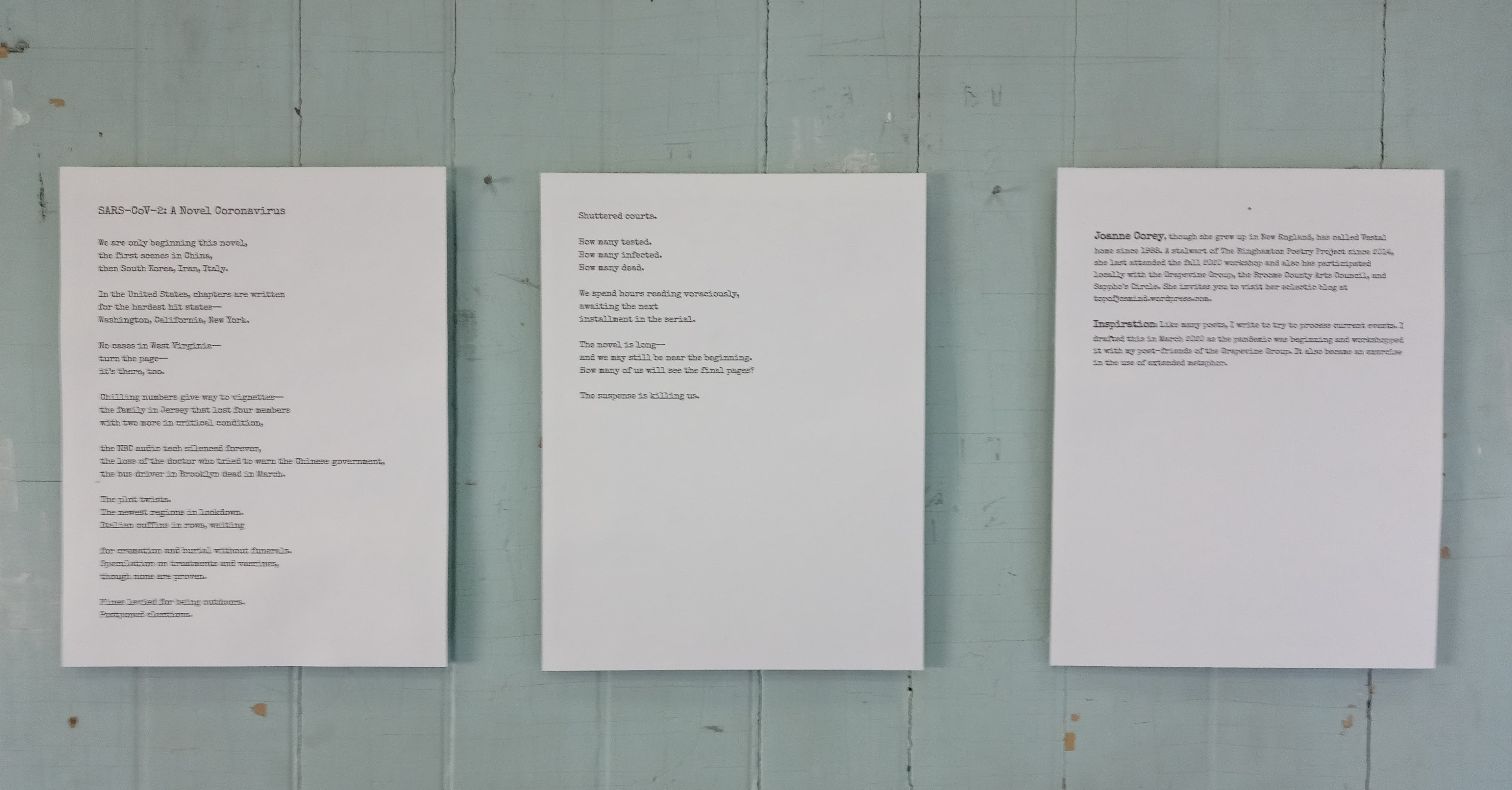
My poem, bio, and inspiration statement on display
Because it is very hard to read from the photo, here is the text, although not in the special font:
SARS-CoV-2: A Novel Coronavirus
We are only beginning this novel, the first scenes in China, then South Korea, Iran, Italy.
In the United States, chapters are written for the hardest hit states— Washington, California, New York.
No cases in West Virginia— turn the page— it’s there, too.
Chilling numbers give way to vignettes— the family in Jersey that lost four members with two more in critical condition,
the NBC audio tech silenced forever, the loss of the doctor who tried to warn the Chinese government, the bus driver in Brooklyn dead in March.
The plot twists. The newest regions in lockdown. Italian coffins in rows, waiting
for cremation and burial without funerals. Speculation on treatments and vaccines, though none are proven.
Fines levied for being outdoors. Postponed elections. Shuttered courts.
How many tested. How many infected. How many dead.
We spend hours reading voraciously, awaiting the next installment in the serial.
The novel is long— and we may still be near the beginning. How many of us will see the final pages?
The suspense is killing us.
*
Joanne Corey, though she grew up in New England, has called Vestal home since 1988. A stalwart of The Binghamton Poetry Project since 2014, she last attended the fall 2020 workshop and also has participated locally with the Grapevine Group, the Broome County Arts Council, and Sappho’s Circle. She invites you to visit her eclectic blog at topofjcsmind.wordpress.com.
Inspiration: Like many poets, I write to try to process current events. I drafted this in March 2020 as the pandemic was beginning and workshopped it with my poet-friends of the Grapevine Group. It also became an exercise in the use of extended metaphor. *****
I wish I could share more of the poems here, but I only have permission for my own work. I hope that local folks will be able to see the exhibit in person. It is currently scheduled to be on display through May 31st. The link in the first paragraph will give times that the Museum is open and information on any special events.
While you are there, make sure to take part in the community poetry exercise. We are creating an exquisite corpse poem. Each person is invited to compose a sentence with adjective+noun+verb+adjective+noun without looking at the prior line. Bonus: You get to type it on a manual typewriter! Although I learned to type on a manual, it had been a long time since I had used one. Daughter T was with me and I had to do a bit of coaching. Physical carriage return was not something that she had ever experienced.
The Ekphrastic Review has a regular series of Ekphrastic Writing Challenges, in which they post a piece of visual art and invite writers to respond to it. I have had several poems published in this way.
Here is a link to the artwork and response pieces for the most recent challenge, “The Two Sisters” by Théodore Chassériau (France) 1843. Among them is a poem by Kyle Laws, fellow Boiler House Poets Collective member and ekphrastic writer extraordinaire!
My piece was not chosen in this go-round, but I thought I’d share it here. Enjoy!
Sisters
Is it the matching outfits that proclaim sisterhood – my sisters and I in pale
yellow with coordinating hats and gloves for Easter mass –
my daughters in black velvet with lacework collars in a rare formal portrait –
my granddaughters in rainbow- and-unicorn pajamas in pandemic London –
or is it the dimples that appear with smiles the entwined arms







 Joanne Corey