End of an IBM era

For the first time since 1912, IBM (International Business Machines) does not have a physical footprint in Endicott, New York.

Broome County is the birthplace of IBM, which formed in Endicott as the Computer-Tabulating-Recording Company in 1911. It changed its name to International Business Machines in 1924.

For many decades, under the leadership of legendary CEOs Thomas J. Watson, Sr. and Jr., Endicott maintained a special place within the international corporation, employing thousands of people with several blocks of buildings downtown. They were a huge presence in the community, donating to charitable organizations, organizing volunteer activities, and providing recreation and education for their employees and their families. There were generations of people who worked for the company, which had an ethos of respect and care for their employees and the greater community. Even during the Great Depression of the 1930s, IBM did not lay off workers. The loyalty IBM showed to its workers was returned and there were many families who had multiple members across generations who were IBM employees. Even when IBM headquarters moved elsewhere, Endicott was honored as the birthplace of the company. There was even a company museum on site.

When my spouse B joined IBM in 1989, many of the IBM traditions were still in place but that was about to change. IBM had for decades chosen CEOs from within the company but in 1993 hired Louis Gerstner who massively changed the corporate culture, with layoffs and the attitude that employees were expenses to be cut rather than the expertise that allowed IBM to have products to sell. In 2002, IBM sold the Endicott campus, renting back some space from the new owners, which eventually was whittled down to one, nondescript building.

In March 2020, due to the COVID pandemic, IBM closed access to the building and many months of working from home began. This relaxed somewhat over time and this January, employees began working three days/week in the office and the other two from home. B and his team all came in on the same three days to facilitate collaboration. They also enjoyed lunches together, often taking walks afterward, as they had pre-pandemic.

This spring, though, IBM announced their decision not to renew the lease on the building and not to seek another physical site, ending 112 years in Endicott. The employees remaining, many of whom have over thirty years of experience, will go back to working from home until they retire.

Yesterday, August 31, 2023, was the last day.

B and his team were there working, left their now-empty offices, and turned in their keys.

It’s sad for us and for the community to lose what had been such an integral part of life here, although it has been a long, slow, painful bleed. Some of the old IBM buildings have been renovated and are in use but a number of them are now condemned and awaiting demolition. The good news is that Endicott is being re-cast as a renewable technology/battery hub. There are plans for a gigafactory to make batteries for EVs and such as part of the Triple Cities Innovation Corridor, for which Endicott is the advanced manufacturing hub.

The irony is, of course, that IBM was doing advanced manufacturing on the site for decades and now won’t be onsite for this new era.

One of the buildings that I hope will remain as a monument is the North Street Clocktower building, which is emblazoned on the cake at the beginning of this post. It contains the motto THINK carved into the stone.

A good reminder anytime.

the last building for IBM Endicott

COVID update – late summer 2023

There are many people here in the United States who are no longer taking COVID-19 seriously and a disturbing number who never did.

I am not one of them.

I’ve written dozens of posts over the past three and a half years about it, including about my family’s participation in the Pfizer/BioNTech Phase III clinical trial. I’ve tried to encourage people to take precautions to reduce their chances of infection and serious illness. In that vein, I offer this update.

There was a summer wave in the US with the most prevalent strain being Omicron XBB.1.5. On September 12, the Centers for Disease Control and Prevention Advisory Committee on Immunization Practices will meet to develop a recommendation for a newly formulated booster based on the XBB.1.5 variant. It’s anticipated that the recommendation will be that most people get this new booster, which is expected to be available by the end of September. I will get the booster as soon as I am able. To my knowledge, I’ve still not contracted COVID and would love to keep it that way. Even if the vaccine does not keep me from getting infected, it, along with taking an anti-viral such as Paxlovid, will likely keep me from being hospitalized.

Of course, SARS-CoV-2 continues to mutate. Even now, the variant mix has shifted in the US. EG.5 has become the highest in prevalence with FL.1.5.1 next in an array of variants currently circulating. (You can find current data in the US at the CDC site here.) It is expected that the new booster, though based on XBB.1.5, will still be effective against these other Omicron strains.

The unfortunate wild card at this point is another Omicron variant BA.2.86. The link is to a 8/22 post from epidemiologist Dr. Katelyn Jetelina, explaining why this variant may be more problematic than others, perhaps even warranting the World Health Organization to name it a variant of concern with the name “Pi.” BA.2.86 has over 30 mutations of the spike protein, which is part of the virus that our bodies learn to recognize via vaccines, infection, or both. The fear is that we could see another world-wide wave develop because BA.2.86 might be able to evade our defenses. Researchers are studying it to see if our current tests, vaccines, and treatments will work against it and how it might affect individuals and populations exposed to it. The current number of cases world-wide are thought to be small, but that has been the beginning status of any variant that has become dominant.

Part of the problem is that we don’t have as much data to work with. Most COVID cases aren’t reported to public health authorities anymore. Surveillance and genomic sequencing are lower. This results in less public awareness and information. Theoretically, we should be able to ramp up our system more quickly if a new wave occurs but I wish we had kept up our system in the first place in a proactive stance.

I’m concerned about the attitude that equates COVID infection with other viruses. A study in the journal Nature Medicine shows increased risks for an array of medical conditions, including diabetes, pulmonary and cardiovascular problems, two years after COVID infection, even if the initial case was mild.

“A lot of people think, ‘I got covid, I got over it and I’m fine,’ and it’s a nothingburger for them. But that’s not everything,” said the study’s senior author, Ziyad Al-Aly, a clinical epidemiologist at Washington University School of Medicine in St. Louis. After a couple of years, “maybe you’ve forgotten about the SARS-CoV-2 infection … but covid did not forget about you. It’s still wreaking havoc in your body,” said Al-Aly, chief of research at the Veterans Affairs St. Louis Health Care System.

source: https://www.washingtonpost.com/health/2023/08/21/long-covid-lingering-effects-two-years-later/

The risk of long COVID is real. The article cited above, which is free to access, explains more about the attempts to do research and get care for people with long COVID. People need to realize that they might be someone who gets COVID and has a mild case without long-term repercussions or they might become seriously ill or they might have symptoms for months and years to come. They could also infect someone else who would face the same uncertainties.

I’m once again imploring people to take COVID seriously. Vaccinate, if it is recommended for you. (Being in the US, I’m most familiar with recommendations here but people should look to their own local health authorities and medical practitioners for guidance in their area.) Test and treat an infection. Stay home if you are sick and avoid infecting others. Avoid crowds indoors; wear a high-quality mask if you can’t. If infection rates are significant in your area, mask indoors when you are away from home. Increase ventilation and air filtration. Wash your hands. Get adequate rest and nutrition. Remember that everyone deserves respect, so never question someone else’s decision to mask; they could be immunocompromised, caring for a vulnerable person, etc. and need that protection.

Eventually, we may get to a place where COVID is endemic, like the flu, but we aren’t there yet. Be careful and be kind as we continue to face this still-formidable challenge.

SoCS: left alone

All I can think of is how hard it was for my father to be left alone when my mother passed away. It was the thing she had been most worried about. What she couldn’t have known was that a pandemic would arrive which severely curtailed our ability to visit.

I’m grateful that she never had to know.
*****
Linda’s prompt for Stream of Consciousness Saturday this week is “left alone.” Join us! Find out more here: https://lindaghill.com/2023/06/02/the-friday-reminder-and-prompt-for-socs-june-3-2023/

four years

Today is the fourth anniversary of my mother’s death.

As often happens with these dates, sometimes it seems that it couldn’t have been that long and other times it seems longer ago. This warping of time is even more prominent because of the pandemic. I remain grateful that my mother died before we were all faced with the impossible prospect of not being able to visit her in the nursing home where she spent her final months. That would have been a particularly heavy burden for my father, with whom she had celebrated their 65th wedding anniversary a few weeks before she died.

This year feels especially poignant for me as I await the publication of my first chapbook of poetry, Hearts, from Kelsay Books, most likely in June or July. The poems center on my mother with a particular emphasis on her last years dealing with heart failure. She appreciated my writing and I think she would be pleased to know she is the focus of my first book.

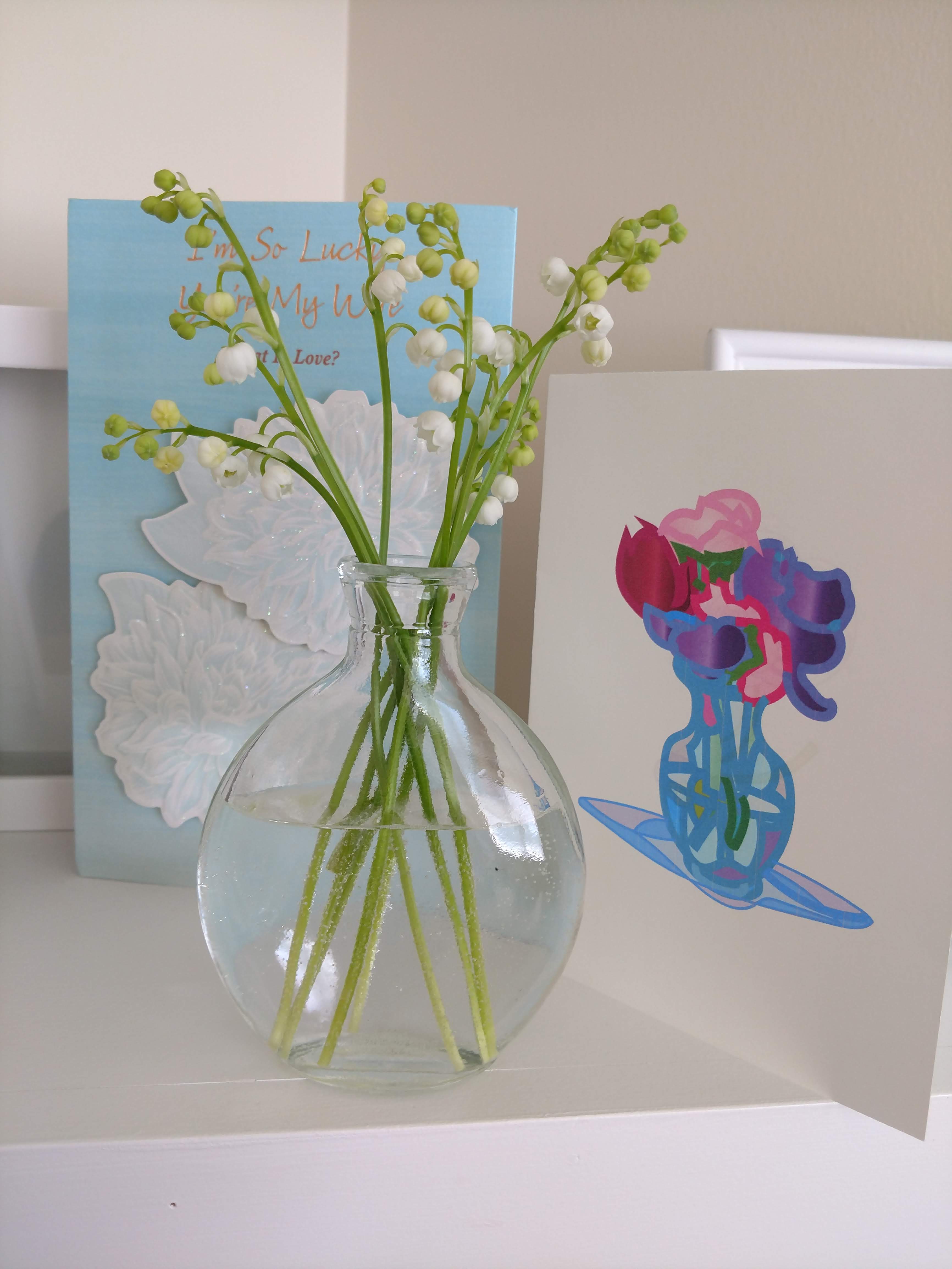
She didn’t enjoy having her picture taken, so I will share a photo, taken four years ago in her final days, of one of her favorite flowers, lily-of-the-valley, which was also her birth flower.

Lily of the valley, with Paco’s card to Nana and birthday card made by artist-friend Jim


Love you, Mom. Miss you. Still cry every once in a while…

What comes after emergency?

As someone who participated in a COVID vaccine clinical trial, who has other vulnerable people in my life, and who tries to be a diligent and responsible community member, I’ve been following the science, public health information, and news about the pandemic over these last, long 3.5 years. I’ve done so many blog posts about it, I’ve lost count.

As you may know, the World Health Organization and the United States are winding down their public health emergency declarations.

This does not mean, though, that the pandemic itself has ended. COVID-19 is still widespread across the world and hundreds die every day as a result. There is still the potential for new variants and COVID is not yet seasonal, like influenza. Eventually, COVID will become endemic, as the flu is, but we aren’t there yet.

While some US programs, such as tracking hospitalization rates and wastewater testing, will continue, others will end. I will miss the COVID maps and risk ratings that the CDC has been providing. Besides the overall community risk assessment, the transmission rate maps were important to me in deciding how much public masking I needed to do or whether large, indoor gatherings were advisable at all. It’s true that, with so many COVID cases discovered through home testing and never officially recorded, the statistics are not as comprehensive as they were during the months of testing centers, but, for example, it’s helpful for me to know that my county has a moderate transmission rate but the county to our east is currently at the highest transmission rate level, two notches higher than here. Having that information could inform a decision between using a drive-through or dining in on my way through the county, as well as alerting me that the higher infection levels could spread in my direction. After Thursday, that information will not be readily available to me.

I’ll still follow the science and public health advice as best I can and will get my next booster when recommended. I’ll test at home if I have symptoms and avoid being in public when I’m sick with anything, COVID or not. I’ll keep a supply of KF94 masks in my size nearby for high-risk situations that may arise. I’ll try to do all the things we should be doing all the time, like eating well, getting enough rest, and practicing good hygiene.

I still, though, don’t want to get COVID if I can help it. To the best of my knowledge, I’ve never been infected, although I could have had an asymptomatic case at some point. I know very few people who are in that category these days.

Will the end of the emergency declarations and the resulting decline in data be a factor in my eventually contracting COVID?

Impossible to predict, but fingers crossed.

How low can you go?

This month, my county (Broome in New York) has finally made it into the low community risk level for COVID-19, using the current US Center for Disease Control tracking method. Our community transmission rate is still in the medium category, the second lowest of four categories. Both of these are the lowest levels that I recall seeing since this tracking model went into effect.

In recognition of this, I’ve begun to back off from masking in indoor public spaces. For example, I went to church on Easter and this weekend unmasked. On Friday night, I ate and sang unmasked with Madrigal Choir at a retirement dinner in honor of a Binghamton University professor who is a long-time choir member.

It feels a bit strange after masking for so many months.

I know there is still risk. A friend came down with COVID a few days ago. I had not seen her recently, so I wasn’t exposed, but it’s definitely a reminder that I may not be able to stay COVID-free forever. The number of people I know in the never-been-infected category is tiny at this point.

I don’t want to get sick and I especially don’t want to transmit COVID to someone else but I’m feeling that, with the community risk level at low and major personal events like my two cataract surgeries and visit from our UK branch of the family completed, I can let down my guard a bit. I’ll still be tracking our local statistics so I can put more precautions back in place as warranted.

Madrigal Choir is going into a busy week, getting ready for our final concert of the season next Sunday, so fingers crossed…

COVID-19 origin stories

A leak of a “low confidence” assessment from the United States Department of Energy that COVID-19 originated from a lab leak in China has set off another round of upset.

The base problem is that no one has access to all the data to come to a definitive conclusion and likely never will.

Most epidemiologists, researchers, and US government departments think that the most likely origin is from markets in Wuhan that dealt with wild animals that harbored the virus which then jumped to people. This article in Science is representative of that opinion. The animal to human route is a common mechanism which we have seen with diseases such as ebola and SARS-CoV-1.

Rather than arguing about lab leaks, we should put our energies toward strategies that will help to avoid or contain future illnesses. Yes to tightening controls at laboratories doing research on pathogens. Yes to limiting exposure to wild animals that can carry diseases to humans. Yes to rapid response and open sharing of information about emerging diseases.

No to wild speculation that is not grounded in fact. For example, there is no evidence that SARS-CoV-2 was lab-engineered rather than naturally occurring. It is irresponsible to share disproven theories.

As I know from public health statistics and recent cases among friends, COVID-19 is still out there, sickening millions and adding to the global death toll of over 6.8 million people. Protect yourself in accord with your local conditions and resources. Vaccinate and receive the bivalent booster if it’s available. Increase ventilation in indoor spaces. Avoid crowds. Wear a high-quality mask indoors when transmission rates are significant. Wash your hands. Take extra caution if you or someone you live with or visit is especially vulnerable due to age, medical condition, etc. Make sure you have accurate, scientifically valid information behind your decisions. Be respectful of those who choose to mask in public. They are trying to protect themselves and their loved ones. It’s possible they are getting over an illness themselves and are being cautious in order to protect you.

At some point, COVID-19 will become endemic. We aren’t there yet. Do your best to be a help, not a hindrance, to that end.

SoCS: time together

Given that we live in the US and our granddaughters live in the UK, we prize any time that we have together.

Our five-year-old granddaughter ABC lived with us and her mom until she was a bit over two years old. Then, E’s spousal visa came through and they joined their spouse-and-dad in London. We made our first trip “across the pond” a couple of months later, hoping to return again in the spring, but that was 2020 and the pandemic struck, so, no.

We missed the birth and whole first year of granddaughter JG’s life. We met her first on a bittersweet trip here so that E could have a last visit with her grandfather Paco. We will always be grateful that Paco was able to meet JG and that ABC, who remembered him from living here when she was a baby/toddler, was able to see him and dance and sing for him. E was Paco’s first grandchild and it was so important that she got to see him one last time. I’m crying now just thinking about it. It was just after that visit that Paco began his last, steep decline and he died a few weeks later.

That visit had been very confusing for JG. As a pandemic baby, she hadn’t been out of her house very much, much less flown across an ocean and plunked down in a new country with new people. She was also at a developmental time of stranger anxiety, so we had to be careful not to intrude on her comfort zone.

Without having to care for Paco, we were able to make a couple of trips to the UK (although they happened to be during omicron surges); still, JG was not too sure about these people who occasionally appeared on her mom’s computer screen suddenly showing up.

Enter 2023. JG is now almost 2 and a half and having a surge in language development and is able to make connections that she had been too young to make previously. She starts calling us by name when we video chat and wanting to say hi and showing us things. When we went to visit earlier this month, she gave us hugs and played with us and let us pick her up and called us by name and stayed with us at our Airbnb while her mom and dad did errands and snuggled and fell asleep cuddled on the couch.

For the first time, she knew we were her grandparents, her mom’s mom and dad. Correction: her mum‘s parents, as mom is the more common American expression and she is, of course, adopting the more British mum.

What a prize! I had been afraid that JG wouldn’t really remember us because we are so far away and that occasional visits wouldn’t be enough to establish a real relationship with her as we have enjoyed with her sister ABC.

Transatlantic grandparenting will still be challenging. I don’t have personal experience with such a long distance between grandparents and grandchild, but I think we’ll figure it out.

We are hopeful that E and her family will be here in April for Easter, JG’s first trip back since she came to meet Paco just after she turned one. I don’t think she will remember having been here, although ABC will probably still remember every nook and cranny of our house and yard, as she did when they came back to see Paco a year and a half ago.

It was a week ago that we said our good-byes to fly back to the States. Anticipating a visit from them in just a few weeks made it easier to leave them. Although JG won’t remember the house, she will remember us.

What a comfort!

What a prize!
*****
Linda’s prompt for Stream of Consciousness Saturday this week is “prize,” which I sneakily used to write the post I needed to write this weekend. Join us! Find out more here: https://lindaghill.com/2023/02/24/the-friday-reminder-and-prompt-for-socs-feb-25-2023/.

JC’s Confessions #26

In the first few seasons of The Late Show, Stephen Colbert did a recurring skit, then a best-selling book, called Midnight Confessions, in which he “confesses” to his audience with the disclaimer that he isn’t sure these things are really sins but that he does “feel bad about them.” While Stephen and his writers are famously funny, I am not, so my JC’s Confessions will be somewhat more serious reflections, but they will be things that I feel bad about. Stephen’s audience always forgives him at the end of the segment; I’m not expecting that – and these aren’t really sins – but comments are always welcome.

Ugh.

Folks who have been reading my blog regularly (thank you!) know that I have been dealing with a lot of loss and stress in recent years. I’ve been struggling to find energy to accomplish things and often feel like I can’t concentrate.

I’ve taken a lot of steps to cut down on what I’m trying to do in a day/week but there are still days that nothing of import gets started, much less done. I’ve tried to reach out for additional support but there are times when I can’t even manage to gather the energy needed to reach out and arrange to meet. Granted, the pandemic waves aren’t helpful, either.

I recognize from friends who study such things and from my reading that I am still grieving and that my brain is quite literally rewiring itself in line with my new reality.

A few weeks ago, I decided to try to shift my perspective. I decided to set aside some things I had been trying to do/worrying about and to give myself more grace/space to wait out the brain changes.

My doctor warned me it would be difficult and it is.

There have been little glimmers of hope. I’ve been able to arrange for some self-care appointments that I need. I’ve managed to post every day this month so far for Just Jot It January, although I confess I’m looking forward to February when that pressure I’ve put on myself will be off. I’ve made progress on preparing my chapbook manuscript for publication.

Overall, though, I am still struggling and struggling to accept that I’m still struggling, which is a large part of what I was hoping to do.

Maybe that is the way things must be for now.

I just need to accept it.
*****
Join us for Linda’s Just Jot It January! Find out more here: https://lindaghill.com/2023/01/27/daily-prompt-jusjojan-the-27th-2023/

SoCS: count on it

Linda posts the prompt for Stream of Consciousness Saturday on Friday so that people have a chance to mull the prompt before writing the post, which is stream of consciousness so no editing allowed.

Confession: Sometimes, I write the post on Friday and just schedule it to come out on Saturday.

Second Confession: Sometimes, I plan the post in my head more than I probably should to be true stream of consciousness.

I usually do, though, manage to have some thoughts about the prompt or I just don’t participate that week.

Because it’s Just Jot It January and because I already didn’t do Stream of Consciousness one week because I had a post of my own I wanted to get out, I really wanted to do SoCS this week.

The prompt is to use “count on it” in the post.

When I read it Friday morning, I thought that it would be pretty straightforward. Something would pop into my head as the focus for the post.

But that didn’t happen.

A lot of things that I can no longer count on came into my head, but it seemed too unsettling to write about that.

I think the combination of personal losses, the pandemic, the divisiveness of the United States, and the feeling that I’m always waiting for the next shoe to drop – and it does – have left me unsure that there is anything I can count on.

It’s probably more feeling than fact.

It’s cold and grey today.

The sun will rise tomorrow.

I can count on it.

Yes, let’s go with that.
*****
Join us for Linda’s Stream of Consciousness Saturday and/or Just Jot It January! Find out more here: https://lindaghill.com/2023/01/20/the-friday-reminder-for-socs-jusjojan-2023-daily-prompt-jan-21st/