moving toward Christmas

I’m managing to do more Christmas preparation than I have in the last several years.

I have over half my holiday cards sent.

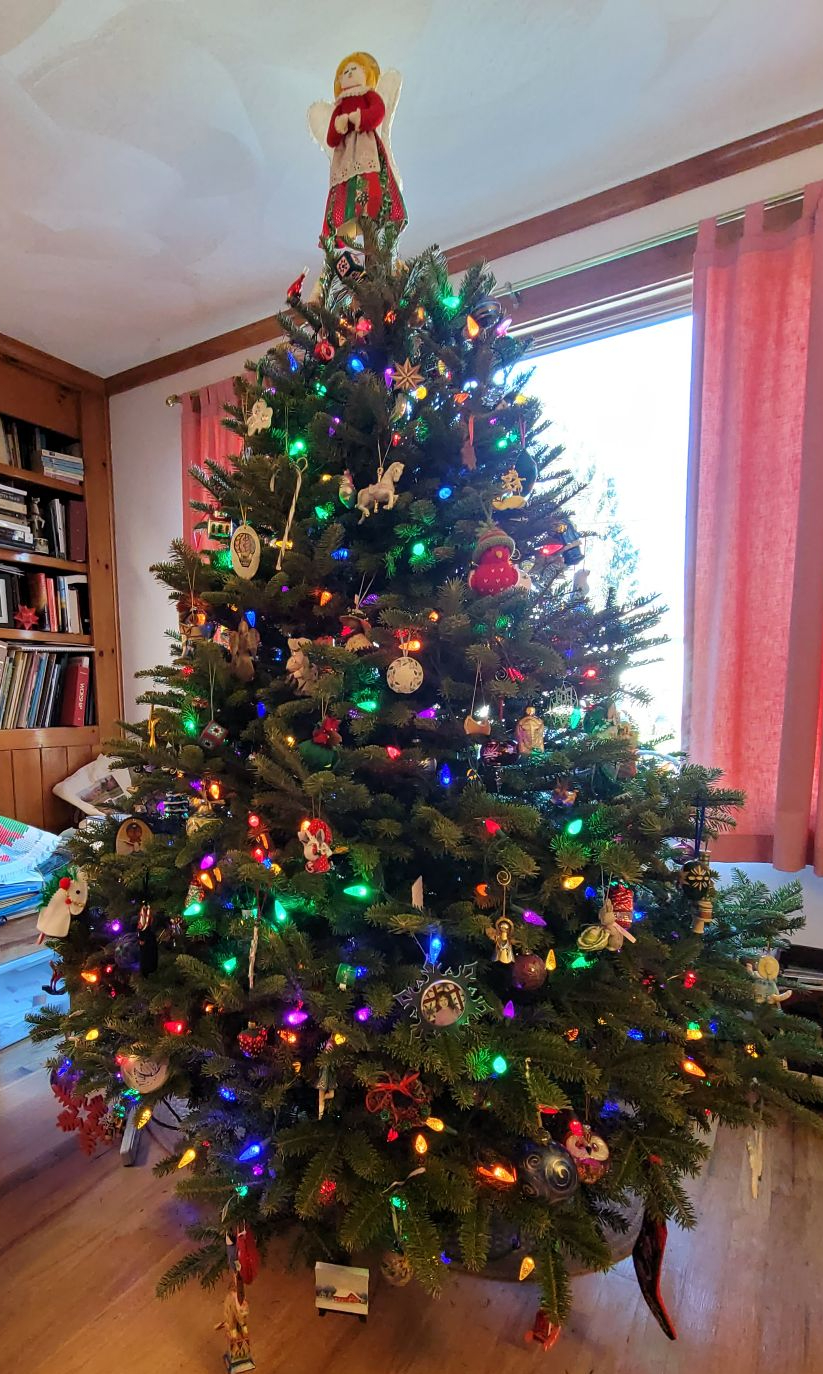
Yesterday, B and I went to the tree farm to buy our Christmas tree and wreath. Today, along with daughter T, we decorated the tree.

I love our Christmas ornament collection. There are ornaments that belonged to our parents. Ones we have bought on our travels over the years. Ones we received as gifts. Home-made ones by my grandmother, B’s mom, B as a child, our children. Handcrafted ones made by artists on four continents, including my friend Yvonne Lucia. Ornaments made of cloth, yarn, wood, birch bark, wax, corn husks, glass, paper, teasels, metal, ceramic, plastic, even eggshell. The angel on top of the tree is one I made from a kit with the help of a friend shortly after B and I married. The latch-hooked tree skirt featuring candy canes was made by my mother.

If our home suffered a disaster and our ornament collection was lost, it would be impossible to re-create.

Still, during the years when I was caring for my parents and in the immediate aftermath of their passing, as much as I cherish these ornaments, I couldn’t being myself to unwrap them, touch them, place them on the tree. Even when others had done so, I could only manage a few glances at them.

Dealing with grief and loss is an individual and unpredictable endeavor. Last Christmas, our first since the death of my father, known here as Paco, we traveled to visit daughter E and her family in London, so we didn’t have our usual Christmas decorations. I really wasn’t sure how much of the usual Christmas routine I would be able to resume this year, so I am grateful that I felt up to participating in some decorating.

Granted, Christmas this year will be quieter than usual. It will be just B, T, and I celebrating at home. I will be going to church on my own. There will be stockings and some presents to open. (I admit my Christmas enthusiasm has not yet extended to shopping.) We will have a nice dinner and dessert although we haven’t settled on the menu yet. We have decided not to make our usual number of cookies, most years dozens of cookies in at least a half dozen varieties. It just doesn’t make sense for three people.

I think one of the factors in my feeling some Christmas spirit this year was singing Lessons and Carols with the Madrigal Choir of Binghamton last weekend. Given that I spent so many years doing liturgy planning and music in Catholic churches, I’m not accustomed to singing Christmas music publicly during Advent, but I think this year doing so boosted my anticipation for Christmas and helped me to feel up to helping with decorating.

If I’m lucky, it will carry me through finishing the cards next week.

If not, I will try to remember to take the advice that I offer to others who are dealing with loss: Be gentle with yourself.

Maybe the fragrance of the Canaan fir, the rainbow-hued lights, the meaningful ornaments will help lift my spirit if it flags.

Christmas trees are beautiful, even through misty eyes.

SoCS: too much

I’ve got too much on my plate – and my blogging has been suffering because of it.

I’ve been busy with poetry, singing, family activities, and chores and a lot of the other things on my plate, like blogging and doing poetry submissions have been pushed off to the side.

As is often the case, it’s not so much that I need more time as that I need more brain power. While I thought that I had gotten through the alternating bouts of numbness and thought-swirl that happen from grieving, this fall has shown that I was mistaken. I have only limited time when I can concentrate well enough to write – and some days that doesn’t come at all.

I know better than to make promises about catching up on blog posts.

I do have a few submissions that will be coming up on deadlines that need to get moved up on the list of tasks – or to the center of the plate if I can make myself return to the original metaphor – and I will need to work on holiday cards, which are a high priority item for me.

I’m hoping that I will have a couple of poems published in December, so there will be posts for those.

If I’m lucky, I’ll be able to get my mind in a more stable place and clear some of the items off my plate.

(She writes, really trying to do stream of consciousness metaphor…)

Stay tuned…
****
Linda’s prompt for Stream of Consciousness Saturday this week is “on your/my plate.” Join us! Find out more here: https://lindaghill.com/2022/11/25/the-friday-reminder-and-prompt-for-socs-nov-26-2022/

SoCS: ring

I’ve been out all day at the bicentennial of my hometown so this will be a short SoCS post.

When I saw that Linda’s prompt was ring, what came to mind was the poem I wrote about taking off my father’s wedding ring after he died. The first anniversary of his death was Wednesday. The poem was published this spring by Wilderness House Literary Review here.
*****
Join us for Linda’s Stream of Consciousness Saturday! Find out more here: https://lindaghill.com/2022/09/16/the-friday-reminder-and-prompt-for-socs-sept-17-2022/

One-Liner Wednesday: Paco memorial

Paco and an Irish rainbow

Remembering my father on the first anniversary of his death.
*****
Join us for Linda’s One-Liner Wednesdays! Find out more here: https://lindaghill.com/2022/09/14/one-liner-wednesday-he-was-a-fun-guy/

My First Chapbook!

I am thrilled to announce that Hearts, my first chapbook, will be published by Kelsay Books in 2023! I don’t yet have an exact release date but expect it to be around September.

Kelsay Books was founded by poet Karen Kelsay in 2012 and currently has over a thousand titles listed in its bookstore. This makes it a much larger press than most of my previous submissions, some of which went to presses that only publish one or two titles a year. I took a chance submitting to Kelsay because two of my local Grapevine Poets, Jessica Dubey and Burt Myers, have books forthcoming from them. I’ll be sure to post their books here at Top of JC’s Mind when they become available.

Kelsay publishes poetry exclusively under four different imprints: Aldrich Press for free verse poetry up to 90 pages; White Violet Press for formal poetry up to 100 pages (Burt’s category); Alabaster Leaves for chapbooks under 50 pages (Jessica and my books will be under this imprint); and Daffydowndilly for rhyming poetry by adults for children.

Another welcome feature of Kelsay is that they respond very quickly, generally within fourteen days of submission. I received word of acceptance on day ten. This is blazingly fast. The typical response time for prior submissions I had done was six months, with a few taking more than a year to send out rejections.

Hearts centers around my mother, known here at TJCM as Nana, particularly in the last years of her life as she struggled with heart failure. The first incarnation of the chapbook was assembled in fall of 2017 as an entry into the QuillsEdge Press contest with the theme “Transitions.” It was named a finalist and the poem “Sixteen Hours” was included in an anthology that was published in conjunction with the winning manuscript, Skin Gin. That version also placed in the top 1% of submissions in another contest.

That early positive feedback proved to be important in the following years. As Nana’s health continued to decline, I wrote poems to help me process but couldn’t think about reworking the manuscript. After her death in May, 2019, I took some time to extend, workshop, and edit the chapbook and started sending it out in spring of 2020. That version was a semifinalist in a contest but was also getting a lot of rejections from contests and open submission periods.

I continued to do edits and added a new poem in spring, 2021. At that point, my father, known here as Paco, was entering the last few months of his life, so doing submissions faded into the background. He passed away last September and I returned to doing a few submissions before the end of the year. I was doing submissions for my full-length manuscript, as well.

Kelsay was the 34th submission for Hearts in its various forms.

There is a difference of opinion on whether that is a lot or just run-of-the-mill. Most of the people that I’ve told have noted my perseverance and commitment in the face of rejection but a few, who have decades-long experience as poets, think thirty-four isn’t that bad or unusual.

For now, I’m still feeling joy mixed with relief. In these past years, I’ve watched many of my poet-friends publish their first books and had begun to wonder if I just wasn’t good enough. Now, I’m coming to think of it more as finding the right match. Kelsay Books makes clear they are seeking manuscripts that are accessible to a general audience. I consider myself a community poet, as my experience has come through workshopping with fellow poets and community poetry sessions with the Binghamton Poetry Project and others, instead of from academic studies. I tend to write in a narrative style. While I occasionally write in Chinese/Japanese-derived forms like tanka, I have never written anything decent in traditional European forms, like sonnet or villanelle. Every once in a while, a rejection email comes with a bit of feedback, which tends to run along the lines of my work not being crafted well enough or sophisticated enough. While I do continue to work on craft and revision skills, I will never write like someone with an MFA (Master of Fine Arts) degree.

And that’s okay.

It’s just easier to believe now that I can say I have a book forthcoming.

I’m sure I will post more about this as I work through the process of publication and gain more skills along the way. Style guidelines. Fonts. Cover art.

One of the blessings of being in a community of poets, though, is that help is available if I need it. I also now have a publisher with a team of professionals to get my book out into the world.

It still feels strange to be able to say that.

But I think I could get used to it.

August 1st

When we were visiting in London last Christmas, daughter E gave us a calendar featuring photos of granddaughters ABC and JG. Most often, the photos were taken in that month the prior year, so turning the page for August brought a four generation photo with Paco from their visit last year.

The timing of that visit was a blessing, existing in the tiny window of their being able to get travel permission from the US and UK and before Paco’s final steep decline that led to his death in September.

I’ve been struggling this summer with the memories from last year, many of which have been difficult.

It’s good to have this photo with smiles that I can feel in my heart, even if my eyes fill with tears.

JC’s Confessions #24

In the first few seasons of The Late Show, Stephen Colbert did a recurring skit, then a best-selling book, called Midnight Confessions, in which he “confesses” to his audience with the disclaimer that he isn’t sure these things are really sins but that he does “feel bad about them.” While Stephen and his writers are famously funny, I am not, so my JC’s Confessions will be somewhat more serious reflections, but they will be things that I feel bad about. Stephen’s audience always forgives him at the end of the segment; I’m not expecting that – and these aren’t really sins – but comments are always welcome.

JC

Over the many years of caregiving and volunteering I have done, people have often advised (admonished) me to “take care of myself.”

I don’t think it is something that I do very well.

I do try. I eat well (usually) and sleep (generally not so well, but not for lack of trying). I do my physical therapy exercises most days and speak with my counselor on a regular basis. (I love getting massages but the pandemic and other complications have interfered with what used to be a regular part of my self-care plan.)

I admit that the amount of stress, grief, and loss has been high for a lot of years. I would sometimes joke in recent years that it was too late for whatever stressor to give me gray hairs, although I notice that my eyebrows are beginning to turn silver and that my facial lines seem to be more indicative of sadness, unless I am actively smiling. (Or maybe this is straight-up aging, rather than stress-induced?)

(Hmmm…wonder if my extensive use of parentheses in this post is a form of denial, distancing, or hedging?)

But here’s the thing. When people want you to “take care of yourself,” the subtext is often to put yourself first, which is not my nature as an HSP (Highly Sensitive Person). I will always care about what people close to me are experiencing and try to do whatever is in my power (and sometimes attempt what is not really in my power) to help. I also feel compelled to serve my neighbors, whether near or far, which, given the state of the US and the world, is a huge task, but I try to shoulder my tiny sliver of it as best I can.

It’s a lot.

I can hear some people’s brains clicking with (totally valid) thoughts about boundaries and such…

And maybe I’ll manage that wisdom if I am gifted with enough years.

Or maybe I will always be “guilty” of prioritizing the needs of others before my own.

Or maybe that is just who I authentically am.

this Fourth of July

It’s the fourth of July, commemorated here in the United States as Independence Day. It’s supposed to be a “happy” day, but it’s hard to feel happy with our country mired in divisiveness and the undermining of our fundamental rights and democratic institutions.

I know I have been relatively silent here at Top of JC’s Mind lately. Part of it is a renewed wave of grief over Paco as we have entered the one year anniversary of his fall and final decline and the fact that I had deferred a large portion of my grief over Nana while dealing with his needs.

The larger share of my delays in posting, though, is that the posts I need to write about the Supreme Court decisions and the January 6 Select Committee hearings are difficult to write.

The Preamble to our Constitution proclaims that “We the People” are striving toward “a more perfect Union.” This Fourth of July is one of grief, watching my country lurch further away from that ideal rather than making halting, if messy, progress toward it.

a lake, a landmark, and rubies

Spouse B and I returned yesterday from a weekend celebrating our 40th wedding anniversary at Geneva on the Lake. We had never been there before but had received a gift certificate for the inn as an expression of gratitude from my sisters after our father’s death for the years of caretaking for Nana and Paco as the “local daughter.”

Geneva on the Lake is located in the Finger Lakes region of central New York State, on the north end of Seneca Lake, about a two-and-a-quarter hour scenic drive from our home, featuring views of farms, vineyards, forested hills, and the entire western side of the lake.

After delays in our getaway due to pandemic surges, weather conditions, and our trips to the UK to visit family, we decided to go for the weekend of our 40th wedding anniversary. The gift certificate allowed us to splurge on the Loft Suite in the original 1910 portion of the villa, directly overlooking the gardens and Seneca Lake. In this photo, our suite is located on the third floor above the central doors, where you see three half-moon windows and three rectangular windows above.


Here you can see the windows from the inside and why it is called the Loft Suite:


All the furniture in the suite, including in the adjoining bedroom, is Stickley, which is a venerable upstate New York mainstay, still headquartered in Manlius, near Syracuse. I especially enjoyed the loft space for reading and looking out at the lake.

There was also a full kitchen and a small dining table, although we didn’t have much use for them as we ate breakfasts and dinners at the Inn. Our first evening there was warm, so we ate under the canopy on the terrace but the other meals were in the Lancellotti dining rooms. Because we like to eat (unfashionably) early, we were able to sit near the windows and enjoy our food and the view in relative – and unmasked – quiet.

When staff asked if we were there celebrating, we told them it was our 40th anniversary. They would offer congratulations, followed on a couple of occasions by the question, “What’s your secret?” Like the college reunion question about what I’d been doing for the last forty years, I didn’t have a ready answer. If I had been able to think quickly enough, I might have echoed Paco’s line about taking it one day at a time, although I don’t think that is the answer.

Like my answer to most questions, it’s complicated. First, I don’t think there is a secret to being married for forty years. It helps to find the right person when you are young and to manage not to develop a grave illness that threatens longevity. Of course, there needs to be love and respect between the spouses, but that is not a secret.

I think, for B and me, an important factor is that we met and became friends early in high school. Because we experienced adolescence together, we managed to influence, complement, and support each other as we grew into adulthood. I don’t think I would be the same person that I am now without B’s love, encouragement, and commitment over the years.

B and I share our rural roots and were both raised by long-married parents; my parents, known here as Nana and Paco, celebrated their 65th anniversary not long before her death in 2019. We both are of a serious temperament with wide-ranging interests and the inclination to dig deeply into topics. However, our central interests differ. I spend much more time on the arts, especially music, writing, and poetry, and on spiritual/philosophical issues, which influence my analysis on politics and public policy. B is much more involved with technology and quantitative/analytical issues with additional interests in history and science fiction/fantasy. We are both liberal-artsy enough, though, to be able to understand and approach different topics and problems from multiple vectors. This helps when we have to make decisions, whether it’s nuts and blots plans for our home or complex care-giving situations. We have faced a greater than average number of medical problems across our families’generations. Many marriages succumb to these kinds of stressors, but B and I have been able to weather them with our ability to think and talk things through and our commitment to dedicate ourselves to doing the best we are able. Our mantra has been “no regrets” and, while we certainly do have instances where outcomes were not what we had hoped, we are content that we were able to give comfort and care to the best of our abilities.

Sunday was also Father’s Day, our first without Paco and B’s first as being part of the eldest generation in the family. I admit that our anniversary was a good distraction for me to keep me from dwelling too much on being without my father on Father’s Day for the first time. I hope that B will be granted a similarly long stint as a grandparent and, if ABC and/or JG choose, the opportunity to become a great-grandfather someday. B loves being a grandpa, although the distance factor does present complications. We are hoping, though, that when B retires, we may be able to spend some longer periods of time in the UK.

We returned home from Geneva in time to celebrate Father’s Day and our anniversary with daughter T, who had chosen cards for the occasion. When we decorate envelopes for hand-delivered greeting cards, we often draw a personalized “stamp” in the corner. On our anniversary card, T had drawn a shining ruby. As I don’t often wear jewelry, I had neglected to look up that the 40th anniversary is commemorated with rubies.

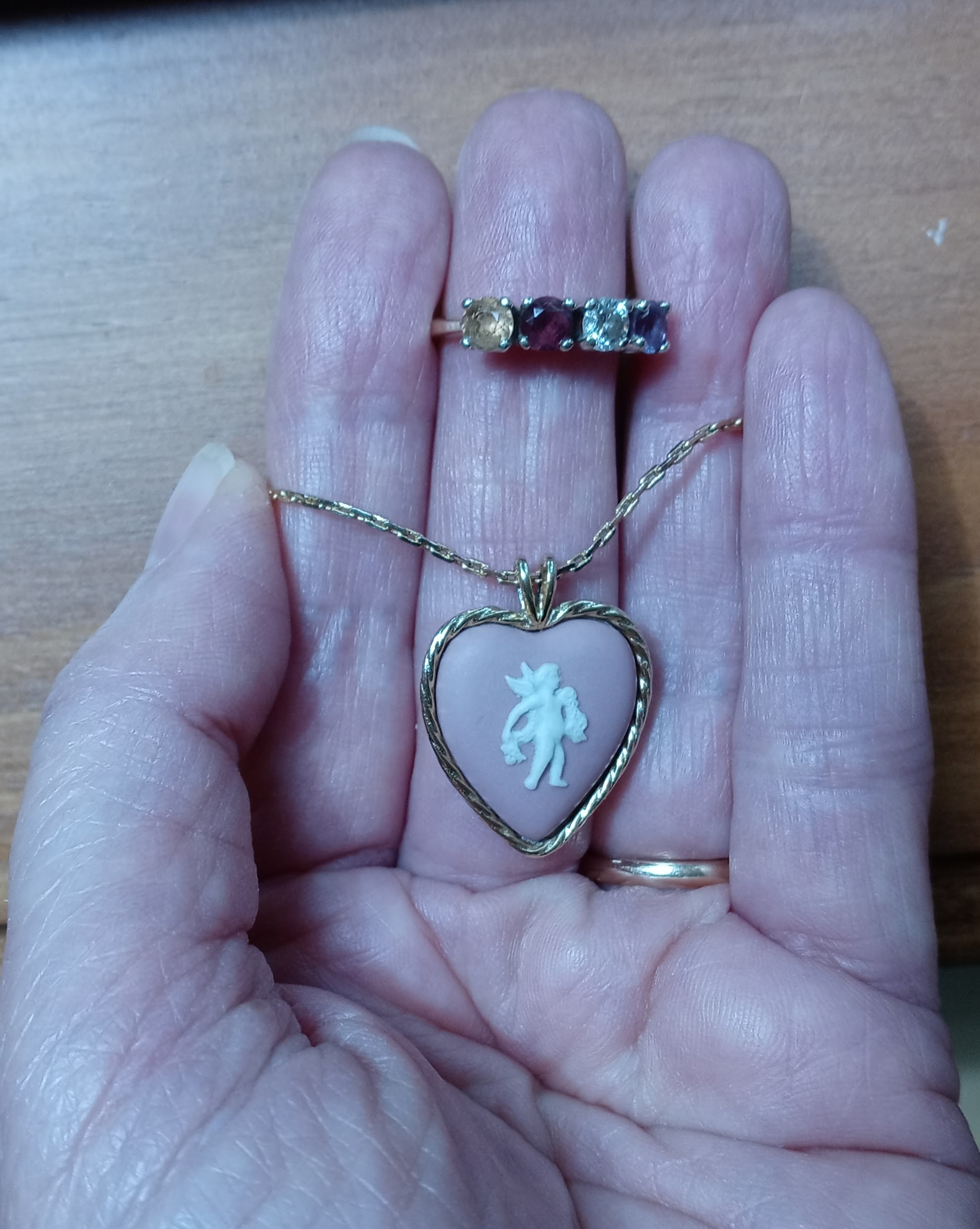
I had, however, worn two significant pieces of jewelry for the weekend.

The ring is a family birthstone ring with topaz for B, rose zircon for me, the diamond that was originally in my engagement ring for E, and alexandrite for T. The necklace is by Wedgwood and was B’s wedding gift to me.

In the photo, you can also see my gold wedding band, which I always wear. It’s a simple gold band and has been resized once but still bears its original inscription of our name and wedding date on the inside.

It’s more precious to me than any ruby could be.

My 40th reunion at Smith

Last week, I attended my fortieth reunion at Smith College in Northampton, Massachusetts. For those who may not be familiar, Smith is a women’s liberal arts college, chartered in 1871, one of the traditional Seven Sisters, five of whom remain as women’s colleges.

I came into town a day early in order to meet up with an alumna friend who lives in Northampton and graduated a year before me. Her sister was a member of my class and passed away in fall 2020. I was honored to be able to commemorate her at the Service of Remembrance during our reunion. My ’81 friend and I enjoyed hours of conversation on her front porch, followed by dinner on the porch at Mulino’s, an Italian restaurant that did not exist back in my student days.

I stayed at the historic Hotel Northampton, which has fun features like a mail slot near the elevators on each floor that connects to a large brass mailbox on the main floor for pick-up by the postal service every morning. I also got to do a bit of shopping at Thorne’s Marketplace, a collection of local shops and restaurants housed in a grand historic building. Thorne’s was a fairly new undertaking back in my undergrad days and I’m glad to see that it continues to thrive. I bought some cards and gifts and books and made two trips to Herrell’s ice cream shop. I got a sampler each time, so I got to enjoy eight – count ’em, eight! – of their delicious homemade flavors. This will surprise no one that knows me. I also got to have lunch at Fitzwilly’s, a restaurant/bar that was also relatively new during my student days. I had mac ‘n cheese that featured fresh asparagus from a farm in nearby Hadley. I love asparagus, which is one of the glories of spring in New England; it reminds me of going with my parents to harvest a patch near my father’s hydro station, a remnant of a garden from an old company-owned house that had been torn down.

On Thursday afternoon, I went up to campus for the duration of reunion. Because of the pandemic, everyone had to have proof of vaccination and boosting to register and many of the meals and events were held outdoors. Indoor events were masked, except while eating and drinking. I immediately met up with some of my ’82 friends and the celebration began!

One of the things about Smith reunions – and Smith alums in general – is that we somehow manage to have meaningful conversations with each other at the drop of a hat. Perhaps because of our shared liberal arts background, we are engaged with a broad range of topics across current affairs, public policy, arts and culture, and on and on. Of course, the deepest conversations happen with our close friends but there is a lot of sharing of ideas with acquaintances, too. In retrospect, I wish I had prepared a succinct answer to the question “What do you do?” Lacking a shorthand reply, like “I’m a lawyer, working for this government agency” or “I teach at such-and-such school”, I found myself stumbling to explain forty years of my life in any brief, comprehensible way.

Unlike the vast majority of my classmates, I’ve done little paid work in my life. I’ve devoted many years to being a caregiver of both elder and younger generations, with more than our share of medical issues. I’ve volunteered in church music and liturgical ministry and facilitated a spiritual book study group. During my daughters’ years in public school I served on curriculum committees and shared decision making teams and helped design the honors program at the high school. I joined NETWORK, a national Catholic social justice lobby, in 2000 to advocate for social justice. I was part of the anti-fracking movement in New York which finally achieved an administrative and later legislative ban in our state; this led to ongoing involvement in the fight for climate and environmental justice. There is my writing life, as a blogger and poet.

This does not condense into an easy answer to “What do you do?” but it does constitute the bulk of my adult life, which would not have been as rich and varied were it not for my Smith education. The ideal of a liberal arts education is that you “learn how to learn.” By studying across the spectrum of academic disciplines, one absorbs different approaches to real-life issues, enabling critically sound and creative solutions that promote well-being for ourselves and others and for our environment.

Maybe I should have replied, “Just forty years of being liberal-artsy.”

The other thing that I hadn’t quite prepared myself for was the flood of family memories. Because it was only an hour-ish drive to campus, my parents visited often for concerts and events. They were there for my recitals in Helen Hills Hills Chapel and John M. Greene Hall. They visited at Haven House where I lived all four of my years on campus. There were there, of course, at B and my wedding, a few weeks after commencement with the reception at the Alumnae House. This reunion was the first time since their deaths that I was back on campus and missing them added another layer to the strange mix of familiarity and difference that the passage of forty years brings. For example, I thought about my parents when we were attending the remembrance service, sitting in rows of chairs where the pews had once stood. The pews were removed years ago to allow for more flexible use of the space but their absence felt strangely current when I remembered B and my parents there in the front pews on either side for our wedding.

I also found myself missing my mother in particular among the spring flowers. We were blessed with unusually warm weather for mid-May and the flowers and trees were blooming simultaneously and profusely in response. The scent of the lilacs between the President’s House and the Quad, where we were staying, was so overwhelming I nearly choked. There were lily-of-the valley in bloom, which are Nana’s birth flower. What would have been her 90th birthday was the day after reunion and the third anniversary of her death is a few days from now.

I’m grateful to have been among friends who could support me with this grief aspect. Many of us have lost our parents now, with some still in the phase of dealing with their final years and indeterminate endpoint. As classmates, we were also dealing with the deaths of more of our ’82ers, adding to the list that, sadly, began during our senior year when we lost one classmate in a plane accident and a second to cancer. That’s why I and some friends always make a point to attend the service of remembrance during reunion. We want to honor our departed ones and their importance in our lives, even if they left us long ago. After the service, we visited the memorial tree planted beside the chapel in honor of our classmate Beth. We took a photo which we will send to her mother, who I know finds comfort that we remember her all these decades after her death.

While the central activity in reunion is visiting friends, there are plenty of other things to keep us busy. Some are long-standing traditions, such as Ivy Day when the alums, wearing white, parade between rows of the graduating seniors, also wearing white and carrying red roses, welcoming them into the community of alumnae. The night before commencement, the central campus is illuminated with Japanese lanterns. People stroll among them with live music in several locations.

There are also a number of lectures, receptions, and concerts. The President gave an update on the state of the college. Everyone is very excited that grants are replacing loans in financial aid packages at Smith, making an education possible without graduating in debt. Smith also highlights its accessibility for students who are the first generation in their family to attend college. That was my situation forty years ago but it was not recognized in the way it is today. I also attended two lectures of interest. One was how the Botanic Gardens are being re-imagined in keeping with the UN Sustainable Development Goals and best practices for preserving species in the face of climate change, all with an eye toward education and social/environmental justice. The other was about the transition of campus to ground-source heating and cooling, which will be a major contributor to Smith being carbon-neutral by 2030 without making extensive use of purchased off-sets. I was particularly interested in this because of the projects we have done at our home to reduce our carbon footprint and because my church is in the process of drawing up a strategic plan to reduce or eliminate our use of fossil fuels.

Besides college activities, we had a few opportunities just for our class. I alluded to one in this post – an open mic event to read something from our college years. I chose a passage from my adult psychology course journal about my experience coming from a tiny town to Smith. A few of us had brought something with us but we had time to do additional sharing which was fun. Our class theme for Reunion was “Writing Our Next Chapter” and I appreciated that our futures also came into that discussion.

We were also honored to have a preview screening of Where I Became, a documentary about South African students who came to Smith during apartheid. Our classmate Jane Dawson Shang is co-producer and shared some of her experiences making the film. When it becomes publicly available, I will surely share that information here at Top of JC’s Mind so everyone can see the remarkable story of these women.

Reunions at Smith are always exhilarating but exhausting. I had originally planned to attend commencement on Sunday morning but opted for quiet conversation with friends. Walking 17-20,ooo steps a day for three days straight in hot. humid weather proved to be a bit much for my feet and ankles, which swelled rather impressively.

It also meant that my reunion experience ended with what is always most important, sharing with friends in a place that was instrumental to our lives. I hope to see some of them and return to campus before our next reunion.

Five years seems too long to wait.