SoCS: the phone

At this point in my life, I’m not a big fan of the telephone.

It can take a lot of time and energy to convince myself to make the call, especially if I know I’m likely to have to work through endless phone menus or get put on hold multiple times and shuffled between service personnel.

(Yeah, looking at you insurance companies, utilities, etc.)

There were periods in my younger years when the phone was an important lifeline and source of connection – when B used to travel a lot on business, when I was away from my mom.

Even after my parents retired near us, I usually also spoke to them every day by phone, even on days when I also saw them in person.

Those calls were not hard to make. Or receive.

I still use my landline for calls whenever I can and still have an answering machine to pick up if I can’t – or if the caller ID suspects spam, which is most of the time these days. All three of us happened to be out together earlier this week and I went to check the machine for messages when we got home. I realized that since Paco (my father) died over two years ago I seldom get personal messages on my phone.

Actually, it’s longer ago than that because Paco forgot how to make phone calls in his last months.

Somehow, though, I keep checking for a call…
*****
Linda’s prompt for Stream of Consciousness Saturday/Just Jot It January today is “make the call.” Join us! Find out more here: https://lindaghill.com/2024/01/26/the-friday-reminder-for-socs-jusjojan-2024-daily-prompt-jan-27th/

Christmas ’23

I’ve been struggling with whether or not to write a post for Christmas Day.

Maybe, it’s because I’ve been struggling with just about everything related to Christmas this year.

For so many years, the Christmas season brought most of our extended family together, often over a period of days and in various constellations, but this year, it will be just me, spouse B, and daughter T at home together. Daughter E and her family are celebrating an ocean away at home in London. B’s and my siblings are all busily dealing with their families and/or medical issues.

This lack of planned travel and guests turned out to have a silver lining when T was offered a slot for a needed shoulder surgery last week due to a cancellation in the surgeon’s schedule. So, our already subdued Christmas plan got even quieter as we have factored in the early stages of recovery.

While I’ve done some of the Christmas preparations, like singing in Lessons & Carols with the Madrigal Choir of Binghamton, writing Christmas cards and letters, and some gift-shopping and wrapping, the bulk of the decorating, cooking, and baking has been handled by B, with an assist from T prior to her surgery.

I’m sure that my feeling more somber than festive is not helped by the state of the world. The continuing horrors of war in Ukraine, the Middle East, Sudan, and elsewhere. The ever-increasing evidence of climate change impacts. The increasingly vile political rhetoric and threats against judges, Jewish people, Muslims, immigrants, pubic officials, etc. here in the US. The local battle against CO2 fracking with global implications here in the Southern Tier of New York. Increases in cases of flu and COVID in the Northern Hemisphere as winter sets in.

This somber time we face is also reflected in my religious observances. For many years, I was actively involved in music and liturgy planning for Advent and the Christmas season, but I haven’t been for a number of years now. While I still attend and participate in services, some of the anticipation and joy is muted for me.

It’s also true that there are many difficult issues raised by the nativity narrative that seem particularly salient to me this year. The real dangers that Mary faced as a young woman facing pregnancy before marriage. Her being forced to travel and give birth away from the comforts of home and neighbor-women who could come to her aid. The threats to her baby’s life. The slaughter of children ordered in an attempt to kill him. Fleeing to protect her child and their becoming refugees.

Angels and magi aside, there was a lot of pain, fear, and loss.

With all of this in my head, I went to 10 PM mass at my church for Christmas Eve. There was a photo of the baby Jesus amid rubble as displayed at a Palestinian-Lutheran Church in Bethlehem, the birthplace of Jesus on the West Bank, where Christmas observances usually draw crowds from around the world but are not being publicly held this year because of the war. The homily dealt directly with the struggle that I have been having this year and called on us to have hope. As part of the homily, we sang the first verse of “O Little Town of Bethlehem” near the beginning and the fourth, final verse at the end. We sang:

O holy Child of Bethlehem,
descend to us, we pray;
cast out our sin and enter in;
be born in us today.
We hear the Christmas angels,
the great glad tidings tell;
O come to us, abide with us,
our Lord Emmanuel!

Phillips Brooks

The message is to have hope because God, who is Divine and Eternal Love, is with all people of good will, as the angels announce.

I admit that hope is not one of my better virtues, but I will continue to add my actions, small though they are, in the efforts to make the world safer, more loving, more kind.

After all these centuries, still searching for the peace the angels proclaimed…

One-Liner Wednesday: five years ago

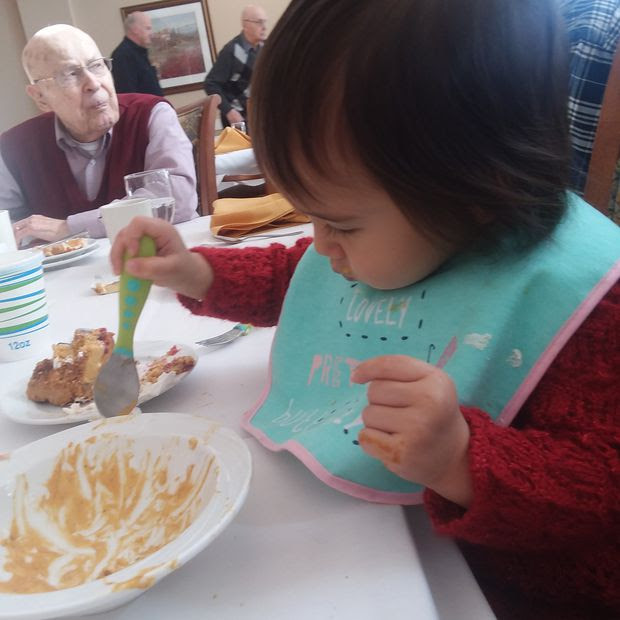
Our then one-year-old granddaughter ABC enjoying Thanksgiving dinner with her great-grandfather Paco in the background; I’m missing both of them today, one due to distance, the other to death.

Please join us for Linda’s One-Liner Wednesdays! Find out more here: https://lindaghill.com/2023/11/22/one-liner-wednesday-clownin-around-2/

Two years without Paco

I work up in the very early morning darkness today thinking about my father, known here and in real life for the last 33-ish years of his life as Paco, the name bestowed on him by my firstborn and his first grandchild E as she was learning to talk.

I suppose this is not surprising because this is the second anniversary of his death. You can read a tribute that I wrote to him a few weeks after his passing here.

What is unfortunate is that in the early morning darkness in which I am now writing this post I am remembering so much of his final years, when I was struggling to get proper support and medical care for him, exacerbated by the pandemic. Even though I was living locally, there were long stretches in which I could not visit in person at all or only for short amounts of time. Phone and video calls were often frustrating, as you can tell from this poem, which was first published in Rat’s Ass Review.

Video Chat with our 95-year-old Father

You said it was scary
today
that we were there

in your bedroom
your three daughters
in pulsating squares

on a screen
You remembered where
home

is for each of us
but not where
it is for you

confused that you
could see us
hear us

but we were not
there
with you

We talked about the snowy
winter, so like our New England
childhoods, when you would

wrangle your orange
snowblower to clear
our way out

We asked if the cut
and bruise on your hand
had finally healed

if you had finished
all the Valentine
goodies we’d sent

Distracted
by a sound
from the living room

you set the tablet
aside
left us

staring at the ceiling

What was most difficult was that, no matter how hard I tried, I couldn’t secure correct diagnoses or treatments for Paco, illustrated by the fact that his death certificate states that he died from end-stage heart failure, but he was only diagnosed with heart failure about ten days before he died. I had been trying for months to tell the staff at his assisted living and then skilled nursing units of his continuing care community that he was having unexplained symptoms and had accompanied him to outside doctors and emergency room visits, when the pandemic protocols allowed me to stay with him, but it was never enough to get to the bottom of his health difficulties.

I thought I had worked my way out of most of the trauma of that but, in the early morning darkness of this anniversary day, apparently there is still some of that pain left. It’s not that I think I could have further prolonged his 96 years – something that would not have served any of us – but that his final months would have been so much easier for him if he could have received timely, proper diagnosis and medications.

One of the comforts of Paco’s death was the thought of his reuniting with my mom, known here as Nana, who died in May, 2019, also of heart failure and, gratefully, before the pandemic struck. I drafted this poem, which was first published by Wilderness House Literary Review, only a couple of weeks after Paco’s death.

We probably should have taken off					

his wedding ring before
he died		    before
his hands cooled	      started
to claw
but we couldn’t		       remove
that symbol
			of Elinor
	of two years
		   three months
			twenty-three days
						left
without		her
after
	sixty-five years
		      one month
			   three days
married to her
			the ring
				of her
even    in    days    of    delirium
	    haze			confusion

his ring		not
	sixty-seven years	  old
		but	   twenty
her gift 	         a remedy
	 for missing		some		thing
		of his
  to cling to 		during his three weeks
			       in the hospital
his chest cracked			 open
     		widow-maker averted
				somehow

She inscribed 		his ring	
      ALL MY LOVE  “ME”
     the way she signed 	cards to him
birthday	anniversary	  Christmas
	St. Patrick’s Day
		valentines
the words against his left
	ring finger		believed
to lead most directly to the heart
	which finally failed
		after ninety-six years
			five months
				nineteen days
as hers had
	after eighty-seven years
		     six days

While I go to the sink
to fetch soap 		to ease
the ring off 	his finger
my sister works
it over	 his reluctant 	knuckle

I carry it 	home 
to my daughter
Elinor’s and Leo’s rings
	   unite
on their granddaughter’s finger

[For those of you who might be new to Top of JC’s Mind, I will note that it is really unusual for me to fold poems into posts like this, but somehow, in the early morning darkness, it seemed appropriate.]

I’ll close this post by explaining the significance of the four-generations photo, taken a few weeks before Paco’s death, that begins this post. It shows Paco, me, eldest grandchild E who named Paco, and great-granddaughters, then 4-year-old ABC and just turned 1-year-old JG. This was the first and only meeting of Paco and JG, who had been born in London, UK, in the early months of the pandemic. ABC lived here in the States with us for her first two years and remembered Paco very well. The restrictions on international travel had kept E and her family from visiting but they were able to get special permission to travel together to come visit Paco one last time.

Paco’s health declined quickly after that visit and I’m so grateful that we all had that brief, sweet time together.

Remembering that final farewell through a few tears in the still-before-dawn darkness of this anniversary morning.

Remembering Ron Perera

Ronald C. Perera, composer and the Elsie Irwin Sweeney Professor of Music Emeritus at Smith College, passed away on August 4, 2023 at his home in Massachusetts.

Mr. Perera – I’m supposed to call him Ron but can’t quite bring myself to do so – was one of the most important people in my education at Smith (1978-1982). I was fortunate to be placed in his first-year music theory section. At the time, Smith’s sequence for teaching theory was unique. The first semester was based in 20th century music, with an emphasis on studying rhythm and melody. Having almost no background in 20th century music, I was in over my head, but Mr. Perera was always patient, good-humored, and available for extra help. The wisdom of studying the structure of melody early on in theory studies didn’t sink in until much later but it is still a help to me when learning to sing new pieces.

In the second semester, we studied common practice period four-part harmony, which meant a lot of exercises in realizing figured bass, setting hymn tunes, and analyzing Bach chorales. I was an organist at the time and Mr. Perera had been one earlier in his life; I remember us sitting together at the piano in his office geeking out over the intricacies of Bach’s harmonizations. I think some of the class thought we went a bit overboard, but I will always honor the way Mr. Perera deepened my appreciation of the genius of J.S. Bach.

(For the record, the second year of the theory sequence was a semester of counterpoint, followed by one of chromatic harmony.)

By my junior year, I had declared music as my major and Mr. Perera was my major advisor. Not wanting to finish my required theory sequence with an elective in analysis, I decided to take a semester of music composition. Once again, I was in Mr. Perera’s class. I had, of course, been doing some composition as part of my theory classes, but formally studying composition with Mr. Perera was a revelation. I was inspired to sign on to his music composition seminar for my senior year.

Composition seminar was basically private lessons in composition with occasional meetings with the other students, some of whom were graduate-level, for special presentations. That year deepened my appreciation for Mr. Perera as a teacher. He offered guidance in realizing my artistic vision for the work without interjecting his own style and aesthetic. He was always gentle, patient, and understanding, which became even more important when a family emergency occurred during my senior year. He also taught me that the work of composition is not just the creating and revising. The technical aspects, like score creation and extraction of parts, were also important; I did all of that by hand before there was software available as is common today. My seminar piece, “Psalms of Praise and Justice,” for string quintet, SSA chorus, and mezzosoprano soloist was performed at a concert for student composers and won the Settie Lehman Fatman Prize.

It was also a privilege to hear some of Mr. Perera’s compositions in concerts on campus. I particularly remember a concert featuring “Bright Angels” for organ, percussion, and tape performed in John M. Greene Hall. Mr. Perera wrote and taught electronic music as well as acoustic music and sometimes combined the two in live performance, as he did here. The score was intricate and beautiful. As a former organist, Mr. Perera understood well how to write for the instrument and fully use its capabilities while leaving the performer room to adapt for the particular instrument and room.

The other concert that immediately springs to mind was the world premiere performance of The White Whale, a monodrama for baritone and full orchestra, based on the character Ahab from Herman Melville’s Moby Dick. It is a riveting character study. All these years later, I can still recall the recurring motif, “Have you seen the white whale?”

Mr. Perera was especially well-known for his ability to wed words and music. He composed songs for solo voice, choral music, and several operas, with texts ranging from Sappho to St. Francis of Assisi to Shakespeare to Robert Frost to Mary Oliver. His love for both words and music is evident in his work.

After I graduated, I would try to reconnect with Mr. Perera when I was back at Smith for reunions or events. This became trickier after he retired in 2002. He was often at his home on Cape Cod during my visits to Northampton. I was lucky that he was in town when I returned to campus to sing in the chorus for Mahler’s Second Symphony this spring. Ron treated me to lunch at the Coolidge Park Cafe in the historic Hotel Northampton. We had a wonderful, wide-ranging conversation about family, music, poetry, current events, religion, and life in general. This quote from his obituary expresses it very well. “Ron was deeply and genuinely curious about many things, including each person he encountered. A long, thoughtful conversation was his signature, and his generous listening made everyone feel that they were the most important person in the room.” 

Mr. Perera and Jay, his wife of 56 years, attended the Mahler concert. I was pleased that I got to see them there and re-connect them with some of the other Smith singers from my era who were in attendance.

At that time, I knew that my poetry chapbook Hearts would be published soon and Mr. Perera asked me to send him notice when it became available. I did so and he ordered it. He sent me a lovely note, reflecting on his reading.

I didn’t know that would be my last contact with him.

I am so grateful to have had that wonderful conversation with him over lunch. I told him how much he meant to me when I was his student and how much I admired his ability to empower his students to realize their own artistic vision. He was an inspiration to generations of students and colleagues at Smith and beyond. They are part of his legacy along with his family – his eyes always lit up when he spoke of them – and, of course, his music which will outlive all of us.

Rest in peace, Ron.

He did tell me I should call him Ron.
Maui wildfire

Like many people in the United States and around the world, I have been watching the devastating news of the wildfires in Hawai’i, especially on Maui, with sorrow and horror. The confirmed death toll is currently 93 but hundreds of people are still missing, so that total is expected to rise. Eighty per cent of the buildings in Lahaina have been destroyed, along with the livelihoods of most of the residents.

If you are able to contribute to relief efforts, please consider contributing to the Maui Strong Fund, under the auspices of the Hawai’i Community Foundation, which is able to put donations to use immediately on the ground.

One of the difficult things about this tragedy is knowing that it was made worse by human intervention. Climate change is implicated both in the drought conditions in Hawai’i and the strong hurricane, that, while well south of landfall, combined with a high pressure area to send winds up to 80 mph (128 kph) onto the islands that quickly spread the wildfires, knocking out communication infrastructure and trapping many people.

The colonization of the Islands also played a role in the fires, as the landscape and plants have been altered from the species that evolved on Pacific islands. My daughter T, who holds a master’s degree in conservation biology of plants, told me that African grasses that were brought to Hawai’i evolved with fire as part of their lifecycle, burning quickly but than sprouting again soon after. These grasses were implicated in the dangerous speed with which the wildfires spread.

My family has several connections to Hawai’i. B and I visited Kauai for our tenth wedding anniversary and were drawn to the beauty of Hawai’i and the welcoming nature of the people. Our daughter E lived in Honolulu for several years, while studying at the University of Hawai’i – Manoa. She met her spouse L there and they married at their local parish.

Daughter T, while an undergrad at Cornell, spent a Sustainability semester in Hawai’i. They were in residence most of the time on the island of Hawai’i. (There were significant wildfires there as well, but the destruction was not as widespread because of the areas affected.) They also participated in conservation projects on other islands, including Maui. In 2014, B and I went to Hawai’i with T, three years after her semester there. You can read a series of posts about that visit starting here. That visit also led to this poem.

Hawai’i is one of the most remote places on earth, being far away from any of the large continents. Its isolation, though, does not exempt it from the increasing tide of disasters turbocharged by the climate crisis. These tragic wildfires are another reminder that we all need to do what we can to transition to lives that don’t pollute our atmosphere with even more carbon.

United Nations Secretary-General António Guterres is convening a Climate Ambition Summit next month to help speed these efforts. There will be a large March to End Fossil Fuels in New York City on September 17. We need world governments to act NOW. It’s too late for all those lost on Maui and other climate-change influenced disasters around the world. We need to save as many people and other beings as we can in the future.

SoCS: five

When I was growing up, five was my favorite number because there were five people in my family, my parents, known here as Nana and Paco, and my two sisters, one older and one younger, and me.

It’s bittersweet to think of that now, with both Nana and Paco having passed on.

I don’t have a favorite number anymore.
*****
Linda’s prompt for Stream of Consciousness Saturday this week is to think of a number and write about it. Join us! Find out more here: https://lindaghill.com/2023/08/04/the-friday-reminder-and-prompt-for-socs-aug-5-2023/

One-Liner Wednesday: remembering Tony Bennett

When asked if he got tired of singing “I Left My Heart in San Francisco,” Tony Bennett replied, “Do you ever get tired of making love?”

This homage to Tony Bennett, who passed away last week at the age of 96, is brought to you through Linda’s One-Liner Wednesdays. Join us! Find out more here: https://lindaghill.com/2023/07/26/one-liner-wednesday-whats-the-hold-up/

losing our first parent

Today is the eighteenth anniversary of my father-in-law’s death. He was the first of B’s and my parents to pass away. I wasn’t blogging or writing poetry then; it took years for me to process enough to write about his death. This poem was first published by Eunoia Review here in 2016. As it happened, he was the only one of our four parents that we were able to be with at the moment of death.

The Last Night
~ ~ ~ by Joanne Corey

Hospice told my husband what to expect
as his father’s death approached,
skin mottled,
eyes open but unseeing.

Crush the morphine,
mix with water,
spoon into his gaping mouth
every two hours.

The death rattle started,
unmistakable,
though we had never
heard it before.

We did what we could,
smoothing his hair,
holding his hand,
another dose of morphine.

I prayed the rosary silently,
lacking beads,
counting the decades
with my fingers.

When he quieted,
breath slow, gentle,
we woke his wife
of fifty-one years.

She lay beside him that last hour.

Breaths shallower,
with pauses between,
longer –
longer still –
until, near dawn,
no next breath comes.

We switch off
the oxygen concentrator.
Silence heralds
his absence.

A month of Hearts

Just about a month ago, Kelsay Books published my first chapbook, Hearts, available from Kelsay, from Amazon, from me personally (if you are local), or by asking your local bookstore to order it through Ingram.

The experience has been exciting, gratifying, emotional, and exhausting by turns. There have been new things to learn, like keeping a spreadsheet to track sales tax and profit and signing contracts to place books on consignment. I’ve been trying to get the hang of doing publicity, which is a different universe from writing poetry. Sending notices to my poet-friends and non-poet-friends was relatively straightforward, although I admit it feels strange to ask people to spend money to read my work. I’d never been paid for my writing beyond gratitude and the occasional in-print copy of a publication but I am finding it easier to say writing is a profession for me now, even though the total amount of money I earn from it will be small.

Besides the discomfort of self-promotion, which works against my introverted nature, there is the sobering personal aspect of asking people to read poems about my mother’s final years. I’m grateful to know that the poems touch people’s hearts. I’ve had people tell me that our story reminds them of their own experiences with aging loved ones, that the poems made them cry. My heart goes out to them and it is humbling to think that my words might be a help to them as they continue to deal with their loss.

It’s also gratifying to know that I fulfilled one of my goals with this book. I am seldom overt about my own feelings in my work, preferring to “show rather than tell.” I try to leave space in my poems for people to bring their own reactions and emotions to the work and I seem to have succeeded, at least among those who have communicated with me. Three people have even written Amazon reviews, although it seems a bit surreal that I have an Amazon listing at all.

One thing that has happened since the book came out that I wasn’t expecting is the technical publishing questions that I’m asked. Most of these are a version of “how do you get a book published?” which I don’t feel well-equipped to answer. Generally, the person is asking because a family member writes as a hobby and they want to know how to get a book in print, but publishing poetry is different from fiction or memoir or non-fiction, which often involve having an agent, and self-publishing bypasses all the querying and rejection but means you need to know or hire expertise and have financial resources up front. People have also asked me how many copies I’ve sold but I have no idea. I could count up how many I’ve sold, but I have no idea how many have ordered from Kelsay and Amazon. I do occasionally look at the stat for the Poetry by Women category on my Amazon page; at the moment it’s #720, but I have no idea how that translates into number of copies. I probably won’t know until early next year when I get my first annual royalties payment from Kelsay.

I’m feeling as though I’m through most of my initial promotion list but I have more to do. A friend has offered to help me line up a couple of readings or signings locally. I need to find a printer to do business cards and bookmarks to have at events. There is a list of reviewers and awards to look through, although that seems a bit rarefied for me.

And more promotion.

No doubt, more blog posts here at Top of JC’s Mind.

I’m also trying to do more submissions for my new chapbook, full-length collection, and individual poems. Hearts proved that it can take a few dozen attempts to get an acceptance.

Having a book in print does, though, make it seem more possible that another acceptance will come my way.

And, if not, there will always be Hearts