Halloween

I live in the Northeast United States where it was unusually warm for Halloween yesterday. We set a new temperature record of 75 degrees F. (24 degrees C.)

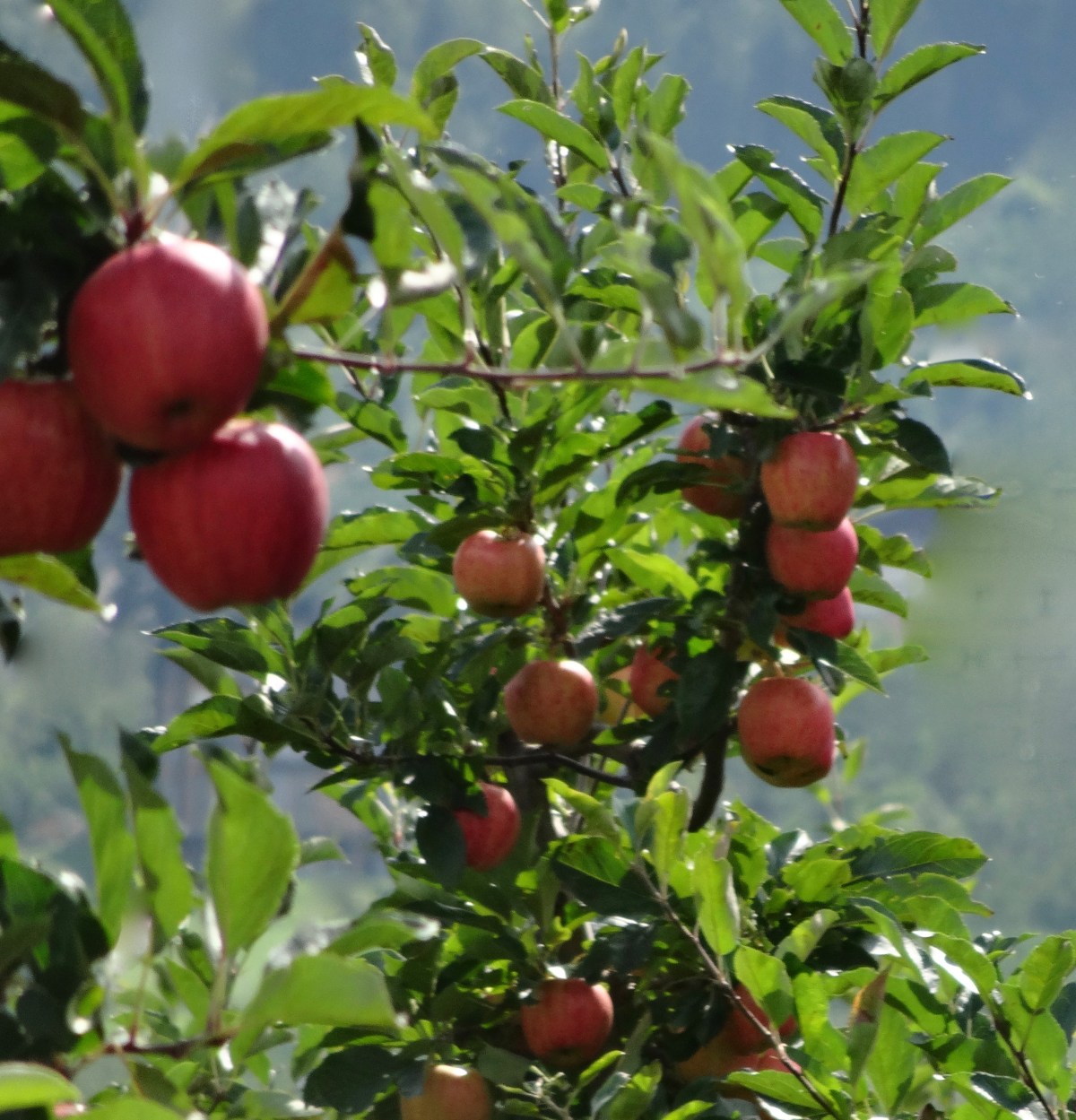
We aren’t sure if it was the mild weather or some other factor but we had dozens upon dozens of trick-or-treaters last night. We distributed about 75 apples, 30 packets of pretzels, 50 packets of fruit snacks, and 45 peanut butter cups.

It’s nice that so many children choose apples and are excited about seeing them in our treats basket. I was afraid I had overbought but we only had seven apples left over.

I see another trip to the Cider Mill to buy more apples before they run out and close for the season.

One-Liner Wednesday: Trump’s threat to birthright citizenship

Donald Trump has pledged to end birthright citizenship for the children of immigrants by executive order, if he is elected, which would be a clear violation of the 14th Amendment of the US Constitution.

This fact is brought to you as my post in Linda’s One-Liner Wednesdays series. Find out how to join us here: https://lindaghill.com/2024/09/25/one-liner-wednesday-flowers/

One-Liner Wednesday: Project 2025 and child labor

Project 2025, the lengthy document spearheaded by the Heritage Foundation to lay out plans for the “conservative president” they expect to be elected this year and which mirrors Trump’s Agenda 47 and the Republican party platform, would weaken child labor protections, allowing youths to do dangerous jobs (p. 595).

Join us for Linda’s One-Liner Wednesdays! Find out more here: https://lindaghill.com/2024/08/07/one-liner-wednesday-twice-the-bang-for-the-buck/

Gingerbread Poem on Silver Birch Press!

It’s no secret that submitting poetry for publication is mostly an exercise in rejection, but this week is a time to share some successes. Yesterday, I posted about the publication of three poems in Emulate. Today, I’m happy to share that Silver Birch Press has published my poem “My husband and daughters make Christmas gingerbread” as part of their SPICES & SEASONINGS Series! Many thanks to Melanie and the Silver Birch Press team for including me in this several-months-long-and-counting series!

I submitted to the series back in late August and received the acceptance notification in early September, but assumed, correctly, that they would hold publication until Christmas-cookie-baking season. It’s fun and festive to have it appear now. (Photo is some of our gingerbread from 2010.)

This poem started with a prompt from Heather Dorn in December, 2015, when she was facilitating a women’s poetry workshop called Sappho’s Circle. The middle “action” section of the poem descends from that time. When the Silver Birch Press call for submissions came in this summer, calling for writing about a specific spice or seasoning, I immediately thought of that poem and set about revising it to “spice it up.”

B and I have often discussed how it is the amount of clove in these cookies that distinguishes them so that became the focus of the new opening and closing sections. I was also able to workshop the poem with my fellow Grapevine Poets before submitting to Silver Birch Press.

As it happens, Silver Birch published the poem on their site yesterday, so I was able to share it via social media then, while waiting to do the blog post today, given that I had already posted about the poems in Emulate yesterday and wanted to spread the poetic good news reporting out a bit here at Top of JC’s Mind.

Because of that, I’ve already had a number of comments on Facebook about the poem. One from my college roommate was especially touching, as she referenced her “unexpected joy” at seeing her mother’s words in the cookbook inscription in my poem. My eyes welled with tears, remembering our moms, both of whom died a few years ago.

In workshopping this poem, there was discussion about how much detail to leave in the poem and how much to cut. There is always a tension in revision on this point and I admire poets who can choose just the right detail to impact their audience. I tend to be guilty of too much detail, which sometimes leads to comments of “why should I care?” about some detail or other. I’m grateful, though, that I chose to leave that particular detail in this poem.

Granted, no other reader may have found that specific moment of joy from this poem, but, perhaps, there is another detail that struck them, that reminded them of family or baking or Christmas tradition. It’s not something that I’m likely to ever know.

This poem has been described to me as “lovely” and “charming.” I realize that others would term it overly sentimental or unsophisticated.

Perhaps, it is all of those things.

I do know, though, that it is authentic to who I am as a poet and as a person. I think – or, at least, I hope – that comes through to those who encounter my work.

As always, your comments are welcome, either here, on Facebook, or at the Silver Birch Press post.

Wishing you all a delicious treat that suits your taste!

A poem for Banned Books Week

In honor of Banned Books Week, I’m sharing my poem “The Banned Bookmobile” which was first published in the Fall-Winter 2022 issue of Rat’s Ass Review.

THE BANNED BOOKMOBILE by Joanne Corey
 
Do you need a special license to drive
a bus of books? Children
 
are more fragile; books,
more combustible.
 
Children’s minds need fire,
need those books to start a blaze.
 
How else to know that a pair of penguin
dads can raise a chick?
 
That witches and wizards can be evil
or good or somewhere in the flawed between?
 
That even the bluest eye cannot
confer beauty and love?
 
That it’s a sin to kill
a mockingbird?


(You can read a bit of backstory for this poem in my blog post here.)

One-Liner Wednesday: London snow

My granddaughters after a rare snowfall in London, UK – excited 5-year-old ABC who remembers snow from living with us in upstate NY when she was little and 2-year-old JG who had never experienced snow.

Join us for Linda’s One-Liner Wednesdays! Find out more here: https://lindaghill.com/2022/12/14/one-liner-wednesday-the-lost-days/

US education

In the United States, some school districts have already started the new school year and the rest will follow over the next couple of weeks.

In many places, the situation is fraught.

First, an organizational primer for those outside the US. The United States, unlike many countries, does not have a national education system. The various states exercise control over the curriculum and policies to greater or lesser degrees, depending on the state. The greatest degree of control usually rests with local school boards.

It’s a mixed blessing.

In some districts, the local school boards have bought into the notion that something as simple as having a book that includes a gay character in the library is akin to “grooming” students to be gay. Or that it isn’t permissible to discuss racism because it might make white students feel bad or guilty. This puts teachers in the uncomfortable position of being afraid to teach history, civics, literature, science, etc. in the way that they were trained to do as educators.

Some of these issues are even more pronounced when they become a state policy. The most prominent example of this at the moment is Florida. This school year marks the beginning of enforcement of the Parental Rights in Education Act, informally known as the “Don’t Say Gay” law. The most prominent provision of the law is that there must be no classroom instruction on sexual orientation or gender identity in kindergarten through third grade. The reasoning is that these topics should be totally controlled by (heterosexual) parents.

But, here’s the thing. We use gendered language ALL THE TIME. Some of the first sight words that children learn – mother, father, boy, girl, man, woman, he, she – are all gendered terms. Are teachers supposed to use gender-neutral words at all times, referring to students, parents, and siblings rather than using such common terms as boys and girls, moms and dads, and brothers and sisters? What if a student asks why the family picture a classmate drew has two moms or two dads? Will the teacher be sued if they say anything beyond “ask your parents”?

Florida is also facing what has been termed a “critical teacher shortage.” It’s hard to say how much is due to curriculum concerns versus low pay, lack of administrative support, large class sizes, contract provisions, etc. Teacher shortages are fairly common in the United States, especially in math and science. To fill gaps, some states allow people to teach subjects in which they are not certified or even allow people to teach who are not certified at all.

Meanwhile, teachers and schools are under COVID-related pressures. Although almost all students, teachers, and staff are eligible, many remain unvaccinated, raising the risk of illness. During the pandemic, some students fell far behind academically during the period of remote instruction and need highly qualified teachers and extra tutoring to help them catch up to grade level. Teachers are also struggling with the mental health and developmental needs of students who faced fear, uncertainty, and isolation for months and now struggle with inattention, misbehavior, and lack of age-appropriate social skills. Some teachers are opting to retire as soon as they are eligible rather than continue under these stresses.

In some areas, schools are dealing with church/state issues, as well. Because of the First Amendment to the United States Constitution, the government may not establish a religion. However, a couple of recent decisions by the conservative majority of the Supreme Court have poked holes in what had been termed the wall of separation between church and state. Both cases benefit the expression of Christianity; I wonder if the decisions would have been the same if they had been about public prayer by Muslims, for example. In some localities or states, there are even instances of (white) Christian nationalism creeping into school curricula, such as teaching that the United States was founded as a Christian nation, which it was not, and downplaying the role of enslavement and indigenous land theft/genocide in our national history.

A lot of this is supposedly done in the name of parental rights, that is, that parents are the ones who should determine what their children learn in public school. I don’t agree with that. I look upon public education as a public good. I want free, high-quality education for every student so they can grow into responsible, mature members of our communities. They need to learn wide-ranging skills in communication, quantitative and scientific skills, technology, social studies and civics, and the arts. Having a broad base helps to develop critical and creative thinking and to identify where a student’s interests lie. Learning in community teaches how to work together and solve problems in a civil way. That was my expectation when I chose to send my children to public school. If my priority had been to control what they were exposed to, I would have opted to home school them. If I wanted them to have learn through a faith-based approach, I would have sent them to a religious school.

I don’t believe that a subgroup of parents should be able to dictate the learning environment of all children in our public schools. If a parent thinks that a certain assignment is inappropriate for their child, the vast majority of schools have a mechanism to assign an alternative. However, that parent should not have the power to say that the other students can’t undertake the original assignment. If those parents don’t understand that in terms of community values, they should at least understand that the parents of the other students have the same right to direct their child’s education as they do. If a parent thinks that all/most of the assignments are inappropriate for their child, it’s time to either homeschool or send their child to a private or religious school that meets their needs.

With my daughters in their thirties and my grandchildren abroad, I admit that I am grateful to have been spared the personal pressures of education during the pandemic. There is a lot of ground to make up for students in the US. Let’s concentrate on that for the good of their future and our country.
SoCS: two

I have two sisters.

Two daughters.

Two granddaughters.

I had two parents, but they are both gone now. A few days ago, we observed the first wedding anniversary for them since Paco died last September. They celebrated 65 anniversaries together and this year would have been 68.

I can’t start recording all my losses. Too many.

I will instead, today, cherish the pairs that I still have with me.
*****
Linda’s prompt for Stream of Consciousness Saturday this week is “too/to/two.” Join us! Find out more here: https://lindaghill.com/2022/04/22/the-friday-reminder-and-prompt-for-socs-april-23-2022/

a momentous visit

While my blogging has been haphazard for months due to my father’s declining health, I wanted to share a post about the recent visit of our daughter E, her spouse L, and their daughters, four-year-old ABC and one-year-old JG. As people who check in here at TJCM periodically may recall, they live in London UK and the pandemic left us unable to visit each other. This meant that when they arrived in the US, it was our first chance to meet JG in person.

All the adults are fully vaccinated, but the children are too young to qualify. While our area of upstate New York is not a COVID hot zone, the transmission rate is still high enough due to the delta variant that we were very cautious about taking the girls to indoor public spaces. While I had scaled back my expectations for the visit a lot, I hadn’t scaled them back quite as much as I should have. For example, I had hoped to see a few more friends than we were able to. Unfortunately, Paco, my 96-year-old father, had more health challenges appear and his unit at the nursing home had to go into lockdown due to a couple of COVID cases among vaccinated staff.

In a way, though, it was nice to have them in our home, doing normal, everyday things like we had when E and ABC lived with us for over two years while waiting for E’s spousal visa to be accomplished.

B, with an assist from ABC, got to bake yummy treats for breakfast.

Everyone enjoyed watching the birds at the birdfeeders. ABC especially liked the tufted titmouse and goldfinches, while others were partial to the cardinals.

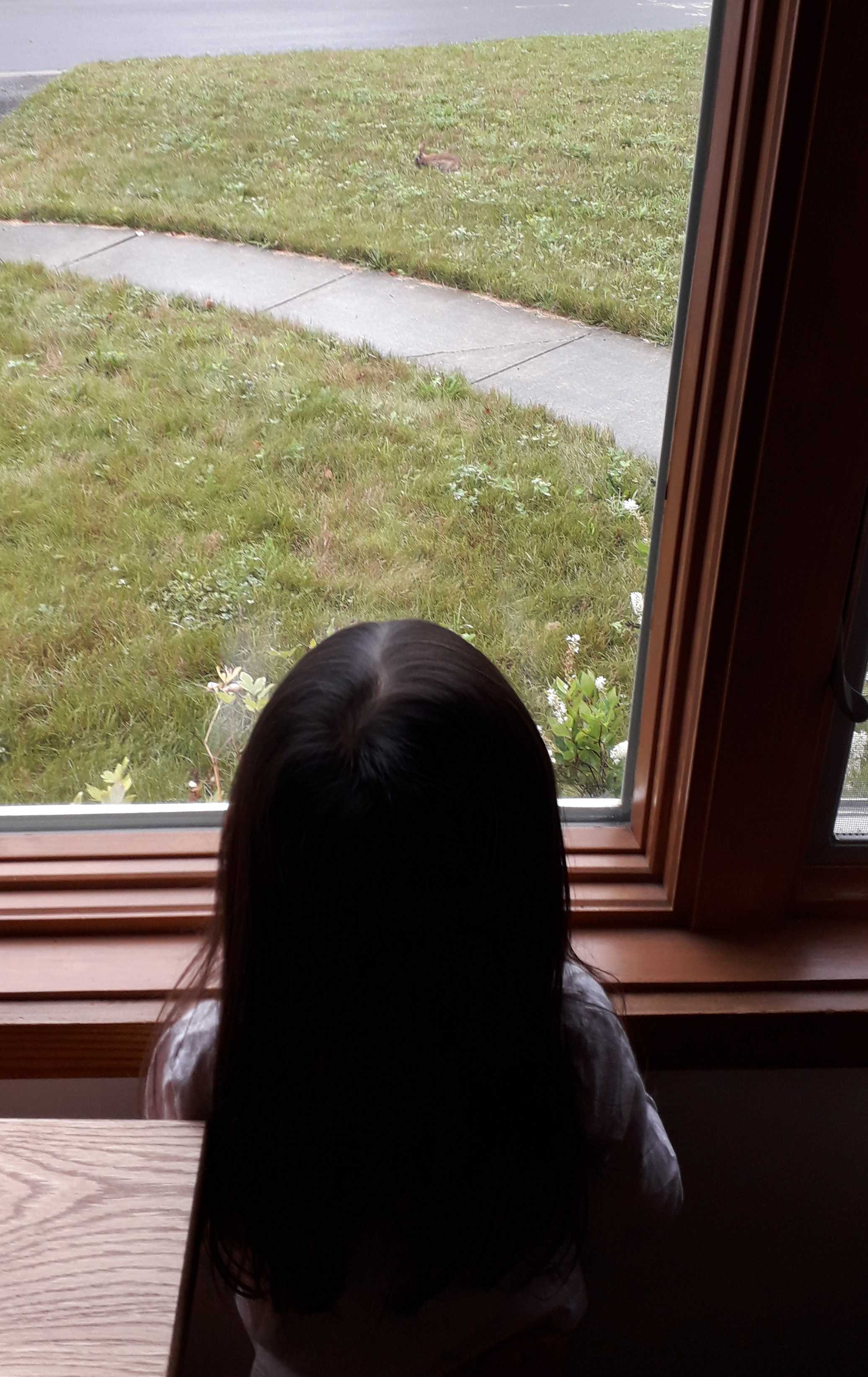
We enjoyed watching other wildlife, too. ABC even spotted some deer near the back fence. We also spent a lot of time watching the bunnies eating various leaves and flowers in the lawn.

You probably can’t see the bunny, but – trust me – it’s there.

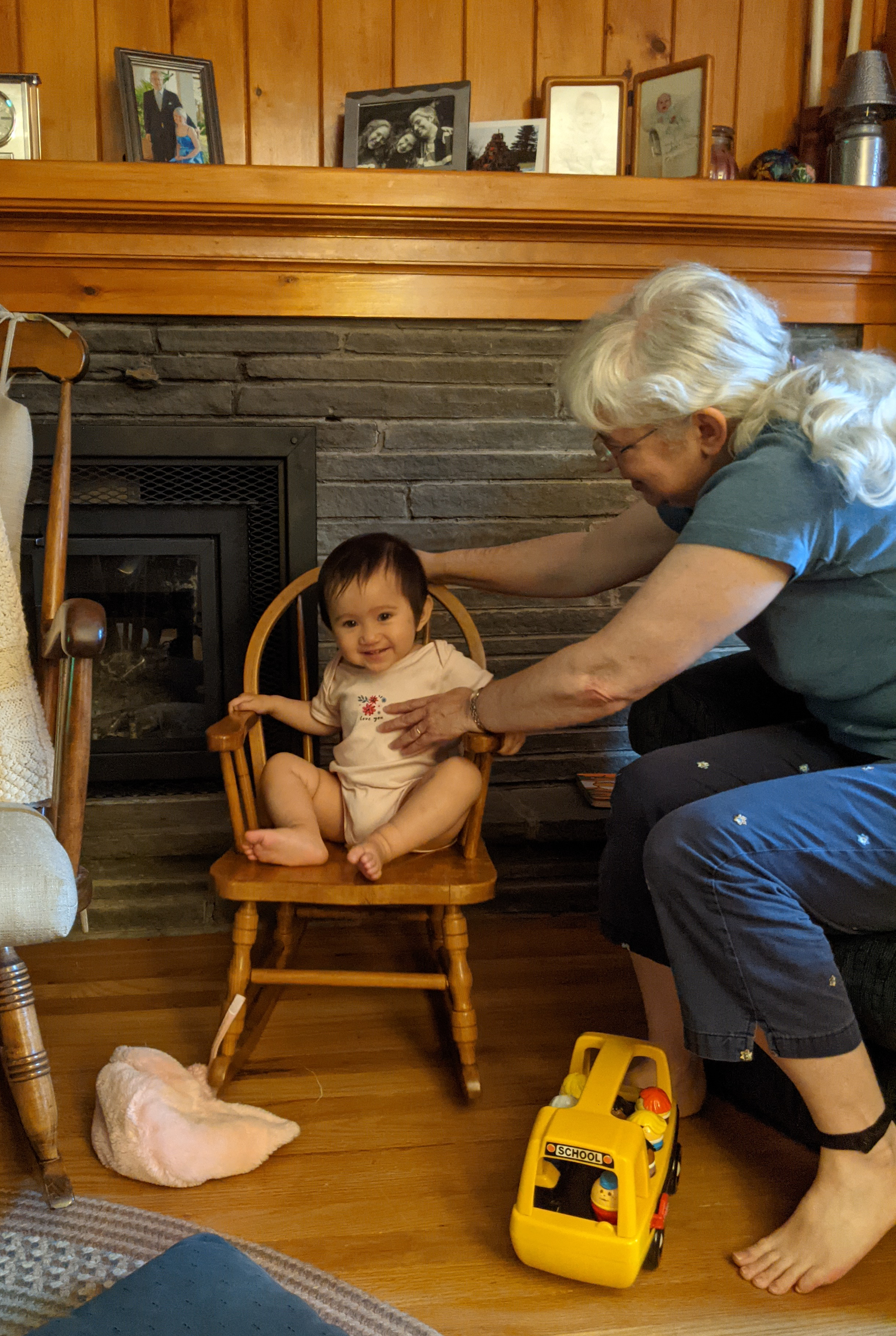
One thing that they don’t have at home in London is rocking chairs. JG especially loved the one that was her size!

JG was an early walker so we missed her being a babe-in-arms, but Auntie T did get a taste of what that phase was like when JG got so tired she actually fell asleep in her arms.

L took the girls on walks. Here is ABC at the 1 mile – or is it 1 smile? – mark on the Rail Trail. Our area, like many others in the US, has re-purposed places where there used to be railroad tracks into recreational trails.

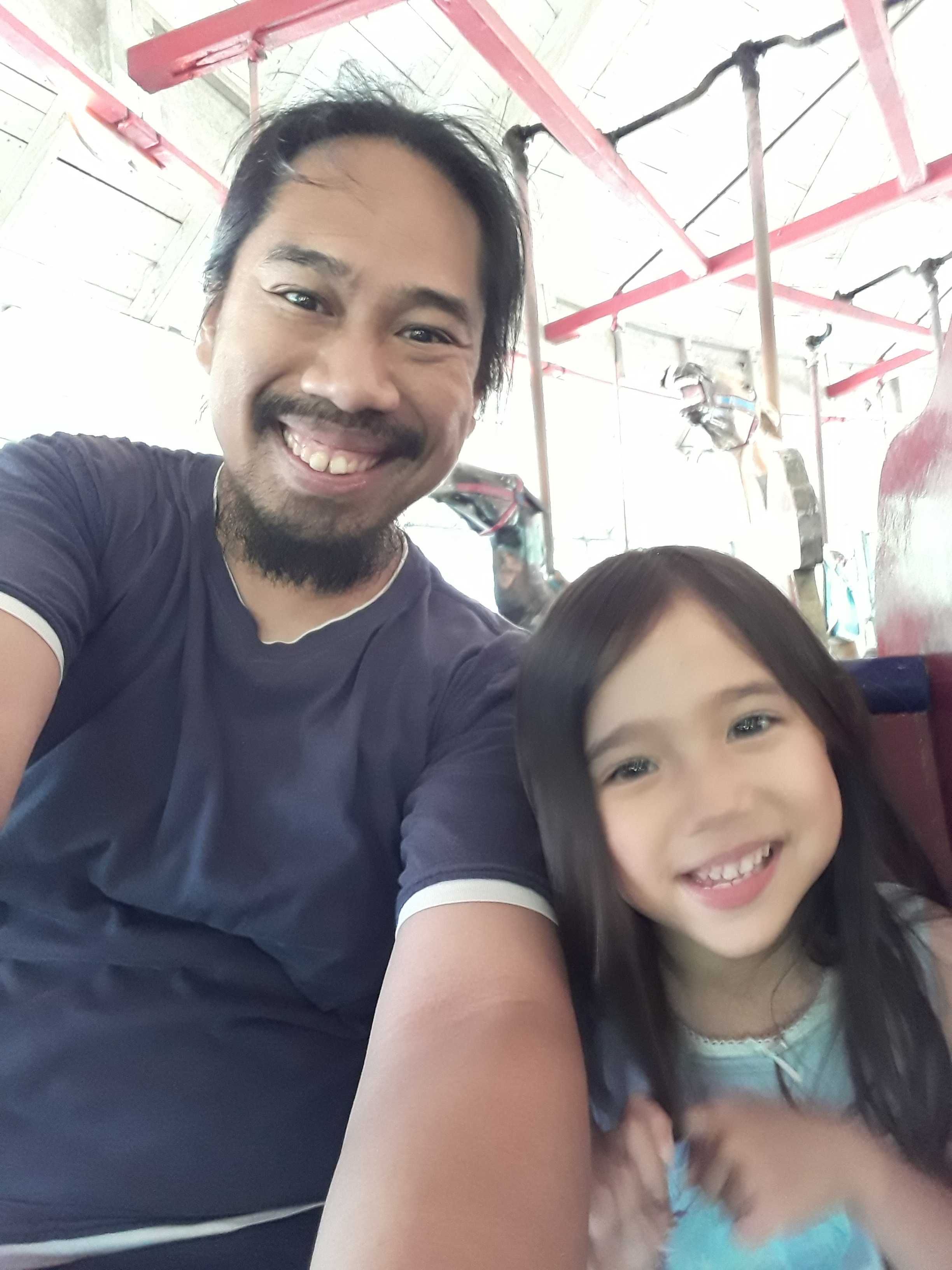
We also got to visit the parks and carousels. Broome County has six vintage carousels and it was very nostalgic to revisit them with ABC and introduce them to JG. ABC made friends everywhere she went.

L and ABC enjoyed rides in the carousel chariot
JG loves being on the swings!
JG also enjoys being on the move!

We got to enjoy a lot of playtime with the girls. ABC, at four, has a great imagination and enjoys making elaborate scenarios. She is also quite operatic! Besides singing songs that she knows, often from Frozen I and II, she likes to make up songs while she is playing. With both her parents being accomplished singers and instrumentalists, she appears to come by music naturally. She is learning to play the piano, so we got to experience her lessons with her daddy.

ABC is also a beginning reader, so sometimes she would read to us and other times we would read to her. It was an honor to be chosen as the final bedtime story reader. Of course, she also requested a bedtime song before going to sleep.

The most important event of the trip, though, was the one visit we were able to make with Paco in the outdoor courtyard of the nursing home. ABC was being her charming self, singing and dancing and clapping for Paco.

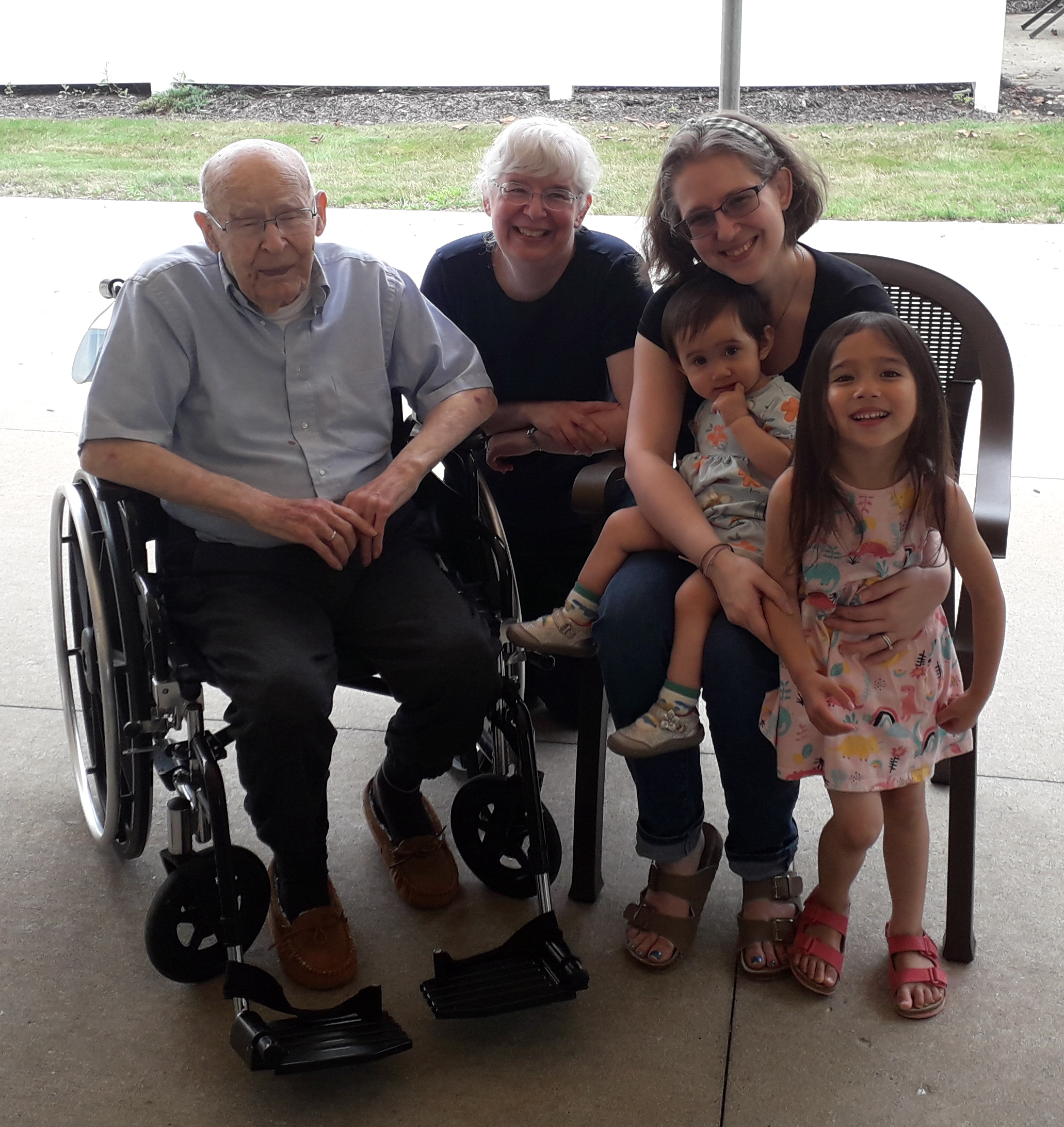
The most precious photo is this one of the four generations.

Paco’s health has declined so much in the weeks since we had this visit that he has now been admitted to hospice care. I will be forever grateful that Paco had the opportunity to meet his second great-granddaughter who won’t remember that day and to see his first granddaughter E and first great-granddaughter ABC who certainly will.

Another Pfizer vaccine advance

Yesterday, the Pfizer/BioNTech vaccine against COVID-19 was granted emergency use authorization for children aged 12-15, extending the prior age range of 16+. These younger teens can receive the same dosage as older teens with similar effect. This is good news because all high school and most middle school students should be able to be protected before schools open in August or September 2021.

Pfizer and other vaccine suppliers are currently studying the proper dosage for younger children. These eventual approvals will probably be split into several groups, 5-11-year-olds, 2-4, and 6-23 months. The research with these younger children takes longer because they have to start with lower doses and increase to find the lowest possible dose that will still mount a strong immune response. Until these children can be vaccine protected, they need for all the teens and adults to get vaccinated to reduce their chances of being exposed. While young children tend to be less sick than adults if they get infected, they can become very ill, even fatally, and suffer long-term symptoms. Even if they have mild or no symptoms, they also keep the community spread of the virus going, which means that the pandemic phase cannot end.

Canada gave authorization for 12-15 for the Pfizer vaccine last week. It’s expected that Moderna will be doing so soon. Pfizer has also applied for full authorization in the US, a process that will take several months to complete. I am especially pleased with the success of the Pfizer vaccine because data from spouse B and daughter T are part of the research findings that are showing how safe and effective the vaccine is. Monitoring for them continues to see how long immunity lasts and whether boosters are needed. I also continue to participate in the trial, but, because I was originally part of the placebo group, I didn’t receive the vaccine until February so my data are not useful for the longevity factor, although I could become part of a test group for boosters in the future if warranted.

Internationally, vaccine companies are continuing their research and manufacturing, but distribution is neither fast nor broad enough. India is particularly tragic, with widespread disease, scant treatment, and, despite being a major manufacturer of pharmaceuticals and vaccines, very little vaccine protection among its residents. President Biden has joined growing calls for vaccine companies to suspend their patent protections so that countries around the world can manufacture vaccines for their regions. This would also entail making available the raw materials, supplies, and expertise to manufacture the vaccines, some of which require new techniques such as mRNA.

I feel an odd mix of hope, dread, and sorrow. The COVID rate in New York State where I live is very low now. We are gradually relaxing some of our restrictions and I am planning to go on a writing retreat later this month. This summer, we think we are finally going to be able to travel to the UK to visit daughter E and her family and get to hold our granddaughter JG for the first time, although she is almost walking on her own and may not want to stop long enough to be held by the time we can get there.

At the same time, there are still people sick and dying in my state and exponentially more in other states and countries. It’s frustrating because we have treatment tools and vaccines now that we didn’t have a year ago but they aren’t reaching all the people that need them. What’s most frustrating is people who do have access but don’t take advantage of the opportunity, letting their fear, ideology, contrariness, or sense of invincibility stand in the way of personal and public health.

Please, everyone, continue to do all that is within your power to end the pandemic. This will look different depending on personal and community circumstances, but mask in indoor public spaces, distance when appropriate, be careful about the size of gatherings, stay home if you are sick, vaccinate when it’s available for you, keep up to date on the newest public health recommendations.

Show your respect for others and do your best to protect them. Pandemics are, by definition, phenomena that affect us all. It takes all of us working together to end one.