Last Friday, the US Centers for Disease Control and Prevention (CDC) changed their methods of assessing COVID risk to include the strain on the health care system, resulting in about 70% of the population now being classified as being in low or medium risk areas, meaning that indoor masking in public places and distancing measures can be rolled back.
However, Broome County, New York, where I live, is still in the high risk category. In the even more granular Covid Act Now tracker, our risk level is rated as very high, the fourth of five levels, with 26 daily new cases per 100,000 residents as of today, February 27.
The problem is that, when New York State rescinded its mask mandate, our local government also rescinded theirs. Our local conditions don’t warrant that, but, without a rule in place, the vast majority of people will not be masking in public, which will likely delay further progress in getting our case numbers down. Another thing that would help would be increasing our vaccine booster rate, which has crept up to 34% but is still low for our state, as is the 63% full vaccinated rate.
Earlier this month when New York dropped its mask mandate, I posted that I would continue to wear an N95 in public and to avoid crowds in an effort to stay COVID free. As a participant in the Pfizer/BioNTech vaccine trial, I am supposed to be following CDC protocols. With our county still being at high risk according to the current CDC map, I am still in compliance with my obligations to the trial.
The next decision point for me will be when Broome County finally gets into a lower risk category. In discussions with my personal physicians, they have advised attempting to avoid infection entirely for as long as possible. I share in this viewpoint. Many public health commentators have gone to the less stringent goal of trying to keep out of the hospital or dying from COVID and to prevent strain on the health care system. I, however, want to protect myself, my family and friends, and my community from being infected at all, so they won’t have to deal with the threat of severe illness, long COVID, and long-term cardiovascular, pulmonary, or neurological damage that can follow infection, even in those who didn’t have serious enough symptoms to warrant hospitalization.
The CDC does say in their guidance that “People may choose to mask at any time.” That will probably be me for quite some time yet, unless our county improves dramatically soon.
Lent is about to start. I’m trying to be hopeful that our situation will improve enough that I can safely drop my crowd avoidance in time to participate in some of the Lenten and Holy Week liturgies. We’ll see.
Over the course of the pandemic, I’ve posted frequently about it, the Pfizer/BioNTech vaccine trial in which B, T, and I are participating, the evolving science on the SARS-CoV-2 virus and its variants, the similarly evolving public health recommendations, and how these are being implemented here in my home state of New York and elsewhere in the United States. I do sometimes comment on the pandemic in the UK and globally, but I know best what happens close to home.
Throughout the pandemic, New York had been in the vanguard of following the recommendations of public health experts, avoiding the tendency we have seen in so many other states to ignore the benefits of masking, distancing, limiting crowds, getting vaccinated, isolating if infected, etc.
That ended this week.
Governor Hochul bowed to public and political pressure and lifted the mask mandate for businesses. While it is true that statewide the peak of the Omicron wave has passed and the vaccination rate is decent, my county’s risk is still rated as very high, with 44.7 per 100,000 daily cases. Technically, New York as a state is also in the very high category with 31.2/100,000 today (February 11), but it is counties like mine that are keeping the state in that risk category rather than dropping into the (merely) high category. Medium and low risk are a long way off at this point.
Meanwhile, the national Centers for Disease Control and Prevention are recommending not only that everyone age two and over wear a mask while in public but also that those masks be N95 or similarly protective types because Omicron is so highly contagious. Alarmingly, an even more contagious omicron sub-variant has reached the US, making protective masks that much more important.
Does this sound like the proper time to end mask mandates for businesses in New York State?
Certainly not, if one is truly following the science.
The problem is that many people are tired of having to deal with the pandemic and are complaining very loudly. The politicians who had been following the science hear them and loosen the rules that had been helping to get their residents through the current wave with as little hospitalization and death as possible. This could extend the current omicron wave and increase the likelihood of yet another new variant that has the potential to be even more transmissible or evade current vaccines and treatments or cause more severe disease.
Regardless of New York State rules, I am continuing to follow medical advice, to avoid crowds, and wear an N95 when in public. Because I am vaccinated and boosted, I will still visit with people who are similarly protected without a mask. I had hoped to return to church services this weekend but have decided that I can’t do so with the daily case rate still being so high; being stationary in a room with that many people for over an hour is too much risk for me, even masked.
Sigh.
At some point, the pandemic will end and I will follow medical and scientific advice on what my “new normal” will be. I had hoped that our state policies would be an aid in this, as they had been through most of these past months, but that remains to be seen.
I’m just hoping that this latest relaxation of protections doesn’t cause even more cases than we have already suffered.
Update: Almost immediately after publishing this post, I saw reports of this study from the CDC, which shows that booster effectiveness wanes significantly after four months. Given that B, T, and I all had our boosters on the early side due to our participation in the Pfizer/BioNTech vaccine trial, I’m all the more resolute in my vigilance regarding masking, distancing, etc. While we are all still likely to avoid severe disease or hospitalization due to our longer-than-four-months-ago boosters, I prefer to try to avoid infection entirely.
Over the last few weeks, many people here in the United States have said publicly that they are “over COVID” or “through with the pandemic” and are going to “go back to normal” which means living like they did before SARS-CoV-2 appeared.
Guess what? Pandemics don’t disappear just because we are tired or frustrated or in denial. There were 3,622 COVID deaths reported in the US yesterday, adding to the almost 900,000 deaths in the US since the start of the pandemic and 5.7 million deaths worldwide. These staggering totals are almost certainly undercounted, as some regions don’t have the will or capacity to track and report. Also, some deaths result from lasting heart, lung, or neurological damage from COVID rather than from the active infection itself and so may not be identified as COVID related.
Some people are saying we just have to live with COVID, as we do with flu and other viruses. Thus, they are saying that it is now endemic, but here is the problem. There is a specific definition of pandemic, “(of a disease) prevalent over a whole country or the world” (Oxford Languages). Looking at case numbers in the US and around the world, it’s obvious this is still a pandemic. We will get to a point where it is endemic, someday, through a mix of vaccination and immunity from having been infected, although no one yet knows how long immunity acquired through either route will last. Dictionary.com has a handy non-epidemiologist explainer of pandemic, epidemic, and endemic.
The subtext of being “over COVID” seems to be more along the lines of I’m tired of masking and distancing and avoiding crowds, so I’m just going to get back out there because a) I’m vaccinated/boosted so I don’t think I’ll get sick or at least not seriously so; b) I am young/strong/take vitamins/exercise so I’m not going to get sick; c) I don’t believe there is such a thing as this virus; d) you can’t tell me what to do; or e) we have to ease up on restrictions now so that we can re-institute them when the next variant or spike in cases occurs.
The thing is that a virus doesn’t care about your age or status or location. It’s only mission is to live and replicate and it will adapt to make that happen as easily and widely as possible. Exhibit A: the Omicron variant, which is wildly contagious and somewhat able to cause breakthrough infections in the vaccinated.
As regular readers here may recall, spouse B, daughter T, and I are all part of the Pfizer/BioNTech phase three vaccine trial. We are all vaccinated and boosted, although we were boosted on the early side of the curve, B and T as part of the trial that is contributing efficacy data that we see reported out in the news, and I who received a booster through the trial as soon as it was authorized for public use but before most people in my age range were eligible. I am also contributing data for the study, but I’m not on the leading edge like B and T. Therefore, while many of the boosted can get comfort from knowing that their immunity is likely still strong because the data from the trials is showing that, I don’t know if B and T might be showing a decline because there hasn’t been enough time to collect and analyze that data. I’m sure we would all love to know that booster immunity lasts a year or longer but it’s only been about seven months so far, so we can’t know. Likewise, we don’t know how long immunity lasts after infection.
I know that I am unlikely to become seriously ill, to be hospitalized, or to die if I contract COVID, but that doesn’t mean that I’m ready to be cavalier about it. I don’t want to be sick if I can prevent it by continuing with masking, distancing, and avoiding crowds. Even mild cases of COVID can result in months of symptoms, which is termed “long COVID.” As someone who has lived with a person suffering from FM/ME, which causes similar symptoms, I find the prospect of long COVID frightening.
What frightens me even more is the danger of spreading COVID to someone else. I have many friends who are older than I and at higher risk, as well as friends who are immunocompromised. Young children still are not eligible for immunization, although Pfizer/BioNTech has just applied for emergency use authorization for children 6 months-4 years of age, so perhaps that will begin in the coming weeks. I’m sure I also happen upon unvaccinated people because the fully vaccinated rate in my county is 62% and the boosted rate is only 33%. Some of the fully vaccinated are not yet booster eligible but we know that boosted people have the best chance against Omicron, so, if I am out in public, chances are that only 1 in 3 people I encounter will be a similar status to me.
Those are not great odds, especially with a variant as contagious as Omicron accounting for 99% of US cases. I have recently upped my mask protection to N95s, as I wrote about here. I’m learning how to deal with them as someone who needs progressive lenses in her glasses. The tighter fit of the N95 masks makes it difficult for my glasses to be in the correct position, so I can get a headache from eyestrain if I try to do close work for any length of time. Still, I’m trying to wear the N95s when I have to go out with a surgical mask/good quality cloth mask combo if I have to take the N95 off.
I used this site, https://covidactnow.org/us/new_york-ny/county/broome_county/?s=28791756, to find today’s Broome County statistics. (You can use it to find statistics in your area in the US. International data may be found here: https://coronavirus.jhu.edu/.) It rates our risk level as “Extremely High.” While other may be “over COVID,” I am not ready to take that much risk for myself, my family, and my community.
As conditions change, I will re-evaluate and adjust my behavior as I see fit. Until then, I hope that those I meet will respect my viewpoint.
To my immediate left is a throw on the back of the couch which features carousel horses.
Here in Broome County NY, carousels are part of our identity. Back in the early part of the twentieth century, one of the important sources of jobs for immigrants and for people already established here was the shoe company named Endicott-Johnson for its founders. They also gave their names to two of the villages, Endicott and Johnson City, that with the City of Binghamton make up the Triple Cities of Broome County. I’m sure everyone is excited to learn this local geography!
The Endicott and Johnson families wanted their employees and their families to have a good quality of life, so they paid them fairly and helped with home ownership, as well as innovations like providing health care and pensions. They also invested in creating recreation opportunities, which brings us to carousels.
The families installed carousels in six public parks scattered around the area. Because they didn’t want anyone to be deprived of a ride, part of the stipulation of the gift was that they would always be free to ride. And because one of the founders recalled the disappointment of getting onto a carousel but being on a stationary horse, all the horses on these carousels are “jumpers” which means they go up and down as well as ’round and ’round.
Most of the figures on the carousels are horses, but some also have a couple of other animals included, such as a dog or boar. Most of the carousels also include chariots to accommodate babes-in-arms or anyone who can’t climb up onto a horse.
When my daughters were young, we spent many hours at the various carousels. They traditionally open Memorial Day weekend and close after Labor Day weekend. I admit that I also love to ride carousels and we would see many other adults there, too. Sometimes, bridal parties will even make stops at the carousels to take photos. My favorite visitors would be elders who grew up in the area but then had moved away; they would come to take a ride and tell stories of how it had been visiting the carousels when they were young.
In our photo albums, we have a succession of years of photos of E and T visiting the carousels. It was a privilege when granddaughter ABC was living with us to introduce her to the carousels, too. It won’t be this summer, but maybe next it will be safe to travel and we’ll get to bring ABC and her little sister JG to the carousels for a ride. We’ll take photos with our phones that they can look at when they return home to the UK and remember.
ABC’s first carousel ride in a chariot being held by her mom with her dad riding on the horse beside them
The number of known COVID-19 deaths in the United States is over 200,000.
It’s hard for me to grasp the total, knowing that each of these was someone’s child, parent, sibling, co-worker, neighbor, friend.
A few days ago when I was working on this post, I needed to look up the population of Broome County, New York, where I live.
It’s about 190,000.
I am imagining the city of Binghamton empty, the University and all the other schools without students and staff, all the towns and villages without people, just the wild creatures and birds alive.
It’s sobering.
In reality, Broome County has lost 85 residents to COVID, each person a loss to their family and community. Somehow, though, my thought experiment in concentrating the loss to our country as the obliteration of our entire county has given me a sense of scale and of grief that the statistics alone did not elicit.
Last week, I needed to bring one of our vehicles to a dealership for a recall. The one we usually use wasn’t certified to work on the electrical/battery system of our hybrid, so we made the appointment at another dealer in a neighboring county. We live near the county line, so it’s just a couple of towns to our west.
Tioga County is a rural county; Broome, where I live is a mix of rural, urban, and suburban, although Binghamton is a small city by most standards with a population of about 46,000. Broome County’s population is about 190,000 in 716 square miles; Tioga’s is 48,000 in 523 square miles.
Your geography trivia for the day!
So, I arrive at the service department of the dealership, wearing my mask. There is a sign on the door that face coverings are optional for customers but required for staff, which seemed a bit odd as New York State rules are to wear a mask whenever people are closer than six feet (2 meters). I was surprised to walk up to the service desk to find that there was no plexiglass barrier to protect the employee and he was not wearing a mask.
I tried to maintain distance as best I could. I checked in, walked past unmasked customers in line, and sat in the waiting area with unmasked customers while unmasked employees walked through several times. When the repair was complete, the employee doing checkout hastily put on a mask after the window that separated her desk from the hallway was opened.
The experience left me feeling not endangered, because I was masked and maintained social distance most of the time, but disrespected. While the business knew that its employees should be masked when in proximity to another employee or a customer, they were not complying.
As the designated shopper in our house, I’m used to visiting businesses which have implemented careful measures to keep their employees and customers as safe as possible. The result has been that our infection rate in the state has remained very low as we methodically re-open businesses and services. If I am ever in a similar situation that I have to use this car dealership, I’ll make arrangements to drop the car off the evening before so that I only need to go inside to do the final paperwork when it’s ready.
I hope that there won’t be any outbreaks from the disregard that I witnessed at the car dealership, which, presumably, was considered acceptable to others in that community. For me, it seemed a small taste of what I hear on the news from other states, that folks don’t believe that masks and distancing help prevent COVID infections or that masks infringe on their liberties or that COVID doesn’t exist, all of which contribute to the appalling rates of illness and death in the United States.
At least I know that no one there will have contracted COVID from me.
Some of you may recall my secret poetry mission to write and present a poem in honor of Emily Jablon and Peg Johnston for the 2016 Heart of the Arts award ceremony. I was invited to participate by the Binghamton Poetry Project, because they receive funding from the United Cultural Fund, which is the grant-bestowing branch of the Broome County Arts Council.
I am excited to share the video of me reading the poem at the dinner. The video was taken from a distance and I am mostly obscured by the podium, but the sound is good. The title got a bit cut off; it is “Thanks to the Department of Public Art.” The diction is pretty good. There are only a few words that are hard to understand – but I, of course, know what I am saying, so feel free to chime in if you have any presentation points for me. I’m not used to reading with a mike or in a large room. It’s rare for community poets like me to get this kind of opportunity and I am very grateful to the Binghamton Poetry Project and the Broome County Arts Council for making it possible.
I also want to thank my spouse B and my daughter T for keeping me (somewhat) calm at the event. I will share that B’s favorite word from the poem is “tessellate.” I don’t know that I will ever write another poem where that is an appropriate word choice, but at least I have done it once!
I am hoping to publish the poem in the fall anthology of the Binghamton Poetry Project; after that, I will share the text here at Top of JC’s Mind.
Of course, this will be the long, chronological version of the story…
Over the third weekend in August, I got a message from the current director of the Binghamton Poetry Project, asking if I would like to write and present a poem at the annual Hearts of the Arts awards dinner. The dinner is a fundraiser for the United Cultural Fund of the Broome County Arts Council, which provides one of the grants that keeps the Binghamton Poetry Project functioning. The poem needed to be a 2-3 minute response to the arts in our community, as the two Heart of the Arts honorees, Emily Jablon and Peg Johnston, are both very active in public art.
The Binghamton Poetry Project has been very important to my growth as a poet. I have learned different craft aspects and how to write from prompts. My participation with them led to my joining both the Bunn Hill Poets and Sappho’s Circle; I also continue to attend the Binghamton Poetry Project workshops, which are organized in five-week units three times a year. I wanted to take on this special mission to help the Binghamton Poetry Project say thanks to one of our funders and to raise its profile in the local arts community; I also admit that it appealed to me to have the opportunity to present myself as a poet to the arts community which would not recognize me at all, except, perhaps as a long-serving member of University Chorus. (It’s the hair and the fact that I am short, so usually in the front row.)
As much as I wanted to do this, it was also a daunting prospect. First, there was the actual writing of the poem. Although I have been writing a lot of ekphrastic poetry, which means poetry about another (usually visual) art form, I had never written a poem for a public occasion. Second, I would need to read in front of a full ballroom with a stage, podium, and microphone, wearing relatively formal dress. Most of the readings I have done are informal and for a dozen people or fewer, so the prospect of reading for 150 or more made me pretty anxious.
Third, there was the timeline to consider. I decided that I would need to write the poem within the next few days so I could workshop it, revise, and have a final copy before my mom’s diagnostic heart catheterization on August 31st. Then, I would have time for practice readings before the September 19th event.
So, I accepted the challenge and got to work. I did a bit of online research on the artist-honorees, Emily Jablon and Peg Johnston. I was familiar with their public art projects in downtown Binghamton, but made plans to go down to visit early the following week to take some photos to help inspire my writing.
My usual writing process is to swish things around in my head for a while before writing. Given my timeline, I was very lucky that a basic idea and structure for the poem came to me over the weekend, so that I had the bones of the poem together even before I got downtown to view the art.
Stencil from Water Street Parking Ramp art installation
Peg Johnston was the director of a large stencil and mural project in the parking garage now located on the site that once housed Bundy Time Recording Machines and Link Pipe Organs, which later became Link Flight Simulation.
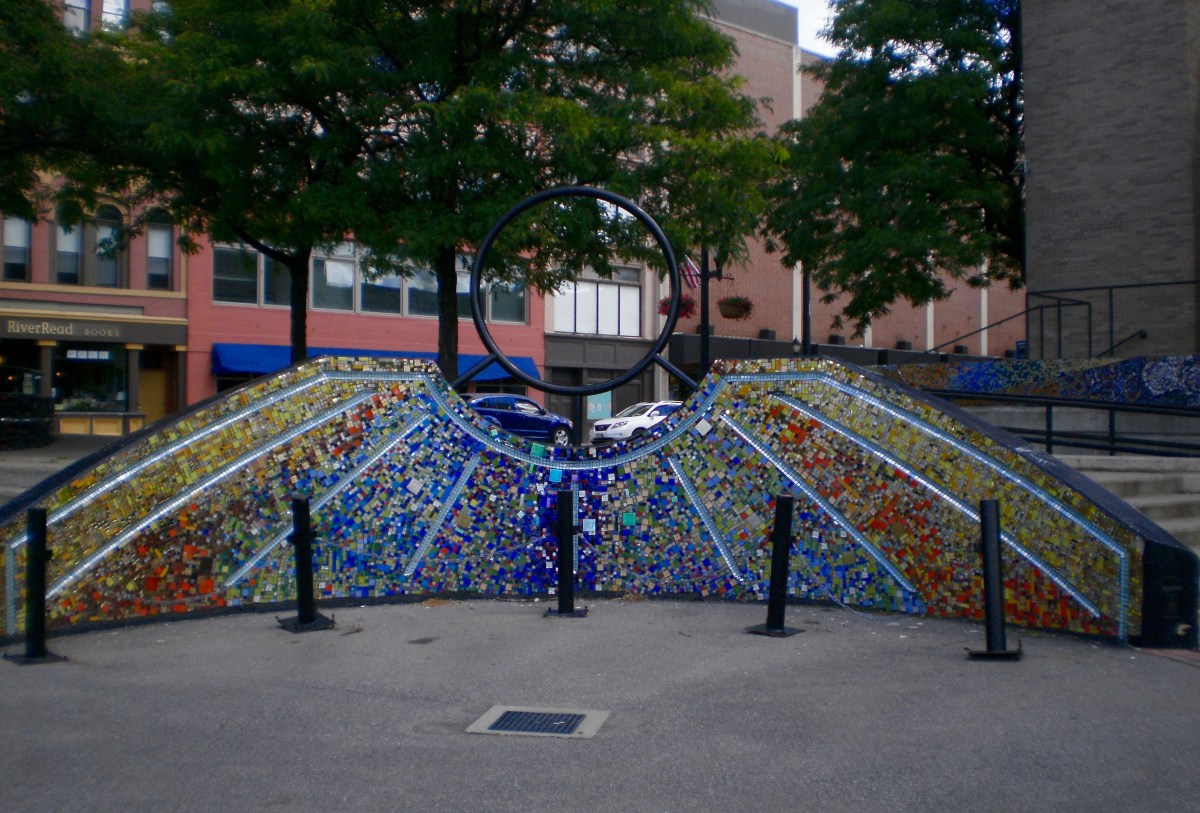
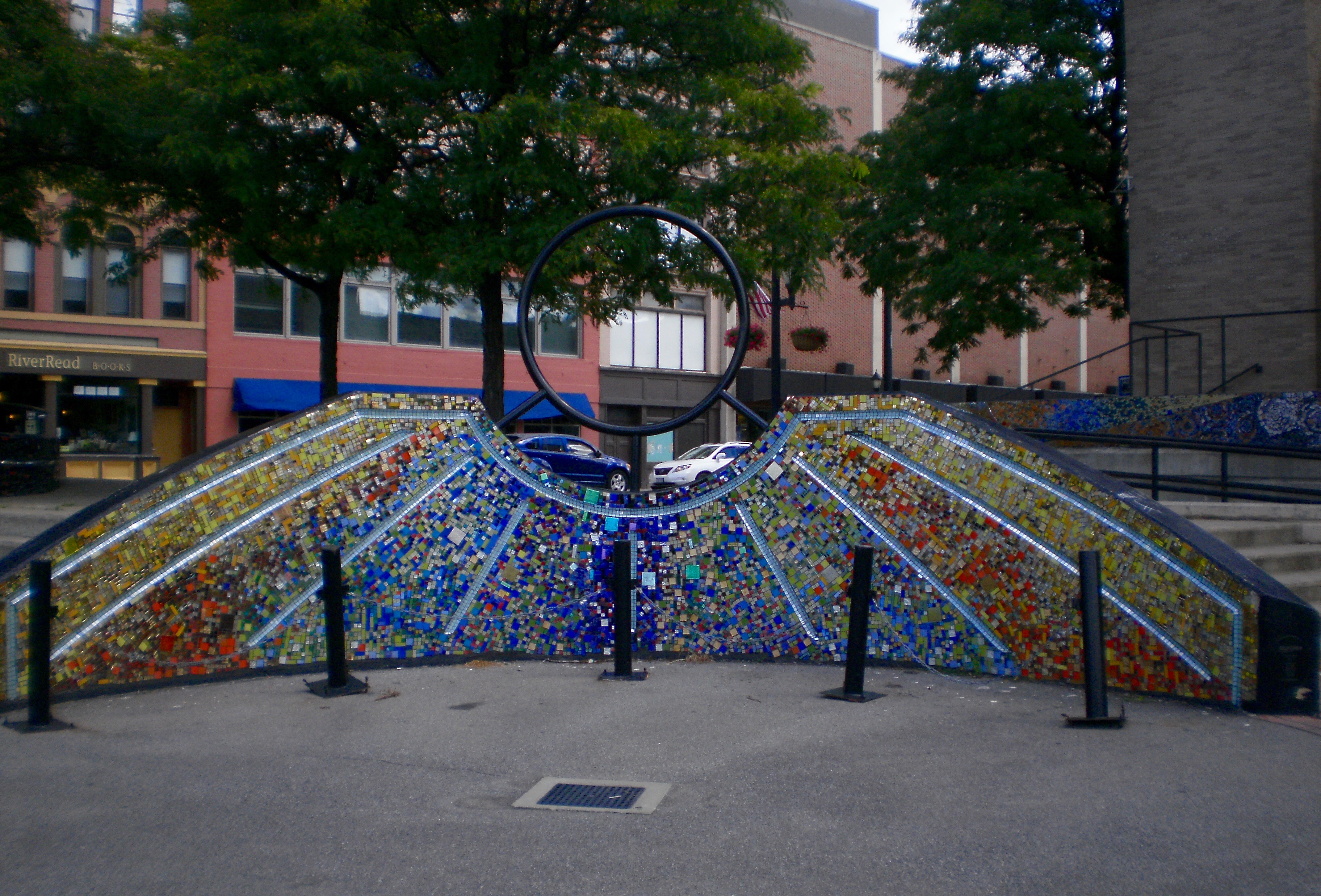
Mosaics along the Chenango
Emily Jablon was one of the lead mosaicists for this project where Court Street meets the Chenango River.
With new details in hand, I finished my draft in time for a planned Wednesday meeting with the Bunn Hill Poets, my main workshopping group. I explained the situation, read the draft, and then got really apprehensive in the silence that followed. When one of the poets, who has many published poems, readings, and commissions to his credit, started out with, “I have to be perfectly honest,” I got even more worried, but it turned out that he was just surprised that I could write this style of poem. Whew! Everyone was very positive about the poem, so I sent it off to the current and the former directors of the Binghamton Poetry Project for additional feedback, did a round of revisions, and had the poem finished by my August 31st deadline.
I was very grateful that I did, as family issues did take a lot of time and energy over the following weeks. Despite my intentions, I didn’t do much practice reading until the last couple of days before the awards ceremony. I admit that I got super nervous. I was fortunate to have daughter T here to listen to me practice and help me figure out which dress to wear, which sandals, which necklace. I was also lucky that the dinner organizers made provisions for family members to attend the performance, so both my spouse B and daughter T were there for moral support.
The performers were all tied to the Arts Council in some way, most representing organizations that receive funding through the United Cultural Fund. It was an honor to be on the same program with actors and musicians from the Madrigal Choir of Binghamton, Tri-Cities Opera, the Binghamton Youth Symphony, the Binghamton Community Orchestra ,and the Cider Mill Playhouse, as well as this year’s Lifetime Achievement Award winner Dr. Timothy Perry from Binghamton University.
I am pleased to report that my reading went well and the poem was well received. The stage lights were pretty blinding, so I couldn’t see myself, but T told me that Peg Johnston gave my poem a standing ovation, which was a huge honor for me, given that the poem was inspired in part by her work. In her acceptance speech that followed, she gave a shout-out to the Binghamton Poetry Project, and, after the event, sent a friend to ask me for a copy of the poem to take back to the Cooperative Gallery, of which she is a founder.
It also meant a lot to me to have Clara Barnhart, current director of the Binghamton Poetry Project, and her predecessor Heather Dorn there lending support, as well as Vernon Boyd who is a fellow BPP poet who also contributed an art poem for the event.
It was especially close to my heart that B and T were there with me. I don’t read often and an opportunity to read at such an auspicious event is unlikely to present itself again, so I’m glad they could share the evening with me.
So, now you are probably thinking, why am I not publishing the poem in this post? Because I wrote it under the auspices of the Binghamton Poetry Project, I want them to have first publication rights. When our fall anthology comes out in November, I will share the poem here at Top of JC’s Mind as well, so stay tuned!
I have spent countless hours over the last several years working on the issues of shale oil/gas fracking, climate change, and renewable energy, primarily through online commentary. Although I make my case using science, real-world experience, sociology, and economics, much of my personal energy for this work comes from my grounding in the principles of Catholic social doctrine and my calling to live them to the best of my abilities.
Earlier this month, I was very grateful to attend a workshop/retreat entitled “Healing the World: One Step at a Time” led by the Rev. Dr. Bruce Epperly. It was designed as a time to reflect on challenges to our natural and human environment as we in the Christian churches prepare for the Lenten season. The timing was perfect for me because just as we in New York received the fantastic, unexpected news of a planned ban on high volume hydrofracking (HVHF), I developed a case of shingles, which kept me from participating in the spontaneous celebrations that happened in the following days. It was a blessing to have the opportunity to see some of the other people who had worked so hard on this cause and to meet others who were also working on caring for creation, including humanity, and to renew our hope as we continue our work.
There were so many important reminders:
To remember to take time away from activity to reflect, pray, and renew.
To not let opponents become dehumanized in our own minds, which I manage quite well with my environmental advocacy, even in the face of derogatory comments directed at me, but less well when it comes to confronting those who commit atrocities such as the terror attacks in France or the horrible massacres and kidnappings by Boko Haram in Nigeria.
To not get caught in the either/or of dualism.
To realize that one small action or prayer can have an effect in the world that we can neither predict not know, a principle that played out for us in the battle against HVHF in New York, where hundreds of thousands of individual actions added up to what had seemed to be an improbable, or even impossible, victory.
To challenge what is in need of reform while offering an alternative path that is good, sustainable, life-giving, and cognizant of the interdependence of creation, which, while I understand that to be within the concept of God-who-is-Love, exists both within and apart from spiritual traditions.
One of the great gifts of the workshop was a special video message to us from Bill McKibben, co-founder of 350.org and one of the world’s leading voices on climate change issues. I had expected a somewhat generic welcome and acknowledgment but was stunned at how personally Bill spoke to us. It was obvious that he knew our area of the country, calling Interstate 88 “Warren Anderson’s driveway”, which is an inside, local joke, and talking about our beautiful rolling hills and our history of technological innovation. He recognized the immense work of the Broome County fractivists, which was very meaningful to me because, however hard we worked to get our message out there, it seemed that the public perception of our county was that our pro-fracking politicians were speaking for their constituents rather than for themselves, the JLCNY, and the fossil fuel and other business interests who gave them campaign contributions. While I will always be grateful to our allies in Ithaca and the Catskills and NYC and around New York State and our beleaguered friends from PA who fought so hard for our cause, it was heartening to know that Bill McKibben recognized our efforts here as vital to the victory.
Bill went on speaking to us from both an environmental and a faith perspective, challenging us to build new sustainable systems. I appreciated him mentioning building up local agriculture, in which initiatives are already underway with more to come, and alternative energy, another area in which we have already made advances and hope to build upon rapidly now that we no longer have the threat of HVHF’s industrialization and pollution making our homes unpleasant or unlivable. I think everyone in the room loved when Bill spoke of taking “energy from above, rather than below.” Such a potent metaphor. No to fossil fuels. No to negativity. Yes to wind, water, and sun. Yes to responsible use of biomass/biofuels. Yes to heat pumps (Even though the geothermal ones probably fit in the “below” category, I’m claiming them for the surface.) Yes to the energy of people taking action to protect the environment and to protect people, especially those most vulnerable to the ravages of poverty and climate change. Yes to the power of Divine Love, which we envision as coming to us from above, but which also surrounds us in creation and imbues us with energy to protect and cherish every being and every thing.
Bill McKibben said, “People of faith bring their own reasons.” I thank him, Dr. Epperly, all the workshop participants, the Peace with Justice Committee of the Broome County Council of Churches and all the other sponsors for reminding me of my reasons and renewing my energy to continue to serve God in love through cooperating with others to care for creation – the environment, creatures, and humanity.
While it would seem that the impending fracking ban in NY would cut down on my incessant commenting on shale oil/gas issues, there has instead been a flurry of reports and editorials to answer, such as this one. Yes, I got carried away, but it really upsets me when people in other parts of the state misrepresent my home area. My (very long) comment to an editorial in the Syracuse Post-Standard:
I live in a Broome County town bordering PA and this editorial’s contention that we are looking forlornly across the border at prosperity in PA is dead wrong. Across the border in PA there is shale gas drilling going on, but a lot of negative impacts. Besides the health problems that have been documented in the peer-reviewed scientific literature, there are socioeconomic problems with high rents, increased crime rates, inability to insure, finance, or sell homes near wells, plummeting royalty payments, noise pollution, light pollution, increased rates of homelessness, increased truck traffic, accidents, liens placed on properties when drilling companies didn’t pay their subcontractors, and strains on medical and emergency services. People who wanted to live in a nice country setting are now in a noisy industrialized setting. I am grateful that these problems won’t be coming to my town.
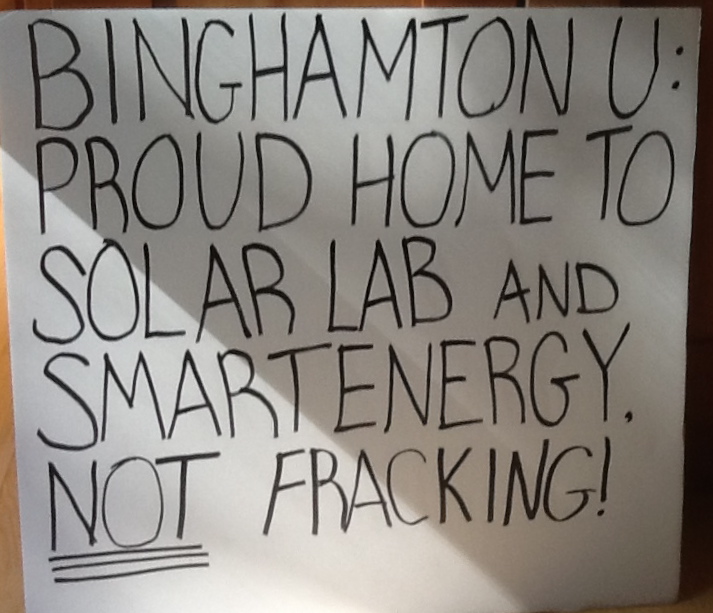
Meanwhile, I think the editors should take a trip to Greater Binghamton and look around. It is not the poverty-stricken, despairing place you seem to think it is. Two of our biggest employment sectors are medical, anchored by Lourdes and two UHS hospitals, and education, anchored by BInghamton University and SUNY-Broome, with a new graduate school of pharmacy about to be built. We still have high tech jobs, though fewer than we once had, with IBM, Link flight simulation, and BAE, among others. Our most exciting new plans in high tech are in the the area of renewable energy/energy storage. Binghamton University’s Solar Lab has been conducting research for a number of years already and has developed a thin-film solar cell that uses only common elements without any rare earth elements. Two large projects are currently being built, a High-Tech incubator in downtown BInghamton and the SmartEnergy Center on the Vestal campus. The combination of these should expand our high-tech/energy sector in the future. Meanwhile, Broome County is a state leader in energy efficiency upgrades through NYSERDA Green Jobs, Green NY and in expansion of solar for homes and small businesses. The energy projects alone have created many times more jobs than shale drilling would have, without the pollution and industrialization of residential and rural areas that would have occurred with drilling.
And about the potential of shale drilling in NY. DEC had to weigh possible economic benefit versus potential costs of drilling to the state and to residents; it’s part of its job. The economic impact section of the draft SGEIS made a number of faulty assumptions, including that shale plays are uniformly productive, that large swaths of NYS would be viable to drill, and that the wells would produce for thirty years. Data from PA and other areas with shale drilling have shown that there are distinct sweet spots in shale plays that are high-producing, with the rest of the play being much less so. Most of the shale in NYS is too thin and too shallow to contain large amounts of methane and there are not natural gas liquids, which have a better economic profile than dry methane, at all. Shale wells of all kinds have very steep decline curves, with the vast majority of the gas being produced in the first 18 months and most of the rest in the following 3-6 years, much shorter than the 30-year timeframe the SGEIS assumed. The industry has done some test wells in various parts of the Marcellus and Utica in NY – and didn’t think it was worth applying for permits. The major companies in their own maps of the play never showed the potential drilling area going much over the NY border. Production numbers in PA bear this out; once you head north from the NEPA sweet spot, production goes way down. Because HVHF wells are so expensive to drill and frack, methane prices would have to more than double to break even in southern Broome County and the figures just get worse from there. It’s time to stop pretending that fracking – or casinos – are the future of the Southern Tier and get to work on building up renewable energy and conservation, while expanding on education, medical, high-tech, agriculture, next-gen transportation, recreation, and tourism jobs.







 Joanne Corey