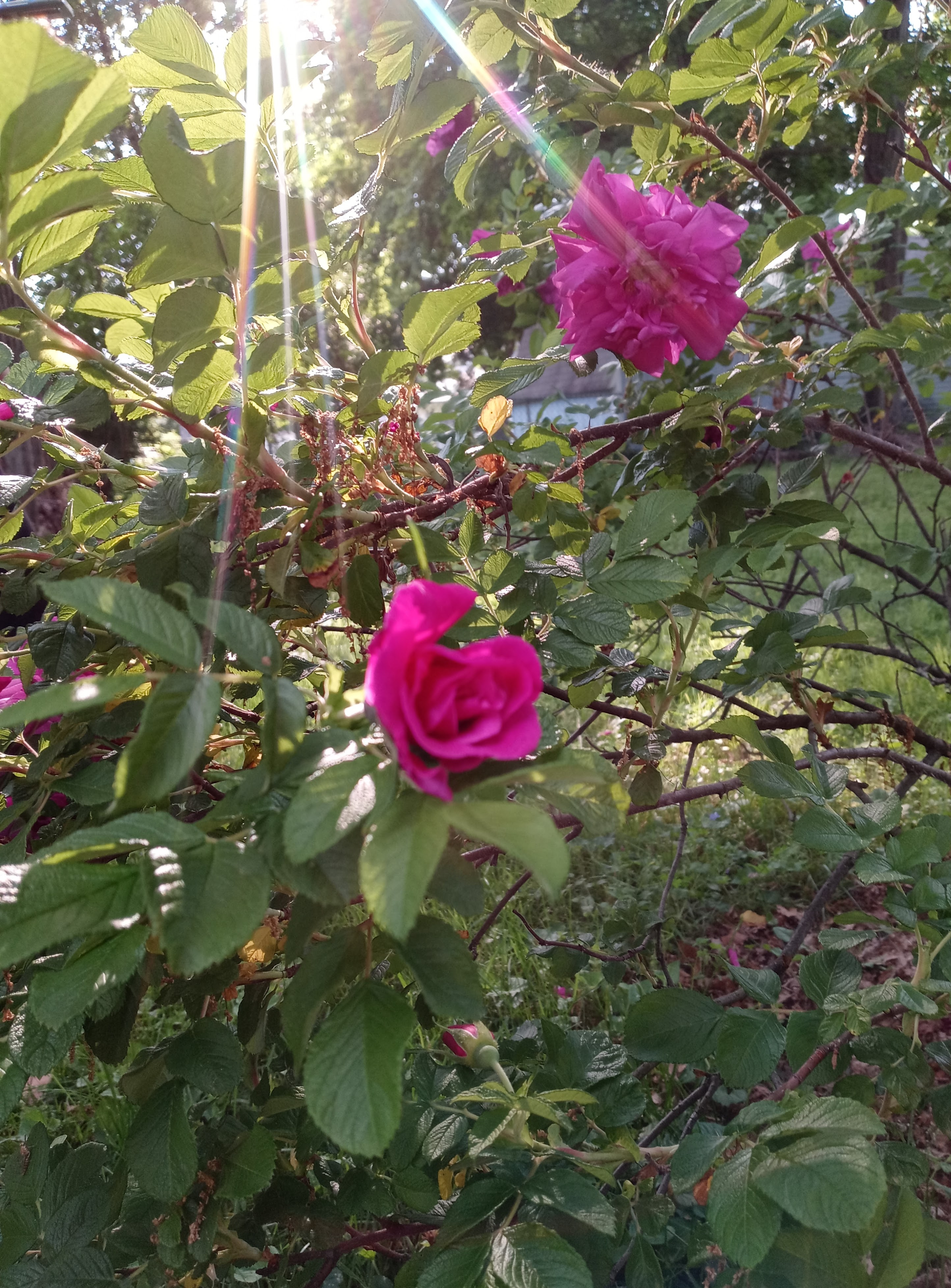
The above inadvertently artsy shot with sunbeams is of roses growing in our back yard. This rose is a daughter of a rosebush that grew near my mother’s childhood home in Hoosac Tunnel, Massachsuetts. You can read more of the backstory in this post which itself includes a personal essay from before I started blogging.
This rosebush is the subject of the one poem that appears in both my chapbook and collection manuscripts, which I can’t share here because it is currently unpublished. It tells the story of the revival of this daughter bush from near death and ends during my mother’s final illness.
We have just passed the second anniversary of her death. The rose bush apparently liked the snowy winter and slowly unfolding spring this year and has more blossoms than I have ever seen. It has also grown very tall, as you can see in the photo below. For reference, I’m 5′ 1.5″ (1.56 meters), so the rose bush is probably close to seven feet (2.1 meters) high.
with
Because this is an heirloom close-to-wild rose rather than a hybrid, it has a very strong scent. With so many blossoms this year, the smell is heavenly.
Yesterday, when I read that Linda’s prompt for Stream of Consciousness Saturday this week was “yarn,” the very first thing I thought of was my friend Merrill Oliver Douglas’s chapbook Parking Meters into Mermaids. The title poem is about yarn bombing. For someone who may not be familiar with the term, yarn bombing is when someone puts yarn, usually knitted, on unusual objects, like parking meters, or tree trunks, or lampposts. It’s a fun and quirky form of public art.
Things have been pretty quiet here at Top of JC’s Mind for the past few days because I was back in North Adams on a solo writing retreat to work on my poetry collection.
I’m happy to report that I have the bulk of the manuscript assembled, including a few pieces that I wrote this week. There is only one blank page with just a title; I’m hoping to get that poem written and integrated into the manuscript over the holiday weekend. I also need to write a foreword and a notes and acknowledgements section at the end. When I have the draft complete, I will ask my local poetry circle, the Grapevine Group, to do a group review/critique for me, with the goal of having it ready to submit by mid-July.
This collection has been in development for a looooong time. In November, 2015, I took a leap of faith and applied to attend a week-long workshop/residency at the Massachusetts Museum of Contemporary Art, a collaboration between The Studios at MASS MoCA, which had, at the time, only been in operation for a few weeks, and Tupelo Press under the direction of Jeffrey Levine. I was accepted, even though I was a relatively new poet at that point. Had it not been in that particular place, I would not have even applied, but I grew up in the North Adams area and had hopes that a chapbook might grow out of the experience, given the intersection of my personal and family history with the current, very different reality there. Case in point: MASS MoCA occupies the complex that housed Sprague Electric when I was growing up but that started out as Arnold Print Works that made textiles. (If you are interested in how the week went, you can check my blog archive for Nov. 2015, as I blogged every day of the residency.)
Short version of the story is that I was in way over my head, but was saved from going under by my fellow poets. We all bonded so well that we have returned to MASS MoCA every year (except for 2020 due to the pandemic) for a reunion residency as the Boiler House Poets Collective.
So, two things happened to my initial idea of writing a chapbook about my family and the North Adams area. I realized pretty quickly that a chapbook would be too short, so it would need to be a collection. Also, life intervened in the form of a long and ongoing period of inter-generational caregiving, which made the time required to devote myself to the project scarce.
There have been two other attempts at this collection, both of which failed miserably in review. I learned a lot from the failures – at least, I hope I have – and this new iteration of the manuscript has a (I hope) more compelling focus.
We’ll see how manuscript review goes…
There are over fifty poems in the collection and over seventy pages, so there is room for cuts if needed. Most publishers expect collections to be between fifty and one hundred pages, so there is some space for adjustment.
While members of the Grapevine Group have seen a lot of the individual poems, this will be the first time they have seen the manuscript. The two prior iterations of the collection were with Boiler House Poets Collective, back before Grapevine started doing manuscript reviews within the group. The exception is my friend Jessica, who is a member of both groups. It will be especially interesting to see her reaction to this newest iteration.
After Grapevine review and edits, I may see if any other BHPC poets want to weigh in – or maybe even before, if any of them are especially keen on the concept/subject to my begging/gluttons for punishment/very bored.
At any rate, come mid-summer, I’m hoping to start doing submissions with the collection. Then, in the fall and winter, the rejections will start rolling in, where they can join the growing list of rejections for my chapbook manuscript in my submission database.
Eventually, one of them may make it into print. The chapbook has been both a semi-finalist and finalist in contests. So, someday?
This version of the collection is definitely stronger than the two prior attempts. So, maybe, someday?
If it happens, you will definitely be able to read about it at Top of JC’s Mind, which will probably be around even though it is cheugy. I just learned that word…
Or, if the chapbook or collection gets accepted for publication, you may just be able to hear me scream, even if you are not close by. 😉
As I announced in this post, I am spending a few days back in North Adams to work on my poetry collection.
I went to MASS MoCA today and was pleased to be in a good poetry flow! I drafted three poems that will make their way into the manuscript and a fourth that will be a possibility for submission to journals.
I also ate ice cream twice – a dish of ginger ice cream from Lickety Split in MASS MoCA and a mocha sundae from Triple Scoop, a nearby ice cream shop. Mocha is very important here. There are two poems about it in the collection already.
Dashing off this post and then back to my poems from today, getting the drafts into my computer and editing a bit…
I was never much of a stats person with my blog and have become even less so in the last few years as I’ve been needing to spend a lot of brainpower on caregiving, but, every once in a while, I do notice my number of followers which, as I write this, is now 1602!
Thank you to all of you and to anyone who reads any of my posts, whether you choose to follow or not!
I appreciate your patience with my haphazard blogging approach, where I post without having any schedule whatsoever about whatever is at the top of my mind – or was at the top of my mind at some point but took a few days to make it out onto the page. I realize that some of you are only interested in poetry posts or political ones or family ones, so thank you for checking back in to find your favorites.
Next week, I am headed back to North Adams for a few days to work on my poetry collection. Usually, when I go back there, I blog every day, but I’m not putting that pressure on myself this time. Maybe posts will start sloshing around in my head and I’ll post to get them out and have a change of pace from poetry – or maybe not.
So, I should close with instructions on how to follow me, for those who may be new to such things. There are widgets here to follow if you have your own blog or if you want to follow by email. You can also follow the blog’s Facebook page and/or my twitter, both of which always have links appear when I post. I also usually send new blog posts via ello, if anyone has a presence there.
As I have been posting about since early April, the Broome County (NY) Arts Council and WordPlace at the Bundy Museum have been sponsoring a series of weekly Zoom poetry readings with Q&A. The final reading in the series, featuring Craig Czury, Neil Silberblatt, and Richard Bernstein, is now available here: https://broomearts.org/education/the-gift-of-poets/
Unlike the other weeks, I haven’t had the pleasure of meeting any of these poets in person, so don’t have any personal insights to share. Perhaps, I will have the opportunity to do so in the future.
If you haven’t been keeping up with our series, there are links to all the prior weeks’ recordings at the link above or on the BCAC YouTube channel.
And in case you missed my babbling about it, this post is about the week where I was one of the featured poets!
I am also pleased to announce that the BCAC and WordPlace are planning an ongoing monthly series of poets with readings and conversation. I will be sure to post about it here as they become available. As always, stay tuned!
The poetry reading series from the Broome County Arts Council and WordPlace at the Bundy Museum that began with National Poetry Month in April has gone into overtime! This week’s offering is available here, along with the prior weeks’ readings.
Featured this week are Robert Ruane, Joshua Lewis, Merrill Douglas, and Joshua Grosse, who is a Binghamton University undergraduate. I appreciate hearing from one of the younger voices in our local poetry community.
I first met Bob Ruane through the Binghamton Poetry Project but have also seen him at various Catholic social justice gatherings over the years. Bob has an amazing memory, what we would have called in my New England hometown having “a mind like a steel trap.” His poems overflow with details of what he sees and hears. He currently has a poem on display at the Vestal Museum as part of the Empty the Inkpots exhibit in conjunction with the Binghamton Poetry Project.
Josh Lewis earned his PhD from Binghamton University and has facilitated poetry writing workshops through the Broome County Arts Council. My attendance at these is how we became acquainted. He edited and contributed to Transformations, a collaborative chapbook by some of the BCAC poets, which became available almost exactly a year ago. He has recently started a new blog, The Rain Healer.
Merrill Douglas is one of the stalwarts of the Grapevine Group, my local poet-friends who meet regularly to workshop our poems. We first met, though, when her son and one of my daughters were in middle school together, back in the days before I was writing. Merrill is a very astute reader and always gives me very insightful editorial suggestions. I especially admire her ability to choose just the right details and imagery to draw the reader into her poems. I was pleased that Barrett chose to ask her about her use of detail in the Q&A segment after she reads. I’m pleased to share links to samples of her work, as well as the all-important link to order her chapbook Parking Meters into Mermaids, here. Local folks can also find her book in the BCAC Artisan Gallery and in the Museum Shop at the Bundy.
For the recently concluded National Poetry Month, the Broome County Arts Council invited local poets to contribute a short poem about spring, hope, and/or other positive things for their POETREE.
I had hoped to make it down to the gallery to see it and take photos for this post, but I didn’t manage to do that. Instead, I have copied the poem I wrote especially for the project below:
Why We Will Never Use Weedkillers by Joanne Corey
Every spring, we watch the jagged-edged three-ness of strawberry leaves emerge from the snowmelt-soaked lawn, the white five-petaled blossoms attract the bees to their sunny centers, the green-white berries ripen to red in June, the squirrels feasting.
These past few weeks may be the highest concentration of posts about poetry that I have ever done here at Top of JC’s Mind.
By coincidence, I’ve been involved with several readings and anthology launches in recent weeks.
Well, it may be coincidence or it may be that it was because April is National Poetry Month here in the US, although only some of the poetic activities were connected to Poetry Month.
I’m actually expecting to have several more poet-y posts coming up over the next couple of weeks, so stay tuned.
If nothing else, the poetry posts break up the political ones. 😉
You may be thinking, but I don’t understand poetry. I promise that I am not inscrutable, though, so maybe you can give it a try! If you do, I hope you enjoy!
(And, yes, it may be cheating to use SoCS to promote other posts. If so, my apologies to Linda.)
Seven years ago, I began participating in the Binghamton Poetry Project, a community outreach program of the Binghamton Center for Writers. Binghamton University graduate students facilitate free poetry writing workshops for children, teens, and adults. With the pandemic, sessions have had to move online, as have our readings and anthologies.
We had our spring reading and anthology launch today. I contributed three poems to the anthology, which you can find here. I read the poem “Conveyance” from the anthology, as well as “Meanwhile…” from my collection manuscript and “SARS-CoV-2: A Novel Coronavirus” which is currently on display as part of the Empty the Inkpots exhibit at the Vestal Museum.
I had very little formal instruction in poetry when I was in school, so I appreciate all the lessons in the craft of poetry that I have learned through the Binghamton Poetry Project. For example, in this last set of sessions I learned about zeugma, a device which I used in “Conveyance.”
I especially appreciate connecting with my local poetry community, not only the graduate students and participants but the wider poetry community in our area. When I was looking for a year-round poetry workshop to share feedback on my work, Heather Dorn, who was then the assistant director of BPP, connected me with what is now the Grapevine Group. I rely on the Grapevine poets to help me see what I need to refine in my poems. Seeing their work in progress has taught me so much about writing and revising. I’ve also learned how to give and receive constructive criticism. I can sometimes even manage to figure out the truest path when I get suggestions that directly contradict each other!
I hope that the Binghamton Poetry Project will continue for many years to come. BPP is supported by grants and is blessed with an ever-evolving set of Binghamton University graduate students serving as facilitators and administrators. I know there will always being poets in our community wanting to write, learn, connect, and share the gift of poetry.



 Joanne Corey