One-Liner Wednesday: on break

After diligently posting daily for Just Jot It January, I’ve been taking a break but hope to be back with some new posts in a few days, although some planned travel may get in the way…

Join us for Linda’s One-Liner Wednesdays! Find out more here: https://lindaghill.com/2024/02/07/one-liner-wednesday-so-that-happened/

Writing about family

Today’s prompt for Linda’s Just Jot It January is “family,” contributed by Kim of Twisted Trunk Travels. Check out their blogs!

Over these last ten-ish years of writing poetry and blogging here at Top of JC’s Mind, I have written way more often about my family than I thought I would. Of course, it made perfect sense to blog about visiting daughter E and son-in-law L in Hawai’i, as folks often blog about their travels, but as time and circumstances changed and I faced the challenges of caregiving for various generations of the family, posts about family became more frequent. I also used poetry as a way to process things that were going on with my family, most notably about my mother’s experiences living with and dying from heart disease, which became my first published chapbook, Hearts (Kelsay Books, 2023).

I do try to protect my family members by referring to them with initials or nicknames rather than their given names. Nearly all of them use a different surname so only people who know us in real life are likely to recognize them from posts. Currently, spouse B and daughter T are most likely to appear as we are living in the same house, although we will soon be going to visit daughter E, son-in-law L, and granddaughters ABC and JG in London. which may generate some posts. My daughters’ grandparents were called on the blog by the names they used for them, Nana and Paco for my parents and Grandma for B’s mom. (Sadly, B’s dad, known as Grandpa, passed away in 2005, before I was blogging and writing poetry, although his death was the subject of one of my earliest published poems.) If you are perusing the archives of Top of JC’s Mind, you’ll come across posts dealing with their final years and the grief following their deaths.

One thing that strikes me about my family posts and poems is how often they spark comments and conversations about people’s own experiences. Knowing that I offer that space for people to reflect on themselves and their own families is a big part of why I continue to write about my family.

What about you? Do you find it helpful to write about your family, either privately in a journal or in more public ways?
*****
It’s not too late to join in with #JusJoJan24! Find out more here: https://lindaghill.com/2024/01/29/daily-prompt-jusjojan-the-29th-2024/

Snow!

We are having our first major snowstorm of the season here in the Southern Tier of NY.

The system, which is coming up the Atlantic coast, arrived a bit earlier than had originally been expected. I had thought I’d be able to attend vigil mass at 4 PM as I usually do on Saturdays but the roads were too bad for travel. It’s still snowing this morning and some freezing rain is predicted, so it looks like this will be an at-home religious observance weekend, as all of them were during the pandemic.

Good thing I didn’t take the programming for recording mass out of my DVR.

Best wishes to those celebrating Epiphany this weekend and to those celebrating Christmas under the Julian calendar.
*****
Join us for Linda’s Just Jot It January! Find out more here: https://lindaghill.com/2024/01/07/daily-prompt-jusjojan-the-7th-2024/

reflections on BHPC residency ’23

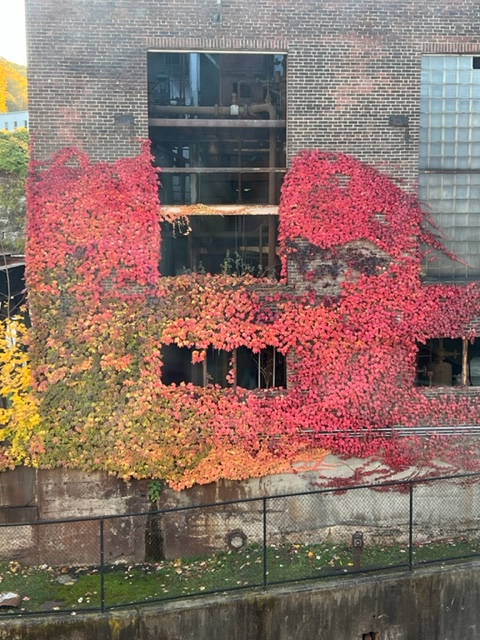
Yes, it’s been over a month since I returned home from the Boiler House Poets Collective residency with The Studios at MASS MoCA (Massachusetts Museum of Contemporary Arts) in North Adams but I am finally getting around to a wrap-up post. I did post a couple of times during the residency, about Marika Maijala and our reading at the Bear & Bee Bookshop, although that was a far cry from most of our years in residence when I would post daily. Things were very busy, so posting took a back seat and this past month has been loaded with other commitments, such as the launch of the Third Act Upstate New York working group and the first concert of the Madrigal Choir of Binghamton’s 45th anniversary season. I also needed time to reflect on the residency and what it meant for the future of the Boiler House Poets Collective.

Until this year, the Boiler House Poets Collective reunion residencies had always had at least half of the participants being members of the original group that met in 2015 as the first group of poets in residence brought together in a collaboration between Jeffrey Levine of Tupelo Press and The Studios at MASS MoCA. For 2023, the number of participants went from eight to ten, with only myself and Kyle Laws planning to return in 2023. (Sadly, last-minute health complications prevented Kyle from joining us, so I was the lone “original” in 2023. I’m hoping to have this be a one-time occurrence.)

I had inherited the role of liaison with The Studios but also wound up acting as an organizer for this year of transition. I was determined to assemble a full complement of ten and to provide for all the elements that had been part of past residencies, including studio time, museum visits, daily workshopping, a group project, a public reading, and discussion/social time (often accompanied by food and drink). Because, in prior years, we had always had a core of originals, adding in new participants from among our poet-friends as slots became available, we hadn’t felt called to define who we were as a group. I thought, at this juncture, we needed to be more intentional about our identity and our goals. I let people know that we would be having an organizational meeting near the end of the residency to talk about what was important to us and what our plans would be going forward.

I admit that I was really nervous about how things would work out with so many people who had never met each other. For the first time, we had a member who was not herself a poet. In 2022, the BHPC residency overlapped with the residency of Nancy Edelstein, whose work centers around light. With that inspiration, I had designed our group project around the theme of light, inviting each person to contribute work that had to do with light. I had expected a group of poems but the amazing thing was that people began to notice light in new ways. One of our members was inspired to take photographs showcasing light and shadow. We were able to share our light-themed work with each other. It’s not yet clear whether or not we will produce some conglomeration of these that is shareable with the public. If we do, I’ll be sure to share it here.

Another thing that was new for BHPC this year was that we workshopped some pieces that were not poetry, including an essay, scene from a play, and excerpt of a radio play. It was interesting to expand our literary horizons. While we expect to remain grounded in poetry, it’s good to have that flexibility to serve our members’ needs.

I felt that the group had a good vibe from the time of our opening night dinner when we were first together but I was nervous for our organizational meeting when people would be assessing how things had gone and if they wanted to return in 2024. I was thrilled – and a bit teary – when all but one person immediately said they wanted to return next year; the remaining person hopes to but lives across the country, creating a lot more complications than those of us within easy driving distance. People enthusiastically volunteered for organizational roles, including inventing some duties I would never have thought of on my own, so that I will be able to concentrate on just doing the liaison role. I even have a deputy who is shadowing me and can take over if I’m sidelined for any reason. This new constellation has embraced being a collective in a wonderful way and I am immensely grateful.

On a personal level, I appreciated how supportive people were of my work. As regular readers here at Top of JC’s Mind may recall, I grew up in the North Adams area and have two manuscripts, a full-length and a chapbook, that I am submitting to presses and contests. I’m at a crossroads with the full-length collection. I have a contract offer from a hybrid publisher but I’m not sure that is the way I want to go. One day over lunch, people were listening to my concerns and offering suggestions, which were very helpful and have led to my scheduling a manuscript consultation with a professional editor next month. I’m hoping that will help me clarify the path I need to pursue.

I also appreciated that people took my work seriously. One of the poets said that my poems were important in preserving the history of the area. That was so gratifying to me, even though I seldom dare to think in those terms. I do think about those poems as being ones that only I would write, given my perspective as someone who grew up there but that has lived elsewhere most of my adult life. It’s a sort of inside/outside perspective that would be difficult to replicate in quite the same way. I don’t tend to think that my following the dictum to “write what you know” would seem important to someone else, so it was nice to hear. It makes my search for a publisher and my wish to have the book be as strong as possible feel more weighty.

So, I have joyfully marked the dates for the 2024 Boiler House Poets Collective residency on my calendar for next October. I’m looking forward to being among this remarkable group of women again, but I’m also grateful to know that, if something happens that prevents me from being there, the group will go on without me.

My heart will be there, though…

The Boiler House Poets Collective 2023

Two years without Paco

I work up in the very early morning darkness today thinking about my father, known here and in real life for the last 33-ish years of his life as Paco, the name bestowed on him by my firstborn and his first grandchild E as she was learning to talk.

I suppose this is not surprising because this is the second anniversary of his death. You can read a tribute that I wrote to him a few weeks after his passing here.

What is unfortunate is that in the early morning darkness in which I am now writing this post I am remembering so much of his final years, when I was struggling to get proper support and medical care for him, exacerbated by the pandemic. Even though I was living locally, there were long stretches in which I could not visit in person at all or only for short amounts of time. Phone and video calls were often frustrating, as you can tell from this poem, which was first published in Rat’s Ass Review.

Video Chat with our 95-year-old Father

You said it was scary
today
that we were there

in your bedroom
your three daughters
in pulsating squares

on a screen
You remembered where
home

is for each of us
but not where
it is for you

confused that you
could see us
hear us

but we were not
there
with you

We talked about the snowy
winter, so like our New England
childhoods, when you would

wrangle your orange
snowblower to clear
our way out

We asked if the cut
and bruise on your hand
had finally healed

if you had finished
all the Valentine
goodies we’d sent

Distracted
by a sound
from the living room

you set the tablet
aside
left us

staring at the ceiling

What was most difficult was that, no matter how hard I tried, I couldn’t secure correct diagnoses or treatments for Paco, illustrated by the fact that his death certificate states that he died from end-stage heart failure, but he was only diagnosed with heart failure about ten days before he died. I had been trying for months to tell the staff at his assisted living and then skilled nursing units of his continuing care community that he was having unexplained symptoms and had accompanied him to outside doctors and emergency room visits, when the pandemic protocols allowed me to stay with him, but it was never enough to get to the bottom of his health difficulties.

I thought I had worked my way out of most of the trauma of that but, in the early morning darkness of this anniversary day, apparently there is still some of that pain left. It’s not that I think I could have further prolonged his 96 years – something that would not have served any of us – but that his final months would have been so much easier for him if he could have received timely, proper diagnosis and medications.

One of the comforts of Paco’s death was the thought of his reuniting with my mom, known here as Nana, who died in May, 2019, also of heart failure and, gratefully, before the pandemic struck. I drafted this poem, which was first published by Wilderness House Literary Review, only a couple of weeks after Paco’s death.

We probably should have taken off					

his wedding ring before
he died		    before
his hands cooled	      started
to claw
but we couldn’t		       remove
that symbol
			of Elinor
	of two years
		   three months
			twenty-three days
						left
without		her
after
	sixty-five years
		      one month
			   three days
married to her
			the ring
				of her
even    in    days    of    delirium
	    haze			confusion

his ring		not
	sixty-seven years	  old
		but	   twenty
her gift 	         a remedy
	 for missing		some		thing
		of his
  to cling to 		during his three weeks
			       in the hospital
his chest cracked			 open
     		widow-maker averted
				somehow

She inscribed 		his ring	
      ALL MY LOVE  “ME”
     the way she signed 	cards to him
birthday	anniversary	  Christmas
	St. Patrick’s Day
		valentines
the words against his left
	ring finger		believed
to lead most directly to the heart
	which finally failed
		after ninety-six years
			five months
				nineteen days
as hers had
	after eighty-seven years
		     six days

While I go to the sink
to fetch soap 		to ease
the ring off 	his finger
my sister works
it over	 his reluctant 	knuckle

I carry it 	home 
to my daughter
Elinor’s and Leo’s rings
	   unite
on their granddaughter’s finger

[For those of you who might be new to Top of JC’s Mind, I will note that it is really unusual for me to fold poems into posts like this, but somehow, in the early morning darkness, it seemed appropriate.]

I’ll close this post by explaining the significance of the four-generations photo, taken a few weeks before Paco’s death, that begins this post. It shows Paco, me, eldest grandchild E who named Paco, and great-granddaughters, then 4-year-old ABC and just turned 1-year-old JG. This was the first and only meeting of Paco and JG, who had been born in London, UK, in the early months of the pandemic. ABC lived here in the States with us for her first two years and remembered Paco very well. The restrictions on international travel had kept E and her family from visiting but they were able to get special permission to travel together to come visit Paco one last time.

Paco’s health declined quickly after that visit and I’m so grateful that we all had that brief, sweet time together.

Remembering that final farewell through a few tears in the still-before-dawn darkness of this anniversary morning.

Maui wildfire

Like many people in the United States and around the world, I have been watching the devastating news of the wildfires in Hawai’i, especially on Maui, with sorrow and horror. The confirmed death toll is currently 93 but hundreds of people are still missing, so that total is expected to rise. Eighty per cent of the buildings in Lahaina have been destroyed, along with the livelihoods of most of the residents.

If you are able to contribute to relief efforts, please consider contributing to the Maui Strong Fund, under the auspices of the Hawai’i Community Foundation, which is able to put donations to use immediately on the ground.

One of the difficult things about this tragedy is knowing that it was made worse by human intervention. Climate change is implicated both in the drought conditions in Hawai’i and the strong hurricane, that, while well south of landfall, combined with a high pressure area to send winds up to 80 mph (128 kph) onto the islands that quickly spread the wildfires, knocking out communication infrastructure and trapping many people.

The colonization of the Islands also played a role in the fires, as the landscape and plants have been altered from the species that evolved on Pacific islands. My daughter T, who holds a master’s degree in conservation biology of plants, told me that African grasses that were brought to Hawai’i evolved with fire as part of their lifecycle, burning quickly but than sprouting again soon after. These grasses were implicated in the dangerous speed with which the wildfires spread.

My family has several connections to Hawai’i. B and I visited Kauai for our tenth wedding anniversary and were drawn to the beauty of Hawai’i and the welcoming nature of the people. Our daughter E lived in Honolulu for several years, while studying at the University of Hawai’i – Manoa. She met her spouse L there and they married at their local parish.

Daughter T, while an undergrad at Cornell, spent a Sustainability semester in Hawai’i. They were in residence most of the time on the island of Hawai’i. (There were significant wildfires there as well, but the destruction was not as widespread because of the areas affected.) They also participated in conservation projects on other islands, including Maui. In 2014, B and I went to Hawai’i with T, three years after her semester there. You can read a series of posts about that visit starting here. That visit also led to this poem.

Hawai’i is one of the most remote places on earth, being far away from any of the large continents. Its isolation, though, does not exempt it from the increasing tide of disasters turbocharged by the climate crisis. These tragic wildfires are another reminder that we all need to do what we can to transition to lives that don’t pollute our atmosphere with even more carbon.

United Nations Secretary-General António Guterres is convening a Climate Ambition Summit next month to help speed these efforts. There will be a large March to End Fossil Fuels in New York City on September 17. We need world governments to act NOW. It’s too late for all those lost on Maui and other climate-change influenced disasters around the world. We need to save as many people and other beings as we can in the future.

One-Liner Wednesday: anniversary jazz

When we stayed at the Art-Deco-era Latchis Hotel in Brattleboro, VT for our anniversary, we listened to this album on the record player in our sitting room.

Join us for Linda’s One-Liner Wednesday! Find out more here: https://lindaghill.com/2023/06/28/one-liner-wednesday-day-one-is-in-the-bag/

SoCS: travels

We are travelling, so this will be short!

We arrived yesterday and saw some relatives that we don’t see often. A sight for sore eyes!

On Monday, we will relocate to a new site to celebrate our 41st wedding anniversary.

(Linda’s prompt for Stream of Consciousness Saturday this week is “sight/site” with bonus for using both, although the bonus is psychic, not material.)

(Maybe there is an extra bonus for using both and making it short.)

A Tale of Two Concerts

My recovery from cataract surgery has been complicating my computer time but the delay gives me a chance to draw together two remarkable choral concerts that I was honored to be part of this month.

The first was a performance of Mahler’s Second Symphony at my alma mater, Smith College, on April first. As you might expect, the performance forces were large, 90-some members of the orchestra and almost 200 singers, student ensembles from Smith, Amherst, UMass-Amherst, and Penn State plus alumni from Smith and Penn State. The orchestra filled the stage at John M. Greene Hall, with the chorus in the gallery.

The concert began with a piece from each of the four college choirs, followed by a brief intermission for all of us to assemble for the Mahler. The Second Symphony is known as the “Resurrection Symphony” – you can read more about it at the link above. The chorus sings in the later part of the fifth and final movement, which afforded us the luxury of watching our conductor, Jonathan Hirsh, and the orchestra playing for an hour before we joined in. As always, I was struck by Mahler’s talent in using such large forces in ways both subtle and powerful. He also uses space in an interesting way, for example, by using percussion and brass off-stage. The fourth and fifth movements include soloists, in our performance, Katherine Saik DeLugan, soprano, and
Rehanna Thelwell, mezzo-soprano, who both sang with soaring beauty.

Of course, the disadvantage of singing at the end of a symphony is that you have to have your brain and voice ready when it’s been a couple of hours since you have warmed up. Fortunately, we were able to rise to the occasion and do our part to create a remarkable and moving performance.

It is always risky to assemble a chorus from singers in disparate locations, who literally don’t rehearse together until 24 hours before the performance. Yet, thanks to Jonathan Hirsh’s skill as a conductor, the preparation given by the other choral directors, and the solitary practice of the alums in our homes, we were able to deliver a moving performance. As soon as Jonathan’s baton came down after the final cadence, the audience was on their feet. It was the longest ovation I have ever seen after a performance in which I have participated. It was a fitting tribute to Iva Dee Hiatt, in whose memory the concert was held.

The weekend was also meaningful for me because I was able to connect with several people who I knew in my student days from 1978-82. I had a lovely lunch with RP, my theory and composition professor and major advisor, whom I also saw at the concert along with his wife. I had dinner with my friend LT, who is an alum from ’81 and who lives in town. She joined several other members of ’81 at the concert, including MC who I hadn’t seen in person in about forty years. There were several alum members of the chorus from my era, including my senior year suite-mate PT. I was able to visit some special places on campus – Helen Hills Hills chapel where I played often for services and spent countless hours practicing, the Lyman Plant House and gardens, Sage Hall, Josten Library, John M. Greene Hall where we performed and where I played my senior recital, and the Poetry Center which didn’t exist in my day but has become an important entity for me.

The second concert was on Sunday, April 23rd. The Madrigal Choir of Binghamton sang our way through a hundred years of Broadway tunes. While we are more accustomed to singing art music, it was fun to sing a popular concert. We were thrilled to draw an audience of over 250 people, who smiled, swayed with the beat, and applauded familiar tunes from Gershwin, Rodgers & Hammerstein, Sondheim, and Bernstein, while also enthusiastically receiving some newer tunes that might have been unfamiliar, such as “Who Lives, Who Dies” from Hamilton.

It was also great to have the opportunity to feature our accompanist, Jean Herman Henssler, at the beautiful grand piano at St. Thomas Aquinas Church and soloists from Madrigal Choir. We were honored to have a special guest, Bex Odorisio, who recently completed a national tour of Hadestown, sing a couple of tunes from her extensive repertoire. I especially enjoyed “Times Like This” from Lucky Stiff.

This was our final concert of the season and I’m looking forward to seeing what our director, Bruce Borton, has planned for our next season, which will be the 45th anniversary of the Madrigal Choir of Binghamton. While I’ve only been a member for a little over a year, I’m so grateful to have a choral home again after the demise of the Binghamton University Chorus, with whom I sang from 1982-2019.

Stay tuned for more music gigs, perhaps this summer, but definitely in the fall!

sneaking in a post

A quick update while JG is napping and ABC is enjoying her first ever trip to the cinema with her parents. Also, while I can almost see mid-range things like computer screens before my second cataract surgery tomorrow.

Things have been very busy here. Daughter E, son-in-law L, and grandchildren five-year-old ABC and two-year-old JG have been visiting from London since April 2. It’s great to have them here, enjoying typical things like playing outdoors in the yard or at the park or indoors at home. We went to Easter morning mass together and had an indoor egg hunt afterward, with leg of lamb for Easter dinner. Uncle C from West Virginia was able to make the trip up for E’s birthday last week.

Our biggest family event was Friday into Saturday when my younger sister came up along with her family. We got to meet the significant others of our niece and nephew, as well as their dogs, which led to lots of cuddles, laughter, frolicking, and shrieks from ABC and JG.

When we knew that our London contingent was going to visit, my sister had organized a memorial for our parents, known here as Nana and Paco. The last time E and her family had been here was shortly before Paco passed away. Distance and the pandemic made it impossible to gather again until now. We started our observance outside the building where Nana and Paco’s cremains are inurned. My sister had arranged for military honors for Paco, who served as a US Navy SeaBee during World War II and the Korean Conflict. There was an honor guard and a 21-gun salute using WWII era rifles, prayers, the playing of taps on a trumpet, and the folding and presentation of a large United States flag. We were grateful to all the veterans who came out to honor Paco’s service so long ago.

We went inside to visit the niche and see the memorials that we have placed there. Then, we went to the room that was reserved for us at the hotel where my sister’s family was staying. In the photo, you can see the folded flag in its special case.


My sister had organized our remembrance, which included music, pieces that our niece and nephew had written as children, poems from me and daughter T, a photo book that my sister had assembled, and lots of personal stories from everyone who knew Nana and Paco. It was wonderful to be able to share all of this with the more recent additions to the family. We were sad that our other sister wasn’t able to make the trip to join us. but we thought of her often over the course of the day. After our sharing time, we had lunch together, including one of Paco’s all-time favorites, lasagna. We also enjoyed one of Nana’s favorite desserts, tiramisu.

So, things have been very busy here, but they were complicated by the fact that I had cataract surgery on my left eye last Tuesday. Everything went well. My far vision was clear by the next day but my mid- and close-range, as expected, are taking longer to develop. My newly implanted lens is an advanced design that addresses vision at all distances plus astigmatism. There are healing issues to consider plus the visual part of my brain needs to adjust to the new conditions.

The other complicating factor is that my right eye has been functioning without glasses. It can really only see clearly at very close range, so things like reading and using a computer have been very difficult. I’m managing this post because my mid-range in my left eye has improved enough that I can see my laptop screen with an enlarged font.

Tomorrow morning, I will have the cataract surgery on my right eye. I anticipate that my far vision will be really good by Wednesday. I’m hoping that my mid-range will continue to improve with my left eye so that I can easily see my score to sing a gig with Madrigal Choir on Friday night. I think it will help to not have the distraction of a totally blurry right eye, as I have now. Fingers crossed.

I must say that my ophthalmologist, Dr. Daniel Sambursky, is amazing. He has developed advanced techniques using lasers that give superb results. Spouse B had cataract surgery with him five years ago and has enjoyed his new vision, only needing glasses for very fine print or low light conditions. I’m looking forward to that, too. I’ve worn glasses since I was six. I admit it is a bit strange to see myself in the mirror without them and it will take time for friends and family to get used to seeing me without them.

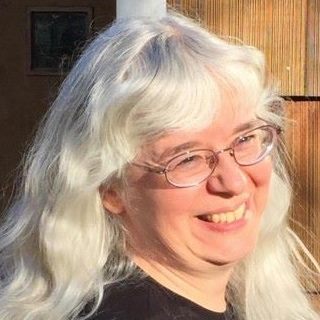
Eventually, I’ll get around to changing my headshot…