
The Ekphrastic Review‘s editor, Lorette C. Luzajic, chose Carousel, a 1906 painting by Ukrainian artist Olexandr Murashko, as a prompt for a recent Ekphrastic Writing Challenge. I am honored that my poem In Kyiv is among those chosen for publication. It is the third response listed. I encourage you to read all the responses, as well as Lorette’s poignant opening note. As always, comments are welcome.
Category: poetry

Nebra Sky Disk
I sometimes write poems in response to the Ekphrastic Challenge prompts from The Ekphrastic Review. I have been honored to have my poems chosen for publication on a few occasions and have taken to publishing the ones that were not chosen here at Top of JC’s Mind.
Just up today are responses to the Nebra Sky Disk, including one by my friend and fellow Boiler House Poets Collective member, Kyle Laws. You can see the artwork and the chosen responses here. My poem follows. As always, comments are welcome.
Nebra Sky Disk
Who buried you,
hid you from the sun,
the moon,
the stars,
as if the earth
could dim your essence?
Did they seek
with soil and swords and hatchets
to protect you from marauders
who might take you away,
where your arcs would not
be wedded to the sun?
They could not know
the buried centuries,
the indignity
of damage by looters,
of clandestine sales,
your glory hoarded.
Finally brought back to light,
to the descendents of your people,
your gold shining their place beneath
the sun,
the moon,
the stars,
the burnished sky.
Share this:

fits and starts
Ugh! There is so much stuff I want/need to do and not nearly enough brainpower to do it.
Admittedly, part of the problem is that I necessarily deferred a lot of things when I was involved with multi-generational caregiving for years and now there is a huge backlog that needs attention. Some are practical things, like dealing with the rest of the belongings of Grandma, Nana, and Paco that are still stored at our house and finishing the remaining work with Paco’s estate, including the final tax filings and, oh, our tax returns, too. Some are creative things, like writing blog posts and poetry, and the administrative tasks that go along with them, like getting submissions in, which I find both tedious and nerve-wracking. Some are educational, trying to stay informed about what is happening in the world and using that knowledge to advocate for social and environmental justice. And, of course, there are the errands, appointments, and household tasks that need doing, although I appreciate that B and T continue to cover a good chunk of the housework that I abandoned in recent years.
The biggest problem for me remains, though, that it’s difficult for me to muster the energy and concentration I need to tackle tasks that need critical and/or creative thought and decision-making. I suppose this is complicated by my INFJ-ness, which means that nearly everything for me involves deep thought.
It’s exhausting.
There is also the reality that I am dealing with several years’ worth of grief and loss. The difficult period leading to Grandma’s death in 2016 followed by Nana’s struggles with heart failure leading to her death in 2019 followed by Paco’s decline and his death in September last year left me with a lot of deferred grief, which I have only recently realized and begun to process. There is also the personal loss of proximity to daughter E and granddaughters ABC and JG, who live across the Atlantic from us. Overlaying these personal losses is the pandemic and the upheaval, suffering, and death it has caused. The death toll in the US alone is 955,000, which, as staggering as that figure is, is probably an underestimate. The world is also in the midst of a major ideological rift between democracy and authoritarianism which is terrifying and destabilizing. I have lost the sense that the US is on a positive trajectory toward “a more perfect Union” as our Constitution terms it, which adds to my sense of grief.
It’s a lot.
I know it’s a lot and there are valid reasons that I find my concentration and energy so scant. I know I should be patient with myself, as I would be with a friend or loved one. I know I should be practicing self-care and not admonishing myself for not having the wherewithal to power through all of this and “accomplish my goals” and “be my best self” and whatever.
I try.
Sometimes, I manage it. Other times, not so much.
Look. Today, I managed to write this post.
Share this:

Avalon–Marilyn McCabe
I’m excited to share with you a newly published videopoem from the Boiler House Poets Collective! We worked on the poem itself during our residency last fall with the marvelous Marilyn McCabe designing and producing the video. Many thanks to Masque and Spectacle Journal for publishing it.
This is an exquisite corpse poem, which is a technique for composing a poem with a group. One poet writes a line. The second writes a line following it and folds the paper so that only that line is showing. Each subsequent poet follows suit, only seeing the last line added. With eight poets, we did two rounds, generating this 16 line poem. The visual element was taken from our beloved namesake, the Boiler House at MASS MoCA. Enjoy!

“Avalon” is an exquisite corpse composition from a group of poets in residency at the Massachusetts Museum of Contemporary Art, where the video images were also taken.
***
The Boiler House Poets meet every fall at the Massachusetts Museum of Contemporary Art for a weeklong residency to develop work individually and as a group. They are: Joanne Corey, Marilyn McCabe, Ann Dernier, Gail DiMaggio, Jessica Dubey, Kyle Laws, Katherine Morgan, Erica Bodwell. All have published poems in literary magazines and/or as collections through a variety of poetry presses. Video producer Marilyn McCabe’s videos have appeared in literary magazines, film festivals, and galleries: MarilynOnaRoll.wordpress.com.
Share this:

SoCS: filling a page
Writers often commiserate over being faced with a blank page and not being able to think of something to write on it.
Or maybe now-a-days a blank screen?
I don’t usually run into that problem, most likely because my brain almost never shuts off. There are actually reasons for this that I will go into when I’m not writing stream of consciousness….
Of course, just because I can always fill a page with thoughts doesn’t mean that the writing is worth sharing.
My natural mode when writing poetry, though, is to slosh things around in my head for days/weeks before writing them down. It’s good, though, that through the Binghamton Poetry Project, Heather Dorn, and Sappho’s Circle, I learned to write poetry quickly from prompts.
It usually works like this: The leader of the workshop gives a few choices for prompts to get you started on a poem and there is a time limit, which can be as short as ten minutes, in which to write. This plays to one of my strengths, which is writing relatively short poems, but definitely challenges me in that there isn’t time to ruminate. You really only have about a minute to decide which prompt you want to respond to and the direction you want to take before starting to draft your poem on the page.
Through practice over the last several years, I’ve gotten pretty decent at writing a poem quickly from a prompt. Obviously, there needs to be revision time later but a number of poems that were in response to prompts have made their way into my manuscripts.
Now, if I could just get one of my manuscripts published…
*****
Linda’s prompt for Stream of Consciousness Saturday this week is “page.” Join us! Find out more here: https://lindaghill.com/2022/02/04/the-friday-reminder-and-prompt-for-socs-feb-5-2022/

Share this:

Thanks to the Department of Public Art
I’m not sure if it’s intended to reblog a post for Just Jot It January or not but I am writing this blurb, so it should count. 😉
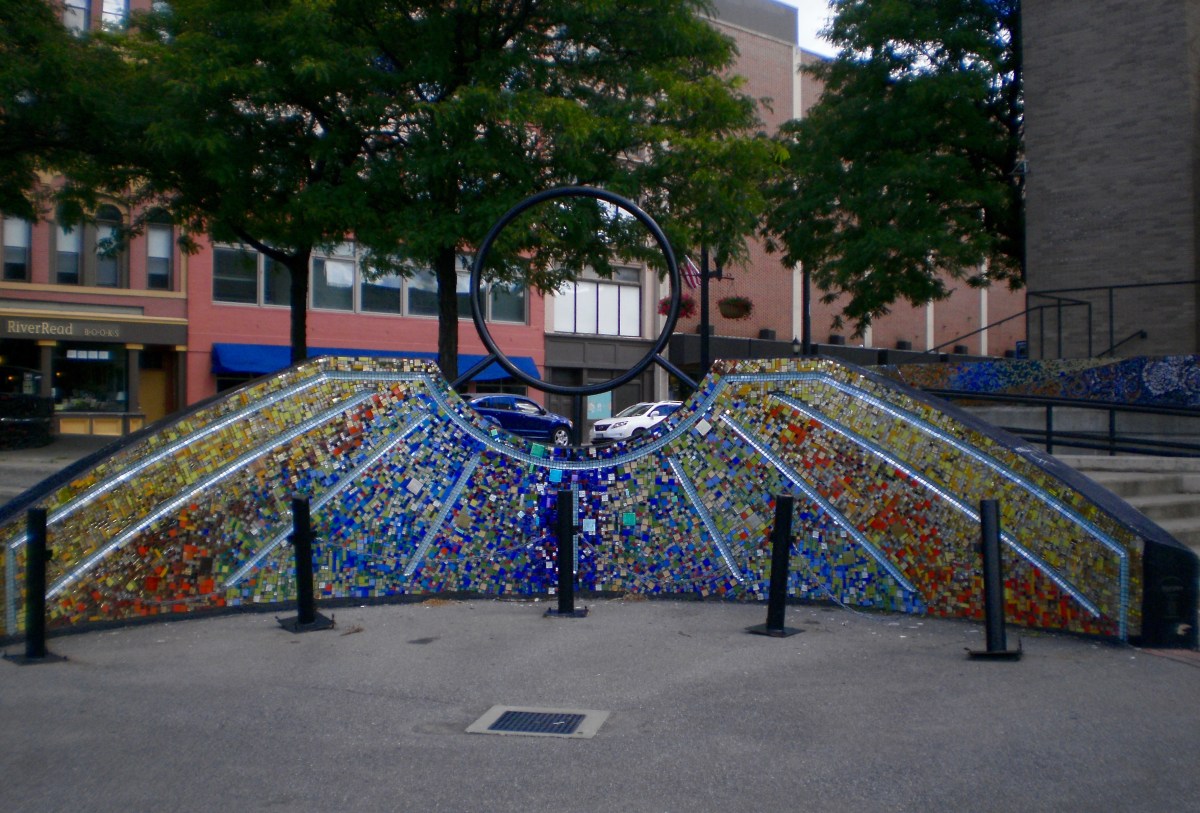
I was thinking of this poem because the Water Street parking ramp which housed murals from the Department of Public Art is being demolished. The whole first stanza is about that art so it feels strange to see local artists discussing its destruction on the news. It remains to be seen if some of the art will be re-created elsewhere as it was very site-specific.
It also occurs to me that, over five years later, the Heart of the Arts dinner crowd is still the largest audience for whom I have read.
Join us for Linda’s Just Jot It January! Find out more here: https://lindaghill.com/2022/01/30/daily-prompt-jusjojan-the-30th-2022/

When I revealed my secret poetry mission, I promised to share the text of my poem “Thanks to the Department of Public Art” after it was published in the fall anthology of the Binghamton Poetry Project. The anthology is available tonight at our reading, so I am pleased to share the poem below. Here is a recording of my original reading at the 2016 Heart of the Arts Awards dinner.
Thanks to the Department of Public Art
~~ by Joanne Corey
for Emily Jablon, Peg Johnston, and all whose hearts are in the arts
Stencils and murals
on descending levels
of the Water Street parking ramp
time-travel through that historic corner –
Link Blue Box flight simulators
evolve from pipe organs –
punching in on Bundy
time recording machines
in the days before IBM
and the move to Endicott –
on street level
“Welcome to the…
View original post 136 more words
Share this:

Unseen

Sometimes, when I haven’t written a poem in a while, I try to write tanka, which is a Japanese form that, when executed in English, is 31 syllables in 5 lines with a turn at the fourth line.
At other times, I will use a prompt to get me started. These can be written specifically as prompts or can be other works of art which serves as a springboard. Poems that are responses to artwork are known as ekphrastic poems. I write them relatively often because I have been part of the Boiler House Poets Collective since 2015. During our residencies at the Massachusetts Museum of Contemporary Art, we often write ekphrastic work with most of us choosing to do this throughout the year.
One of my Boiler House poet-friends, Kyle Laws, introduced me to the Ekphrastic Writing Challenges from The Ekphrastic Review. I have been fortunate to have had several poems of my poems appear as selected response to challenges.
Earlier this month, I submitted a tanka in response to this challenge, the painting Blind Girl Reading, by Ejnar Nielsen (Denmark) 1905. You can see the painting at the link, as well as read the selected poems and short fiction in response.
While my poem was not chosen, I thought I’d share it here:
Unseen
In darkness, pale fingers
glide over pages bound
heavy in her lap –
the only light, electric
impulse from fingers to mind.
Comments are welcome, if you are so moved. (There’s nothing like writing a six paragraph post to present a five line poem!)
*****
Join us for Linda’s Just Jot It January! Find out more here: https://lindaghill.com/2022/01/28/daily-prompt-jusjojan-the-28th-2022/
Share this:

healing the earth together
On Thursday, I posted that I had a new poem available on Silver Birch Press as part of their series “How to Heal the Earth.” The prompt for the series read, in part, “Your poem can offer practical ideas of how to heal the earth from a personal perspective (i.e., something specific to you and not didactic or soapboxy) or your poem can offer fanciful thoughts that defy the practical.”
Anyone who knows me will not be surprised that I came down on the practical rather than fanciful side. (I’ll leave it to you to determine whether my poem or this post is soapboxy.)
I wrote a list poem, helpfully formatted into a checklist by Word, that relates some of the things I and my family have done to help combat environmental degradation and climate change. The list blends practical, individual actions, like using LED bulbs and driving an electric car, with social and political actions, like voting and boycotting. Okay, there are also a few more poetic lines thrown in, too.
One of the excuses people use for not taking individual action is that they don’t think that their change will have any impact in the face of such a large challenge as global warming. It’s true that the impact of any one individual action is infinitesimally small but those actions do add up within your household, in your neighborhood, your region, your country to something larger and helpful. If everyone, though, throws up their hands and accepts the polluting status quo, the condition of the planet worsens faster, often harming worst and first those who did the least to create the problems in the first place. As someone from the United States, which is historically the largest contributor to global warming, I feel a particular responsibility to cut carbon emissions as much as I can and am fortunate enough to have the resources to do so.
Individual actions will never be enough, though, unless systemic changes also occur. The political and economic systems in most countries are heavily weighted toward fossil fuels and those companies wield a lot of power. Trying to counteract that is also an example of needing many, many individual actions to create positive change. For example, I and hundreds of thousands fellow New Yorkers worked for years to ban fracking and enact a climate bill in our state. There were protests, public commentary, writing and calling elected officials, court cases, elections, research, networking, meetings, and on and on, but the needed legislation finally passed. Of course, there is still work to be done as it is being implemented but, if so many of us hadn’t made our voices heard, my region would probably look like our neighboring counties in Pennsylvania with large fracked gas wells and the pollution they bring as part of our landscape.
There is still plenty of work to do on the systemic level in the US and around the world, too. Current efforts include boycotting the banks that fund fossil fuel extraction and infrastructure, despite the danger that the companies may never be able to pay the loans back and will go bankrupt with lots of stranded assets in the form of rights to extract fossil fuels that cannot be fulfilled if the world is going to stay under 1.5, or even 2, degrees Celsius in global warming. There is also a major divestment push against fossil fuel companies with some pension funds, universities, and other large institutions refusing to hold stock in those companies. In the US, we are also trying to get more federal funding for the transition to renewable energy and an end to decades of subsidies for fossil fuels.
All of these efforts have an individual as well as a corporate component. Whether you are inspired by prose or by (the much shorter and easier to read) poetry, I hope you will join me by doing what you are able to do to fight global warming and heal help the earth from wherever you are.
*****
Join us for Linda’s Just Jot It January and/or Stream of Consciousness Saturday! I chose to not take Linda up on the SoCS prompt this week, which is “icing on the cake”, but do want to wish Linda a happy birthday and a peaceful, healthy, creative year to come! You can find out more about #JusJoJan and #SoCS here: https://lindaghill.com/2022/01/21/the-friday-reminder-for-socs-jusjojan-2022-daily-prompt-jan-22nd/
Share this:

How to Heal the Earth poem
Back in November, I posted that I had had a poem accepted by Silver Birch Press as part of their How to Heal the Earth series.
I’m pleased to share that my poem is now available here!
Please visit and comment either there or here if you are so moved. While you are there, you can read dozens of contributions to the How to Heal the Earth series along with the Thoughts About the Earth series.
Thank you to Silver Birch Press for including me in this series and for the lovely photo that they chose to accompany my poem.
*****
Join us for Linda’s Just Jot It January! Find out more here: https://lindaghill.com/2022/01/20/daily-prompt-jusjojan-the-20th-2022/
Share this:

How Does JC’s Mind Work? #2
For months/years, I have threatened/promised to write about how I got to be who I am today and what shaped me along the way. This sporadic series will try to unpack my personal history and influences and, I hope, set people to thinking about their own.
When I posted the first installment of this series and used the word sporadic in the intro, I didn’t think it would be almost a year before I posted the second installment, but here we are. Of course, I didn’t know last February that 2021 was destined to see my father’s final decline and death, which, along with the necessary estate work, occupied so much of my time and mind last year.
What I’ve decided to write about today is how my natural introversion impacts how my mind works.
Any personality assessment I have ever done shows the largest deviation from the centerpoint on the scale toward introversion versus extraversion. I’m not just a little bit introverted. I’m very introverted.
I find crowds overwhelming. When being in groups, the smaller the better. I much prefer an in-depth conversation with one person to small talk with ten. I am also content to be by myself for long stretches. I can function in larger groups when I have to, but it is very tiring and I’m not able to participate in discussion very well.
This is partially a function of not being very good at inserting myself into ongoing discussion and partially another introvert trait, which is that I need time to think through issues before I can formulate opinions and put them into words. If there is a discussion on a topic that I know well, I can participate almost as well as the extraverts in the group, but, if the topic is new, I usually can’t make my brain work fast enough to participate before the discussion has moved on to something else. This is especially difficult for me when workshopping poems that I haven’t studied in advance. I always feel that I am not as helpful as I might be to the other poets in the group.
Introverts often have a preference for writing over speaking. I’ve always loved to write. I find it helpful in clarifying my thoughts. I think part of the reason I’ve been able to sustain this blog is that writing posts organizes my thoughts in a calming way after I have been mulling something. That I can then share those thoughts with others is not as much the primary goal as a bonus.
And introverts are definitely “mulling” types. Decision-making is very deliberative and often involves research, time, and depth of thought. I am not a snap-judgement type and like to take time in forming opinions and action plans. I know this is frustrating for others who are quicker to come to positions and decisions. I can seldom see things in a this-or-that way; everything is a spectrum for me and it takes time to think through where on the spectrum I will land – and more time to adequately explain it to someone else.
One of the things I have learned recently is that introverts’ brains work differently than extraverts. I find this knowledge comforting. There has been pressure on introverts to become extraverts, as though introversion was a choice rather than an inherent part of one’s personality. Knowing that my brain works in the distinctive pattern of introverts strengthens my acceptance of myself as I am.
I am also part of a particular subset of introvert. In Myers-Briggs-speak, I’m an INFJ, which is considered the rarest personality type, so my brain has a few extra quirks going on, but that is a post for another day.
With luck, it won’t take me a year to get to it.
*****
Join us for Linda’s Just Jot It January! Find out more here: https://lindaghill.com/2022/01/18/daily-prompt-jusjojan-the-18th-2022/


