7th blogiversary!

WordPress has helpfully reminded me that today is my seventh blogiversary!

Sending out a big THANK YOU to all my readers, including my 1,400 followers!

Okay, it’s time to calm down and not end every sentence with an exclamation point.

Over these past seven years, I have published 1,383 posts and had over 24,000 visitors from 119 countries. It boggles my mind. I hadn’t really thought about stats seven years ago when I started. Truth to tell, I don’t think about stats that often now, either, but I do appreciate sharing my thoughts with so many people around the world.

I also appreciate that I have been able to keep my blog eclectic. I knew starting out that the recommendation was to target a blog to a specific topic with a regular posting schedule and a plan to build followers, but I chose to take a path that fit my personality better. I have wide-ranging interests and like to be able to bring them up as they become “top of mind.” Circumstances have arisen that have had me writing more about my personal life than I had originally expected, but having an intentionally eclectic blog accommodated that.

For millions around the world, 2020 has been hard to navigate in terms of time. People’s schedules have been disrupted to such an extent that a week can simultaneously feel like forever and a flash. For me, most of the past seven years have been like that, as I’ve lived in a web of intergenerational health problems, moves, on-site and long-distance caretaking, and lots of unpredictability. I didn’t know seven years ago how important writing poetry would become in my life. I didn’t know that we would lose both my mother and mother-in-law. I didn’t know I’d now have two precious and faraway granddaughters.

Sometimes, in writing a post, I need to look back into my post archive to refresh my memory on when something occurred. In reading older posts, I am gratified to find that, in most cases, the writing has held up pretty well. You all have an open invitation to stroll through the posts from prior months and years. You might stumble across something that interests you.

I have never kept a diary or journal going for any length of time, so I am glad to have Top of JC’s Mind as a keepsake of these past seven years.

Which reminds me, I really need to figure out how to do a proper back-up…

September 11

Nineteen years ago today, terrorists, most of whom were from Saudi Arabia, attacked the United States, killing thousands of people and destroying airplanes and buildings in New York City, Arlington, Virginia, and Shanksville, Pennsylvania. I remember those killed, the many who acted valiantly to try to save lives, often at the cost of their own, those who worked in the aftermath of the disaster, many of whom suffered illness as a result, and the many thousands, both military and civilian, who were impacted by the wars in Afghanistan and the rest of the Middle East that sprang from the 9/11 attacks.

Nine years ago, my area was suffering from a record flood of the Susquehanna River, brought on by the remnants of tropical storm Lee. What many people don’t realize is how long it takes to recover from such an event – and that some things aren’t recoverable. It took years to repair homes that could be and tear down those that couldn’t. There are neighborhoods with patches of grassland where homes once stood, interspersed with homes that managed to survive. Those neighborhoods have changed character, with fewer older folks in them as they were the most likely to move to higher ground or leave the area after the flood. Our own home was not flooded, but there was standing water three blocks away and significant basement flooding one block away. We had long carried flood insurance on our house, although it isn’t required by the (still outdated) flood maps; we will continue to do so, hoping that we never have to use it while realizing that the increased strength of weather systems and changes to the upper-level wind patterns brought on by global warming may someday send us another record-breaking flood that will reach our home.

Despite these prior events, September 11, 2020 feels even more fraught. The global pandemic has exacted a terrible toll on the United States. We are over six million cases and closing in on 200,000 fatalities. The economic impact, especially on those on the lower end of the socioeconomic spectrum, has been severe, with rising rates of hunger and housing crisis. The pandemic also made more prominent existing problems with the health care system, racism, environmental degradation, education, infrastructure, jobs, wealth, taxation, and social programs. While some of the effects have been buffered by living in New York State, where Governor Andrew Cuomo has been leading an effective response to the crisis, I am appalled by the lack of leadership from the president and the callous intransigence of Senate Majority Leader Mitch McConnell, which are prolonging and deepening the suffering in the country as a whole. Because the Senate hasn’t passed the HEROES Act which the House passed in May, additional federal assistance to households, state and local governments, the post office, and the election system isn’t available. As a result of the national inaction, states are going to have to lay off front-line personnel and the vote count in November’s elections will take a long time.

To make matters worse, this week has seen new evidence that the president’s failure to address the pandemic was not due to lack of understanding the crisis. A just-released recorded interview on February 7 with Bob Woodward makes clear that the president knew that the virus was highly contagious, deadly, and spread through the air, yet he continued to intentionally downplay the threat rather than mount an effective and protective response. If the president had lead the nation in the kind of efforts that Governor Cuomo did in New York, there would have been millions fewer cases of the virus and thousands upon thousands fewer deaths. There would be widespread testing and contact tracing. The test positivity rate would be below one percent, as it has been in New York State for over a month. Businesses and schools would be thoughtfully and carefully re-opening, ready to re-adjust if cases start to rise. Instead, Dr. Fauci, director of the National Institute of Allergies and Infectious Diseases, is telling the United States to “hunker down and get through this fall and winter, because it’s not going to be easy.” I only hope that people take the advice to heart in their own lives and at the state and local level, because Trump and McConnell are still not helping us mount a national response.

The Trump/Bob Woodward interview I mentioned above was just released because Woodward has a book coming out, part of a spate of books about Donald Trump being published with less than two months to go before the presidential election. These books reveal information that, while perhaps suspected, had not previously been confirmed about the president and his staff. The picture isn’t pretty. While there is some straight-up incompetence and inexperience at play, there is even more corruption, selfishness, greed, and disregard for the Constitution and laws, morals, ethics, and the common good.

Time for the pitch. Make a plan and vote! We need there to be a President Biden in January 2021 in order to have any hope of reclaiming our democracy.

Which brings me to another fear. While there is widespread and credible polling both nationally and in battleground states showing that Biden is leading Trump by several percentage points, the election process itself is under threat. The most frightening is that the Russians, along with several other countries, are once again attempting to interfere with election. This week, a whistleblower came forward with evidence that the administration is knowingly tamping down revealing the extent of the Russian interference, in particular. At the same time, the administration and the Republicans are filing lawsuits to disrupt mail-in voting. The postal service is slowing mail delivery, which could make ballots arrive too late to be counted. The president keeps saying that mail-in ballots lead to widespread fraud, which is absolutely a lie; states and local election boards have numerous, proven safeguards in place to prevent fraud. It is true that the final vote tally will take longer, especially in states that don’t count mail-in votes until days after Election Day. (Of course, some of the delays could have been averted if the Senate had acted on the HEROES Act which would have provided more training, machinery, and personnel to count ballots more quickly.) People need to be aware that we may not have final election results for a couple of weeks. This does not mean there is fraud; it means that election bureaus are diligently following their procedures to report an accurate tally.

Nineteen years ago, despite sorrow and shock, the people of the United States pulled together to help us get through the crisis. Nine years ago, our local community drew together to assist those impacted by the flood. Unfortunately, I don’t see that same sense of solidarity in the country as we face the pandemic, government corruption, and economic catastrophe, along with the long-standing problems of racism, lack of equal access to good-quality education and health care, environmental ruin, and other injustices. Granted, it’s a lot, but we can improve our lives and our nation if we act together. When we say in the Pledge of Allegiance “with liberty and justice for all”, we have to mean it.

vaccine trial – injection 2

This week, B, T, and I are receiving our second injections of the Pfizer/BioNTech experimental COVID vaccine or placebo, three weeks after the first round. There is COVID testing and general health screening but no blood draw, which will wait for the next visit to see the antibody response. Throughout the two years of the trial, we will continue with a weekly diary of possible COVID symptoms, although we would contact the trial staff immediately if we suspected we had COVID. We each have an emergency test kit at home to collect samples if we are directed to do so by study personnel.

The possible date of vaccine approval in the United States has become a hot topic. The president has intimated that a vaccine could become available before Election Day, November third. Local health departments around the country are supposed to have plans in place for distribution by November first.

However, that timeline doesn’t jibe with the amount of time needed for preliminary Phase III trial results. Yesterday, Pfizer, BioNTech, and seven other drug companies involved in COVID vaccine development signed a joint pledge to uphold their rigorous testing measure and not request authorization without the requisite data showing safety and efficacy.

I’m pleased that they made this commitment to the public. When vaccines do become available, it is vital that billions of people around the world receive them so that we can end the pandemic. If only a small fraction of the world’s population receive it, the pandemic will not end because there will still be a large pool of potential victims for the virus. Some of those victims will be people who were vaccinated, as no vaccine is 100% effective. The vaccine should lessen the severity in those people who do contract it, as we see with current flu vaccines. It’s important to remember, though, that part of the way vaccines work is by creating herd immunity so that a pathogen can’t create an outbreak. Vaccines offer a safer, less lethal path to herd immunity than just allowing vast swaths of the population to be infected.

I suppose it’s possible that a vaccine might receive emergency use authorization this fall so that it could be used by front-line medical workers and extremely vulnerable individuals before long-term safety and efficacy could be established, but widespread vaccination isn’t possible until next year, at the earliest.

The wisdom of moving forward scientifically and methodically was illustrated this week by AstraZeneca, which put their COVID vaccine trial on hold in order to investigate a possible adverse reaction. It may be that the reaction had another cause, but, until that can be determined, they don’t want to risk the health of their participants. Rushing the swine flu vaccine out to the public in 1976 caused enough serious complications that it had to be suspended after ten weeks; no one wants to repeat that experience with COVID.

Meanwhile, our family will keep doing our small part in advancing the science in hopes that COVID-19 can be brought under control, saving as many people as possible from illness, disability, and death.

update to the chapbook update

Motivated by writing this post yesterday, I started searching for more opportunities to submit my chapbook for publication. After not finding any contests currently available – I could find lots for collections, but not chapbooks – I started looking through the Poets & Writers database of small presses that publish poetry.

I was looking for presses that are currently open for unsolicited chapbook manuscripts, but had to wade through broken links, the almost inevitable changes in schedules due to COVID, and the unfortunate number of presses that seem to have disappeared since they had listed with Poets & Writers two to three years ago.

I did manage to find what seemed to be a good match. The database said they accepted unsolicited manuscripts from September through December, but, when I visited the press’s site, I found out that they had moved up their open reading to the summer and were closing to submissions September 6. So, as it was September 5th, I stopped searching and got to work on the submission.

Given that I had the manuscript in my google docs, you might think that it would be relatively quick and easy to get the submission in, but it actually took a couple of hours. The press preferred a .docx in 5.5×8.5 inch format. I admit that I don’t know Word as well as google docs. I got the page format changed relatively easily, but struggled a bit to get the margins the proper size. I usually write short to medium length lines, but there were some lines long enough that they didn’t fit with the smaller pages. In some instances, I wound up changing my lineations. For the handful of multi-page poems, I had to be mindful of the page breaks to make sure that they weren’t falling in awkward places. I was grateful that there is an easy way to update the table of contents, as it changed considerably.

In the end, I was able to complete the submission yesterday, so, at least, I didn’t send on the very last day! It took a while, but I learned some new Word skills.

And the next time some press wants a 5.5×8.5 inch format, I’ll be ready.

chapbook update

This spring, I entered my chapbook manuscript in eight contests. So far, I’ve received five rejections, although I was a semi-finalist in one of them, which is encouraging, even though it is still a rejection. I expect to hear back from the other three sometime this month or next.

I did another round of revisions and have entered this newest version to one (knowingly virtually impossible to be accepted by) press. I have two other contests in mind, but should probably get myself motivated to search for others.

As long as we are on the topic of things I should do, I should also try to do some journal submissions. While I have made some strides in improving my poetry, I am still a neophyte when it comes to the world of publishing. Trying to choose among hundreds of journals which are most likely to consider the kind of poetry I write is perplexing. Sometimes, it’s easy to figure out where not to send something, such as the contest that wanted you to prove you had read all their requirements by quoting your favorite rap lyric in the cover letter – and I don’t know any rap lyrics. Most often, you read a sampler from the journal and try to guess if they might like your work. Because there are usually reading fees involved, it helps to try to figure out which journals are most likely to be interested. With so much else going on, I have trouble getting myself motivated to slog through lists and databases and spend time following all the different rules for submission, knowing that then you are looking at waiting periods of various lengths and most likely a bunch of rejection emails.

Still, if you want to be published…

Time to get to work.

I can’t even…

There have been so many distressing articles about Donald Trump that you think nothing could possibly break through to elucidate something worse.

Yesterday, Jeffrey Goldberg, editor in chief of The Atlantic, one of the oldest and most venerable magazines in the United States, published this article on Trump’s disparagement of members of the military across generations. Trump has publicly and privately called people who served “losers” and “suckers”, including those who were wounded, captured, or killed in action.

Some of the people interviewed for the story think that Trump can’t understand anyone being motivated by anything other than personal gain, especially monetary gain.

This inability to understand the fundamental nature of public service would be shocking enough coming from a president of the United States who is elected to serve the country and its people, but one particular incident in the report saddened me on an even deeper level.

On Memorial Day 2017, Trump visited Arlington National Cemetery, a short drive from the White House. He was accompanied on this visit by John Kelly, who was then the secretary of homeland security, and who would, a short time later, be named the White House chief of staff. The two men were set to visit Section 60, the 14-acre area of the cemetery that is the burial ground for those killed in America’s most recent wars. Kelly’s son Robert is buried in Section 60. A first lieutenant in the Marine Corps, Robert Kelly was killed in 2010 in Afghanistan. He was 29. Trump was meant, on this visit, to join John Kelly in paying respects at his son’s grave, and to comfort the families of other fallen service members. But according to sources with knowledge of this visit, Trump, while standing by Robert Kelly’s grave, turned directly to his father and said, “I don’t get it. What was in it for them?” Kelly (who declined to comment for this story) initially believed, people close to him said, that Trump was making a ham-handed reference to the selflessness of America’s all-volunteer force. But later he came to realize that Trump simply does not understand non-transactional life choices.

from Jeffrey Goldberg’s article, Trump: Americans Who Died in War Are ‘Losers’ and ‘Suckers’, The Atlantic, Sept. 3, 2020

How could anyone, standing with a father at his son’s gravesite, not have the decency to either offer sympathy or maintain respectful silence?

Trump’s lack of compassion and humanity frighten me even more than his inability to govern and to protect the health and safety of our country. He and the press team at the White House are denying the reporting, but Goldberg’s reporting is well-sourced and has been corroborated by other reporters using their own sources. Sadly, it is also entirely believable because Trump has often publicly disparaged those who have served in the military, including the late senator and former Republican presidential nominee John McCain. For the White House to claim that Trump never said things that are archived in recordings, tweets, etc. only compounds the problem. Denying your lies is just another lie and another reason not to believe anything you say.

I have always believed that character matters and have used it as one of my top criteria in voting. I have made my plan to vote in the November third election and urge all US citizens to make sure they are registered and have a plan in place to safely and securely cast their ballot so that we can unequivocally elect Joe Biden so our country can begin the healing process and restore respect and human decency within and beyond our borders.

Surreal-er

I don’t think surrealer is an accepted English word, but it’s all that comes to mind right now.

When I was away for a week, I didn’t follow news as closely as I usually do, but after a few days back at home, it seems that the levels of contradiction and absurdity and fear-mongering and conspiracy-theorizing have reached new highs in the United States.

Serious journalists have to try to try to explain QAnon. The Republican convention played up fear of anarchy and violence as being part of “Joe Biden’s America” – despite the fact that Donald Trump has been president for over three and a half years – while neglecting to confront the very real fear of the spread of coronavirus. The official case count in the US is now over six million and the actual case number is probably much higher. That’s terrifying.

If the consequences weren’t so disturbing, I’d laugh. Instead, I’m stuck with the bewilderment of surreal-er.

I realize that people who are in a media bubble or conspiracy mindset are not generally inclined to factcheck, but I implore people to seek out credible sources of information. Go to Joe Biden’s campaign website for his positions on issues and his public statements. Go to the Johns Hopkins website for US and world COVID statistics. I was hoping to provide a link for Donald Trump’s plans for a second term, but his official website doesn’t have an issues and plans page; I haven’t heard him give a clear answer about plans in interviews, either. It’s a major problem, especially with so many challenges facing the country right now and so little effective action from the administration.

What will next month bring?

And the month after?

When will life not seem surreal?

SoCS: penny box

Like many people, we have a coin jar at home. When our daughters were young, when the coin jar was full, I would roll the coins and bring them to our credit union for deposit to the girls’ accounts.

That was a long time ago now, but I still have a coin jar. I didn’t fill it very fast in recent years because I would only take coins out of my wallet when it got over-full. I used to do a lot of my everyday shopping in cash, so I would spend my coins. Since the pandemic, though, I seldom use cash, so I’m not accumulating coins.

I was concerned this spring because there was a coin shortage caused by lack of commerce and I was anxious to find a couple of 2020 pennies. Two of my long-time friends have penny boxes that I gave them for their birthdays. The idea came from a book for children titled “The Hundred Penny Box” which had a centenarian who had a penny from each year of her life. Each year, on my friends’ birthdays, I would send them a penny for that year.

My friend with a May birthday had to take an IOU, but I was pleased to pay cash at the grocery store self-checkout one day in late June and receive three shiny 2020 pennies in change. I sent a (very belated) birthday card to my first friend and had a penny to send to my friend with an August birthday on time.

I used to supply pennies to two other boxes. One was a birthday box for my friend Angie, who passed away in 2005. (If you search her name, posts will come up about her here at TJCM.) The other was an anniversary box for my parents, known here as Nana and Paco. We added the last penny to it last year, a few weeks before Nana passed away.

Someday, I may make a penny box for B and my anniversary. Maybe in two years for our 40th. That was when I gave my parents theirs and they wound up making to their 65th.

May we be so blessed.

*****
Linda’s prompt for Stream of Consciousness Saturday this week was to write about something of which we had more than a hundred in our home right now. Join us! Find out how here: https://lindaghill.com/2020/08/28/the-friday-reminder-and-prompt-for-socs-aug-29-2020/

2019-2020 SoCS Badge by Shelley!

Old haunts

This is my last full day in the North Adams area. MASS MoCA is closed today, so I planned to go back to Monroe Bridge, Paco (my dad) and my hometown, and Hoosac Tunnel, Nana’s (my mom) hometown. I thought it would take a couple of hours this morning and I’d be back to the hotel by noon.

I got carried away.

I wound up stopping at a lot of old-but-changed haunts and taking tons of photos. (Don’t worry. I’ll only share a few.) Many of the ones I won’t show are unlikely to be meaningful to anyone without long-standing personal history in the area, as there is a lot of “what used to be here” in play. Warning: There will also be a lot of dams and reservoirs and hydroelectric plants. Paco was superintendent of the Upper Deerfield River (southern Vermont/western Massachusetts) for what was then New England Power Company and my sisters and I grew up traipsing around powerplants and such.

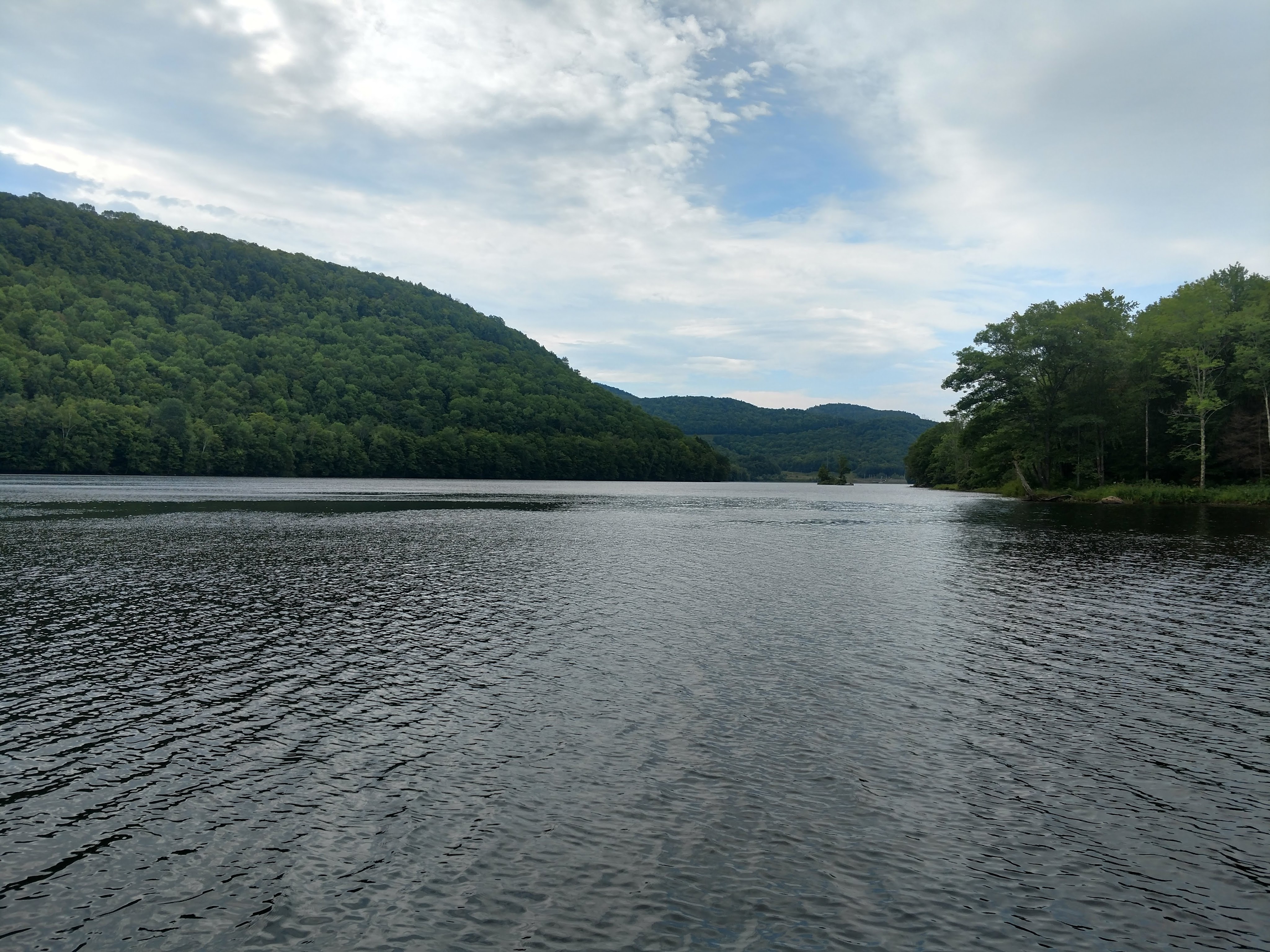
Sherman Reservoir – our house, which is no longer there, was near the dam that created the reservoir
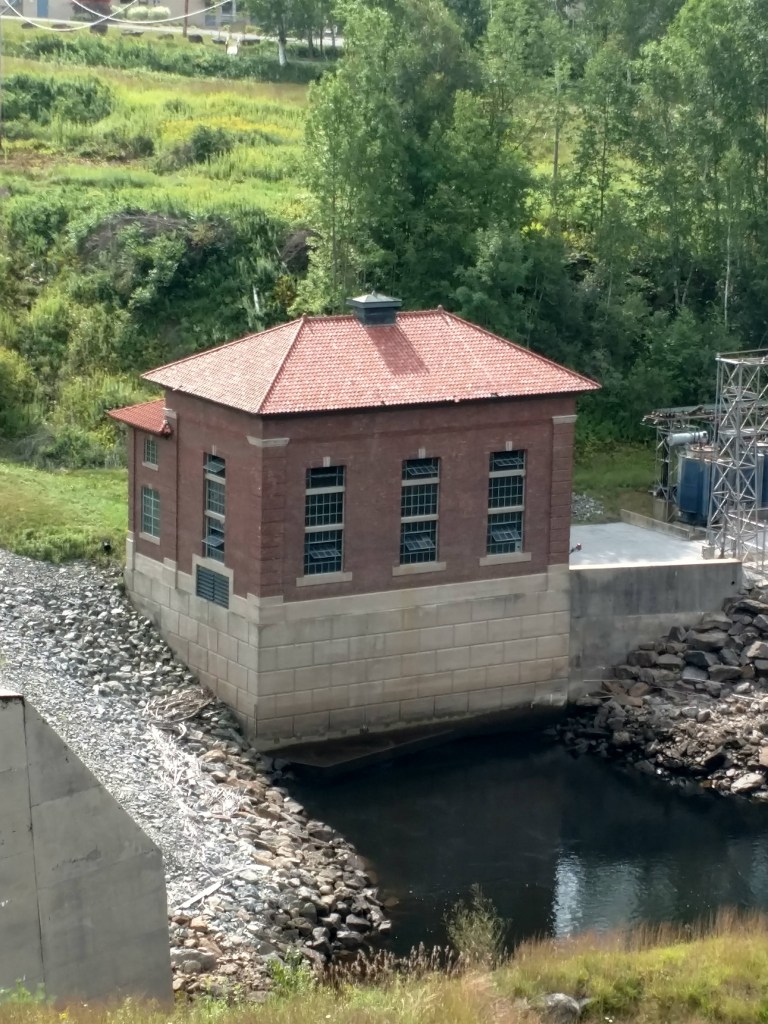
Sherman Station, the hydroelectric plant just below the dam and our “neighbor”

The building in the photo below was built by the WPA in the 1930’s. My father and some of his siblings attended school there when it was new. It also housed the town office and library. They are still there, but most of the building is now offices for the current successor of New England Power Company. The array of mailboxes is a poor substitute for the post office, which was the center of town life for many years. Olga, the postmistress was a good friend of my mom’s; they saw each other nearly every day and stayed in touch after retirement and moves put them at a distance.

Front of the former school with tree dedicated to Olga Simonetti, former postmistress
Olga’s memorial plaque

I went down to the river and crossed the bridge; our town’s name was Monroe, but the mailing address became Monroe Bridge because they would leave the mail at the Monroe bridge. This iteration of the bridge was built in 2015. The dam is quite a lot older. Part of the old paper mill was torn down and replaced with a little park. The rest is still there, although the worse for wear.

I continued downriver. I visited the Dunbar Brook picnic area, which was deserted except for a toad that I startled as I walked across the grass. I got to take a ride on a swing, which was refreshing and nostalgic. When I went back to my car, I was surprised to see that the old road along the river leading toward the Bear Swamp lower reservoir was open. I drove all the way down to the gate just before the Number 5 Station.

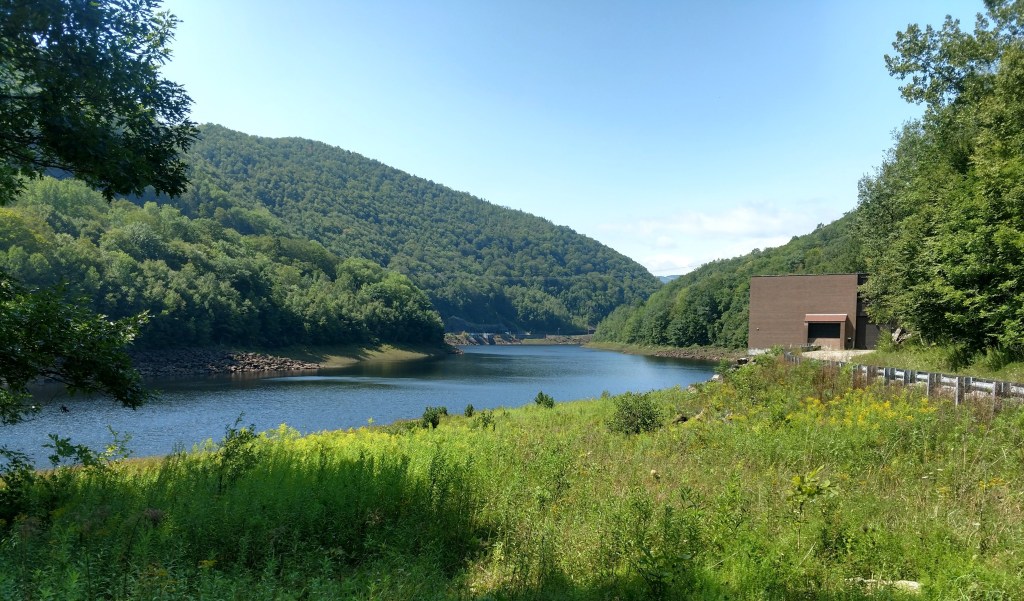
Number 5 Station and the Deerfield becoming the lower reservoir for Bear Swamp pumped storage

When I went back up to the main road, I stopped to pay my respects at the Legate family cemetery. When Nana and Paco were first married, they lived in the old Legate House, which was then owned by New England Power. The house was torn down decades ago, but the little cemetery is still tended to.

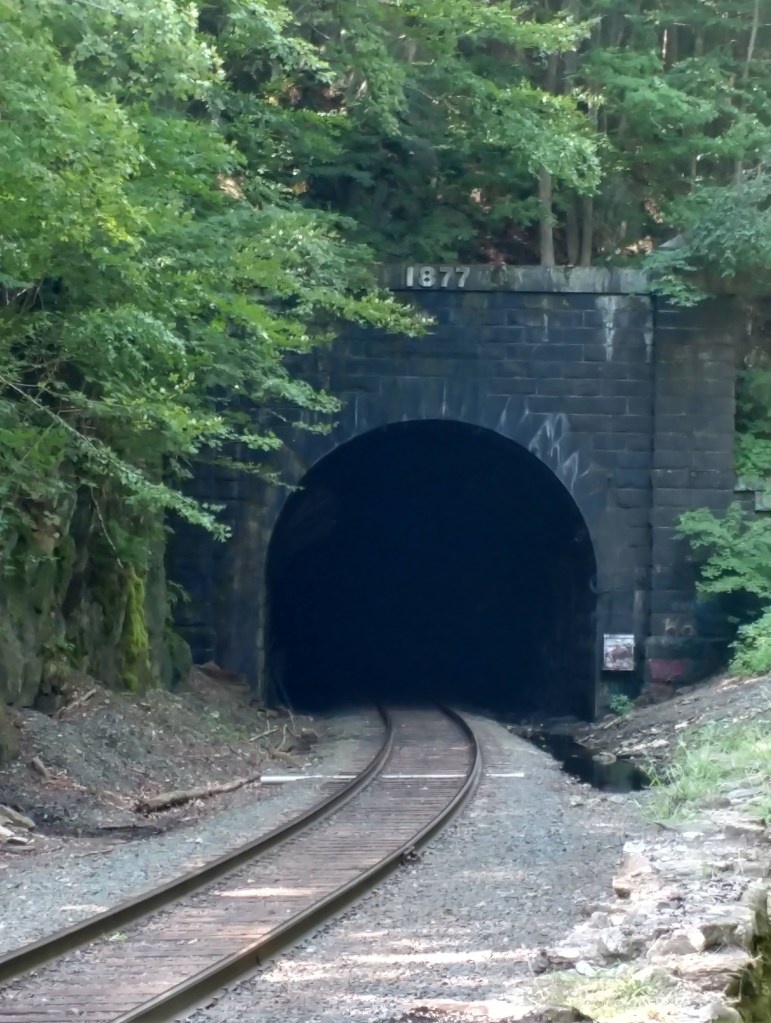
I wish I could show you a decent photo of the lower reservoir for Bear Swamp. I wish even more that I could tour the underground powerhouse that we visited with Paco so many times as it was being built and after it was completed, but it is all fenced in for safety and security reasons. I will close, though, with a photo of the Hoosac Tunnel. Nana grew up in Hoosac Tunnel, a part of the town of Florida, Massachusetts, because her father headed a maintenance crew for the Boston and Maine Railroad. At the time it was built, the Hoosac Tunnel was an engineering marvel. This is the less-fancy eastern portal. The North Adams side was more decorative, befitting a growing city in the late 1800s.

I feel very fortunate to have had the opportunity to revisit my roots. I hope that the sense of connection and the energy and the comfort of familiarity will stay with me so that I can make progress on my poetry collection after I am home.

If not, I may have to come back.

Or, maybe, I’ll come back regardless.

COVID vaccine trial update

Last week, B, T, and I each had our initial visit for the Pfizer/BioNTech vaccine trial for COVID-19. There was a lengthy informed consent document, medical history and physical exam, COVID test, blood draw, and injection with either the trial vaccine or placebo. Two of us had some mild side effects and one of us did not, so we are surmising that one of us received the placebo, but the study is triple-blind (participant, care provider, investigator) so we don’t know for sure if that is the case.

The Pfizer/BioNTech vaccine is a messenger RNA vaccine; this type of vaccine has not previously been approved for widespread use. It works by enclosing a strip of messenger RNA in a lipid shell. When it gets into cells, it manufactures the spike protein that the SARS-CoV-2 has on its exterior, so that the body recognizes it and makes antibodies and T-cells to combat it.

The phase I data looks promising, so I hope that this vaccine will be found effective. RNA vaccines are able to be manufactured quickly, which will be a plus if they are approved for use. I am hoping that a number of vaccines will be able to complete Phase III trials and earn approval, so that we can get as many people around the world vaccinated as quickly as possible. It’s the only way to gain herd immunity without a horrifying level of illness and loss.

The Pfizer/BioNTech trial is expected to finish its primary collection of data needed for approval in mid-April 2021, although the trial will continue to follow participants through November 2022 to see how well antibodies and T-cells persist.

Science takes time and the COVID vaccine is being developed at a blindingly fast rate in terms of past vaccine development. Remember that we are still looking at months before approval, not weeks. Even when one or more vaccines are approved, people will need to keep up with distancing, masks, sanitizing, etc. to keep the disease at bay while vaccination production and distribution campaigns occur.

Please, everyone, do your part to keep yourself, your family, and your neighbors as safe as possible, while vaccines and effective treatments are developed. I’ll post more information about our trial as time goes on.