One of the fears that I have about COVID is the risk of experiencing long COVID, where any number of a vast constellation of symptoms occurs for months/years after the acute infection phase.
The symptoms are very similar to those that characterize ME/CFS (myalgic encephalomyelitis/chronic fatigue syndrome). I have a family member with ME/CFS, so I am achingly familiar with the level of disability that can result. ME used to be referred to as fibromyalgia in the US, but now the ME designation is more common.
The October 5, 2022 edition of the (US) National Public Radio show On Point features an extensive discussion of long COVID and ME/CFS and how long COVID researchers and clinicians are learning from their peers who have been working for years on ME/CFS. All of these conditions are underdiagnosed and undertreated, so I wanted to share this with all of you. I believe this link will permanently take you to a recording of the episode. If the link breaks, you can try searching from the On Point link above or searching on your favorite podcast platform.
Anyone who has experienced these conditions or seen a loved one contend with them knows how difficult they can be. I want to raise awareness so that everyone affected can get the help they need. I also want everyone to realize that these conditions exist and are serious. Too often, affected people are dismissed and told their symptoms are “all in their heads.” While there is still much to learn, help is available, although it may be difficult to find, depending on the medical resources nearby. I hope we will all support research and treatment expansion so that the millions of people affected get the help they need.
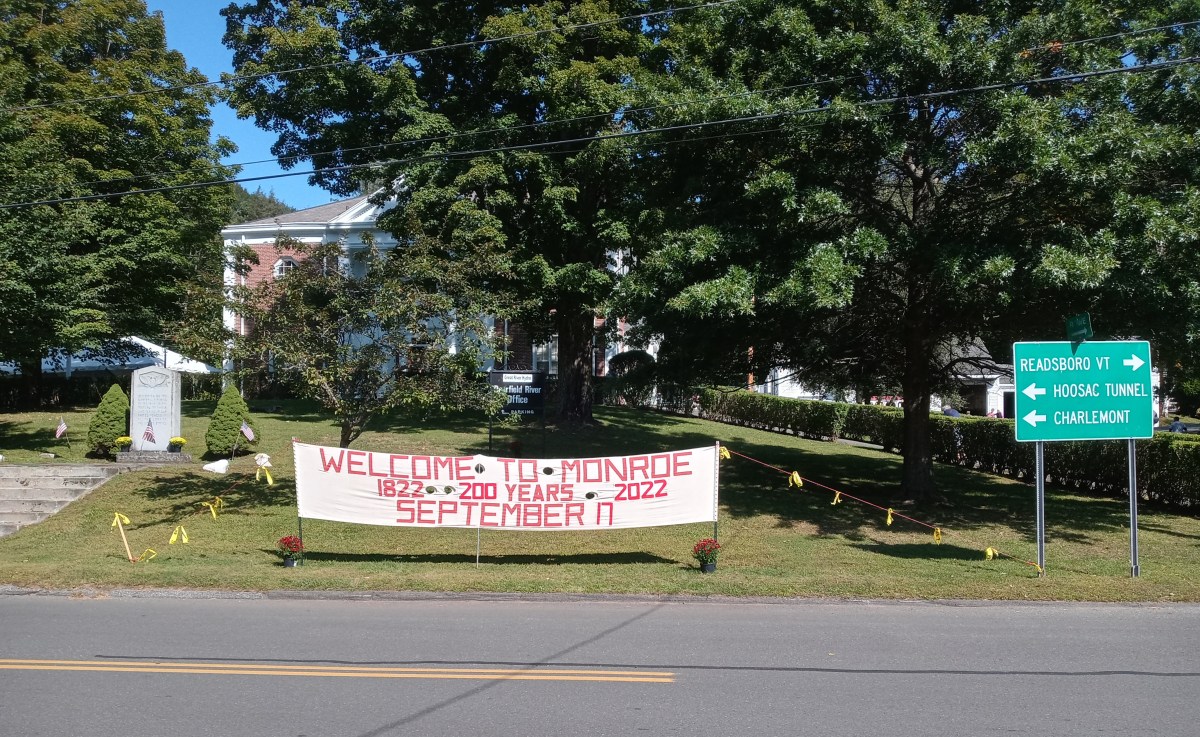
On September 17th, I returned to my hometown, Monroe, Massachusetts, for their bicentennial celebration.
The day began with a presentation from State Representative Paul Mark of a framed copy of the restoration of the original town charter. In his remarks, he noted that, unlike most Massachusetts charters, Monroe’s does not have any mention of an English king. The town was incorporated from parts of other towns and named for President James Monroe, who was president of the United States at the time.
The charter was hung up right away!
When I was growing up there in the 1960s-70s, the town had about 200 residents. In the 2020 census, there were 118 residents, making it the smallest town by population on the mainland of Massachusetts.
The festivities centered around the Town Community Center, which was the school back in my day. (Also, in the days of my father and his siblings, when it was built by the Works Progress Administration in the 1930s.) The building still houses the town offices and library. What had been the classroom for grades 1-4 when I attended is now a community meeting room where many of the indoor activities were housed. The rest of the building is now used as offices by the power company that is the successor to New England Power, for which my father worked for over forty years.
I was able to make some contributions to the memory board and books. I sent some poems and was surprised to find one of them on display with a vintage newspaper photo of me when I graduated from high school.
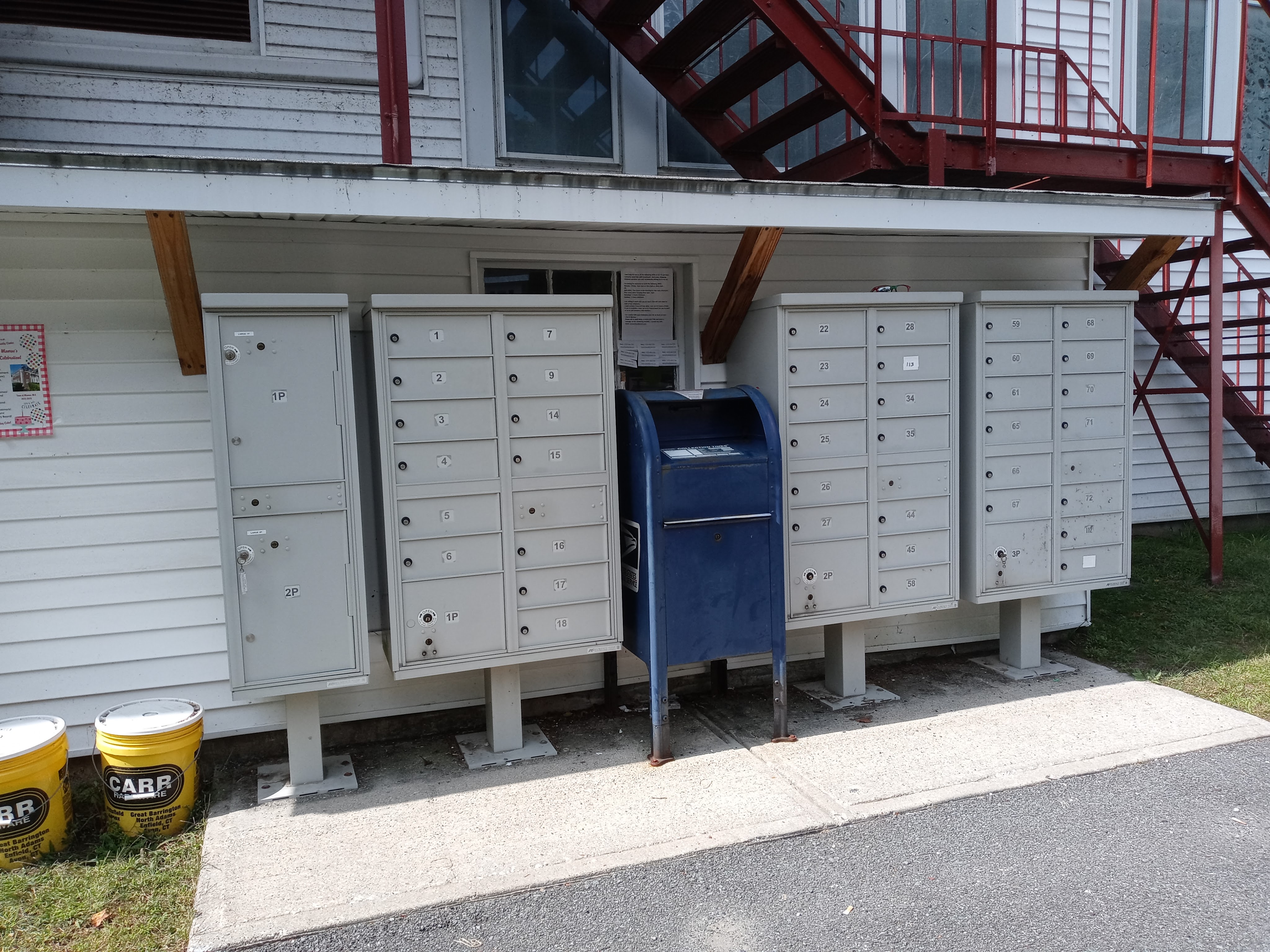
Many of us were feeling nostalgic about the post office. There were two postal employees there to hand-cancel envelopes with a bicentennial commemorative postmark, even though the Monroe Bridge post office closed years ago to be replaced by this:
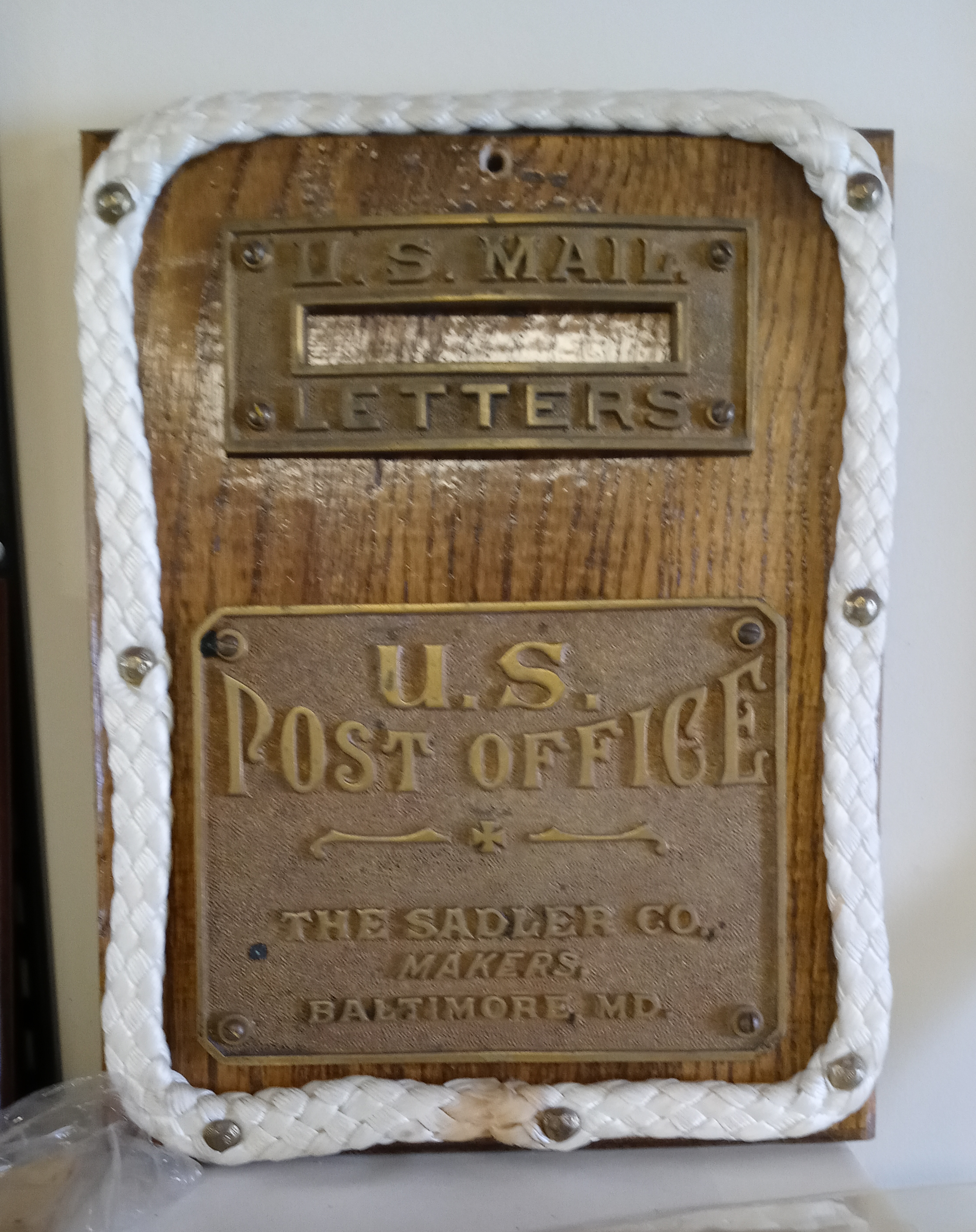
Not nearly as distinctive looking as this mail slot which was salvaged from the old post office and is now in the Monroe Historical Society’s collection.
For an explanation of why it was the Monroe Bridge post office and why I often refer to my hometown as Monroe Bridge, you can read my poem “Monroe Bridge Mail” published by Wilderness House Literary Review here. (It’s the final poem in a set of five.)
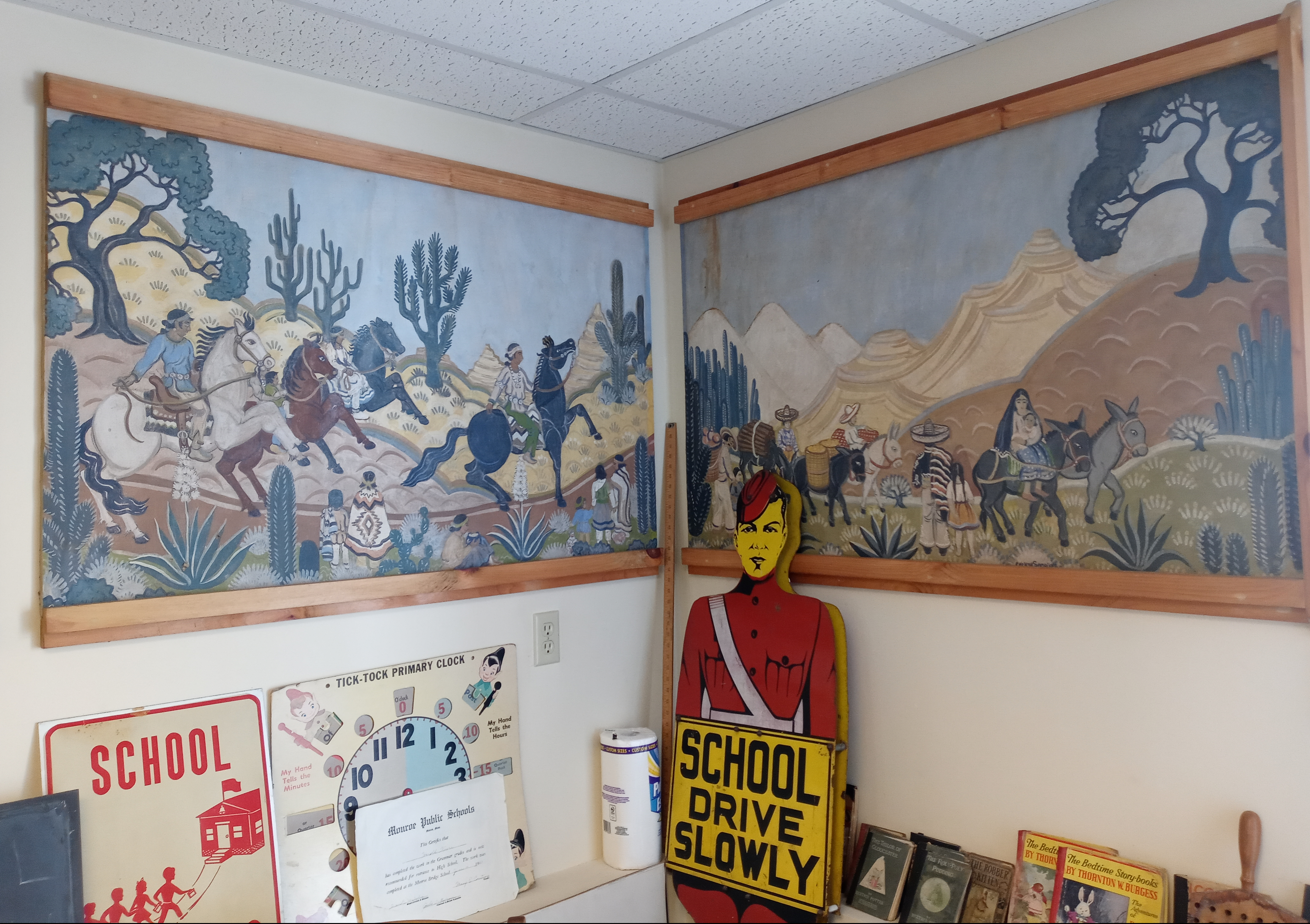
I spent quite a lot of time in the Historical Society, looking at the artifacts and photos. It was nice to see that the murals that had been painted by a WPA artist for our classroom had been moved there:
There was memorabilia from the Town’s sesquicentennial (150th anniversary) which I remembered as a very exciting time when I was in grammar school.
It was fun to get to reminisce with people who had been in town when my family lived there. Some are still residents or folks who have stayed local, while a few, like me, had travelled from further afield. I especially appreciated the time that Lucy spent with me, pointing out family connections among the memorabilia on display or in the Historical Society. I was touched by all the kind words about my parents and the expressions of sympathy on their passing. The celebration was just a few days after the first anniversary of my father’s death; he and my mother were among the founding members of the Monroe Historical Society.
There was Bicentennial swag available! One of my purchases was the Bicentennial History Book. I was honored that my poem “Playground” was chosen to be on the back cover. It reads:
Our WPA-built school housed two classrooms, eight grades, two teachers, twenty-some students, old textbooks, reams of assignments designed to keep us quiet at our desks.
Morning and afternoon recess and the remainder of lunch hour, we jumped off swings, attempted running up the two-story slide, sent the spinning merry-go-round swaying to crash with a satisfying clang into the metal pole from which it hung.
Dodge ball, monkey-in-the-middle, a dozen variations of tag, where the tap of a classmate’s hand thawed you from your frozen state or freed you from jungle-gym-jail.
Jump rope chants “Not last night, but the night before, a lemon and a pickle came a-knockin’ at my door.”
Upper-grade boys against girls in Wiffle ball or kick ball. Despite our skirts, the girls, already becoming young women, usually won. *****
Of course, as promised, there was cake!
It was a great celebration for a little town! Even though I’ve lived out-of-state for forty years now, a part of me is still at home there.
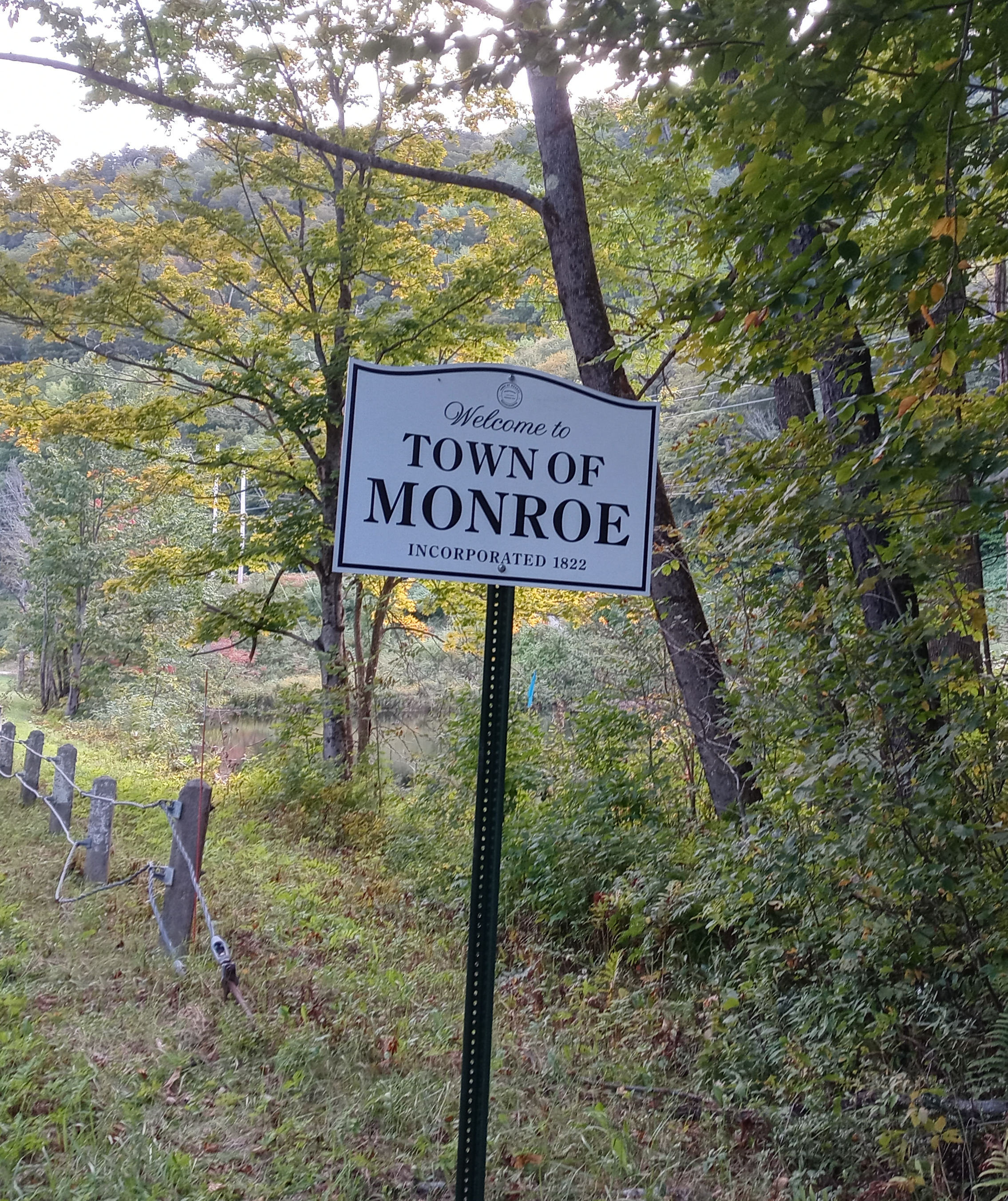
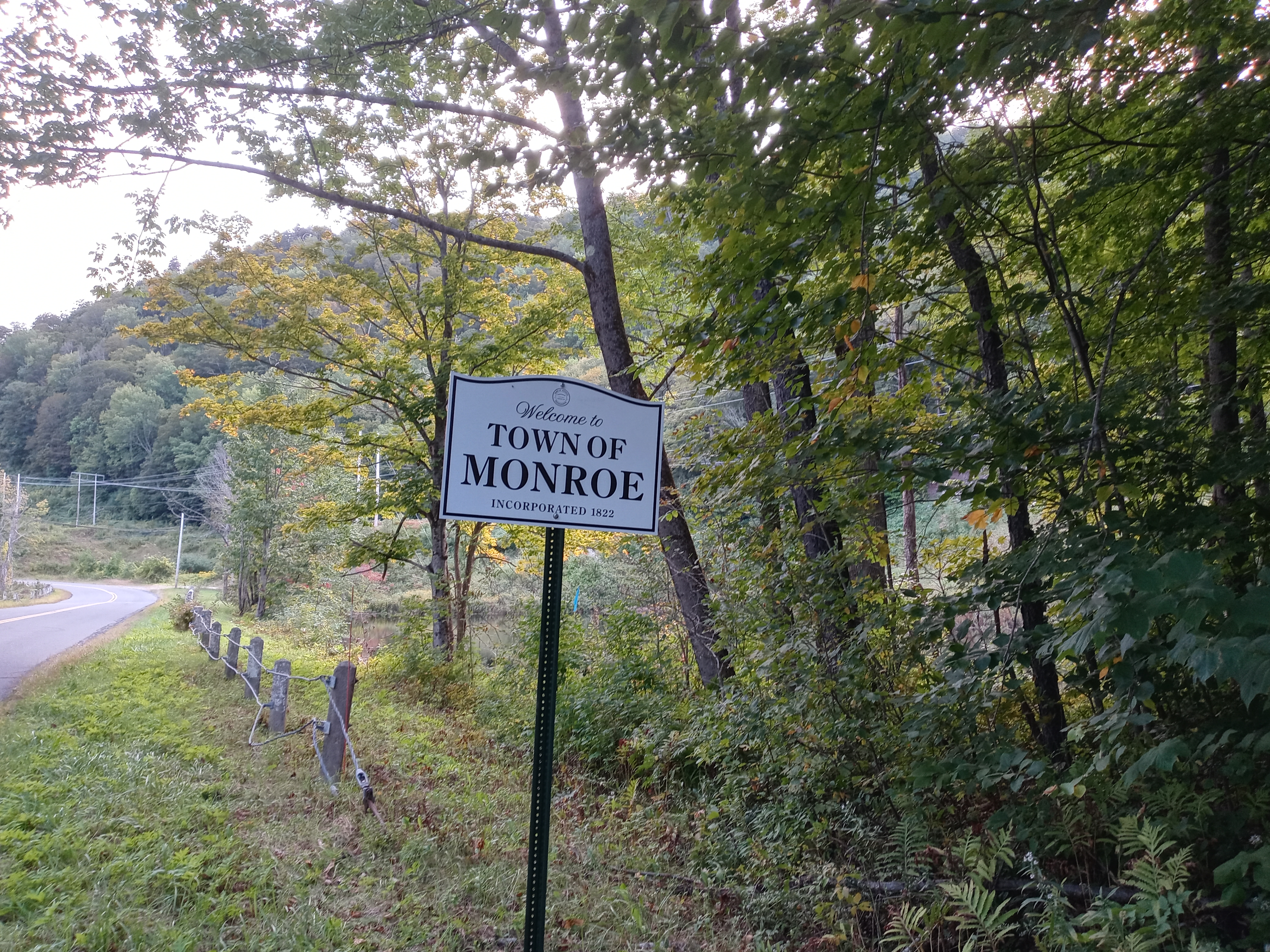
And even if you have never visited, there are now new signs to welcome you. This is the one you will see if you cross the state line from Whitingham, Vermont into Monroe.
The United States is having a rough couple of weeks on the hurricane front. First, Fiona caused major damage in Puerto Rico, and now, Ian has cut a huge swath of destruction across Florida and is making a second landfall in South Carolina.
There have been massive flooding, wind damage, and major infrastructure impacts, including roads, bridges, and electrical, water, and communication systems. Sadly, there have also been injuries and deaths attributed to the storms and their aftermath.
Aid is being rendered by governments at all levels, by utilities, by charitable organizations, and by volunteers.
After the immediate emergency needs are met, attention will turn to rebuilding.
The first question to ask is “Should we?” There are places where the answer may be “No.” I’m thinking about places like barrier islands and directly on shorelines that are geologically unsuitable, being vulnerable to both storms and sea level rise. Further, the sand that characterizes these areas is meant to move and their natural structure serves to help protect inland areas from the worst of the storm surge and winds. Building there is asking for trouble and re-building there is setting up for losses in the future. With stronger and more frequent storms forecast due to global warming, it may be wisest at this point for government and insurers to buy out property owners in these vulnerable places so that homes and businesses can move to safer locations inland.
In other places, rebuilding may be possible but with much stricter requirements. For example, buildings can be elevated so that flood water can rise beneath them without damaging living space. Structures can be designed to be wind-resistant so roofs don’t blow off during storms. Mobile homes, unless they really are mobile, i.e. on wheels so they can be easily relocated away from danger, should not be allowed at all in storm zones.
It’s vital to rebuild infrastructure with resilience in mind. Five years ago, hurricane Maria destroyed the power grid in Puerto Rico. It was still fragile when Fiona hit but locations that had switched to solar power with battery backup were able to keep their power on. Tropical coastlines are great places for solar power and also for offshore wind, which could have the added benefit of reducing wind speeds from storms.
These changes won’t be easy but they are necessary. The alternative is to continue the cycle of destruction and expensive rebuilding over and over again.
Some of you may be thinking that I don’t understand the difficulty and trauma of leaving a beloved location instead of trying to rebuild there, but I have seen it up close in my town. After the last two record floods of the Susquehanna in 2006 and 2011, many people here faced the decision to rebuild in the same place, perhaps with elevation, or move elsewhere. If people took buyouts, the sites of their former homes were converted to greenspace. There are two neighborhoods near me that are dotted with these lots that used to be homes and yards.
My family lives with the realization that our home, on which we carry flood insurance even though we are not technically in a flood zone, could be impacted in the next record flood. (We are just a few blocks from places that flooded last time.) Depending on the damage incurred, we could be faced with the same decision to take a buyout or repair and elevate our home. It’s painful to think about and I don’t know which we’d choose.
We’ve been here for over 35 years. It would be hard to leave the neighborhood. I do know, though, that we wouldn’t ignore reality/risks and try to rebuild as we are now.
A few days ago, spouse B, daughter T, and I attended the wedding of M and S. M is B’s and my niece and is the cousin closest in age to T.
M is also a big fan of Disney World. S chose to propose to M there and M planned their wedding and reception with a Cinderella theme, including the napkin above. There were castles and glass slippers and golden coaches incorporated into decorations, dancing into the night, a beautiful gown with yards of tulle.
Many echoes of a classic fairy tale.
But M and S don’t have an ordinary life. M is nurse with special training in emergency medicine who currently serves as a flight nurse, transporting critically ill or injured people to medical centers that can give them the best care possible. S is a state trooper, doing his best to keep people safe and assist them in emergencies.
They both do extraordinary things on a regular basis.
They also are facing an extraordinary challenge. Early in their courtship, M developed a serious medical issue but S stayed by her side, even when M tried to break up with him in order to protect him.
The strength of their bond in the face of adversity brought more than the usual number of tears at the wedding and during the toasts at the reception, where even the especially-stoic state troopers choked up over M and S’s love story.
Even at a fairy tale wedding, there are no guarantees of how long the “ever after” will be.
M and S showed us, though, that their love is strong and eternal, whatever obstacles are thrown in their path.
On Saturday, September 17, 2022, I went back to my hometown, Monroe, Massachusetts, for their bicentennial celebration. There will eventually be a proper post about the fun and meaningful day I had there but I wanted to give a little shout-out today.
These welcome signs are new. This is the one at the Massachusetts/Vermont state line about half a mile from where our house was back in the day.
I’ve been out all day at the bicentennial of my hometown so this will be a short SoCS post.
When I saw that Linda’s prompt was ring, what came to mind was the poem I wrote about taking off my father’s wedding ring after he died. The first anniversary of his death was Wednesday. The poem was published this spring by Wilderness House Literary Review here. ***** Join us for Linda’s Stream of Consciousness Saturday! Find out more here: https://lindaghill.com/2022/09/16/the-friday-reminder-and-prompt-for-socs-sept-17-2022/
I’m pleased to announce that I have two new poems published in the Fall-Winter issue of Rat’s Ass Review! (In case you are wondering about the somewhat unusual name, read the longer version of their submission guidelines, which is one of the most informative, honest, and entertaining I’ve ever encountered.) Many thanks to current editor Roderick Bates for choosing my work for inclusion in this issue.
There are 61 contributing poets plus cover art, so there’s lots to enjoy! Contributors are arranged alphabetically, so you will find my poems listed under Joanne Corey. Clicking on any poet’s surname takes you to their bio in the last section.
The inspiration for my first poem “The Banned Bookmobile” is a project under development at WordPlace, the Southern Tier Literary Center at the Bundy Museum, Binghamton, NY. J. Barrett Wolf, director of Wordplace, is planning to assemble a collection of banned/challenged books in a bus that can travel about to present programs on the First Amendment, censorship, and other topics. (Editor Rick Bates helpfully made the title of the poem a link to the web page for the project.)
For those of you who may not be familiar, in rural/underserved communities, it was common to have a bookmobile visit several times a year, giving schoolchildren and adults the chance to borrow a wider range of books than were available in town. I remember the excitement in my rural New England town of 200 when the bookmobile visited. Although I loved our town library, it was very small and the bookmobile offered many more options.
My poem references several books/series that have been banned from various schools or libraries in the United States, including And Tango Makes Three, the Harry Potter series, The Bluest Eye, and To Kill a Mockingbird.
“Video Chat with our 95-year-old Father” was written in early 2021, shortly after Paco had moved into the assisted living unit of his senior community. Due to pandemic restrictions, my sisters and I weren’t allowed to visit his place, even though I lived nearby. The staff would set up a video session with their iPad and then leave to attend to other duties. Unfortunately, Paco had difficulty grasping the situation and the technology involved.