SoCS: carousels

To my immediate left is a throw on the back of the couch which features carousel horses.

Here in Broome County NY, carousels are part of our identity. Back in the early part of the twentieth century, one of the important sources of jobs for immigrants and for people already established here was the shoe company named Endicott-Johnson for its founders. They also gave their names to two of the villages, Endicott and Johnson City, that with the City of Binghamton make up the Triple Cities of Broome County. I’m sure everyone is excited to learn this local geography!

The Endicott and Johnson families wanted their employees and their families to have a good quality of life, so they paid them fairly and helped with home ownership, as well as innovations like providing health care and pensions. They also invested in creating recreation opportunities, which brings us to carousels.

The families installed carousels in six public parks scattered around the area. Because they didn’t want anyone to be deprived of a ride, part of the stipulation of the gift was that they would always be free to ride. And because one of the founders recalled the disappointment of getting onto a carousel but being on a stationary horse, all the horses on these carousels are “jumpers” which means they go up and down as well as ’round and ’round.

Most of the figures on the carousels are horses, but some also have a couple of other animals included, such as a dog or boar. Most of the carousels also include chariots to accommodate babes-in-arms or anyone who can’t climb up onto a horse.

When my daughters were young, we spent many hours at the various carousels. They traditionally open Memorial Day weekend and close after Labor Day weekend. I admit that I also love to ride carousels and we would see many other adults there, too. Sometimes, bridal parties will even make stops at the carousels to take photos. My favorite visitors would be elders who grew up in the area but then had moved away; they would come to take a ride and tell stories of how it had been visiting the carousels when they were young.

In our photo albums, we have a succession of years of photos of E and T visiting the carousels. It was a privilege when granddaughter ABC was living with us to introduce her to the carousels, too. It won’t be this summer, but maybe next it will be safe to travel and we’ll get to bring ABC and her little sister JG to the carousels for a ride. We’ll take photos with our phones that they can look at when they return home to the UK and remember.

ABC’s first carousel ride in a chariot being held by her mom with her dad riding on the horse beside them

*****
Linda’s prompt for Stream of Consciousness Saturday this week was to write about the memories evoked by what was to one’s immediate left when writing the post. Join us! Find out more here: https://lindaghill.com/2021/05/07/the-friday-reminder-and-prompt-for-socs-may-8-2021/

post-vaccine life

With my immediate family in the US vaccinated against COVID-19, we are inching our way back to a more interactive life while still following the national and New York State guidelines.

The most important thing that has happened for us personally is a greater ability to see my dad, known here as Paco, who lives nearby in the assisted living unit of his long-time senior community. After months of not being able to visit, we can now go to his apartment, albeit in pre-arranged thirty minute slots. I can also sign him out to go for a car ride; previously, he was only allowed away from the unit for medical care.

This has meant that I can see him more times per week and that I can take him out for treats. Last week, we went to an ice cream stand in the afternoon. This morning, I was able to bring him to get a doughnut and coffee. We are still being cautious about indoor spaces, so I don’t bring him into buildings. We enjoy our treats in the car or at outdoor tables.

The best thing, though, was that my older sister and her spouse were able to come visit for a couple of days last week. They hadn’t been able to visit since last summer. They live in Maryland and couldn’t enter New York until recently due to our travel/quarantine restrictions. Because of the vaccines, those have been relaxed. With all of us vaccinated, we were able to have everyone to our house for dinner. B made lasagna from Nana’s recipe, homemade Italian bread, sautéed asparagus, and apple pie. It was all delicious – and extra heartwarming to be together after so many months apart.

We are also starting to work our way back to activities like dining indoors. I’ve had one lunch and one dinner inside restaurants. We wore masks when not eating or drinking and the tables were spaced so that we weren’t very close to other diners. We are likely to continue doing carryout more often than dining in for a while, especially because dining in most likely involves having to make reservations while carryout is easier to do spur-of-the-moment.

There was just a national policy announcement clarifying mask use recommendations for outdoor events in light of vaccinations. Vaccinated people can exercise, socialize in small groups, and eat outdoors without needing to wear a mask. They should, though, continue to mask if they are in a large group setting, such as a sporting event or concert where the crowd would be close together for extended periods. It is good to have this clarification, but it won’t make much difference for our family. New York has had a mask mandate in place for over a year, but it was adapted in order to deal with the circumstances. Given that we don’t live in a congested area, we were already accustomed to taking maskless walks in our neighborhood. If we stopped to talk to someone, we would just keep six feet of distance between us. Still, it was good to see that there are now different recommendations in place for vaccinated and unvaccinated people. Perhaps it will serve as motivation for people who haven’t yet been vaccinated to arrange to do that. In many locations, you don’t even need to make an appointment in advance.

If people need more motivation to get vaccinated, they can switch on a news report from India to see the horrific toll that the virus takes when it sweeps through an unvaccinated population. The infection and hospitalization rates are staggering. A new variant has emerged and there are so many deaths that the system to handle them is overwhelmed.

This virus remains very dangerous, capable of inflicting serious illness and death. The vaccines are safe and very effective. Everyone aged sixteen and over in the United States has access to vaccine and should be immunized unless there is a personal medical issue that precludes it. If you don’t feel personally vulnerable, remember that, even if you yourself don’t get severe symptoms, you could pass the virus on to someone else who could become very ill or die.

The only way to end the pandemic is for there to be large-scale immunity everywhere. Every effort we make, whether it is our individual vaccination and precautions or our large-scale efforts such as sending vaccines, treatments, and supplies wherever they are needed around the world, is part of what is needed to end this.

And remember: People taking vaccines approved for emergency use are not “guinea pigs.” The “guinea pigs” are the hundreds of thousands of people like me and my family who volunteered to be in clinical trials. (B, T, and I are all part of the Pfizer/BioNTech phase III trial. I’ve posted about it a number of times over the past months.) Government agencies and the pharmaceutical companies are continuing to collect data and have affirmed that the dangers of contracting COVID are much, much greater than any side effects of the vaccine.

Please, everyone do your part to keep yourself and others safe. Vaccinate, mask, distance, and practice good hygiene. Pay attention to credible medical and public health sources. The rewards of being able to safely gather, to give a hug to a loved one, to see a friend’s smile are simple, yet profound.

We just need to work together to make it possible for everyone, everywhere.

Another reading!

It’s been quite a poetry reading week for me! I shared the link for my reading with the Broome County Arts Council here and now I will be sharing an event that happened on Tuesday evening which is now available for viewing through Facebook.

The University Professors Press hosted a book launch and reading for Lullabies and Confessions: Poetic Explorations of Parenting Across the Lifespan. It is the eleventh volume in their Poetry, Healing, and Growth series. I was honored to have my poem “Hydro Superintendent” chosen for inclusion in this anthology.

The event began with an interview of Dr. Louis Hoffman and Dr. Lisa Xochitl Vallejos, both of whom are psychologist/counselors and poets. They are the anthology editors, as well as contributors of poems and authors of the introduction and response activities. I was fascinated to hear them speaking about how they use poetry in and as therapy. The discussion resonated with me as a poet who recognizes the power of poetry to evoke deeper truths and who often uses writing to work through my reactions to real-life events.

Following the interview, over a dozen of the poets read their work from the anthology, including me. The range of work is wide and, as you might expect, some of the topics of the poems are difficult. A poem that dealt with racism was especially searing as we had learned the verdict in the George Floyd case just hours before the event.

The links in the second paragraph will take you to the reading and to University Professors Press if you wish to order your own copy of the anthology. You can also navigate to other volumes in the series, which I’m sure are all equally illuminating about the human experience.

vaccine update

Here in the United States, we are continuing to roll out coronavirus vaccines as quickly as possible, although there are a few snags.

The biggest is that the one-shot Johnson & Johnson vaccine is on temporary pause, due to six cases of a rare blood clotting problem that have been reported among women aged 18-48 within two weeks after vaccination. Given that over six million doses have been administered, the percentage affected is tiny, but the two agencies in charge are being cautious, especially as a small number of similar cases have been reported in Europe in connection with the Oxford/AstraZeneca vaccine, which, like the J&J, is an adenovirus-based vaccine. The pause is allowing them to gather and assess data. Additional cases may surface because of the attention this is receiving in the media. It also lets physicians know to ask about vaccine status when a patient presents with blood clot symptoms. This is important because vaccine-related blood clots call for a different treatment regimen. The hope is that the J&J vaccine will again be cleared for distribution within the next two weeks.

The public reaction has been mixed. Some people say that this pause shows how closely public health officials are tracking the various vaccines and their effects, which raises their confidence level. Others are worried that this means the vaccines weren’t sufficiently tested. A few who have received the J&J vaccine are panicking.

As someone who has been involved in vaccine trials, currently the Pfizer/BioNTech coronavirus vaccine but previously trials for flu, adult RSV, and pneumonia vaccines, I can attest that researchers are very careful in how they conduct trials. However, when you have a side effect that seems to appear in such a small number of people, you are unlikely to find it in a trial of thirty thousand people. If it turns out that the blood clot complication does occur, a person is more likely to be struck by lightning than to develop a blood clot after J&J vaccination. I hope this would calm anyone who is panicking, although people often fear rare events while ignoring those that are much more likely to impact them.

I admit that it boggles my mind that, with over thirty-one million known COVID cases in the US and over 565,000 deaths, people would fear an extremely rare side effect more than the virus itself. There are still about 25% of adults who say they will not get vaccinated, which raises the prospect that we won’t be able to stop community spread and end the pandemic because the pool of susceptible people will remain too large. Also, remember that some people who have been vaccinated may still be infected, but their chances of being severely ill are greatly diminished. Still, the way to end the pandemic is to have 85-90% of people vaccinated so that cases of the virus can be contained rather than spreading throughout the community.

It will help when those younger than 16 can be vaccinated. Pfizer has currently asked for permission to add 12-15-year-olds to those eligible after conducting a trial with that age group. Pfizer, Moderna, and others are also conducting research on the best dosages for younger children.

Meanwhile, research is continuing into how long immunity from the vaccine will remain strong. Spouse B and daughter T who received the Pfizer vaccine last August as part of the phase III trial are part of the effort to answer that question. The six month figures showed that immunity remained strong but they will be followed for at least two years to see how that may change with time. The Pfizer CEO Albert Bourla has said that he thinks a yearly booster is a possibility; they have begun studying this with phase I trial participants. We’ll see when B and T have their one-year follow-up in August whether or not they will have extended the booster dose study to phase III participants.

It is my sincere hope that by then we will have been able to fly to the UK to visit our family there and to meet granddaughter JG in person. While we are doing all we can to make that safely possible, it is frustrating to still see so many people not willing to cooperate with public health measures to keep themselves, their loved ones, and their communities safe using masks, distancing, limits on gatherings, vaccines, etc. to end the pandemic.

Yesterday, there was a Congressional hearing at which Dr. Anthony Fauci, one of the leading health officials in the country, was testifying. Rep. Jim Jordan illustrates the dynamic that has resulted in the unfortunate and dangerous politicization of the pandemic. This is a public health issue, not a “freedom” issue. Living in a free society does not mean that everyone is free to do or say whatever they want; we each have a corresponding responsibility not to cause harm to others or damage their rights and human dignity.

This brings me to my last point. The pandemic affects the whole world. Under the prior administration, the United States suffered terrible losses and did not contain the spread of the virus. Under the Biden administration, the US is making progress and has taken some steps to help the rest of the world in the fight against COVID. The US is now part of the COVAX initiative to help distribute vaccines to lower-wealth countries, although this is just getting underway. It has also sent some of its stockpile of the AstraZeneca vaccine, which has not yet been approved for emergency use in the US, to Canada and Mexico where it has been. While I expect the US to retain doses of approved vaccines as boosters, I’m hoping that once everyone who will accept the vaccine in the US has been vaccinated that we will distribute all the other doses to countries that need them, along with whatever other logistical and medical help is needed.

We can never end the pandemic until the virus has nowhere on the globe where it can run rampant. To me, this is a moral imperative. Others may be motivated by economic self-interest. Whatever the reason, it needs to happen.

Review: A Secret Love

I grew up in a rural area where television was purely by antenna, although we received NBC, ABC, and CBS, the three major networks at the time, which was a luxury. I’ve never been able to keep up with the increasingly complicated media landscape of cable, premium channels, satellite, and streaming options. I’ve gotten used to reading lists of Emmy nominees of shows I have never seen and to which I don’t have access. I usually can’t even keep track of what show or movie is being offered on which platform.

I do occasionally happen upon a recommendation that I can follow through on viewing. I was reading a list of awards geared for older adults from AARP which included the 2020 documentary A Secret Love. It is available through Netflix, the one streaming service to which we are currently subscribed, so spouse B, daughter T, and I settled in one evening to watch it.

A Secret Love is the story of Pat Henschel and Terry Donohue, two Canadian women who fell in love and made a life together in the United States where Terry had played baseball with the Peoria Redwings of the All-American Girls Professional Baseball League. While family back in Canada knew the two were close friends who shared a home, they did not know that they were life partners for many decades. While the film does give us their remarkable personal history, the documentary concentrates on their later years, as they face Pat’s illness and decisions about where to live.

Having dealt with the issues of serious illness, financial and legal complications, and housing decisions with B and my parents, I found much of what Pat and Terry were facing relatable. The complexity of the family dynamic, the cross-border legal issues, and the fact that, while Pat and Terry had been a couple since 1947, they did not have the protection of marriage when it came to things like hospital visitation added even more poignancy to an already daunting situation.

What comes through most clearly, though, is the depth of their love for one another. I am always moved by couples whose bond is so strong that it weathers decades of life together and Pat and Terry’s story is such a beautiful example of that. I will warn you that if you, like me, are inclined to teariness, you may want to have your handkerchief handy.

I will also say that, while the story is about elders, it also holds meaning for younger adults. T loved the film as much as I.

SoCS: last year and the year before

There is an old song “What a Difference a Day Makes” but today I’m thinking about what a difference a year makes.

Or two.

Two years ago this spring, my mom, known here as Nana, was living in the skilled nursing section of the senior community where she and my father, Paco, had lived for ten years. She was under hospice care as she was nearing the end of her battle with heart failure. My father and I visited every day for hours with frequent visits from my daughters and granddaughter ABC, who were living with us at the time. My out-of-town sisters were able to come to visit often, too.

Nana passed away in May 2019, a few days after her 87th birthday. We were able to hold her funeral in her parish church with a visiting hour before with friends coming to comfort us. There was also a gathering at her and Paco’s senior community.

Last spring, we were all in COVID lockdown. Visiting nursing homes was totally shut down with very limited exceptions for end-of-life situations. I often thought of what that would have looked like for us, if Nana had been facing death in spring 2020 rather than 2019. We would have lost those last few weeks with her, which were painful but also filled with precious moments. We were able to bring her flowers, including her beloved lilies-of-the-valley which blossom in May, just in time for Mother’s Day and her birthday. One of the last things she was able to eat was a little fruit tart I had brought for her birthday. I helped her by cutting it and fed her as she had me when I was a baby…

In 2020, we would likely not have been allowed to visit until the very end when she was unconscious. The church was totally closed, so there would have been no funeral, not even for family.

It was hard last spring, too, because we could no longer visit Paco every day in his apartment. Although visits to independent living apartments were not totally forbidden, they were supposed to be limited, with some masked outdoor visits preferred over anything indoors. My sisters had planned to visit for Paco’s 95th birthday in March but that had to be postponed. Little did we realize at the time that that postponement would turn into cancellation.

That brings us to this spring, which is just getting underway here with some of the early bulbs flowering and the first trees starting to bud. Paco is now living in assisted living which is part of the health care center. While visiting and gathering there are still limited, my younger sister and I were able to visit him for half an hour in his apartment on his birthday and he was able to share a large birthday cake we provided with the other residents and staff on his unit later in the day. Later this month, my elder sister will be able to visit in person for the first time since last summer. She lives out-of-state so hasn’t been able to travel to New York without prohibitively lengthy quarantine, but now, with vaccines available and changes in state policy, she will finally be able to see Paco again.

We have no idea, though, if or when daughter E and granddaughter ABC will be able to visit. They moved permanently to the UK in fall 2019, joining son-in-law L in London. They have since been joined by granddaughter JG, who recently had her first tooth break through.

Spouse B, daughter T, and I would love to think that this spring we could jet off to London to meet JG in person for the first time, but it isn’t possible. Maybe this summer? It depends on conditions with the pandemic and travel restrictions.

Will we get to hold her while she is still a baby or will she be an on-the-move toddler by that time?

Will Paco ever get to meet her in person? For the UK family branch to visit the US is much more complicated and we have no idea when that will be feasible. We also, sadly, don’t know how things will go with Paco’s cognitive decline. While sometimes he remembers names of family members, sometimes he forgets them.

Sometimes, he forgets that he has great-grandchildren at all.

In 2019, I knew that spring 2020 would be very different because my mother would not be there. I could not have imagined how different 2020 would turn out to be.

Or 2021.

I dare not project to spring 2022.

*****
Linda’s prompt for Stream of Consciousness Saturday this week is “difference.” Join us! Find out more here: https://lindaghill.com/2021/04/09/the-friday-reminder-and-prompt-for-socs-april-10-2021/

One-Liner Wednesday: Happy 96th!

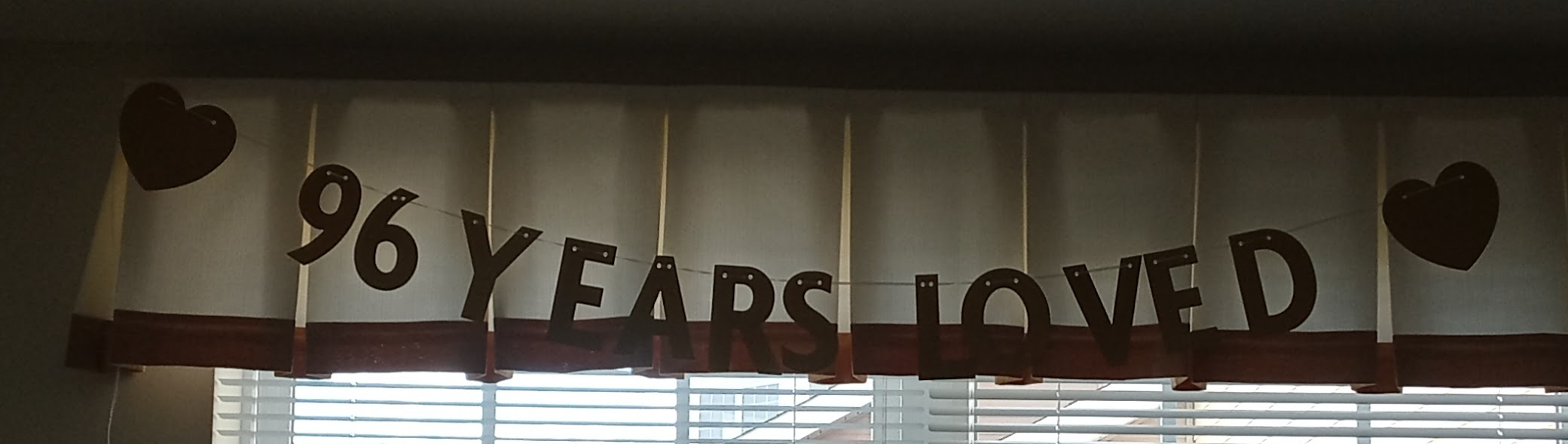
banner with two hearts saying 96 YEARS LOVED

A gift from my sister to honor our dad, known here as Paco, on his 96th birthday last week. ❤

Join us for Linda’s One-Liner Wednesdays! Find out more here: https://lindaghill.com/2021/03/31/one-liner-wednesday-had-to-run/

vaccines vs. variants

Right now, the United States is a place of both hope and fear regarding COVID-19.

The hope comes from the increased pace and availability of vaccine distribution. The two-shot regimens from Pfizer and Moderna and the single-shot Johnson & Johnson have all been approved for emergency use and are being distributed as quickly as possible. There have been over three million shots given daily in recent days. It’s possible that a fourth vaccine, a two-shot course from AstraZeneca may also receive emergency use authorization in the coming weeks. Approximately 29% of adults in the US have received at least one vaccine dose. While most states concentrated first on the older demographic and health care workers, eligibility has expanded to include medically vulnerable adults and middle-aged adults. In some states, the eligibility age has or will soon drop to 16 where Pfizer vaccine is available or 18 with the other two vaccines. Trials are underway to determine the appropriate dosages for younger children. New data have shown that the Pfizer and Moderna vaccines are 90% effective at preventing infection in real-world application; this expands the information from the trials which looked for COVID symptoms and could have missed asymptomatic infections.

There are problems looming, though. A significant proportion of adults say that they will not be vaccinated at all. There is also a political divide in evidence. A recent survey showed that 49% of Republican men are refusing the vaccine. It will be very difficult to halt community spread if so many millions of people remain unvaccinated.

This vulnerability is in addition to the fact that too many places have relaxed their rules about wearing masks, the size of public gatherings, and capacity of indoor venues. Travel within the US has skyrocketed, including air travel. Many college students have gone on spring break trips to warmer states and gathered in large crowds without masks. The majority of states are seeing their COVID cases rise. Yesterday, Dr. Rochelle Walensky, director of the Centers for Disease Control and Prevention, said that she felt a sense of “impending doom” because cases, hospitalizations, and deaths are rising as restrictions have been lifted. She and other health experts fear that the US is at risk for a fourth surge. The protection of the vaccines won’t be able to keep pace with the virus spread by people not observing public health guidance on precautions.

There is also the problem of more infectious variants. The B1.1.7 variant is spreading rapidly in some regions and there is a separate variant that has been identified in the New York City area. While the current vaccines seem to be doing a good job preventing these variants, it will still be harder to stop community spread with the more infectious variants in circulation.

I urge everyone to get vaccinated as doses become available for their age group in their localities. Because spouse B, daughter T, and I all participated in the Pfizer/BioNTech Phase III trials, we are fully vaccinated, B and T last August during the blinded phase of the study and myself in February when the placebo group was offered the vaccine to join the study group on long-term efficacy. (There are numerous posts about our experiences with the vaccine trial if you type Pfizer in my blog search box.)

I appreciate the things that are easier to do now that I am vaccinated. The most important thing is that I am much less worried when I visit my 96-year-old father, know here as Paco. Paco is also fully vaccinated and, while I still follow the protocols to mask and distance, I am now allowed to visit inside his apartment in assisted living.

I took an unmasked walk outdoors with a friend. I have been able to do some health care visits in person rather than virtually. I go to the grocery store with just one mask instead of two. I went to mass in person for the first time in a year and have reserved a place to attend Easter Vigil Saturday evening. My fully vaccinated sister stayed overnight at our house where we could safely be together maskless.

She and I even ate at an indoor restaurant for lunch, masked when we were not eating. The restaurant had good table spacing; our region currently allows 75% capacity at restaurants and our community transmission rate is low. In general, we usually still order carryout, but I think in a few months we may be more comfortable with dining in on a more regular basis. One of the good things about living in New York State is that we have generally been cautious about public health measures and the extent to which certain activities are allowed. Extensive testing is being done so that, if the number of cases begins to rise, they can react quickly to dial back on activities to keep the outbreak from getting worse. Having seen this measured, data-driven approach work in New York, I am that much more worried when I see other places abandon mask mandates and capacity restrictions precipitously. It not only hurts their own residents but also people in other locations because travelers can bring the virus home with them.

I don’t know yet when I will be comfortable resuming travel. If we can continue robust vaccine distribution and infection rates are low, maybe B and I will be able to take a short trip together for our anniversary in June. I had hoped to return to North Adams for another private writing retreat this spring, but I need to see what happens with vaccine distribution and transmission rates over the next few weeks to decide if that would be wise.

Of course, the big prize will be when we can go to the UK to visit daughter E, son-in-law L, and granddaughter ABC and finally get to meet granddaughter JG in person. We are hoping it will be on or before her first birthday in August, but it is impossible to plan. While the UK has also been on a vigorous push for vaccine distribution and re-opening, E and L haven’t been eligible for vaccination yet and what the rules will be for summer visitors from the US is a mystery.

Still, we are closer to being able to go than we have been before and we have also built up our own capacity for patience. Love, care, and concern for others are great motivators to remain cautious and vigilant until the pandemic is truly over.

back to church

Yesterday, for the first time in over a year, I attended mass in person.

If you had told me prior to the pandemic that I would ever go a year without going to church, I would not have believed it. I grew up Catholic and going to mass for Sundays and holydays was an important part of our faith practice. I was in church as a teen more than most because I became our small country church’s only organist in my second year of high school. I spent many years in music and liturgical ministries and, although I hadn’t been active in them in recent years, I still considered taking part in mass and receiving the Eucharist a vital part of my faith life.

Last March, when the severity of COVID was first becoming apparent, I decided not to go to mass for fear of exposing my father, one week before New York State went into lockdown and the churches temporarily closed. I began participating via televised mass as my mother had done when she was ill. Over time, churches here resumed services, first outdoors or broadcast to congregants in their cars in the parking lot. Later, indoor services were permitted with distancing, masking, temperature checks, pre-registration, and other measures in place, although the bishops have kept the dispensation from in-person attendance in place.

Because being part of a large group of people who are speaking and singing is inherently more risky than being at home or in a grocery store, I had made a personal decision not to attend mass in person until I was fully vaccinated. Last week, two weeks after my second dose of the Pfizer vaccine, I called the church to make a reservation to attend the Saturday vigil mass yesterday.

I arrived early, knowing that there would be a check-in process and that we would need to maintain spacing. I was masked, of course, and gave my name to the volunteer at a table, who found my name and contact information on her list. They keep the information on file so they can call if a positive test is reported. There was a temperature check and the distribution of a leaflet with the day’s music. I was allowed to choose my own seat among the pews, although every other row was blocked off by purple cords draped around the end. I sat near the music ministers, so that I could watch my friend play the organ and see the cantor who would be leading the singing.

If I had to choose one word for the experience, it would be stark. This is partly a function of it being Lent, which is a penitential season. There are no flowers and the sanctuary is kept as simple as possible. What was striking to me, though, was the space between all the ministers. The priest, deacon, two lectors, and single altar server were in chairs scattered around the altar and ambo, which is necessary for viral reasons. It amplified my sense of separation from them and from the rest of the congregation. Only people from the same household can sit in a group, so many of us were sitting alone.

I felt most like I was part of the assembly when we were praying aloud together. Although we were masked and there were far fewer of us than our pre-pandemic numbers, our voices carried well and we could hear one another, ironically helped by the acoustics of the space without so many bodies to absorb the sound. This was, however, a double-edged sword. During the prelude, I was annoyed by a couple behind me discussing home improvement projects, no doubt unaware how well their masked voices carried in the space.

As often happens, there were emotional moments for me during the liturgy, although not when I had expected them. As part of the prelude, my friend improvised on the Irish hymn tune St. Columba, which is often used with the text “The King of Love My Shepherd Is”. It is one of my favorite tunes. Back in the days when I could play the organ and was practicing, it was one of the hymns I would sing as a personal prayer. I was very grateful to hear it yesterday.

When we prayed the Lord’s Prayer together, I was particularly drawn to the last phrase, “deliver us from evil.” I am still pondering the full implications of being drawn to that at this time. Like most Christians, I have prayed this prayer thousands of times. It is a testament to its strength that it reveals different aspects of faith as our circumstances change.

The third moment was that I choked up as we started to sing the Lamb of God. This simple text, which is placed in the liturgy shortly before communion, has long been my favorite prayer of the mass ordinary. Long ago, I set it in a choral anthem paired with a text from Isaiah. Again, a prayer that I have recited or sung thousands of times but that was somehow connecting with me in a new way.

Strangely, the thing that I expected to be very emotional was not and perhaps goes back to my feeling of starkness. In order to maintain distancing, communion was not distributed at the usual time. Instead, we prayed the concluding rite and then received communion. The priest and the deacon went to positions at the end of the far aisles and the congregants, keeping six feet of distance between them, filed up to receive the host, step away, briefly lower their mask to consume the host, then immediately process to the doors by a different route and exit, all while the communion hymn was being sung. Because I was near the front of the church, that meant exiting during the hymn without an opportunity to join in that prayer. Intellectually and from the public health viewpoint, this procedure for communion makes perfect sense. It keeps people from congregating in the building or around the exits and minimizes the chance of spreading the virus. From a liturgical perspective, though, it feels stark. The word Eucharist means thanksgiving and the word communion has the same roots as the word community; this more isolating experience feels counter to that. As someone who has study music and liturgy, it also was very difficult for me to leave while there was still sung prayer ongoing.

I was grateful to be able to attend in person but I don’t think that I will try to do it every week yet. Due to the cleaning protocols involved, there are only two masses per weekend; with fewer masses and reduced capacity, I don’t want to deprive other people from being there by taking up space myself on a regular basis. I do hope to go once during Holy Week, Easter Vigil if possible or Holy Thursday if the Vigil is in high demand.

Otherwise, I will continue to participate from home until our area progresses to the point where we can gather safely in large numbers again, when we can exchange a sign of peace, when things will not be so stark.

When we do get to that point, there will be another, more complex decision to make, which is how much of the politics and abuses of power in the church itself I can continue to tolerate. The clergy of the church continue to grapple with its own history and legacy of crimes, abuse, and sin, or worse, some grapple and some continue to deny. Meanwhile, lay people are not given the opportunity to fully use their gifts in service to the people and the church.

It’s exhausting.

The pandemic has blunted the effect of having this struggle before me every week. I haven’t decided yet if I can take it on so consistently again. I used to go to mass every week, even when I cried because of the pain. I did it because I couldn’t imagine being separated from the Eucharist. Because of the pandemic, I now know that spiritual communion is a reality, that I can feel close to Christ and to creation and all people, even when I’m not able to attend mass in person.

I don’t know what I will choose to do.

Another aspect of life in which I dwell in mystery.
SoCS: the last year

I had planned to post about the pandemic anniversary today, so it was fortuitous that Linda took the occasion to have us write about our past year. She also gave us permission to edit if we chose, so this post will be only stream-of-conscious-ish. I’m hoping to only need to do light editing.

So, compared to most other people in the US, I have been fortunate over this pandemic year. My spouse B has been working from home so we didn’t take a financial hit. He and I and daughter T have been safe in our home. My state, New York, was initially hit very hard by the pandemic, although not as much so in my home region of the Southern Tier. While we did have a period of time as a local COVID “hot spot,” we followed the precautions on masking, avoiding gatherings, handwashing, etc. and stayed safe.

This is not to say that we didn’t have to make changes in our lives. T’s job search has been on indefinite hold. Grocery shopping and meal planning became a major endeavor for me, due to shortages and restrictions. Some of my poetry activities moved online, but the year hasn’t been as productive as I had hoped. The Boiler House Poets Collective annual residency at MASS MoCA was cancelled due to COVID, although I did craft my own writing retreat in North Adams in late summer which turned out to be a perfect time, given the sooner than expected fall surge. (Additional posts from that time are here and here.)

There are two big personal impacts for me as a result of the pandemic. The first is the separation from daughter E and her family, who live in London, UK. We visited in December, 2019, with plans for several 2020 trips, including a visit to meet our new grandchild, and a plan for them to visit us here in the States in December 2020. None of that happened, due to COVID. While we have been in touch virtually, we have all been largely confined to our respective homes. It’s been hard watching from a distance as they dealt with likely cases of COVID in their household at a time when there wasn’t even testing available unless one needed hospitalization. We missed granddaughter ABC’s third birthday and the birth of granddaughter JG. We missed ABC starting nursery school, which has been variously in person and virtual depending on how viciously the virus was spreading in London at any given time. JG is now seven months old and we have no idea when we will be able to visit. She may be a toddler by the time we get to meet in person.

The second personal difficulty has been trying to care for my almost-96-year-old father, known here as Paco. Before the pandemic, we visited him every day in his apartment in the independent living building of his senior community. His memory was poor, but we were able to keep him safe and on an even keel. Once the pandemic began, though, we needed to limit contact, so we reverted to handling most things by phone with screened staff handling some tasks that had to be in person. This proved to be difficult but when Paco developed a medical problem that required a few days in the hospital, it became impossible for him to be safe in his apartment. In December, he moved to the health care building, first for three weeks of rehab in the skilled unit and then permanently to the assisted living unit. This is where he needs to be at this point, but due to state COVID rules, it was very difficult to visit in person. I am happy to report, though, that yesterday and today we had our first visits to his new apartment; before that, we had to meet in the visitors room or do window visits where we spoke by phone on either side of a window. We still have to mask and distance, but we could at least organize and tidy his rooms for him.

The greatest difficulty that is more universal is the sorrow at the immense cost the pandemic has exacted. So much illness. So much death. So many without even the most basic essentials for a secure existence. So much social isolation. So many who risked their own health to meet the needs of others. In the United States, the bewildering politicization of the crisis.

As we have been commemorating this first anniversary of the pandemic, though, I am feeling hopeful. We are about seven and a half weeks into the Biden administration and vaccine distribution has seen a big boost. Although the number of cases, hospitalizations, and deaths is still much too high, it is lower than it has been in months. In New York State, we are able to continue our gradual, science-and-metrics-driven increase in public activities. I went to church in person for the first time in a year today. It feels like we are making real progress toward ending the pandemic.

Real hope after a year of fear.

I’m very grateful for the vaccines and the people who are being diligent in observing public health measures. I’m grateful that B, T, and I were able to be of public service as participants in the Pfizer vaccine trial, which I’ve written about frequently here at TJCM.

I admit the fear isn’t totally gone. It’s upsetting to see people who are ignoring public health advice still. Especially with so many variants of the virus active and so many people unwilling to be vaccinated, it’s possible the virus will start to surge again.

Still, for the first time, the hope outweighs the fear in my mind.

Please, everyone, be careful. Stay safe. Protect yourself and your neighbors. We can end the pandemic after this awful year.

Together.

*****
Linda’s prompt this week was to write about our experiences over this last pandemic year, stream of consciousness style or not, or “day/week/month/year.” I chose the first option. Join us! Find out more here: https://lindaghill.com/2021/03/12/the-friday-reminder-and-prompt-for-socs-march-13-2021/