celebrating the new year

When E and T were children, we started celebrating the New Year with them at midnight Greenwich Mean Time, which is 7:00 PM in our time zone. We would have a toast with sparkling cider or grape juice.

Not being night owls, we still follow that tradition at our house. B found an online feed from the BBC of the celebration in London, with the chiming of Big Ben and fireworks along the Thames, this year not only celebrating the New Year but also recognizing the 50th anniversary of Gay Pride, the death of Queen Elizabeth and beginning of the reign of King Charles, and support for Ukraine and for all those suffering around the world.

It’s especially meaningful to celebrate with London with daughter E and her family living there. While we were watching the broadcast, E sent us a video of fireworks being set off in her neighborhood.

For a moment, it made the distance between us feel smaller.

Happy New Year to you, wherever you are on the globe. May peace, love, and care for each other increase.

a quiet Christmas

Spouse B, daughter T, and I were on our own this Christmas. While we had originally hoped that daughter E, son-in-law L, and granddaughters ABC and JG were going to be able to join us from London, UK, circumstances prevented that, probably a blessing in disguise given the travel disruptions caused by the extreme weather here in the US.

We here in Broome County, New York, were spared the worst of the storm. While it was cold and windy, we didn’t get a lot of snow and ice. Our hearts go out to places that suffered flooding or blizzard conditions. Erie County, about 200 miles to our west, has reported 25 deaths so far from the intense blizzard.

I did change my plan for when I went to church, in deference to the cold. I decided to attend the 4 PM vigil rather than the 10 PM. We had a prelude program from a wonderful brass quintet from Southern Tier Brass. I especially appreciated their rendition of “Lo, How a Rose” which was arranged from the Brahms organ chorale prelude that I learned when I was in college and which has always been a favorite of mine.

I also loved the introduction to the liturgy, which welcomed everyone whatever their state in life. It meant a lot to me to hear such an explicit statement of universality. The word catholic means universal but the Church has often strayed from that concept. I appreciated hearing this all-encompassing welcome at Christmas-time when people who aren’t members are often in attendance while visiting family or friends.

In the evening, B, T, and I watched Miracle on 34th Street, which is celebrating its 75th anniversary this year. T had never seen it and it had been many years since B and I had watched it. It was a sweet way to spend Christmas Eve.

In the morning, we enjoyed cranberry and date nut bread so breakfast, made by B who does a lot of the cooking and baking, especially over the holidays. We opened stockings and gifts. I was especially pleased to receive a 10th generation iPad from B; our current one is 2nd generation, so definitely a step up!

We had a chance to video chat with our London family when it was mid-morning here and mid-afternoon there. The energy of a two- and a five-year-old was palpable, even five time zones away. B and I were also lucky to have phone conversations with our siblings.

When E and T were young, celebrating Christmas was a days-long endeavor. Christmas Day would be spent with my parents who lived nearby. In the following days, my sisters would arrive with their families for a couple of days and then we would travel to B’s parents’ home in Vermont, which usually involved a celebration with his extended family. Days and days of gifts, socializing, and eating.

With just the three of us, we scaled back on the extent of our traditional holiday fare. B did make lasagna for Christmas dinner, using Nana’s recipe. He also made fresh, artisanal bread and sauteed asparagus, followed by tiramisu for dessert. On Christmas Day, we used to have a variety of homemade Christmas cookies for dessert; we would make eight or so types, sometimes supplemented by homemade dried-fruit fruitcake and chocolate fudge. At the moment, we only have two kinds of cookies, pecan puffs from B’s family recipe and cranberry-pistachio biscotti.

Although our celebration was scaled down this year, it felt right, homey and comfortable and mostly low-stress.

I don’t know if we will ever return to a predictable pattern for Christmas celebrations. With all our elder generation now passed on, it’s unlikely that we will have big, extended family gatherings as we were accustomed. Last year, the first Christmas after Paco passed away, we went to London for three weeks over the holidays, just as the first wave of Omicron was cresting. It was complicated.

The pandemic has reinforced the lesson to expect the unexpected and to be open to change. It’s difficult because we often carve certainty and routine. The parlance you often hear is “return to normal.” For me, there is no way for that to happen – for holidays or for much of the rest of life.

So, this year I will be content with a quiet Christmas, having no idea what next year will bring but hoping I will have the grace and support to handle it.

One-Liner Wednesday: London snow

My granddaughters after a rare snowfall in London, UK – excited 5-year-old ABC who remembers snow from living with us in upstate NY when she was little and 2-year-old JG who had never experienced snow.

Join us for Linda’s One-Liner Wednesdays! Find out more here: https://lindaghill.com/2022/12/14/one-liner-wednesday-the-lost-days/

Sweets by Wendy Stewart (ONE GOOD MEMORY Series)

Another poem from a fellow Grapevine and Boiler House Poets Collective friend as part of the Silver Birch Press ONE GOOD MEMORY series! Enjoy “Sweets” by Wendy Stewart, especially those of you who enjoy marzipan treats for Christmas.

silverbirchpress's avatarSilver Birch Press

fieryphoenixSweets
by Wendy Stewart

For Christmas we make marzipan fruits.
They are as big as my thumbs.

Apples are round and red,
like apples. I get it.

Plums are purple like plums.
I like them best.
Bananas are yellow and long.

I say grapes and she laughs.
I get it. They’d be so little.

Once she says Oh! That one
I thought must be a real plum.

She puts them on the glass tray.
They stay set on the cold porch.

When company comes,
we offer them our candies.
She holds the tray.

I tell how my mum
was fooled by my plum:
That one.

PHOTO:Marzipan fruits by Fiery Phoenix.

NOTE FROM THE AUTHOR: I wrote “Sweets” when my daughter was little, perhaps littler than I was in this poem, and I was missing my mother. It is a fond memory. It struck me that you don’t know what’s…

View original post 70 more words

tree drama

A few hours after I wrote this post, B, T, and I were watching television when there was a horrible crash behind us. Our newly decorated tree had tipped over! Apparently, the bolts that hold it in the stand weren’t tightened quite enough.

We all sprang into action! B pulled the tree off the floor, T ran to get towels for the water, I pulled back the carpet so it would’t get soaked, T and I got towels down on the wood floor, and T and I held the tree in position so B could secure the bolts.

We got water back in the stand and re-positioned the ornaments and lights which had dislodged. We were fortunate that we only lost three small glass ornaments, none of them heirlooms. There was quite a lot of sweeping up to do, with needles and broken glass strewn about the floor.

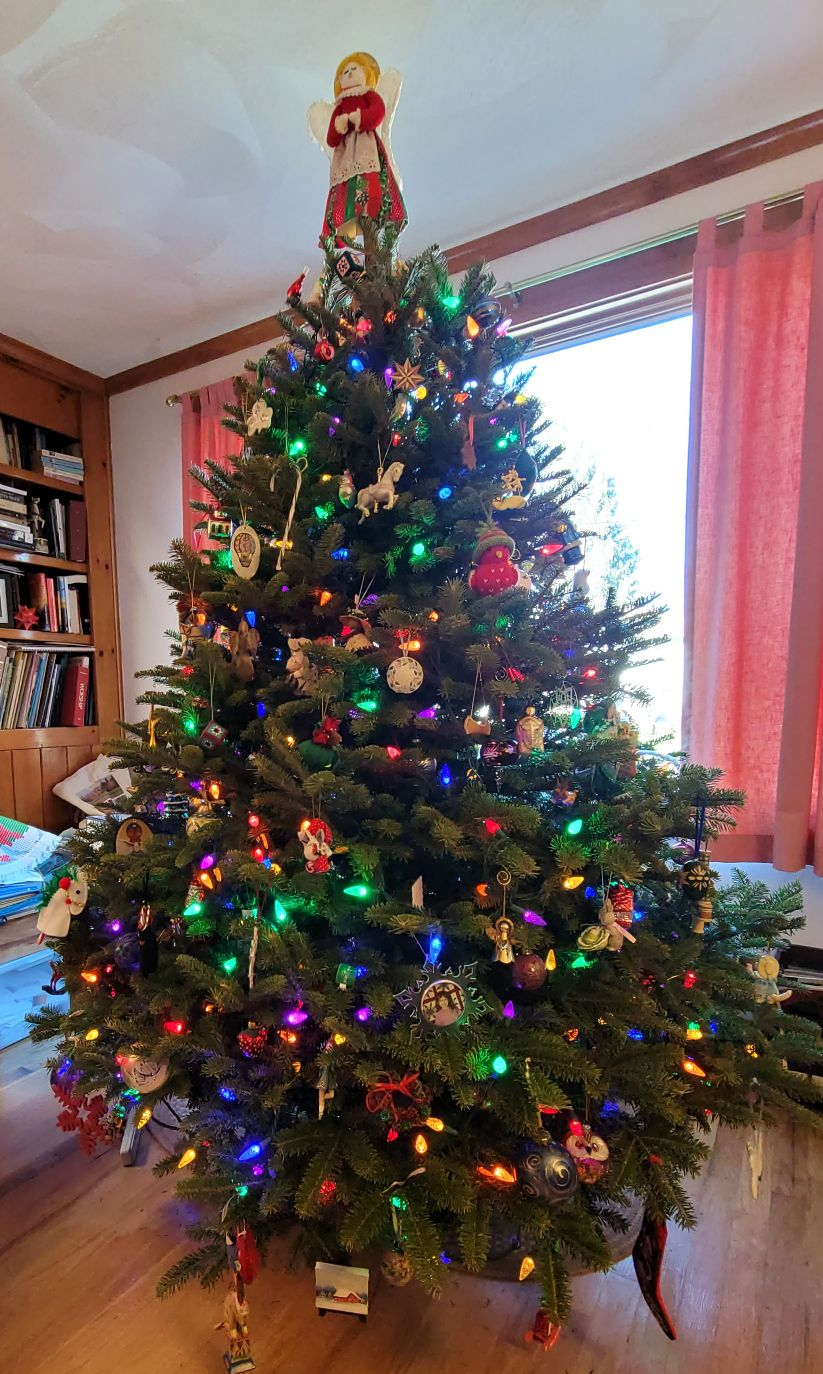
Now, the tree looks almost like this again! (Besides the three that broke, a few others are in different places now.)

moving toward Christmas

I’m managing to do more Christmas preparation than I have in the last several years.

I have over half my holiday cards sent.

Yesterday, B and I went to the tree farm to buy our Christmas tree and wreath. Today, along with daughter T, we decorated the tree.

I love our Christmas ornament collection. There are ornaments that belonged to our parents. Ones we have bought on our travels over the years. Ones we received as gifts. Home-made ones by my grandmother, B’s mom, B as a child, our children. Handcrafted ones made by artists on four continents, including my friend Yvonne Lucia. Ornaments made of cloth, yarn, wood, birch bark, wax, corn husks, glass, paper, teasels, metal, ceramic, plastic, even eggshell. The angel on top of the tree is one I made from a kit with the help of a friend shortly after B and I married. The latch-hooked tree skirt featuring candy canes was made by my mother.

If our home suffered a disaster and our ornament collection was lost, it would be impossible to re-create.

Still, during the years when I was caring for my parents and in the immediate aftermath of their passing, as much as I cherish these ornaments, I couldn’t being myself to unwrap them, touch them, place them on the tree. Even when others had done so, I could only manage a few glances at them.

Dealing with grief and loss is an individual and unpredictable endeavor. Last Christmas, our first since the death of my father, known here as Paco, we traveled to visit daughter E and her family in London, so we didn’t have our usual Christmas decorations. I really wasn’t sure how much of the usual Christmas routine I would be able to resume this year, so I am grateful that I felt up to participating in some decorating.

Granted, Christmas this year will be quieter than usual. It will be just B, T, and I celebrating at home. I will be going to church on my own. There will be stockings and some presents to open. (I admit my Christmas enthusiasm has not yet extended to shopping.) We will have a nice dinner and dessert although we haven’t settled on the menu yet. We have decided not to make our usual number of cookies, most years dozens of cookies in at least a half dozen varieties. It just doesn’t make sense for three people.

I think one of the factors in my feeling some Christmas spirit this year was singing Lessons and Carols with the Madrigal Choir of Binghamton last weekend. Given that I spent so many years doing liturgy planning and music in Catholic churches, I’m not accustomed to singing Christmas music publicly during Advent, but I think this year doing so boosted my anticipation for Christmas and helped me to feel up to helping with decorating.

If I’m lucky, it will carry me through finishing the cards next week.

If not, I will try to remember to take the advice that I offer to others who are dealing with loss: Be gentle with yourself.

Maybe the fragrance of the Canaan fir, the rainbow-hued lights, the meaningful ornaments will help lift my spirit if it flags.

Christmas trees are beautiful, even through misty eyes.

SoCS: too much

I’ve got too much on my plate – and my blogging has been suffering because of it.

I’ve been busy with poetry, singing, family activities, and chores and a lot of the other things on my plate, like blogging and doing poetry submissions have been pushed off to the side.

As is often the case, it’s not so much that I need more time as that I need more brain power. While I thought that I had gotten through the alternating bouts of numbness and thought-swirl that happen from grieving, this fall has shown that I was mistaken. I have only limited time when I can concentrate well enough to write – and some days that doesn’t come at all.

I know better than to make promises about catching up on blog posts.

I do have a few submissions that will be coming up on deadlines that need to get moved up on the list of tasks – or to the center of the plate if I can make myself return to the original metaphor – and I will need to work on holiday cards, which are a high priority item for me.

I’m hoping that I will have a couple of poems published in December, so there will be posts for those.

If I’m lucky, I’ll be able to get my mind in a more stable place and clear some of the items off my plate.

(She writes, really trying to do stream of consciousness metaphor…)

Stay tuned…
****
Linda’s prompt for Stream of Consciousness Saturday this week is “on your/my plate.” Join us! Find out more here: https://lindaghill.com/2022/11/25/the-friday-reminder-and-prompt-for-socs-nov-26-2022/

Review: The Letter

At the Vatican on October 4, 2022, the feast day of St. Francis of Assisi, a new film premiered, entitled The Letter.

The Letter in the title refers to Laudato Si’: On Care for our Common Home, Pope Francis’s 2015 papal encyclical which was addressed not only to Catholics around the world but also to all people of good will. Its release in May helped to build momentum for the Paris climate talks that fall that resulted in 196 countries signing onto the landmark agreement on climate change.

Laudato Si’ espouses integral ecology, which involves both care for the earth and care for all people, especially those most vulnerable. The encyclical cites science and various faith traditions to build a framework for fighting climate change and for lifting up those dealing with hunger, poverty, dislocation, water scarcity, and other challenges.

The film’s title has a second meaning, as the first part of the film shows five people around the world receiving a letter from Pope Francis, inviting them to the Vatican to discuss the issues of Laudato Si’ with him. Together, they represent both “the cry of the earth and the cry of the poor.” It is these five people and the communities they represent that form the bulk of the film.

They are:
~ Cacique Dadá, an indigenous leader of the Borarí people from the Maró Indigenous Territory of Brazil, representing indigenous communities
~ Arouna Kandé, a climate refugee from Senegal, representing the impoverished
~ Ridhima Pandey, a teen-aged climate justice activist from India, representing young people who are inheriting a world that has been damaged by prior generations
~ Greg Asner and Robin Martin, a married couple from Hawai’i in the United States, who are both marine biologists studying the impacts of climate change on ocean ecosystems, representing the voice of nature

The stories of their native places are stunningly conveyed by director Nicolas Brown and the team of Off The Fence Originals, in conjunction with The Laudato Si’ Movement. I especially appreciated the segments from the Amazonian rain forest and the Pacific marine environments.

I also appreciated the diversity of age, race, gender, country of origin, and faith portrayed in the film. While Pope Francis and the Vatican officials are, of course, Catholic, we see participants who follow other faiths, including Islam and indigenous traditions. It is a true reflection of the encyclical being addressed to “all people of good will.”

In keeping with that diversity, people in the film speak in their native languages with subtitles and narration available in English, French, Spanish, Italian, and Portuguese. There are also subtitles available for the entire film in many other languages. You may watch the film free of charge at the link in the first paragraph of this post or on the YouTube Originals channel. Details about offering a free screening for groups can be found here.

My hope is that many people around the world will view the film and take action on social and environmental justice issues. We are one human family and we must together care for each other and our common home.

(not) feeding the birds

One of the things I’ve enjoyed most about the location of our house is that our back yard abuts a natural area with a state-owned fence giving us a barrier to large wildlife. We’ve used this relative protection to feed birds year-round, watching them swooping down for seeds and suet and then back into our trees.

our backyard bird feeder system

That sense of protection was shattered last week when we awoke to find the central pole snapped and the mostly empty feeders on the ground. The plexiglass of the hopper feeder was broken, making it unusable. The copper suet feeder was bent and had been taken across the yard to one of the large trees.

Our assumption is that a bear had come around the end of the fence and entered our neighborhood and used our feeder station to fatten up for hibernation.

Although it wasn’t the first time a bear had been sited near us, it was the first time we had ever had our feeders raided. Because our local Wild Birds Unlimited store recently closed, B and I trekked up to the store in Fayetteville on Saturday to get the supplies we needed to repair our system.

I had thought that, given the rarity of bears in our neighborhood, we were safe to resume feeding the birds who need the food even more as the weather gets colder and the growing season ends.

I was wrong.

Sunday morning, we awoke to find our new pole broken and empty feeders scattered around its base. Fortunately, this time, the damage to the feeders is repairable without needing to get new parts.

Unfortunately, we won’t be able to put them back out until winter is setting in and the bears are hibernating.

The back yard seems empty without the feeders there and the cardinals, woodpeckers, blue jays, nuthatches, finches, juncos, titmouses, and my favorite chickadees flying in and out, especially at dawn, midday, and before sundown. I know, as wild things, they will be okay without our seeds and suet set out for them but I feel badly withdrawing a food source they have relied on for so long.

Maybe in a few weeks…

Monroe Bicentennial

On September 17th, I returned to my hometown, Monroe, Massachusetts, for their bicentennial celebration.

The day began with a presentation from State Representative Paul Mark of a framed copy of the restoration of the original town charter. In his remarks, he noted that, unlike most Massachusetts charters, Monroe’s does not have any mention of an English king. The town was incorporated from parts of other towns and named for President James Monroe, who was president of the United States at the time.

The charter was hung up right away!

When I was growing up there in the 1960s-70s, the town had about 200 residents. In the 2020 census, there were 118 residents, making it the smallest town by population on the mainland of Massachusetts.

The festivities centered around the Town Community Center, which was the school back in my day. (Also, in the days of my father and his siblings, when it was built by the Works Progress Administration in the 1930s.) The building still houses the town offices and library. What had been the classroom for grades 1-4 when I attended is now a community meeting room where many of the indoor activities were housed. The rest of the building is now used as offices by the power company that is the successor to New England Power, for which my father worked for over forty years.

I was able to make some contributions to the memory board and books. I sent some poems and was surprised to find one of them on display with a vintage newspaper photo of me when I graduated from high school.

Many of us were feeling nostalgic about the post office. There were two postal employees there to hand-cancel envelopes with a bicentennial commemorative postmark, even though the Monroe Bridge post office closed years ago to be replaced by this:

Not nearly as distinctive looking as this mail slot which was salvaged from the old post office and is now in the Monroe Historical Society’s collection.

For an explanation of why it was the Monroe Bridge post office and why I often refer to my hometown as Monroe Bridge, you can read my poem “Monroe Bridge Mail” published by Wilderness House Literary Review here. (It’s the final poem in a set of five.)

I spent quite a lot of time in the Historical Society, looking at the artifacts and photos. It was nice to see that the murals that had been painted by a WPA artist for our classroom had been moved there:

There was memorabilia from the Town’s sesquicentennial (150th anniversary) which I remembered as a very exciting time when I was in grammar school.

It was fun to get to reminisce with people who had been in town when my family lived there. Some are still residents or folks who have stayed local, while a few, like me, had travelled from further afield. I especially appreciated the time that Lucy spent with me, pointing out family connections among the memorabilia on display or in the Historical Society. I was touched by all the kind words about my parents and the expressions of sympathy on their passing. The celebration was just a few days after the first anniversary of my father’s death; he and my mother were among the founding members of the Monroe Historical Society.

There was Bicentennial swag available! One of my purchases was the Bicentennial History Book. I was honored that my poem “Playground” was chosen to be on the back cover. It reads:

Our WPA-built school housed
two classrooms, eight grades,
two teachers, twenty-some students,
old textbooks, reams of assignments
designed to keep us quiet at our desks.

Morning and afternoon recess
and the remainder of lunch hour,
we jumped off swings,
attempted running up the two-story slide,
sent the spinning merry-go-round swaying
to crash with a satisfying clang
into the metal pole from which it hung.

Dodge ball, monkey-in-the-middle,
a dozen variations of tag,
where the tap of a classmate’s hand
thawed you from your frozen state
or freed you from jungle-gym-jail.

Jump rope chants
“Not last night, but the night before,
a lemon and a pickle
came a-knockin’ at my door.”

Upper-grade boys against girls
in Wiffle ball or kick ball.
Despite our skirts, the girls,
already becoming young women,
usually won.
*****

Of course, as promised, there was cake!

It was a great celebration for a little town! Even though I’ve lived out-of-state for forty years now, a part of me is still at home there.

And even if you have never visited, there are now new signs to welcome you. This is the one you will see if you cross the state line from Whitingham, Vermont into Monroe.