I’ve got too much on my plate – and my blogging has been suffering because of it.
I’ve been busy with poetry, singing, family activities, and chores and a lot of the other things on my plate, like blogging and doing poetry submissions have been pushed off to the side.
As is often the case, it’s not so much that I need more time as that I need more brain power. While I thought that I had gotten through the alternating bouts of numbness and thought-swirl that happen from grieving, this fall has shown that I was mistaken. I have only limited time when I can concentrate well enough to write – and some days that doesn’t come at all.
I know better than to make promises about catching up on blog posts.
I do have a few submissions that will be coming up on deadlines that need to get moved up on the list of tasks – or to the center of the plate if I can make myself return to the original metaphor – and I will need to work on holiday cards, which are a high priority item for me.
I’m hoping that I will have a couple of poems published in December, so there will be posts for those.
If I’m lucky, I’ll be able to get my mind in a more stable place and clear some of the items off my plate.
(She writes, really trying to do stream of consciousness metaphor…)
At the Vatican on October 4, 2022, the feast day of St. Francis of Assisi, a new film premiered, entitled The Letter.
The Letter in the title refers to Laudato Si’: On Care for our Common Home, Pope Francis’s 2015 papal encyclical which was addressed not only to Catholics around the world but also to all people of good will. Its release in May helped to build momentum for the Paris climate talks that fall that resulted in 196 countries signing onto the landmark agreement on climate change.
Laudato Si’ espouses integral ecology, which involves both care for the earth and care for all people, especially those most vulnerable. The encyclical cites science and various faith traditions to build a framework for fighting climate change and for lifting up those dealing with hunger, poverty, dislocation, water scarcity, and other challenges.
The film’s title has a second meaning, as the first part of the film shows five people around the world receiving a letter from Pope Francis, inviting them to the Vatican to discuss the issues of Laudato Si’ with him. Together, they represent both “the cry of the earth and the cry of the poor.” It is these five people and the communities they represent that form the bulk of the film.
They are: ~ Cacique Dadá, an indigenous leader of the Borarí people from the Maró Indigenous Territory of Brazil, representing indigenous communities ~ Arouna Kandé, a climate refugee from Senegal, representing the impoverished ~ Ridhima Pandey, a teen-aged climate justice activist from India, representing young people who are inheriting a world that has been damaged by prior generations ~ Greg Asner and Robin Martin, a married couple from Hawai’i in the United States, who are both marine biologists studying the impacts of climate change on ocean ecosystems, representing the voice of nature
The stories of their native places are stunningly conveyed by director Nicolas Brown and the team of Off The Fence Originals, in conjunction with The Laudato Si’ Movement. I especially appreciated the segments from the Amazonian rain forest and the Pacific marine environments.
I also appreciated the diversity of age, race, gender, country of origin, and faith portrayed in the film. While Pope Francis and the Vatican officials are, of course, Catholic, we see participants who follow other faiths, including Islam and indigenous traditions. It is a true reflection of the encyclical being addressed to “all people of good will.”
In keeping with that diversity, people in the film speak in their native languages with subtitles and narration available in English, French, Spanish, Italian, and Portuguese. There are also subtitles available for the entire film in many other languages. You may watch the film free of charge at the link in the first paragraph of this post or on the YouTube Originals channel. Details about offering a free screening for groups can be found here.
My hope is that many people around the world will view the film and take action on social and environmental justice issues. We are one human family and we must together care for each other and our common home.
One of the things I’ve enjoyed most about the location of our house is that our back yard abuts a natural area with a state-owned fence giving us a barrier to large wildlife. We’ve used this relative protection to feed birds year-round, watching them swooping down for seeds and suet and then back into our trees.
our backyard bird feeder system
That sense of protection was shattered last week when we awoke to find the central pole snapped and the mostly empty feeders on the ground. The plexiglass of the hopper feeder was broken, making it unusable. The copper suet feeder was bent and had been taken across the yard to one of the large trees.
Our assumption is that a bear had come around the end of the fence and entered our neighborhood and used our feeder station to fatten up for hibernation.
Although it wasn’t the first time a bear had been sited near us, it was the first time we had ever had our feeders raided. Because our local Wild Birds Unlimited store recently closed, B and I trekked up to the store in Fayetteville on Saturday to get the supplies we needed to repair our system.
I had thought that, given the rarity of bears in our neighborhood, we were safe to resume feeding the birds who need the food even more as the weather gets colder and the growing season ends.
I was wrong.
Sunday morning, we awoke to find our new pole broken and empty feeders scattered around its base. Fortunately, this time, the damage to the feeders is repairable without needing to get new parts.
Unfortunately, we won’t be able to put them back out until winter is setting in and the bears are hibernating.
The back yard seems empty without the feeders there and the cardinals, woodpeckers, blue jays, nuthatches, finches, juncos, titmouses, and my favorite chickadees flying in and out, especially at dawn, midday, and before sundown. I know, as wild things, they will be okay without our seeds and suet set out for them but I feel badly withdrawing a food source they have relied on for so long.
On September 17th, I returned to my hometown, Monroe, Massachusetts, for their bicentennial celebration.
The day began with a presentation from State Representative Paul Mark of a framed copy of the restoration of the original town charter. In his remarks, he noted that, unlike most Massachusetts charters, Monroe’s does not have any mention of an English king. The town was incorporated from parts of other towns and named for President James Monroe, who was president of the United States at the time.
The charter was hung up right away!
When I was growing up there in the 1960s-70s, the town had about 200 residents. In the 2020 census, there were 118 residents, making it the smallest town by population on the mainland of Massachusetts.
The festivities centered around the Town Community Center, which was the school back in my day. (Also, in the days of my father and his siblings, when it was built by the Works Progress Administration in the 1930s.) The building still houses the town offices and library. What had been the classroom for grades 1-4 when I attended is now a community meeting room where many of the indoor activities were housed. The rest of the building is now used as offices by the power company that is the successor to New England Power, for which my father worked for over forty years.
I was able to make some contributions to the memory board and books. I sent some poems and was surprised to find one of them on display with a vintage newspaper photo of me when I graduated from high school.
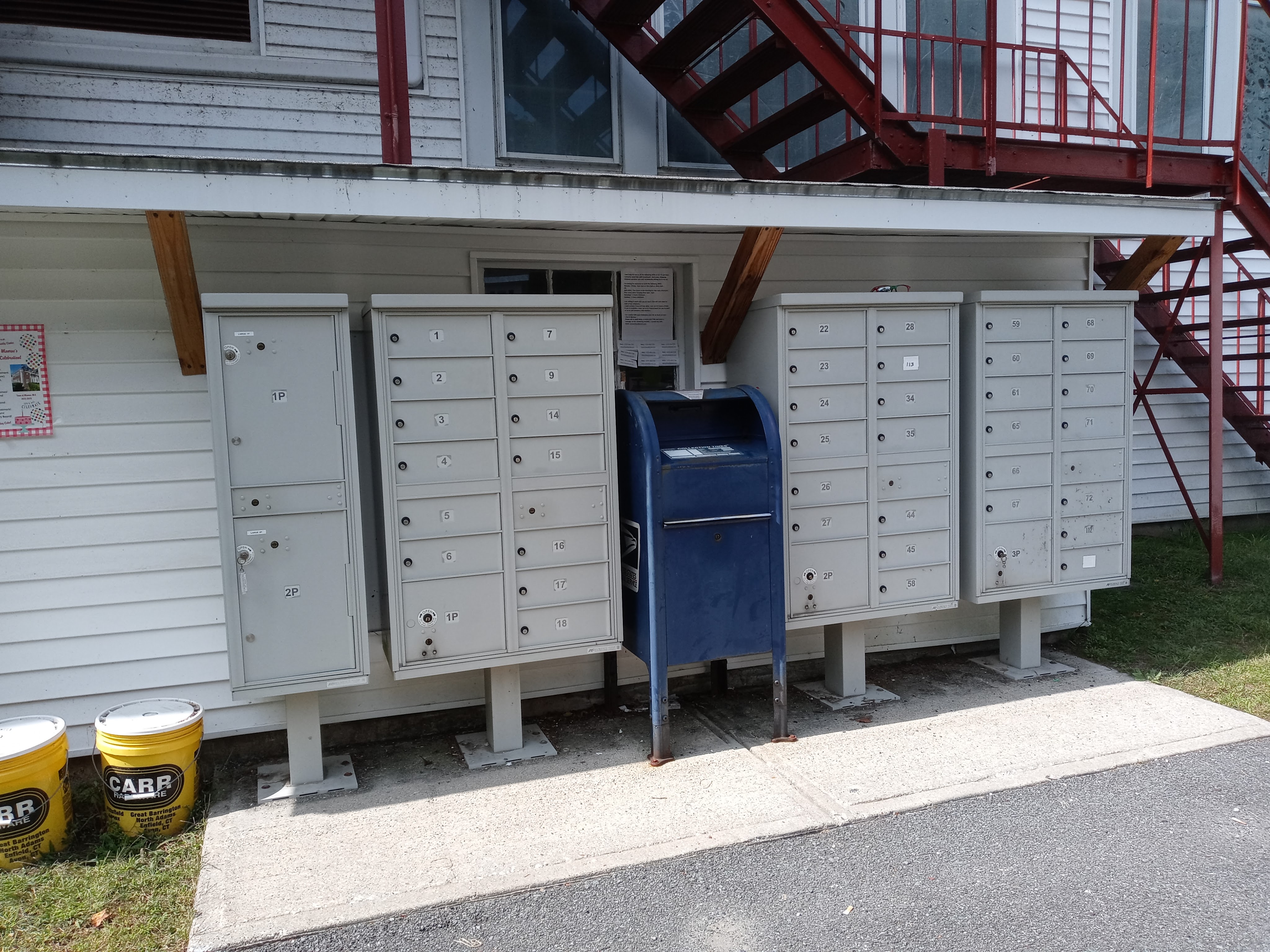
Many of us were feeling nostalgic about the post office. There were two postal employees there to hand-cancel envelopes with a bicentennial commemorative postmark, even though the Monroe Bridge post office closed years ago to be replaced by this:
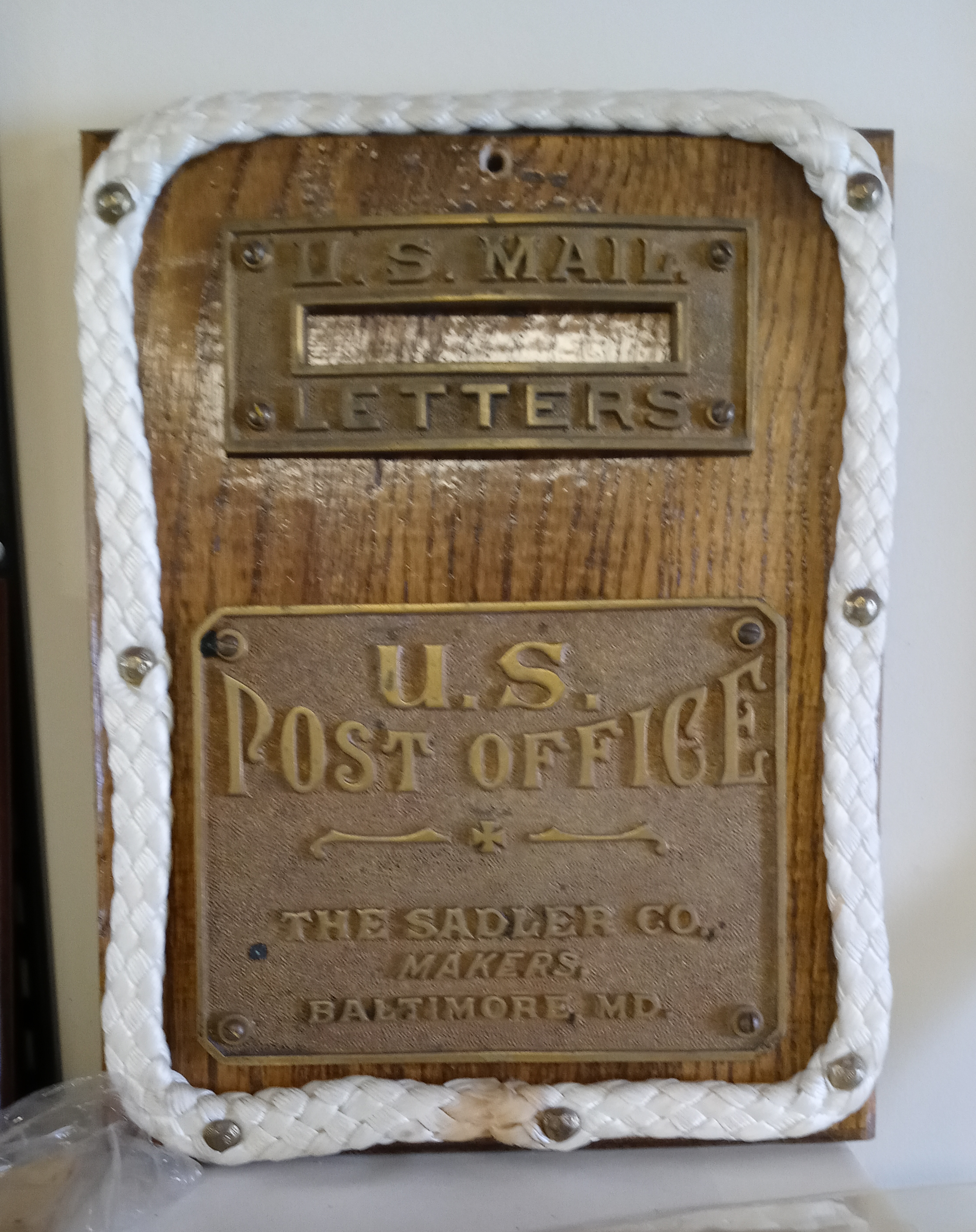
Not nearly as distinctive looking as this mail slot which was salvaged from the old post office and is now in the Monroe Historical Society’s collection.
For an explanation of why it was the Monroe Bridge post office and why I often refer to my hometown as Monroe Bridge, you can read my poem “Monroe Bridge Mail” published by Wilderness House Literary Review here. (It’s the final poem in a set of five.)
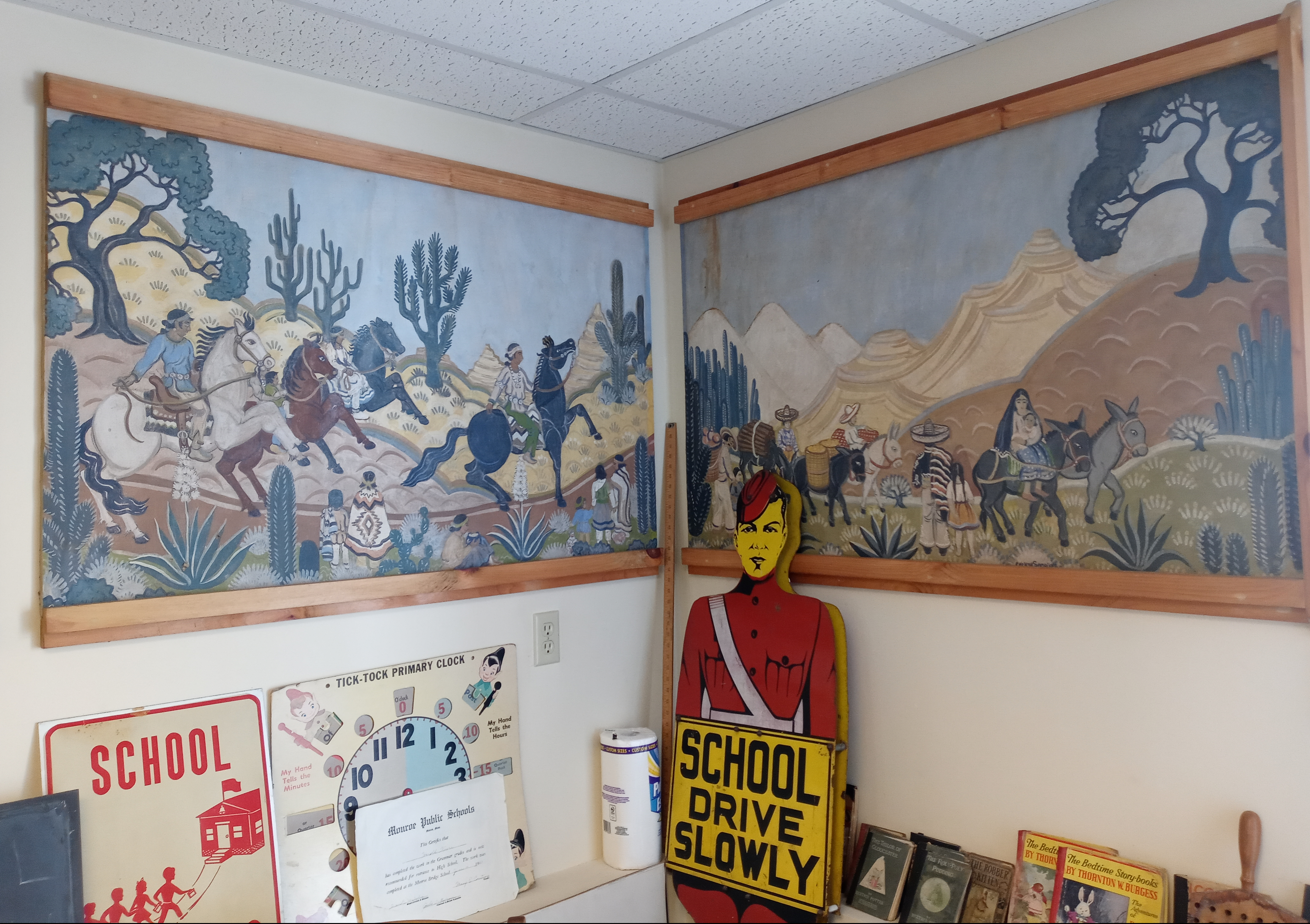
I spent quite a lot of time in the Historical Society, looking at the artifacts and photos. It was nice to see that the murals that had been painted by a WPA artist for our classroom had been moved there:
There was memorabilia from the Town’s sesquicentennial (150th anniversary) which I remembered as a very exciting time when I was in grammar school.
It was fun to get to reminisce with people who had been in town when my family lived there. Some are still residents or folks who have stayed local, while a few, like me, had travelled from further afield. I especially appreciated the time that Lucy spent with me, pointing out family connections among the memorabilia on display or in the Historical Society. I was touched by all the kind words about my parents and the expressions of sympathy on their passing. The celebration was just a few days after the first anniversary of my father’s death; he and my mother were among the founding members of the Monroe Historical Society.
There was Bicentennial swag available! One of my purchases was the Bicentennial History Book. I was honored that my poem “Playground” was chosen to be on the back cover. It reads:
Our WPA-built school housed two classrooms, eight grades, two teachers, twenty-some students, old textbooks, reams of assignments designed to keep us quiet at our desks.
Morning and afternoon recess and the remainder of lunch hour, we jumped off swings, attempted running up the two-story slide, sent the spinning merry-go-round swaying to crash with a satisfying clang into the metal pole from which it hung.
Dodge ball, monkey-in-the-middle, a dozen variations of tag, where the tap of a classmate’s hand thawed you from your frozen state or freed you from jungle-gym-jail.
Jump rope chants “Not last night, but the night before, a lemon and a pickle came a-knockin’ at my door.”
Upper-grade boys against girls in Wiffle ball or kick ball. Despite our skirts, the girls, already becoming young women, usually won. *****
Of course, as promised, there was cake!
It was a great celebration for a little town! Even though I’ve lived out-of-state for forty years now, a part of me is still at home there.
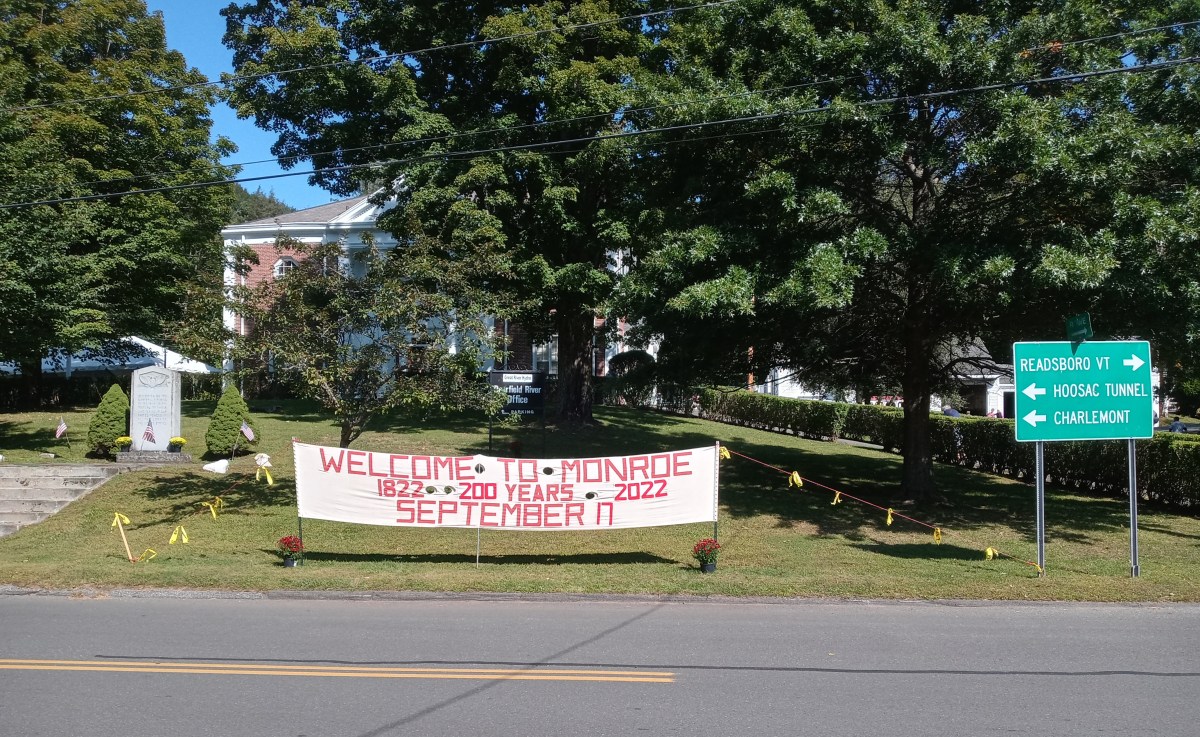
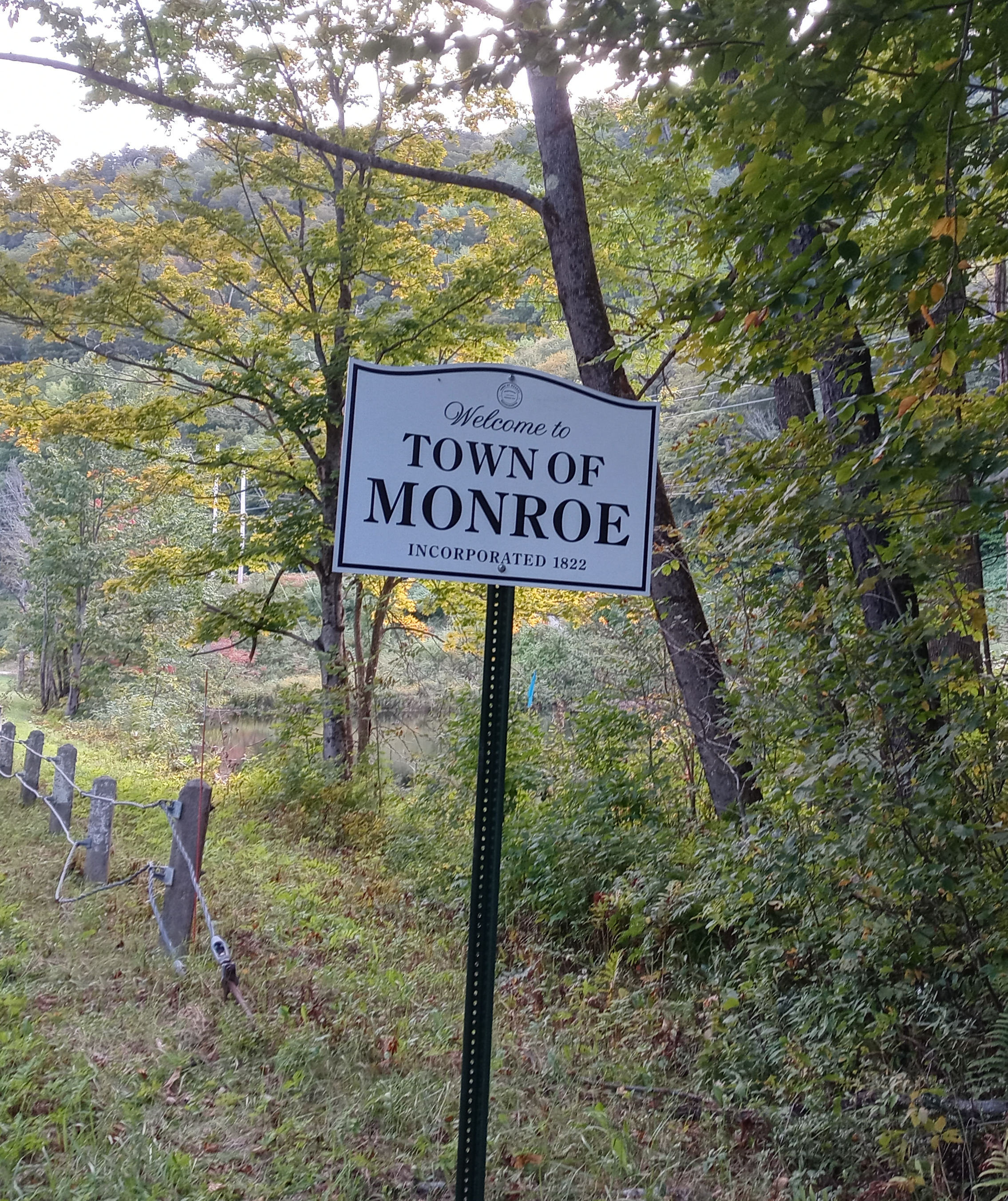
And even if you have never visited, there are now new signs to welcome you. This is the one you will see if you cross the state line from Whitingham, Vermont into Monroe.
A few days ago, spouse B, daughter T, and I attended the wedding of M and S. M is B’s and my niece and is the cousin closest in age to T.
M is also a big fan of Disney World. S chose to propose to M there and M planned their wedding and reception with a Cinderella theme, including the napkin above. There were castles and glass slippers and golden coaches incorporated into decorations, dancing into the night, a beautiful gown with yards of tulle.
Many echoes of a classic fairy tale.
But M and S don’t have an ordinary life. M is nurse with special training in emergency medicine who currently serves as a flight nurse, transporting critically ill or injured people to medical centers that can give them the best care possible. S is a state trooper, doing his best to keep people safe and assist them in emergencies.
They both do extraordinary things on a regular basis.
They also are facing an extraordinary challenge. Early in their courtship, M developed a serious medical issue but S stayed by her side, even when M tried to break up with him in order to protect him.
The strength of their bond in the face of adversity brought more than the usual number of tears at the wedding and during the toasts at the reception, where even the especially-stoic state troopers choked up over M and S’s love story.
Even at a fairy tale wedding, there are no guarantees of how long the “ever after” will be.
M and S showed us, though, that their love is strong and eternal, whatever obstacles are thrown in their path.
I’ve been out all day at the bicentennial of my hometown so this will be a short SoCS post.
When I saw that Linda’s prompt was ring, what came to mind was the poem I wrote about taking off my father’s wedding ring after he died. The first anniversary of his death was Wednesday. The poem was published this spring by Wilderness House Literary Review here. ***** Join us for Linda’s Stream of Consciousness Saturday! Find out more here: https://lindaghill.com/2022/09/16/the-friday-reminder-and-prompt-for-socs-sept-17-2022/
I’m pleased to announce that I have two new poems published in the Fall-Winter issue of Rat’s Ass Review! (In case you are wondering about the somewhat unusual name, read the longer version of their submission guidelines, which is one of the most informative, honest, and entertaining I’ve ever encountered.) Many thanks to current editor Roderick Bates for choosing my work for inclusion in this issue.
There are 61 contributing poets plus cover art, so there’s lots to enjoy! Contributors are arranged alphabetically, so you will find my poems listed under Joanne Corey. Clicking on any poet’s surname takes you to their bio in the last section.
The inspiration for my first poem “The Banned Bookmobile” is a project under development at WordPlace, the Southern Tier Literary Center at the Bundy Museum, Binghamton, NY. J. Barrett Wolf, director of Wordplace, is planning to assemble a collection of banned/challenged books in a bus that can travel about to present programs on the First Amendment, censorship, and other topics. (Editor Rick Bates helpfully made the title of the poem a link to the web page for the project.)
For those of you who may not be familiar, in rural/underserved communities, it was common to have a bookmobile visit several times a year, giving schoolchildren and adults the chance to borrow a wider range of books than were available in town. I remember the excitement in my rural New England town of 200 when the bookmobile visited. Although I loved our town library, it was very small and the bookmobile offered many more options.
My poem references several books/series that have been banned from various schools or libraries in the United States, including And Tango Makes Three, the Harry Potter series, The Bluest Eye, and To Kill a Mockingbird.
“Video Chat with our 95-year-old Father” was written in early 2021, shortly after Paco had moved into the assisted living unit of his senior community. Due to pandemic restrictions, my sisters and I weren’t allowed to visit his place, even though I lived nearby. The staff would set up a video session with their iPad and then leave to attend to other duties. Unfortunately, Paco had difficulty grasping the situation and the technology involved.
As you may recall, spouse B, daughter T, and I were all participants in the Phase III clinical trial for the COVID-19 vaccine from Pfizer/BioNTech. We then all participated in a follow-on third dose trial. B and I left the trial this spring because we were eligible to receive a fourth dose and wanted the extra protection before travelling. T stayed in the trial until its end earlier this summer.
Here in the United States, a new booster was recently approved which combines the original formulation with a new one designed to better combat the Omicron BA.4 and BA.5 variants. BA.5 is the dominant variant currently in the US, accounting for about 88% of cases. About 11% are caused by BA.4. The new booster is expected to strengthen protection against serious illness/death and, one hopes, cut down on symptomatic infection somewhat, as well.
Given that I am still trying to remain COVID-free and that I have several trips coming this fall, I decided to receive one of the new boosters at my local pharmacy. I chose to receive the Pfizer formulation because all my others have been theirs, although there is a Moderna version which is also a fine choice. This was my first time receiving the vaccine in a pharmacy setting. My prior doses had all been in a medical office or a state vaccination site. I made an appointment online and everything was very fast and efficient.
Dr. Ashish Jha, who is the White House COVID-19 response coordinator, and Dr. Anthony Fauci, the long-time director of the National Institute of Allergy and Infectious Diseases, have said that it is possible that we may have reached a point where an annual booster will be enough to protect the vast majority of Americans from serious illness/death from COVID, similar to annual flu shots. Some people who are especially vulnerable due to age or medical condition might need more frequent boosters. The wild card, though, would be the emergence of a new strain that could evade our antibodies and current vaccines.
So, my message is to receive one of these new boosters as soon as they become available wherever you are. The US has been first to authorize them, but it seems they will become more widely available globally soon. Remember, though, that these are booster doses given to people who have already completed an initial vaccine series. If you haven’t completed an initial vaccine series, start NOW!
Meanwhile, here in Broome County, our community risk level is still medium. While I wait for the new booster to take full effect, I will still mask for indoor gatherings and shopping. I’ll be evaluating what to do after that, although these boosters are so new that data may be hard to come by.
I am thrilled to announce that Hearts, my first chapbook, will be published by Kelsay Books in 2023! I don’t yet have an exact release date but expect it to be around September.
Kelsay Books was founded by poet Karen Kelsay in 2012 and currently has over a thousand titles listed in its bookstore. This makes it a much larger press than most of my previous submissions, some of which went to presses that only publish one or two titles a year. I took a chance submitting to Kelsay because two of my local Grapevine Poets, Jessica Dubey and Burt Myers, have books forthcoming from them. I’ll be sure to post their books here at Top of JC’s Mind when they become available.
Kelsay publishes poetry exclusively under four different imprints: Aldrich Press for free verse poetry up to 90 pages; White Violet Press for formal poetry up to 100 pages (Burt’s category); Alabaster Leaves for chapbooks under 50 pages (Jessica and my books will be under this imprint); and Daffydowndilly for rhyming poetry by adults for children.
Another welcome feature of Kelsay is that they respond very quickly, generally within fourteen days of submission. I received word of acceptance on day ten. This is blazingly fast. The typical response time for prior submissions I had done was six months, with a few taking more than a year to send out rejections.
Hearts centers around my mother, known here at TJCM as Nana, particularly in the last years of her life as she struggled with heart failure. The first incarnation of the chapbook was assembled in fall of 2017 as an entry into the QuillsEdge Press contest with the theme “Transitions.” It was named a finalist and the poem “Sixteen Hours” was included in an anthology that was published in conjunction with the winning manuscript, Skin Gin. That version also placed in the top 1% of submissions in another contest.
That early positive feedback proved to be important in the following years. As Nana’s health continued to decline, I wrote poems to help me process but couldn’t think about reworking the manuscript. After her death in May, 2019, I took some time to extend, workshop, and edit the chapbook and started sending it out in spring of 2020. That version was a semifinalist in a contest but was also getting a lot of rejections from contests and open submission periods.
I continued to do edits and added a new poem in spring, 2021. At that point, my father, known here as Paco, was entering the last few months of his life, so doing submissions faded into the background. He passed away last September and I returned to doing a few submissions before the end of the year. I was doing submissions for my full-length manuscript, as well.
Kelsay was the 34th submission for Hearts in its various forms.
There is a difference of opinion on whether that is a lot or just run-of-the-mill. Most of the people that I’ve told have noted my perseverance and commitment in the face of rejection but a few, who have decades-long experience as poets, think thirty-four isn’t that bad or unusual.
For now, I’m still feeling joy mixed with relief. In these past years, I’ve watched many of my poet-friends publish their first books and had begun to wonder if I just wasn’t good enough. Now, I’m coming to think of it more as finding the right match. Kelsay Books makes clear they are seeking manuscripts that are accessible to a general audience. I consider myself a community poet, as my experience has come through workshopping with fellow poets and community poetry sessions with the Binghamton Poetry Project and others, instead of from academic studies. I tend to write in a narrative style. While I occasionally write in Chinese/Japanese-derived forms like tanka, I have never written anything decent in traditional European forms, like sonnet or villanelle. Every once in a while, a rejection email comes with a bit of feedback, which tends to run along the lines of my work not being crafted well enough or sophisticated enough. While I do continue to work on craft and revision skills, I will never write like someone with an MFA (Master of Fine Arts) degree.
And that’s okay.
It’s just easier to believe now that I can say I have a book forthcoming.
I’m sure I will post more about this as I work through the process of publication and gain more skills along the way. Style guidelines. Fonts. Cover art.
One of the blessings of being in a community of poets, though, is that help is available if I need it. I also now have a publisher with a team of professionals to get my book out into the world.








 Joanne Corey