Nat’l Poetry Month celebration with me!

I posted here and here about the first two readings from the Broome County Arts Council in celebration of National Poetry Month. I am pleased to announce that this week, I am featured along with Rindi Tas and kohloa, two poets whom I met through the Binghamton Poetry Project. We were scheduled to be joined by another BPP poet, Anita Shipway, but technical difficulties prevented Anita from joining us. The recording of the reading and our bios are available here.

I’m not sure how I came to be invited to participate in this series but I was honored to be asked. And excited. And nervous. This is my first time as a featured reader with a Q&A component and I was anxious to do a good job, knowing that most of the readers in the series are much more experienced, knowledgeable, and academically credentialed than I. I asked poet-friends to review my selections and practiced my reading, recording myself on Zoom to see how I sounded and looked. I plead guilty to over-thinking and over-preparing, but it kept me a lot calmer when we recorded.

I possibly babbled a bit answering Barrett’s questions. Barrett is part of the Grapevine Group, my local circle of poets who meet on a regular basis to workshop our poems, so we are used to “talking shop” together, but I’m not used to interacting with him in a formal setting. He asked thoughtful questions that flowed from the choices I had made for the reading but I am not great at thinking on my feet, so you all can be the judge on whether I made sense or not.

Because I didn’t take up poetry as a serious pursuit until recent years, I am not that well-known or widely published. I decided to do a mini-sampler of the kinds of poems I tend to write, realizing that I would be an unknown quantity to most prospective listeners. Of the four poems I read, only one is published. It appeared in the Nov. 2020 anthology of the Binghamton Poetry Project and can be viewed here.

The recording should be available on the BCAC website at the link at the end of the first paragraph, at least for the next few weeks. It will also be broadcast locally on the Bundy Museum’s radio station WBDY-FM radio (99.5 FM). Because I’m not sure how long BCAC will have the webpage active, I’m embedding the youtube link here, which I think will be permanent:

If you choose to give the reading a listen, I hope you enjoy it. Please feel free to comment here or on the Top of JC’s Mind Facebook page. If you want to send me a private message at topofjcsmind@gmail.com, please put a comment on this post telling me to check for it so it doesn’t get lost among the various digests and posts sent there. My inbox is out of control!

One-Liner Wednesday: mini-daffodils

mini-daffodils from the supermarket that we will be able to plant in our yard this fall to bloom again next spring

Join us for Linda’s One-Liner Wednesdays! Find out more here: https://lindaghill.com/2021/04/14/one-liner-wednesday-ive-been-shot/

Nat’l Poetry Month Part 2

The second installment of the Broome County (NY) Arts Council (BCAC) series to celebrate National Poetry Month is now available here. This week features readings and discussion with Nicole Santalucia, Wendy Stewart, Mike Foldes, and Joshua Lindebaum.

I owe two of these poets a particular debt of gratitude.

When Nicole Santalucia, who is a Broome County native, returned to do graduate work at the state university, she founded the Binghamton Poetry Project (BPP). I first heard about BPP when Nicole read at a 2013 National Poetry Month episode of Off the Page, a radio program hosted by Bill Jaker on WSKG, our local public broadcasting radio station. Off the Page invited listeners to send in poems to their website and I was thrilled when they chose to read mine on the air! I began attending BPP’s free community poetry workshops for the general public, led by Binghamton University graduate students, in spring 2014. The connections I made there, particularly with Heather Dorn who has been a workshop leader, assistant director, and director of BPP, led to my joining the Grapevine Group, my local poetry critique group which you will hear more about shortly, and Sappho’s Circle, a women’s poetry circle which is, sadly, not currently active. The BCAC supports BPP through grants, so I was able to connect with them, as well. I was even invited to contribute a poem to BCAC’s Heart of the Arts award dinner in 2016. (Video here and text here.) I don’t think any of that would have happened without Nicole Santalucia and the Binghamton Poetry Project, so I owe her a huge thank you.

A shout-out also to Wendy Stewart, who is a member of the aforementioned Grapevine Group. Wendy always offers thoughtful advice on my poems and is supportive of me when I am being insecure, which happens with some frequency. Sometimes, we joke that she is just being Canadian!

I love the way Wendy uses language. I’ve learned a lot of new vocabulary from her. She is also masterful in the way she juxtaposes seemingly unrelated things so that we are invited to make connections we otherwise would not. She often uses her sly wit and penchant for understatement, both in her writing and in conversation, in a way that I admire, although cannot emulate.

Thank you, Wendy!

I hope you enjoy the recording. I’ll be back next week when I will be one of the featured poets.

Review: A Secret Love

I grew up in a rural area where television was purely by antenna, although we received NBC, ABC, and CBS, the three major networks at the time, which was a luxury. I’ve never been able to keep up with the increasingly complicated media landscape of cable, premium channels, satellite, and streaming options. I’ve gotten used to reading lists of Emmy nominees of shows I have never seen and to which I don’t have access. I usually can’t even keep track of what show or movie is being offered on which platform.

I do occasionally happen upon a recommendation that I can follow through on viewing. I was reading a list of awards geared for older adults from AARP which included the 2020 documentary A Secret Love. It is available through Netflix, the one streaming service to which we are currently subscribed, so spouse B, daughter T, and I settled in one evening to watch it.

A Secret Love is the story of Pat Henschel and Terry Donohue, two Canadian women who fell in love and made a life together in the United States where Terry had played baseball with the Peoria Redwings of the All-American Girls Professional Baseball League. While family back in Canada knew the two were close friends who shared a home, they did not know that they were life partners for many decades. While the film does give us their remarkable personal history, the documentary concentrates on their later years, as they face Pat’s illness and decisions about where to live.

Having dealt with the issues of serious illness, financial and legal complications, and housing decisions with B and my parents, I found much of what Pat and Terry were facing relatable. The complexity of the family dynamic, the cross-border legal issues, and the fact that, while Pat and Terry had been a couple since 1947, they did not have the protection of marriage when it came to things like hospital visitation added even more poignancy to an already daunting situation.

What comes through most clearly, though, is the depth of their love for one another. I am always moved by couples whose bond is so strong that it weathers decades of life together and Pat and Terry’s story is such a beautiful example of that. I will warn you that if you, like me, are inclined to teariness, you may want to have your handkerchief handy.

I will also say that, while the story is about elders, it also holds meaning for younger adults. T loved the film as much as I.

SoCS: last year and the year before

There is an old song “What a Difference a Day Makes” but today I’m thinking about what a difference a year makes.

Or two.

Two years ago this spring, my mom, known here as Nana, was living in the skilled nursing section of the senior community where she and my father, Paco, had lived for ten years. She was under hospice care as she was nearing the end of her battle with heart failure. My father and I visited every day for hours with frequent visits from my daughters and granddaughter ABC, who were living with us at the time. My out-of-town sisters were able to come to visit often, too.

Nana passed away in May 2019, a few days after her 87th birthday. We were able to hold her funeral in her parish church with a visiting hour before with friends coming to comfort us. There was also a gathering at her and Paco’s senior community.

Last spring, we were all in COVID lockdown. Visiting nursing homes was totally shut down with very limited exceptions for end-of-life situations. I often thought of what that would have looked like for us, if Nana had been facing death in spring 2020 rather than 2019. We would have lost those last few weeks with her, which were painful but also filled with precious moments. We were able to bring her flowers, including her beloved lilies-of-the-valley which blossom in May, just in time for Mother’s Day and her birthday. One of the last things she was able to eat was a little fruit tart I had brought for her birthday. I helped her by cutting it and fed her as she had me when I was a baby…

In 2020, we would likely not have been allowed to visit until the very end when she was unconscious. The church was totally closed, so there would have been no funeral, not even for family.

It was hard last spring, too, because we could no longer visit Paco every day in his apartment. Although visits to independent living apartments were not totally forbidden, they were supposed to be limited, with some masked outdoor visits preferred over anything indoors. My sisters had planned to visit for Paco’s 95th birthday in March but that had to be postponed. Little did we realize at the time that that postponement would turn into cancellation.

That brings us to this spring, which is just getting underway here with some of the early bulbs flowering and the first trees starting to bud. Paco is now living in assisted living which is part of the health care center. While visiting and gathering there are still limited, my younger sister and I were able to visit him for half an hour in his apartment on his birthday and he was able to share a large birthday cake we provided with the other residents and staff on his unit later in the day. Later this month, my elder sister will be able to visit in person for the first time since last summer. She lives out-of-state so hasn’t been able to travel to New York without prohibitively lengthy quarantine, but now, with vaccines available and changes in state policy, she will finally be able to see Paco again.

We have no idea, though, if or when daughter E and granddaughter ABC will be able to visit. They moved permanently to the UK in fall 2019, joining son-in-law L in London. They have since been joined by granddaughter JG, who recently had her first tooth break through.

Spouse B, daughter T, and I would love to think that this spring we could jet off to London to meet JG in person for the first time, but it isn’t possible. Maybe this summer? It depends on conditions with the pandemic and travel restrictions.

Will we get to hold her while she is still a baby or will she be an on-the-move toddler by that time?

Will Paco ever get to meet her in person? For the UK family branch to visit the US is much more complicated and we have no idea when that will be feasible. We also, sadly, don’t know how things will go with Paco’s cognitive decline. While sometimes he remembers names of family members, sometimes he forgets them.

Sometimes, he forgets that he has great-grandchildren at all.

In 2019, I knew that spring 2020 would be very different because my mother would not be there. I could not have imagined how different 2020 would turn out to be.

Or 2021.

I dare not project to spring 2022.

*****
Linda’s prompt for Stream of Consciousness Saturday this week is “difference.” Join us! Find out more here: https://lindaghill.com/2021/04/09/the-friday-reminder-and-prompt-for-socs-april-10-2021/

SoCS: Who knows?

Who knows?

These days, seemingly no one.

I guess that is a bit overbroad. It depends on the context and what comes after the “who knows” bit.

If someone asks, who knows what the dinner plan is for tonight, there’s a pretty good chance that I would have an answer. I couldn’t tell you if the plan would have follow through, but I could at least tell you the plan…

The hardest questions are the “who knows why” variety.

Yesterday, the Capitol Police, who are the ones who guard the Congress in Washington, DC, lost another officer in the line of duty. A second officer is hospitalized and expected to recover.

The man who attacked the police with his car and a knife is dead and the news reports are full of questions about why he did this.

So, who does know why?

Perhaps, no one knows. Even if he were alive, he might not be able to articulate a reason, especially if he was suffering from mental illness.

Even without knowing, I hope that everyone will offer support to all the impacted families and work together to reach out to those who are suffering. I also hope that Congress will honor the service of the Capitol police who protect them and their families by expanding the number of officers and giving them more resources for training, equipment, and protection. Of course, we should also expand medical care, including mental health care, so that every person always has access to it.

We may not know why this happened, but we can work to make it less likely to happen in the future.

*****
Linda’s prompt for Stream of Consciousness Saturday this week is to begin a post with who or whom. Join us! Find out more here: https://lindaghill.com/2021/04/02/the-friday-reminder-and-prompt-for-socs-april-3-2021/

2019-2020 SoCS Badge by Shelley!

One-Liner Wednesday: Happy 96th!

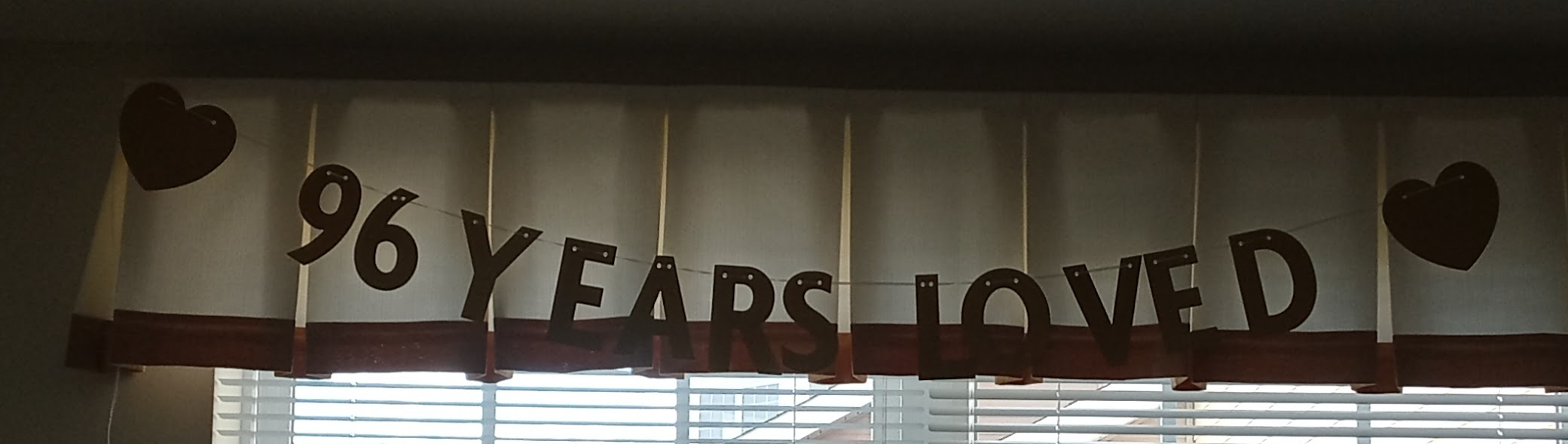
banner with two hearts saying 96 YEARS LOVED

A gift from my sister to honor our dad, known here as Paco, on his 96th birthday last week. ❤

Join us for Linda’s One-Liner Wednesdays! Find out more here: https://lindaghill.com/2021/03/31/one-liner-wednesday-had-to-run/

filibuster update

Here at Top of JC’s Mind, I sometimes – and more frequently in recent years – wade into the political waters of the US. Last October, I mentioned the Senate filibuster and my hopes that is would be reformed, tangentially in this post and fleshed out a bit in the comments.

Remarkably, these early weeks of the Biden administration have given rise to a lot of public discussion of the filibuster and how this arcane Senate rule might be reformed or eliminated so that legislation can pass the Senate by majority vote rather than needing 60 of 100 senators to end debate and proceed to a vote. This is called “invoking cloture.”

For decades, filibusters and cloture votes were rare. Maddeningly, filibusters were used to attempt to derail legislation on civil rights, voting rights, labor rights, and anti-lynching. (Republican Minority Leader Sen. Mitch McConnell has tried to argue that the filibuster was not used as a racist tool, but this twitter thread from Kevin Kruse proves him wrong with a long, but not exhaustive, list of past racially-motivated filibusters.)

During the Obama presidency, McConnell and the Republicans frequently used the filibuster to slow or prevent approving appointments and to keep legislation from reaching the floor for a vote. This was possible because all a senator needed to do was to say they wanted to filibuster and it would take sixty votes to end it, which, with all the Republicans sticking together, meant that there were never enough votes to invoke cloture and proceed to a vote. This led to a rule change that appointments were not subject to the filibuster, though other kinds of legislation still were.

One of the reforms to the process currently being discussed is to require that a senator wanting to filibuster must stay on the Senate floor and speak on the bill being debated. This revives the practice that was in place until 1975, although senators then weren’t required to speak on the bill and could read from the phone book or cookbooks or talk about totally unrelated topics.

There is also a proposal to change the cloture vote. Rather than needing sixty votes to end the debate, which puts the burden on the majority, the new rule would be that 40 or 41 senators would need to vote to continue the debate. This preserves the ability of the minority to put forth their arguments on something they feel strongly about but requires them to put forth effort to do so.

The hope is that these two reforms would break the stranglehold on bills that became so stark during the Obama administration. It might also engender more bipartisan bills actually making it to the Senate floor for a vote. (Mitch McConnell famously once filibustered his own bill when it became clear that President Obama would sign the bill into law. McConnell valued gridlock over governing.)

Or, given that it is just a Senate rule and not a law, the filibuster could be eliminated. Many think this would be the simplest path, but a few Democratic senators are vehemently opposed to ending it totally, although the impetus for reform is definitely gaining momentum.

While I had hoped that, under President Biden who was a long-time senator, some of the more moderate Republicans would want to vote for common-sense and popular bills such as the American Rescue Plan, we have yet to see that happen. The American Rescue Plan, despite its popularity with the public and its many provisions that benefit people in their states, garnered no votes from Republicans in Congress; it passed with a simple majority in the Senate due to special budgetary rules that prevented a filibuster.

There are now some popular and much-needed bills that have passed the House that will become test cases on whether or not bipartisan support is possible or whether it will take filibuster reform or elimination to get them on the floor for a vote. The For the People Act (H.R. 1/S. 1) addresses voting rights, campaign finance reform, government ethics, gerrymandering, and election security. Further voting rights issues are addressed in the John R. Lewis Voting Rights Advancement Act, which would help to restore provisions of the 1965 Voting Rights Act which the Supreme Court struck down in 2013, on the grounds that these racial provisions were now obsolete. Sadly, we have seen evidence that they are not, as efforts are now underway in 43 states to restrict voting access to certain groups of people, including by making it harder for people of color to vote or by making it more difficult for students or elders to register and vote by mail.

There are two House-passed gun safety bills, one on universal background checks and one extending the time the FBI has to vet purchasers to ten days instead of the current three. Both of these measures have broad public support, including among Republicans and gunowners. An increase in the federal minimum wage is very popular with the public, as are bills to re-build our infrastructure, increase our production of goods and green energy to create sustainable jobs, and to increase taxes on the very wealthy.

If bills like these pass the House and appear on the Senate floor, what will the Republicans do? Will they vote yes in accord with their constituents? Will they filibuster to stop a vote from occurring? If they do decide to filibuster, they risk the Democrats reforming the filibuster, voting that certain kinds of bills such as voting rights are not subject to it, or eliminating it all together.

Fingers crossed that whatever scenario unfolds, these laws will be enacted for the common good. We have been waiting for Congress to actually participate in governing in the way the Constitution sets before them.

again and again and again

I didn’t want to write about mass shootings in the United States today. I’ve written way too many posts about this in the past, most recently about the Atlanta-area shootings last week.

But here we are again, mourning the deaths of ten people, including a responding police officer, at a Boulder, Colorado supermarket. A suspect is in custody, but it is early in the investigation so many details are not yet public.

It is likely that this will become the third Colorado mass shooting to lodge in the nation’s consciousness along with the high school in Columbine and the movie theater in Aurora.

The list of mass shootings in the United States is so long that only some of them are invoked as a litany. I live near Binghamton, New York, which suffered a 2009 mass shooting at the American Civic Association. This post that I wrote for the fifth anniversary of that shooting explains why I think Binghamton is not part of that litany.

There has long been a majority of the public in favor of taking measures nationally to curb gun violence. Some of the proposals are universal background checks to purchase firearms, limits on size of ammunition clips, banning of military-style assault weapons, and requiring gun licensing. At this point, each state has its own laws with some allowing municipalities to enact stricter regulations and others not.

There are also proposals to better diagnose and treat mental health issues. Some mass shooters, such as the one in Binghamton, suffer from mental illness. The biggest potential reduction in deaths from firearms related to mental health would be from self-inflicted shootings. In the United States, suicides account for the largest percentage of gun deaths every year. (For help with issues about suicide in the United States, please reach out to the National Suicide Prevention Lifeline at 1-800-273-8255 or https://suicidepreventionlifeline.org/ .)

What compounds the recent tragedies in Atlanta and Boulder, though, is that there will be sadness, outrage, prayers, vigils, fundraisers, and hopes that this will be the time when Congress finally takes action – and they won’t. Again.

And then, inevitably, there will be another mass shooting which gets attention and hundreds of other murders and thousands of suicides which won’t.

And the cycle will repeat.

typewriters and poetry

I’m pleased to announce that I have a poem on display in my hometown. The Vestal Museum has just opened a new exhibit entitled Empty the Inkpots: The History of American Typewriters. They are displaying vintage typewriters and have compiled a binder with their research on the various manufacturers. In collaboration with the Binghamton Poetry Project, the Museum is also displaying poems by area poets who have attended BPP workshops. We poets were invited to submit and I was fortunate to have one of my poems selected.

My poem with two vintage typewriters and the research binder
An Oliver company typewriter

One of the fun things about the poems on display is that they are written in a monospaced typewriter-style font. Because most of us are used to reading text in variable-width fonts these days, the look of the poems on the page is quite distinctive.

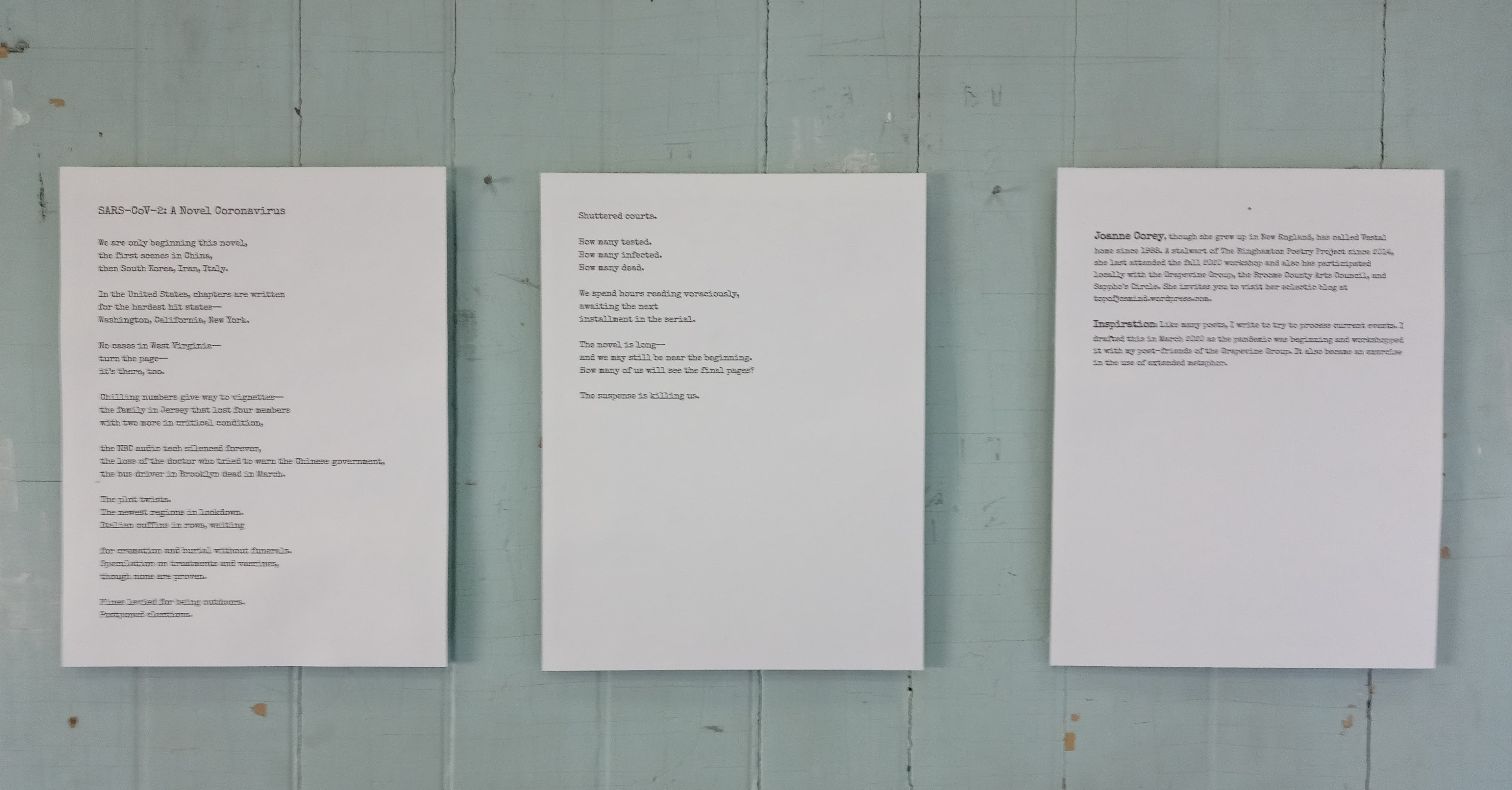
My poem, bio, and inspiration statement on display

Because it is very hard to read from the photo, here is the text, although not in the special font:

SARS-CoV-2: A Novel Coronavirus

We are only beginning this novel,
the first scenes in China,
then South Korea, Iran, Italy.

In the United States, chapters are written
for the hardest hit states—
Washington, California, New York.

No cases in West Virginia—
turn the page—
it’s there, too.

Chilling numbers give way to vignettes—
the family in Jersey that lost four members
with two more in critical condition,

the NBC audio tech silenced forever,
the loss of the doctor who tried to warn the Chinese government,
the bus driver in Brooklyn dead in March.

The plot twists.
The newest regions in lockdown.
Italian coffins in rows, waiting

for cremation and burial without funerals.
Speculation on treatments and vaccines,
though none are proven.

Fines levied for being outdoors.
Postponed elections.
Shuttered courts.

How many tested.
How many infected.
How many dead.

We spend hours reading voraciously,
awaiting the next
installment in the serial.

The novel is long—
and we may still be near the beginning.
How many of us will see the final pages?

The suspense is killing us.

*

Joanne Corey, though she grew up in New England, has called Vestal home since 1988. A stalwart of The Binghamton Poetry Project since 2014, she last attended the fall 2020 workshop and also has participated locally with the Grapevine Group, the Broome County Arts Council, and Sappho’s Circle. She invites you to visit her eclectic blog at topofjcsmind.wordpress.com.

Inspiration: Like many poets, I write to try to process current events. I drafted this in March 2020 as the pandemic was beginning and workshopped it with my poet-friends of the Grapevine Group. It also became an exercise in the use of extended metaphor.
*****

I wish I could share more of the poems here, but I only have permission for my own work. I hope that local folks will be able to see the exhibit in person. It is currently scheduled to be on display through May 31st. The link in the first paragraph will give times that the Museum is open and information on any special events.

While you are there, make sure to take part in the community poetry exercise. We are creating an exquisite corpse poem. Each person is invited to compose a sentence with adjective+noun+verb+adjective+noun without looking at the prior line. Bonus: You get to type it on a manual typewriter! Although I learned to type on a manual, it had been a long time since I had used one. Daughter T was with me and I had to do a bit of coaching. Physical carriage return was not something that she had ever experienced.