Blog – Top of JC’s Mind

filibuster update

Here at Top of JC’s Mind, I sometimes – and more frequently in recent years – wade into the political waters of the US. Last October, I mentioned the Senate filibuster and my hopes that is would be reformed, tangentially in this post and fleshed out a bit in the comments.

Remarkably, these early weeks of the Biden administration have given rise to a lot of public discussion of the filibuster and how this arcane Senate rule might be reformed or eliminated so that legislation can pass the Senate by majority vote rather than needing 60 of 100 senators to end debate and proceed to a vote. This is called “invoking cloture.”

For decades, filibusters and cloture votes were rare. Maddeningly, filibusters were used to attempt to derail legislation on civil rights, voting rights, labor rights, and anti-lynching. (Republican Minority Leader Sen. Mitch McConnell has tried to argue that the filibuster was not used as a racist tool, but this twitter thread from Kevin Kruse proves him wrong with a long, but not exhaustive, list of past racially-motivated filibusters.)

During the Obama presidency, McConnell and the Republicans frequently used the filibuster to slow or prevent approving appointments and to keep legislation from reaching the floor for a vote. This was possible because all a senator needed to do was to say they wanted to filibuster and it would take sixty votes to end it, which, with all the Republicans sticking together, meant that there were never enough votes to invoke cloture and proceed to a vote. This led to a rule change that appointments were not subject to the filibuster, though other kinds of legislation still were.

One of the reforms to the process currently being discussed is to require that a senator wanting to filibuster must stay on the Senate floor and speak on the bill being debated. This revives the practice that was in place until 1975, although senators then weren’t required to speak on the bill and could read from the phone book or cookbooks or talk about totally unrelated topics.

There is also a proposal to change the cloture vote. Rather than needing sixty votes to end the debate, which puts the burden on the majority, the new rule would be that 40 or 41 senators would need to vote to continue the debate. This preserves the ability of the minority to put forth their arguments on something they feel strongly about but requires them to put forth effort to do so.

The hope is that these two reforms would break the stranglehold on bills that became so stark during the Obama administration. It might also engender more bipartisan bills actually making it to the Senate floor for a vote. (Mitch McConnell famously once filibustered his own bill when it became clear that President Obama would sign the bill into law. McConnell valued gridlock over governing.)

Or, given that it is just a Senate rule and not a law, the filibuster could be eliminated. Many think this would be the simplest path, but a few Democratic senators are vehemently opposed to ending it totally, although the impetus for reform is definitely gaining momentum.

While I had hoped that, under President Biden who was a long-time senator, some of the more moderate Republicans would want to vote for common-sense and popular bills such as the American Rescue Plan, we have yet to see that happen. The American Rescue Plan, despite its popularity with the public and its many provisions that benefit people in their states, garnered no votes from Republicans in Congress; it passed with a simple majority in the Senate due to special budgetary rules that prevented a filibuster.

There are now some popular and much-needed bills that have passed the House that will become test cases on whether or not bipartisan support is possible or whether it will take filibuster reform or elimination to get them on the floor for a vote. The For the People Act (H.R. 1/S. 1) addresses voting rights, campaign finance reform, government ethics, gerrymandering, and election security. Further voting rights issues are addressed in the John R. Lewis Voting Rights Advancement Act, which would help to restore provisions of the 1965 Voting Rights Act which the Supreme Court struck down in 2013, on the grounds that these racial provisions were now obsolete. Sadly, we have seen evidence that they are not, as efforts are now underway in 43 states to restrict voting access to certain groups of people, including by making it harder for people of color to vote or by making it more difficult for students or elders to register and vote by mail.

There are two House-passed gun safety bills, one on universal background checks and one extending the time the FBI has to vet purchasers to ten days instead of the current three. Both of these measures have broad public support, including among Republicans and gunowners. An increase in the federal minimum wage is very popular with the public, as are bills to re-build our infrastructure, increase our production of goods and green energy to create sustainable jobs, and to increase taxes on the very wealthy.

If bills like these pass the House and appear on the Senate floor, what will the Republicans do? Will they vote yes in accord with their constituents? Will they filibuster to stop a vote from occurring? If they do decide to filibuster, they risk the Democrats reforming the filibuster, voting that certain kinds of bills such as voting rights are not subject to it, or eliminating it all together.

Fingers crossed that whatever scenario unfolds, these laws will be enacted for the common good. We have been waiting for Congress to actually participate in governing in the way the Constitution sets before them.

again and again and again

I didn’t want to write about mass shootings in the United States today. I’ve written way too many posts about this in the past, most recently about the Atlanta-area shootings last week.

But here we are again, mourning the deaths of ten people, including a responding police officer, at a Boulder, Colorado supermarket. A suspect is in custody, but it is early in the investigation so many details are not yet public.

It is likely that this will become the third Colorado mass shooting to lodge in the nation’s consciousness along with the high school in Columbine and the movie theater in Aurora.

The list of mass shootings in the United States is so long that only some of them are invoked as a litany. I live near Binghamton, New York, which suffered a 2009 mass shooting at the American Civic Association. This post that I wrote for the fifth anniversary of that shooting explains why I think Binghamton is not part of that litany.

There has long been a majority of the public in favor of taking measures nationally to curb gun violence. Some of the proposals are universal background checks to purchase firearms, limits on size of ammunition clips, banning of military-style assault weapons, and requiring gun licensing. At this point, each state has its own laws with some allowing municipalities to enact stricter regulations and others not.

There are also proposals to better diagnose and treat mental health issues. Some mass shooters, such as the one in Binghamton, suffer from mental illness. The biggest potential reduction in deaths from firearms related to mental health would be from self-inflicted shootings. In the United States, suicides account for the largest percentage of gun deaths every year. (For help with issues about suicide in the United States, please reach out to the National Suicide Prevention Lifeline at 1-800-273-8255 or https://suicidepreventionlifeline.org/ .)

What compounds the recent tragedies in Atlanta and Boulder, though, is that there will be sadness, outrage, prayers, vigils, fundraisers, and hopes that this will be the time when Congress finally takes action – and they won’t. Again.

And then, inevitably, there will be another mass shooting which gets attention and hundreds of other murders and thousands of suicides which won’t.

And the cycle will repeat.

hate crimes

The United States is once again mourning the victims of a mass shooting. This time, it was in the Atlanta, Georgia area. Six women of Asian heritage who owned or worked for three day-spas were killed, along with a white man who was an employee at one location and a white woman who was a customer.

The gunman has admitted that he did this, citing his sex addiction as a motive. He bought the gun that he used that day. Unlike some states, Georgia has no waiting period to buy a firearm.

Somehow, much of the public discussion has centered around whether or not charges will be brought specifically as a hate crime in addition to murder charges.

I think the answer is clearly yes, this is a hate crime. The statute is written to account for gender-based violence and the gunman has already admitted that he set out to kill women. Further investigation may reveal that there was also racial motivation, which would add another parameter to this hate crime.

The racial aspect of this crime has spotlighted a disturbing rise in abuse and violence against Asian immigrants and people of Asian/Pacific Islands descent across the United States, particularly since the beginning of the pandemic. Thousands of incidents have been reported and many more are likely unreported. While the majority of attacks are verbal, others are physical and have resulted in serious injury or death. In some majority AAPI neighborhoods in cities, volunteers accompany elders when they go out on errands to keep them safe.

The discussion about this crime has also engendered discussion about a particularly virulent form of sexism against AAPI girls and women, in which they are subjected to hypersexualized comments and assault. Sexual harassment and violence are always wrong but the addition of a racial/ethnic component compounds the damage.

Sadly, discrimination, abuse, and violence against AAPI people in the United States is a long-standing problem. There were official government policies that hugely damaged communities, such as the Chinese Exclusion Acts in the nineteenth century and the shameful interment of Japanese immigrants and Japanese-Americans during World War II. Many AAPI people have been subjected to discrimination in schooling and employment, name-calling, exclusion, and, as we are highlighting recently, abuse, assault, and murder.

The recent rise in incidents seems to be tied to the pandemic. Because the prior administration blamed China for the COVID-19 pandemic, some members of the public decided to attack individual people verbally or physically. While the administration was blaming the Chinese specifically, these attacks have been against people with roots in a range of Asian and Pacific Island countries because the perpetrators think they “look Chinese.”

Whatever the motivation, all these incidents are appalling. I hope that the exposure of these attacks will lead to greater protection for AAPI communities and greater accountability for perpetrators.

Hate must not go unchallenged.

In the United States, there is supposed to be equal protection under the law. The race, ethnicity, immigration status, gender, religion, age, health status, or any other attribute of the person does not change that.

We all deserve safety.

typewriters and poetry

I’m pleased to announce that I have a poem on display in my hometown. The Vestal Museum has just opened a new exhibit entitled Empty the Inkpots: The History of American Typewriters. They are displaying vintage typewriters and have compiled a binder with their research on the various manufacturers. In collaboration with the Binghamton Poetry Project, the Museum is also displaying poems by area poets who have attended BPP workshops. We poets were invited to submit and I was fortunate to have one of my poems selected.

My poem with two vintage typewriters and the research binder
An Oliver company typewriter

One of the fun things about the poems on display is that they are written in a monospaced typewriter-style font. Because most of us are used to reading text in variable-width fonts these days, the look of the poems on the page is quite distinctive.

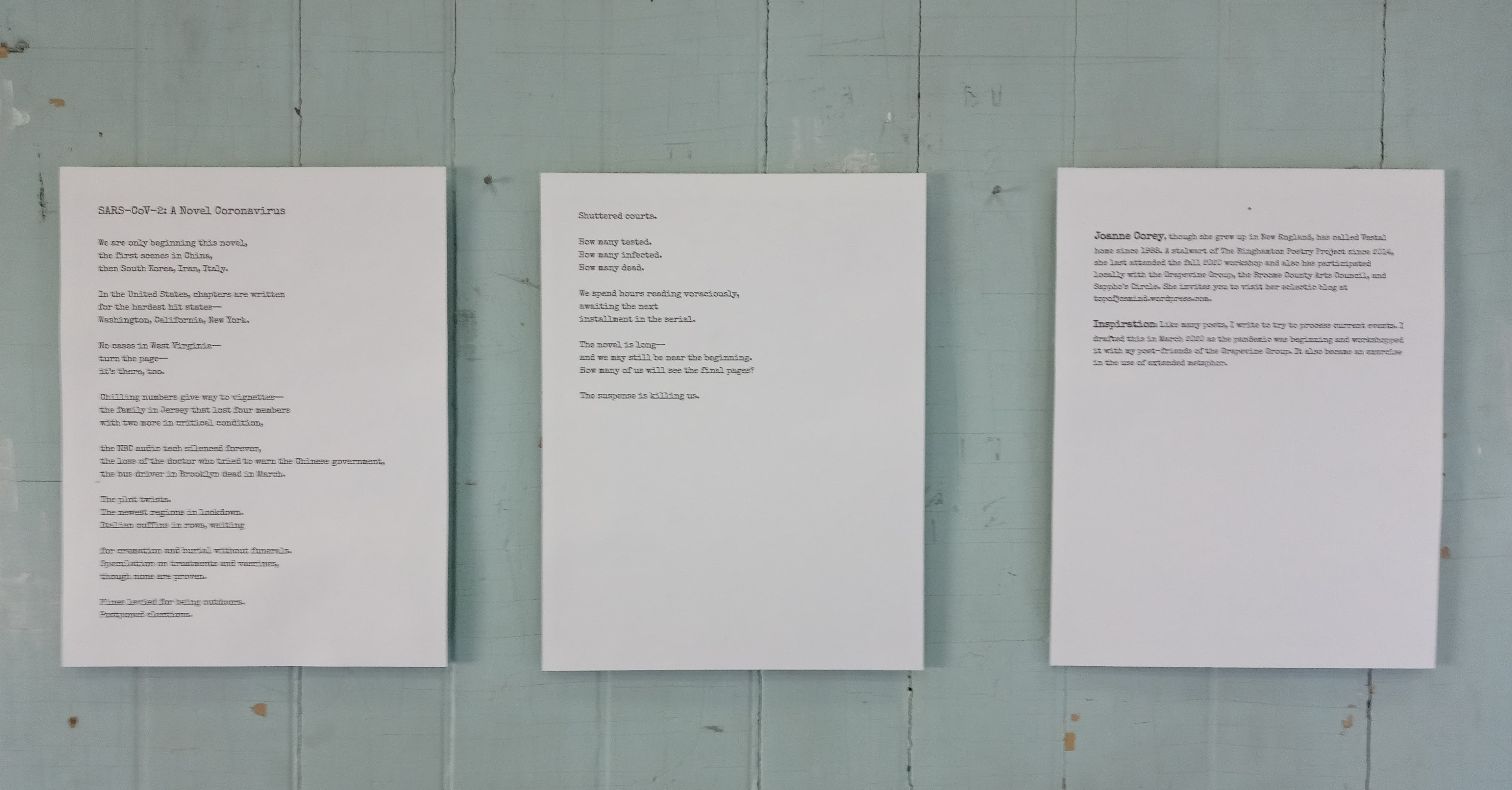
My poem, bio, and inspiration statement on display

Because it is very hard to read from the photo, here is the text, although not in the special font:

SARS-CoV-2: A Novel Coronavirus

We are only beginning this novel,
the first scenes in China,
then South Korea, Iran, Italy.

In the United States, chapters are written
for the hardest hit states—
Washington, California, New York.

No cases in West Virginia—
turn the page—
it’s there, too.

Chilling numbers give way to vignettes—
the family in Jersey that lost four members
with two more in critical condition,

the NBC audio tech silenced forever,
the loss of the doctor who tried to warn the Chinese government,
the bus driver in Brooklyn dead in March.

The plot twists.
The newest regions in lockdown.
Italian coffins in rows, waiting

for cremation and burial without funerals.
Speculation on treatments and vaccines,
though none are proven.

Fines levied for being outdoors.
Postponed elections.
Shuttered courts.

How many tested.
How many infected.
How many dead.

We spend hours reading voraciously,
awaiting the next
installment in the serial.

The novel is long—
and we may still be near the beginning.
How many of us will see the final pages?

The suspense is killing us.

*

Joanne Corey, though she grew up in New England, has called Vestal home since 1988. A stalwart of The Binghamton Poetry Project since 2014, she last attended the fall 2020 workshop and also has participated locally with the Grapevine Group, the Broome County Arts Council, and Sappho’s Circle. She invites you to visit her eclectic blog at topofjcsmind.wordpress.com.

Inspiration: Like many poets, I write to try to process current events. I drafted this in March 2020 as the pandemic was beginning and workshopped it with my poet-friends of the Grapevine Group. It also became an exercise in the use of extended metaphor.
*****

I wish I could share more of the poems here, but I only have permission for my own work. I hope that local folks will be able to see the exhibit in person. It is currently scheduled to be on display through May 31st. The link in the first paragraph will give times that the Museum is open and information on any special events.

While you are there, make sure to take part in the community poetry exercise. We are creating an exquisite corpse poem. Each person is invited to compose a sentence with adjective+noun+verb+adjective+noun without looking at the prior line. Bonus: You get to type it on a manual typewriter! Although I learned to type on a manual, it had been a long time since I had used one. Daughter T was with me and I had to do a bit of coaching. Physical carriage return was not something that she had ever experienced.

One-Liner Wednesday: Happy St. Patrick’s Day

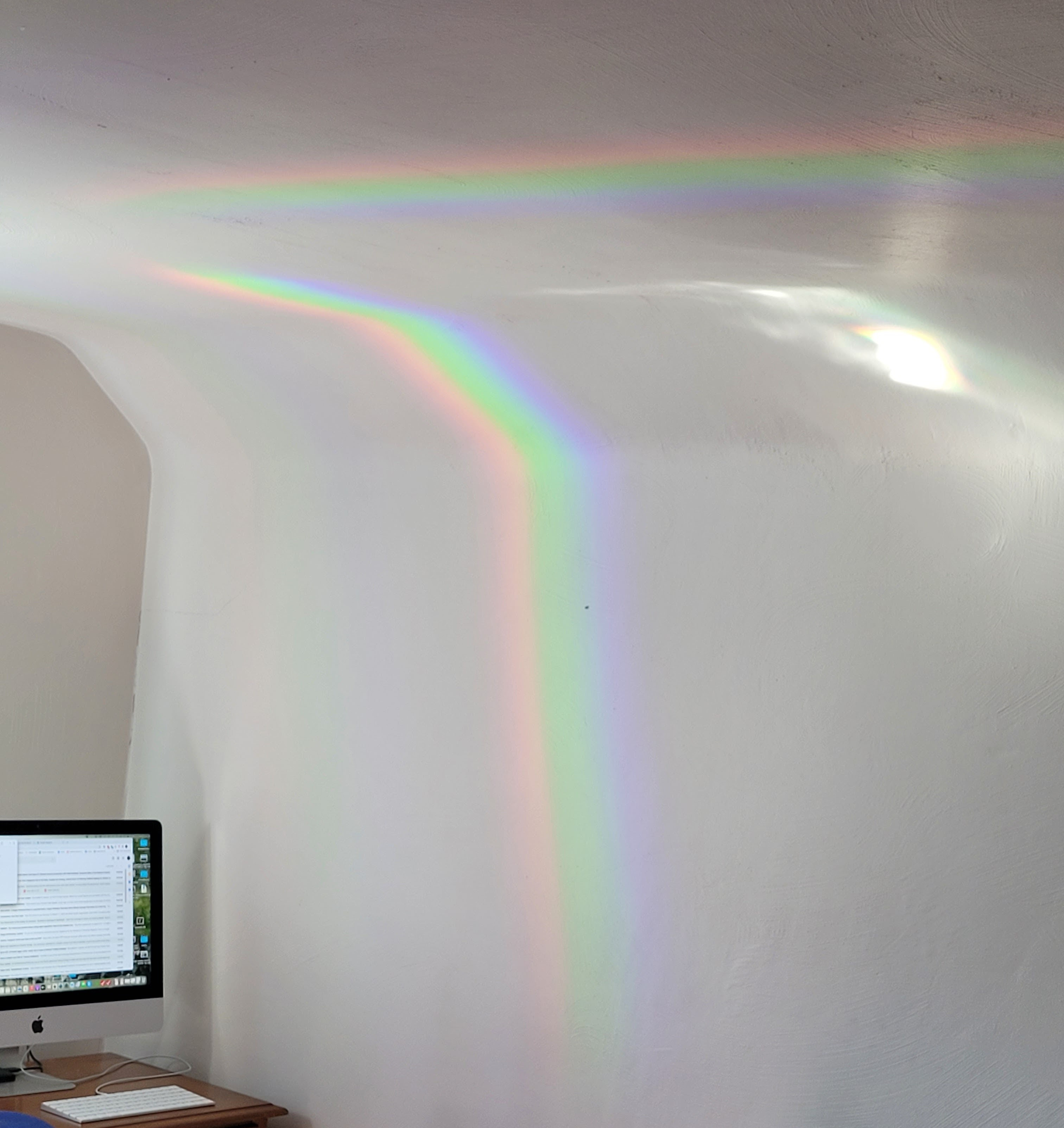
No pot of gold at the end of this rainbow, but happy Saint Patrick’s Day nonetheless!

Join us for Linda’s One-Liner Wednesdays! Find out more here: https://lindaghill.com/2021/03/17/one-liner-wednesday-nothing-lasts-forever/

back to church

Yesterday, for the first time in over a year, I attended mass in person.

If you had told me prior to the pandemic that I would ever go a year without going to church, I would not have believed it. I grew up Catholic and going to mass for Sundays and holydays was an important part of our faith practice. I was in church as a teen more than most because I became our small country church’s only organist in my second year of high school. I spent many years in music and liturgical ministries and, although I hadn’t been active in them in recent years, I still considered taking part in mass and receiving the Eucharist a vital part of my faith life.

Last March, when the severity of COVID was first becoming apparent, I decided not to go to mass for fear of exposing my father, one week before New York State went into lockdown and the churches temporarily closed. I began participating via televised mass as my mother had done when she was ill. Over time, churches here resumed services, first outdoors or broadcast to congregants in their cars in the parking lot. Later, indoor services were permitted with distancing, masking, temperature checks, pre-registration, and other measures in place, although the bishops have kept the dispensation from in-person attendance in place.

Because being part of a large group of people who are speaking and singing is inherently more risky than being at home or in a grocery store, I had made a personal decision not to attend mass in person until I was fully vaccinated. Last week, two weeks after my second dose of the Pfizer vaccine, I called the church to make a reservation to attend the Saturday vigil mass yesterday.

I arrived early, knowing that there would be a check-in process and that we would need to maintain spacing. I was masked, of course, and gave my name to the volunteer at a table, who found my name and contact information on her list. They keep the information on file so they can call if a positive test is reported. There was a temperature check and the distribution of a leaflet with the day’s music. I was allowed to choose my own seat among the pews, although every other row was blocked off by purple cords draped around the end. I sat near the music ministers, so that I could watch my friend play the organ and see the cantor who would be leading the singing.

If I had to choose one word for the experience, it would be stark. This is partly a function of it being Lent, which is a penitential season. There are no flowers and the sanctuary is kept as simple as possible. What was striking to me, though, was the space between all the ministers. The priest, deacon, two lectors, and single altar server were in chairs scattered around the altar and ambo, which is necessary for viral reasons. It amplified my sense of separation from them and from the rest of the congregation. Only people from the same household can sit in a group, so many of us were sitting alone.

I felt most like I was part of the assembly when we were praying aloud together. Although we were masked and there were far fewer of us than our pre-pandemic numbers, our voices carried well and we could hear one another, ironically helped by the acoustics of the space without so many bodies to absorb the sound. This was, however, a double-edged sword. During the prelude, I was annoyed by a couple behind me discussing home improvement projects, no doubt unaware how well their masked voices carried in the space.

As often happens, there were emotional moments for me during the liturgy, although not when I had expected them. As part of the prelude, my friend improvised on the Irish hymn tune St. Columba, which is often used with the text “The King of Love My Shepherd Is”. It is one of my favorite tunes. Back in the days when I could play the organ and was practicing, it was one of the hymns I would sing as a personal prayer. I was very grateful to hear it yesterday.

When we prayed the Lord’s Prayer together, I was particularly drawn to the last phrase, “deliver us from evil.” I am still pondering the full implications of being drawn to that at this time. Like most Christians, I have prayed this prayer thousands of times. It is a testament to its strength that it reveals different aspects of faith as our circumstances change.

The third moment was that I choked up as we started to sing the Lamb of God. This simple text, which is placed in the liturgy shortly before communion, has long been my favorite prayer of the mass ordinary. Long ago, I set it in a choral anthem paired with a text from Isaiah. Again, a prayer that I have recited or sung thousands of times but that was somehow connecting with me in a new way.

Strangely, the thing that I expected to be very emotional was not and perhaps goes back to my feeling of starkness. In order to maintain distancing, communion was not distributed at the usual time. Instead, we prayed the concluding rite and then received communion. The priest and the deacon went to positions at the end of the far aisles and the congregants, keeping six feet of distance between them, filed up to receive the host, step away, briefly lower their mask to consume the host, then immediately process to the doors by a different route and exit, all while the communion hymn was being sung. Because I was near the front of the church, that meant exiting during the hymn without an opportunity to join in that prayer. Intellectually and from the public health viewpoint, this procedure for communion makes perfect sense. It keeps people from congregating in the building or around the exits and minimizes the chance of spreading the virus. From a liturgical perspective, though, it feels stark. The word Eucharist means thanksgiving and the word communion has the same roots as the word community; this more isolating experience feels counter to that. As someone who has study music and liturgy, it also was very difficult for me to leave while there was still sung prayer ongoing.

I was grateful to be able to attend in person but I don’t think that I will try to do it every week yet. Due to the cleaning protocols involved, there are only two masses per weekend; with fewer masses and reduced capacity, I don’t want to deprive other people from being there by taking up space myself on a regular basis. I do hope to go once during Holy Week, Easter Vigil if possible or Holy Thursday if the Vigil is in high demand.

Otherwise, I will continue to participate from home until our area progresses to the point where we can gather safely in large numbers again, when we can exchange a sign of peace, when things will not be so stark.

When we do get to that point, there will be another, more complex decision to make, which is how much of the politics and abuses of power in the church itself I can continue to tolerate. The clergy of the church continue to grapple with its own history and legacy of crimes, abuse, and sin, or worse, some grapple and some continue to deny. Meanwhile, lay people are not given the opportunity to fully use their gifts in service to the people and the church.

It’s exhausting.

The pandemic has blunted the effect of having this struggle before me every week. I haven’t decided yet if I can take it on so consistently again. I used to go to mass every week, even when I cried because of the pain. I did it because I couldn’t imagine being separated from the Eucharist. Because of the pandemic, I now know that spiritual communion is a reality, that I can feel close to Christ and to creation and all people, even when I’m not able to attend mass in person.

I don’t know what I will choose to do.

Another aspect of life in which I dwell in mystery.

SoCS: the last year

I had planned to post about the pandemic anniversary today, so it was fortuitous that Linda took the occasion to have us write about our past year. She also gave us permission to edit if we chose, so this post will be only stream-of-conscious-ish. I’m hoping to only need to do light editing.

So, compared to most other people in the US, I have been fortunate over this pandemic year. My spouse B has been working from home so we didn’t take a financial hit. He and I and daughter T have been safe in our home. My state, New York, was initially hit very hard by the pandemic, although not as much so in my home region of the Southern Tier. While we did have a period of time as a local COVID “hot spot,” we followed the precautions on masking, avoiding gatherings, handwashing, etc. and stayed safe.

This is not to say that we didn’t have to make changes in our lives. T’s job search has been on indefinite hold. Grocery shopping and meal planning became a major endeavor for me, due to shortages and restrictions. Some of my poetry activities moved online, but the year hasn’t been as productive as I had hoped. The Boiler House Poets Collective annual residency at MASS MoCA was cancelled due to COVID, although I did craft my own writing retreat in North Adams in late summer which turned out to be a perfect time, given the sooner than expected fall surge. (Additional posts from that time are here and here.)

There are two big personal impacts for me as a result of the pandemic. The first is the separation from daughter E and her family, who live in London, UK. We visited in December, 2019, with plans for several 2020 trips, including a visit to meet our new grandchild, and a plan for them to visit us here in the States in December 2020. None of that happened, due to COVID. While we have been in touch virtually, we have all been largely confined to our respective homes. It’s been hard watching from a distance as they dealt with likely cases of COVID in their household at a time when there wasn’t even testing available unless one needed hospitalization. We missed granddaughter ABC’s third birthday and the birth of granddaughter JG. We missed ABC starting nursery school, which has been variously in person and virtual depending on how viciously the virus was spreading in London at any given time. JG is now seven months old and we have no idea when we will be able to visit. She may be a toddler by the time we get to meet in person.

The second personal difficulty has been trying to care for my almost-96-year-old father, known here as Paco. Before the pandemic, we visited him every day in his apartment in the independent living building of his senior community. His memory was poor, but we were able to keep him safe and on an even keel. Once the pandemic began, though, we needed to limit contact, so we reverted to handling most things by phone with screened staff handling some tasks that had to be in person. This proved to be difficult but when Paco developed a medical problem that required a few days in the hospital, it became impossible for him to be safe in his apartment. In December, he moved to the health care building, first for three weeks of rehab in the skilled unit and then permanently to the assisted living unit. This is where he needs to be at this point, but due to state COVID rules, it was very difficult to visit in person. I am happy to report, though, that yesterday and today we had our first visits to his new apartment; before that, we had to meet in the visitors room or do window visits where we spoke by phone on either side of a window. We still have to mask and distance, but we could at least organize and tidy his rooms for him.

The greatest difficulty that is more universal is the sorrow at the immense cost the pandemic has exacted. So much illness. So much death. So many without even the most basic essentials for a secure existence. So much social isolation. So many who risked their own health to meet the needs of others. In the United States, the bewildering politicization of the crisis.

As we have been commemorating this first anniversary of the pandemic, though, I am feeling hopeful. We are about seven and a half weeks into the Biden administration and vaccine distribution has seen a big boost. Although the number of cases, hospitalizations, and deaths is still much too high, it is lower than it has been in months. In New York State, we are able to continue our gradual, science-and-metrics-driven increase in public activities. I went to church in person for the first time in a year today. It feels like we are making real progress toward ending the pandemic.

Real hope after a year of fear.

I’m very grateful for the vaccines and the people who are being diligent in observing public health measures. I’m grateful that B, T, and I were able to be of public service as participants in the Pfizer vaccine trial, which I’ve written about frequently here at TJCM.

I admit the fear isn’t totally gone. It’s upsetting to see people who are ignoring public health advice still. Especially with so many variants of the virus active and so many people unwilling to be vaccinated, it’s possible the virus will start to surge again.

Still, for the first time, the hope outweighs the fear in my mind.

Please, everyone, be careful. Stay safe. Protect yourself and your neighbors. We can end the pandemic after this awful year.

Together.

*****
Linda’s prompt this week was to write about our experiences over this last pandemic year, stream of consciousness style or not, or “day/week/month/year.” I chose the first option. Join us! Find out more here: https://lindaghill.com/2021/03/12/the-friday-reminder-and-prompt-for-socs-march-13-2021/

JC Confessions #18

In the first few seasons of The Late Show, Stephen Colbert did a recurring skit, now a best-selling book, called Midnight Confessions, in which he “confesses” to his audience with the disclaimer that he isn’t sure these things are really sins but that he does “feel bad about them.” While Stephen and his writers are famously funny, I am not, so my JC’s Confessions will be somewhat more serious reflections, but they will be things that I feel bad about. Stephen’s audience always forgives him at the end of the segment; I’m not expecting that – and these aren’t really sins – but comments are always welcome.

JC

I do not know how to apply make-up.

Other than the fact that I couldn’t teach my daughters how to do it, this has not been a hardship in my life. I’m comfortable with my natural look.

My main experience with make-up dates back to high school, when I was in some musicals. We had to wear make-up so that we didn’t appear washed out by the harsh lights and distance to the audience. This generally meant very heavy eyeliner and some blush, which looked good from far away and comical up close. Once, when I was playing Sister Sophia, one of the older nuns in The Sound of Music, I sported black lines on my face to make me look older. I remember getting comments that I looked good that way, which I chose to take as compliments of how I would look as I aged rather than criticism of how I looked at seventeen.

The thing about not wearing make-up that does bother me sometimes though is the association that many people make that if a woman does not wear make-up, she is “letting herself go.” While it’s true that I don’t wear make-up, I am not unkempt. While I understand that many women will not go out in public or attend video meetings without wearing make-up, it doesn’t mean that those of us who choose to present our natural skin to the world are less competent, committed, or caring than they.

Make-up is also touted as a way to “look younger.” I prefer to look, well, how I look. Admittedly, I am not good at guessing how old people are. I’m now sixty, so this is what 60 looks like for me.

I wonder if my long-ago teen classmates would think that Sister Sophia was sixty and I look like her now…

One-Liner Wednesday: true or false

Our brains prefer a simple falsehood to a complex truth.

Brian McClaren describing complexity bias in an insightful post

Join us for Linda’s One-Liner Wednesdays! Find out more here: https://lindaghill.com/2021/03/10/one-liner-wednesday-thief/

Governor Cuomo, continued

I wrote here about the developing situation with Andrew Cuomo, our governor here in New York State, where I live in Broome County, far from both New York City and Albany, our capital. In the week and half since I wrote, things have become increasingly contentious, both on the reporting of nursing home death issue and the sexual harassment/bullying issue.

The nursing home death reporting issue parameters are largely unchanged. The administration reported deaths where they happened, whether in a hospital, nursing home, or elsewhere, such as a private residence. Some people wanted to know how many of the hospital deaths were people who had come to the hospital from nursing homes; they wanted the term “nursing home deaths” to refer to people who had likely contracted the virus in a nursing home, regardless of where they died. The newest wrinkle in this is that it appears some of the governor’s top aides edited a report over the summer in such a way as to not reveal how many of the hospital deaths were people who had come from nursing homes at a time when the governor was writing a book on his leadership during the pandemic.

In reaction to all this, the legislature has rescinded the broad authority to take executive action that it had granted to the governor last spring. This is their right to do, of course, but I would feel better if they committed to staying in session past June. Getting things through the New York State legislature is often a long, drawn-out affair and there are times with the pandemic when things change quickly and new policies need to be enacted as expeditiously as possible. The governor can continue to extend existing executive orders.

I am grateful that the existing orders can still stand because, by and large, they have worked well in keeping as many New Yorkers safe as practicable. While the initial outbreak in New York was horrible, the policies the governor enacted in conjunction with public health, medical, scientific, and legal experts were adopted by the public and brought the infection rate down well below the national average. Although there have been spikes, for example over the holiday season when many people travelled and gathered in groups against the state and public health recommendations, New York has not suffered the fate of other states that didn’t implement mask mandates, distancing requirements, gathering size restrictions, etc. or that lifted restrictions too quickly. By being thoughtful and incremental in re-opening and by gathering, analyzing, and adjusting in response to data, most New York businesses and schools are open and are expanding hours as our vaccination rates go up and infection rates go down. New York needs to continue on its science- and data-driven path to keep from suffering the spikes we have seen in other states that were less thoughtful in their plans. Governor Cuomo made mistakes during the past year, but he took responsibility for them and changed policies to correct problems. His leadership mattered and I will always be grateful for what he did because he helped as many New Yorkers as he could to survive a devastating year.

I think New Yorkers need to remember that Governor Cuomo is also a regional and national leader. He spearheaded an effort in the Northeast for states to cooperate on policies and on procuring supplies after the prior federal administration decided not to have a national strategy. In 2020, he was vice chair of the National Governors Association; in 2021, he is chair. This gives him even more opportunity to advocate for policies to help everyone in the US in these trying times. In a few days, it is likely that federal aid to state and local governments will finally be enacted as part of the American Rescue Plan, an initiative that Cuomo has been championing since last spring.

I admit that I am somewhat perplexed that people are surprised by Cuomo’s personal behavior. Any casual observer of New York politics or regular viewer of his pandemic press conferences has seen him being combative and displaying his sense of humor, which ranges from dry to caustic. His sense of what is appropriate to say in public is – um, let’s say – less circumspect than one would expect. He seems especially unable to understand younger people’s sensibilities. For example, when his three 20-something-year-old daughters and one of their boyfriends were living with him last year, he said any number of embarrassing things regarding them. I don’t think he really understands current mores on what is appropriate to say or do in work settings, which is why I think his apologies following the young women’s stories of feeling uncomfortable with his behavior are credible. He is as clueless as Joe Biden who faced criticism for touching and whispering in the ears of women while on the campaign trail or George W. Bush who tried to give German Chancellor Angela Merkel a shoulder rub.

I think that the independent investigation that is ongoing is very important to gather evidence on stories of sexual harassment and hostile work environment. If there is evidence of impeachable acts by the governor, then that should take place. Unlike a corporate executive, the governor is elected by voters, not a board of directors, so there is no relevant authority to fire him or force him to resign. While some state legislators have gone on record calling on Gov. Cuomo to resign because these investigations are a distraction, the governor is carrying on with his duties, adjusting the pandemic policies as conditions warrant and getting ready for budget negotiations with the legislature. Unlike most states, New York’s budget is supposed to be passed by April first, so, once the American Rescue Plan is signed into law, there will be a short window in which to finalize and pass the state budget. Although Lieutenant Governor Kathy Hochul has been involved in the pandemic response, especially in her home region of western New York, it would be much more disruptive to the state budget process to have Gov. Cuomo step down at this time.

While I admire Governor Cuomo’s leadership through the pandemic, I do not admire him as a person. I find him to be arrogant, overbearing, and a boor. Unlike his father, the late Governor Mario Cuomo, who was principled and articulate, Andrew has always been a bare-knuckles brawler and bully as a politician. Despite being a Democrat, during his early years as governor, he governed more like what used to be a moderate Republican. He and then New York City Mayor Michael Bloomberg were willing to inflict the health and environmental consequences of fracking on our area, as long as the watershed for New York City water supplies was kept free of drilling. (The eventual fracking ban in New York was thanks to Dr. Zucker of the Health Department and later passed into law once the Democrats had the majority of both houses of the legislature.) It wasn’t until it was clear that the national electorate was becoming more progressive and the Democrats controlled both houses of the legislature that Governor Cuomo started to govern and talk like a Democrat.

Because past Republican candidates for governor have been unqualified and put forward ideas which I oppose and because I didn’t like or trust Andrew Cuomo, I have been voting for the Green Party candidate for governor, whose platform aligns most closely with my own. Granted, in heavily Democratic New York, it was unlikely that my choice to vote third-party would have any real bearing on the outcome of the elections, but I wanted to make clear here that my admiration of the governor’s handling of the pandemic was not a reflection of my being a fan of him personally. Likewise, my observations of his personality and behavior are not coming from a place of partisanship.

At this point, my main motivation is pragmatism. The next couple of months are critical in the course of the pandemic. As national health experts and the Biden administration are pointing out repeatedly, we need to be cautious in ending pandemic protection measures until we have a much higher level of protection among the general public. Texas and a number of states have, as they did in previous waves, lifted restrictions too soon. Governor Cuomo will continue to follow the science to keep us from having a large spike in cases. He is also setting up vaccine sites among underserved populations, trying to address the health and social inequities that caused people of color and those with low income to be hit hardest by the pandemic. I don’t think the New York State legislature is nimble enough to address these issues and I’m not sure if Cuomo’s prior executive actions would stay in force if Lt. Gov. Hochul were to become governor.

Also, the budget negotiations will be very difficult. In New York, for a number of complicated historical reasons, the budget gets hammered out largely by the governor, the speaker of the Assembly, and the majority leader of the Senate. The budget also includes a lot of non-budgetary legislation; one hot topic in the last several fiscal years has been the legalization of recreational marijuana. I don’t think it would be fair to expect Hochul to be thrown into the midst of that process with the deadline coming up in three weeks.

I have often written about how the stress of our governmental function adds to my personal stressors. After the November election, I had hoped that, by this time, the governmental stress might have eased more than it actually has. With the aftermath of the insurrection and the state of the Republican party on the national level and the upheavals with Governor Cuomo, my hopes were not fully realized.

But, hey, what’s life without stress?

I’ll never know.