These days, I create poems. I create posts here at Top of JC’s Mind.
I also express myself creatively in less obvious ways. Through cooking. Through taking photos (on occasion. I’m not one to be constantly photographing.) In conversation. While singing. In correspondence. In my own thoughts as I’m puzzling through a complex situation and trying to find options.
I love my role in creating my family.
I also love being part of creating community, whether that is on a small, local level or something much broader, like the global community working on climate change. Even though I am a very, very tiny part of such a large community, I realize that my creativity and energy are adding to the effort.
An aspect of creativity that was very important to me as a young adult was writing music. That part of my creative life was lost to me in 2005 when we went through a crisis at my Catholic parish that fractured my relationship with it and my music ministry. Because I wrote music for them, my impetus to use my creativity to write music also broke. I think that rupture may be part of the reason I turned to poetry as a means of creative expression. That artistic energy needed somewhere to go.
Will I eventually return to writing music? At this point, I don’t anticipate that happening.
The search for a new Republican House speaker was long, fraught, and ugly – and resulted in the election of Mike Johnson of Louisiana who apparently does not have the mindset, skills, and experience to effectively govern.
Given that his own Republican conference is fractious and has only a slim majority, he should follow the lead of the Republicans in the Senate and work with the Democrats to craft legislation that can garner the votes of both a majority of Democrats and Republicans. Passing bills with only Republican support in the House isn’t going to do any good when they will not be taken up in the Senate and, even if they were, wouldn’t get the president’s signature. Legislation needs to be in line with the budget agreement already passed in the spring. Bills also need to be “clean,” meaning that they shouldn’t have unrelated amendments tacked on, such as federal abortion restrictions.
There are crucial pieces of legislation that need to pass soon. One is for funding for Israel and Ukraine, for border security, and for humanitarian and disaster relief, both at home and abroad. Another is a continuing resolution to keep the government funded until the final appropriations bills are adopted. The current resolution expires on November 17, so this needs to happen very soon to avoid a government shutdown. The Farm Bill, which covers a five-year period and is up for renewal now, needs to be enacted; besides framing bills, it also includes important nutrition programs. It would be nice if actual appropriations bills were passed – the Senate committees have passed these bills but the full Senate can’t vote on them until the House has acted – but an omnibus bill that folds all the budgetary bills together is also a possibility.
It’s possible that if Speaker Johnson does put bipartisan bills on the floor, a disgruntled House Republican will force a vote to vacate the chair, meaning to remove the Speaker, but the vote won’t succeed if the rest of the conference sticks together.
The Republicans have an opportunity to show that they are able to govern in a responsible way, fulfilling the promises made in the Preamble of our Constitution. Any member who instead chooses obstructionism should not be re-elected in 2024. We send our representatives to Washington to govern, not whine.
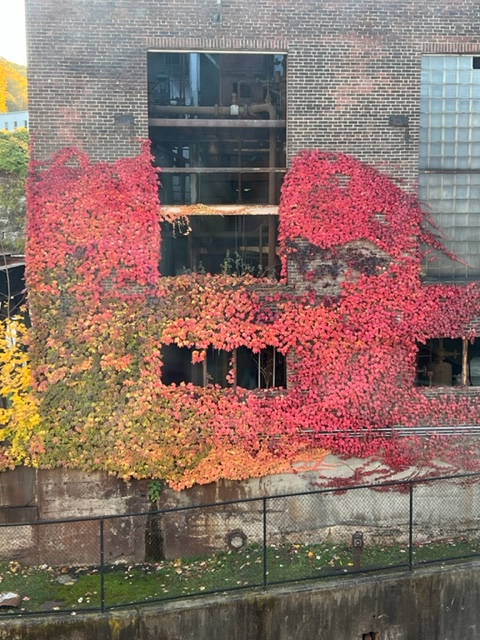
Yes, it’s been over a month since I returned home from the Boiler House Poets Collective residency with The Studios at MASS MoCA (Massachusetts Museum of Contemporary Arts) in North Adams but I am finally getting around to a wrap-up post. I did post a couple of times during the residency, about Marika Maijala and our reading at the Bear & Bee Bookshop, although that was a far cry from most of our years in residence when I would post daily. Things were very busy, so posting took a back seat and this past month has been loaded with other commitments, such as the launch of the Third Act Upstate New York working group and the first concert of the Madrigal Choir of Binghamton’s 45th anniversary season. I also needed time to reflect on the residency and what it meant for the future of the Boiler House Poets Collective.
Until this year, the Boiler House Poets Collective reunion residencies had always had at least half of the participants being members of the original group that met in 2015 as the first group of poets in residence brought together in a collaboration between Jeffrey Levine of Tupelo Press and The Studios at MASS MoCA. For 2023, the number of participants went from eight to ten, with only myself and Kyle Laws planning to return in 2023. (Sadly, last-minute health complications prevented Kyle from joining us, so I was the lone “original” in 2023. I’m hoping to have this be a one-time occurrence.)
I had inherited the role of liaison with The Studios but also wound up acting as an organizer for this year of transition. I was determined to assemble a full complement of ten and to provide for all the elements that had been part of past residencies, including studio time, museum visits, daily workshopping, a group project, a public reading, and discussion/social time (often accompanied by food and drink). Because, in prior years, we had always had a core of originals, adding in new participants from among our poet-friends as slots became available, we hadn’t felt called to define who we were as a group. I thought, at this juncture, we needed to be more intentional about our identity and our goals. I let people know that we would be having an organizational meeting near the end of the residency to talk about what was important to us and what our plans would be going forward.
I admit that I was really nervous about how things would work out with so many people who had never met each other. For the first time, we had a member who was not herself a poet. In 2022, the BHPC residency overlapped with the residency of Nancy Edelstein, whose work centers around light. With that inspiration, I had designed our group project around the theme of light, inviting each person to contribute work that had to do with light. I had expected a group of poems but the amazing thing was that people began to notice light in new ways. One of our members was inspired to take photographs showcasing light and shadow. We were able to share our light-themed work with each other. It’s not yet clear whether or not we will produce some conglomeration of these that is shareable with the public. If we do, I’ll be sure to share it here.
Another thing that was new for BHPC this year was that we workshopped some pieces that were not poetry, including an essay, scene from a play, and excerpt of a radio play. It was interesting to expand our literary horizons. While we expect to remain grounded in poetry, it’s good to have that flexibility to serve our members’ needs.
I felt that the group had a good vibe from the time of our opening night dinner when we were first together but I was nervous for our organizational meeting when people would be assessing how things had gone and if they wanted to return in 2024. I was thrilled – and a bit teary – when all but one person immediately said they wanted to return next year; the remaining person hopes to but lives across the country, creating a lot more complications than those of us within easy driving distance. People enthusiastically volunteered for organizational roles, including inventing some duties I would never have thought of on my own, so that I will be able to concentrate on just doing the liaison role. I even have a deputy who is shadowing me and can take over if I’m sidelined for any reason. This new constellation has embraced being a collective in a wonderful way and I am immensely grateful.
On a personal level, I appreciated how supportive people were of my work. As regular readers here at Top of JC’s Mind may recall, I grew up in the North Adams area and have two manuscripts, a full-length and a chapbook, that I am submitting to presses and contests. I’m at a crossroads with the full-length collection. I have a contract offer from a hybrid publisher but I’m not sure that is the way I want to go. One day over lunch, people were listening to my concerns and offering suggestions, which were very helpful and have led to my scheduling a manuscript consultation with a professional editor next month. I’m hoping that will help me clarify the path I need to pursue.
I also appreciated that people took my work seriously. One of the poets said that my poems were important in preserving the history of the area. That was so gratifying to me, even though I seldom dare to think in those terms. I do think about those poems as being ones that only I would write, given my perspective as someone who grew up there but that has lived elsewhere most of my adult life. It’s a sort of inside/outside perspective that would be difficult to replicate in quite the same way. I don’t tend to think that my following the dictum to “write what you know” would seem important to someone else, so it was nice to hear. It makes my search for a publisher and my wish to have the book be as strong as possible feel more weighty.
So, I have joyfully marked the dates for the 2024 Boiler House Poets Collective residency on my calendar for next October. I’m looking forward to being among this remarkable group of women again, but I’m also grateful to know that, if something happens that prevents me from being there, the group will go on without me.
Today’s notification from WordPress: “Congratulations! Your site, Joanne Corey, passed 100 all-time views.” This is my author site and domain name that I finally set up in honor of the release of my first chapbook and the tenth anniversary of Top of JC’s Mind. I suppose it shouldn’t have taken almost two months to get 100 views, but, hey, not bad for a poet. 😉
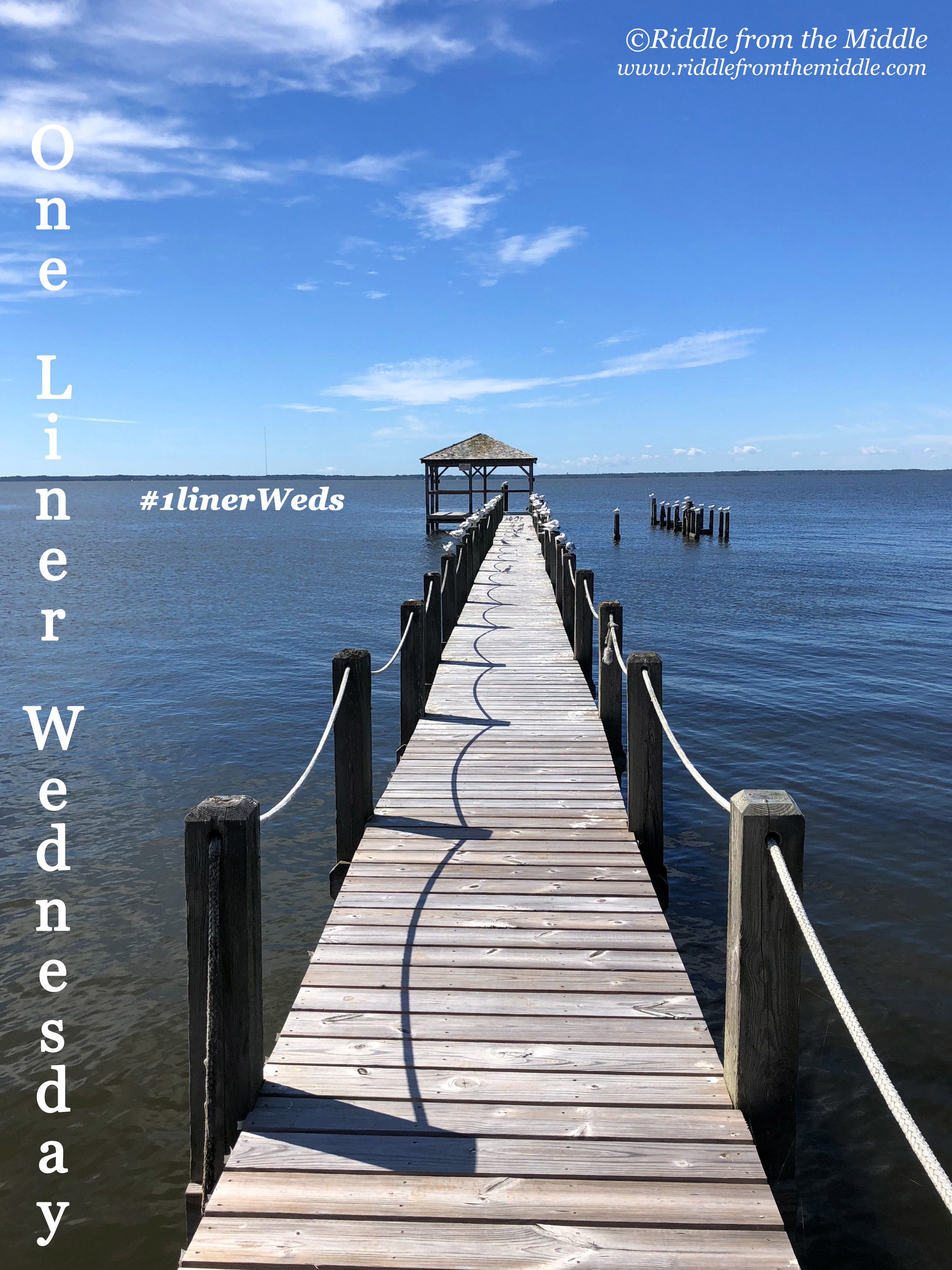
This super-sized One-Liner Wednesday post is part of a series spearheaded by Linda Hill, author and blogger at Life in Progress. Click the link for a lovely autumnal photo and for instructions on how to join in the #1linerWeds fun!
This will be super short because I’m going to meet up with a lot of people today. (Well, a lot for me, at least!)
This morning, I have a Creation Care Team meeting at church.
From early afternoon through early evening, I’ll be going to a gathering of women, organized by a friend and being held at the retreat space of another. There will be expressive arts, chair yoga, an opportunity to walk a labyrinth, companionship, and, of course, some food. I made a big bowl of applesauce to bring and share. Very indicative of fall in the Northeast.
I don’t usually see that many people in a day – or, perhaps, it’s more accurate to say I don’t usually interact with that many people in a day.
When you are doing improvisation exercises in theater, there is an understanding that you will do “yes, and” to build on whatever came before you. It’s the way that you keep the improvisation going.
I have found, though, that saying “yes, and” on a regular basis in life quickly leads to being overwhelmed.
Sometimes, you need to say “no” – no matter how worthy the cause. Or, at least, “not right now.”
I managed to illustrate this lesson over these last few months. I had planned to spend them concentrating on poetry, learning to market my first chapbook, Hearts, and preparing for the Boiler House Poets Collective residency in late September-early October.
I’m not sorry that I did these things; they were valuable and I gained new skills and friendships. They were also all expressions of things that are close to my heart and ways to serve others. It was just that saying “yes, and” a bit too much led to a lot of stress and was unsustainable for more than a few months. It also, unfortunately, meant that something had to give, which turned out being my efforts at book marketing, which was the only thing I could give up without having to sacrifice a group goal.
Realizing all of this, I was able to say “no, at least for now” to being on the Communications Committee for Third Act Upstate NY after our successful launch. The Boiler House Poets Collective residency was a great experience, with the BHPC members coming together to divvy up the work to prepare for next year that had largely fallen to me this year. (I really do need to get to a wrap-up post for the BHPC residency. Coming soon…) Madrigal Choir made it through our first concert of the season with flying colors. The next few weeks will be busy as we prepare and present our annual Lessons & Carols concerts the first weekend in December; there will also be Board work ongoing.
Still, things will be calmer and more manageable than the last few months have been.
I’m excited – and a bit nervous – about an upcoming manuscript consultation for my full-length collection, which I’m hoping will clarify where to seek publication for it. I have a bit more editing to do in advance of that. I’m getting some writing done with the fall season of Binghamton Poetry Project up now and have some more editing and possible new work following up from the BHPC residency.
Oh, and Top of JC’s Mind! Although I’m perpetually behind where I would like to be, I was able to celebrate the tenth anniversary of the blog in September, including the launch of joannecorey.com as an author site with access to TJCM as a feature. No worries if you continue to visit here at topofjcsmind.wordpress.com. That is the permanent address of the blog for all time – or while we still use this technology.
There are some other projects waiting in the wings and, of course, Thanksgiving, Christmas, and New Year’s are coming and I have done literally no planning for them so far.
I don’t know if I can find the impetus to go back to trying to learn book marketing or not. I may have used up my energy for learning new things and being outside my comfort zone for the year.
Another mentally ill man with an assault rifle mowing down people, including children, who were out with family and friends enjoying recreation and sharing meals in another US city. This time, it was Lewiston, Maine. As I write this, there are 18 confirmed dead, although only eight have been officially identified. Assault weapons cause such grievous injuries that even family members may not be able to identify victims by sight, so forensic methods need to be used. Thirteen people are injured.
As of October 27th, the Gun Violence Archive has recorded 566 mass shootings in the United States so far in 2023, which is tragic and appalling. The total number of deaths due to gun violence is 35,389 with 19,800 of those being self-inflicted, which is also tragic and appalling.
The entire population of Lewiston, Maine was listed as 36.617 in 2021. Would we finally be able to get more governmental attention to the issue of gun violence if we think of it as an entire small city dying due to guns rather than looking at each individual instance in isolation?
Even though there is support from over 80% of the public for some gun safety measures like universal background checks for all gun sales, Congress has not been able to pass these into law. The House Representative whose district includes Lewiston has apologized to his constituents for his prior opposition to gun safety laws and now promises to support them. I challenge other members of Congress to look at gun violence in their own districts and states, whether they are mass shootings, individual homicides, accidents, suicides, or woundings, and determine a path to make life safer for all people.
It’s too late for 35,389 people this year but not too late for countless others. Congress, act now.
So, bottom line: when you burn fossil fuel you produce particulates which lodge in lungs and kill you (one death in five on the planet comes from breathing the byproducts of fossil fuel combustion), and when you burn fossil fuel you produce carbon, which lodges in the atmosphere, driving heatwaves and floods that kill you.
Over the weekend, my alma mater, Smith College, inaugurated Sarah Willie-LeBreton as their twelfth president in a joy-filled celebration.
For those of you who may not be familiar, Smith was established in 1871 in Northampton, Massachusetts as a women’s college that would provide an education for women equal to that which had long been available to men. It has continued that mission through the years and has in recent decades worked diligently to make a Smith education possible to promising students in underserved communities, such as those who are the first generation in their family to seek higher education. For example, it has eliminated student loans from its financial aid packages and gives grants to students in need to help them obtain essential items like computers.
I was a Smith student during the tenure of the first woman to be Smith president, Jill Kerr Conway (1975-85). We affectionately referred to her as “Jill” although we would always have addressed her as President Conway in person. It felt right to me to hear an alumna during the inauguration refer to Dr. Willie-LeBreton as “President Sarah” so that is how I am thinking of her now.
President Sarah is a sociologist, a member of the Society of Friends (Quakers), a Black woman, and an experienced educator and administrator. She exudes joy and elicits it in others. Her official inauguration, coming several months into her tenure as president, was a joyous celebration of the history and heritage of President Sarah and of Smith College and how they are entwined as a community for the present and the future. I loved the greetings and involvement of other college presidents, who were so welcoming of President Sarah in their remarks. I especially appreciated the video appearance of Ruth Simmons, who was Smith’s first Black president – until she was stolen recruited by Brown University to become the first Black president of an Ivy League institution.
President Sarah’s inaugural address was impressive. I appreciated her strong support for liberal arts education. She emphasized how our knowledge must be in conjunction with our values. She says:
We are at our peril when we teach rote memorization without collaborative problem-solving and when we encourage the fusion of identity with grades, rather than with what challenges students and brings them joy. We are at our peril when we nurture cleverness without providing the opportunities to consult our moral compass, without providing opportunities to do for and with others. The liberal arts education we provide is the perfect antidote to the division, threats to democracy, diminishing of rights and freedoms, violence, and natural catastrophes to which we wake up on a daily basis.
(The inauguration ceremony is available online here; President Sarah’s remarks begin at the 1:12 mark.)
I would have loved to attend in person, but, like many alumnae, could only watch virtually. Smith did a good job of including us, even though we couldn’t be there physically. One way that they did this was to invite us to send a photo and caption of where we find joy. The photos were assembled into an interactive mosaic. The mosaic is searchable by name, class year, or key word to find specific photos in the mosaic. I sent a photo of my granddaughters, ABC and JG, heading out on their new school year. I’m honored to have them represented as we all share and, in so doing, multiply our joy.
Congratulations, President Sarah! I look forward to years of connection, love, commitment, and joy as a continuing, if geographically distant, part of the Smith family.
(Photo is of my first and most enduring Smith friend, my roommate Mary, and me, on tour with the Smith Alumnae Chorus in Slovenia in 2019.)











 Joanne Corey