The heart of justice is truth telling, seeing ourselves and the world the way it is rather than the way we want it to be. More than ever before we, as a society, need to renew a commitment to truth telling.
I try to keep up-to-date on the news, particularly in the US, and often blog about what is happening with politics and public policy.
I admit it has been daunting to write about the upcoming midterm elections next week. There has been so much disheartening rhetoric that I haven’t been able to make myself post about it but I feel compelled to post today after watching the continuing aftermath of the horrific attack against Paul Pelosi, spouse of House Speaker Nancy Pelosi.
For those of you not in the US, early Friday morning, a 42-year-old man broke into the San Francisco home of Paul and Nancy Pelosi. He had zip ties and duct tape with him and asked where Nancy was. (She was in Washington, DC.) He attacked the 82-year-old Paul Pelosi with a hammer, fracturing his skull and injuring his hands and arms. Pelosi is still in intensive care following surgery and is expected to recover over time from his physical injuries. The suspect is in police custody and will be charged soon, most likely for attempted murder among other charges.
The suspect had posted on social media his belief in a number of conspiracy theories, including those that demonize the Democrats as child abusers. While Democrats have been vocal and universal in the condemnation of the attack, Republicans have been much less so. Instead of recognizing this as political violence, some are saying it is just another example of increasing crime. They also fail to acknowledge that their political advertising, posts, and speeches featuring weapons and demonizing Speaker Pelosi and other prominent Democrats have any role in the increase in political violence.
The Republicans do a lot of “what-about-ism” in which they try to create false equivalencies and fear-monger on their talking points, all while conveniently dismissing any responsibility. In this case, they ignore things like the fact that most of the rise in crime is occurring in Republican-controlled areas that have relaxed regulations on guns. It’s likely that one of the reasons that Mr. Pelosi was attacked with a hammer rather than a gun is that California has a more rigorous system of allowing gun permits than Republican-led states, such as Texas. Republicans, including those in New York, blame bail reform for the increase in violent crime, even though the data show this isn’t true. There is also a much higher level of violent extremism on the far right than on the left. And, of course, we have recent and ongoing trials and convictions of perpetrators of political violence on January 6, 2021 at the US Capitol and the thwarted kidnapping of Michigan governor Gretchen Whitmer.
My usual way of determining for whom to vote is to look at the stand of the candidate and their party on a range of issues. Given my personal background, I place the highest priority on environmental and social justice issues. This is in keeping with the principles of Catholic social justice doctrine and with the call in the Preamble to the US Constitution to “promote the general welfare.”
I look at the candidates’ character, personal behavior, and integrity. I also look at their personal experience and intelligence. I want to vote for candidates who are smarter and more experienced than I. I don’t choose candidates on the basis of “who I want to have a beer with!” That comment may sound strange to those outside the US but there is recurring theme about this question as a gauge for likability/authenticity since about the year 2000.
In this election, there is an additional factor that I honestly never thought would be an election issue here in the United States. Do you believe in democracy? So many of the Republican candidates seem to be embracing anti-democratic, even autocratic, leadership and policies. They don’t believe in the outcome of free and fair elections, such as the 2020 election, even though they have no evidence to the contrary. They won’t say that they will accept the outcome of their own election if they lose. They won’t say that Biden was legitimately elected president. They have tried and sometimes succeeded in making it more difficult for minorities, elders, young people, and lower-income people to vote. They have broken up likely Democratic voters who live in a community into different voting districts to dilute the power of their vote.
What is most destructive is that they continue to support and perpetrate the lie that Donald Trump won the 2020 election and that he is not responsible for the January 6 insurrection, for illegal possession of presidential documents (including sensitive national security information), for obstruction of justice, and for other crimes for which there is ample, publicly available evidence.
Apparently, Republicans are into wielding governmental power for their own benefit – and the benefit of the wealthy people and corporations who underwrite them – rather than being public servants.
I won’t be voting for any of them.
I will vote for candidates who uphold our American values and who are serious about enacting and executing laws that improve our lives and communities, that try to heal our planet and climate, and that work with all people of good will to end conflict and disease.
I hope millions of others will join in this cause and remember that democracy is on the ballot.
There are a lot of people sick with respiratory viruses here in the US.
We are still struggling with COVID. Today’s (Oct. 28, 2022) statistics from the Centers for Disease Control show a weekly case count of 265,893 with 2,649 deaths. The case count is almost certainly low, as many at-home positive tests are never reported to health departments and some jurisdictions don’t gather data at all. The uptake of the reformulated boosters has been poor, with only 7.3% of people age five and over having received an updated booster.
While the community risk level map shows the majority of the country in the low (green) level, the community transmission rate is substantial or high in much of the county. You can see the various maps using a drop down menu here. The community transmission rate is based on case counts and/or positive test results; the community risk map also includes data on other factors, such as hospital admissions and stresses on the health care system. A personal illustration: Although the community risk level in my county (Broome in New York State) has been low in recent days, I have had a rash of friends being sickened with COVID. This is explained by our community transmission rate being high, which is the highest of four levels. (As I was writing this post, the maps were updated. Due to the emerging strains on the health care system, our county community risk just shifted from low to high.)
Meanwhile, the flu season has hit earlier and harder than usual. The predominant strain is H3N2, which is known to have a high incidence of complications, especially among young children, elders, and the medically vulnerable. Like many other illnesses, the effects of inflammation from the flu raise the risk of heart attack and stroke for weeks following the initial infection, further endangering not just personal health but also the stability of medical institutions, such as hospitals. So far this flu season in the US, the CDC reports 880,000 flu cases, with 6,900 hospitalizations and 360 deaths. Generally, flu season starts in October but this year it is running about six weeks earlier than usual.
The third virus that is currently surging is RSV (respiratory syncytial virus). For most people, RSV is like a cold but for infants, young children, and elders it can progress to lung infections. These can lead to hospitalization and even death, especially among elders. Unfortunately, there is not yet a vaccine against RSV. I actually participated in a clinical trial for one a few years ago but none has yet reached a level of effectiveness to be approved.
The triple whammy of COVID plus flu plus RSV has already pushed some pediatric hospitals to the edge of their capabilities. Ironically, the RSV rate is a critical factor. Because so many infants and young children were isolated due to COVID risk and lack of day care/school interaction during the pandemic, there is a much larger group than normal that is vulnerable to RSV infection.
There is also concern that the rate of new cases of all three viruses may climb even higher as the weather gets colder and people spend more time indoors.
Some things that people can do to help: Vaccinate as appropriate. Wash hands frequently. Avoid touching your face. Cover coughs and sneezes. Stay home and away from people as much as possible if you get sick. Mask in crowded places or avoid going to them. Get adequate rest and eat healthy foods. If you develop symptoms, talk to a health care provider so you can get testing and supportive treatments to help keep you from developing more severe symptoms and avert a hospital stay, if possible.
I know some level of sickness is inevitable but we can help cut down the case numbers if we watch out for ourselves and our communities.
The Design Thinking Initiative and the Boutelle-Day Poetry Center at Smith College, my alma mater, are currently spearheading a Common Reassemble project using the works of Emily Dickinson.
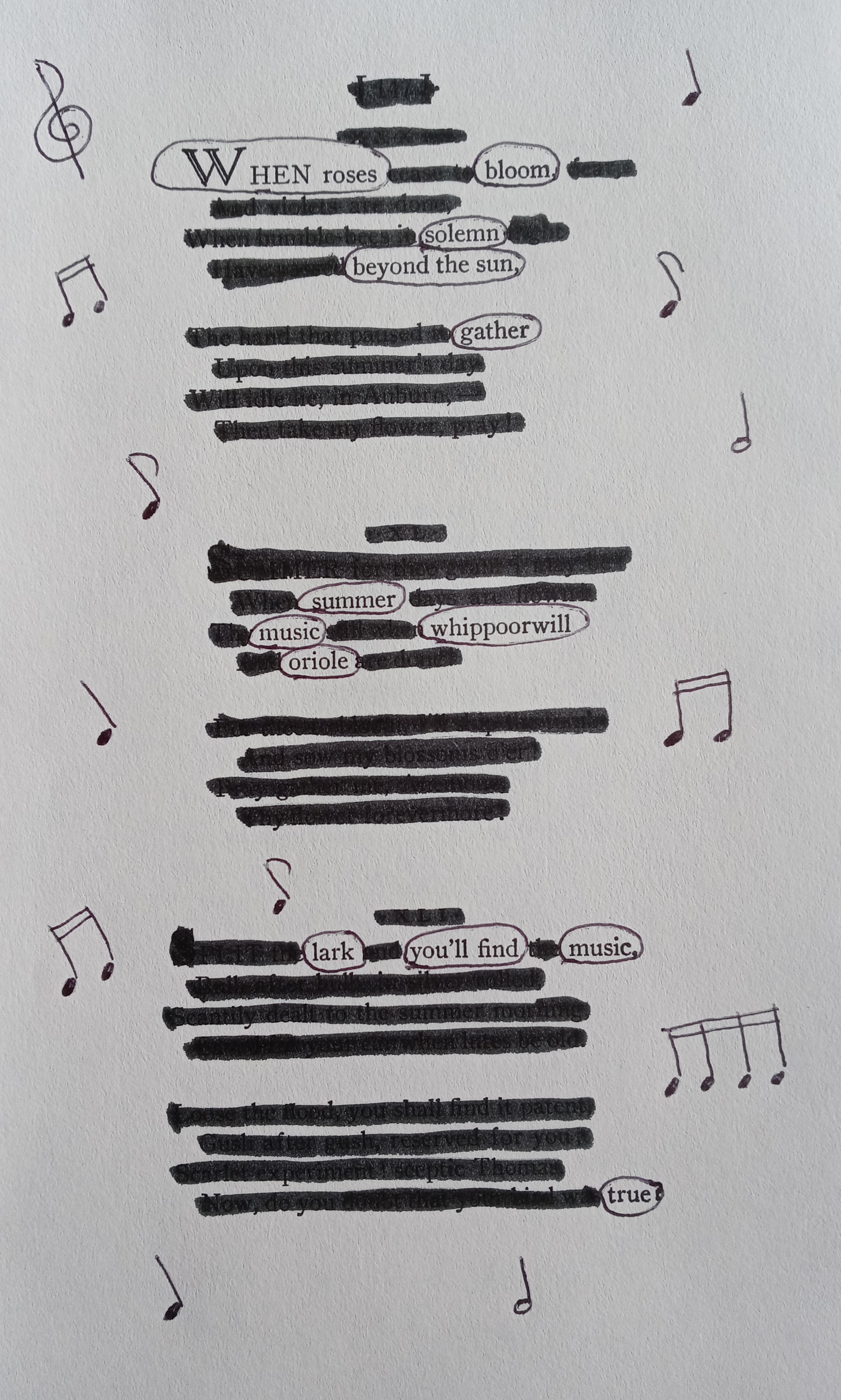
To participate in the Emily Dashes project, members of the Smith community take a page or two of Dickinson’s poems and create a response to the work using whatever materials they see fit.
I have submitted two pages. Being more of a poet than a visual artist, I relied on erasure style with a bit of added decoration.
The pages will be displayed at the Poetry Center and may be shared on social media. At the conclusion of the project, they will be assembled and housed at the library as part of the Mortimer Rare Book collections.
What a fun and innovative way to leave a bit of myself “in residence” at Smith!
One of the things I’ve enjoyed most about the location of our house is that our back yard abuts a natural area with a state-owned fence giving us a barrier to large wildlife. We’ve used this relative protection to feed birds year-round, watching them swooping down for seeds and suet and then back into our trees.
our backyard bird feeder system
That sense of protection was shattered last week when we awoke to find the central pole snapped and the mostly empty feeders on the ground. The plexiglass of the hopper feeder was broken, making it unusable. The copper suet feeder was bent and had been taken across the yard to one of the large trees.
Our assumption is that a bear had come around the end of the fence and entered our neighborhood and used our feeder station to fatten up for hibernation.
Although it wasn’t the first time a bear had been sited near us, it was the first time we had ever had our feeders raided. Because our local Wild Birds Unlimited store recently closed, B and I trekked up to the store in Fayetteville on Saturday to get the supplies we needed to repair our system.
I had thought that, given the rarity of bears in our neighborhood, we were safe to resume feeding the birds who need the food even more as the weather gets colder and the growing season ends.
I was wrong.
Sunday morning, we awoke to find our new pole broken and empty feeders scattered around its base. Fortunately, this time, the damage to the feeders is repairable without needing to get new parts.
Unfortunately, we won’t be able to put them back out until winter is setting in and the bears are hibernating.
The back yard seems empty without the feeders there and the cardinals, woodpeckers, blue jays, nuthatches, finches, juncos, titmouses, and my favorite chickadees flying in and out, especially at dawn, midday, and before sundown. I know, as wild things, they will be okay without our seeds and suet set out for them but I feel badly withdrawing a food source they have relied on for so long.
I was working on a poem to send to Rattle Poets Respond, which is an online series from Rattle in which poets submit new work based on something that happened in the news that week. I was literally on the last step to submit this poem when my daughter E, who lives in London, UK, told me that Liz Truss was about to make a statement. I delayed hitting send and, in those few minutes, the poem became moot. Still, I thought it was worth sharing here as a moment in time.
Liz Truss or Lettuce
Which will last longer? asks the Daily Star.
On Day One, the iceberg is unadorned, but soon
enhanced with googly eyes, a smile,
sprouts a full head of blonde hair.
While the PM dodges questions, sheds
Cabinet ministers, the lettuce tries to stay
fresh, despite the spotlight, enjoys snacks, a glass
of wine, some tofu on day six, a nod
to the departed Home Secretary.
The bookies’ current odds are 1 / 2
that Liz will outlast the lettuce.
Place your bets before it’s too late.
Rattle also requests an explanatory note and links to the news stories involved. This is what I had prepared: With the government of UK Prime Minister Liz Truss in turmoil, the Daily Star has a livestream of her photo beside an increasingly adorned head of lettuce. Brits seem to have a special talent for finding humor in any situation. A clip explaining the Home Secretary/tofu connection can be found here.
If anyone is moved to share this post or poem, please include my name, Joanne Corey. I hope it will give people a smile or chuckle, however rueful.
My apologies for the infrequent posts as of late. There has been a string of important events and I haven’t had much time/brain for posting, but I did want to get the word out that I am back at The Studios at the Massachusetts Museum of Contemporary Art (MASS MoCA) for the annual reunion residency of the Boiler House Poets Collective.
We have three first-time members joining us this year and there have been some renovations at the Studios. With ever-evolving COVID protocols in addition, things feel somehow new as we make our way together, taking the opportunity to re-vamp our usual routine.
I’m very excited that we will be doing our first public reading in several years on Friday, October 14, 2022 at 4 PM at the Artist Book Foundation in North Adams. If you are in the area, come join us for a sampler of the work of eight members of the Boiler House Poets Collective!
One of the fears that I have about COVID is the risk of experiencing long COVID, where any number of a vast constellation of symptoms occurs for months/years after the acute infection phase.
The symptoms are very similar to those that characterize ME/CFS (myalgic encephalomyelitis/chronic fatigue syndrome). I have a family member with ME/CFS, so I am achingly familiar with the level of disability that can result. ME used to be referred to as fibromyalgia in the US, but now the ME designation is more common.
The October 5, 2022 edition of the (US) National Public Radio show On Point features an extensive discussion of long COVID and ME/CFS and how long COVID researchers and clinicians are learning from their peers who have been working for years on ME/CFS. All of these conditions are underdiagnosed and undertreated, so I wanted to share this with all of you. I believe this link will permanently take you to a recording of the episode. If the link breaks, you can try searching from the On Point link above or searching on your favorite podcast platform.
Anyone who has experienced these conditions or seen a loved one contend with them knows how difficult they can be. I want to raise awareness so that everyone affected can get the help they need. I also want everyone to realize that these conditions exist and are serious. Too often, affected people are dismissed and told their symptoms are “all in their heads.” While there is still much to learn, help is available, although it may be difficult to find, depending on the medical resources nearby. I hope we will all support research and treatment expansion so that the millions of people affected get the help they need.
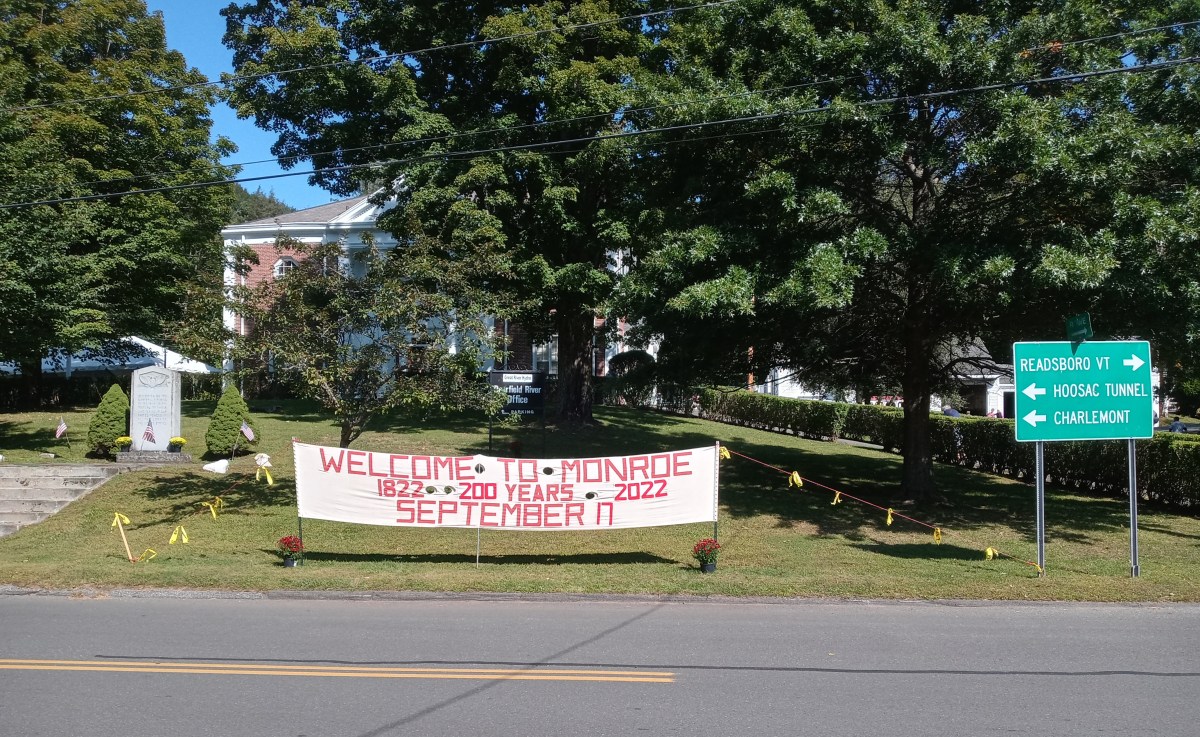
On September 17th, I returned to my hometown, Monroe, Massachusetts, for their bicentennial celebration.
The day began with a presentation from State Representative Paul Mark of a framed copy of the restoration of the original town charter. In his remarks, he noted that, unlike most Massachusetts charters, Monroe’s does not have any mention of an English king. The town was incorporated from parts of other towns and named for President James Monroe, who was president of the United States at the time.
The charter was hung up right away!
When I was growing up there in the 1960s-70s, the town had about 200 residents. In the 2020 census, there were 118 residents, making it the smallest town by population on the mainland of Massachusetts.
The festivities centered around the Town Community Center, which was the school back in my day. (Also, in the days of my father and his siblings, when it was built by the Works Progress Administration in the 1930s.) The building still houses the town offices and library. What had been the classroom for grades 1-4 when I attended is now a community meeting room where many of the indoor activities were housed. The rest of the building is now used as offices by the power company that is the successor to New England Power, for which my father worked for over forty years.
I was able to make some contributions to the memory board and books. I sent some poems and was surprised to find one of them on display with a vintage newspaper photo of me when I graduated from high school.
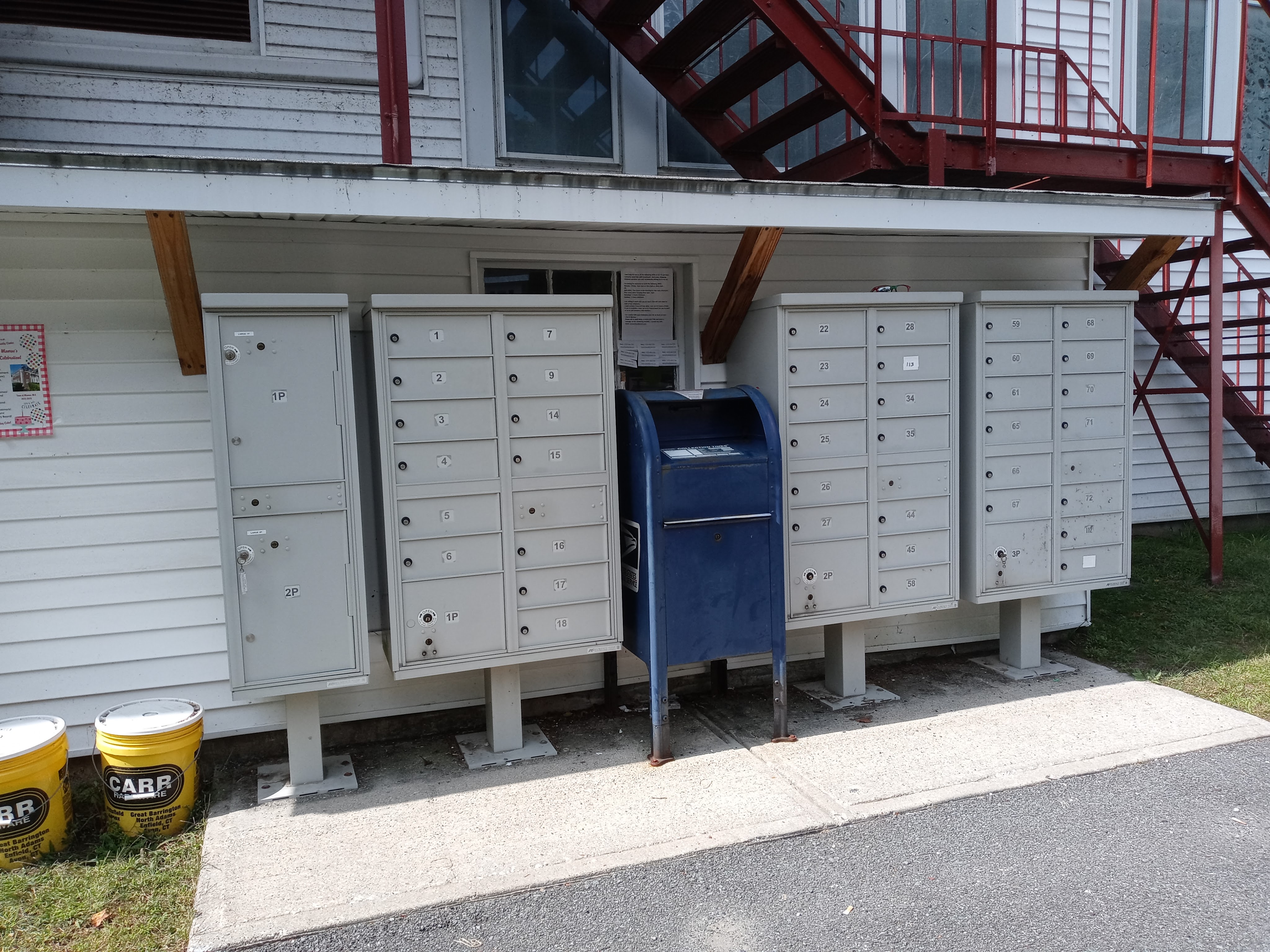
Many of us were feeling nostalgic about the post office. There were two postal employees there to hand-cancel envelopes with a bicentennial commemorative postmark, even though the Monroe Bridge post office closed years ago to be replaced by this:
Not nearly as distinctive looking as this mail slot which was salvaged from the old post office and is now in the Monroe Historical Society’s collection.
For an explanation of why it was the Monroe Bridge post office and why I often refer to my hometown as Monroe Bridge, you can read my poem “Monroe Bridge Mail” published by Wilderness House Literary Review here. (It’s the final poem in a set of five.)
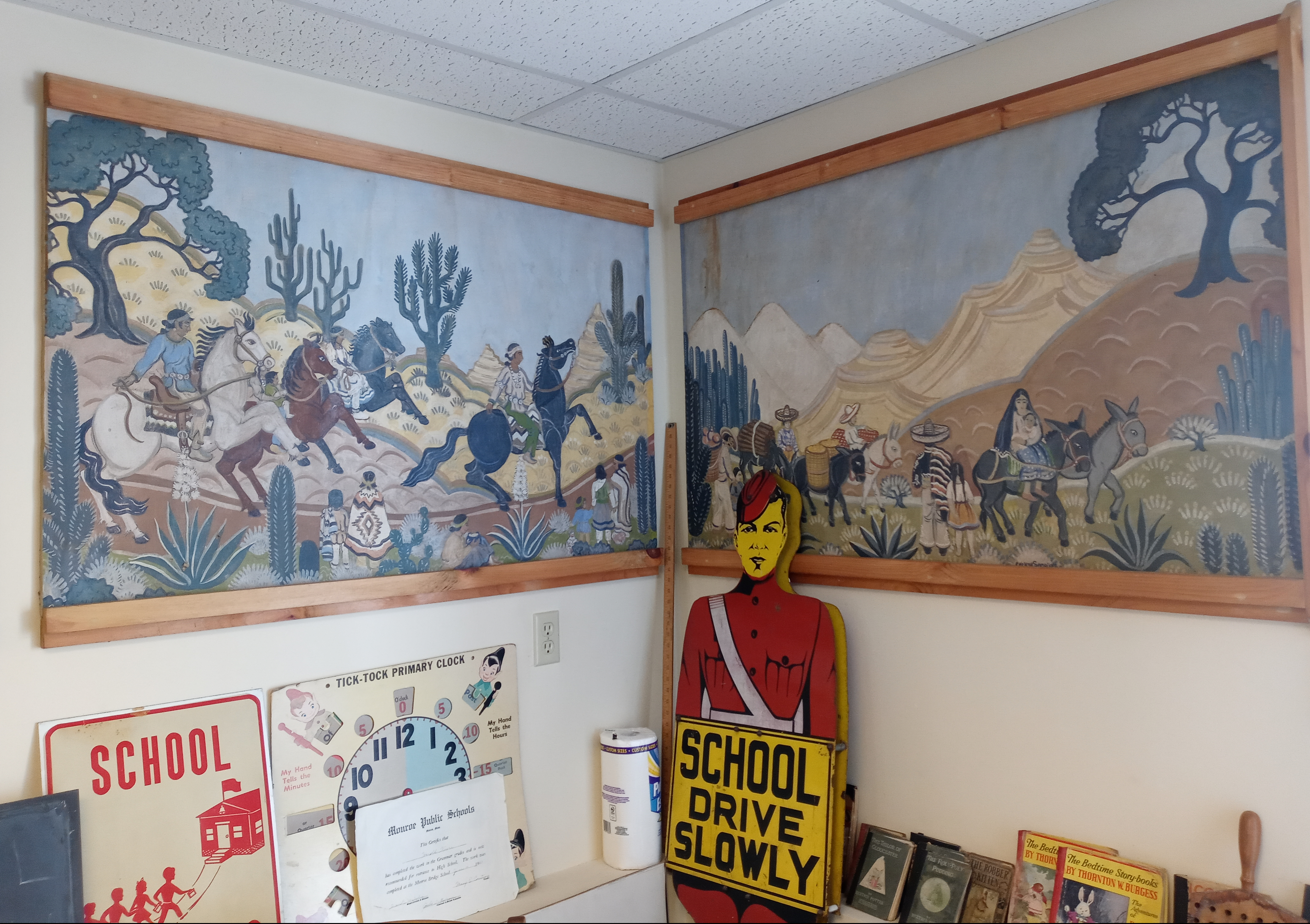
I spent quite a lot of time in the Historical Society, looking at the artifacts and photos. It was nice to see that the murals that had been painted by a WPA artist for our classroom had been moved there:
There was memorabilia from the Town’s sesquicentennial (150th anniversary) which I remembered as a very exciting time when I was in grammar school.
It was fun to get to reminisce with people who had been in town when my family lived there. Some are still residents or folks who have stayed local, while a few, like me, had travelled from further afield. I especially appreciated the time that Lucy spent with me, pointing out family connections among the memorabilia on display or in the Historical Society. I was touched by all the kind words about my parents and the expressions of sympathy on their passing. The celebration was just a few days after the first anniversary of my father’s death; he and my mother were among the founding members of the Monroe Historical Society.
There was Bicentennial swag available! One of my purchases was the Bicentennial History Book. I was honored that my poem “Playground” was chosen to be on the back cover. It reads:
Our WPA-built school housed two classrooms, eight grades, two teachers, twenty-some students, old textbooks, reams of assignments designed to keep us quiet at our desks.
Morning and afternoon recess and the remainder of lunch hour, we jumped off swings, attempted running up the two-story slide, sent the spinning merry-go-round swaying to crash with a satisfying clang into the metal pole from which it hung.
Dodge ball, monkey-in-the-middle, a dozen variations of tag, where the tap of a classmate’s hand thawed you from your frozen state or freed you from jungle-gym-jail.
Jump rope chants “Not last night, but the night before, a lemon and a pickle came a-knockin’ at my door.”
Upper-grade boys against girls in Wiffle ball or kick ball. Despite our skirts, the girls, already becoming young women, usually won. *****
Of course, as promised, there was cake!
It was a great celebration for a little town! Even though I’ve lived out-of-state for forty years now, a part of me is still at home there.
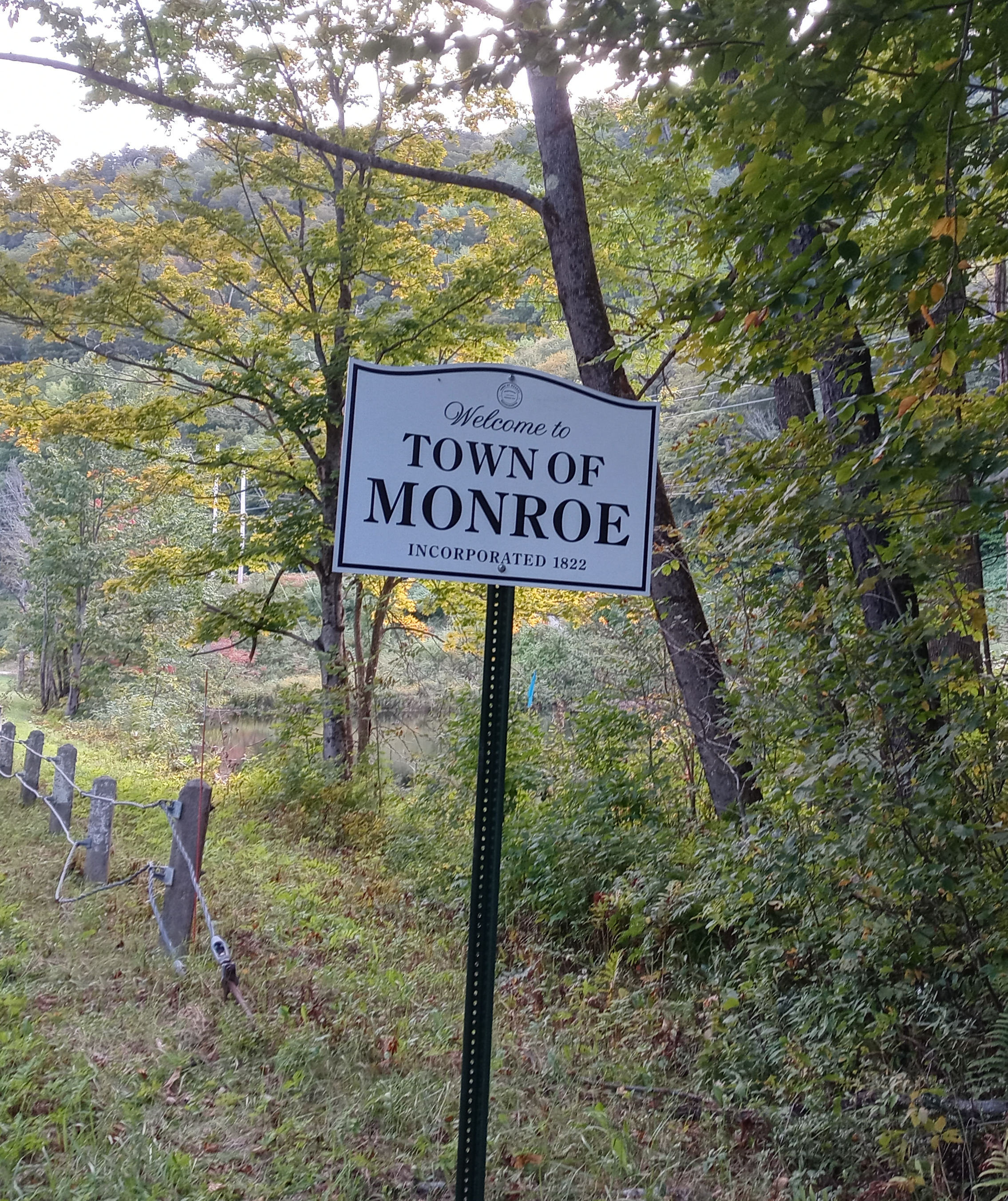
And even if you have never visited, there are now new signs to welcome you. This is the one you will see if you cross the state line from Whitingham, Vermont into Monroe.
Over the last ten or so years, I’ve spent a lot more time thinking about methane than most people.
This is due to the fighting against fracking here in my region with the Marcellus shale, in the shale plays in the US, and the export of the technology around the world.
I will spare you all the detailed things I learned about fracking and methane’s effects on climate from Bob Howarth, Tony Ingraffea, Sandra Steingraber, Walter Hang, and so many others back in the thick of the fight in New York State, which led to first an administrative ban and later a legislative one. One of my roles at the time was to comment on media articles as part of a rapid response team. I learned to argue from economic, health, environmental, social, and other perspectives, depending on the circumstances.
Fun times.
N0t really. It was super stressful. It was also important to get accurate information out into the public and I was very grateful that we were able to get some better policies in place.
Unfortunately, the damage done by fracking and by methane leakage is still with us, widespread and massive.
Atmospheric methane levels are at record highs and are part of the supercharging of global warming that we are seeing now. As a greenhouse gas, methane is more short-lived in the atmosphere than carbon dioxide but it is much more powerful in the near term. In a ten-year timeframe, methane is about a hundred times more powerful than carbon dioxide, so it is imperative to cut emissions of it now to avert various tipping points.
There was a major methane reduction initiative signed last year, which is good. The problem is that emissions have not been carefully measured or monitored by governments and the fossil fuel industry and estimates have been much lower than what some scientific studies have shown. I was just reading about a study earlier in the week and will try to insert the link after I’m done stream-of-conscious-ing.
It’s cold comfort that the problems the scientists and environmentalists have been pointing out for years are finally being more widely acknowledged when so much damage that could have been averted has already been done.
We need to stop adding fossil methane to our climate system in order to have any hope of meeting the 1.5 degree C level in the Paris accord.
I am very distressed about the breaks in the Nordstream pipelines. Every time I see video of the roiling, methane-saturated sea water, I feel sick, knowing how dangerous it is. It’s especially upsetting to see it in juxtaposition with the footage of the devastation caused by hurricane Ian. Most media coverage is finally acknowledging the role of climate change in supercharging storms but I wish they had been doing it years ago when it would have been easier to avert this level of greenhouse gases. We finally have some decent federal legislation in place but the scope of the problem outstrips that level of spending. The damage estimates from Ian will be higher than the climate spending in the law.
Our family over these last years has taken steps to stop using methane. When we installed a geothermal heat pump a few years ago, we were able to disconnect from the methane system. Our electricity comes from either our solar panels or a 100% renewable grid supplier, so we aren’t using electricity generated from burning fossil fuels. I continue to advocate for the transition away from methane and other fossil fuels.