reflections on ten years of blogging

As I promised in this post announcing the creation of joannecorey.com, here are some reflections on ten years of blogging here as Top of JC’s Mind – a little later than planned, but what else is new?

Ten-ish years ago, I was just starting to write poetry as a serious pursuit and writing a lot of commentary on fracking and related topics, which I sometimes cross-posted to Facebook. I also posted on Facebook articles and comments on a wide range of current issues. Several friends suggested that I start a blog and, as preserved for posterity in my first post, I fell into it on September 13, 2013.

Of course, as in so many other things I’ve chosen or been compelled to do, I didn’t really know what I was doing. [Embarking on projects for which I do not have sufficient training/background is somewhat of a life theme with me. I’m forever grateful to Smith College for grounding me in the liberal arts and schooling me in how to think critically and creatively, so that I’ve been able to branch out into different activities without making a total hash of it.] I had planned for Top of JC’s Mind to be an eclectic blog, hence the tagline “eclectic like me.”

While I have found a number of other blogs that deal with anything/everything, it’s usually recommended for blogs to have a theme, like food or music or travel. It’s also recommended to have a set publication schedule, every Monday and Thursday, for example. It’s strongly encouraged to incorporate images into all your posts.

So, I flew in the face of all that advice, not because it isn’t good advice, but because it didn’t work for me. Sticking to one topic is much too confining. My personal schedule, if you can even apply that term, has always been unpredictable and became more so as I dealt with multi-generational caregiving. My nod to regular posting has been to often, though not always, participate in the series from Linda G. Hill’s Life in progress blog, One-Liner Wednesdays and Stream of Consciousness Saturday. I’ve also participated in her initiative, Just Jot it January, in which we are challenged to post every day for the month. My One-Liner Wednesday and Stream of Consciousness Saturday posts are accessible through entries in the main menu.

I did initiate a series of my own, JC’s Confessions, loosely modeled after a recurring segment in the early years of The Late Show with Stephen Colbert in which Stephen “confessed” to things that, while not really sins, he felt badly about. Of course, Stephen is humorous and I am not. A link to JC’s Confessions is also in my main menu.

I also started a series How Does JC’s Mind Work? but it only has two entries so far. It’s inspired by the slow-dawning realization that my mind works in some atypical ways, as an INFJ who is also an HSP. I’ve only recently started to learn more about these categorizations and it’s helped to explain a lot of things that were puzzling to me. For example, studies have shown that brains like mine are wired differently and process thoughts, emotions, stimuli, etc. differently than the majority of people. I think we all tend to default to the position that others’ brains and minds operate the same way ours does; I know that I tended to do so. I do find myself sometimes explaining to people what I’m thinking or feeling because I’m often misinterpreted and then get in trouble with people based on their perceptions rather than my reality. This series is also a place for me to talk about personal history and influences that shaped who I am today. And, yes, I really should get back to this series, at some point..

One of the things that I intended to do was to share poetry, which I do, although seldom with poems that aren’t already published elsewhere. What I didn’t realize when I started Top of JC’s Mind is that, for many journals and publishers, even a personal blog post with a handful of views is disqualifying. I usually only post original work that I don’t foresee being able to publish in a journal, such as current event poems that have been rejected by the couple of venues I know that publish such things or ekphrastic poems that I aren’t chosen in response to The Ekphrastic Review‘s Writing Challenge Series.

What I didn’t foresee was how much I would post about the process of writing poetry and learning about writing poetry. I didn’t know that I would be part of a workshop-in-residence at the Massachusetts Museum of Contemporary Art in North Adams with the Boiler House Poets Collective. Or that I would be publishing in anthologies with the Binghamton Poetry Project. I certainly had no clue that I would eventually publish my first chapbook, Hearts.

I also didn’t realize how much I would write about my family. For their privacy, I chose to refer to them by initials or nicknames, so only people who know us in real life can easily find them. Ten years ago, I didn’t know the paths that the final years of my parents and mother-in-law would take or that I would have two granddaughters who would be living across an ocean from me.

I certainly didn’t know that I would post extensively about a pandemic. I’m continuing to add an occasional COVID-19 post. (I’m getting my updated vaccine on Monday, so another post will be coming.) One of the local historical societies decided to keep an archive of how the pandemic affected daily life in our area and I’m proud that they chose to include print-outs of my COVID-19 posts in that collection. Maybe, a hundred years from now, someone will stumble across them while doing research…

I do weigh in on current events, which are often disconcerting. I’ve written about gun violence and hatefulness in US society because of their sad, overwhelming prevalence. I’ve written quite a lot about government and the bewildering lack of attention to the Constitutional call to “promote the general welfare.” I mourn over the continuation of racism, sexism, bigotry, intolerance, and hatefulness that are so much in evidence and seem to be worsening rather than lessening. I try to show my values of love, respect, inclusion, and care for others and the world. I strive to express my authentic self here at Top of JC’s Mind and take care to be factually correct.

I welcome comments to my posts and do my best to respond. I will engage in respectful debate with those who disagree with me. It doesn’t happen often but I have had instances where I’ve had to delete or edit a comment. This is my platform and I will not have it used to spread misinformation or hatefulness. (I also don’t allow coarse language. My inability to swear or engage in vulgarity is a bit of a running joke among my poetry circles. Somewhere in the back of my head is a voice from my childhood saying, “What! Were you raised in a barn?”)

One of the things that bloggers are supposed to do is amass readers and followers. It’s suggested that a blogger spends a third of their time reading others’ blogs, a third writing posts, and a third writing comments on others’ blogs and responding on their own. That way, you connect with others in the blogging community and get noticed by more bloggers and readers. I really did try to do that early on but, as demands on my personal time grew, I found I only had time to write posts and tend to their comments, with occasional frenzied bouts of reading. Consequently, I don’t have tons of views and followers.

Of course, bloggers are also supposed to track stats. WordPress has a handy page to do this – and I don’t usually – but I will put my all-time stats in this post for the sake of posterity. Ten years of Top of JC’s Mind has ammased:
1,839 posts
7,107 comments
62,805 visits
34, 983 unique visitors
1,950 subscribers/followers

The subscriber/follower number is somewhat inflated. It includes people who have followed me through WordPress, liked my Top of JC’s Mind Facebook page, signed up to receive posts by email, and followed me through Twitter (now X and no longer available for automatic sharing through WordPress.) This means that some individuals are counted more than once. A few that I know of are now deceased. Many of the followers through WordPress are folks who found their way to one of my posts, hit follow, and never visited again. I do have a small core of readers who visit frequently and comment often, which I appreciate so much. You know who you are! I can’t really tell you how many readers I have for a typical post because I can only track site visits; I have no way of knowing how many people read posts sent via email.

I do, though, want to thank everyone who has ever visited Top of JC’s Mind, liked a post, commented, followed, or subscribed. While the process of writing helps to clarify my thoughts, writing for others challenges me to express those thoughts in a cogent way. I appreciate the opportunity to discuss different topics and share thoughts, experiences, and feelings with whoever happens to drop into my tiny sliver of the blogosphere.

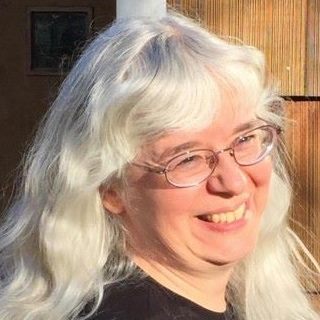
I try to keep growing as a blogger. I’m being forced to trying to improve my use of images in order to crosspost to Instagram, which requires an image. (But, seriously, Instagram! Why do you insist on .jpgs only? Why not allow .png and .webp? And why do you have this thing with squares?) Instagram is the reason that so many of my posts lately, including this one, have my photo at the top. I’m trying to decide if I should get a new headshot taken of my post-cataract surgery, post-Invisalign self but I’ve used this photo that spouse B took of me to accompany this poem for so long that I’m loathe to replace it.

So, will I blog here for another ten years? I can’t guarantee, but I do have hope. I hope at least a few of you will stay tuned and journey with me.

Peace,
Joanne Corey of Top of JC’s Mind

Two years without Paco

I work up in the very early morning darkness today thinking about my father, known here and in real life for the last 33-ish years of his life as Paco, the name bestowed on him by my firstborn and his first grandchild E as she was learning to talk.

I suppose this is not surprising because this is the second anniversary of his death. You can read a tribute that I wrote to him a few weeks after his passing here.

What is unfortunate is that in the early morning darkness in which I am now writing this post I am remembering so much of his final years, when I was struggling to get proper support and medical care for him, exacerbated by the pandemic. Even though I was living locally, there were long stretches in which I could not visit in person at all or only for short amounts of time. Phone and video calls were often frustrating, as you can tell from this poem, which was first published in Rat’s Ass Review.

Video Chat with our 95-year-old Father

You said it was scary
today
that we were there

in your bedroom
your three daughters
in pulsating squares

on a screen
You remembered where
home

is for each of us
but not where
it is for you

confused that you
could see us
hear us

but we were not
there
with you

We talked about the snowy
winter, so like our New England
childhoods, when you would

wrangle your orange
snowblower to clear
our way out

We asked if the cut
and bruise on your hand
had finally healed

if you had finished
all the Valentine
goodies we’d sent

Distracted
by a sound
from the living room

you set the tablet
aside
left us

staring at the ceiling

What was most difficult was that, no matter how hard I tried, I couldn’t secure correct diagnoses or treatments for Paco, illustrated by the fact that his death certificate states that he died from end-stage heart failure, but he was only diagnosed with heart failure about ten days before he died. I had been trying for months to tell the staff at his assisted living and then skilled nursing units of his continuing care community that he was having unexplained symptoms and had accompanied him to outside doctors and emergency room visits, when the pandemic protocols allowed me to stay with him, but it was never enough to get to the bottom of his health difficulties.

I thought I had worked my way out of most of the trauma of that but, in the early morning darkness of this anniversary day, apparently there is still some of that pain left. It’s not that I think I could have further prolonged his 96 years – something that would not have served any of us – but that his final months would have been so much easier for him if he could have received timely, proper diagnosis and medications.

One of the comforts of Paco’s death was the thought of his reuniting with my mom, known here as Nana, who died in May, 2019, also of heart failure and, gratefully, before the pandemic struck. I drafted this poem, which was first published by Wilderness House Literary Review, only a couple of weeks after Paco’s death.

We probably should have taken off					

his wedding ring before
he died		    before
his hands cooled	      started
to claw
but we couldn’t		       remove
that symbol
			of Elinor
	of two years
		   three months
			twenty-three days
						left
without		her
after
	sixty-five years
		      one month
			   three days
married to her
			the ring
				of her
even    in    days    of    delirium
	    haze			confusion

his ring		not
	sixty-seven years	  old
		but	   twenty
her gift 	         a remedy
	 for missing		some		thing
		of his
  to cling to 		during his three weeks
			       in the hospital
his chest cracked			 open
     		widow-maker averted
				somehow

She inscribed 		his ring	
      ALL MY LOVE  “ME”
     the way she signed 	cards to him
birthday	anniversary	  Christmas
	St. Patrick’s Day
		valentines
the words against his left
	ring finger		believed
to lead most directly to the heart
	which finally failed
		after ninety-six years
			five months
				nineteen days
as hers had
	after eighty-seven years
		     six days

While I go to the sink
to fetch soap 		to ease
the ring off 	his finger
my sister works
it over	 his reluctant 	knuckle

I carry it 	home 
to my daughter
Elinor’s and Leo’s rings
	   unite
on their granddaughter’s finger

[For those of you who might be new to Top of JC’s Mind, I will note that it is really unusual for me to fold poems into posts like this, but somehow, in the early morning darkness, it seemed appropriate.]

I’ll close this post by explaining the significance of the four-generations photo, taken a few weeks before Paco’s death, that begins this post. It shows Paco, me, eldest grandchild E who named Paco, and great-granddaughters, then 4-year-old ABC and just turned 1-year-old JG. This was the first and only meeting of Paco and JG, who had been born in London, UK, in the early months of the pandemic. ABC lived here in the States with us for her first two years and remembered Paco very well. The restrictions on international travel had kept E and her family from visiting but they were able to get special permission to travel together to come visit Paco one last time.

Paco’s health declined quickly after that visit and I’m so grateful that we all had that brief, sweet time together.

Remembering that final farewell through a few tears in the still-before-dawn darkness of this anniversary morning.

One-Liner Wednesday: Ten!

To celebrate today’s tenth anniversary of Top of JC’s Mind, I’ve finally upgraded to having my own domain, joannecorey.com, so you can read Top of JC’s Mind selected from the menu there or, as always, at topofjcsmind.wordpress.com.

This shameless bit of self-promotion brought to you as part of Linda’s One-Liner Wednesdays. Join us! Find out more here: https://lindaghill.com/2023/09/13/one-liner-wednesday-nostalgia/

New domain!

Tomorrow will be the tenth anniversary of Top of JC’s Mind!

To celebrate, I’ve (finally) upgraded my plan and have my own domain address, joannecorey.com. There is a link to Top of JC’s Mind in the main menu and topofjcsmind.wordpress.com will remain active as the blog address indefinitely.

Things are super simple at the moment. I’m using the same Twenty Sixteen theme but without the side bars, widgets, and banners, at least to start. It’s been exciting enough just to get the site up and running this afternoon!

I’ve decided to keep the Author Page in the menu for Top of JC’s Mind, at least for now. Most of the content on joannecorey.com is taken from that page, although divvied up into more reasonable chunks across three pages. Now, though, I can claim to have an author site.

You all can probably guess what my One-Liner Wednesday will be about tomorrow, although I hope to also write a more substantive post about making it through ten years of blogging later in the week.

Enjoy!

SoCS: mostly overwhelmed

I’ve spent this summer feeling overwhelmed.

Well, mostly.

I’ve had some rare moments where I feel that things are on the right track so that they will get completed successfully on schedule – and then the next set of complications arises and I’m back to feeling overwhelmed.

I had planned for this summer to be mostly about poetry – learning more about marketing to get Hearts properly launched, working on getting poem and manuscript submissions in, and generating new work and revising after workshopping. Oh, and making preparations for the upcoming Boiler House Poets Collective residency at The Studios at MASS MoCA in North Adams that will begin late this month.

There are a lot of sayings about what happens when you make plans and then life happens and they fall apart. You can insert your favorite here…

I sit on a number of boards or committees as a volunteer, all worthy causes, centered around the environment, social justice, and the arts. They usually only take up a couple of hours a month each, but this summer, all of them seemed to simultaneously encounter a serious obstacle or be presented with an important opportunity that demanded a lot more meetings and a lot of prep work between meetings.

This all plays into my natural tendency to analyse and think deeply and brainstorm possible solutions and really, really care deeply – but this summer, about way too many things at once. With a few family health issues thrown on top and B’s move out of the offices, I’ve been feeling really stressed and that I’m not on top of anything.

Oh, and this month will bring the tenth anniversary of Top of JC’s Mind and I wanted to do some things to celebrate, like finally upgrading to have my own domain name and such. Maybe that will happen?

(You can probably tell I’m having trouble keeping my mind on one thing at a time…)

At least, an end is in sight.

The residency will happen whether or not I’m optimally prepared, followed by the official launch of the Third Act Upstate New York Working Group on October 5 – you’ll be hearing more about that when registration information becomes available – and the first Madrigal Choir of Binghamton concert on October 22nd, which you’ll also be hearing more about closer to the date. And stuff will be going on with church and poetry and blogging and family and the news and on and on.

So, I did say “an end” rather than “the end.”

I know that more complications will arise and there will be more to do and ponder and meet about but I’m making plans to step back in some ways so that I’m not feeling so overwhelmed and can try to concentrate more on poetry again, as I had originally intended.

Not sure if I will manage it or not but you’ll probably (eventually) find out by staying tuned here at Top of JC’s Mind.

At least, I hope so…
*****
Linda’s prompt for Stream of Consciousness Saturday this week is “mostly/at least.” Join us! Find out more here: https://lindaghill.com/2023/09/08/the-friday-reminder-and-prompt-for-socs-sept-9-2023/

Catholic women and the diaconate

This week, I’ve attended celebrations at my parish in honor of St. Phoebe, who carried St. Paul’s letter from the area of Corinth to Rome. In the opening of the letter, Paul refers to her as a deacon, diakonos in Greek.

For the first few centuries of the Christian church, women served as deacons (and priests) but this ministry was suppressed as the church took on the power structure of the Roman Empire. The diaconate for men became a temporary step on the way to the ordination as a priest. The permanent diaconate was restored for men in the Catholic Church by the Second Vatican Council in the 1960s and there has been conversation since about restoring it to women. Under Pope Francis, there have been two study commissions and many bishops at the synod on the Amazon voted in favor of ordaining women, who are already doing this ministry as lay workers, as permanent deacons. However, their recommendation was not included in the final report.

On October 4th, Pope Francis will convene a new synod, called “For a Synodal Church: Communion, Participation, and Mission.” While the majority of voting members will still be bishops, there will also be vowed religious and lay men and women as voting members. It will be the first time that women have ever been voting members in a synod. The document that will be the center of their discussions, called the Instrumentum Laboris, available in several languages here, is made up largely of questions gleaned from listening sessions around the world. A major theme that arose in every region was the treatment of women in church and society and ways to recognize their ministry, service, and leadership in the Church.

The truth is that women constitute the majority of those who work in church ministry but, because they are not ordained, they seldom serve in official, high-level leadership roles. Meanwhile, in many parts of the world, particularly in the global South, where ordained priests are rare, women are ministering in their communities, teaching, preaching, leading prayer services, visiting the sick, and acting as the leader of their parishes without having the option of diaconal ordination. There is hope that this synod, which will conclude next year, will finally make women deacons a renewed reality in the Catholic Church.

So, sorry for the long wind-up, but back to celebrating St. Phoebe this week…

The impetus to celebrate St. Phoebe on or near her September third feast day comes from an organization named Discerning Deacons, whose “mission is to engage Catholics in the active discernment of our Church about women and the diaconate.” I admire their work and pray that the Synod will heed the voice of the Holy Spirit and restore the diaconate to Catholic women.

But, it’s complicated for me to have hope because of my and my sisters-in-faith’s history on the issue of women’s ordination.

I have long believed that God calls people to ordained ministry without regard to their age, gender, nationality, race, language, or any other personal characteristic. In his earthly ministry, Jesus called many disciples from among the marginalized, including women. Besides historical evidence of Catholic women deacons, there is evidence of women priests and bishops in the early centuries. Married men as priests persisted into the twelfth century; their prohibition had more to do with inheritance and property rights than with spiritual matters. For centuries, the power in the church has resided in the clergy. During Pope Francis’s papacy, he has worked to re-organize the structures of the church to allow more lay people, including women, to have leadership roles and to combat the clericalism that led to so many abuses of power and the ensuing cover-ups over the centuries.

While having women restored to ordination in the diaconate could increase leadership roles for women in the church, it doesn’t address the continued denial by the Church of the full personhood of each individual, regardless of their gender. The Church considers sexism a social sin but it cannot credibly call it out in other institutions while continuing to practice it itself.

As Catholics, we are taught to see the image of Christ in each person. Somehow, though, we are supposed to believe that only a celibate male can image Christ while standing at the Eucharistic table.

Treating women as second-class, sadly, also spills over into our social world with serious, even deadly, consequences. For example, the official Catholic viewpoint that prioritizes fetal life over the life and health of the pregnant person is leading to death or loss of fertility when care for a complication is delayed because a fetal heartbeat can still be detected, even when the gestational age or medical condition of the fetus makes survival impossible.

Even within the Church, women are not equally respected as employees. I have experienced this personally and seen it happen over and over with other women, including vowed religious. In the US, church employees don’t have recourse to employment discrimination law, so the Church can act without regard to state and federal law. Of course, it does violate Catholic social justice doctrine on respecting the dignity of work and of the worker. Sadly, restoring the diaconate to women will not address these larger inequities unless it is accompanied by intensive structural reforms of the institution, especially the clergy.

So, now comes the hard part of this post – the personal history.

Back in the mid 1980s- 1990s, I belonged to a local group called Sarah’s Circle. We began as a group of Catholic women, most of whom felt called to ordination – we did also include a couple of male members – who gathered once or twice a month for prayer, discussion, and support. While we did participate in an occasional public prayer service or event, we existed for our own spiritual fulfillment and to hold each other up when life in the Church became difficult.

Some things that our members did ruffled some feathers in the diocese. For example, the diocese ran a program to enlist parishioners to submit names for possible candidates to ordained ministry or vowed religious orders. A number of Sarah’s circle members, including me, submitted women’s names to become priests or deacons.

We wound up being discovered by the broader community when someone wrote a letter to the editor of the local newspaper accusing us of being witches, which was laughable as we were Catholics, not Wiccan. Somehow, this morphed into a brief moment of national notoriety, which included us being denounced by radio personality Rush Limbaugh. It was all very strange but served to make our local circle more powerful. We even were featured as part of a 60 Minutes piece about women’s ordination in 1996.

Over time, most of our members drifted away from the Church. Some joined other Christian denominations. One is now an ordained minister. I still grieve that the Catholic Church was so blinded by patriarchy that they turned away these compassionate, talented, holy women from ordained ministry.

Despite the pain, I stayed in the Church. I used to joke that it was “just me and the nuns” who were sticking it out. (Technically, they weren’t nuns, who are usually cloistered; they were vowed religious sisters.) As more and more of our members were drawn in different directions, we stopped meeting, staying in touch in little arcs, instead of a full circle. Sarah’s Circle’s records are now part of the archives of the Burke Library of the Union Theological Seminary, part of the Columbia University system, in New York City.

So, back to the present reality. My parish is looking into starting a Discerning Deacons group and I don’t know if I should join. Part of the reason I was able to stay within the Church was that, in a long-standing attitude of cowardice, I never did the spiritual work to discern if I was being called to ordained ministry as a deacon or priest.

Not that there weren’t signs that I should do so.

When I was a young mother, I had two vivid dreams in which I was a priest.

Back in the days before the diocese started to specify that only men and single women were invited to inquiry meetings about the call to ordination or religious life, I attended one. After the more general information sessions, we had to break into groups for prospective deacons, priests, or sisters. I originally wanted to join the priest group but didn’t want to disturb the teens and young-adult men there, so I joined the deacon’s group. I remember the deacon who was leading the group saying that, often, the wives of deacons would attend all the preparatory courses and training with their husbands and what a shame it was that, at the end, their husbands were ordained and they received no recognition of their own gifts.

Later, after my daughters were grown and before I joined my present parish, there was a powerful homily about God’s call to individuals that was entwined with the singing of the hymn “Here I Am, Lord” by Dan Schutte. At the time, the deacon serving the parish was ill and I remember looking at his empty seat near the altar and thinking, “I could be that.” I was crying while singing the refrain: “Here I am, Lord. Is it I, Lord? I have heard you calling in the night. I will go, Lord, if you lead me. I will hold your people in my heart.” I did make an appointment to speak to the pastor, who was sympathetic but, at the time, there wasn’t really anything to be done.

So, moving on to this summer. As the St. Phoebe observance was coming together at my current parish, the pastor invited me to read the gospel passage for the prayer service. I was honored to be asked because, during mass, reading the gospel is reserved to ordained clergy only. During a prayer service, lay people may read from the gospels so I wasn’t breaking any rules, but the symbolism of the invitation to publicly read from the gospels was significant for me.

I expected the evening to be emotional for me, which it was, and fraught, which it also was.

I have circled back to another opportunity to discern God’s call, but now about to turn 63 and unsure of how long I will live in this place – or live at all. I’ve amassed a lot of valuable experience but also am burdened by the pain the Church has inflicted on me and my loved ones. I’m tired. Of the struggles. Of the dismissals. Of the lack of charity. understanding, and compassion.

Do I dare to discern?

Do I, despite the history, dare to hope?

One-Liner Wednesday: sensitivity


Join us for Linda’s One-Liner Wednesdays! Find out more here: https://lindaghill.com/2023/09/06/one-liner-wednesday-warning/

End of an IBM era

For the first time since 1912, IBM (International Business Machines) does not have a physical footprint in Endicott, New York.

Broome County is the birthplace of IBM, which formed in Endicott as the Computer-Tabulating-Recording Company in 1911. It changed its name to International Business Machines in 1924.

For many decades, under the leadership of legendary CEOs Thomas J. Watson, Sr. and Jr., Endicott maintained a special place within the international corporation, employing thousands of people with several blocks of buildings downtown. They were a huge presence in the community, donating to charitable organizations, organizing volunteer activities, and providing recreation and education for their employees and their families. There were generations of people who worked for the company, which had an ethos of respect and care for their employees and the greater community. Even during the Great Depression of the 1930s, IBM did not lay off workers. The loyalty IBM showed to its workers was returned and there were many families who had multiple members across generations who were IBM employees. Even when IBM headquarters moved elsewhere, Endicott was honored as the birthplace of the company. There was even a company museum on site.

When my spouse B joined IBM in 1989, many of the IBM traditions were still in place but that was about to change. IBM had for decades chosen CEOs from within the company but in 1993 hired Louis Gerstner who massively changed the corporate culture, with layoffs and the attitude that employees were expenses to be cut rather than the expertise that allowed IBM to have products to sell. In 2002, IBM sold the Endicott campus, renting back some space from the new owners, which eventually was whittled down to one, nondescript building.

In March 2020, due to the COVID pandemic, IBM closed access to the building and many months of working from home began. This relaxed somewhat over time and this January, employees began working three days/week in the office and the other two from home. B and his team all came in on the same three days to facilitate collaboration. They also enjoyed lunches together, often taking walks afterward, as they had pre-pandemic.

This spring, though, IBM announced their decision not to renew the lease on the building and not to seek another physical site, ending 112 years in Endicott. The employees remaining, many of whom have over thirty years of experience, will go back to working from home until they retire.

Yesterday, August 31, 2023, was the last day.

B and his team were there working, left their now-empty offices, and turned in their keys.

It’s sad for us and for the community to lose what had been such an integral part of life here, although it has been a long, slow, painful bleed. Some of the old IBM buildings have been renovated and are in use but a number of them are now condemned and awaiting demolition. The good news is that Endicott is being re-cast as a renewable technology/battery hub. There are plans for a gigafactory to make batteries for EVs and such as part of the Triple Cities Innovation Corridor, for which Endicott is the advanced manufacturing hub.

The irony is, of course, that IBM was doing advanced manufacturing on the site for decades and now won’t be onsite for this new era.

One of the buildings that I hope will remain as a monument is the North Street Clocktower building, which is emblazoned on the cake at the beginning of this post. It contains the motto THINK carved into the stone.

A good reminder anytime.

the last building for IBM Endicott

COVID update – late summer 2023

There are many people here in the United States who are no longer taking COVID-19 seriously and a disturbing number who never did.

I am not one of them.

I’ve written dozens of posts over the past three and a half years about it, including about my family’s participation in the Pfizer/BioNTech Phase III clinical trial. I’ve tried to encourage people to take precautions to reduce their chances of infection and serious illness. In that vein, I offer this update.

There was a summer wave in the US with the most prevalent strain being Omicron XBB.1.5. On September 12, the Centers for Disease Control and Prevention Advisory Committee on Immunization Practices will meet to develop a recommendation for a newly formulated booster based on the XBB.1.5 variant. It’s anticipated that the recommendation will be that most people get this new booster, which is expected to be available by the end of September. I will get the booster as soon as I am able. To my knowledge, I’ve still not contracted COVID and would love to keep it that way. Even if the vaccine does not keep me from getting infected, it, along with taking an anti-viral such as Paxlovid, will likely keep me from being hospitalized.

Of course, SARS-CoV-2 continues to mutate. Even now, the variant mix has shifted in the US. EG.5 has become the highest in prevalence with FL.1.5.1 next in an array of variants currently circulating. (You can find current data in the US at the CDC site here.) It is expected that the new booster, though based on XBB.1.5, will still be effective against these other Omicron strains.

The unfortunate wild card at this point is another Omicron variant BA.2.86. The link is to a 8/22 post from epidemiologist Dr. Katelyn Jetelina, explaining why this variant may be more problematic than others, perhaps even warranting the World Health Organization to name it a variant of concern with the name “Pi.” BA.2.86 has over 30 mutations of the spike protein, which is part of the virus that our bodies learn to recognize via vaccines, infection, or both. The fear is that we could see another world-wide wave develop because BA.2.86 might be able to evade our defenses. Researchers are studying it to see if our current tests, vaccines, and treatments will work against it and how it might affect individuals and populations exposed to it. The current number of cases world-wide are thought to be small, but that has been the beginning status of any variant that has become dominant.

Part of the problem is that we don’t have as much data to work with. Most COVID cases aren’t reported to public health authorities anymore. Surveillance and genomic sequencing are lower. This results in less public awareness and information. Theoretically, we should be able to ramp up our system more quickly if a new wave occurs but I wish we had kept up our system in the first place in a proactive stance.

I’m concerned about the attitude that equates COVID infection with other viruses. A study in the journal Nature Medicine shows increased risks for an array of medical conditions, including diabetes, pulmonary and cardiovascular problems, two years after COVID infection, even if the initial case was mild.

“A lot of people think, ‘I got covid, I got over it and I’m fine,’ and it’s a nothingburger for them. But that’s not everything,” said the study’s senior author, Ziyad Al-Aly, a clinical epidemiologist at Washington University School of Medicine in St. Louis. After a couple of years, “maybe you’ve forgotten about the SARS-CoV-2 infection … but covid did not forget about you. It’s still wreaking havoc in your body,” said Al-Aly, chief of research at the Veterans Affairs St. Louis Health Care System.

source: https://www.washingtonpost.com/health/2023/08/21/long-covid-lingering-effects-two-years-later/

The risk of long COVID is real. The article cited above, which is free to access, explains more about the attempts to do research and get care for people with long COVID. People need to realize that they might be someone who gets COVID and has a mild case without long-term repercussions or they might become seriously ill or they might have symptoms for months and years to come. They could also infect someone else who would face the same uncertainties.

I’m once again imploring people to take COVID seriously. Vaccinate, if it is recommended for you. (Being in the US, I’m most familiar with recommendations here but people should look to their own local health authorities and medical practitioners for guidance in their area.) Test and treat an infection. Stay home if you are sick and avoid infecting others. Avoid crowds indoors; wear a high-quality mask if you can’t. If infection rates are significant in your area, mask indoors when you are away from home. Increase ventilation and air filtration. Wash your hands. Get adequate rest and nutrition. Remember that everyone deserves respect, so never question someone else’s decision to mask; they could be immunocompromised, caring for a vulnerable person, etc. and need that protection.

Eventually, we may get to a place where COVID is endemic, like the flu, but we aren’t there yet. Be careful and be kind as we continue to face this still-formidable challenge.

One-Liner Wednesday: Ross Gay on language

Rather than acknowledge the fact of male-centered or male-dominant or nonmale erasing thinking which the universal “he” enacts — magically, in his book, converting all imagined readers and writers into men — it’s magic, rally, how language stokes the imagination, and the imagination language; actually, it’s not magic at all — rather than pushing into language, pushing against it, dancing with it, so that it not only expresses the multiplicity of possible pronouns and genders and worlds but engages the language such that the difficulty, the richness, the loveliness of an author’s thinking might be contained and expressed.

Ross Gay, The Book of Delights, #32 Nota Bene

This very long sentence, showing off what a poet can do when writing prose, is shared with you through Linda’s One-Liner Wednesdays. Join us! Learn more here: https://lindaghill.com/2023/08/30/one-liner-wednesday-tough-week-so-far/