The Boiler House Poets Collective after our reading at The Bear & Bee
When I last posted, I had intended to post again sooner, but I found that the BHPC reading had taken a lot more out of me than I had thought, so I concentrated the energy I had on writing new poems and actually making it to workshop sessions.
We also had our planning meeting for next year, which will mark the tenth anniversary of the formation of the Boiler House Poets Collective after the original members met at the first workshop-in-residence by the Studios at MASS MoCA in conjunction with Jeffrey Levine of Tupelo Press. No details available now but lots of fun ideas under consideration!
I am so grateful to be a part of BHPC and am particularly thankful that we have become a true collective, with everyone pitching in to make it all work. I love our creative, supportive, and affirming atmosphere. Given my current health limitations, I would not have been able to participate this year without everyone else’s generosity in lending me a hand – sometimes literally when my balance was off! I also love how our three new members this year brought creative, joyful energy along with them and all plan to return next year.
I came home to a week of medical appointments and tests and an unfortunate uptick in symptoms. We are still working on a diagnosis with more tests and specialists forthcoming. We’ve ruled out a lot of possibilities but I’m anxious to arrive at a diagnosis so that we have a shot at figuring out an effective treatment plan.
Meanwhile, we have less than three weeks until Election Day here in the US. I hope to get out another Vote for Democracy ’24 post out soon.
We all arrived safely yesterday afternoon and enjoyed a welcome dinner together at Nara Sushi. After that, we all went back to our apartments. I stayed up talking with my apartment-mate, cleared up a few things on my computer, and went to sleep.
For a few hours.
I woke up at about four and, after I realized I wasn’t going to be able to go back to sleep, started drafting a poem in my head, which I then wrote out on paper because it gave me a better pallette for the spacing. I showed it to my apartment-mate before she left in the still-early morning darkness for our studios.
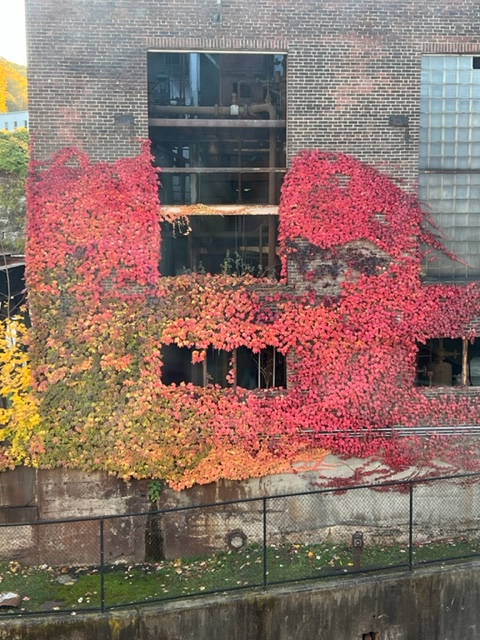
I also came to the studios on the early side and we visited a bit. She graciously swapped chairs with me to make it easier for me to have head and neck support. I wasn’t sure I was going to be able to write more, but, looking out my studio window, photo above, I was able to write another section to the poem I started earlier.
It is one of those angsty, personal poems reflecting on my current health and worries. It might never make it even as far as workshopping, but I apparently needed to write it. It’s the first poem I’ve written spontaneously since the tinnitus and other symptoms started in March. I have worked on some revisions and wrote a new poem in a workshop with Abby E. Murray, but, otherwise, hadn’t been feeling creative in that way.
So, yay, for having written something new, even if it is not viable as a work for sharing.
This spring is the tenth anniversary of my involvement with the Binghamton Poetry Project, which offers workshops to the area community, let by graduate students at Binghamton University.
Today, I’m sharing the link to the 2023 online anthology which became available at some point over these last weeks. Usually, an anthology release coincided with our final readings at the end of the spring and fall sessions, but, last year, for various reasons, no anthologies were published at those times. The link above has three poems from the spring 2023 workshops; I had submitted three from the fall, but they appear to have evaporated into cyberspace.
My poems, “With Nana” “After Cataract Surgery” and “The Way Home”, were written from prompts from our workshop leaders. “After Cataract Surgery” is closest to “real life”; the other two are more imagined. They were written and revised quickly because I needed to make the original anthology deadline, so no judgement on the level of editing!
A transition is underway with Binghamton Poetry Project which is now being re-named the Binghamton Writers Project. The plan is to offer community workshops in other literary genres in addition to poetry. Right now, we are still waiting to see what that will look like.
I owe a lot to the Binghamton Poetry Project. I’ve learned a lot about craft from their workshops. BPP connections helped me find the Grapevine Poets, with whom I workshop on a regular basis year-round and participate in readings. I was invited to write and deliver a poem at the Broome County Heart of the Arts dinner in 2016. A number of poems in my chapbook Hearts and in my still unpublished full-length collection began as Binghamton Poetry Project prompts.
I’m hoping (selfishly) that the Binghamton Writers Project will always keep a poetry offering available.
I wonder how long it will take me to stop calling it the Binghamton Poetry Project or BPP?
Yes, it’s been over a month since I returned home from the Boiler House Poets Collective residency with The Studios at MASS MoCA (Massachusetts Museum of Contemporary Arts) in North Adams but I am finally getting around to a wrap-up post. I did post a couple of times during the residency, about Marika Maijala and our reading at the Bear & Bee Bookshop, although that was a far cry from most of our years in residence when I would post daily. Things were very busy, so posting took a back seat and this past month has been loaded with other commitments, such as the launch of the Third Act Upstate New York working group and the first concert of the Madrigal Choir of Binghamton’s 45th anniversary season. I also needed time to reflect on the residency and what it meant for the future of the Boiler House Poets Collective.
Until this year, the Boiler House Poets Collective reunion residencies had always had at least half of the participants being members of the original group that met in 2015 as the first group of poets in residence brought together in a collaboration between Jeffrey Levine of Tupelo Press and The Studios at MASS MoCA. For 2023, the number of participants went from eight to ten, with only myself and Kyle Laws planning to return in 2023. (Sadly, last-minute health complications prevented Kyle from joining us, so I was the lone “original” in 2023. I’m hoping to have this be a one-time occurrence.)
I had inherited the role of liaison with The Studios but also wound up acting as an organizer for this year of transition. I was determined to assemble a full complement of ten and to provide for all the elements that had been part of past residencies, including studio time, museum visits, daily workshopping, a group project, a public reading, and discussion/social time (often accompanied by food and drink). Because, in prior years, we had always had a core of originals, adding in new participants from among our poet-friends as slots became available, we hadn’t felt called to define who we were as a group. I thought, at this juncture, we needed to be more intentional about our identity and our goals. I let people know that we would be having an organizational meeting near the end of the residency to talk about what was important to us and what our plans would be going forward.
I admit that I was really nervous about how things would work out with so many people who had never met each other. For the first time, we had a member who was not herself a poet. In 2022, the BHPC residency overlapped with the residency of Nancy Edelstein, whose work centers around light. With that inspiration, I had designed our group project around the theme of light, inviting each person to contribute work that had to do with light. I had expected a group of poems but the amazing thing was that people began to notice light in new ways. One of our members was inspired to take photographs showcasing light and shadow. We were able to share our light-themed work with each other. It’s not yet clear whether or not we will produce some conglomeration of these that is shareable with the public. If we do, I’ll be sure to share it here.
Another thing that was new for BHPC this year was that we workshopped some pieces that were not poetry, including an essay, scene from a play, and excerpt of a radio play. It was interesting to expand our literary horizons. While we expect to remain grounded in poetry, it’s good to have that flexibility to serve our members’ needs.
I felt that the group had a good vibe from the time of our opening night dinner when we were first together but I was nervous for our organizational meeting when people would be assessing how things had gone and if they wanted to return in 2024. I was thrilled – and a bit teary – when all but one person immediately said they wanted to return next year; the remaining person hopes to but lives across the country, creating a lot more complications than those of us within easy driving distance. People enthusiastically volunteered for organizational roles, including inventing some duties I would never have thought of on my own, so that I will be able to concentrate on just doing the liaison role. I even have a deputy who is shadowing me and can take over if I’m sidelined for any reason. This new constellation has embraced being a collective in a wonderful way and I am immensely grateful.
On a personal level, I appreciated how supportive people were of my work. As regular readers here at Top of JC’s Mind may recall, I grew up in the North Adams area and have two manuscripts, a full-length and a chapbook, that I am submitting to presses and contests. I’m at a crossroads with the full-length collection. I have a contract offer from a hybrid publisher but I’m not sure that is the way I want to go. One day over lunch, people were listening to my concerns and offering suggestions, which were very helpful and have led to my scheduling a manuscript consultation with a professional editor next month. I’m hoping that will help me clarify the path I need to pursue.
I also appreciated that people took my work seriously. One of the poets said that my poems were important in preserving the history of the area. That was so gratifying to me, even though I seldom dare to think in those terms. I do think about those poems as being ones that only I would write, given my perspective as someone who grew up there but that has lived elsewhere most of my adult life. It’s a sort of inside/outside perspective that would be difficult to replicate in quite the same way. I don’t tend to think that my following the dictum to “write what you know” would seem important to someone else, so it was nice to hear. It makes my search for a publisher and my wish to have the book be as strong as possible feel more weighty.
So, I have joyfully marked the dates for the 2024 Boiler House Poets Collective residency on my calendar for next October. I’m looking forward to being among this remarkable group of women again, but I’m also grateful to know that, if something happens that prevents me from being there, the group will go on without me.
I’m excited to share that my poem “April 19, 2022 – Vestal, New York” has just been published by Third Wednesday Magazine on their website and will be included in their quarterly print edition this spring!
This poem began as a Binghamton Poetry Project prompt on that date from workshop leader Suzanne Richardson. We were studying the use of a central image or metaphor. We were meeting via Zoom as I sat at my desk in the midst of a late snowstorm, so snow/storms became the central image.
One thing about writing from prompts in a workshop is that there isn’t a lot of time for planning, so I tend to go with the first thing that presents itself. Fortunately, I had experience with snowstorms, so my mind had somewhere to turn.
I workshopped the poem with the Grapevine Poets and did revisions before sending it out. I’m grateful that it has found a home with Third Wednesday! ***** Join us for Linda’s Just Jot It January! Find out more here: https://lindaghill.com/2023/01/09/daily-prompt-jusjojan-the-9th-2023/
I’m pleased to share the Fall 2022 online anthology of the Binghamton Poetry Project, which includes four of my poems, some of which need more explanation than others!
“Ode to Pentel P207” was written from a prompt during a summer workshop on response poetry with Samia Ahmed. Not surprisingly, we were studying odes that week. As it happened, odes were also a topic of a workshop on Romanticism with Samantha Flatt this fall, so this poem represents both of those sessions.
I do have a special relationship with my Pentel mechanical pencils! I started using them extensively when I was in college. They fit my hand well and are great for fine work, such as writing music manuscripts by hand, which we had to do before music editing software became readily available. I’ve continued to use them and they are my go-to writing implement when I draft poems and when I workshop them.
I hadn’t thought it was weird to have a favorite pencil until I was workshopping this poem, first published by Wilderness House Literary Review:
In my purse
cheap pens I won’t miss if they’re lost my wallet, heavy with too many coins ibuprofen for headaches a pack of tissues hair ties for windy days a dog-eared calendar my license to drive a crumpled shopping list emergency cough drops a pyx my favorite mechanical pencil, extra lead credit cards – insurance cards – loyalty cards a laminated prayer card from my mother’s funeral
Several people commented that the line that let them know something was up was the line about the mechanical pencil, which to me was just a normal thing to carry in a purse. Perhaps, though, it is a bit strange to make a pencil the subject of an ode, although we did study some odes that had been written about everyday objects.
“Beauty can be…” was written in response to Samantha Flatt’s workshop on Romanticism and Beauty with a prompt to describe my relationship with beauty. I was trying to capture the sentiment that I find beauty in many, seemingly contradictory circumstances.
“Hoosic” was written in response to the second week of Suzanne Richardson’s workshop on prose poems. Those three weeks were my first time to attend an in-person Binghamton Poetry Project workshop series since we went virtual in spring 2020 due to the pandemic. The prompt was to include in our prose poem an illogical or associative leap or a surreal moment or a mix of fact and fantasy. As often happens when presented with a prompt and the need to write quickly, I turned to a familiar topic, here, the Hoosic River, about which I have written several poems as part of my full-length manuscript centered on the North Adams, Massachusetts area. I will leave it to the reader to decide if my personification of the river fulfills the prompt.
The reason that there is a fourth poem listed is because “He Pines” was written at a special summer event, Much Ado in the Garden, a Shakespearean-themed festival. I participated in a Binghamton Poetry Project reading and mini-workshop, resulting in this very atypical poem. In keeping with the prompts, it includes some no longer used (and somewhat insulting) words. It also has the line count and rhyme scheme of a Shakespearean sonnet, although not the iambic pentameter. I am notoriously bad at writing in Western received forms, so that I managed anything even sonnet-like is an achievement. This is a disclaimer, though, that I agreed to include it in the anthology only as an example of playing with language for this special event, not because it is actually a good poem!
This fall also marked the return to an in-person Binghamton Poetry Project public reading, although I had a conflict and couldn’t attend. Perhaps in the spring, I will be able to participate, if the tripledemic has alleviated by then.
Please feel free to read the whole Fall 2022 anthology. You can also view past anthologies and browse the site for other features. Enjoy!
I’m pleased to share the Binghamton Poetry Project Spring 2022 Anthology. The Binghamton Poetry Project is a grant-supported outreach program in which graduate students in poetry and creative writing from Binghamton University offer free community workshops, offering children, youth, and adults the chance to learn more about and write poetry. BPP moved online during the pandemic, although we are hopeful that an in-person workshop will be possible again this summer.
This spring, I attended two workshops. My poem “Aubade with Birds” was written in response to a prompt in Suzanne Richardson’s workshop, Fresh Images and Form. This was my first attempt at writing an aubade, which the Poetry Foundation defines as “a love poem or song welcoming or lamenting the arrival of the dawn.” I seldom write love poems and this one is definitely more on the lament side.
The other two poems were written during Shannon Hearn’s FIELDING TENDER: Nature Writing for the Apocalypse. “Kaʻūpūlehu” is based on a visit to the dryland forest preserve by that name on the Big Island of Hawai’i where daughter T interned during a semester spent in the Islands while she was a student at Cornell University. B and I were not able to visit during that semester but made a trip there several years later with her. Kaʻūpūlehu is an amazing place; you can see some videos and photos and learn more about it here.
The haiku in the anthology is one of five I wrote during a fun session with Shannon in which we wrote haiku in response to an image and a randomly generated word. (There is a note with the information on the word and image included on the page with the poem.) There was quite a bit of laughter that evening as some of the images and words led to pretty fantastical literary leaps, but I thought this particular haiku managed to make sense apart from its origin in the exercise.
Thank you for visiting the Binghamton Poetry Project anthology. Please check out the other poets while you are there. Some of the past anthologies are also available through the drop-down menu.
I am a member of the Broome County Arts Council and recently participated in their Women of Words poetry reading and Spring Awakenings exhibit.
One of the many services of BCAC is sharing news from other arts councils and organizations in our region. That was how I found out that the Tioga Arts Council’s National Poetry Month project was to post recordings of people reading a favorite poem along with an explanation of why they chose it.
I’m pleased to say that the recordings are now available. If you click on my name Joanne Corey, you will hear me reading “Bereft” by Merrill Oliver Douglas from her chapbook Parking Meters into Mermaids. Merrill is a local poet-friend and one of the Grapevine Poets with whom I workshop on a regular basis. Jessica Dubey, another Grapevine Poet, also has a recording up, as well as Jordan Jardine and Diane Weiner, whom I have not yet met.
On Saturday, we will gather at the Tioga Arts Council’s home in Owego for a reading, so I hope to meet them there. I’m sure you can expect another post about that here at Top of JC’s Mind.
Many thanks to Christina Di Stefano of the Tioga Arts Council for making this project possible!
Writers often commiserate over being faced with a blank page and not being able to think of something to write on it.
Or maybe now-a-days a blank screen?
I don’t usually run into that problem, most likely because my brain almost never shuts off. There are actually reasons for this that I will go into when I’m not writing stream of consciousness….
Of course, just because I can always fill a page with thoughts doesn’t mean that the writing is worth sharing.
My natural mode when writing poetry, though, is to slosh things around in my head for days/weeks before writing them down. It’s good, though, that through the Binghamton Poetry Project, Heather Dorn, and Sappho’s Circle, I learned to write poetry quickly from prompts.
It usually works like this: The leader of the workshop gives a few choices for prompts to get you started on a poem and there is a time limit, which can be as short as ten minutes, in which to write. This plays to one of my strengths, which is writing relatively short poems, but definitely challenges me in that there isn’t time to ruminate. You really only have about a minute to decide which prompt you want to respond to and the direction you want to take before starting to draft your poem on the page.
Through practice over the last several years, I’ve gotten pretty decent at writing a poem quickly from a prompt. Obviously, there needs to be revision time later but a number of poems that were in response to prompts have made their way into my manuscripts.
So, I haven’t been posting as much as I intended these last few weeks, but (for once) I have a writing-related excuse.
I’ve been spending a lot of my creative time on poetry.
The most vital piece of that has been connected to my full-length poetry collection. I was finally able to hold a long-delayed workshop session with the Grapevine Group, my local poetry circle, and do revisions. On Friday, I sent out the newly revised manuscript to a publisher for the first time. I hope to send more submissions for both the collection and my chapbook over the next couple of weeks. Given the necessary slowdown of my writing activities during my father’s final months, I haven’t submitted much for a long time, but the rejections have been rolling in, leaving me with very few active submissions. Besides manuscript submissions, I hope to put in some individual poem ones, too. Fingers crossed…
Meanwhile, the Binghamton Poetry Project has been holding its fall sessions. I chose to attend a workshop called Poetic Yearnings: Desire, Place, and the Placeless with Nicholas Kanaar. I write a lot of poetry of place, so it was a good fit for me. Due to the pandemic, we are still meeting online instead of in person. Our fall 2021 online anthology includes three poems I wrote in response to prompts from the workshop along with the work of other BPP poets. Yesterday, we also held a reading via Zoom. I chose to read three poems of place from my manuscript, which revolves around the area from which I and several generations of my family hail.
I am determined to get more submissions in soon and will try to update you on my progress. If I get anything accepted, I will certainly let you all know ASAP. The only way that will happen soon, though, is if I manage to get accepted in a publication that has a very quick turnaround time. Most journals take a few weeks or months to reply and book submissions are several months to a year. Odds are very much against acceptance, especially with books. One recent book submission pool I was in chose four books out of 1,400 to publish, so…






 Joanne Corey