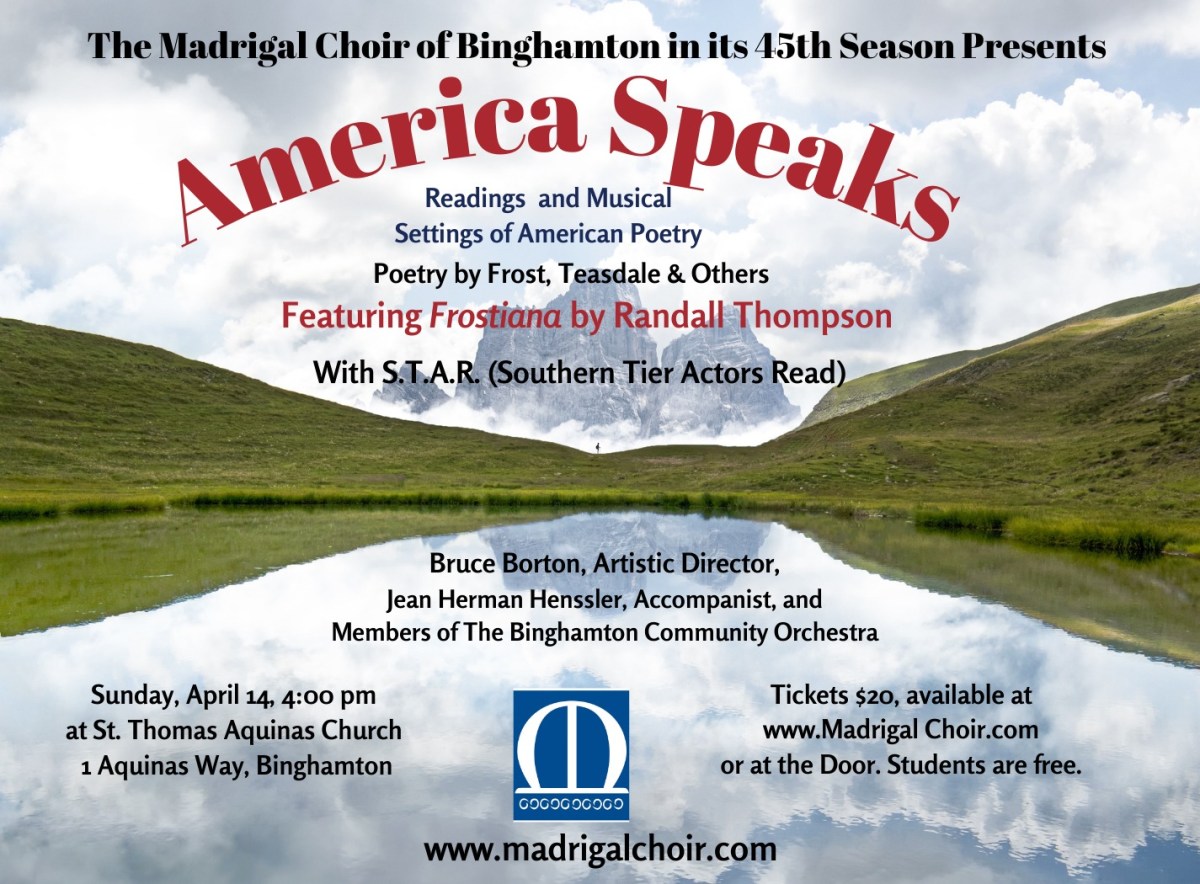
Binghamton NY area folks are invited to celebrate music and American poets this National Poetry Month with the Madrigal Choir of Binghamton at St. Thomas Aquinas Church on Sunday, April 14, at 4 PM.
Yes, it’s been over a month since I returned home from the Boiler House Poets Collective residency with The Studios at MASS MoCA (Massachusetts Museum of Contemporary Arts) in North Adams but I am finally getting around to a wrap-up post. I did post a couple of times during the residency, about Marika Maijala and our reading at the Bear & Bee Bookshop, although that was a far cry from most of our years in residence when I would post daily. Things were very busy, so posting took a back seat and this past month has been loaded with other commitments, such as the launch of the Third Act Upstate New York working group and the first concert of the Madrigal Choir of Binghamton’s 45th anniversary season. I also needed time to reflect on the residency and what it meant for the future of the Boiler House Poets Collective.
Until this year, the Boiler House Poets Collective reunion residencies had always had at least half of the participants being members of the original group that met in 2015 as the first group of poets in residence brought together in a collaboration between Jeffrey Levine of Tupelo Press and The Studios at MASS MoCA. For 2023, the number of participants went from eight to ten, with only myself and Kyle Laws planning to return in 2023. (Sadly, last-minute health complications prevented Kyle from joining us, so I was the lone “original” in 2023. I’m hoping to have this be a one-time occurrence.)
I had inherited the role of liaison with The Studios but also wound up acting as an organizer for this year of transition. I was determined to assemble a full complement of ten and to provide for all the elements that had been part of past residencies, including studio time, museum visits, daily workshopping, a group project, a public reading, and discussion/social time (often accompanied by food and drink). Because, in prior years, we had always had a core of originals, adding in new participants from among our poet-friends as slots became available, we hadn’t felt called to define who we were as a group. I thought, at this juncture, we needed to be more intentional about our identity and our goals. I let people know that we would be having an organizational meeting near the end of the residency to talk about what was important to us and what our plans would be going forward.
I admit that I was really nervous about how things would work out with so many people who had never met each other. For the first time, we had a member who was not herself a poet. In 2022, the BHPC residency overlapped with the residency of Nancy Edelstein, whose work centers around light. With that inspiration, I had designed our group project around the theme of light, inviting each person to contribute work that had to do with light. I had expected a group of poems but the amazing thing was that people began to notice light in new ways. One of our members was inspired to take photographs showcasing light and shadow. We were able to share our light-themed work with each other. It’s not yet clear whether or not we will produce some conglomeration of these that is shareable with the public. If we do, I’ll be sure to share it here.
Another thing that was new for BHPC this year was that we workshopped some pieces that were not poetry, including an essay, scene from a play, and excerpt of a radio play. It was interesting to expand our literary horizons. While we expect to remain grounded in poetry, it’s good to have that flexibility to serve our members’ needs.
I felt that the group had a good vibe from the time of our opening night dinner when we were first together but I was nervous for our organizational meeting when people would be assessing how things had gone and if they wanted to return in 2024. I was thrilled – and a bit teary – when all but one person immediately said they wanted to return next year; the remaining person hopes to but lives across the country, creating a lot more complications than those of us within easy driving distance. People enthusiastically volunteered for organizational roles, including inventing some duties I would never have thought of on my own, so that I will be able to concentrate on just doing the liaison role. I even have a deputy who is shadowing me and can take over if I’m sidelined for any reason. This new constellation has embraced being a collective in a wonderful way and I am immensely grateful.
On a personal level, I appreciated how supportive people were of my work. As regular readers here at Top of JC’s Mind may recall, I grew up in the North Adams area and have two manuscripts, a full-length and a chapbook, that I am submitting to presses and contests. I’m at a crossroads with the full-length collection. I have a contract offer from a hybrid publisher but I’m not sure that is the way I want to go. One day over lunch, people were listening to my concerns and offering suggestions, which were very helpful and have led to my scheduling a manuscript consultation with a professional editor next month. I’m hoping that will help me clarify the path I need to pursue.
I also appreciated that people took my work seriously. One of the poets said that my poems were important in preserving the history of the area. That was so gratifying to me, even though I seldom dare to think in those terms. I do think about those poems as being ones that only I would write, given my perspective as someone who grew up there but that has lived elsewhere most of my adult life. It’s a sort of inside/outside perspective that would be difficult to replicate in quite the same way. I don’t tend to think that my following the dictum to “write what you know” would seem important to someone else, so it was nice to hear. It makes my search for a publisher and my wish to have the book be as strong as possible feel more weighty.
So, I have joyfully marked the dates for the 2024 Boiler House Poets Collective residency on my calendar for next October. I’m looking forward to being among this remarkable group of women again, but I’m also grateful to know that, if something happens that prevents me from being there, the group will go on without me.
As one of the original members of the Boiler House Poets Collective, I’m thrilled to share an interview that Devon Ellington did with some of our members for The Rumpus. (I realize I threw an inordinate amount of links in that sentence; the “interview” link will open the article in a new tab.)
When Devon contacted us with interview questions, it was a pleasant and energizing surprise. Email messages and reminiscences flew among us. It was fun for those of us who are “originals” to fill in some of the history for people who have joined more recently.
It also highlighted the strength of being a collective in that we can retain our core identity while incorporating new members. At this fall’s residency, for the first time, “originals” will be in the minority. I admit to anticipatory sadness at missing seeing so many of my BHPC poet-friends, but I’m excited to add to our ranks as we continue to grow as artists and as community.
I hope you enjoy the article and want to explore more about BHPC. You can check out our inaugural reading in the Boiler House at MASS MoCA and more under the Collaborative Projects tab.
So, I haven’t been posting as much as I intended these last few weeks, but (for once) I have a writing-related excuse.
I’ve been spending a lot of my creative time on poetry.
The most vital piece of that has been connected to my full-length poetry collection. I was finally able to hold a long-delayed workshop session with the Grapevine Group, my local poetry circle, and do revisions. On Friday, I sent out the newly revised manuscript to a publisher for the first time. I hope to send more submissions for both the collection and my chapbook over the next couple of weeks. Given the necessary slowdown of my writing activities during my father’s final months, I haven’t submitted much for a long time, but the rejections have been rolling in, leaving me with very few active submissions. Besides manuscript submissions, I hope to put in some individual poem ones, too. Fingers crossed…
Meanwhile, the Binghamton Poetry Project has been holding its fall sessions. I chose to attend a workshop called Poetic Yearnings: Desire, Place, and the Placeless with Nicholas Kanaar. I write a lot of poetry of place, so it was a good fit for me. Due to the pandemic, we are still meeting online instead of in person. Our fall 2021 online anthology includes three poems I wrote in response to prompts from the workshop along with the work of other BPP poets. Yesterday, we also held a reading via Zoom. I chose to read three poems of place from my manuscript, which revolves around the area from which I and several generations of my family hail.
I am determined to get more submissions in soon and will try to update you on my progress. If I get anything accepted, I will certainly let you all know ASAP. The only way that will happen soon, though, is if I manage to get accepted in a publication that has a very quick turnaround time. Most journals take a few weeks or months to reply and book submissions are several months to a year. Odds are very much against acceptance, especially with books. One recent book submission pool I was in chose four books out of 1,400 to publish, so…
I can’t bear to go through the details but I will say that things appear to be on an upswing at the moment with some hope for stability on the horizon.
There will be a rare event to end the week, though, as B and I will be attending the wedding of two of my poet-friends this afternoon.
On July tenth, there was a rare island of normalcy.
Or an almost normal version of a rare event.
I participated in a live poetry reading in conjunction with the Empty the Inkpots exhibit at the Vestal Museum. The reading was part of the Summer Art Festival, a collaboration of the Museum and the Vestal Public Library. Several of the poets from the Binghamton Poetry Project who have work included in Empty the Inkpots read from the stage/deck at the Museum with the audience arrayed in scattered chairs and benches and on the lawn. It was the first time in many months that I have participated in a live-and-in-person poetry reading. It had been even longer since I had had to read with a microphone. The amplification was useful because the museum is near a busy roadway.
I chose not to read the poem I had on display, which is about the early months of the pandemic; it is available at the link above. Instead, I read three poems from my manuscript about the North Adams, Massachusetts where I grew up. “Conveyance” appeared in the spring 2021 anthology of the Binghamton Poetry Project. The other two poems, “North Adams Public Library” and “Monroe Bridge Mail”, are currently unpublished so I won’t share them here.
I was very happy with the reading on a number of counts. First, there were people in the audience who came at my invitation, including one who saw my Facebook announcement of the event. Second, though I was nervous before, I was reasonably comfortable during the reading, even managing the microphone adjustment without much trouble. Third, the reading was well-appreciated by our audience. We had six poets, with diverse styles and viewpoints, represented. We read in alphabetical order. Uncharacteristically, I was not first, which was helpful for me. I like to read early in the order, but I’m better at reading second than first. I was also grateful that the most experienced poet and performer was last as it gave a strong finish to event. No one should have to follow J. Barrett Wolf at a reading!
Lastly, I was pleased to receive personal compliments after the reading from family and friends, some of whom are also poets. What was most heart-warming was that a woman that I did not know came up to me afterward and told me how much she enjoyed my poems and asked where she could find my work. Of course, I don’t have any books of my own out, but I was able to give her my paper copies of my poems, which included my bio for the exhibit and the address for Top of JC’s Mind.
The reading was an island of normalcy not only because of the pandemic but also because most of my time these days has been wrapped up in dealing with the care of my 96-year-old dad who is currently in a rehab/skilled nursing facility after a fall and ensuing complications. It’s why it has taken me so long to post about the reading.
It’s also why, for the first time in years, I am not registered for the current sessions of the Binghamton Poetry Project. I am usually visiting my father in the early evenings. Even if another family member is available to visit, I can’t predict if I will have any creativity/brainpower left late in the day.
It’s made the reading that much more important as a reminder that my poetry life is still there, waiting for me to go back to it when things are more settled.
Seven years ago, I began participating in the Binghamton Poetry Project, a community outreach program of the Binghamton Center for Writers. Binghamton University graduate students facilitate free poetry writing workshops for children, teens, and adults. With the pandemic, sessions have had to move online, as have our readings and anthologies.
We had our spring reading and anthology launch today. I contributed three poems to the anthology, which you can find here. I read the poem “Conveyance” from the anthology, as well as “Meanwhile…” from my collection manuscript and “SARS-CoV-2: A Novel Coronavirus” which is currently on display as part of the Empty the Inkpots exhibit at the Vestal Museum.
I had very little formal instruction in poetry when I was in school, so I appreciate all the lessons in the craft of poetry that I have learned through the Binghamton Poetry Project. For example, in this last set of sessions I learned about zeugma, a device which I used in “Conveyance.”
I especially appreciate connecting with my local poetry community, not only the graduate students and participants but the wider poetry community in our area. When I was looking for a year-round poetry workshop to share feedback on my work, Heather Dorn, who was then the assistant director of BPP, connected me with what is now the Grapevine Group. I rely on the Grapevine poets to help me see what I need to refine in my poems. Seeing their work in progress has taught me so much about writing and revising. I’ve also learned how to give and receive constructive criticism. I can sometimes even manage to figure out the truest path when I get suggestions that directly contradict each other!
I hope that the Binghamton Poetry Project will continue for many years to come. BPP is supported by grants and is blessed with an ever-evolving set of Binghamton University graduate students serving as facilitators and administrators. I know there will always being poets in our community wanting to write, learn, connect, and share the gift of poetry.
In the United States, April is National Poetry month.
Broome County Arts Council (BCAC) is joining the celebration by hosting a series of virtual poetry readings by poets with ties to our area. The first reading, featuring Elizabeth Cohen, Dante Di Stefano, and Andrei Guruianu is available here.
Enjoy!
I’ll be back with additional posts as the celebration continues, including a more extensive post the week that I am featured along with other poets from the Binghamton Poetry Project.
One of the opportunities that has arisen during the pandemic is the easy availability of poetry readings, as many institutions have re-imagined their live readings as online events.
I admit that I wasn’t in the habit of going to a lot of readings in-person before the pandemic. They are usually in the evenings and I try to keep as much evening time reserved for family as possible, so it was difficult for me to commit to the transport time plus the reading time. That is less of a factor now that I can attend and still be at home, in case something comes up that needs my immediate attention.
It’s been wonderful to hear poets reading their work and I’ve also appreciated the opportunity to hear poets speak about their lives and work in interviews or question and answer sessions.
I admit, though, that these discussions, particularly when they take place in academic settings, can shake my sense of myself as a poet.
I consider myself to be a community poet, meaning that my work is informed by my experiences much more so than by my academic background. While I have been blessed with learning about craft through the Binghamton Poetry Project, the Broome County Arts Council, Sappho’s Circle, and my poet-friends of the Grapevine Group and Boiler House Poets Collective, the last time that poetry was a significant part of my academic work was in grammar school, many decades ago. I’ve also learned a lot by reading different poets.
In comments in their readings, poets that I admire talk about the wonders of writing in forms like sonnets or villanelles and how this focuses their writing.
I’ve tried variously to write in form. I’ve never managed to write a traditional sonnet or villanelle that was worth making it out of my notebook.
The thought of trying to write a decent sestina is enough to make me break out in hives.
I do a bit better with forms that have made their way into English from Japan. I have written some successful haiku, tanka, and haibun. I am especially fond of tanka and have included several in my chapbook manuscript, which is still in circulation with publishers and amassing an impressive list of rejections. (Note to self: send more submissions.)
When I am feeling shaken about not having formal training, an English major, or an MFA with all their attendant skills and expertise, I try to remember the times that my poet-friends have reassured me that, although my poetry is different, it is still worthwhile – and that I am indeed a poet.
Now if I can just find those presses and publishers that agree…





 Joanne Corey