an unexpected association

While visiting the London contingent of our family, we often rode by a JFK Special School. For people from the United States, JFK commonly refers to President John Fitzgerald Kennedy but we assumed that these schools must refer to a different JFK.

Our daughter and son-in-law, though, told us that the school program is named after President Kennedy. The schools are for students with special needs and recognize the Kennedy family’s involvement in the development of education for those with special needs. While there are some stand-alone schools for those with the most complex needs, many of the JFK programs are now within schools where students are mainstreamed.

President Kennedy signed some of the first legislation to assist people with mental illness and intellectual disabilities. Many members of the Kennedy family across several generations have been involved in helping those with these conditions, most notably JFK’s sister, Eunice Kennedy Shriver, who worked through the Joseph P. Kennedy Foundation for many years and founded the Special Olympics. Rosemary Kennedy, another sister in their large family, had been born with an intellectual disability and is thought to have inspired Eunice in her work.

It’s great to know that so much good has come from the work of the Kennedy family, not just in the US but across the world.

This post is part of Linda’s Just Jot It January. Join us! Find out more here: https://lindaghill.com/2026/01/05/daily-prompt-jusjojan-the-5th-2026/

Come Home to Smith!

Smith College, my alma mater, is celebrating its 150th anniversary this year with a number of events. I travelled to our Northampton, Massachsuetts campus for the “Come Home to Smith” events on November 1st. The campus was beautiful as always and it was a privilege to be back on campus with other alums and current students, as well as family members who were visiting as it was also Family Weekend.

It was my privilege to also attend the first-ever event of the Smith VOICES (Variety of Opinions, Interests, Cohorts, and Experiences are Supported) initiative, organized around the theme of “Joyful Care.” I enjoyed fascinating presentations on wellness for individuals and communities, offered by alums and staff. I appreciated the opportunity to interact with other alums from across the age spectrum and from many different backgrounds and communities.

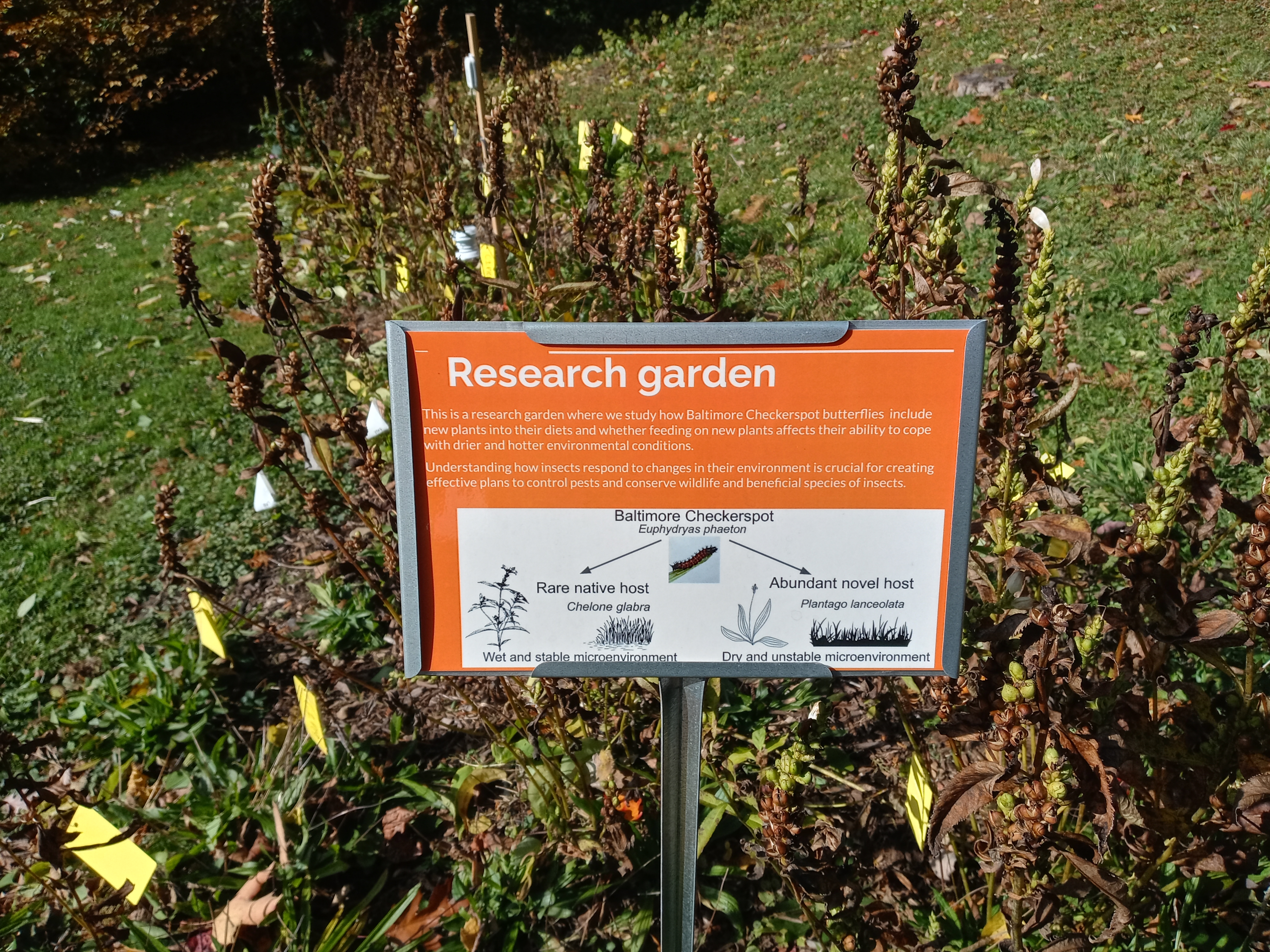
I especially enjoyed the opportunity to learn new things, reflect, and deepen my understanding. Smith is a champion for liberal arts education, encouraging both breadth and depth of learning and I cherish being part of that tradition. While I didn’t have as much time and energy to wander around campus, I had to stop and learn about this research garden, tucked along the pathway between Wright Hall and Chapin House:


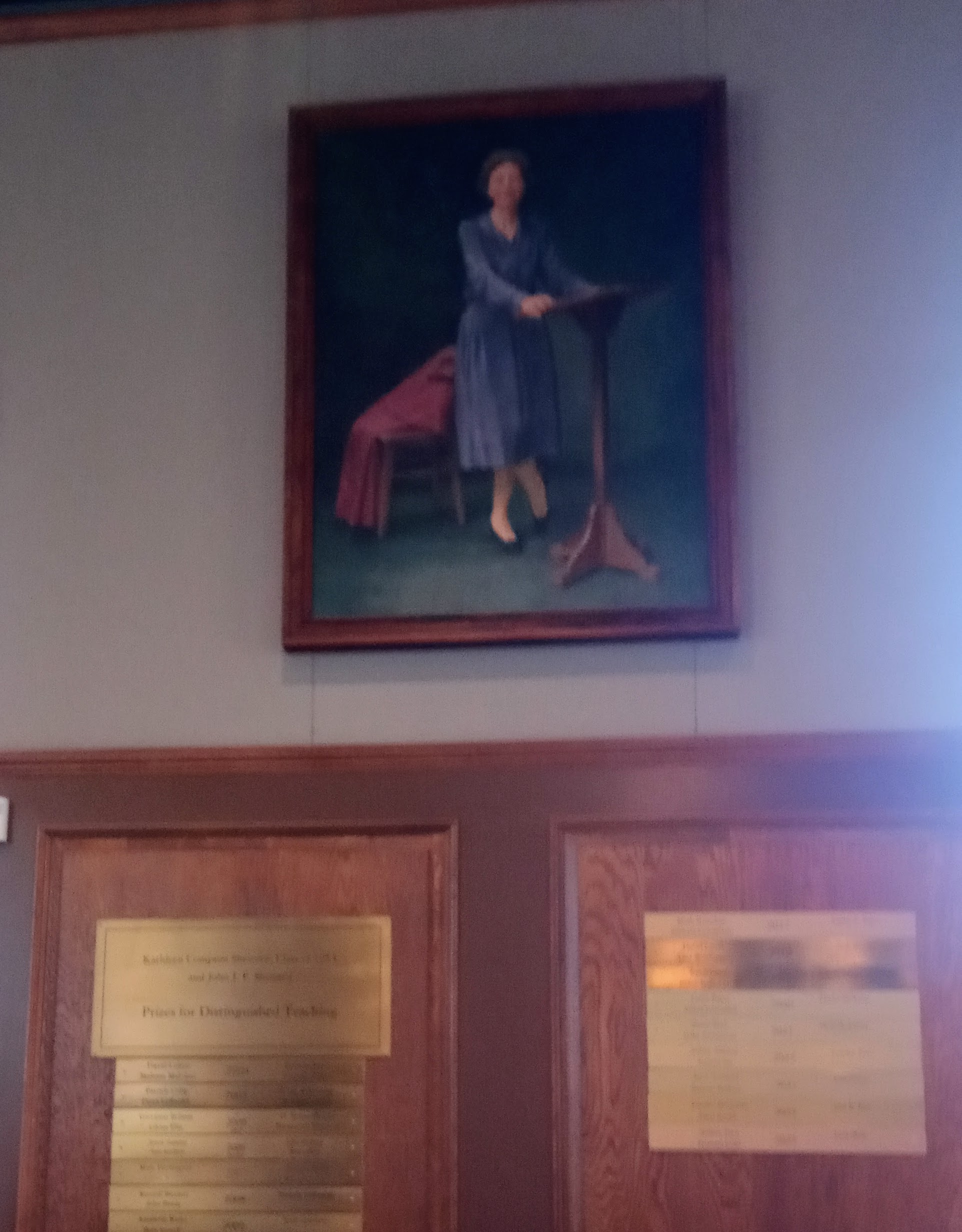
I also enjoyed spending time in some renovated spaces on campus. The opening of VOICES was in Alumnae House in the same room where we held our wedding reception in 1982. Later presentations were in Neilson Library. The photo below was taken in the Browsing Room and shows the official portrait of Jill Kerr Conway, the first woman president of Smith, who was president when I was a student.


To cap the Come Home to Smith activities, current president Sarah Willie-LeBreton addressed the alums and answered questions with insight and warmth. I heard from several alums and staff members how vital President Sarah’s leadership has been in these stressful times for higher education and for society in general. I also love how everyone calls her “President Sarah” with true affection. This was my first opportunity to hear her speak in person. She was astute, thoughtful, and joyful, even when touching on challenges that we are facing.

I ended the day with the Montage concert, which brought together musical groups now active on campus, over half of which were not in existence when I was a student. My favorite new-to-me group was the Wailing Banshees, Smith’s Celtic music ensemble. I loved seeing that the handbell choir, which was very small in my day, has grown to enable ringing five octaves. A newer tradition that has developed is ending with an audience participation piece. We joined in with “Let There Be Peace on Earth” with the Glee Club and Orchestra, which, I admit, made me teary.

In her will, Sophia Smith provided the funds to build and maintain a college for women that would provide an education equal to that available to men. The will states, “It is my wish that the institution be so conducted, that during all coming time it shall do the most good to the greatest number. I would have it a perennial blessing to the country and the world.” I’m grateful that Smith College continues to be a blessing and that it grows and changes in ways that honor Sophia Smith’s wishes. Having previously made their financial aid packages loan-free, Smith recently announced the Next 150 Pledge , which will make Smith tuition-free for families with incomes up to $150,000.

I’m proud to be part of the Smith College family and hope that we will continue as a “perennial blessing” for the next 150 years and beyond!

One-Liner Wednesday: Dept. of Education

Project 2025, the lengthy document spearheaded by the Heritage Foundation to lay out plans for the “conservative president” they expect to be elected this year, calls for the elimination of the Department of Education and limitations on federally supported services such as special education, school meals, Title IX, and student loans. (pp. 319-361)

This information is provided to assist US voters as they make decisions for this year’s election as part of Linda’s One-Liner Wednesday series, which you may learn more about here: https://lindaghill.com/2024/07/10/one-liner-wednesday-i-love-my-neighbourhood-2/. (#1linerWeds are usually fun and/or inspirational. I’m just in serious political mode these days…)

One-Liner Wednesday: Life-long learning

We need to remember across generations that there is as much to learn as there is to teach.

Gloria Steinem

Join us for Linda’s One-Liner Wednesdays! Find out more here: https://lindaghill.com/2024/05/08/one-liner-wednesday-taking-bunny-pics/

The inauguration of President Sarah

Over the weekend, my alma mater, Smith College, inaugurated Sarah Willie-LeBreton as their twelfth president in a joy-filled celebration.

For those of you who may not be familiar, Smith was established in 1871 in Northampton, Massachusetts as a women’s college that would provide an education for women equal to that which had long been available to men. It has continued that mission through the years and has in recent decades worked diligently to make a Smith education possible to promising students in underserved communities, such as those who are the first generation in their family to seek higher education. For example, it has eliminated student loans from its financial aid packages and gives grants to students in need to help them obtain essential items like computers.

I was a Smith student during the tenure of the first woman to be Smith president, Jill Kerr Conway (1975-85). We affectionately referred to her as “Jill” although we would always have addressed her as President Conway in person. It felt right to me to hear an alumna during the inauguration refer to Dr. Willie-LeBreton as “President Sarah” so that is how I am thinking of her now.

President Sarah is a sociologist, a member of the Society of Friends (Quakers), a Black woman, and an experienced educator and administrator. She exudes joy and elicits it in others. Her official inauguration, coming several months into her tenure as president, was a joyous celebration of the history and heritage of President Sarah and of Smith College and how they are entwined as a community for the present and the future. I loved the greetings and involvement of other college presidents, who were so welcoming of President Sarah in their remarks. I especially appreciated the video appearance of Ruth Simmons, who was Smith’s first Black president – until she was stolen recruited by Brown University to become the first Black president of an Ivy League institution.

President Sarah’s inaugural address was impressive. I appreciated her strong support for liberal arts education. She emphasized how our knowledge must be in conjunction with our values. She says:

We are at our peril when we teach rote memorization without collaborative problem-solving and when we encourage the fusion of identity with grades, rather than with what challenges students and brings them joy. We are at our peril when we nurture cleverness without providing the opportunities to consult our moral compass, without providing opportunities to do for and with others. The liberal arts education we provide is the perfect antidote to the division, threats to democracy, diminishing of rights and freedoms, violence, and natural catastrophes to which we wake up on a daily basis.

(The inauguration ceremony is available online here; President Sarah’s remarks begin at the 1:12 mark.)

I would have loved to attend in person, but, like many alumnae, could only watch virtually. Smith did a good job of including us, even though we couldn’t be there physically. One way that they did this was to invite us to send a photo and caption of where we find joy. The photos were assembled into an interactive mosaic. The mosaic is searchable by name, class year, or key word to find specific photos in the mosaic. I sent a photo of my granddaughters, ABC and JG, heading out on their new school year. I’m honored to have them represented as we all share and, in so doing, multiply our joy.

Congratulations, President Sarah! I look forward to years of connection, love, commitment, and joy as a continuing, if geographically distant, part of the Smith family.

(Photo is of my first and most enduring Smith friend, my roommate Mary, and me, on tour with the Smith Alumnae Chorus in Slovenia in 2019.)

learning civics and history

Earlier this week, I was listening to a discussion around Richard Haass’ new book, The Bill of Obligations: The Ten Habits of Good Citizens.

The discussion centered around the dearth of knowledge among many in the United States on the basics of civics and history. The root of this lies seems to lie in our educational system.

Unlike most countries, the United States does not have a national educational system. Schools are controlled by local school boards with a greater or lesser role played by state education boards, depending on the state. This leads to a wide range of what students learn in school and the depth of that learning.

I went to public schools in western Massachusetts in the mid-1960s through the 1970s. Civics and history were an important part of our schooling. I remember in the later grades of grammar school reading the US Constitution and summaries of landmark Supreme Court cases. We were expected to apply what we had learned from history to current events, such as deciding for whom we would vote for president in a mock election. This being small-town New England, we would attend town meeting day with our families, showing democracy in action.

Having already learned the basics of US and world history in our younger years, in high school, our coursework was designed to delve more deeply into particular areas of social studies. One of the best courses I took was one on minorities in America. I learned about such important historical events as the Chinese Exclusion Act and the internment of Japanese-Americans during the Second World War. We studied the Black experience in the US, from enslavement and Jim Crow through the civil rights movement, which was, of course, ongoing. I learned for the first time about the discrimination that had affected my own Italian grandparents and Irish great-grandparents. By the time I turned 18 and could register to vote, I had a good understanding of the complexities of our past and of how to evaluate issues of the present and future.

My daughters went to school in New York, where the State Board of Regents is the main driver of curriculum. The Regents set the required courses and use statewide exams in high school to ensure that the students are fulfilling the goals of the curriculum. While the State is fond of survey courses, they do expect students to do much more than memorize historical facts. A major component of history exams is a document-based essay, where the student is given primary source material, such as political cartoons, government documents, and newspaper articles, and asked to use them to write an essay expressing support or opposition to a given proposition. It demonstrates the kind of decision-making that voters need to do to evaluate candidates or stances on current issues. High school students, usually in their final year, also take a semester course on participation in government, which is considered the capstone of their civics education. This New York State framework, which my daughters used in the 1990s-early 2000s, remains in place today.

Some other states and localities do a poor job of educating their students in history and civics. Some even boast about the limitations they place on what is taught in their schools. A current egregious example of this is the state of Florida, which passed a law last year severely limiting teaching about race and identity. This led Florida to reject a pilot of the new Advanced Placement African American Studies course because it includes materials about current topics such as intersectionality, the reparations movement, and Black feminist literary critique. They also objected to students reading works by such well-known Black scholars and writers as bell hooks, Angela Davis, and Kimberlé Crenshaw. Florida officials claimed the course was more indoctrination than education, failing to realize that one needs to learn deeply through the full spectrum of a field of study to be truly educated and able to make judgments. Perhaps, their own education was too limited for them to appreciate the complexities we all now face.

At this point, we have a lot of catching up to do, with adults needing more education in civics, as well as many younger students. Part of this effort must be to emphasize our responsibilities to each other as citizens, or, as Richard Haass calls them, our “obligations.” (I haven’t had the opportunity to read his book, which was just released this week, so the following thoughts are mine and not from his work.)

For example, the First Amendment states that the federal government cannot establish a religion or prevent anyone from practicing their religion. I have the right to practice a religion or not, as I choose. However, I have a responsibility to not impose my religious tenets on anyone else. The First Amendment also says that laws can’t be made to abridge freedom of speech, but I am responsible for what I say and should take care that it is truthful and appropriate.

There is some tendency in the US for people to be hyper-individualistic, crowing about their individual rights, viewpoints, possessions, etc. while ignoring that we all exist in community and relationships, with people who are similar to us and those who are different in some way. Part of the reason that education in civics is so important is to increase the realization that we are responsible to each other as members of the community and the nation.

We are responsible for finding out the facts on an issue, forming a reasoned opinion, and taking action. We need to be respectful of others and set a good example. We need to keep listening and keep learning, as new information and discoveries come to light every day.

We need to be civil.
*****
Join us for Linda’s Just Jot It January! Find out more here: https://lindaghill.com/2023/01/26/daily-prompt-jusjojan-the-26th-2023/

US education

In the United States, some school districts have already started the new school year and the rest will follow over the next couple of weeks.

In many places, the situation is fraught.

First, an organizational primer for those outside the US. The United States, unlike many countries, does not have a national education system. The various states exercise control over the curriculum and policies to greater or lesser degrees, depending on the state. The greatest degree of control usually rests with local school boards.

It’s a mixed blessing.

In some districts, the local school boards have bought into the notion that something as simple as having a book that includes a gay character in the library is akin to “grooming” students to be gay. Or that it isn’t permissible to discuss racism because it might make white students feel bad or guilty. This puts teachers in the uncomfortable position of being afraid to teach history, civics, literature, science, etc. in the way that they were trained to do as educators.

Some of these issues are even more pronounced when they become a state policy. The most prominent example of this at the moment is Florida. This school year marks the beginning of enforcement of the Parental Rights in Education Act, informally known as the “Don’t Say Gay” law. The most prominent provision of the law is that there must be no classroom instruction on sexual orientation or gender identity in kindergarten through third grade. The reasoning is that these topics should be totally controlled by (heterosexual) parents.

But, here’s the thing. We use gendered language ALL THE TIME. Some of the first sight words that children learn – mother, father, boy, girl, man, woman, he, she – are all gendered terms. Are teachers supposed to use gender-neutral words at all times, referring to students, parents, and siblings rather than using such common terms as boys and girls, moms and dads, and brothers and sisters? What if a student asks why the family picture a classmate drew has two moms or two dads? Will the teacher be sued if they say anything beyond “ask your parents”?

Florida is also facing what has been termed a “critical teacher shortage.” It’s hard to say how much is due to curriculum concerns versus low pay, lack of administrative support, large class sizes, contract provisions, etc. Teacher shortages are fairly common in the United States, especially in math and science. To fill gaps, some states allow people to teach subjects in which they are not certified or even allow people to teach who are not certified at all.

Meanwhile, teachers and schools are under COVID-related pressures. Although almost all students, teachers, and staff are eligible, many remain unvaccinated, raising the risk of illness. During the pandemic, some students fell far behind academically during the period of remote instruction and need highly qualified teachers and extra tutoring to help them catch up to grade level. Teachers are also struggling with the mental health and developmental needs of students who faced fear, uncertainty, and isolation for months and now struggle with inattention, misbehavior, and lack of age-appropriate social skills. Some teachers are opting to retire as soon as they are eligible rather than continue under these stresses.

In some areas, schools are dealing with church/state issues, as well. Because of the First Amendment to the United States Constitution, the government may not establish a religion. However, a couple of recent decisions by the conservative majority of the Supreme Court have poked holes in what had been termed the wall of separation between church and state. Both cases benefit the expression of Christianity; I wonder if the decisions would have been the same if they had been about public prayer by Muslims, for example. In some localities or states, there are even instances of (white) Christian nationalism creeping into school curricula, such as teaching that the United States was founded as a Christian nation, which it was not, and downplaying the role of enslavement and indigenous land theft/genocide in our national history.

A lot of this is supposedly done in the name of parental rights, that is, that parents are the ones who should determine what their children learn in public school. I don’t agree with that. I look upon public education as a public good. I want free, high-quality education for every student so they can grow into responsible, mature members of our communities. They need to learn wide-ranging skills in communication, quantitative and scientific skills, technology, social studies and civics, and the arts. Having a broad base helps to develop critical and creative thinking and to identify where a student’s interests lie. Learning in community teaches how to work together and solve problems in a civil way. That was my expectation when I chose to send my children to public school. If my priority had been to control what they were exposed to, I would have opted to home school them. If I wanted them to have learn through a faith-based approach, I would have sent them to a religious school.

I don’t believe that a subgroup of parents should be able to dictate the learning environment of all children in our public schools. If a parent thinks that a certain assignment is inappropriate for their child, the vast majority of schools have a mechanism to assign an alternative. However, that parent should not have the power to say that the other students can’t undertake the original assignment. If those parents don’t understand that in terms of community values, they should at least understand that the parents of the other students have the same right to direct their child’s education as they do. If a parent thinks that all/most of the assignments are inappropriate for their child, it’s time to either homeschool or send their child to a private or religious school that meets their needs.

With my daughters in their thirties and my grandchildren abroad, I admit that I am grateful to have been spared the personal pressures of education during the pandemic. There is a lot of ground to make up for students in the US. Let’s concentrate on that for the good of their future and our country.

SoCS: JC’s Confessions #25

When I saw that Linda’s prompt for Stream of Consciousness Saturday this week was “key,” I knew that this would be another intersection with JC’s Confessions, my occasional series in which I “confess” to things that aren’t really sins but that I feel vaguely guilty about. (I’ll paste the usual intro to JC’s Confessions at the end of this post.)

I sometimes wear my Phi Beta Kappa key when I am nervous about a challenging meeting as a confidence booster. It’s on a necklace chain, so it isn’t that noticeable and, if someone does notice it, they are likely to think that it’s just my sorority or my husband’s fraternity key. (This would only be possible if the person doesn’t know us. I went to Smith College, which does not have sororities. B’s university did have fraternities but he would never have considered joining one.)

I think the origin of my feeling guilty about it is that I’m wearing it as a secret reminder that I am intelligent in the best liberal-artsy way, that I can use those skills to delve into new terrain, and that I can contribute to solutions to complicated problems.

That I want my membership in Phi Beta Kappa to be a secret is the problem.

So, I was always a good student. I was valedictorian of my high school class. I graduated summa cum laude from Smith College, which, at that time, placed me in the top 1% of my class. I made first election to Phi Beta Kappa in the fall of my senior year.

There is somehow in the United States an undercurrent of suspicion of people who are “smart.” Having been a good student is taken to mean that you must hold yourself above others. This is not at all true of me but others may assume it is and react in a hostile way.

I nearly always kept my little secret undetected. The one time someone noticed and commented on my key was when I was serving as a parent volunteer on a school district committee doing curriculum work. It was daunting for me to be the one person who was not a professional educator. We did do training together for the work but I had to rely on my personal skills and intellect rather than on pertinent academic background in education. Thus, my need to boost my confidence with my key.

During a break, one of the teachers commented on my Phi Beta Kappa. I probably blushed! In retrospect, it shouldn’t have surprised me, as he earned a couple of degrees from Harvard himself and would certainly have known those Greek letters when he saw them.

It was nice to have someone in on my secret that day, someone who understood what it meant without thinking I was being a show-off.

It’s been quite a while since I’ve worn my Phi Beta Kappa key. My life has been much more contained, especially since COVID appeared.

Maybe I’ll wear it someday not as a confidence booster but as a celebration of my now long ago academic past.

In the first few seasons of The Late Show, Stephen Colbert did a recurring skit, then a best-selling book, called Midnight Confessions, in which he “confesses” to his audience with the disclaimer that he isn’t sure these things are really sins but that he does “feel bad about them.” While Stephen and his writers are famously funny, I am not, so my JC’s Confessions will be somewhat more serious reflections, but they will be things that I feel bad about. Stephen’s audience always forgives him at the end of the segment; I’m not expecting that – and these aren’t really sins – but comments are always welcome.

JC

*****
As previously mentioned, Linda’s prompt for Stream of Consciousness Saturday this week is “key.” Join us! Find out more here: https://lindaghill.com/2022/08/19/the-friday-reminder-and-prompt-for-socs-aug-20-2022/

My 40th reunion at Smith

Last week, I attended my fortieth reunion at Smith College in Northampton, Massachusetts. For those who may not be familiar, Smith is a women’s liberal arts college, chartered in 1871, one of the traditional Seven Sisters, five of whom remain as women’s colleges.

I came into town a day early in order to meet up with an alumna friend who lives in Northampton and graduated a year before me. Her sister was a member of my class and passed away in fall 2020. I was honored to be able to commemorate her at the Service of Remembrance during our reunion. My ’81 friend and I enjoyed hours of conversation on her front porch, followed by dinner on the porch at Mulino’s, an Italian restaurant that did not exist back in my student days.

I stayed at the historic Hotel Northampton, which has fun features like a mail slot near the elevators on each floor that connects to a large brass mailbox on the main floor for pick-up by the postal service every morning. I also got to do a bit of shopping at Thorne’s Marketplace, a collection of local shops and restaurants housed in a grand historic building. Thorne’s was a fairly new undertaking back in my undergrad days and I’m glad to see that it continues to thrive. I bought some cards and gifts and books and made two trips to Herrell’s ice cream shop. I got a sampler each time, so I got to enjoy eight – count ’em, eight! – of their delicious homemade flavors. This will surprise no one that knows me. I also got to have lunch at Fitzwilly’s, a restaurant/bar that was also relatively new during my student days. I had mac ‘n cheese that featured fresh asparagus from a farm in nearby Hadley. I love asparagus, which is one of the glories of spring in New England; it reminds me of going with my parents to harvest a patch near my father’s hydro station, a remnant of a garden from an old company-owned house that had been torn down.

On Thursday afternoon, I went up to campus for the duration of reunion. Because of the pandemic, everyone had to have proof of vaccination and boosting to register and many of the meals and events were held outdoors. Indoor events were masked, except while eating and drinking. I immediately met up with some of my ’82 friends and the celebration began!

One of the things about Smith reunions – and Smith alums in general – is that we somehow manage to have meaningful conversations with each other at the drop of a hat. Perhaps because of our shared liberal arts background, we are engaged with a broad range of topics across current affairs, public policy, arts and culture, and on and on. Of course, the deepest conversations happen with our close friends but there is a lot of sharing of ideas with acquaintances, too. In retrospect, I wish I had prepared a succinct answer to the question “What do you do?” Lacking a shorthand reply, like “I’m a lawyer, working for this government agency” or “I teach at such-and-such school”, I found myself stumbling to explain forty years of my life in any brief, comprehensible way.

Unlike the vast majority of my classmates, I’ve done little paid work in my life. I’ve devoted many years to being a caregiver of both elder and younger generations, with more than our share of medical issues. I’ve volunteered in church music and liturgical ministry and facilitated a spiritual book study group. During my daughters’ years in public school I served on curriculum committees and shared decision making teams and helped design the honors program at the high school. I joined NETWORK, a national Catholic social justice lobby, in 2000 to advocate for social justice. I was part of the anti-fracking movement in New York which finally achieved an administrative and later legislative ban in our state; this led to ongoing involvement in the fight for climate and environmental justice. There is my writing life, as a blogger and poet.

This does not condense into an easy answer to “What do you do?” but it does constitute the bulk of my adult life, which would not have been as rich and varied were it not for my Smith education. The ideal of a liberal arts education is that you “learn how to learn.” By studying across the spectrum of academic disciplines, one absorbs different approaches to real-life issues, enabling critically sound and creative solutions that promote well-being for ourselves and others and for our environment.

Maybe I should have replied, “Just forty years of being liberal-artsy.”

The other thing that I hadn’t quite prepared myself for was the flood of family memories. Because it was only an hour-ish drive to campus, my parents visited often for concerts and events. They were there for my recitals in Helen Hills Hills Chapel and John M. Greene Hall. They visited at Haven House where I lived all four of my years on campus. There were there, of course, at B and my wedding, a few weeks after commencement with the reception at the Alumnae House. This reunion was the first time since their deaths that I was back on campus and missing them added another layer to the strange mix of familiarity and difference that the passage of forty years brings. For example, I thought about my parents when we were attending the remembrance service, sitting in rows of chairs where the pews had once stood. The pews were removed years ago to allow for more flexible use of the space but their absence felt strangely current when I remembered B and my parents there in the front pews on either side for our wedding.

I also found myself missing my mother in particular among the spring flowers. We were blessed with unusually warm weather for mid-May and the flowers and trees were blooming simultaneously and profusely in response. The scent of the lilacs between the President’s House and the Quad, where we were staying, was so overwhelming I nearly choked. There were lily-of-the valley in bloom, which are Nana’s birth flower. What would have been her 90th birthday was the day after reunion and the third anniversary of her death is a few days from now.

I’m grateful to have been among friends who could support me with this grief aspect. Many of us have lost our parents now, with some still in the phase of dealing with their final years and indeterminate endpoint. As classmates, we were also dealing with the deaths of more of our ’82ers, adding to the list that, sadly, began during our senior year when we lost one classmate in a plane accident and a second to cancer. That’s why I and some friends always make a point to attend the service of remembrance during reunion. We want to honor our departed ones and their importance in our lives, even if they left us long ago. After the service, we visited the memorial tree planted beside the chapel in honor of our classmate Beth. We took a photo which we will send to her mother, who I know finds comfort that we remember her all these decades after her death.

While the central activity in reunion is visiting friends, there are plenty of other things to keep us busy. Some are long-standing traditions, such as Ivy Day when the alums, wearing white, parade between rows of the graduating seniors, also wearing white and carrying red roses, welcoming them into the community of alumnae. The night before commencement, the central campus is illuminated with Japanese lanterns. People stroll among them with live music in several locations.

There are also a number of lectures, receptions, and concerts. The President gave an update on the state of the college. Everyone is very excited that grants are replacing loans in financial aid packages at Smith, making an education possible without graduating in debt. Smith also highlights its accessibility for students who are the first generation in their family to attend college. That was my situation forty years ago but it was not recognized in the way it is today. I also attended two lectures of interest. One was how the Botanic Gardens are being re-imagined in keeping with the UN Sustainable Development Goals and best practices for preserving species in the face of climate change, all with an eye toward education and social/environmental justice. The other was about the transition of campus to ground-source heating and cooling, which will be a major contributor to Smith being carbon-neutral by 2030 without making extensive use of purchased off-sets. I was particularly interested in this because of the projects we have done at our home to reduce our carbon footprint and because my church is in the process of drawing up a strategic plan to reduce or eliminate our use of fossil fuels.

Besides college activities, we had a few opportunities just for our class. I alluded to one in this post – an open mic event to read something from our college years. I chose a passage from my adult psychology course journal about my experience coming from a tiny town to Smith. A few of us had brought something with us but we had time to do additional sharing which was fun. Our class theme for Reunion was “Writing Our Next Chapter” and I appreciated that our futures also came into that discussion.

We were also honored to have a preview screening of Where I Became, a documentary about South African students who came to Smith during apartheid. Our classmate Jane Dawson Shang is co-producer and shared some of her experiences making the film. When it becomes publicly available, I will surely share that information here at Top of JC’s Mind so everyone can see the remarkable story of these women.

Reunions at Smith are always exhilarating but exhausting. I had originally planned to attend commencement on Sunday morning but opted for quiet conversation with friends. Walking 17-20,ooo steps a day for three days straight in hot. humid weather proved to be a bit much for my feet and ankles, which swelled rather impressively.

It also meant that my reunion experience ended with what is always most important, sharing with friends in a place that was instrumental to our lives. I hope to see some of them and return to campus before our next reunion.

Five years seems too long to wait.

One-Liner Wednesday: history

History does not repeat, but it does instruct.

Timothy Snyder

Join us for Linda’s One-Liner Wednesdays! Find out more here: https://lindaghill.com/2022/02/16/one-liner-wednesday-i-won-2/