New York’s reopening plan

I’ve posted several times about how my state is handling the pandemic. Unlike many other states, New York State has taken a methodical, metric-based approach.

The whole state has been under a program called PAUSE, which is a stay-at-home order for all but essential workers and shopping for necessities. Starting on May 15th, certain regions of the state that have met the criteria will be moving into phase one of four for re-opening certain businesses.

My region, the Southern Tier, is qualified to re-open companies with worker and customer safety plans in place in construction, manufacturing, delivery/curbside pick-up retail, wholesale, agriculture, forestry, fishing, and hunting. The region needs to continue to meet the criteria each week, including testing and having contact tracers available. If criteria continue to be met, other businesses will open in phases. If the statistics show an outbreak is developing, the phased-in businesses will close until all the criteria are again met.

The state has a website called New York Forward, which has up-to-date information about the plan and the current status of each region. There is more information about the phase-in of businesses here. For those who would like more detail, there are many different pages and sections available on different aspects of the plan from the New York Forward main page link above, as well as a 50 page book, which includes some history, the basics of the plan itself, and future goals.

While there are no certainties in dealing with the pandemic, I am reassured that there is a detailed plan with metrics based on science and the experiences of other places dealing with the virus. It’s also good to know that there is continuous monitoring of the situation so that we can adapt the implementation as needed.

For the good of our state and the health and well-being of our residents, I hope the plan works well. If it does, I hope other governments will be able to use it as a template for their own plans.

We are better off if we make thoughtful, science-based decisions. This pandemic has shown how connected the world is. We all need to cooperate if we are ever going to end this diesase.

bad timing

The United States government authorized direct cash payments to adults in order to help people face the challenges of the pandemic economic impacts.

The implementation has been dicey, though.

Most of the payments were based on 2018 or 2019 income tax returns and were made by direct deposit, if banking information was on file with the Internal Revenue Service, or by check.

Unfortunately, the IRS didn’t cross-reference with the Social Security system, which meant that some payments were issued to people who were deceased. That is what happened with my parents, known here as Nana and Paco, who received a payment by direct deposit last month, even though Nana’s date of death was on file at Social Security.

Many others were similarly affected and, at first, it seemed that surviving spouses would be allowed to keep the full payment as had happened in a similar economic stimulus program a number of years ago.

However, a few days ago, the government issued instructions that required people to mail them a check for any payment sent on behalf of someone who had died.

I am not arguing against the principle of payments to only those who are living, but I wish that the program had been implemented with accuracy. It’s been painful dealing with the hassles and uncertainty of the situation.

I couldn’t make myself write the check and required note to the IRS on Mother’s Day, my first without my mom. I did put it in the mail today. Later this week will be Nana’s birthday and the following week the first anniversary of her death. I didn’t need another reminder of her absence from the government in the midst of it.

I feel badly for those whose loss is more recent, who may need the money to help pay funeral bills or to support surviving family. I would hope in those instances that the government would not demand that the money be returned, but I doubt that the current administration will act with compassion and competence.

It’s sad.

New York State and plans

Every day, I listen to Governor Andrew Cuomo of New York give his daily coronavirus briefing and take questions from the press.

I am definitely not alone.

I often watch through Facebook Live, so there is a comment stream during the briefing. While some of the people are, like me, New York residents, many others tune in from other states and countries. While there are some trolls, many people thank Governor Cuomo for his candid, factual presentation and his compassion. There are always some calls for him to run for president. I admit to having the occasional, totally improbable political fantasy that both the nominating conventions decide to choose a governor who has handled the pandemic as well as possible to run for president, so that instead of Trump versus Biden, we would have, say, Hogan versus Cuomo. Not going to happen, but I, for one, would breathe easier if it did.

This is a big week for New York State. Our current stay-at-home order expires May 15 and it is expected that some regions, including the Southern Tier where I live, will qualify to enter phase one (of four) for expanding what businesses and services may be opened and under what circumstances. There are a number of criteria to meet before being eligible, including at least a two-week decline of new cases, hospital and intensive care unit availability, and testing and contact tracing capabilities. All the businesses have to have plans in place for safe working conditions and customer delivery protocols. If COVID-19 cases start to increase, the state will go back to its prior level of operations until conditions improve again. The New York plan is based on medical science and the experiences of other countries and cities around the world as they try to increase economic and social activities after outbreaks of the virus. For reference, businesses like hair salons and dine-in restaurants don’t re-open until phase three.

Because of the planning and vigilance of our state government, I feel relatively secure that New York will be able to protect public health while gradually opening more and more public and private entities. I remain very worried, however, about the majority of states who are re-opening without even having had a decline in the number of cases. Indeed, right now, if you take New York out of the national statistics, you find that while New York’s infection rate is on a steady decline, the rest of the country is still on the increase. In addition, some countries that had contained the outbreak, such as Germany and South Korea, are having to back off with some of their re-opening of businesses because their case numbers are rising again.

I am hopeful that our region and other New York State regions that qualify will be able to move forward with our slow and thoughtful plans while still protecting public health. If that happens, I hope other states and countries will study our approach and adapt it to their regions.

With over four million confirmed cases world-wide, we need the best practices devised and enacted as soon as possible around the world.

re-opening fears

Some of the states here in the US are re-opening stores, hair, salons, dine-in restaurants, recreation activities, and other businesses, even though they haven’t met the not-very-ambitious federal benchmarks to do so during the pandemic.  They feel safe enough because they are not large cities like New York City or Chicago and they don’t have thousands of new cases every day in their state – or are ignoring it if they do.

I’m afraid they are ignoring not only science but also the experience of my state, New York.

The health guidelines are that limited re-opening should not occur until a state has had two weeks of decline in the number of cases. The reason for the two week timeframe is that fourteen days is considered the maximum incubation period, although people can develop symptoms as few as two days after exposure. If numbers are declining for two weeks, it signals that the outbreak is under some measure of control, so careful resumption of some business and recreational activities can resume in conjunction with testing widespread enough to quickly detect a rise in cases, in which case stricter measures would be resumed until there was again a two week decline. Not only do the states that are opening not meet the two-week decline criteria but also they don’t have the testing capacity to quickly detect an uptick in cases.

The Centers for Disease Control and Prevention, in studying the virus’s path in the United States, now realize that the strain that has caused so much illness and death in New York came through Europe, not directly from China. This strain appears to be even more virulent than the strain that came to the western US directly from China. During the weeks when the administration was banning travel from China, thousands upon thousands of travellers arrived from Europe to NYC area airports, some of them bringing the virus with them. It’s now estimated that there were 10,000 cases in the NYC area before any were officially recognized as COVID-19; this explains why New York State has so many more cases and, unfortunately, deaths than other states. The virus was already wide-spread in an area with a high population density weeks before anyone realized it.

New York, through closing all but essential or work-from-home businesses and encouraging most people to stay at home except to buy needed supplies, has managed to bring down the number of new cases, hospitalizations, and deaths, although not yet for long enough to enter phase one re-opening of some businesses. Plans are being made for eventual re-opening with testing in place to make sure that things will not get so out of hand that our hospitals will be overwhelmed with critical cases. There is the very real possibility that, despite all the planning and precautions, we might have to reverse course and close down again if the numbers start climbing. Until there is a vaccine, it is unlikely we will be able to get the case number down to zero or resume large-scale gatherings.

It’s not that Governor Cuomo and other state leaders don’t want to open more of the economy. They do, but not at the cost of more debilitating illness and death. As a community, we are all responsible for trying to protect the health of others, especially those most vulnerable to complications and those who are working in health care, food service, delivery, transit, custodial, and the other essential businesses that have been continuing to serve throughout the pandemic and who have been getting sick at much higher rates than other New Yorkers.

Our state leaders are also acutely aware of those who are unable to work because of the restrictions in place. There is enhanced unemployment insurance in place, as well as emergency food, utility, health, and homeless outreach programs. They are refusing the false dichotomy of illness/death or the economy, trying to prioritize health and life for everyone so that we are healthy to re-build our economy.

There are some New Yorkers and some folks in other states who are claiming that they have a right to be anywhere they want and do anything they want and that government has never interfered in people’s lives like this. They are overlooking that with our rights, both political and human, come responsibilities. The individual has the right to risk their own health, for example by drinking alcohol, but with that comes the responsibility not to harm others through violence or driving drunk. National and state governments have taken action to protect the public health in prior epidemics, such as the 1918 flu pandemic and the waves of polio that afflicted the world before the development of the vaccine. As I am fond of pointing out, in the Preamble of the Constitution, we the people of the United States established our national government to “promote the general welfare.” Each person has that responsibility to all the others. While some may have fallen into the illusion that individual freedom entitles them to do whatever they want, our system has always been a social one. One person’s freedom can’t interfere with others’ well-being, at least, not without challenge.

As I watch the news of opening of businesses in other states and see people in large gatherings without personal protection, I worry that, within a couple of weeks, there will be coverage of spikes in cases, more hospitalizations, and more deaths, especially because some of the states have re-opened with major outbreaks in factories, nursing homes, and prisons, as though those cases won’t spread beyond facility walls. Maybe the strain they have circulating is not the more virulent one we have suffered with in New York.

Or, maybe, our collective burden of sorrow will be increased, knowing that learning lessons from New York’s experience could have saved heartbreak and lives, if only people had heeded them.

SoCS: looking for meaning

I, along with millions of others, am searching for a deep, inner meaning in these troubled times.

I’m fortunate to be affiliated with a number of organizations that center on social and environmental justice. While these organizations are working on ways to help in the immediate circumstances, they are also looking forward toward lessons to take away from these times and ideas to transform our social systems to better support people and the planet in the future.

Here in the United States, it is easier than ever to see the impacts of income inequality. So many people don’t earn enough to have any savings cushion at all that the sudden loss of work immediately puts them at risk of hunger and/or homelessness. As we rebuild our economy in the coming months/years, I hope the US will finally institute some kind of living wage protocol so workers can afford to live a dignified life and support their families, with some ability to save for future needs. We also need a stronger social safety net to help people who, due to age, health status, location, caregiving responsibilities, etc., are not able to have paid work.

At the moment – and for decades before now – the United States has had economic policies that have favored business owners and stockholders over the rest of the population. Money is taken to be a form of free speech and politicians have been showered in money by the powerful. Many of them are representing these monied interests more so than their human constituents. As we take stock of the pandemic and post-this-particular-pandemic world, we need to return to the founding principle that government exists to “promote the general welfare.” (That’s from the preamble of the US Constitution, for those not familiar with the phrase.)  It’s also often called working for the common good.

Scientists have noted how much clearer the air is, especially in major cities. With people in many countries staying at home and with a large number of businesses shut down, there are a lot fewer emissions that cause air pollution and that add to the climate crisis. Those of us who have been working on climate issues have been hearing for years that there isn’t political will to change our lifestyles to cut carbon for the sake of the planet, but the pandemic shows that our world can mobilize on a large scale – and quickly – to change business as usual. Obviously, emissions will rise when more businesses are able to re-open, but, perhaps, the pandemic will lead to some permanent changes that will keep emissions lower than what had been the status quo. Perhaps some employees will work from home most days of the week, coming together physically only on certain days to better work out solutions to problems. Maybe there will be less business travel in favor of teleconferencing. Maybe the reorganizing of the economy will include more local/domestic manufacturing and food production to cut down on shipping and boost supplies. Maybe the US will follow the lead of Europe and use this juncture to institute a “green deal” that promotes both climate/environmental and social justice causes.

So many possibilities.

There is a lot of work that many are doing to meet the immediate needs of people in this time of pandemic and I commend all of them for their deep sense of duty and service. I also appreciate those who are able to analyze the past and the present and use those insights to help us prepare for the future. If we are wise and brave, we will build a safer, better, sustainable, and dignified life for all living beings and our planet.
*****
Linda’s Stream of Consciousness Saturday/A to Z prompt is “deep.” Join us! Find out how here:  https://lindaghill.com/2020/04/03/the-friday-reminder-and-prompt-for-socs-april-4-2020/

2019-2020 SoCS Badge by Shelley!
https://www.quaintrevival.com/

socialism?

In the film adaptation of William Goldman’s The Princess Bride, Inigo Montoya, played by Mandy Patinkin, says, “You keep using that word. I do not think it means what you think it means.”

I think of that quote every time I hear someone accuse Bernie Sanders, Elizabeth Warren, Nancy Pelosi, or any other member of Congress of being a socialist.

Merriam-Webster defines socialism as “any of various economic and political theories advocating collective or governmental ownership and administration of the means of production and distribution of goods.” The second definition is a) “a system of society or group living in which there is no private property” b) “a system or condition of society in which the means of production are owned and controlled by the state.”

No member of the United States Congress is calling for the abolition of private property or for government ownership of businesses. Capitalism continues, although with more legislation to ensure that workers are paid adequate wages, have safe work conditions, and are protected from discrimination or abuse.

Most proposals also call for higher taxes on the very wealthy. The top marginal tax rate in the United States was 70% or higher from 1936-1980. To be clear, the US income tax is a graduated tax. The first bracket of taxes is at a low rate; as income increases, the percentage of tax also increases. If someone is being paid millions of dollars a year, they still pay a low rate on the first bracket amount, paying a higher amount on each bracket. Only the amount of income above the starting level of the highest bracket is charged at the top marginal rate. For reference, the top marginal tax rate is currently 37% for income over $510,300/individual or $612,350/married couple.

None of the health care reform proposals is calling for “socialized medicine.” This system, which is currently used in the United Kingdom, is one in which the medical providers work directly for the government. All the proposals of the Democratic presidential candidates are either a combination of public and private health insurance or single-payer systems. Medical care providers continue to work for private practices, hospitals, etc. as they do now. In the single-payer system, the government acts as the insurer. This is the system in place in Canada. The current Medicare system is a form of single-payer, although many recipients also have a private supplemental plan. The “Medicare-for-all” proposals also expand Medicare to include dental, vision, and hearing care, while cutting premiums and co-pays to at or near zero.

What confuses things more is that a few members of Congress consider themselves “democratic socialists.” What they favor is what is generally called “social democracy” in Europe. Many European countries have a social-democratic party and use some of these principles in their governments. The Nordic countries are structured with a lot of social democracy principles. They have strong social safety nets and much lower levels of income inequality than the US, and their citizens rank among the happiest in the world. Yet, the vast majority of their workers still work for private companies.

So, the next time you hear “socialist” being thrown about as an epithet or a scare tactic, ask yourself if the speaker is using the word accurately. Chances are high that they are not.
*****
Join us for Linda’s Just Jot It January! Find out how here:  https://lindaghill.com/2020/01/10/daily-prompt-jusjojan-the-10th-2020/

Green New Deal

The Green New Deal is a concept that combines a rapid transition to sustainable energy to help keep global warming as low as possible – the Green part – with social justice action, not only to fund the initiatives but also to guarantee living wage jobs and truly affordable, quality health care – the New Deal part.

At this point, it has not been formalized as legislation, but there are plans to have a Congressional committee to study all the components and put them together into a viable bill, if not for the current iteration of Congress, perhaps the next.

Time is of the essence, as recent scientific reports both from the US and internationally have made clear that the next 10-12 years are critical in keeping climate change impacts from becoming catastrophic. We know that we are already experiencing some disturbing impacts and that there is no currently known way to fully reverse those changes. We also know that the United States has had very high carbon emissions over the last century and a half and, therefore, carries a major obligation to cut emissions quickly and to make major contributions to help our country and the international community to adapt to climate change impacts. The Green New Deal looks to be a powerful aid to doing that.

Yesterday, I was part of a group visiting our local Congressional office to deliver petitions and discuss the Green New Deal. Our representative, Anthony Brindisi, just took office last month, so we wanted to let him know that climate change, good-paying and secure jobs, renewable energy, labor rights, regenerative agriculture, and environmental and economic justice are important to many of his constituents.

The staff member with whom we spoke was very attentive and let us gather and talk in the office. This was a stark contrast to our former representative who did not want us gathering even outside the building where the office is and called the police to remove us, which they didn’t do because we were on public property and not blocking passersby.

We are hopeful that this will be the first of several visits and meetings to engage with Rep. Brindisi and his staff. We think that the Green New Deal concepts will help the people of our district, as well as the rest of the country and the world.

Update:  You can read the Green New Deal Congressional resolution text here.

Hate to say they told you so, but…

So the US stock market – and most of the other major world stock indices – have been tanking lately. Part of the reason given is the low price of crude oil, at a time of oversupply  and the added stress of Iranian oil entering the market.

Middle Eastern oil is cheap to produce and can still make money at $27/barrel.

US oil, especially shale oil, can not. Production costs can be double that amount, so, as one would expect, there has been a huge drop in the number of new wells being drilled.

To make matters worse, the companies were borrowing the money to drill wells, betting they could make enough profit to pay make loan payments and keep drilling.

Some economists and fossil fuel sector experts, such as Art Berman and Deborah Lawrence, had warned of a “shale bubble” which could burst, causing a wave of bankruptcies in the drilling sector and massive troubles for the banks loaning to them.

Their predictions are coming true.

We can’t say we weren’t warned.
*****
This post is part of Linda’s Just Jot It January. Join us! Start here:  http://lindaghill.com/2016/01/21/just-jot-it-january-21st-mittens/

JJJ 2016

To find the rules for Just Jot It January, click here and join in today.

Defending Broome County

While it would seem that the impending fracking ban in NY would cut down on my incessant commenting on shale oil/gas issues, there has instead been a flurry of reports and editorials to answer, such as this one. Yes, I got carried away, but it really upsets me when people in other parts of the state misrepresent my home area. My (very long) comment to an editorial in the Syracuse Post-Standard:

I live in a Broome County town bordering PA and this editorial’s contention that we are looking forlornly across the border at prosperity in PA is dead wrong. Across the border in PA there is shale gas drilling going on, but a lot of negative impacts. Besides the health problems that have been documented in the peer-reviewed scientific literature, there are socioeconomic problems with high rents, increased crime rates, inability to insure, finance, or sell homes near wells, plummeting royalty payments, noise pollution, light pollution, increased rates of homelessness, increased truck traffic, accidents, liens placed on properties when drilling companies didn’t pay their subcontractors, and strains on medical and emergency services. People who wanted to live in a nice country setting are now in a noisy industrialized setting. I am grateful that these problems won’t be coming to my town.

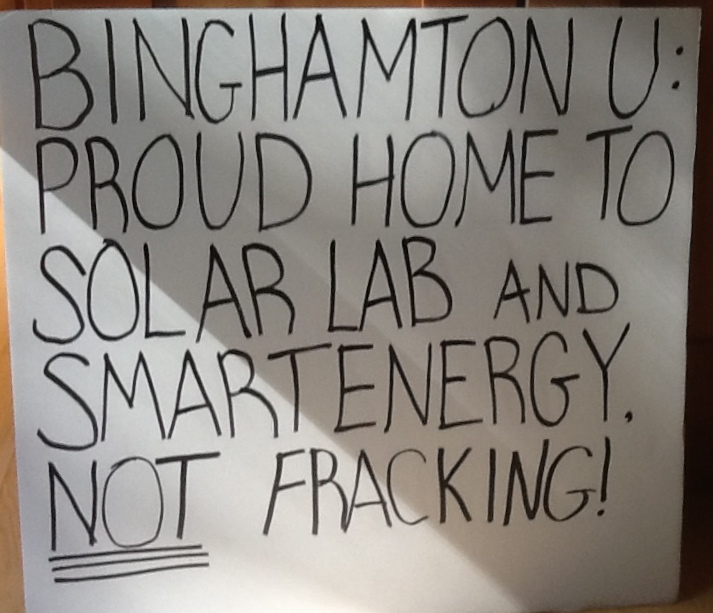
Meanwhile, I think the editors should take a trip to Greater Binghamton and look around. It is not the poverty-stricken, despairing place you seem to think it is. Two of our biggest employment sectors are medical, anchored by Lourdes and two UHS hospitals, and education, anchored by BInghamton University and SUNY-Broome, with a new graduate school of pharmacy about to be built. We still have high tech jobs, though fewer than we once had, with IBM, Link flight simulation, and BAE, among others. Our most exciting new plans in high tech are in the the area of renewable energy/energy storage. Binghamton University’s Solar Lab has been conducting research for a number of years already and has developed a thin-film solar cell that uses only common elements without any rare earth elements. Two large projects are currently being built, a High-Tech incubator in downtown BInghamton and the SmartEnergy Center on the Vestal campus. The combination of these should expand our high-tech/energy sector in the future. Meanwhile, Broome County is a state leader in energy efficiency upgrades through NYSERDA Green Jobs, Green NY and in expansion of solar for homes and small businesses. The energy projects alone have created many times more jobs than shale drilling would have, without the pollution and industrialization of residential and rural areas that would have occurred with drilling.

And about the potential of shale drilling in NY. DEC had to weigh possible economic benefit versus potential costs of drilling to the state and to residents; it’s part of its job. The economic impact section of the draft SGEIS made a number of faulty assumptions, including that shale plays are uniformly productive, that large swaths of NYS would be viable to drill, and that the wells would produce for thirty years. Data from PA and other areas with shale drilling have shown that there are distinct sweet spots in shale plays that are high-producing, with the rest of the play being much less so. Most of the shale in NYS is too thin and too shallow to contain large amounts of methane and there are not natural gas liquids, which have a better economic profile than dry methane, at all. Shale wells of all kinds have very steep decline curves, with the vast majority of the gas being produced in the first 18 months and most of the rest in the following 3-6 years, much shorter than the 30-year timeframe the SGEIS assumed. The industry has done some test wells in various parts of the Marcellus and Utica in NY – and didn’t think it was worth applying for permits. The major companies in their own maps of the play never showed the potential drilling area going much over the NY border. Production numbers in PA bear this out; once you head north from the NEPA sweet spot, production goes way down. Because HVHF wells are so expensive to drill and frack, methane prices would have to more than double to break even in southern Broome County and the figures just get worse from there. It’s time to stop pretending that fracking – or casinos – are the future of the Southern Tier and get to work on building up renewable energy and conservation, while expanding on education, medical, high-tech, agriculture, next-gen transportation, recreation, and tourism jobs.

http://www.syracuse.com/…/new_yorks_hydrofracking_ban_drape…