charting a pandemic path

Around the world, most of us are sharing in the battle to limit the damage from COVID-19 to the extent possible.

In some places, the path is proscribed by local or national government and there are not a lot of personal decisions to make.

Here in my county in upstate New York (USA), things are not laid out as clearly. I have been trying to prepare and make plans, but circumstances keep changing – and so must the plans. Our state and local governments and community organizations have been much more proactive than the federal government, but, as more and more cases are diagnosed closer and closer to where I live, additional measures continue to roll out.

Over a week ago, I started the general preparedness guidelines to have a couple of weeks of food and medications available in case we had to self-isolate. This was not a big deal for our house, but I have been much more concerned about preparing things for my dad, known here as Paco. He lives in a senior community in an independent living apartment, so he has a number of services available in-house, but I visit every day to check on him, make sure his medications are all organized and his schedule is laid out, etc. Early last week, a sign went up that people who were having any symptoms of illness should not visit. This is practical and a commonsense precaution that I would follow anyway, but, later in the week, the health care part of the center was closed to all visitors, except those whose loved one is in very grave condition. This meant that Paco could no longer go over to concerts and singalongs held in the health care facility. At the same time, they cancelled activities in independent living that involved outside performers or volunteers. For example, the Irish dancers would not be able to come for a scheduled pre-St. Patrick’s Day performance.

At this point, I had to face the probability that even healthy visitors might not be able to visit independent living at some point, so I started making contingency plans that could be carried out reasonably well without me. Sadly, we’ve had to cancel a planned visit from my sisters and their families to celebrate Paco’s 95th birthday later this month. They all live in areas where the virus is more prevalent and we didn’t want to risk them bringing it with them, given that they might not have obvious symptoms.

Thursday night into Friday, several large employers announced that they would be having most of their employees work from home starting on Monday. The universities had also announced that they were moving most of their instruction online for several weeks or the rest of the semester. Professional sports leagues announced they were suspending or delaying their seasons. Some combination of these functioned as a trigger that caused some people who hadn’t been taking the virus very seriously to spring into action – or, at least, into shopping. I went to my favorite grocery store to pick up a few things for Paco and for my household and was surprised to find that there was almost no peanut butter, canned legumes, frozen vegetables, etc. in the store. And I hadn’t even checked the cleaning supplies and paper goods aisles. The evidence of panic-buying took me by surprise. Given that I had been in concern and preparation mode for days, I had obviously underestimated the number of people who were suddenly paying attention and freaking out a bit.

On Saturday, the county executive announced that all primary and secondary schools will close through mid-April. Now, people are even more upset.

It appears that there are some people who still think that fears of the virus are overblown, given that we have no known cases in our county, even though our neighboring counties do have confirmed cases; they don’t want their personal and family routines disrupted. Others have been following the news and the advice of medical experts and realize that, while we can’t stop the virus completely, there will be fewer deaths and more treatment available to those with severe illness if we can spread out the number of cases over a longer period of time, so as not to overwhelm our medical system. The way to do that is to reduce the number of people who are in close contact and in large groups, also known as social distancing.

There are a number of different opinions about how much distance is required and how many is considered too many to be in a crowd. This leaves some situations to personal discretion. I admit that I had a difficult time figuring out what to do about church attendance this weekend. Our diocese has dispensed with our obligation to attend mass, but services are still being held. I am not especially concerned about my getting seriously ill, but I am concerned with the possibility of bringing the virus into Paco’s community, so I’ve decided to participate in a mass on television. At least for now, I plan to still shop. occasionally eat at restaurants, and attend small gatherings with friends. If we start seeing community spread in my town, though, I’d cut back further. If we get to that point, I’m sure I wouldn’t be able to visit Paco; it’s likely that only residents and staff would be allowed in the building.

I admit that it is disconcerting to know that, despite our best efforts, people are going to continue to get sick, some of them severely sick, and some of them will die. I hope that our communities will face up to this challenge and do as much as we can to protect people, especially the most vulnerable.

Be well. Be kind. Be thoughtful. Be considerate.

Hospice month

November is National Hospice and Palliative Care Month in the United States. Some people don’t realize that palliative care exists outside of the context of hospice. Palliative care addresses pain that affects someone from any cause. People who are dealing with chronic or severe pain can consult with a palliative care specialist, who will put together a pain management plan for them. Hospice care involves palliative care for those in their final weeks/months of life.

While the alleviation of pain is an important part of hospice care, hospice is meant to serve other needs for the person who is dying and their loved ones. There are social workers and chaplains for help with personal, social, and spiritual needs. Aides help with physical care and companionship. Volunteers come to keep the patient company or offer special skills, such as massage, to relieve pain and stress. Nurses are the driving force that coordinates care. They visit as often as needed as circumstances change.

Hospice as a philosophy is meant to unfold over the final weeks and months, but sometimes is only called in for the very last days. For decades, hospice care providers have been advocating for referrals to be made enough in advance that there is time to develop a relationship with the patient and their loved ones, so that they can provide services while the patient is still able to interact. There are, of course, instances in which that is not possible, when an accident or final illness occurs without notice, but it is still unfortunately common for primary care physicians and specialists to delay hospice referrals.

We experienced such a delay with a family member, so that hospice was only called in for the final day. Even though time was brief, the experienced nurses were able to give us the tools we needed to relieve pain and recognize the progression of symptoms when our loved one was near death.

Our experience with Nana was on the other end of the spectrum. She was under hospice care for fifteen months, was decertified and off hospice for four and a half months, and back on for her final ten weeks. Some people commented to us that we had called hospice in too early, but that wasn’t really the case. Without hospice care, Nana would have died much sooner. At least twice, they were able to treat symptoms that would have caused fatal repercussions, had the hospice nurses not been able to get them under control.

It is true, however, that there are a lot of rules, especially with insurance, about hospice care. Those rules are set up for people who have a fairly accurate life expectancy estimate, such as someone with late stage cancer or kidney failure. With something more unpredictable, like certain types of congestive heart failure or pulmonary disorder, the hospice rules requiring a certain amount of decline over a given time don’t fit very well. I hope that, over time, the rules will be changed to make hospice care more accessible.

As National Hospice and Palliative Care month comes to a close, I salute all the compassionate nurses, aides, volunteers, social workers, chaplains, and administrators of hospice. You help people at one of their most vulnerable times. I wish you the strength and peace needed to continue in such important work.

All Souls

In the Catholic tradition, early November is dedicated to remembering those who have died. November first is All Saints Day and November second is All Souls Day. Our parish does a special commemoration for All Souls Day of all the people whose funerals were held at the church since All Souls Day of the prior year. Family members loan the church a picture of the deceased and they are displayed on tables with name cards and candles for the whole month of November.

This year, my mom, known here on the blog as Nana, was one of those commemorated. I printed an enlargement of a favorite photo of her; Nana was not fond of having her picture taken, so photos of her alone are pretty rare. I bought a Shaker-style wooden frame for it. I admit that the liturgy was emotional for me, but it was also comforting. It also felt fitting that the handbell choir played at the mass. Nana always loved to hear E and T ring.

In the evening, I attended a concert for all souls by the Southern Tier Singers Collective (STSC). I know a number of the members, including one whom I met in University Chorus and with whom I have been close for years. The founder and director of the group is Bill Culverhouse, the current choral director at Binghamton University. The concert was beautiful, although the music was emotional for me, given that the loss of my mom is still very much in my mind and heart. Thankfully, I was able to join some friends from University Chorus in the audience, which helped me to feel supported during the performance.

The concert took place at Saint Patrick’s Church, Binghamton, which is considered the mother church in our county. The building is old, high-ceilinged, and has lots of hard surfaces, so the acoustics are good for choral singing, especially a capella, which is what STSC does. St. Patrick’s was the boyhood parish of my retired pastor, who sang there, in Latin, as an altar server. After his retirement from our parish, members of our music ministry came together there to participate in a mass celebrating his 50th anniversary of ordination. It was a large group with instrumentalists, so I helped out by conducting. Several years later, we came together again to sing for his wake service and funeral, so thoughts of him were also present in my mind.

The most moving piece in the concert for me was Dale Trumbore’s How to Go On (2017). She chose to set texts from 21st century women poets Barbara Crooker, Laura Foley, and Amy Fleury. The passages speak more to acceptance of mortality than to mourning. I loved the language of the poems and the often haunting, often meditative, way they were set. The piece begins with a question from Barbara Crooker’s poem “Some Fine Day”:  “How can we go on, knowing the end of the story?” I could feel my own answer to that question working its way through my mind in response to the poetry and music – and could imagine my mother’s.

There was a third woman that I could also imagine, a woman my age who died recently. I had sung in the choir for her funeral on Wednesday. She was a beloved member of our community, who used all her skills and gifts in service to her family, her work, and charitable causes. She died at our local hospice residence, where she had been serving as president of the board of directors. I know that she must have found her own answer.

A passage from the movement “Sometimes peace comes” from Laura Foley’s poem “Syringa” speaks to part of my answer at this point in my life.

and you have stepped into
a place beyond time,
beyond sadness and form.
A wide, high plain
where in the endless, deep silence
you find out what it is, what it is,
and your part in it.


Mourning

As anyone who has dealt with it will tell you, mourning is a process.

Likely, a lifelong process that has different impacts over time.

As this TED talk explains, grief is not something you move on from, but something that you move forward with.

It’s been a bit over three months since my mom’s death. Much of that time has been busy, with a lot of things that needed my attention, although I have often felt that my brain was full of holes and I wasn’t thinking clearly.

I kept hoping that I could clear out some mental space and feel that I could organize my thoughts better – and maybe even feel a bit creative, which is important as I have some poetry commitments coming up.

Instead, I’m just feeling overwhelmed and sad. I don’t feel like thinking or deciding things. I can make myself do important things, but it is difficult to feel I am doing them well.

I’ve been talking with some wise friends who have helped me to realize that where I am now is not unusual.

Or permanent.

That mourning is personal and unpredictable and meanders through the terrain of life as it will with no apparent timeframe.

I think I have cried more in the past week than any week since Mom died. I know that is okay, even though it seems sort of backwards.

I am blessed with family and friends to help me while I am in this frame of mind and am trying to muster the energy to ask for help when I need it, although even that can be difficult when organized thought feels like so much work.

But I’m okay. Really. Please don’t worry about me.

It’s just grief.

Remembering Nana in Slovenia

Our Smith College Alumnae Chorus tour of Slovenia was only a few weeks after the death of my mother, known here at Top of JC’s Mind as Nana. One of the things that was comforting to me was saying prayers for my mom at the various churches we visited. Sometimes, I was even able to light a candle in her memory.

In prior tour posts, I have shared some photos from some of the churches we visited, but I wanted to share a few more. The ceiling from the chapel of Ljubljana Castle:
img_0137

Most of the churches we saw on our trip had kneelers that were built into the wooden seats. I loved the curves of these pews from the Ljubljana castle chapel:
Ljubljana castle chapel pews

A cross silhouetted against Lake Bled in the entrance to the Mary of the Assumption:
img_0172

The beautifully painted Stations of the Cross there:
Stations of the Cross at Lake Bled

In Trieste, the organ and a bit of the rose window, which was a later addition to Saint Just, when technology had progressed enough to have that large an opening in the wall:

img_0236

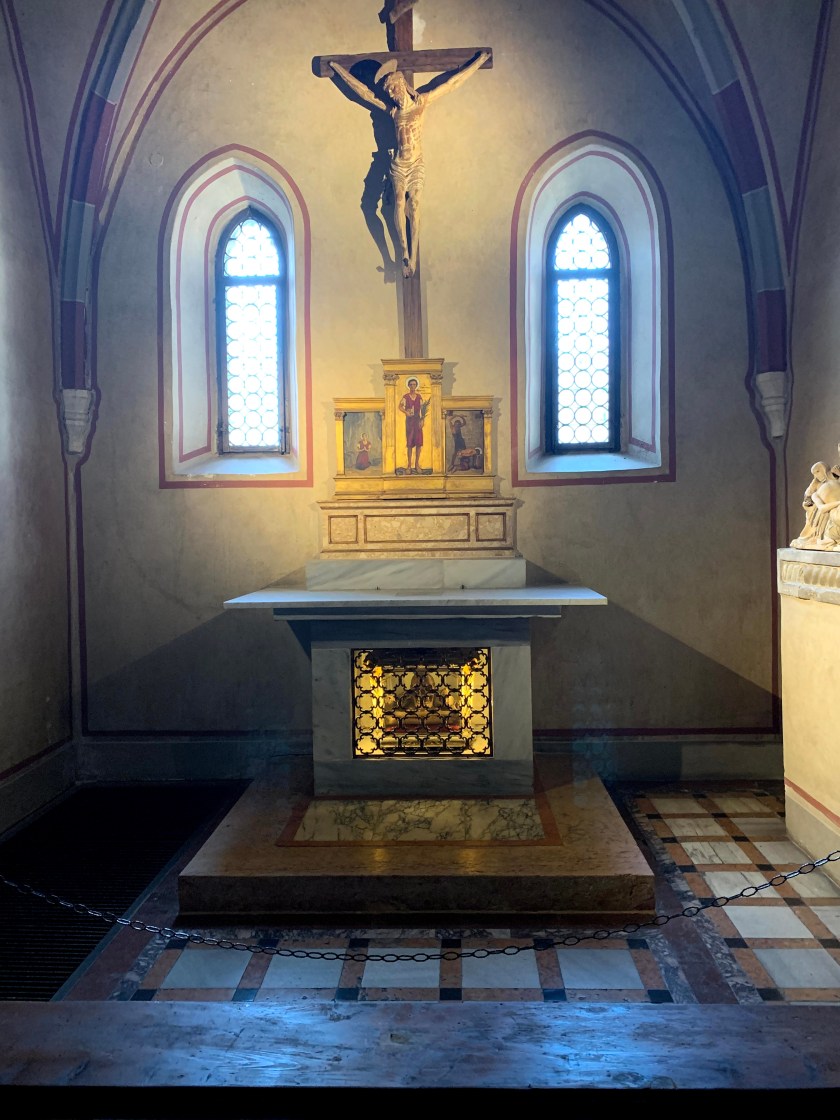
Catholic altars contain relics, but one seldom sees them in such a conspicuous way:img_0233

A crucifix at St. George in Piran that had been restored from one of the older iterations of the church. I was struck by how contemporary designers have recalled this centuries-old style in their own work:
img_0300

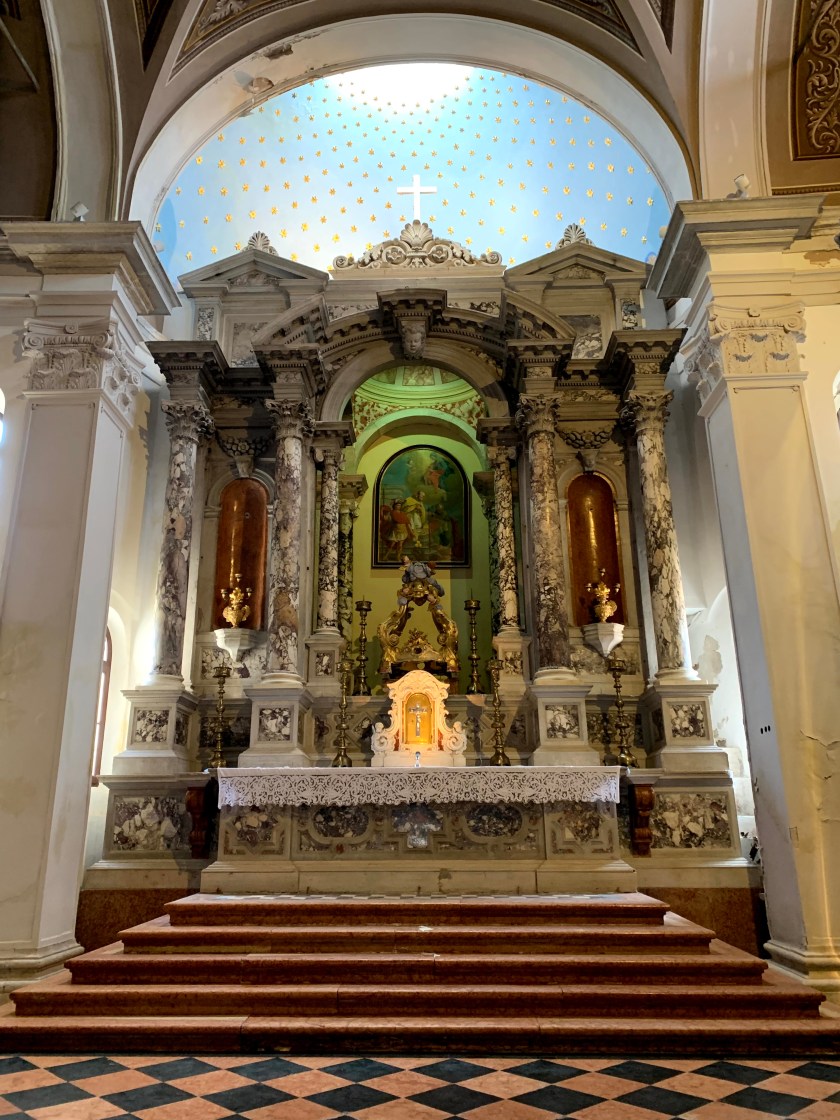
The main altar:
img_0296

And the ceiling above the chancel:
chancel ceiling - St.George, Piran

There were two churches that I visited that were not part of the official tour. Because I was there as a pray-er rather than a tourist, I don’t have photos inside the churches, but they remain close to my heart. One was in Trieste, near the amphitheater ruins. Nana’s ethnic heritage was northern Italian, so it was special to be able to spend some quiet time in the church there. The other was when I went to Mass on our last morning in Ljubljana. It was comforting to be there as part of the congregation, even though they were speaking a language I didn’t know. All the same, I felt that the prayers in my heart were understood.

Besides my private prayer pilgrimage, I also silently dedicated my performances of the Duruflé Requiem to my mother.  This requiem is based on chants from the early church and is sung in Latin, as it would have been before the Second Vatican Council. Much of it is spare and meditative, beautiful but difficult to perform because the individual vocal lines are often exposed.

The most moving of these text for me is the “In Paradisum”, which is the final commendation of the deceased to God at the end of the funeral rite. The text translates:

May the Angels lead you into paradise:
may the martyrs receive you at your coming,
and lead you into the holy city, Jerusalem.

May the choir of Angels receive you,
and with Lazarus, who once was poor,
may you have everlasting rest.

At my mother’s funeral, this was the point at which I was most emotional, so I worried that I might have difficulty singing through it, especially as Duruflé sets the first stanza for sopranos only. I found, though, that it was comforting for me to bring my mother to mind at that moment, making the traditional prayer even more meaningful. In the powerful silence after we very quietly finished the piece, I could find peace.

SoCS: Mom

When a loved one dies and leaves us behind, there is a lot to do, which can make one too busy to write. This is very short because I just finished a long-for-me post about the remembrances for my mom. There is a lot to do today, so I will leave it at that.
*****
Linda’s prompt for today’s Stream of Consciousness Saturday is “leaves.” Join us! Find out how here:  https://lindaghill.com/2019/06/21/the-friday-reminder-and-prompt-for-socs-june-22-19/

Remembering Nana

My mother, known here at ToJCM as Nana, passed away last month.

I have been wanting to write a post about her funeral and other commemorations but I haven’t been able to find the quiet time needed to do so. When a loved one dies, close-by family members often become very busy with memorial planning and estate issues and a rather astonishing amount of phone calling and paperwork. It’s necessary, but also distracting and can make it seem that reflection and grieving have to be stuffed into little pockets of time between tasks.

I also realize that I have been grieving over a long period of time as Nana was declining. This anticipatory grief has made my initial reactions to my mother’s death very different from the shock of my mother-in-law’s death, which was like being suddenly submerged rather than a slow walk into the waves.

I have begun this post in the middle of the night when I should be sleeping. The silence in the house reminds me of my mother’s absence. We literally spoke to each other almost every day of my 58 years. Will I eventually get used to that silence?

But, I set out to write about the funeral, so I will try to re-direct my thoughts…

I should probably start with the planning. My sisters, who live out of town, were staying with my dad and helping with tasks like moving Nana’s things out of the skilled nursing unit, while I embarked on the funeral planning and paperwork. I am very grateful that my spouse B took time off work to be with me while we met with the funeral director and the florist and signed papers at the memorial park and such. Some of the plans were already in place, but other decisions remained.

One of these was choosing prayer cards. The funeral director gave us a binder with pictures for the front of the cards and verses for the back. Even in the midst of such a solemn occasion, there are moments of levity and the prayer card binder provided that opportunity. Most of the pictures were mid-20th century paintings of praying hands, or Jesus crowned with thorns, or various saints in pious poses, none of which seemed appropriate. We decided to use the one set of nature photographs, which reminded us of various places where Nana had lived or visited. Finding the most appropriate choice among a hundred verses was more difficult. Most of the Bible verses were King James, which is not a translation that my church uses any more. The poems were incredibly sappy with the kind of rhymes that give poetry a bad name; this was the source of most of the levity. Poems in which one invites the Blessed Mother to tea just don’t quite have the cultural relevance they used to, if indeed they ever did. We did, though, find a very nice quote from Ralph Waldo Emerson to use, even though it meant that our prayer cards didn’t have a prayer on them. The quote can be found at the end of this post.

Planning the funeral gave me several writing assignments: the obituary for the newspaper, the words of welcome which would preface the funeral mass, and the intercessory prayers that conclude the liturgy of the word. Usually the family chooses from a set of readings and prayers that are already established, but because I spent a lot of years doing liturgy committee and music ministry, I was able to suggest some other choices. My daughters helped me choose the scripture readings and I had my writing done and some music ideas before I met with the pastoral minister Sister A and the music director, with whom I have been friends for many years. Everything focused on love because that seemed the best expression of Nana.

The hour before the funeral, we had time for friends to visit with the family. My younger sister had put together some photographs which were on a table as people entered. Nana had chosen cremation, so the urn with her cremains was there with flowers on either side. We had a mix of my parents’ friends and staff from their retirement community and caregivers and hospice volunteers. There were also some of B’s co-workers and my friends, including some poets, singers, and spiritual companions. I appreciated everyone’s support.

The funeral was very meaningful for me. My words of welcome focused on how Nana was so welcoming and loving with people and how she was such a good listener. I admit that I was grateful to speak first, because then I could concentrate on the rest of the service without distraction. Well, without distraction other than grief and tears, both personal and family. We were blessed to have family and friends in special roles. A priest-friend who came to concelebrate. Sister A who had been visiting Nana and Paco over the months reading from Proverbs. My niece and nephew sharing the reading of 1Cor 13. The hospice volunteer who had visited and called on a regular basis for almost two years reading the prayer petitions. My daughters E and T and the almost-two-year old ABC, along with son-in-law L, who was able to make the trip from London to be with us, bringing up the offertory gifts. Music ministers singing with the Resurrection Choir representing the parish community. My long-time friend at the organ, who had been such a support to me during Nana’s illness as I had tried to be to her through years of struggle with her parents.

After the mass, the family and two of Nana and Paco’s closest friends proceeded to the chapel at the memorial park for the committal service, led by the deacon from our church, and reminiscences shared by my younger sister. Then, we went to one of Nana’s favorite restaurants for lunch. We had a server who remembered what Paco usually ordered, even though he hadn’t been there over the last couple of years. The restaurant also treated us to desserts, which was so thoughtful of them.

The next day, we had a gathering in the social hall of the senior living community that has been home to Nana and Paco for over ten years. Along with coffee, punch, and cookies provided by dining services, we had an assortment of homemade cookies, mostly made by B – lemon and chocolate pizzelles, snickerdoodles, shortbreads, and cherry-pistachio biscotti, all family favorites. The snickerdoodle recipe is written in Nana’s cursive. Nana was especially fond of the lemon pizzelles, shortbread, and biscotti. The photos were on display, which was nice because some of the residents, staff, and hospice folks weren’t able to come to the church, but could join us then.

I’m so grateful for all those who have supported us during Nana’s decline and who are grieving with us, offering the love and compassion which Nana had shared with so many over the course of her eighty-seven years. Her example is the reason we chose this passage by Ralph Waldo Emerson for the remembrance cards:

To laugh often and much; to win the respect of intelligent people and the affection of children; to earn the appreciation of honest critics and endure the betrayal of false friends; to appreciate beauty; to find the best in others; to leave the world a bit better whether by a healthy child, a garden patch, or a redeemed social condition; to know even one life has breathed easier because you have lived. This is to have succeeded.


SoCS: after

Silence takes on new meaning after the death of a loved one. Perhaps it is in that silence that we can still hear our loved one in our hearts.
*****
Linda’s prompt for Stream of Consciousness Saturday this week is “silent/silence.” Learn more about SoCS here:  https://lindaghill.com/2019/05/31/the-friday-reminder-and-prompt-for-socs-june-1-19/

One-Liner Wednesday: gratitude on a sad day

Thanks, Mom.
(something I just wanted to say today, the day of my mother’s funeral)
*****
Join us for Linda’s One-Liner Wednesday. Find out how here: https://lindaghill.com/2019/05/29/one-liner-wednesday-reason-27-why-sign-language-is-our-friend/

Nana

I have often written posts about my parents, known here as Nana and Paco. I’m sad to tell you that Nana passed away last week. After months of declining health due to congestive heart failure, she had a few days of rapid decline and died peacefully with my older sister with her and the rest of the family able to gather quickly for some final time together with her.

Over these last few days, my sisters have been staying at Paco’s apartment and taking care of him, while my spouse B and I have been tending to preparations for the funeral, which will take place mid-week.

We are very fortunate that this week is a week off for my son-in-law L, who was able to fly here from London to be with daughter E, granddaughter ABC, and all of us.

I admit that my mind has been richoting from one subject to another. Now that the funeral plans are all in place, I’m hoping I can calm my mind a bit, but it remains to be seen.

With so much happening, I’m not online very much, so I may not be able to keep up with responding to comments. Please know that I appreciate all the thoughts and prayers that you send on behalf of Nana and our family.

In peace,
Joanne