March 17

Today is March 17, which is usually celebrated as Saint Patrick’s Day. Although it is a feast day for Saint Patrick in the Catholic church, it is generally celebrated in the United States also as a secular holiday with parades, Irish food, and, in many cases, way too much alcohol.

This year, with COVID-19 social distancing protocols in place, things are very, very quiet. Paco will still get to have corned beef and cabbage and potatoes, but he will be eating it in his apartment instead of a dining room filled with his senior living community friends wearing green and sitting at tables decorated for the occasion.

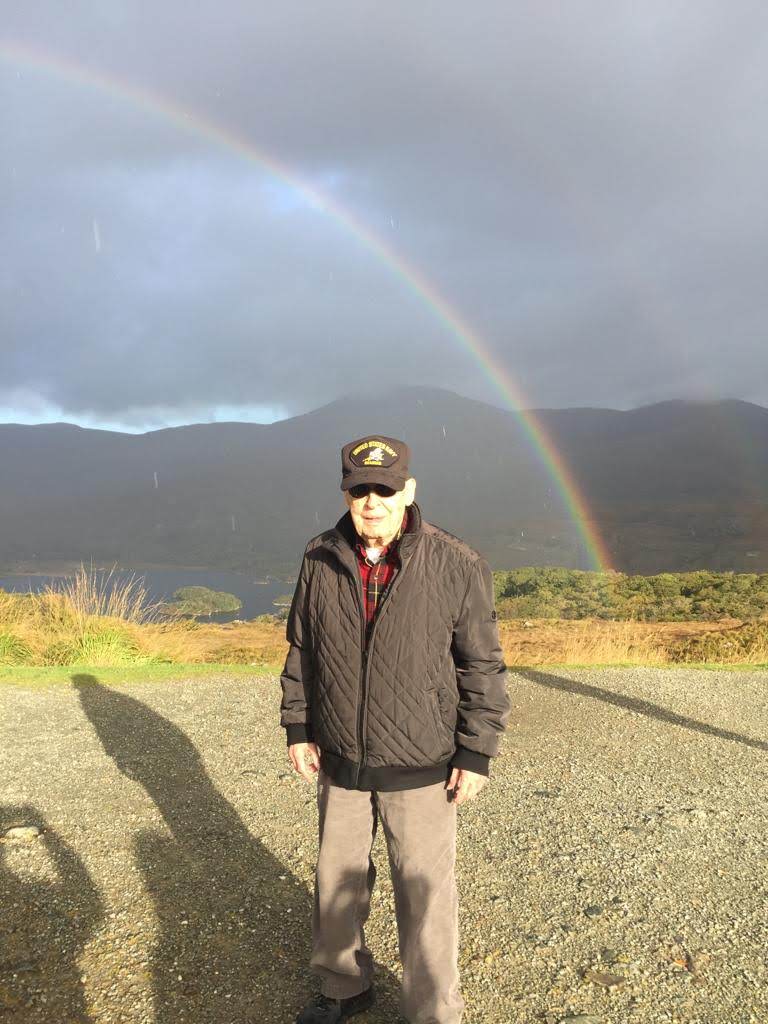
Fun fact:  Paco’s middle name is Patrick. He finally got to visit Ireland, the home of his grandparents, last fall.
img-20191016-wa0000

B’s side of the family had some different March 17th traditions. B’s dad was an elementary school principal who had a running joke with his students and staff. He celebrated March 17th as Evacuation Day, which commemorates the British leaving Boston on that date in 1776 after an eleven month siege, under pressure by the Continental Army, commanded by George Washington and bolstered by cannons captured from Fort Ticonderoga. Parts of Massachusetts celebrated it as an official holiday, although not the western part of the state where his school was located. He used to make an announcement on the public address system in the morning and even designed an evacuation day card which he printed with his then-new dot matrix printer.

He also used to buy an “evacuation day” bouquet for B’s mom, known here at TJCM as Grandma. After he passed away, B and I continued the tradition of giving Grandma evacuation day flowers, first ordering them delivered to her home from their favorite local florist and then bringing them in person after she moved to our area.

In 2016, we changed it up a bit and gave Grandma a planter. We had no way of knowing that she would pass away after a heart attack a few days later. Our daughter T, who has a special affinity for plants, took over care of the planter, eventually having to separate the plants into different pots as they grew too large.

Today, the African violet and the kalanchoe from the planter are in full bloom.

On the dining room table, is an evacuation day bouquet that B bought for T.

today’s changes

When I wrote about covid-19 over the weekend, I assumed that things would continue to change.

I was correct.

Today, I learned the following:

  1. While visitors are still allowed in Paco’s independent living apartment building, they are no longer allowed in public areas, including the dining room. This means that our usual Sunday morning breakfast together won’t be possible, unless we order ahead and Paco goes to pick it up from the dining room.
  2. My hopes that the panic buying for groceries, medications, and household goods was just for Friday and over the weekend were dashed. It took three stores today to find a short list of items that Paco or my household needed. None of it was hoarding or earth-shatteringly necessary, but it was so strange to still see entire categories of foods unavailable.
  3. Stores are adjusting to the circumstances as best they can. Wegmans, where I usually do most of my shopping, has instituted limits on certain items, hoping to keep staples available for as much of the day as they can. They are usually open 24 hours a day, but are now closing between midnight and 6 AM to allow for more extensive re-stocking. Even with that, there was almost no fresh meat this morning and there were signs up saying they wouldn’t be getting a shipment until tomorrow afternoon.
  4. People must rely a lot on peanut butter, because it is very hard to find.
  5. France is reporting that over-the-counter anti-inflammatories may worsen covid-19 symptoms. They recommend other fever-reducing medications, such as acetaminophen.
  6. Starting at 8 PM today, all restaurants in New York, New Jersey, and Connecticut will be open only for takeout and delivery. Also, the new definition of allowable gathering size is 50. This will effectively close lots of businesses and organizations.
  7. Many of the closures are scheduled until end of March or mid-April, but many of us assume they will go on longer.
  8. I had thought that the United States national government had the most haphazard response to covid-19, but it appears the United Kingdom is also in the running for this dubious distinction. Because my daughter and her family are in London, we often exchange news. The UK is not even using social distancing as a strategy for the population at large. It’s mind-boggling and scary. [Update:  Right after I published this post, my daughter sent me a link showing that someone finally got through to Boris Johnson that he needs to change his strategy for the UK.]

Who knows what tomorrow will bring?

(I will try to make my next post be about something cheerier.)

charting a pandemic path

Around the world, most of us are sharing in the battle to limit the damage from COVID-19 to the extent possible.

In some places, the path is proscribed by local or national government and there are not a lot of personal decisions to make.

Here in my county in upstate New York (USA), things are not laid out as clearly. I have been trying to prepare and make plans, but circumstances keep changing – and so must the plans. Our state and local governments and community organizations have been much more proactive than the federal government, but, as more and more cases are diagnosed closer and closer to where I live, additional measures continue to roll out.

Over a week ago, I started the general preparedness guidelines to have a couple of weeks of food and medications available in case we had to self-isolate. This was not a big deal for our house, but I have been much more concerned about preparing things for my dad, known here as Paco. He lives in a senior community in an independent living apartment, so he has a number of services available in-house, but I visit every day to check on him, make sure his medications are all organized and his schedule is laid out, etc. Early last week, a sign went up that people who were having any symptoms of illness should not visit. This is practical and a commonsense precaution that I would follow anyway, but, later in the week, the health care part of the center was closed to all visitors, except those whose loved one is in very grave condition. This meant that Paco could no longer go over to concerts and singalongs held in the health care facility. At the same time, they cancelled activities in independent living that involved outside performers or volunteers. For example, the Irish dancers would not be able to come for a scheduled pre-St. Patrick’s Day performance.

At this point, I had to face the probability that even healthy visitors might not be able to visit independent living at some point, so I started making contingency plans that could be carried out reasonably well without me. Sadly, we’ve had to cancel a planned visit from my sisters and their families to celebrate Paco’s 95th birthday later this month. They all live in areas where the virus is more prevalent and we didn’t want to risk them bringing it with them, given that they might not have obvious symptoms.

Thursday night into Friday, several large employers announced that they would be having most of their employees work from home starting on Monday. The universities had also announced that they were moving most of their instruction online for several weeks or the rest of the semester. Professional sports leagues announced they were suspending or delaying their seasons. Some combination of these functioned as a trigger that caused some people who hadn’t been taking the virus very seriously to spring into action – or, at least, into shopping. I went to my favorite grocery store to pick up a few things for Paco and for my household and was surprised to find that there was almost no peanut butter, canned legumes, frozen vegetables, etc. in the store. And I hadn’t even checked the cleaning supplies and paper goods aisles. The evidence of panic-buying took me by surprise. Given that I had been in concern and preparation mode for days, I had obviously underestimated the number of people who were suddenly paying attention and freaking out a bit.

On Saturday, the county executive announced that all primary and secondary schools will close through mid-April. Now, people are even more upset.

It appears that there are some people who still think that fears of the virus are overblown, given that we have no known cases in our county, even though our neighboring counties do have confirmed cases; they don’t want their personal and family routines disrupted. Others have been following the news and the advice of medical experts and realize that, while we can’t stop the virus completely, there will be fewer deaths and more treatment available to those with severe illness if we can spread out the number of cases over a longer period of time, so as not to overwhelm our medical system. The way to do that is to reduce the number of people who are in close contact and in large groups, also known as social distancing.

There are a number of different opinions about how much distance is required and how many is considered too many to be in a crowd. This leaves some situations to personal discretion. I admit that I had a difficult time figuring out what to do about church attendance this weekend. Our diocese has dispensed with our obligation to attend mass, but services are still being held. I am not especially concerned about my getting seriously ill, but I am concerned with the possibility of bringing the virus into Paco’s community, so I’ve decided to participate in a mass on television. At least for now, I plan to still shop. occasionally eat at restaurants, and attend small gatherings with friends. If we start seeing community spread in my town, though, I’d cut back further. If we get to that point, I’m sure I wouldn’t be able to visit Paco; it’s likely that only residents and staff would be allowed in the building.

I admit that it is disconcerting to know that, despite our best efforts, people are going to continue to get sick, some of them severely sick, and some of them will die. I hope that our communities will face up to this challenge and do as much as we can to protect people, especially the most vulnerable.

Be well. Be kind. Be thoughtful. Be considerate.

A timely poem from Anne Harding Woodworth

As we are all dealing with COVID-19 in some way, I wanted to share a topical poem with you.

Anne Harding Woodworth is an accomplished poet who I met through the Smith College Alumnae Chorus. We have sung together for several concerts, including three performances of Mozart Requiem on tour in Sicily. This poem brilliantly references the Requiem in the context of an audience-less performance held recently due to COVID-19 caution.

The site where it appears is New Verse News, which publishes poems on current topics of interest. I appreciate that they make it possible for poets to publish work about recent or ongoing situations without having to wait months for journal publications.

You can find “Mozart Requiem Streamed in a Time of COVID-19” here:  https://newversenews.blogspot.com/2020/03/mozart-requiem-streamed-in-time-of.html

SoCS: a disconcerting disconnect

There is a major disconnect between the president of the United States and public health regarding covid-19, the form of coronavirus that is causing illness and death around the world and which may soon cross the line to become a pandemic.

From its start in China, there are now major outbreaks in Japan, South Korea, Italy, and Iran, with cases in lots of countries in both hemispheres. Some of the countries have tested thousands of people, ramped up medical care, imposed quarantines, even closing schools for weeks as was just announced in Japan in the last few days.

Meanwhile, the United States has only tested a few hundred people. There are under a hundred confirmed cases, but most likely there are more cases that only had mild symptoms or no symptoms. This is dangerous because those people can spread the virus unknowingly.

Ordinary Americans have been watching the news of the spread of covid-19, first in China and then into other countries. Some doctors and public health specialists were speaking in the media about the epidemic – and preparedness and cases in the US. Earlier this week, some federal government officials who work in agencies like the Centers for Disease Control and Prevention had spoken publicly about the virus in the United States.

The stock market in the United States went down – a lot – this week, the steepest decline since the financial crisis of 2008. This finally got the president’s attention and there was an evening news conference about the virus in the US. Unfortunately, the president made mistakes in his remarks, including saying there were only 15 cases in the US when there were actually 60 confirmed cases. He also put the vice-president in charge of the US efforts against the virus, which is disconcerting because, as governor of Indiana, he botched an early intervention effort against HIV. It’s also disconcerting that all communication from the federal government has to be approved by him first, including public statements by Dr. Anthony Fauci, longtime director of the infectious disease department for the country.

Late this week, there was the announcement of the first covid-19 case that couldn’t be traced to someone who had contracted it abroad. This is an important development because it could mean that there would be community spread here in the US, which would also bring the world closer to declaring a pandemic. It’s scary because it brings to mind the flu pandemic of 1918, which infected millions worldwide and had a mortality rate of almost two percent. Early statistics from China show that covid-19 has a mortality rate of a little over two percent, which is beyond the ability of even large modern health systems to combat. There would be shortages of needed equipment like respirators and of appropriate hospital facilities that can isolate the patients so that no one catches the virus in the hospital.

Yesterday evening, I was watching a news station. Several times throughout the evening, the stories they were covering were interrupted by news of several new confirmed cases in different locations that appeared to be the result of community spread, instead of direct transmission from abroad or from being in the household of someone who contracted it abroad. This bring some communities in the US close to needing to impose states of emergency and doing things like prohibiting public gatherings, including school and work and church.

The most chilling thing for me was that, at the same time, the president was speaking to a rally in South Carolina, telling them that covid-19 in the US was a hoax perpetrated by Democrats.

This is disconcerting and irresponsible and shows how disconnected the president is from the reality that the country is facing.

To be clear, I am not a paranoid person regarding disease. I’m not running around in a mask and gloves in fear of covid-19. I am, however, vigilantly watching the public health news and, as recommended, making plans for possible cases and restrictions on travel and being out in public in my region.

While I hope and pray for safety and good health around the world, I want to be prepared to stay as safe as possible if this epidemic does become a pandemic. In the US, I hope that people will make sure that the information they get comes from a reliable source.

Sadly, our president is not a reliable source.
*****
Linda’s prompt for Stream of Consciousness Saturday this week is base the post on a word that contains “ect”. Join us! Find out how here:  https://lindaghill.com/2020/02/28/the-friday-reminder-and-prompt-for-socs-feb-29-2020/

2019-2020 SoCS Badge by Shelley!
https://www.quaintrevival.com/