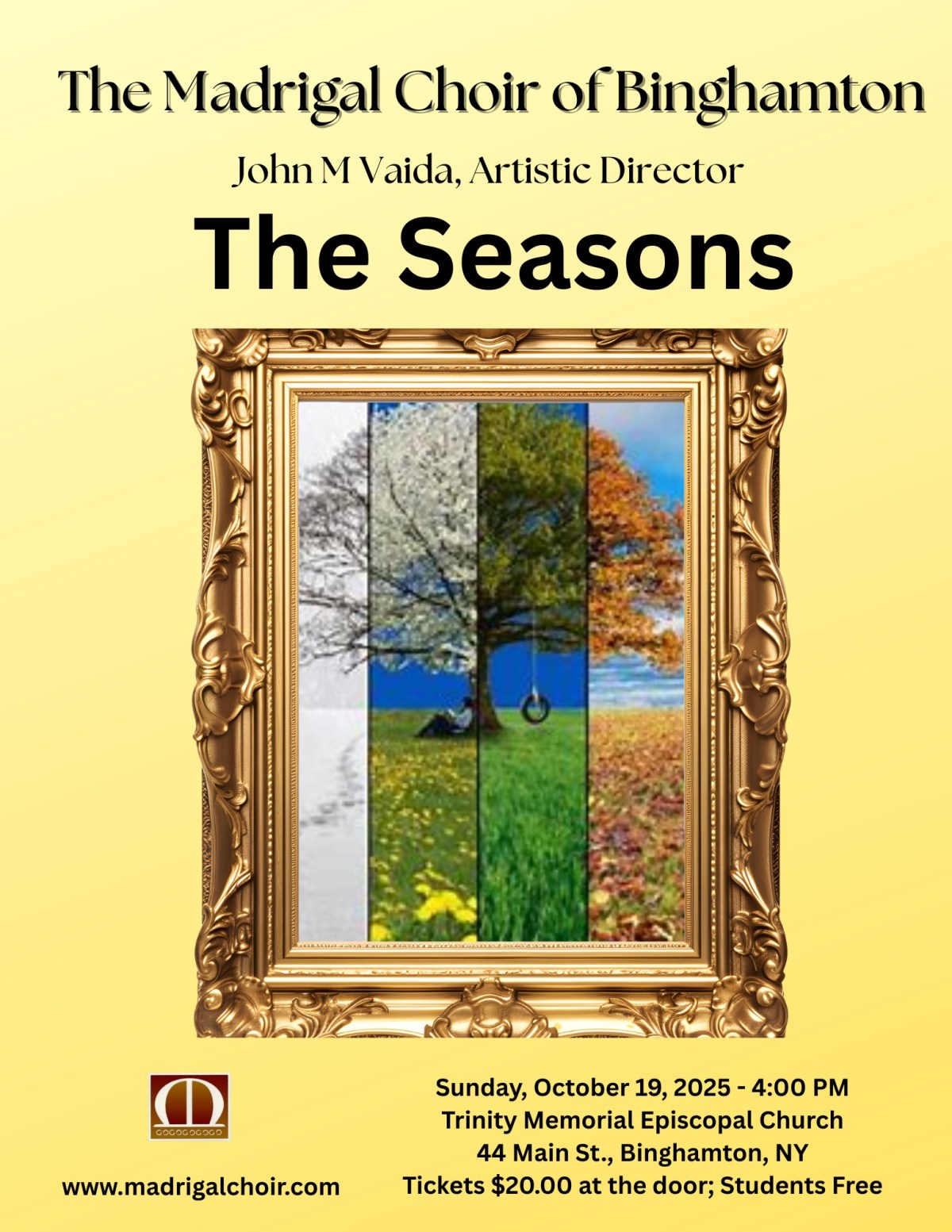
Binghamton NY area folks are cordially invited to celebrate all times of year with the Madrigal Choir of Binghamton’s concert “The Seasons” on Sunday, October 19, 2025 at 4 PM at Trinity Memorial Episcopal Church, 44 Main St., Binghamton.
The Madrigal Choir of Binghamton is thrilled to announce that John M. Vaida will be our next artistic director, beginning in January, 2025, with his first concert with us scheduled for March 30th.
Last week, I attended a choral concert at Binghamton University that had been billed as a tribute to Dr. Bruce Borton, who had served in the music department for almost three decades and who passed away in August.
I wrote here about the concert that the Madrigal Choir of Binghamton presented last month and had hoped that the concert at the University would address Bruce’s legacy there, but I was disappointed. It seemed that the choral groups had prepared their fall concert as usual and just tacked a couple of pieces on the end that they tied to Dr. Borton.
The most direct tie was the combined choirs singing “Bogoroditse Devo” from the Rachmaninoff All-Night Vigil. I had sung the piece with the now-defunct University Chorus under Bruce’s direction and this particular movement additional times. It was chosen because Bruce was a scholar of Rachmaninoff and loved this work in particular.
It was difficult for me to listen to it. I knew it well and could notice the differences in interpretation but the most glaring difference was the lack of maturity in the sound, especially from the basses. It’s not, of course, the singers’ fault that their voices are still maturing, but it demonstrated the reason that University Chorus, which included students, staff, and community members, was so important to Bruce. A more age-diverse choir can produce a richer sound and excute a greater expressive range than a younger choir. This might not matter with some repertoire, but it does with Rachmaninoff.
I was disappointed that they hadn’t reached out to the University Chorus alums still in the area to join the students to perform this piece. It wouldn’t have taken much rehearsal to include us as we know the piece well and it would have been very meaningful for us. I wish they had also reached out to us or a faculty member who worked with Bruce to speak about him. As it was, the only spoken tribute was from a former graduate conducting student, read from a cell phone by one of the conductors.
The concert intensified my feelings of loss, not only of Bruce but also of University Chorus, which was so dear to his heart and to our community.
On Sunday, the Madrigal Choir of Binghamton (MCOB) opened its 46th season with a tribute concert to our late director, Dr. Bruce Borton, who passed away in August. He was only the second artistic director of Madrigal Choir and had served on their board and sung with them before being chosen as artistic director when founder Anne Boyer Cotten retired.
For the first few years of his tenure as MCOB director, Bruce was finishing out his long career with Binghamton (NY) University where I had had the privilege of singing under his direction for 29 years as part of the University Chorus, which included singers from the community as well as staff and students from the university. After the closure phase of the pandemic, with Univeristy Chorus permanently disbanded and Madrigal Choir in need of some additional voices, Bruce welcomed me to the second soprano section and invited me to serve on the MCOB board.
In spring of ’23, Bruce developed a serious illness and was on medical leave for most of the ’23-’24 season. He was, though, able to return to conduct Randall Thompson’s Frostiana for our spring concert in April. I had had a feeling at the time that it would be our last opportunity to sing under his direction but had not expected his decline to advance so quickly. I was grateful to be able to join with members of the Madrigal Choir, the Trinity Memorial Episcopal choir, and some of his former students at the University to sing at his funeral.
Uncharacteristically for me who often writes about difficult things in the moment, I couldn’t bring myself to post about Bruce until now.
The Madrigal Choir concert on Sunday was named for the anthem that Bruce had composed in honor of the 25th anniversary of his friend and colleague, Peter Browne, as music director of their church, Trinity Memorial Episcopal. The text is 1 Corinithians 13, which centers on love and is often used at both weddings and funerals. The second half of the concert began with a tribute to Bruce by Alison Dura, long-time Madrigal Choir singer, officer, and board member, followed by the singing of “Love Never Ends.” It was especially poignant to be singing it at Trinity, accompanied by the organ Peter had played for so many years and where both Peter’s and Bruce’s funerals had been held. The meaningfulness of the text and the beauty of Bruce’s setting were able to help me sing it without breaking.
The concert concluded with Morten Lauridsen’s Lux Aeterna, which re-interprets Latin texts and chant into more modern tonalities. It was a reflective way to remember Bruce as we sang, “Requiem aeternam dona eis, Domine, et lux perpetua luceat eis.” Rest eternal grant to them, O Lord, and let perpetual light shine upon them.
If you are in the Binghamton, NY area, please join the Madrigal Choir of Binghamton for this concert, which will include a tribute to our late director, Bruce Borton.
Binghamton area folks are cordially invited to attend the Members Recital of our local chapter of the American Guild of Organists on Sunday, June 2, 2024 at 4 PM at the United Presbyterian Church of Binghamton, 42 Chenango Street.
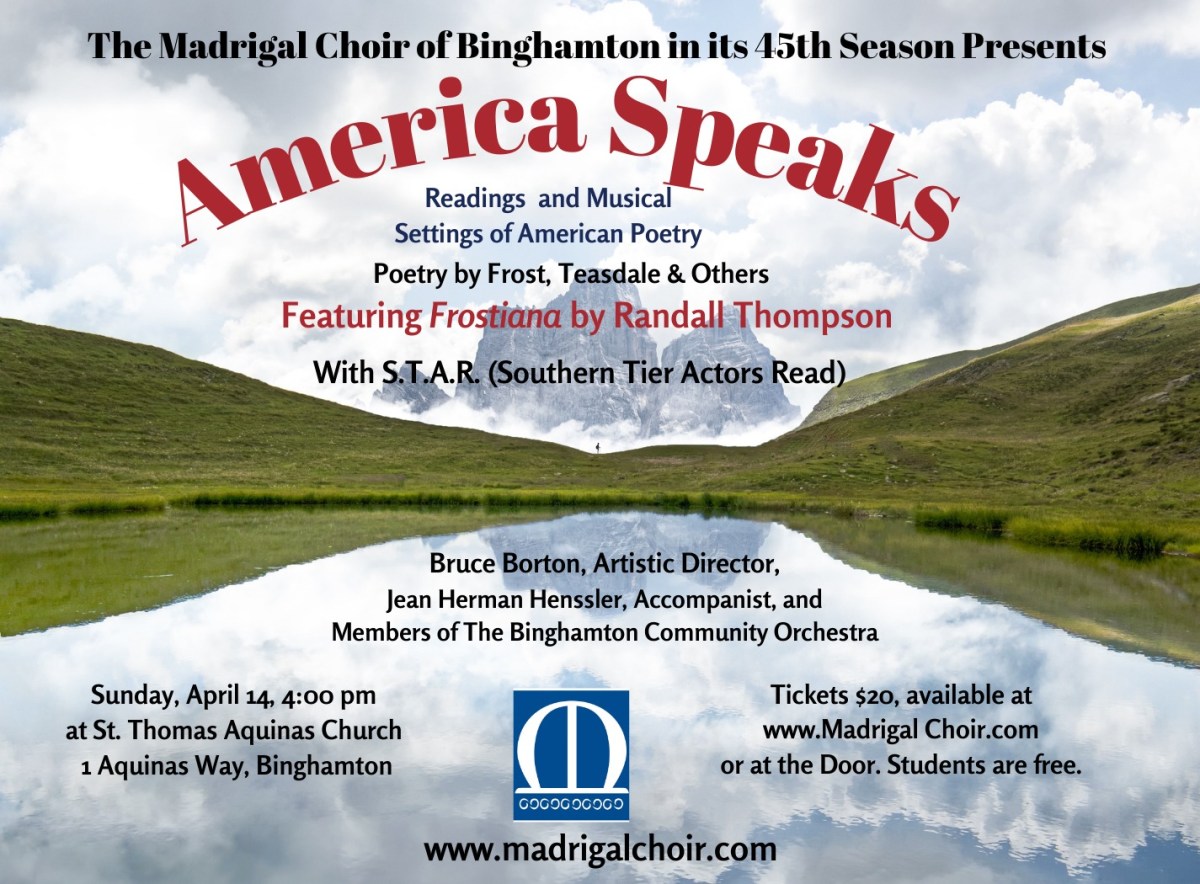
Binghamton NY area folks are invited to celebrate music and American poets this National Poetry Month with the Madrigal Choir of Binghamton at St. Thomas Aquinas Church on Sunday, April 14, at 4 PM.
Earlier this month, I was privileged to attend a memorial concert for Ron Perera, composer and professor emeritus of music at Smith College. The concert took place in Sweeney Concert Hall in Sage Hall, the long-time center of musical life on campus. I had taken five semesters of theory and composition with Mr. Perera and he had been my major advisor. We had been in touch variously over the decades and we had enjoyed a wonderful lunch together last spring when I was back on campus to sing with the Smith College Alumnae Chorus.
All the pieces at the concert were Ron Perera’s compositions, some of which were performed by the musicians for whom they were written. I especially appreciated seeing pianist Professor Emerita Monica Jakuc Leverett perform Out of Shadow almost 36 years after its premiere. Another piano piece that I loved was Three Waltzes for Four Hands, written for Ron’s three daughters, and performed by Professor Emeritus Kenneth Fearn and his daughter, Kaeza. I’m looking forward to ordering a copy for daughter E and son-in-law L to play for our granddaughters ABC and JG.
As a writer and choral singer, I was especially drawn to the choral pieces that opened and closed the concert. The opening was “Hold Out Your Hands Over the Earth” from The Outermost House, text by Henry Beston. The work was commissioned by the Chatham Chorale, on Cape Cod. The Perera family lived on the Cape during the summers and Ron loved to sail there. Some of the text in this movement is:
To all who love her, who open to her the doors of their veins, she gives strength, sustaining them with her own measureless tremor of dark life. Touch the earth, love the earth, honor the earth, her plains, her valleys, her hills, and her seas; rest your spirit in her solitary places.
It was a perfect reflection to begin.
Besides the music, there were four remembrances in the program. The first was from one of Ron’s daughters, Rosalind, which also served as a welcome. Two were from pastors of St. John’s Episcopal Church, located in the midst of Smith’s campus, where Ron was a long-time member and volunteer. The other was from Professor Emeritus Donald Wheelock, who was Ron’s composer-colleague for many years and who helped to organize the concert. It was beautiful to hear them speak about his kind, caring nature and the depth and breadth of his thoughts, talents, interests, and beliefs. Even as a college student, I could sense what a wonderful man he was and it was inspiring to hear how he sustained those qualities throughout his life and shared them with so many, most especially his family.
The concert closed with the Smith College Chamber Singers offering Ron’s setting of Percy Bysshe Shelley’s “Music, When Soft Voices Die” conducted by Jonathan Hirsh, who is a current faculty member, friend of Ron, and another concert organizer. He had graciously kept me apprised of the plans as the memorial came together so that I could arrange to attend. It was such a perfect, quiet, love-filled ending to the memorial. “And so thy thoughts, when thou art gone,/ Love itself shall slumber on.”
At the reception after the concert, I was able to speak briefly with Don Wheelock and Jonathan Hirsh and at greater length with the third organizer, Professor Emerita Karen Smith Emerson. I am grateful for their work in putting the program together to celebrate a remarkable, generous, talented man who leaves a legacy of music and writings but, more importantly, of human connection and spiritual strength.
I’m also grateful to CK, Smith ’81, and her spouse who opened their lovely home near campus to B and me for the weekend. I appreciated their hospitality and their companionship at the concert and reception. I’m hoping CK will be able to sing with us the next time I’m back on campus for an event with the Smith College Alumnae Chorus.
It will be bittersweet, though, knowing that Ron will not be there to hear us. Maybe, we will perform a piece of his music in remembrance…
Just back from a long day that featured the first of Madrigal Choir’s Lessons and Carols performances. It was in a small church to our north. Our audience was small but appreciative. It gives me confidence in our performance in our home county tomorrow, which will draw a larger number of listeners.
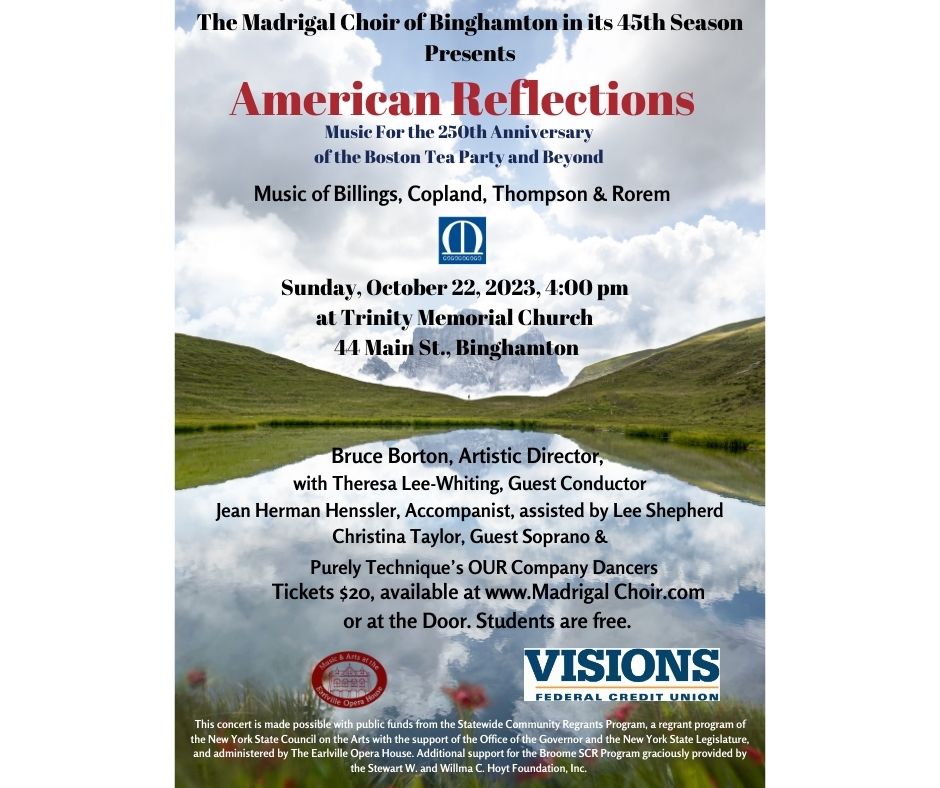
Yesterday, the Madrigal Choir of Binghamton presented the first concert of our 45th anniversary season, “American Reflections.”
Our artistic director, Bruce Borton, chose the program to commemorate a number of anniversaries. We sang a set of pieces by William Billings in commemoration of the 250th anniversary of the Boston Tea Party; Billings was a Boston resident at the time and two of the pieces we sang directly referenced the revolutionary period. Special guest soprano Christina Taylor sang four settings of Walt Whitman poems by Ned Rorem, in honor of Rorem’s centennial. We also sang Randall Thompson’s “The Testament of Freedom,” a setting of Thomas Jefferson texts composed in 1943 for the University of Virginia’s glee club commemorating the bicentennial of their founder Jefferson’s birth. We rounded out our all-American program with pieces from Aaron Copland’s opera, The Tender Land.
I’m pleased to say that the concert went well and was enthusiastically received by our audience. We owe our thanks to Theresa Lee-Whiting, who relinquished her role as singer and president of Madrigal Choir to serve as guest conductor for this concert after Dr. Borton needed to take medical leave. We were grateful that Dr. Borton was feeling well enough to attend the concert and hope that he was proud of the work we had done.
I admit that rehearsing and singing this program had its challenges from a historical perspective. For example, in “Stomp Your Foot” from The Tender Land, the text is very explicit about the devaluing of the work of “ladies” versus men. The story is set in the farmlands of the 1930s Depression era, so it is accurate for the times, if a bit galling to sing these days.
The more problematic text for me was Jefferson’s words in “The Testament of Freedom.” The bulk of the text Thompson chose to set is from the “Declaration of the Causes and Necessity of Taking Up Arms.” There are a number of references to bondage or slavery as a consequence of the colonists not taking up arms against the British. For example, “We cannot endure the infamy and guilt of resigning succeeding generations to that wretchedness which inevitably awaits them if we basely entail hereditary bondage upon them.” It’s difficult to sing the text with the knowledge that Jefferson was holding hundreds of men, women, and children in “hereditary bondage” as he wrote these words. He also writes that the colonists must take up arms “for the protection of our property, acquired solely by the honest industry of our forefathers and ourselves,” as though the work of those he enslaved was not also adding to his wealth, although he would have considered those people part of his property. I wonder if Thompson would have chosen the passages to set differently if more modern scholarship on the colonial and Revolutionary War times had been available to him in the 1940s.
Given that he was composing this work during World War II, the final movement, using text from a letter Jefferson wrote to John Adams in 1821, is poignant. “And even should the cloud of barbarism and despotism again obscure the science and liberties of Europe, this country remains to preserve and restore light and liberty to them…” Some of the young men premiering this work would have been about to enter the armed forces to fight in Europe or the Pacific theater. Both my and my spouse’s fathers were in the service during World War II eighty years ago. It was sobering for me to sing these words at a time when democracy is again assailed by authoritarian and fascist influences in Europe and here in the United States.
The fourth movement begins with these words from Jefferson to Adams, “I shall not die without a hope that light and liberty are on steady advance…” On July 4, 1826, both former presidents died on the 50th anniversary of the Declaration of Independence they both signed.
May light and liberty – and music – continue to advance.







 Joanne Corey