SoCS: singing

I like to sing.

I have been singing for as long as I can remember. When I started school, we had a music teacher who came once a week to lead music class. Our classroom teacher also played the piano and would sometimes have us sing in the classroom which was combined first through fourth grade. She had been trained at a normal school before there were education colleges in our area and I think that grammar school teachers for young children had to learn piano as part of their program.

When I was in sixth grade, I was old enough to sing in the choir at church. Because it was a small church, the choir only sang at Christmas and for Holy Week. I sang with them until my sophomore year in high school when I became the organist. Then, I was always singing as I played the hymns. It helps your playing because you are more observant of reflecting when breaths should be taken.

In high school in a city about twenty miles from our little town, I got to sing every day! I sang with the mixed chorus and later also with a small girls’ ensemble. I learned to smile, sing, and do a bit of choreography at the same time, a skill that doesn’t seem all that useful but actually is. It makes it easier to convey the emotion of what you are singing to your audience.

When I was at Smith College, singing was a big part of my life. I worked my way through the extensive choral program at the time, starting with Choir Alpha as a first year, College Choir the next year, and my final two years in Glee Club. I also accompanied for two years for Choir Alpha. As an organist who was Catholic, I also frequently played for mass at Helen Hills Hills Chapel. I got married there the month after I graduated.

When we moved to Broome County, NY, I began to sing with the (Binghamton) University Chorus. (Actually, B had already moved and was working out here when we married, so I guess I should have said when I moved.) I sang with them until they unceremoniously disappeared, just prior to the pandemic. I still miss that group, which was a town/gown group, meaning that we had singers both from the university (students/faculty/staff) and from the broader community.

Until 2005, I also did some singing at my church with our Resurrection Choir, which ministered at funerals. It was sometimes difficult but was so important for the family to have us there to represent the parish in their time of grief.

I had thought when University Chorus ended that I would never have another choir gig but, after the pandemic shutdown, I attended a concert with the Madrigal Choir of Binghamton and found out they had openings for sopranos. This was a bit of a shock as choirs usually have more sopranos than they know what to do with but some people had moved away during the pandemic so they had lost some singers. I knew the director because I had sung with him when he directed University Chorus for 25 or so years before he retired and was very happy when he accepted me into Madrigal Choir.

Despite my current health issues, I’ve been continuing to sing with them and hope to as long as I’m able and my voice holds out. I’m lucky that I don’t have a big natural vibrato, which helps my voice to not get as much shake or wobble as some older singers get.

I hope.
*****
Linda’s prompt for Stream of Consciousness Saturday this week is “sing.” Join us! Find out more here: https://lindaghill.com/2025/05/02/the-friday-reminder-and-prompt-for-socs-may-3-2025/

another tribute?

Last week, I attended a choral concert at Binghamton University that had been billed as a tribute to Dr. Bruce Borton, who had served in the music department for almost three decades and who passed away in August.

I wrote here about the concert that the Madrigal Choir of Binghamton presented last month and had hoped that the concert at the University would address Bruce’s legacy there, but I was disappointed. It seemed that the choral groups had prepared their fall concert as usual and just tacked a couple of pieces on the end that they tied to Dr. Borton.

The most direct tie was the combined choirs singing “Bogoroditse Devo” from the Rachmaninoff All-Night Vigil. I had sung the piece with the now-defunct University Chorus under Bruce’s direction and this particular movement additional times. It was chosen because Bruce was a scholar of Rachmaninoff and loved this work in particular.

It was difficult for me to listen to it. I knew it well and could notice the differences in interpretation but the most glaring difference was the lack of maturity in the sound, especially from the basses. It’s not, of course, the singers’ fault that their voices are still maturing, but it demonstrated the reason that University Chorus, which included students, staff, and community members, was so important to Bruce. A more age-diverse choir can produce a richer sound and excute a greater expressive range than a younger choir. This might not matter with some repertoire, but it does with Rachmaninoff.

I was disappointed that they hadn’t reached out to the University Chorus alums still in the area to join the students to perform this piece. It wouldn’t have taken much rehearsal to include us as we know the piece well and it would have been very meaningful for us. I wish they had also reached out to us or a faculty member who worked with Bruce to speak about him. As it was, the only spoken tribute was from a former graduate conducting student, read from a cell phone by one of the conductors.

The concert intensified my feelings of loss, not only of Bruce but also of University Chorus, which was so dear to his heart and to our community.

Weekend wrap-up

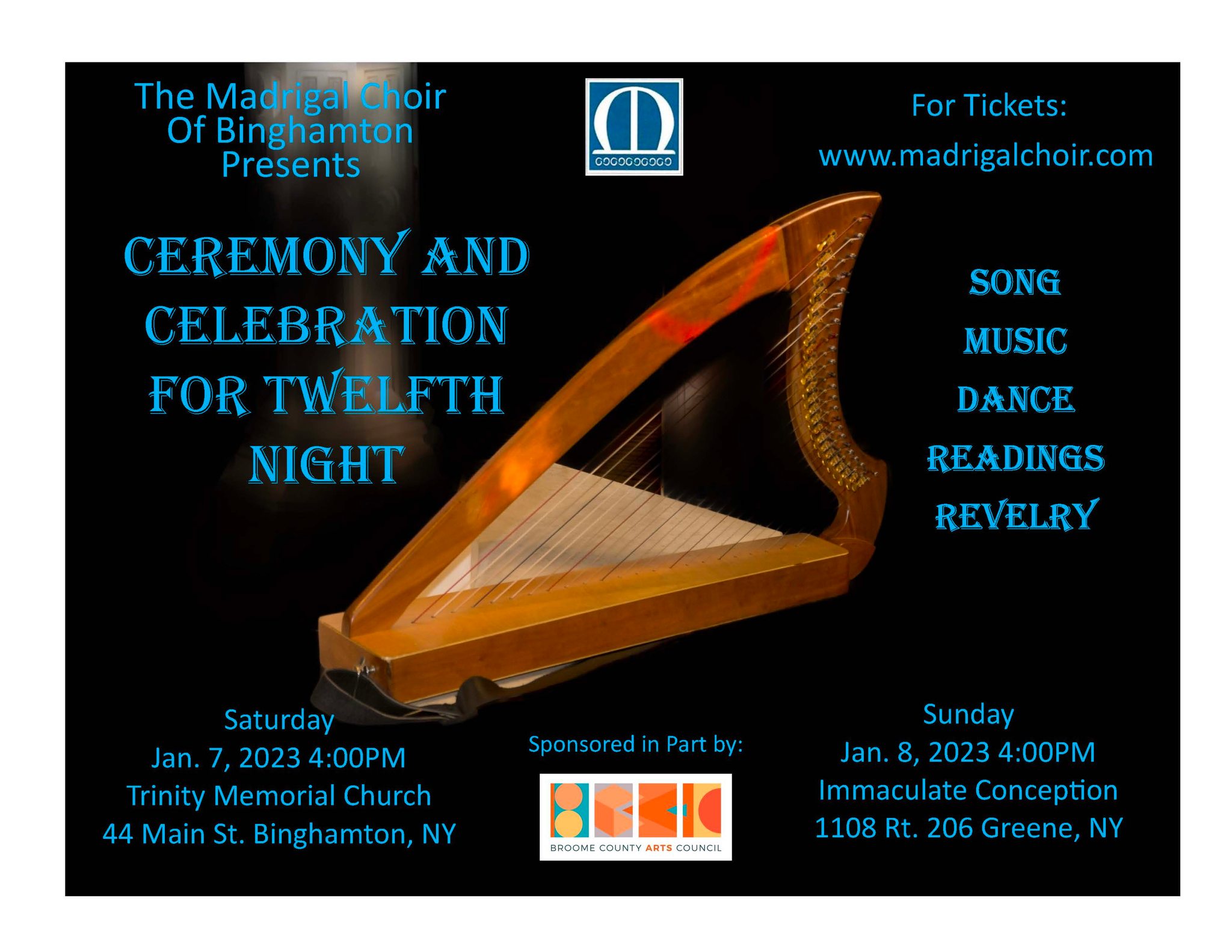
Just a quick evening post today, because I’ve had a busy weekend with two performances of Twelfth Night with the Madrigal Choir of Binghamton.

Both performances were well received by very appreciative audiences. As always, there are moments that don’t go quite as well as they might have but those aren’t noticeable to the audience, so they don’t matter in the long run.

I was happy to have family and/or friends at both performances. I loved the opportunity to share this music and celebration with them. After the performance today in Greene, there was a lovely reception, which afforded us a chance to meet some of our audience members. This was the first time we had sung in Chenango County, so it was nice to have new community connections.

Madrigal Choir now has a bit of a break before our next set of rehearsals begins for an American Songbook concert in April. Stay tuned!
*****
Join us for Linda’s Just Jot It January! Find out more here: https://lindaghill.com/2023/01/08/daily-prompt-jusjojan-the-8th-2023/

Twelfth Night!

I will be performing with the Madrigal Choir of Binghamton this weekend, my first time participating in their traditional Twelfth Night celebration.

If you are in or near Broome County, New York, please come join in the fun! Tickets are $20 in advance at www.madrigalchoir.com or at the door. There are also $5 student tickets available at the door only.

I’ll be in the second row, dressed like this:


Hope to see you there!
*****
Join us for Linda’s Just Jot It January! Find out more here: https://lindaghill.com/2023/01/06/daily-prompt-jusjojan-the-6th-2023/

Much Ado in the Garden

Why, you may ask, is Joanne wearing a fetching Renaissance costume?

Because tomorrow, Sunday, July 17, 2022, I will be singing madrigals with The Madrigal Choir of Binghamton at the Much Ado in the Garden event, sponsored by Cornell Cooperative Extension-Broome County.

There will be music, dancing, garden tours, Shakespearean scenes, games, food, and more, so come to Cutler Botanic Garden and join us!

Madrigal Choir will be singing at 2:00. At 11:15 AM, I will also be participating in a mini-workshop and reading with the Binghamton Poetry Project, but not in costume.

I’m sure that you want to see my headpiece, so one more costume shot.

Choirs in the time of COVID

I often participate in Linda Hill‘s Stream of Consciousness Saturdays. Her last prompt was “song.” The instruction was to “find a picture–the closest one to you. Your prompt is the title and/or the lyrics of the first song that comes to mind when you look at the picture.”

I couldn’t manage to follow the instruction – my brain doesn’t work that way – but thoughts about song have been flooding my consciousness for the last couple of days.

I can’t remember the first song I sang, but singing has been an important part of my life, especially choral singing. Decades of it. Most of it has been associated with schools or church. It has been my privilege to sing some of the great choral works of Western music. I love singing Bach; my background as an organist probably influences that. My favorite large work to sing is Brahms’ Requiem, in German, of course.

I’ve written sorrowfully of the probable demise of University Chorus due to a re-organization of the choral program at Binghamton. At the time, I never dreamed that choral singing itself would be on indefinite pause.

It turns out that singing is a high-risk activity to spread coronavirus. A choir rehearsal, with lots of people singing in close quarters indoors, can easily become a super-spreader event. While some churches have begun re-opening, they cannot safely have their choirs sing. They can’t even have their congregations sing. The thought of returning to church but having to stay silent is more than I can bear.

Nine years ago, I made my first trip to Europe as part of the Smith College Alumnae Chorus. We sang the Mozart Requiem in Sicily. I have sung with the SCAC in several on-campus events, as well as last year’s tour of Slovenia. Any planning for future events is on hold, not knowing what conditions we will be facing over the next couple of years.

Someday, some year, there will be widespread vaccine and/or effective treatment for COVID-19 and singing in groups will again be reasonably safe. I hope that choral organizations manage to survive so that they can reconvene and make music together again. I hope that I, then in my sixties, will be considered young enough, healthy enough, and mellifluous enough to join in.

JC’s Confessions #14

In the first few seasons of The Late Show, Stephen Colbert did a recurring skit, now a best-selling book, called Midnight Confessions, in which he “confesses” to his audience with the disclaimer that he isn’t sure these things are really sins but that he does “feel bad about them.” While Stephen and his writers are famously funny, I am not, so my JC’s Confessions will be somewhat more serious reflections, but they will be things that I feel bad about. Stephen’s audience always forgives him at the end of the segment; I’m not expecting that – and these aren’t really sins – but comments are always welcome.

JC

After all the safer-at-home pandemic protocols, I’m afraid that it will be difficult for me to resume going back out to church, meetings, events, etc.

The truth is that I am both introverted and shy. It takes a lot of energy for me to be in a group setting and even more for me to actively participate. I much prefer one-on-one interaction, the exception being among family.

I wrote yesterday about the explosion of Zoom and other virtual meetings. I’m finding that these are also very draining and even more difficult to navigate than in-person meetings, because it is harder to gauge how/when to break into the conversation when we are each in our own little box.

I wonder if some of the group activities I used to do will even exist after a vaccine makes social interaction relatively safe again. While I had been mourning my lack of a chorus with whom to sing, now no one has a chorus available and may not for a long time, given that singing in a group is an especially dangerous virus-spreader. The spirituality group that I have facilitated for years at church is almost entirely people in high-risk groups and we don’t have the option to go virtual due to technical limitations.

Some organizations, like the Binghamton Poetry Project, will eventually have to decide if they go back to in-person meetings or stay in Zoom, which allows people who don’t have transportation or who live outside the area to participate.

It’s possible that there won’t be many groups expecting my physical presence when we get to the post-pandemic world, but there will no doubt be some. Will I be able to muster the energy to venture back out on a regular basis or will I just stay home?

I don’t know.

JC’s Confessions #10

On The Late Show, Stephen Colbert does a recurring skit, now a best-selling book, called Midnight Confessions, in which he “confesses” to his audience with the disclaimer that he isn’t sure these things are really sins but that he does “feel bad about them.” While Stephen and his writers are famously funny, I am not, so my JC’s Confessions will be somewhat more serious reflections, but they will be things that I feel bad about. Stephen’s audience always forgives him at the end of the segment; I’m not expecting that – and these aren’t really sins – but comments are always welcome.
~ JC

I don’t feel like a musician anymore.

I started playing piano at seven. I began studying organ as a preteen and was the organist of my rural Catholic church at fourteen. I majored in music at Smith College, where organ was my main instrument, I played often at chapel, I sang in choirs, learned that I could compose, and was named the Presser Scholar in my senior year.

After I graduated, married B, and moved to the Binghamton NY area, I continued with church music until I took a few years away when my children were young.  Realizing that it wouldn’t work for our family for B and I to never have a common day off, I volunteered with the music ministry at my church, accompanying the youth and junior choirs and subbing when our music director needed to be away. When tendon problems in my elbow eventually made it impossible for me to play for very long at a time, our music director would play and I would conduct.

When our parish disintegrated in 2005 and my church music volunteering evaporated, except for occasional special celebrations, I still had my long-time affiliation with University Chorus to keep me musically active. After the retirement of our long-time director, though, University Chorus, which used to sing a major concert every semester, has cut back to only singing at one concert a year, at most. This academic year, we have not met at all and I am not sure we will ever re-convene. Due to uncertainty and personal scheduling complications, I haven’t been able to join another group.

With my last steady musical commitment gone, I don’t feel that I am still a musician, which leaves an empty space in my identity. In a period of my life when there has been so much loss, losing that piece of myself is especially difficult because music has long served as a vehicle to express emotion and to find community and comfort.

I don’t know if I will ever recover the musician part of my identity. Theoretically, I could be singing on my own every day and working on sight reading so that I would be ready to audition if there is an opportunity, but it feels too futile, not helped by the fact that I am a very anxious and not particularly good auditioner.

It is likely that I will sing again with the Smith Alumnae Chorus, either on campus or on tour, but those choral experiences would only be a few days a year. Not an identity-affirming amount of time.

Maybe what I should say is that, for many years, I was a musician.

singalong

Yesterday, I attended an event of the Madrigal Choir of Binghamton. They presented a Handel Messiah Parts II & III sing with soloists from the choir and orchestra volunteers from the Binghamton Community Orchestra. The director, Bruce Borton, is an emeritus from Binghamton University. I sang in the University Chorus under his leadership for over 25 years.

There were a lot of people there, including a good number who had sung with UC. We were sitting in mixed formation and I sat with three good friends whose participation with UC was even longer than mine.

I had performed part one of the Messiah, but not the rest, except for a scattered chorus here and there. It’s hard to have sung for as many decades as I have without having sung the “Hallelujah Chorus”! Admittedly, there were some sections that I could not keep up with, given that I was sightreading with text at tempo, but I am so familiar with Baroque style that I could manage to re-orient myself harmonically, at least in time to cadence.

It was fun to have a chance to sing with my friends again and to watch Bruce conduct, but it was sad, too. I have no idea when I will have the opportunity to do choral singing again.

Bittersweet.


snow day

There have been a lot of big storms in the United States in recent weeks. Our region hadn’t had too much bad weather – until yesterday and today.

The storm started Sunday morning with an extended period of freezing rain, which made driving inadvisable. Sunday evening, it changed to a heavy, wet snow and it has snowed nearly all day today (Monday). The trees and utility lines are all weighted down with snow. We have lost some limbs from the trees in our yard.

The roads are impossible to keep clear and all the schools, including the University, cancelled classes. Lots of businesses decided to close, as well, for the safety of their employees and customers. Our museum and science center closed. Even our doctors’ office is closed.

B and most of his colleagues are working from home.

As I was contemplating all the closings, I remembered snow days when E and T were young. One of them had learned a song in elementary chorus and we used to sing it sometimes when there are snow days. “There’ll be no school tomorrow, no school tomorrow, no school tomorrow, if it snows.”

And because YouTube exists now, I can search and find recordings! The words and music are by Jay Althouse.