Eric Carle, beloved author/artist of The Very Hungry Caterpillar and many other books, lived in western Massachusetts where I grew up and I’m very happy that Bombas chose to honor his legacy with a line of socks for both children and adults.
“…and this was said to me by a cryptologist: If you think technology is going to solve your problems, you don’t understand technology and you don’t understand your problems.” ~~~ Laurie Anderson
There are Big Hug mugs that came years ago filled with FTD flowers. A pair of floral mugs that B and I received as a wedding gift 42 years ago. Mugs from my various Smith College reunions. A line of mugs related to B’s jobs. A mug with children from around the world that was given to me by the middle school principal years ago as a thank-you for being on the building planning team. Some hand-crafted ones which double as works of art. A Doctor Who mug that changes its design depending on the temperature of the liquid inside. Some mugs designed for soup instead of beverages. Sandra Boynton mugs spanning several decades.
Our most recent acquisition is a Sunday Today mug that T and I gave to B for Father’s Day. Its claim to fame is that it is very big, although, of course, it isn’t obligatory to fill it all the way. However, if you do, you need to use two tea bags.
I don’t use mugs very often myself. I don’t drink coffee or tea. I used to love cocoa but it riles up one of my medical conditions. I sometimes will drink white hot chocolate in the cooler weather or make hot milk with spices but it isn’t that frequent.
I do, though, like having reminders of our past in the cupboard, even when they make me nostalgic, like the mug from our children’s elementary school or from the elementary school where my father-in-law was principal for decades. He passed away in 2005, a few years after he retired.
Some day, we will have to downsize and cull some of our mugs.
Yesterday was a loooong day here in North Adams. I managed to get some studio time in the first part of the morning, including writing another section of the poem I started my first day here. If anything, it got a bit darker/starker. I’m not sure if this will be the final section or if one more may appear before the end of residency. I just know it’s unlikely to be today.
I went to the museum when they opened at 10:00. My goal was to blitz the new exhibits and take some photos for future reference. I also collected the guides for the new work to use as reminders and background if I decide to write some ekphrastic poems. MASS MoCA is not a collecting museum. While there are some long-term exhibits, most are only here for a year or so before moving on to another location. It’s one of the things that keeps returning here every year fresh. I wanted to do a walk-through as soon as possible – the museum was closed on Tuesday – so that I’d have time to let some ideas percolate and then return to specific pieces to take notes or even draft new poems.
I did, though, re-visit some of my long-term favorite exhibits, including our namesake Boiler House. (I have a poem about that.) The photo above was taken there. For some reason, this equipment really caught my eye this year, perhaps because it is colorful among the rust.
I was also on the lookout for the formerly upside-down tress of Natalie Jeremijenko’s Tree Logic. (I have a poem about that.) The piece had been in the courtyard at MASS MoCA’s entrance for almost 25 years, with the trees periodically swapped out and planted. As they return to their natural position, the bends in the trunk and branches eventually straighten. Positive phototropism! The last six trees were planted near Richard Nonas’ Cut Back Through (for Bjorn). I have a poem about that, too, which I will actually share here. This is a revised version of the poem that first appeared in Emulate.
Time/Rate/Distance after Cut Back Through (for Bjorn), Richard Nonas
Three thrones hold court, sun-warmed, polished granite; ancient mica flecks five rough-hewn footstools.
Bees prefer surrounding clover, sweet white sustenance for inevitable winter, oblivious to any human, serve their sisters and queen.
I, too green, too new, too fragile for this place, settle on footstool, absorb warmth of sun, strength of stone, whole-heartedness of bees.
After being on my feet for so long, my neck and back were tired and I accepted the offer that my apartment-mate had made to rest on her mat in her studio, which is outfitted with an acupressure mat for the back and neck. That revived me enough to be ready for our group lunch at 1:00.
After lunch, we took two of our new BHPC members on a tour of the Boiler House, which is a fun tradition.
Then, I went to our apartment to rest for the afternoon to get ready for our reading. I scooted out for an early solo dinner at Boston Seafood, which has been in North Adams since before I can remember in the 1960s. Bonus: they serve mocha sundaes, one of the few places left that holds to that North Adams tradition. (I have a couple of mocha poems, of course.)
The reading was at 7 PM at The Bear & Bee Bookshop. I’m pleased to say that we were standing room only and the reading was very well received. Through the miracle of alphabetical order, I was first up and read three North Adams poems, one about Drury High School, an ekphrastic poem about Xu Bing’s Phoenix which ties into some local history, and one about the public library. I was grateful to be first so that I could enjoy the rest of the reading. There were even some questions during the Q&A!
While most of the poets went to a neighboring restaurant for dinner/celebrating after the reading, I went back to the apartment to lie down and rest my neck and back. When my apartment-mate came home, we talked for a couple of hours – or maybe closer to three? – before turning in.
The long day with lots of walking and stairs and standing had gotten to me, though. My neck, shoulders, and back all tightened up and I had a lot of trouble sleeping. Today is going to be a slow day. I’m in my studio now but will probably head back to the apartment after I post this to rest and/or nap before lunch at 1. I’ll probably need to spend most of the rest of the afternoon prone, too, in order to be upright for supper out and evening discussion. It’s annoying to have to spend so much time lying down and resting but everyone is having a good and fruitful experience with our residency and I’m very grateful for that and for being here, even though I have unaccustomed limits this year.
I am honored to have been selected for the fourth annual Glimmer Globe Theatre/Fenimore Art Museum Write Out Loud performance on Saturday, April 20th. There were 22 writers represented with a mix of poems, short story, essays, and even a short play, all written by people living within a 100-mile radius of Cooperstown, New York.
My daughter T and I decided to make a weekend of it. We visited the Museum in the afternoon. Our favorite new exhibition was “As They Saw It: Women Artists Then and Now.” It will be showing through September 2, 2024. We loved how it demonstrated the power of women’s artistic expression over time, both as individuals and in relation to other women across the generations. We also appreciated viewing the thoughtfully curated Eugene and Clare Thaw Collection of American Indian Art, which has had a home at the Fenimore since 1995.
After a delicious early dinner at the Council Rock Brewery in a room filled with vintage clocks, T and I headed back to the Fenimore for the performance. We arrived early so that I could attend a walk-through. I had the opportunity to meet Christine Juliano, the actor who would read my poem, “Some Time Else” from my chapbook, Hearts. I admit that the whole evening was much more relaxing because I didn’t have to perform myself. It made the walk-through more interesting as I could observe the microphone adjustment and lighting cues without having to worry about dealing with them myself. It was also a good reminder that having a mike is not an excuse to dial back on vocal projection.
We had a good house for the performance, filling the auditorium, which was exciting for me who is more used to wondering if the readers will outnumber the audience! A brief bio from each writer was read as they or the actor reading their piece took the stage. There were also accompanying visuals projected behind the stage that complemented each reading.
The range of topics was wide and it was fun to have a mix of genres represented. While the age of the writers skewed older, we did have some younger folks participating. Quite a number of the writers had been professors or editors or directors of writing series, so I, totally lacking in academic English credentials myself, felt honored to have been chosen alongside them. Submissions for Write Out Loud are read anonymously so the individual piece is selected, not the author. I was also surprised that a large majority of writers had chosen to present themselves; one of the things that had attracted me to submit was the opportunity to hear an actor read my work. I must admit, though, that some of the writers were so evocative in their performance that I couldn’t imagine an actor would have done better.
I learned that Write Out Loud began as a virtual performance during the pandemic, which then continued as a live event when restrictions were lifted. This year saw the largest number of participants thus far.
I’m not going into too much detail about the program itself because, on Saturday, April 27 at 7 PM, the recording will be released on the Fenimore Art Museum’s YouTube channel. Update: The video of Write Out Loud 2024 is now available here. If you expand the description, you will find the program, helpfully indexed to bring you to whichever piece you select.
Thanks to the Fenimore Art Museum and the Glimmer Globe Theatre, especially Mike Tamburrino, Manager of Performing Arts Programs at the Fenimore Art Museum and the affiliated Farmers’ Museum, for including me in this special event!
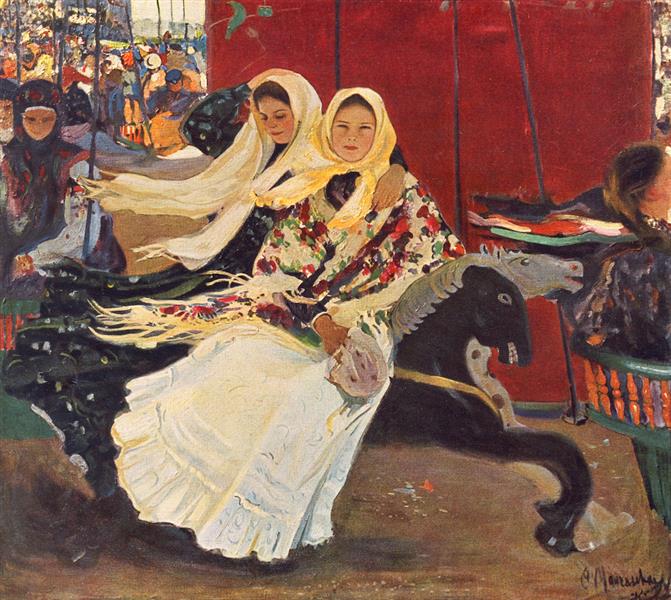
In the early weeks of this most recent phase of the war Russia is waging against Ukraine, Lorette Luzajic of The Ekphrastic Review chose Carousel, a 1906 painting by the Ukrainian artist Olexandr Murashko, as the prompt for the biweekly Ekphrastic Writing Challenge.
the earth shakes the horses fall the bloodied flee
or fight
~~~ Joanne Corey
I’m sorry that, nearly two years later, the Ukrainian people are still suffering this terrible invasion. I call on all freedom-loving nations to continue to support Ukraine without delay and without letting would-be authoritarians or autocrats get in the way. I particularly call on the United States Congress to pass an aid package without preconditions or extraneous amendments.
What I had to say to you, moreover, would not take long, to wit: Practice any art, music, singing, dancing, acting,drawing, painting, sculpting, poetry, fiction, essays, reportage, no matter how well or badly, not to get money and fame, but to experience becoming, to find out what’s inside you, to make your soul grow.
Last night, B, T, and I watched American Symphony on Netflix, a documentary which followed the extraordinary musician Jon Batiste in 2022. It is also being shown in theaters.
I had loved watching Jon Batiste on The Late Show with Stephen Colbert. He and his band, Stay Human, were the house band on the show, beginning with its inaugural episode in 2015. I appreciated Jon’s talent, his ability to cross and blend musical genres, and his gentle, positive spirit. While his jazz roots were always in evidence, he would often use elements from classical music or indigenous/folk music in his compositions, arrangements, and improvisations. During the early part of the pandemic when the show was being produced remotely, Jon would often still have a segment with Stephen where they would talk from their respective homes and Jon would play a bit on his piano or sing. Even though things were very different, it was a comfort to hear Jon’s expressive, calming voice in a difficult time.
Jon always had multiple projects going on, including performing, recording, and composing. For example, he won an Oscar for best original score as one of the composers for Disney-Pixar’s Soul in 2021. 2022 was set to be another busy, productive year for Jon Batiste, which director Matthew Heineman set out to document on film.
Jon was preparing to premiere his “American Symphony” which would bring together elements of influence of his and American music on stage at Carnegie Hall for a one-time-only performance. He was about to be nominated for 11 Grammy awards across an array of genres. There was still his Late Show gig.
And then, his long-time partner and soon-to-be spouse, the writer/author Suleika Jaouad, had a recurrence of leukemia after ten years in remission and American Symphony transformed from being a documentary about a composer and his music into a film about love, life, living, and how art expresses that all, helps us to process, and propels us forward.
The openness of Jon and Suleika in showing us their pain, anxieties, and vulnerability, as well as their love, art, and joys, is incredibly brave and moving. It was upsetting to me to hear that Jon faced a lot of criticism and negative comments about his eleven Grammy nominations – and eventual five wins, announced while Suleika was beginning chemotherapy. It just seemed so mean-spirited to inflect on a gentle soul at such a vulnerable time. I had known that things were stressful for Jon because he needed to end his years as band leader at The Late Show, but I hadn’t realized the extent of the situation until watching American Symphony.
While being a musician or music-lover will add to your appreciation of this film, it is certainly recommended to all teens and adults who are open to honest expressions of the human condition. It is not for younger children, who might be upset by the intensity of the medical side of the story.
My best wishes to Jon and Suleika for many years of love and art to come. Thank you for sharing so much of yourselves with us.
Today is the first day of winter in the Northern Hemisphere and one of the first things I read is this tender, reflective piece from Eugene Robinson of the Washington Post about the unfinished art quilt and essay “Winter” – the last in a series that his spouse Avis Collins Robinson was working on at the time of her death. (The link above is a gift so it will open for everyone without paywall.)
The piece begins:
For Avis Collins Robinson, the artist who created these works heralding the seasons, winter meant both an end and a beginning. The bare trees and sere landscape were stark, but they held the promise of spring and renewal — not a mere hope but a promise.
I wanted to share his words and her art with you as the seasons continue to unfold inexorably before us.
We are fortunate that art and words continue to speak to us, even when their creators have passed away.
I’m pleased to share the online version of Emulate Magazine Fall 2023 (Volume 5, Issue 1), which includes three of my MASS MoCA (Massachusetts Museum of Contemporary Arts) ekphrastic poems. Many thanks to the Emulate Magazine team at Smith College for including my work in this issue! Smith is my alma mater, so being chosen for this publication is particularly close to my heart.
The theme of the issue is “Metamorphosis.” I was excited to discover that the editorial team had chosen my poem, “Time/Rate/Distance,” to open the issue! This poem is based on Richard Nonas’s Cut Back Through (for Bjorn), which is a long-term outdoor installation on the MASS MoCA grounds. It is comprised of three large granite chairs and five footstools. I suppose “Time/Rate/Distance” could be considered an American sonnet, because it has 14 lines, with a turn between lines 8 and 9, like an Italian sonnet. (Just throwing that comment in to address the common criticism that I don’t write enough in received Western forms, like sonnets, villanelles, and sestinas.)
“I Must Speak My Poem” (page 11) is based on Stephen Vitiello’s sound installation All Those Vanished Engines, housed in the Boiler House at MASS MoCA. My beloved Boiler House Poets Collective recorded our first reading there and we always visit when we are back for our reunion residencies. I was disappointed this year that we weren’t able to climb all the way to the rooftop, which offers a spectacular view of North Adams and the surrounding hills.
“Translation” (page 26) is a haiku based on the works of Justin Favela, whose pieces translating landscape paintings by José María Velasco using the paper and glue techniques of piñata art were part of the MASS MoCA Kissing Through a Curtain exhibition (2020-2021). I especially love that this poem appears on the page with a striking photograph by Avery Maltz.
All three of these poems are part of my chapbook manuscript of ekphrastic poems based on current and past exhibitions at MASS MoCA. Two of them are also included in my full-length manuscript centered on the North Adams area. I will, of course, add Emulate Magazine to my list of acknowledgements and my author page, joannecorey.com.
Be sure to check out this issue of Emulate Magazine! It is chock-full of poetry, prose, and images, all centered on metamorphosis and the myriad ways it manifests.









 Joanne Corey