SoCS: work

He’s 68 percent completed with the task. Which is not great, but will have to do for now. I wonder if I should send someone to help, although it might be more complicated to give someone else the necessary background than to have him just keep working alone.

I’d help if I could, but I’m only 85 percent, 72 percent, 59 percent, and 42 percent done on the stuff I already have in front of me.

We need more hours in the day and more days in the week.

(The opening words – see the prompt below – were from Rachel Maddow’s work, Blowout, which I reviewed here. They were so specific that I wound up doing something that I don’t do on my blog; I wrote a fictional vignette. It does sound a bit like the worklife of some people I know, though.)
*****
Join us for Linda’s Just Jot It January and/or Stream of Consciousness Saturday! This week’s SoCS prompt is complicated, so I am copying it directly from Linda’s site:
Your prompt for #JusJoJan and Stream of Consciousness Saturday is: “the first 3 words of the first full sentence.” Okay, follow me here. This is what I want you to do: 1. Grab the closest book to you when you sit down to write your post. 2. Open it to a random page. 3. Locate the first complete sentence on that page. 4. Use the first three words of that sentence to start your post, then take it from there–write whatever comes to mind. That’s it! Have fun!
You can visit Linda’s prompt page here: https://lindaghill.com/2020/01/10/the-friday-reminder-for-socs-jusjojan-2020-daily-prompt-jan-11th/

2019-2020 SoCS Badge by Shelley! https://www.quaintrevival.com/

Review(ish): A Beautiful Day in the Neighborhood

I may have made a mistake in my quest to catch up on movies.

Because I admire Tom Hanks as an actor and Fred Rogers as a loving and generous soul, I wanted to see A Beautiful Day in the Neighborhood. I had appreciated the 2018 documentary on Fred Rogers, Won’t You Be My Neighbor?, and wanted to see what more this fact-inspired fictional movie had to say. I knew that it was about a journalist who had written a piece about Fred Rogers, but little else, other than that Tom Hanks had been nominated for a Golden Globe as Best Supporting Actor rather than Best Actor.

I found the juxtaposition of the much darker story of the journalist, Lloyd, played by Matthew Rhys, with the gentle, caring, spiritual depth of Fred Rogers to be jarring. I also hadn’t known that the death of a parent is a major theme in the movie; while the situation in the film is very different from my own recent experience, that aspect of the story was still upsetting for me.

My reaction reminded me of my response to the film Julie & Julia, another film about an unlikely pair of protagonists in which I reacted positively to the elder and negatively to the younger. An aside: the link in the prior sentence is to a blog post I wrote in 2014 about my reaction to the film and blogging. Re-reading it just now was… an experience – and a chance to look back at a post from early in my blogging and poetry days and reflect on where I am now as opposed to where I thought I might be. At any rate, I think it still stands up as a decent piece of writing, so, if you have the time and are so inclined, check it out.

When my daughters were young, PBS was a mainstay in our house. I admit that I had a more enjoyable time watching Sesame Street with the girls than Mr. Rogers’ Neighborhood. I wasn’t a fan of the slow pacing and I was not at all a fan of the Neighborhood of Make-Believe. Every time someone said, “Correct, as usual.” to King Friday the XIII, I cringed. Over the years, I’ve learned to think about it more from the child’s viewpoint and understand that the show was built to give children the time and space to deal with their whole range of emotions. This was not readily apparent to me as a young parent.

There is one episode that has always stayed with me. Yo-Yo Ma was Mr. Rogers’ guest and was playing a movement of one of the Bach cello suites. Fred asked him if he played it differently after he had had children and Yo-Yo Ma said that he did play it differently after he became a parent, that the emotions underlying his interpretation were changed because of his children. As a musician myself, this resonated with me and has stayed with me over the (many intervening) years.

Some of the most emotionally resonant moments in A Beautiful Day in the Neighborhood for me were ones where something Mr. Rogers was saying reminded me of my own family. For example, there is thread in the story about Mr. Rogers’ attachment to his puppets, like Daniel Tiger, even though they were getting worn. In an attempt to draw him out, Mr. Rogers asks Lloyd about his own childhood “special friend”, which turned out to be a stuffed toy called Old Rabbit.

My mind immediately flashed to a story of childhood toys that take on larger meaning. When my daughter E and her spouse L had to spend major amounts of time on different continents while doing research or while waiting for the visa process to finally complete, they would exchange their favorite stuffed toys. E’s cow “Kuh” and L’s duck “Pineapple” made quite a few transoceanic flights and are now ensconced in London permanently with E, L, and their daughter ABC. To show you the extent to which Kuh and Pineapple were connected to E and L’s love story, here is the wedding cake topper that a friend made for them:
Beth and Larry's caketopper

Back to the movie. When the journalist Lloyd finishes his piece, his spouse reads it, saying that it is brilliant but not really about Mr. Rogers. I feel the same way about this blogpost, which is why I said in the title that it is “review(ish)”. Fred Rogers’ greatest gift was caring about each person he met on a deep level, meeting them where they were and helping them connect with and express their own feelings. It is all to the good that this film, the documentary, the vast archives of Mister Rogers’ Neighborhood, and the non-profit organization he founded, re-named Fred Rogers Productions after his death, which now produces Daniel Tiger’s Neighborhood, serve as continuing reminders to accept ourselves and care for others.

Mr. Rogers often said or sang, “I like you just the way you are.” That message to me is part of the call, expressed in Christianity and held by those of many other spiritual paths, to “love your neighbor as yourself.” Fred Rogers was an ordained Presbyterian minister who taught by his example. I appreciate those who are carrying his message in the present and into the future.

The world needs to hear that message now more than ever.
*****
This post is part of Linda’s Just Jot It January. Join us! Find out how here:  https://lindaghill.com/2020/01/09/daily-prompt-jusjojan-the-9th-2020/

Review: Little Women

As part of my “sabbatical”, I decided to see some movies that I have been wanting to see. The one I most wanted to see was Little Women, so I started there.

This is the best film adaptation of Louisa May Alcott’s book that I have ever seen. Director/screenwriter Greta Gerwig made some interesting choices. She begins the film with scenes that happen much later in the story of the March sisters, then moves back seven years to show us what had led to these opening scenes. The moving back and forth in time continues throughout the film, but without the onscreen warning of the first switch. Having read the book several times as a child and having seen numerous adaptations over the years, I could easily follow the timeline switches, but they could momentarily confuse those new to the story.

The cast was superb. I especially enjoyed Saoirse Ronan’s nuanced portrayal of Jo and Florence Pugh’s spirited portrayal of Amy, who is ages 13-20 in the film.

I especially enjoyed the settings. Most of the action in Alcott’s book takes place in Concord, Massachusetts in the 1860s and 70s. I grew up in the still-rural northwestern part of the state and the outdoor scenes with woods and fields reminded me of home. The architecture was also very appropriate to New England in that era. I made a point to watch for shooting location in the credits and was thrilled to see that it had been filmed in Massachusetts. No wonder the trees looked familiar!

At 2 hours 15 minutes, it is a relatively long movie by current standards, but it did not feel long because there is so much happening. I congratulate Greta Gerwig on her excellent sense of storytelling and pacing. It is a beautiful film which I hope many people will see, in theaters and in other formats, for years to come. It is a timeless classic.
*****
Join us for Linda’s Just Jot It January! Find out more here:  https://lindaghill.com/2020/01/07/daily-prompt-jusjojan-the-7th-2020/

Blowout by Rachel Maddow

One of the most impressive parts of Rachel Maddow’s book Blowout is the end. No, not the index, but the twenty pages of “Notes on Sources.” I had often found myself thinking as I read the text, “How could she possibly know this level of detail?” but I know that Rachel Maddow and her staff are very dedicated to research and accuracy, so I didn’t doubt the veracity of the stories she was relating. I was pleased to see the “Notes on Sources” because she lists the books, papers, interviews, news stories, videos, magazines, etc. that she had used to find the facts, giving readers a chance to learn more and showing that she and her staff had, indeed, been diligent in their research.

The full title of the book is Blowout: Corrupted Democracy, Rogue State Russia, and the Richest, Most Destructive Industry on Earth. That industry is, of course, the oil and gas industry.

Because of my many years in the anti-fracking and climate justice movements, I was familiar with the broad outlines of much of the oil and gas industry story. I appreciated the abundance of details on topics such as Oklahoma, the depths to which it rises or falls on fossil fuel dollars, earthquakes and induced seismicity, and the rise of Oklahoma City, including its entance into the world of big-league sports. I knew that Russia used its fossil fuel exports as a cudgel and that Putin and his oligarchs ran roughshod over whomever stood in their way, but hadn’t realized all the factors involved, including the immensity of the impact of US sanctions that stopped Rex Tillerson’s ExxonMobil from assisting Russian Arctic drilling and spearheaded Russian interference in the 2016 US presidential election.

I was less familiar with the expressions of the “resource curse” in other parts of the world, such as Equatorial Guinea. These stories illustrate how the proceeds of the oil and gas industry flow to the already powerful leaders of government and industry and not to the general populations of the countries, who often remain mired in poverty and ecological devastation.

While I brought a considerable amount of personal background/geekery to my reading, the book is equally as enjoyable and informative for those who know little of the industry. Maddow’s writing is clear and compelling. Much of the book reads like literature, with compelling, recurring characters, rich details, and unexpected plot twists. That the stories are all true heightens their impact.

That we are continuing to deal with the repercussions of the events in this book makes reading it that much more important.
*****
Please join us for Linda’s Just Jot It January! Find out more here:  https://lindaghill.com/2020/01/06/daily-prompt-jusjojan-the-6th-2020/

writing, singing, etc.

I had been trying to post more regularly – and have now proceeded not to post for a week and a half. I’m sure that isn’t a shock to regular readers. As much as I hope to create a even a semblance of a schedule, I haven’t managed to get there yet.

Even though I haven’t been posting here, I’ve been doing a bit of writing. A letter to the editor at NCR online. A short piece that may appear as a Small Earth Story at NCR. A bio to accompany a poem that is going to be published soon. This will be in the mini-anthology that will be a companion to the winning chapbook from QuillsEdge Press; all the finalists will have a poem printed. This was also exciting because I had to approve the proof and sign a contract. It was a needed reminder that I am still a poet, even though I haven’t published much lately – or even submitted. Maybe, after the first of the year, I can concentrate on a revised version of the chapbook to send out…

I don’t have a choir with which to sing on a regular basis this fall, but have sung with the combined music ministry at church for three funerals over the last three weeks. All the funerals have been for family members of music ministers, the last being the brother of my friend, who has been director of music for decades. Sadly, she has had to play and direct for the funerals of both her parents and, now, her eldest brother. Another staff member described it as “her last gift to him.” Perhaps that, along with her professionalism and faith, is the way she can manage to keep her focus in such difficult circumstances.

At the luncheon after the funeral, I was sitting with people who I met years ago at our former parish. It’s been fourteen years since we were all together there. Even after so much time belonging to other parishes, we still miss it.

That our sense of connection remains strong is a testament to how special and loving the community was. It had a part in forming our identities and that is a lasting gift.

silver linings

There are some silver linings of not having a 2-year-old in the house.

  • Not crashing into the gate at the bottom of the stairs while trying to navigate at night
  • Being able to open cabinets without fiddling with a latch
  • Fewer smudges on the windows
  • Not having to juggle vehicles to make sure one with a car seat was available at home for outings
  • Cutting back on energy usage with fewer laundry loads, lights, electronics, etc.
  • Not having to wrestle with doorknob guards on the basement and linen closet doors – they were hard for little hands to open but also for my petite grown-up hands
  • The opportunity to sleep more, although this is only theoretical
  • More flexibility to travel, write, exercise, etc., although this, too, is theoretical
  • A break from watching some part of Moana, which ABC called “Ocean”, and/or Frozen, which ABC called “Snowman”, every day, although I might sneak a peek at them now and then because I appreciate the theme of love of family, especially grandmother/granddaughter and sisters

Of course, I would trade it all in a moment, if I could, although I know ABC is where she needs to be, settling in with her mom and dad and London grandparents and enjoying the amenities that only a big, historic city can provide. We had a chance to videochat with E and ABC over the weekend and to make arrangements to visit in December. It will be exciting to see everyone and all the places they go! It might be a bit too exciting, though, as we will be there for the election on the 12th…


MASS MoCA poets’ tour

As promised, the first video from the Boiler House Poets Collective for 2019. We each read a short passage from one of our poems with the artwork. Unfortunately, one of our poets had to leave a bit early, so there are only seven poets represented here. Enjoy!

Tour 2019 from Mar McCabe on Vimeo.

the last day of residency

Tuesday was the final day of the Boiler House Poets’ reunion residency at MASS MoCA.

There for our fifth year, this was the first time that the museum has carried its summer hours into mid-October. This was great for us because the museum was open 10-6 every day, instead of the winter hours which are 11-5 every day of the week except Tuesday. We all appreciated having additional time with the art, while still having time to meet together to workshop.

We needed to be moved out of our apartments by 11:00 Tuesday morning. I got my things packed and in my van early and went to my studio to do a bit more editing. I followed up with quick trip to the gift store and couldn’t resist a couple of books for ABC. I went back to the apartment to help with the final clean-up. All the poets were meeting back at the studios at 11ish to make some plans for next year and are pleased to have booked dates for another reunion next fall.

Also, in the type of creativity burst that I so admire about the Boiler House Poets, we spontaneously embarked on a second group project for this residency. I described our first project in this post. For this second one, we each chose a line or short passage from a poem we had written about an artwork currently at the museum. Marilyn used her phone to record our voices reading our passage while filming the artwork. It was so much fun, traipsing through the buildings of the museum, reading sntaches of our work for each other and heading on to the next exhibit on our list. I will be sure to post both projects here at ToJCM when they become available.

We had one last lunch together before heading for home. We miss each other’s company immediately, but will be reminded of each other frequently as we work through editing the poems we workshopped together and as we write new poems enriched by the advice and artistic vision of the poets and the artwork on exhibit.

I admit that the re-entry to what passes as normal life here has been a bit rough. I’m still way behind on routine things I missed being away for a week and there are a number of unique events coming up this month. That’s why, despite being behind on things, I am making it a point to get this post about Tuesday written on Friday evening. I’ll attempt to post about events as I can, although, most likely, I’ll be late getting the news out.

And that’s just the personal stuff. News is happening so fast here in the US that it is nearly impossible to take it all in.

I hope you’ll stay tuned…

Update 10/14/19 – The first video is available through this post.

a parade and complexities

On Sunday morning, I went to early mass at St. Elizabeth of Hungary, just across from MASS MoCA. It’s the building I knew as St. Anthony’s – and the church where we held the funerals of my mom’s parents. At that time, it was mostly people who, like my grandparents, were ethnically Italian. At the time, North Adams had five Catholic churches; over the years, they have combined into a single parish, which took a new name. Vestiges of the original churches are represented by statues and such taken from the other churches, but it always strikes me, when I look at the dedications of the windows and the pews as I walk to communion, that the building is still centered in Italian heritage.

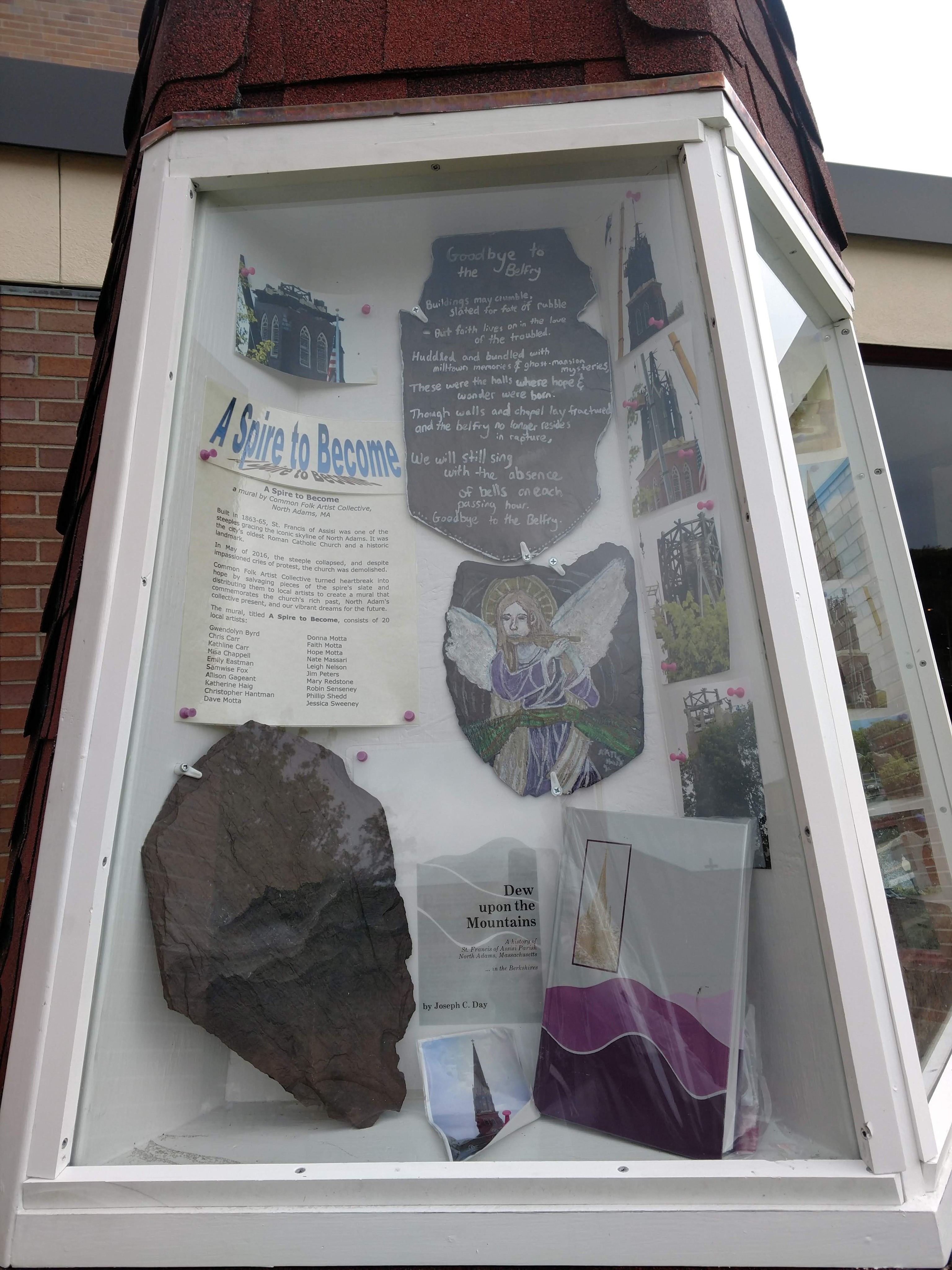
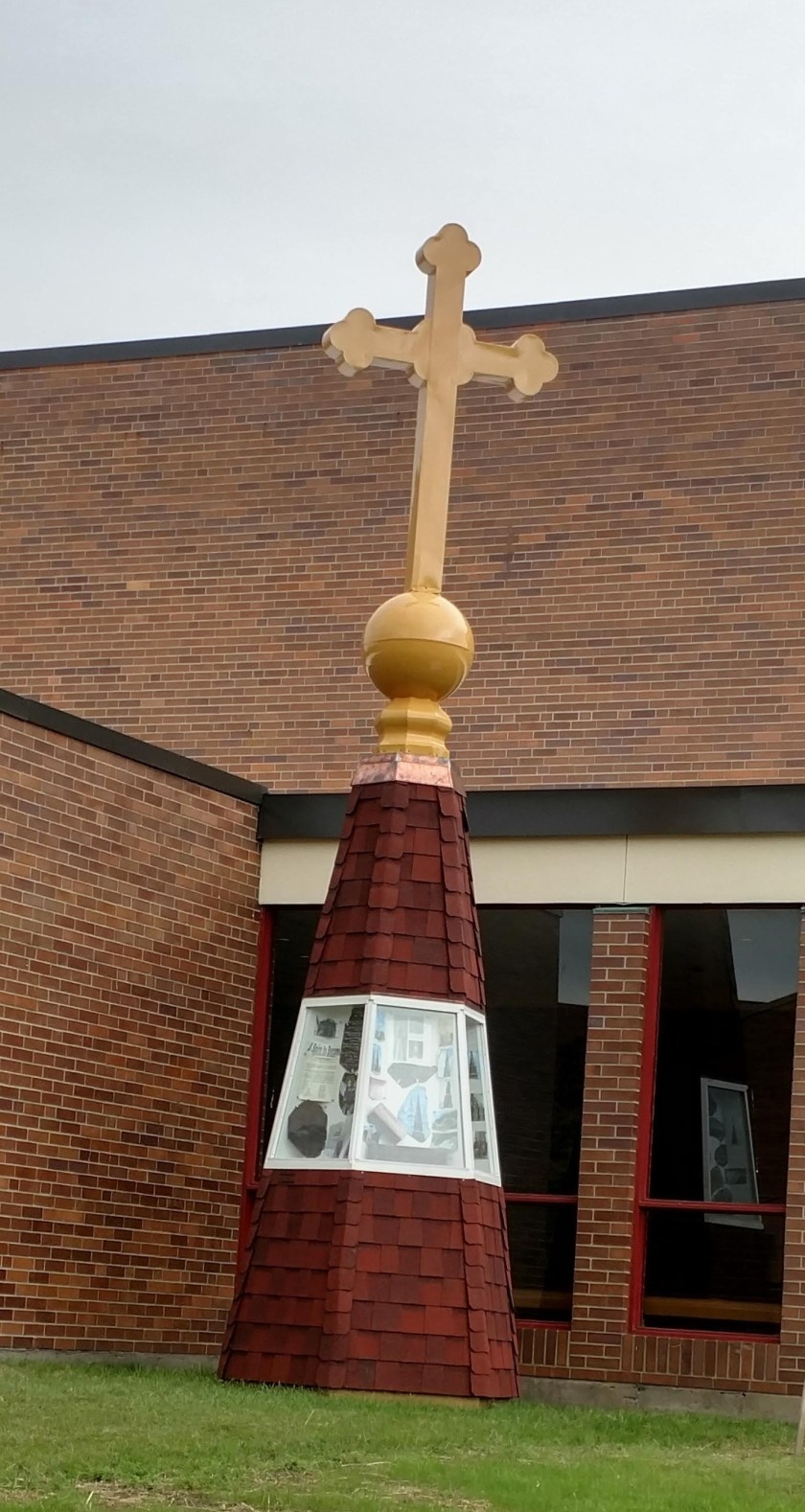
I exited through one of the back doors and was surprised to find a new memorial tucked into a small lawn between the driveway in the parking lot and the entrance to the parish hall. It’s a replica of the top of the steeple of St. Francis church, the mostly Irish-heritage church that had to be demolished when its structure deteriorated to a dangerous degree. Built into glassed-in alcoves on its sides is a memorial to the church with various memorabilia are twenty pieces of slate that had been salvaged from the wreckage and given to twenty local artists to create remembrances. Some are painted with scenes or designs, but some have text.
St. Francis memorial - North Adams
img_20191006_092542012-1
img_20191006_092612300_hdr
img_20191006_092556508_hdr
This is probably how the nostalgia/memorial spiral that I had feared started.

I had decided to attend the Fall Foliage Parade in the afternoon. I grabbed my box lunch from the museum cafe and found a spot on Hadley Overpass near City Hall, the last stretch before the turn onto Main Street and the reviewing stand. I had written poetry about the parades of my youth and the one I had attended a couple of years ago, but I wanted to see how people interpreted this year’s theme, “There’s no place like home in the Berkshires.” As I ate my sandwich and waited for the parade to reach us, I watched the vendors going by and, because I was near some families with young children, stopping to sell their wares. Most of the things were expected – various inflated toys, stuffed animals, plastic horns – but a few were jarring. The most puzzling combination was the vendor selling Trump 2020 flags alongside a green marijuana flag. I can’t say that I remember either political or drug-oriented flags at Fall Foliage parades before.

I was happy to see that, while there were only a few high school bands, they were larger than the last parade I had seen. I could have done with a lot fewer emergency vehicles in the opening section. I might not have minded so much if they hadn’t all felt compelled to blare their sirens all the time. I also could have done with fewer Oz-themed floats and costumes. You know your grand marshal is a good sport when she is waving from the back of an open convertible dressed as Glinda.

My favorite floats and signs had more pertinent interpretations of home. The young baseball and softball players doing variations on there’s no place like home plate. The signs which read, “There’s No Place Like a Safe Home” and “There’s No Place Like the Headstart.” Even though it was partially advertisement, the Grand Marshal’s Award went to Mountain One Bank with the theme “There’s No Place Like Your Hometown Bank.” The float that was closest to my heart, though, was the Hayden Award winner from Greylock Elementary School, “North Adams Is Our Emerald City.” Beyond being incredibly sweet, I was also touched that Greylock is continuing to be very active in the city. My father-in-law was principal there for decades, long enough to have been principal for three generations in some families, and I was moved to see that his spirit is still alive there.

Later in the afternoon, I workshopped one of my North Adams poems with the Boiler House Poets before heading to a high school friend’s home for dinner. Her husband made us a delicious dinner as I knew he would; he was a chef for many years and we ate at his restaurants many times. After dinner, my friend and I talked for hours, sometimes about current events, but mostly about our families with the array of illnesses and losses and moves and growth and letting go and plans and sorrows and disappointments. We hadn’t been able to see each other for a year, so there was a lot to catch up with, but all of Sunday put me in a vulnerable place for Monday, the last full day of our residency.

I had been workshopping North Adams-oriented poems, but decided to edit a poem which may end a revision of a chapbook I am working on about my mother’s experiences with congestive heart failure. She passed away in May and I thought I was ready to work on this poem, but I probably was not. I managed to do the edits, but it was stressful enough that I slipped back into my brain-full-of-holes, unmoored state that has been affecting me more often than not these last months.

I went back to my room in the apartment to rest for a while, but headed back to the museum for our usual 1:00 lunch. We had to make some plans for the rest of our time, but I was feeling indecisive and scattered. I knew I couldn’t write. One of the poets had told us at lunch that she had read one of her poems at the artwork about which it was written. I decided that I would follow her lead and read a poem in the place it belonged. In my case, though, it wasn’t about an artwork, but about a building.

Building 6 is the largest in the museum complex. It is located where the two branches of the Hoosic meet, so it is shaped somewhat like a wedge. The renovation created a shape in the narrow end of the building called “The Prow.” It is one of my favorite spaces in the museum and the subject of a poem I wrote about looking out its windows. I found a copy of it and went to read it there, except that I forgot to put it into my pocketbook to bring with me. I managed to find it on my phone, though, so I was able to read it there as I looked out at the river and the street and the hills. No one was there to hear it, but that was better. I might not have been able to gather the gumption needed to recite with an unsuspecting audience.

Despite my misgivings, I was able to workshop my poem when we met in the late afternoon. I have some more edits to make and some more things to mull. I’m not sure when, but maybe in a few weeks.

I know this month is going to be incredibly complicated.

Birthday and more

As I mentioned at the end of my last post, I celebrated my birthday at my Boiler House Poets reunion residency at MASS MoCA.

Actually, I started celebrating with my family before I left for North Adams with early birthday cards and gifts. ABC had chosen a card for me with a dinosaur (or maybe a dragon or alligator?) on it, so after I opened it, she, in her own cute way, took possession of it as a plaything. She and my daughters gave me a framed quilled floral piece from a local artists’ shop. My spouse B gave me a copy of Blowout by Rachel Maddow, which had just become available. It deals with the fossil fuel industry and its political ramifications, I’ve dealt with these issues frequently over these last years in the anti-fracking, climate action, and environmental justice movements and look forward to reading the book. Rachel Maddow does meticulous research, so I’m sure I will gain valuable insights.

I had planned to keep my birthday low-key this year, but was grateful for all the greetings on Facebook, text, in person, and by mail. I was especially grateful to have dinner with cousins that evening. They are the only family B and I have left living here and I always enjoy seeing them when I am back.

Saturday was a very busy day at MASS MoCA and with the Fall Foliage Festival in North Adams. The skies were very clear, which made the early morning very chilly, but I went to the farmer’s market as soon as it opened. I visited familiar vendors, buying maple syrup from B’s hometown and jams, relishes, and pickled beets from nearby Adams. I picked up an extra jar of cranberry-apple relish for E to take on her move to London. They plan to celebrate American Thanksgiving in November and cranberries, being a North American fruit, aren’t easy to come by in the UK – and who knows what the trade situation will be like in November?

I did a bit of writing in the very cold studio. Apparently, the building hasn’t swapped over to heating yet, but I called on my hearty New England roots to make it through! At noon, I visited the craft fair on Main Street, which had been blocked of from traffic. This year, there was also a dance party going on, but I don’t dance – except with ABC in my arms.

At our group lunch, we chose by random drawing the work we would each write about for this year’s Boiler House Poets’ project, Orange Country by ERRE. Marilyn McCabe, our recording and video guru, will put all of our poems together and I’ll post the link here at ToJCM when it becomes available. For a taste of Marilyn’s work, check out this amazing video chapbook. With eight poems to be included, each needs to be short, so I turned to tanka for my contribution. I find that only having 31 syllables to work with helps me distill my thoughts in what I hope will be a meaningful way. It also allows me to do multiple drafts in a relatively contained timeframe. I whittled away words from my original thoughts to create the tanka. The sixth draft will be the final one for the recording, I think.

As it happened, MoCA was having a day of special events to coincide with the city festival. I saw a performance piece by the artist MPA which took place in the midst of her art installation. There was an excellent talk by author Akiko Busch on the current exhibit of works by Rafa Esparza. These works are made of adobe, using water from the Hoosic River which runs through the museum complex and other local and natural materials, and much of Busch’s talk centered around our place in the world and our relationship to it, which is totally in my wheelhouse with my collection in progress. Later in the afternoon, I heard Jimena Canales, a science and technology historian, speak. Unfortunately, she only got through a fraction of her presentation, so we never really got to the intended conclusion on what makes us human and the relationship of humans to art. The bonus, though, was that a wonderful harpist played for us in that same gallery space immediately after. This hadn’t been on the schedule, so we would have missed it otherwise.

Because of all the special events, the poets had decided to do our workshopping after supper. I decided to strike out on my own to eat at Boston Seafoods. I still have trouble calling it that; it’s been around for a long time and I still think of it as what we grew up calling it, the Fish Market. I had fish and chips and then a mocha sundae! I had been upset that the place I used to get mochas had closed, so I was happy to see it on the menu. The mocha sauce is not a fluffy as what we used to get at Apothecary Hall when I was a kid – and they put whipped cream on it, which was not traditional – but it was still delicious and relieved my longing for a North Adams mocha. It occurs to me that people are likely to find this whole mocha business odd, but mocha sundaes were important here. There will probably be two mocha poems in my collection whenever I finish it…

We workshopped poems until after 11:00 PM. I’m hoping the other poets got more sleep than I did, although, with a bar that dates back to 1933 down on the first floor of our building on the Saturday of Fall Foliage Festival weekend, maybe not.

I’m sure we will power through our Sunday, though.

I wonder how many of us will attend the parade today?