Cold

Here in the lower 48 of the United States, we have been experiencing unusually cold weather.

Some people, including our president, have been taking this as evidence that there is not global warming going on, but our cold snap is actually a predictable part of global climate change.

Some points on this topic:

  • What we experience day to day is weather; global climate has to do with the whole world over a longer time period. Weather of all sorts continues to happen as generally appropriate to one’s locality.
  • Global warming does not rescind seasons, which occur due to astronomical conditions. It is still winter here in the Northern Hemisphere.
  • The disruption of global warming impacts different regions in different ways rather than uniformly. For example, the arctic regions are warming more quickly than other regions, which disrupts the upper level winds and changes the temperature and water-carrying capacity of weather systems. The cold air that has made its way into most of the lower 48 states has been able to do so because the mechanisms that have historically kept these winter air masses confined to Alaska and Canada have broken down. It is a symptom, not a refutation of global warming – and part of the reason that the term global climate change is used more often than global warming.
  • If the climate system were in equilibrium, one would expect roughly the same number of record high and record low recorded temperatures. There have been significantly more high than low temperature records globally in recent years. This article has a good explanation, along with a graphic that shows the proportion in the US for the last 365 days. In some regions in the world, the disparity is even greater, as high as 5 to 1.

I hope everyone will stay warm – or cool – as needed in the location where you are. I also hope that people will look to see what changes or adaptations they need to make to deal with current and expected changes to our climate.
*****
Join us for Linda’s Just Jot It January! Find out more here:
 https://lindaghill.com/2018/01/04/jusjojan-daily-prompt-january-4th-2018/


Harvey

I join with the millions of people in the US and around the world in sending thoughts, prayers, and charitable donations to those affected by tropical system Harvey. The amount of damage from the winds and historic amount of rainfall is mind-boggling. Recovery will take years and some locations will not recover at all.

When my area suffered two record floods of the Susquehanna River, I learned a lot of lessons that, while our geographic and demographic situations differ, applies to Texas and Louisiana now:
– There is no way to adequately prepare for a flood of that magnitude. No amount of prepositioning of supplies and personnel could cover such a vast area with so much destruction over some many days. Yes, lessons can be learned for the future, but don’t waste time now casting aspersions. There is too much work to do.
– Accept help! I volunteered in a flood relief center in my town after the 2011 flood. We sometimes had problems getting people to accept the food, cleaning supplies, and other help we had available. They wanted to forgo it in order to leave it for someone worse off than they. We had to gently explain that everything had been donated to help those affected by the flood and that that included them; there was plenty to go around. On a larger scale, this goes to the question of whether the states accept help from other states and countries. They should graciously accept offers to help, in the same spirit in which they have offered help in past disasters. Obviously, there needs to be coordination so that donations mesh well. I know that the New York governor has offered the services of our Air National Guard because the need is so great and Texas has already mobilized all its available forces.
– Don’t argue about whether it is a 500-year flood or a 1000-year flood. Those probabilities were based on historic records that no longer apply due to climate changes. My area suffered two record floods in five years. Areas flooded that had never flooded before. A number of lots that had had homes on them have now been bought out and converted to green space because the flooding threat is too high to have people continue to live there. If you are going to rebuild in flood-prone areas, you have to be smart and elevate homes, build protective wetlands, and minimize impermeable surfaces. Which brings me to my last point…

– Accept the science about how storm strength and mobility are affected by global warming. Michael Mann helps to explain the factors that made Harvey so destructive. (More information and links can be found here.) Yes, there have always been category 4 hurricanes, but the warmer surface temperatures of the Gulf of Mexico and the higher sea level made the rainfall and storm surge higher than they would have been in years past. The lack of steering currents kept the storm spinning in the same area, dropping over three feet (one meter) of rain over a large area. This same mechanism had a hand in the first record flood here in 2006, which was caused by a stationary front, as was a flood a few years ago in the Boulder, Colorado area.

Part of what we all need to do going forward is pay attention to preparing for increasingly severe weather. We need to think about resiliency in our building, zoning, and planning. We need to look at restoring natural aids, like barrier islands, dunes, and wetlands. We can place offshore wind turbines strategically to help blunt high winds. We can move away from fossil fuels as quickly as possible so that warming does not cross over into the catastrophic category. We can’t afford wishful thinking about the latest severe storm being once-in-a-lifetime. We need to work together to help each other recover and prepare for the future.


Writer Beat comment

My recent post on the US, the Paris accord, and climate change was picked up by Autumn of Writer Beat and republished here. Due to personal circumstances, I have been remiss in answering comments, but I was up early today and baby ABC was asleep so I managed to put together a response. I urge you to visit the Writer Beat post to read the comments to which this response was written – and to check out the site which has many, many interesting posts from a range of bloggers.
*****
I wanted to share this link which has one of the best explanations of climate change/global warming I have ever read, compiled by knowledgeable scientists.

In terms of social responsibility, I truly appreciate the visions and insights of Pope Francis. In his encyclical Laudato Si’, he describes an integral ecology, which includes both care for creation (the environment) and care for people, especially those most vulnerable. One of the advantages of renewable energy is that it is often produced locally, eliminating the need for long-range distribution grids and powering other development needs.

A real-world example is a project in conjunction with my county’s community college and a remote village in Haiti. Solar panels with battery storage power a pump for a community water well for safe drinking water and a modern bathroom near the church and school. The community has started a garden to grow staple crops to feed the schoolchildren. Solar ovens are allowing the cooks to bake extra goods for sale to people in the village. LED lighting, which does not need much electricity to operate, allows the children to gather at the church and school to do homework in the evenings. Adults and children are able to use computers. Communication can be accomplished with cellular networks rather than by hardwire.

Climate change impacts are felt most acutely by those who are most vulnerable economically. Drought; collapse of native crops, fisheries, and wildlife; coastal, river, and flash flooding; and other climate and severe weather related problems disproportionately affect populations least able to defend against them. We are already seeing conflicts arise over water and other resources. Access to water and/or fossil fuels underlies many of the conflicts in the Middle East and in Africa. Natural gas transport is the subtext for the Russian land grab in Ukraine. The problems in Venezuela are connected to economic dependence on oil.

My personal viewpoint is that the United States, as one of the largest current greenhouse gas producers and historically the largest total greenhouse gas producer, should help people at home and abroad to deal with the effects of climate change as a moral responsibility. Doing so would not impoverish the wealthy or our country. We can re-prioritize our spending, especially in taking some of our current military budget and putting it toward human needs. Our military leaders have been speaking out for some time about the dangers that climate change poses to world stability and have been big advocates for using renewable energy as much as possible when they are in action. It makes sense to redirect some of the military budget to helping population around the world deal with climate change, hunger, water scarcity, pollution, sea level rise, and other problems, both because it is the just and moral course and because it will reduce causes of military conflict.

The US and climate

I did not want to have to write this post.

I listened with dismay to DT’s Rose Garden address yesterday, astonished at the level of misunderstanding of climate science, domestic and international economics, and the Paris climate agreement in evidence.

While the president made it seem that the United States is immediately leaving the Paris accord, that is not the case. There is a three year period starting in November, 2016 during which no signatory may exit the agreement. The one-year period in which the separation would occur can’t start until then, so the earliest date that the United States could officially leave would be Nov. 4, 2020, the day after our next presidential election. A lot can happen in three and a half years and my hope is that the United States will never officially withdraw from the Paris agreement.

Even without the federal government’s leadership, many of the states, cities, companies, and individuals in the US will be continuing reductions in carbon emissions and promotion of renewable energy and energy efficiency. Over sixty mayors of large cities declared their intention to follow the climate agreement. The governors of New York, California, and Washington have started an initiative for states to continue working on their clean energy goals. Many companies, large and small, are committed to renewable energy sources for their operations. Many families, like mine, are weatherizing their homes, using energy efficient appliances and lighting, buying solar panels, and driving hybrid or all-electric vehicles like our Chevy Bolt.

The majority of the people of the United States believe in the Paris accord and will continue to work alongside the nations of the world to combat climate change. I hope we will soon return to official federal-level participation. It would not be the first time that the administration has had to backpedal after an unwise decision.

One-Liner Wednesday: Facts

“Facts do not cease to exist because they are ignored.”
~~ Aldous Huxley

Join us for Linda’s One-Liner Wednesdays!  Find out how here:  https://lindaghill.com/2017/05/31/one-liner-wednesday-a-dogs-purpose/

Songbird smarts

Thanks again to Steph of Partial Ellipsis of the Sun for another fascinating post! Here she writes and posts lovely and informative pictures on songbirds, their songs, and the brains behind it all:
https://wordwomanpartialellipsisofthesun.blogspot.com/2017/05/birdsong-and-creativity-songbirds-name.html
At the moment, we have a robin’s nest resting in the crook of the downspout near our back door. No eggs yet, but we’ll see.

seeing the unseen

As some readers will recall, older daughter E is currently living with us while her spouse L, a British citizen, is in London with his family. He will be arriving soon for a three month stay to encompass the final weeks of E’s pregnancy, the arrival of Baby, and the early weeks of cuddling, bonding, and diaper/nappy changing. (Have I mentioned lately how dysfunctional and/or in flux the immigration policies of both the US and the UK are?)

In L’s absence, one of my happy duties is to accompany E to the obstetrician’s office. Fortunately, the pregnancy has been progressing smoothly and Baby seems to be thriving and growing according to schedule.

I was pregnant thirty-one and twenty-seven years ago, so a lot has changed in prenatal care. Fetal heart monitors have gotten a lot more compact and easier to use. There is a lot less belly prodding and measuring than when I was expecting. There are more blood tests and standard glucose testing. My daughter received a booster for diphtheria, tetanus, and pertussis so that Baby will have stronger resistance at birth to help prevent whooping cough until the infant vaccines can kick in.

The biggest change, though, is the use of ultrasound. I never had an ultrasound when I was pregnant. While they were available, they were not yet routine and there was no diagnostic reason to order one. As women had for millennia, I relied on hope and faith that all was well, bolstered by the experienced hands and measuring tape of my health providers.

It has been a revelation to be there for E’s ultrasound exams. Most of the time, we have been able to have L join us via skype, which has been nice. E and I have been able to watch as the technician measures the length of Baby’s femur and the circumference of the head. I have been amazed to see the the entire backbone, tiny fingers and toes, all the chambers of the heart beating over 150 times a minutes, the stomach, the bladder, and other organs. From the last ultrasound, we know that Baby weighs about 3 pounds, 10 ounces (1.65 kg) at 31 weeks. We could even seen some fringe of hair atop Baby’s head, not surprising given that both E and L were born with thick heads of hair.

This last detail was particularly poignant for me, because the first detail we knew about baby E was that she had hair on her head, a fact conveyed to us by the maternity nurse who first examined me at the hospital after I arrived late on a Friday night in April with ruptured membranes at 36 weeks. I was only a centimeter dilated, but she could feel the hair on E’s head as it nestled down, getting ready to enter the world. It wasn’t until the early hours of Sunday morning that we would know the hair was strawberry blonde and belonged to our little girl.

We didn’t know that morning, as we welcomed our first child into the world, how wonderful, complicated, heart-warming, and heart-rending parenting would be. We didn’t know the depths of fear, joy, and love we would experience.

And we didn’t know that, thirty-one years later, we would be on hand to witness that cycle of family begin anew for her and her husband as parents, for B and me as grandparents, and for Nana and Paco as great-grandparents.

Even though it is the most common story in the world, its power isn’t diminished. Love makes the ordinary extraordinary.

Beatrix Potter, mushrooms, and more

Blogger-friend and fellow Smith alumna Steph has an interesting new post, blending Beatrix Potter, poetry, mushrooms, and more. Check it out!

https://wordwomanpartialellipsisofthesun.blogspot.com/2017/04/gaiman-fun-guy-on-beatrix-potter.html

SoCS: on our yard and climate

Unlike many people in our area, we keep our yard as natural as we can. No pesticides or herbicides. Big shade trees on the south side of the house – maple, oak, cherry, and ash. a few bushes – lilac, rhododendron, forsythia. We do have a mowed lawn; going full meadow wouldn’t be allowed by our town, but along with the grasses, there are wild strawberries, violets, daisies, and, of course, dandelions. There are animals – squirrels, rabbits, woodchucks, and the occasional skunk – and lots of birds – chickadees, nuthatches, bluejays, mourning doves, several kinds of finches and woodpeckers, tufted titmouse, and, this time of year, robins. At the moment, a robin is building a nest on the bend of the downspout near the back door.

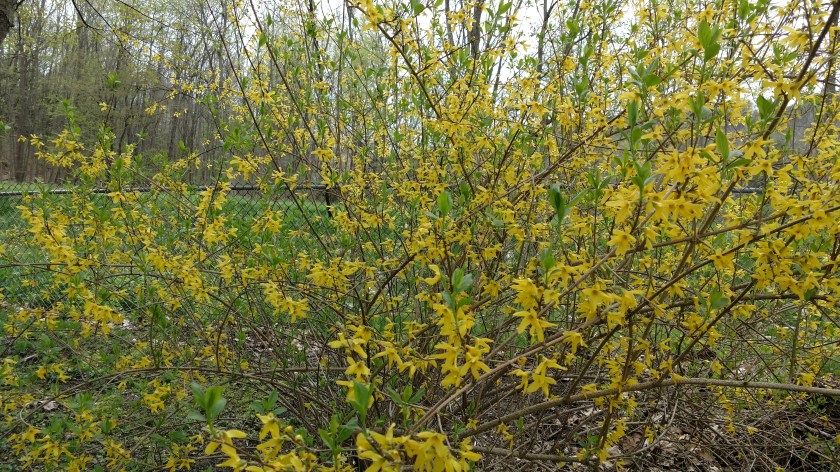
This has been a good year for our forsythia. It is usually a bit anemic. We inherited it when we bought the house and have a suspicion that it was actually a variety that was more suited to a warmer zone. Lately, it seems to have more good years for blossoms than bad. It’s probably not a coincidence, as the climate is warming and growing zones shift.
IMG_20170429_093816815

Of course, this is a particularly appropriate day to talk about climate change, as there are many climate change awareness marches happening today, here in the US and around the world. I wish that I were able to be in Washington DC for the main US march. There are people from my area who boarded a bus at 3ish in the morning to get there to participate.

I will be joining them in spirit. I have been writing, studying, protesting, lobbying, etc. on phasing out fossil fuels, banning fracking, increasing renewable energy quickly, and combating climate change and greenhouse gases’astronomical rise for many years now. With the current administration, we are redoubling, tripling, quadrupling, or exponentially raising our efforts.

If we are wrong on climate policy and the effects of climate change roll on out of control, people will die unnecessarily. Coastal populations and those living in poverty are most vulnerable. There are already climate refugees. Some island nations are under threat of losing their land entirely. Even in the US, there are already some people needing to be relocated due to rising sea levels.

We are all in this together. Every single person throughout the world. The heaviest burdens financially in the cleanup efforts, and mitigation, and relocation, and all the other effects of climate change, should be borne by the countries and companies who were enriched by exploiting fossil fuels beyond what the environment and climate could absorb. Developing economies don’t need to follow the fossil fuel pattern of the industrialized countries. They can build up their communities using renewable and energy-efficient technologies and the wealthier countries must help them to do that.

When Pope Francis released his encyclical Laudato Si’, he addressed all people and called for an integral ecology that would aid the natural world and human communities, with special emphasis on aiding the most vulnerable people and environments. Many people of all spiritual traditions and those who do not follow any faith path have joined together in this endeavor. One-hundred ninety-five countries signed onto the Paris climate accord. Each pledged to all the others to implement goals to combat climate change, help the environment, and support people, especially those most at risk. Progress is being made and many places are reaching beyond their stated goals to effect further greenhouse gas reductions.

We are already feeling the effects of climate change in increased severe weather, droughts, floods, heat waves, wildfires, and species extinctions. Even if the US government unwisely abandoned its promises in Paris, many of our states and localities, our companies, and our citizens and residents will keep going, moving forward with energy efficiency, renewable energy, and preparing our towns and cities for emergencies.

We will continue to march on, literally and figuratively.
*****
Linda’s prompt for Stream of Consciousness Saturday this week is “yard.”  Join us! Find out how here: https://lindaghill.com/2017/04/28/the-friday-reminder-and-prompt-for-socs-apr-2917/


Earth Day and Science March

Happy Earth Day! Sending out good thoughts to all those working in the environmental movement, to the earth itself, and to all its inhabitants. Earth Day this year was chosen as the day for the March for Science, with the main march being in Washington DC, with satellite marches around the country and the world.

It’s sad that we need marches to remind us of the importance of science and of protecting our environment, but there are definitely some people who need reminding. The science march emphasizes the importance of scientific research and advances and of scientific education and literacy in the general public, while celebrating the contributions of science to our world, particularly the contributions of those who have been traditionally underrepresented among scientists, such as women, indigenous people, African-Americans, and Latino/as.

In that spirit, I want to honor two scientists in my family.

First, my older sister who has just retired from decades of work as a research scientist at the National Institutes of Health.  She holds a bachelor’s degree in chemistry from Rensselaer Polytechnic Institute and a master’s and doctorate from Indiana University.  After post-doctoral work at the Cleveland Clinic, she came to NIH for the remainder of her career, where she worked on projects to add to our knowledge of how to fight disease and promote wellness. Today, she participates in the Science March in Washington, DC.

Second, my younger daughter T. She holds a bachelor’s degree from Cornell University and last year completed a Master’s of Professional Studies in conservation biology of plants at State University of New York – Environmental Science and Forestry. She is passionate about plants and hopes to build her career around restoration ecology. Nothing makes her happier than pulling out invasive species so that native plants can thrive! Right now, she is working in Missouri for their Department of Conservation with a study of the effects of fire on prairie plants. She is marching for science in Springfield, Missouri.

I am proud to have these two women scientists in my immediate family! I appreciate their contributions and that of their colleagues across all scientific fields.

I think today is a good day to reflect on how important science is to our lives. Medical science and biology are important in decisions I make every day. I am especially drawn to environmental science and geology and often use that knowledge in my advocacy on environmental and climate change policy and renewable energy. Computer science makes B’s job possible. The list could go on and on…

There is a Sci/Cli March today in Binghamton, a local mash-up of this weekend’s science march with next weekend’s climate march. I had hoped to attend, but I don’t think I will be able to make it. I’ll be marching with them in spirit, as well as with my sister in DC.

Science rules!