Blogger-friend and fellow Smith alumna Steph has an interesting new post, blending Beatrix Potter, poetry, mushrooms, and more. Check it out!
https://wordwomanpartialellipsisofthesun.blogspot.com/2017/04/gaiman-fun-guy-on-beatrix-potter.html

Blogger-friend and fellow Smith alumna Steph has an interesting new post, blending Beatrix Potter, poetry, mushrooms, and more. Check it out!
https://wordwomanpartialellipsisofthesun.blogspot.com/2017/04/gaiman-fun-guy-on-beatrix-potter.html

Unlike many people in our area, we keep our yard as natural as we can. No pesticides or herbicides. Big shade trees on the south side of the house – maple, oak, cherry, and ash. a few bushes – lilac, rhododendron, forsythia. We do have a mowed lawn; going full meadow wouldn’t be allowed by our town, but along with the grasses, there are wild strawberries, violets, daisies, and, of course, dandelions. There are animals – squirrels, rabbits, woodchucks, and the occasional skunk – and lots of birds – chickadees, nuthatches, bluejays, mourning doves, several kinds of finches and woodpeckers, tufted titmouse, and, this time of year, robins. At the moment, a robin is building a nest on the bend of the downspout near the back door.
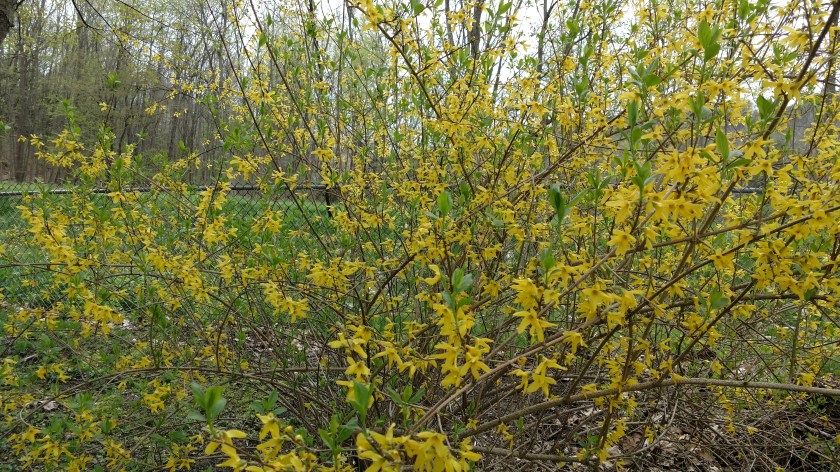
This has been a good year for our forsythia. It is usually a bit anemic. We inherited it when we bought the house and have a suspicion that it was actually a variety that was more suited to a warmer zone. Lately, it seems to have more good years for blossoms than bad. It’s probably not a coincidence, as the climate is warming and growing zones shift.
Of course, this is a particularly appropriate day to talk about climate change, as there are many climate change awareness marches happening today, here in the US and around the world. I wish that I were able to be in Washington DC for the main US march. There are people from my area who boarded a bus at 3ish in the morning to get there to participate.
I will be joining them in spirit. I have been writing, studying, protesting, lobbying, etc. on phasing out fossil fuels, banning fracking, increasing renewable energy quickly, and combating climate change and greenhouse gases’astronomical rise for many years now. With the current administration, we are redoubling, tripling, quadrupling, or exponentially raising our efforts.
If we are wrong on climate policy and the effects of climate change roll on out of control, people will die unnecessarily. Coastal populations and those living in poverty are most vulnerable. There are already climate refugees. Some island nations are under threat of losing their land entirely. Even in the US, there are already some people needing to be relocated due to rising sea levels.
We are all in this together. Every single person throughout the world. The heaviest burdens financially in the cleanup efforts, and mitigation, and relocation, and all the other effects of climate change, should be borne by the countries and companies who were enriched by exploiting fossil fuels beyond what the environment and climate could absorb. Developing economies don’t need to follow the fossil fuel pattern of the industrialized countries. They can build up their communities using renewable and energy-efficient technologies and the wealthier countries must help them to do that.
When Pope Francis released his encyclical Laudato Si’, he addressed all people and called for an integral ecology that would aid the natural world and human communities, with special emphasis on aiding the most vulnerable people and environments. Many people of all spiritual traditions and those who do not follow any faith path have joined together in this endeavor. One-hundred ninety-five countries signed onto the Paris climate accord. Each pledged to all the others to implement goals to combat climate change, help the environment, and support people, especially those most at risk. Progress is being made and many places are reaching beyond their stated goals to effect further greenhouse gas reductions.
We are already feeling the effects of climate change in increased severe weather, droughts, floods, heat waves, wildfires, and species extinctions. Even if the US government unwisely abandoned its promises in Paris, many of our states and localities, our companies, and our citizens and residents will keep going, moving forward with energy efficiency, renewable energy, and preparing our towns and cities for emergencies.
We will continue to march on, literally and figuratively.
*****
Linda’s prompt for Stream of Consciousness Saturday this week is “yard.” Join us! Find out how here: https://lindaghill.com/2017/04/28/the-friday-reminder-and-prompt-for-socs-apr-2917/


Happy Earth Day! Sending out good thoughts to all those working in the environmental movement, to the earth itself, and to all its inhabitants. Earth Day this year was chosen as the day for the March for Science, with the main march being in Washington DC, with satellite marches around the country and the world.
It’s sad that we need marches to remind us of the importance of science and of protecting our environment, but there are definitely some people who need reminding. The science march emphasizes the importance of scientific research and advances and of scientific education and literacy in the general public, while celebrating the contributions of science to our world, particularly the contributions of those who have been traditionally underrepresented among scientists, such as women, indigenous people, African-Americans, and Latino/as.
In that spirit, I want to honor two scientists in my family.
First, my older sister who has just retired from decades of work as a research scientist at the National Institutes of Health. She holds a bachelor’s degree in chemistry from Rensselaer Polytechnic Institute and a master’s and doctorate from Indiana University. After post-doctoral work at the Cleveland Clinic, she came to NIH for the remainder of her career, where she worked on projects to add to our knowledge of how to fight disease and promote wellness. Today, she participates in the Science March in Washington, DC.
Second, my younger daughter T. She holds a bachelor’s degree from Cornell University and last year completed a Master’s of Professional Studies in conservation biology of plants at State University of New York – Environmental Science and Forestry. She is passionate about plants and hopes to build her career around restoration ecology. Nothing makes her happier than pulling out invasive species so that native plants can thrive! Right now, she is working in Missouri for their Department of Conservation with a study of the effects of fire on prairie plants. She is marching for science in Springfield, Missouri.
I am proud to have these two women scientists in my immediate family! I appreciate their contributions and that of their colleagues across all scientific fields.
I think today is a good day to reflect on how important science is to our lives. Medical science and biology are important in decisions I make every day. I am especially drawn to environmental science and geology and often use that knowledge in my advocacy on environmental and climate change policy and renewable energy. Computer science makes B’s job possible. The list could go on and on…
There is a Sci/Cli March today in Binghamton, a local mash-up of this weekend’s science march with next weekend’s climate march. I had hoped to attend, but I don’t think I will be able to make it. I’ll be marching with them in spirit, as well as with my sister in DC.
Science rules!

Here in the United States, we are doing a lot of marching these days.
I participated in a sister march for the Women’s March on Washington on January 21st. These marches took place throughout the United States and around the world, even Antarctica! We had about 3,000 participants in Binghamton, although we had expected only a few hundred.
There have since been other major marches, including one for indigenous rights.
April will see two major marches on Washington with satellite marches elsewhere, one for Science on April 22, which is Earth Day, and a Climate March on April 29. I wish I could be in Washington for both of those, but will probably have to settle for a local combined march.
The marches themselves are energizing, but the larger point is that people use them as educational tools to raise awareness of important issues and then continue their advocacy through follow-up actions. That has been an encouraging thing that we are seeing in the US this year, that so many people are getting involved in civic life at a new level, so…
March On!
*****
Linda’s prompt for Stream of Consciousness Saturday this week is “march.” Join us! Find out how here: https://lindaghill.com/2017/03/24/the-friday-reminder-and-prompt-for-socs-mar-2517/

Check out spectacular geologic images from Steph at this link: http://wordwomanpartialellipsisofthesun.blogspot.com/2017/03/smoking-smoke-rings-mount-etna-sicily.html I especially appreciate the Mount Etna photos because I visited there when the Smith College Alumnae Chorus toured Sicily. Be sure to check out the bonus images in the first comment from Steph, aka Word Woman. Enjoy!

I am not a fan of Daylight Saving Time, which started today in most of the United States.
It is not an accurate name. The amount of daylight is determined by astronomy, not by clocks. Naming the time of sunrise and sunset differently does not change the time between those two events.
What most annoys me, though, is waking up in the dark again. I had just gotten to the point where I was waking up to the light of dawn, which I find more energizing, and now I am instantly back into mid-winter waking-to-darkness.
This is not helped by the fact that we are having a cold snap and may soon have the most snow we have had in weeks, depending on the track of a developing nor’easter.
I know that many people will argue that having it be light longer in the evening makes up for the dark mornings, but we had already been able to eat dinner in natural light, although I admit that we tend to eat dinner on the early side.
By June, it won’t be fully dark until after 9 PM, which makes our usual 10 PM bedtime feel like we are children, being put to bed as soon as evening falls.
Daylight Saving Time, especially the current US implementation, also causes issues with long-distance communications. E’s daily call time with her employer in Hawai’i will shift. B’s daily 6 AM conference call with colleagues in India (thankfully) stays at 6 AM for him, but his India team has to change the time at which they call. Because the US extended the dates of DST, for the next three weeks, US time will be out of sync with many of the countries that observe DST using the original dates.
It would be so much simpler if we just dropped the whole concept and left our clocks alone.
Daylight doesn’t care, but I do.
How do you feel about Daylight Saving Time? Is it observed where you are?

Yesterday, B and T crossed the Mississippi – and the Missouri twice – to reach the town in western Missouri where T will live for the next year, while acting as a crew leader for research in the effects of fire on prairie grasses and other plants.
Today she will be moving into the house that the Missouri Department of Environmental Conservation provides for their short-term workers. “Short” is a relative term. T is there on a one-year contract, which is designed for recent graduates to expand their skills and get leadership experience.
B and T will also be exploring the town and stocking the pantry and other chores to help T settle into her new town. B will fly home on Wednesday and T will start her new job late this week or early next.
E and I already miss T’s hugs and conversation. B and I hope to visit in the spring.
I won’t bother to pretend that our re-configured household will settle into a routine. We are expecting a lot of to-ing and fro-ing in the next three months. Never a dull moment!
*****
Join us for Linda’s Just Jot It January. Only two days left! Find out how here: https://lindaghill.com/2017/01/30/jusjojan-daily-prompt-jan-30th17/


I knew Linda’s prompt this week was “pretty” and I wasn’t sure I would write a post, but this morning, this link: http://wordwomanpartialellipsisofthesun.blogspot.com/2016/11/the-corundum-conundrum-sapphires-rubies.html landed in my inbox.
Steph writes a blog that is a cross between science, often geology, and wordplay. She often has pretty photos of rocks, electron microscope patterns, geologic formations, and today, some very pretty gems.
Her blog is not on WordPress, so it is hard to re-blog other than by link, but I hope people will pop over to Steph’s blog and see some beautiful corundum in various colors.
Thank you, Steph, for sharing pretty pictures and words with us!
*****
Join us for Linda’s Stream of Consciousness Saturday! Find out how here: https://lindaghill.com/2016/11/25/the-friday-reminder-and-prompt-for-socs-nov-2616/

For some great photos of fall leaves in Colorado with a bonus science lesson about the colors of aspen leaves, follow this link to Steph’s blog, Partial Ellipsis of the Sun. Steph always has a great mix of science, photographs, and wordplay, so you should definitely visit and follow her!

Yesterday was the fifteenth anniversary of the the terrorist attacks by plane which cost over 3,000 lives in New York City, Arlington, Virginia and Shanksville, Pennsylvania. The attacks have cost additional lives as those who were exposed to debris and air pollution in the following months went on to develop serious health issues.
Many, many more lives were destroyed – and continue to be destroyed – by the fifteen years of war which have followed.
On Friday at Binghamton University, there was a presentation on the aftermath of the attacks entitled “9/11: What have we learned? Where do we go from here?” Featured speakers were Ray McGovern and Donna Marsh O’Connor. Video is available here. The theme was building peace, not war. Donna Marsh O’Connor, who lost her daughter who was pregnant with her grandchild, spoke movingly about not wanting the death of her daughter to be an excuse for violence and war. Ray McGovern, who was once a CIA analyst, recounted the way that the situation after the attacks was manipuated to spread the war to Iraq. Mr. McGovern is now a peace activist.
Peace.
Something that I want desperately.
For all of us.
Wherever we are.
Whoever we are.
At church on Sunday, we sang, “Let There Be Peace on Earth.” I cried.
Adding to the emotion is a local anniversary. Five years ago, we were suffering from a historic flood after the remnants of tropical storm Lee dropped about ten inches of rain. Parts of my town were underwater, as were other nearby towns along the Susquehanna River. At my home, we had no power and only avoided a flooded basement because we had a generator to keep our sump pump operating. There were flooded homes and standing water three blocks away. In the five years since, we have seen some neighborhoods decmiated as homes were torn down, unable to be replaced as the land was considered too high-risk to inhabit.
Every time there is a flood in the news, we have a good idea what those people are going to go through and how long the process is.
As we watch coverage of floods, blizzards, droughts, heat waves, wildfires, and other weather-related disasters, we are painfully aware that their increased frequency and severity is related to global comate change. There is a new website that shows how much impact global warming has on weather events. It does a good job showing how particular events are tied to changes in the atmosphere brought on by global warming.
It is sobering but a good tool to help explain the science.
Which leads to a third – and significantly happier – anniversary.
This is the fiftieth anniversary of Star Trek. There have been marathons of episodes of the original series and interviews about it and its cultural impact as a franchise that spawned many television shows and movies. In their version of the future, earth is a peaceful place with a thriving natural environment. Poverty has been eliminated. There is racial and ethnic equality, although, while improved from the 1960’s reality, they still have a ways to go on sexual and gender issues.
In an odd way, though it is fiction, it does highlight that we can improve lives and health through science, knowledge, learning from past mistakes, ingenuity, co-operation, and good will.
Let’s get to work on that.

 Joanne Corey